
Rhaphidophora Tetrasperma Leaves Not Splitting: A Light Check
Rhaphidophora tetrasperma leaves not splitting? Light likely matters, but no species-specific threshold is published. Measure light at the leaf and adjust in steps.
Priya Patel · Published 2026-06-16 · 20 min read

Key Takeaways
- No published, species-specific light threshold for Mini Monstera fenestration exists. Treat any number here as a working hypothesis, not a proven cutoff.
- Light plausibly influences growth and adult leaf form, but other variables matter too. Measure before you blame the light.
- Whole leaf shape is largely set inside the furled leaf before it opens. You cannot make an already-open leaf grow holes later.
- Measure light at the leaf, not by how bright the window looks. DLI equals PPFD times hours times 0.0036, while a lux app is only a rough daylight check.
- Change one thing at a time and raise light gradually. Log several successive leaves rather than judging by a single before-and-after.
Your Mini Monstera pushed out fresh growth and the new leaves came out solid. No splits, no holes, just smooth green paddles on a plant that used to fenestrate.
The plant is not broken and it has not forgotten how to split. Something in its recent conditions is favoring plain leaves, and light is one of the more likely culprits to check first.
Fenestration is not simply a reward for age. It shifts with conditions. Among those conditions, the light a plant actually receives is easy to overestimate, so it is worth measuring rather than eyeballing.
A useful metric here is Daily Light Integral (DLI), the total daily dose of usable light your plant receives, because it captures duration as well as brightness.
No published, species-specific light threshold predicts Mini Monstera leaf division. Use measured light to compare your conditions and make gradual changes, not as a formula that guarantees splits.
Why do aroid leaves develop holes in the first place?
Read Leaf Shape as a Developmental Process
Worth a species note first. In Rhaphidophora tetrasperma, the mature leaf is mainly deeply lobed along its margins (pinnatipartite to pinnatisect), with occasional internal holes, per Kew.
The best-studied internal-hole mechanism comes from a relative, Monstera obliqua, and describes those enclosed perforations rather than marginal lobing, so treat it as a related example, not a direct measurement of this species.
In the related Monstera obliqua study, a small patch of cells in the still-folded leaf dies and detaches before the leaf opens. This is a developmental process, not tearing or erosion.
The practical takeaway is the safe part. A leaf's shape is largely set inside the furled bud, so you cannot make a leaf that already opened flat grow holes or deeper lobes later.
Whatever you change affects the leaves still forming, not the ones already out.
Programmed cell death and leaf morphogenesis in Monstera obliqua (Araceae)
Why Do Monsteras Have Holes in Their Leaves
I number leaves in order and record their emergence date, final size, fenestration, and measured DLI at that canopy height. Light at the newest leaf can differ sharply from the level where an older unfenestrated leaf developed.
The next complete leaves must harden before I judge a lighting change. Existing blades will not add splits later, so they remain baseline data rather than failed outcomes.
Each node is marked by whether it was firmly attached to support before its leaf formed. Increasing light cannot substitute for a climbing signal when the vine is hanging away from the pole.
Is fenestration fixed by age, or can a mature plant revert to plain leaves?
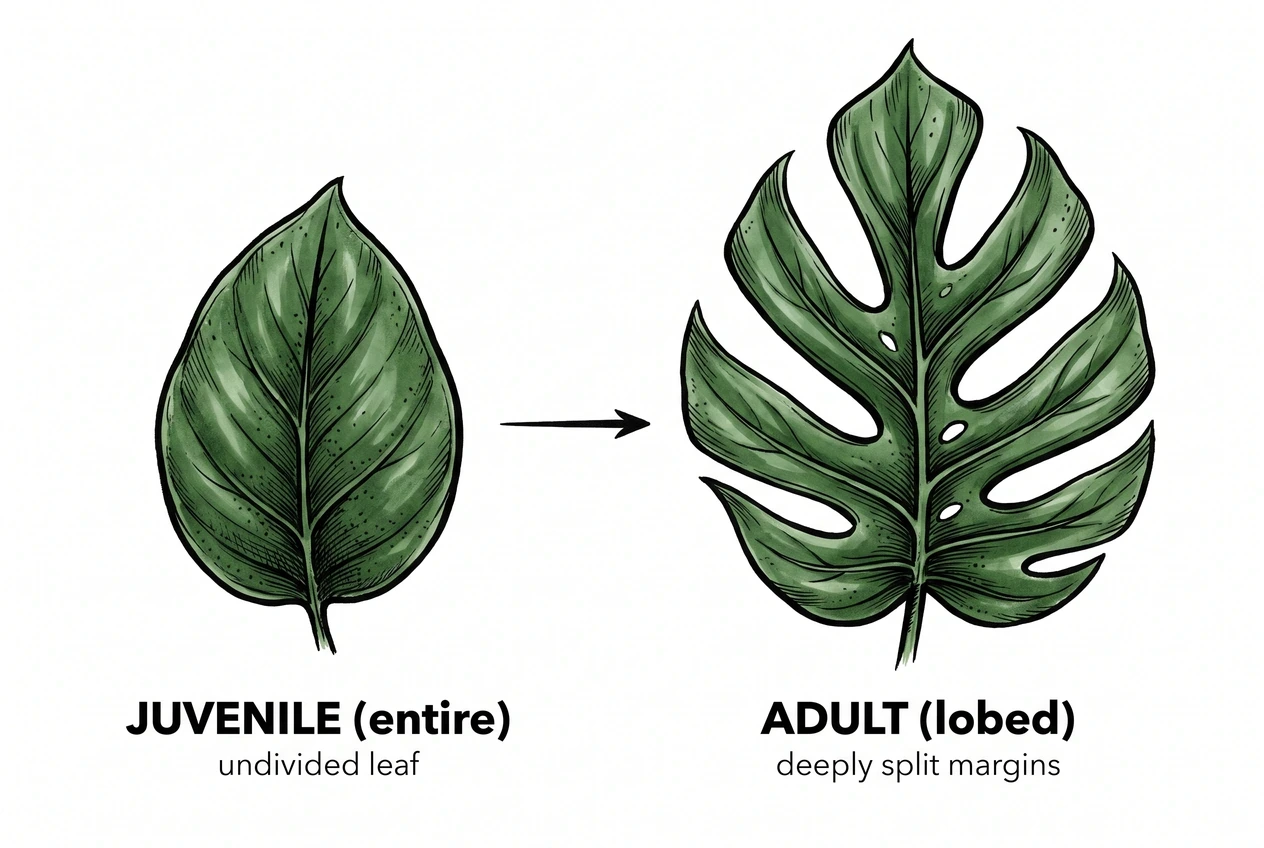
Two things are worth separating here. Rhaphidophora tetrasperma is heterophyllous, so its early juvenile leaves are small and entire and its adult leaves are divided.
That is an ontogenetic phase change. Separately, an adult shoot can produce less-divided leaves under some conditions, which is plasticity, not the same thing.
If your plant divided leaves before, the phase change has already happened, so a run of plainer leaves points to conditions rather than youth.
It is plausible that low light is one such condition, since plants sense light through photoreceptors and carbon status.
But which spectrum, tissue, or signal would drive marginal lobing in this species has not been measured, so avoid narrating a specific on/off program as if it were established.
Hobbyists report plants that stopped dividing in dimmer spots and resumed after a move to brighter light.
Treat these as useful clues that point you toward measuring light, not as controlled proof.
Monstera deliciosa no longer producing fenestrations leaves in brighter light
What actually drives fenestration, light or maturity?
Separate Plausible Drivers From Evidence
There is a plausible evolutionary story for why divided leaves suit these plants. Monstera and its relatives grow in the rainforest understory, where light arrives as brief, unpredictable sunflecks.
A leaf broken up by holes or lobes spreads the same tissue over a wider footprint, which may intercept those scattered flecks more reliably than a compact solid leaf.
A model of Monstera suggests that divided leaves may help a climber use variable rainforest light. It does not measure a DLI threshold, a developmental switch, or Rhaphidophora itself.
Use that only as background. It does not show that light is the only variable, or that hitting a particular number will make your plant divide.
How did the swiss cheese plant get its holes
Why does my mature plant still refuse to split?
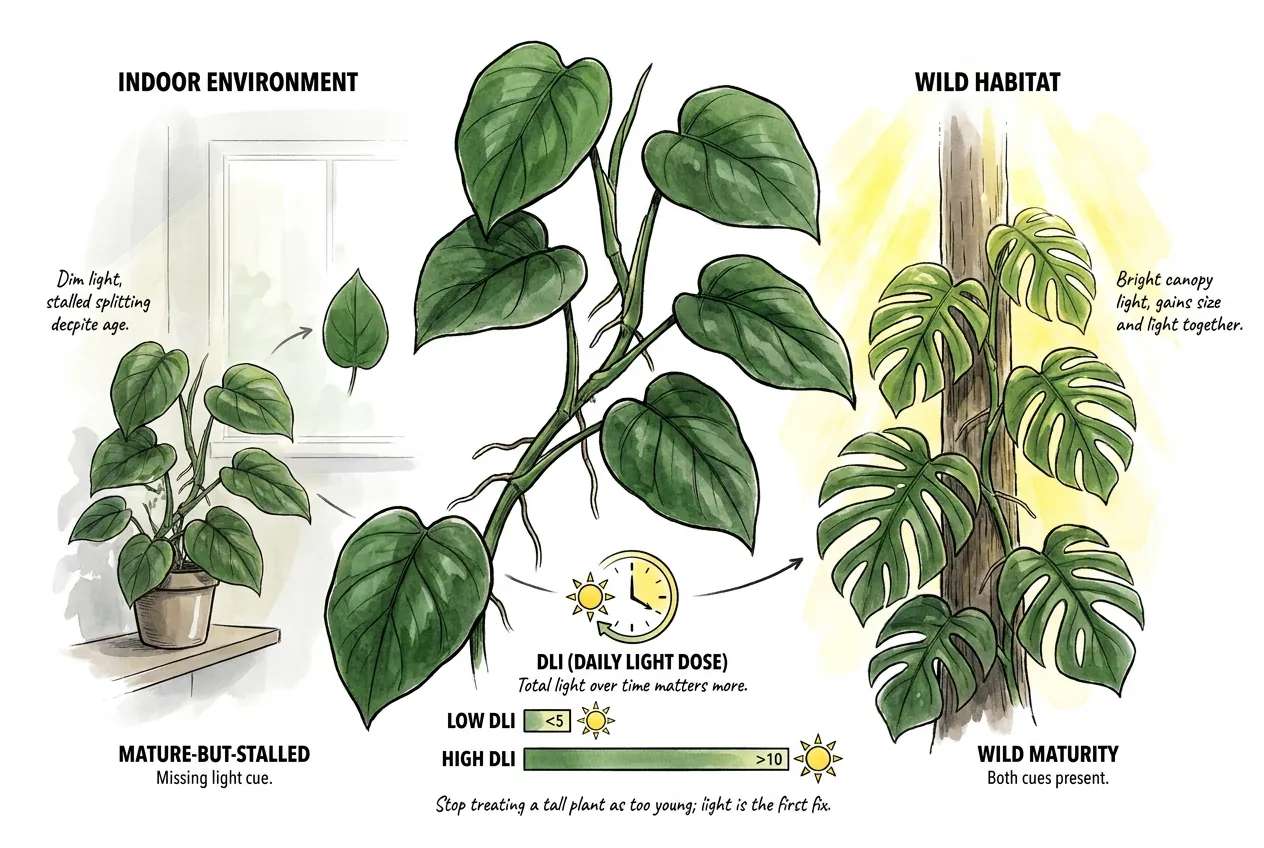
Indoors, size and light can come apart. In the wild a Mini Monstera climbs toward the canopy, gaining both at once.
On your shelf it can be tall and old while sitting in dim light, so age alone does not tell you the light is adequate.
That is why, if the plant has divided leaves before, it is reasonable to check light early rather than assume the plant is still too young.
This is a triage order, not a claim that light is almost always the limiter. Measure the light before deciding, and keep humidity, roots, and recent disturbance on the list.
The practical takeaway is to stop treating a tall, previously divided plant as too young. Maturity is likely settled, so measure the light it actually receives and rule the other causes in or out.
What is DLI and why does it matter more than how bright the window looks?
Compute Daily Light, Not Brightness
DLI is the total daily dose of photosynthetic light, measured in moles per square meter per day.
It is the integral of intensity over time, not a single bright instant. Two spots with identical midday brightness can deliver wildly different DLI if one gets sun for two hours and the other for eight.
Because DLI accounts for duration as well as intensity, it describes the daily light dose more completely than a single lux reading, which is why it is the more useful number to track.
The formula is simple. DLI equals PPFD times hours times 0.0036, which converts micromoles per second into moles per day.
Work an example. A spot at 150 micromoles per square meter per second, lit 12 hours, gives 150 times 12 times 0.0036, which is 6.48 mol per square meter per day.
That tells you the dose precisely. It does not by itself tell you whether this plant will divide its leaves, which is exactly the link no published study has measured for this species.
Important Considerations for Providing Supplemental Light to Indoor Plants
How do published DLI bands map onto houseplants?
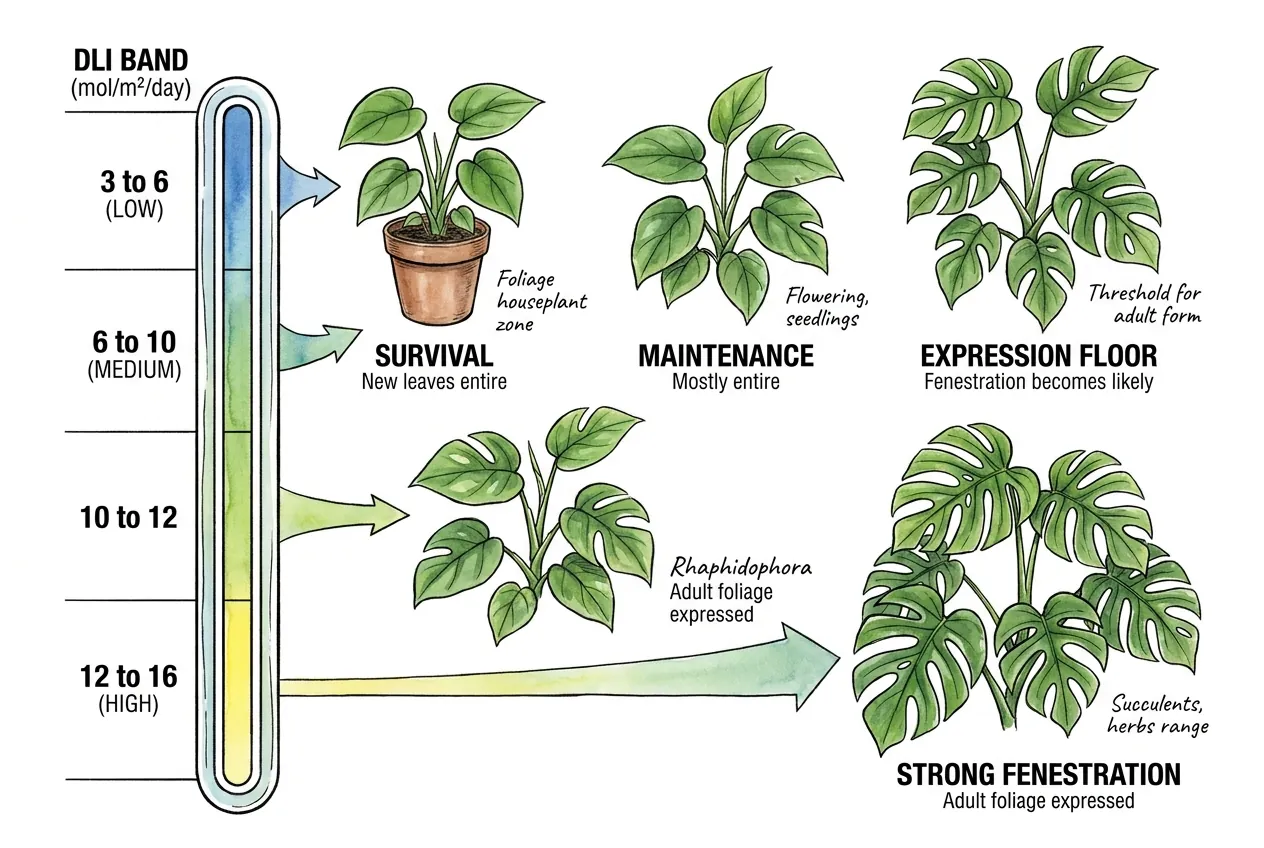
Extension data sorts spaces into broad DLI bands, which helps you judge the general brightness of a spot. Iowa State Extension lists Low at 3-6, Medium 6-10, High 12-16, and Very High at 18-30 mol per square meter per day.
These are planning categories, not leaf-division outcomes. This species can continue growing at very low DLI, so a low reading is not an instant survival boundary. It also does not identify a light level that will produce divided leaves.
| DLI band (mol/m2/day) | Broad example plant groups (Iowa State) |
|---|---|
| 3 to 6 (Low) | Many foliage houseplants |
| 6 to 10 (Medium) | Many flowering plants, seedlings |
| 12 to 16 (High) | Succulents, herbs |
| 18 to 30 (Very High) | High-light crops |
The Daily Light Integral of Plants
Is there a known DLI target for Rhaphidophora tetrasperma fenestration?
Treat the Threshold as Unknown
No published, species-specific measured DLI threshold predicts Mini Monstera leaf division.
You will see figures like 10 to 12 mol per square meter per day quoted online as a fenestration target.
Those are not measured for this species. They are inferred by stitching together generic Iowa State bands and Muir’s evolutionary model, neither of which reports a division threshold, a metabolic cost, or a surplus-energy budget.
So there is no defensible way to name a number below which leaves stay plain and above which they divide.
Treat more light as a reasonable hypothesis, brighten the plant’s spot gradually, measure what it actually receives, and watch several successive leaves. Your before-and-after record can guide care for that plant, but it cannot establish a universal threshold.
Important Considerations for Providing Supplemental Light to Indoor Plants
How did the swiss cheese plant get its holes
What can you say about low-light spots?
At low DLI a plant can still stay green and keep pushing leaves. The 2024 chamber study saw growth continue even in very dim conditions.
What no one has measured for this species is a light level below which its leaves reliably stay undivided, so avoid quoting one.
The practical move is the same regardless. If a spot measures low, it is a reasonable candidate to brighten, but do so gradually and keep checking the other causes rather than assuming a number will flip the leaves.
Raising light is worth trying. Expecting a specific dose to guarantee division is not supported.
Adaptation of indoor ornamental plants to various lighting levels
Why does a blazing June window still leave my plant in the dark?
Because indoor light usually drops off fast as you move away from the glass, and our eyes are poor at judging it.
You will sometimes see the inverse-square law (twice as far equals a quarter of the light) applied to windows, but that law is for point sources.
A window is a broad, extended source, and sky, direct sun, glazing, and room reflections all contribute, so there is no simple universal formula for how quickly it falls off.
The safe statement is qualitative. Expect a marked drop with distance, and measure rather than calculate it.
In practice a bright window sill might read a few hundred micromoles per square meter per second and fall to a small fraction of that a few feet into the room, though the exact numbers depend on the window direction, latitude, time, weather, and any screens or curtains.
Glass, insect screens, and sheer curtains each remove a further slice of usable light. Because it varies this much, a sensor reading at the plant beats any estimate.
Outdoor brightness adds to the confusion. Clear midday full sun is roughly 2000 micromoles per square meter per second, near 108,000 lux, as an approximate reference rather than a constant, while an indoor spot delivers a small fraction of that.
Your eye adapts logarithmically, so a spot at a fraction of outdoor light can still look plenty bright.
An Introduction to the Inverse Square Law
Important Considerations for Providing Supplemental Light to Indoor Plants
Why did my spring repot flush come out plain in midsummer?
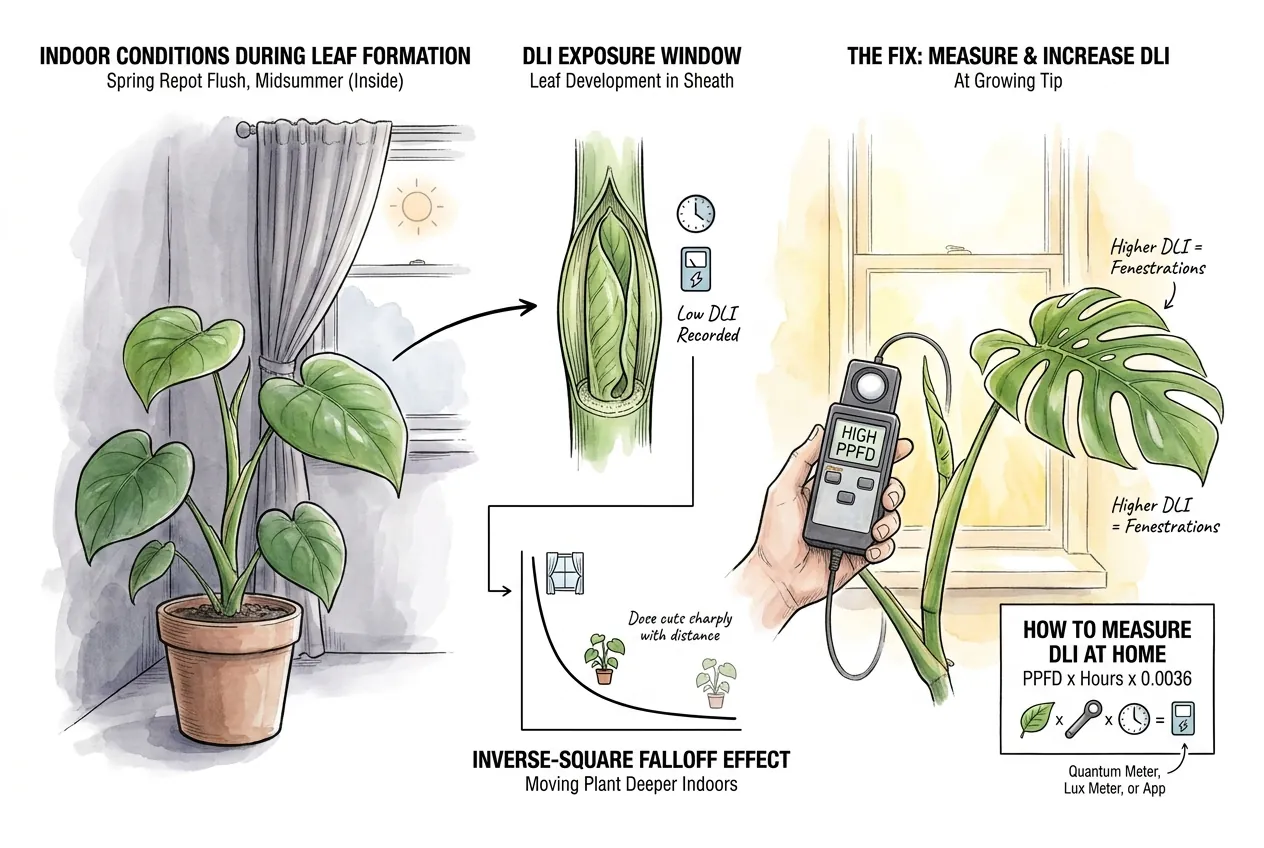
Because leaves record the conditions they formed under, not the weather outside. New leaves take shape over weeks inside the sheath, so they reflect whatever light reached the plant then rather than the bright sky beyond the glass.
A repot can also cause a temporary stall from root disturbance, which does not help.
Two things you cannot know without measuring. What the indoor dose actually was during that window, and how far a move deeper into the room cut it.
Both vary a lot by position and window, so resist the urge to assume the spot was too dim. Check it.
The useful step is to measure light at the growing tip now, and if it reads low, brighten the spot gradually before the next leaves harden while watching the plant’s response.
How do I actually measure DLI at home?
Measure at the Growing Tip
You need PPFD at the leaf plus your photoperiod, then apply DLI equals PPFD times hours times 0.0036.
A quantum, or PAR, meter reads PPFD directly and skips the guesswork. Cheaper paths use a lux meter or phone app, which read lux and require a spectrum-specific conversion.
For daylight, multiply lux by about 0.0185 to estimate PPFD. A fluorescent source is near 0.0172, and LEDs vary widely by spectrum (one direct study of this species used 0.01365 for a white LED after measuring its spectrum), so the factor is never universal.
On top of that, a phone’s light sensor is not a calibrated instrument. Its cosine response, diffuser, and unit-to-unit variation add error.
Treat any app reading as a ballpark, not a decision-grade number.
Work it through. 8000 lux of daylight times 0.0185 is about 148 micromoles per square meter per second.
Times 12 hours times 0.0036 gives about 6.4 mol per square meter per day. That is a solid dose figure to log and compare over time. Just do not read a leaf-division verdict into it.
What to buy for a decision-grade reading
The Apogee MQ-500 Quantum Meter gives a direct PPFD reading and can log DLI over a day. It suits growers comparing several fixtures or plants, or anyone who needs a repeatable record at the growing tip. Its cost is hard to justify for one plant, so borrowing, renting, or using a lux app as a rough daylight comparison can be more practical. A precise light measurement still cannot promise leaf division.
How to Convert Lux to PPFD
How do I raise the light the plant receives?
Raise Delivered Light Gradually
Raise delivered light with three moves, cheapest first. Move the plant closer to the brightest window, extend the photoperiod, and add a supplemental LED grow light if the window alone is not enough.
Light from several sources adds up, but to combine them correctly you integrate the actual hour-by-hour PPFD at the growing tip over the day, not just add peak numbers.
Reposition first, because moving closer to the window usually gains the most for free. Measure the before and after rather than calculating it, since a window does not follow a clean inverse-square curve.
Then extend lit hours, since DLI scales linearly with time, while keeping the photoperiod moderate (a common conservative ceiling is about 16 hours) so the plant still gets a dark period.
Change light gradually and watch for scorch as you go.
Choose a grow light by the PPFD it delivers at your mounting distance, not by wattage equivalence. A center-point rating cannot tell you what reaches every leaf, and a higher reading is not a guarantee of division.
What to buy to close the light gap
SANSI 24W Grow Light Bulb suits one plant in a standard E26/E27 fixture when a window reading remains low. Use a rated, ventilated socket and a timer, then start farther away and acclimate the plant gradually. It is not a fit for a distant room-light installation. Light drops quickly with distance, so measure what reaches the leaves rather than relying on the centre-point rating.
Do a moss pole and humidity matter once light is sufficient?
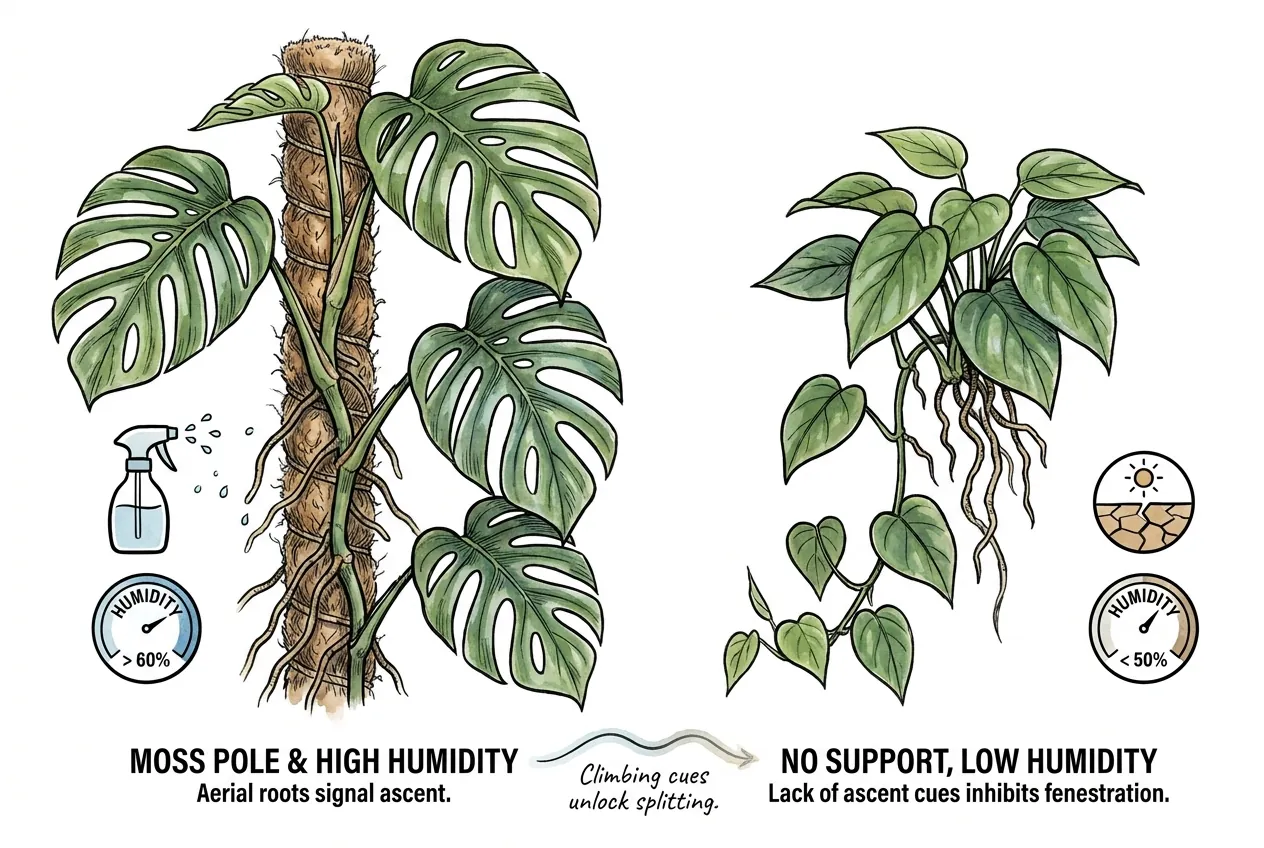
They can help, but as physical growing aids rather than proven triggers for leaf division.
A support lets a vining aroid climb upright, which improves how it grows and displays leaves as it matures.
The idea that aerial roots gripping a pole send a canopy-reached signal that switches on splitting is a nice story, but there is no evidence for that mechanism in this species.
In fact, Kew describes R. tetrasperma as weakly clinging, with adult flowering stems often growing free of a support.
Humidity is similar. A tropical climber may show less moisture stress and unfold leaves more easily in a moderately humid room, so a comfortable range, very roughly 50 percent or a bit more while balancing mold risk indoors, is reasonable to aim for. But there is no comparison study showing that a specific humidity level independently produces more splits, so treat those percentages as comfort targets, not thresholds.
Both support and humidity are also confounded with light and maturity, which is another reason not to credit them with the outcome on their own.
GROWNEER Coir Moss Pole suits a vining plant that needs physical support and a surface for aerial roots to rest against. It is a dry coir support, not a wet sphagnum column, so do not expect misting it to trigger leaf division. Set it near the growing tip and train the vine loosely onto it. A pole is optional for a small juvenile cutting and useful once the plant begins to climb.
The Ultimate Mini Monstera Care Guide
How do I track new leaves after a light change?
Treat the Trial as a Clue
Use a before-and-after record to see whether a gradual light increase appears to help your plant. It cannot isolate light from season, node order, ongoing maturation, or leaves that had already begun forming before the change.
Record the light at the growing tip, the date you changed it, and several successive leaves rather than a single result. Note their size, lobing, node position, and any internal holes. Photographs taken from the same angle make the comparison easier.
A workable routine
Mark the growing tip, record its starting light, then brighten the plant gradually by changing only one variable. Follow leaves that both began forming and opened after the change, because a leaf that was already shaped can still emerge later.
If several fully new leaves become more divided, light may have been limiting, so keep the new conditions stable and continue watching. If they do not, revisit support, humidity, roots, and maturity rather than making several new changes at once.
Programmed cell death and leaf morphogenesis in Monstera obliqua (Araceae)
What else makes new leaves stay plain?
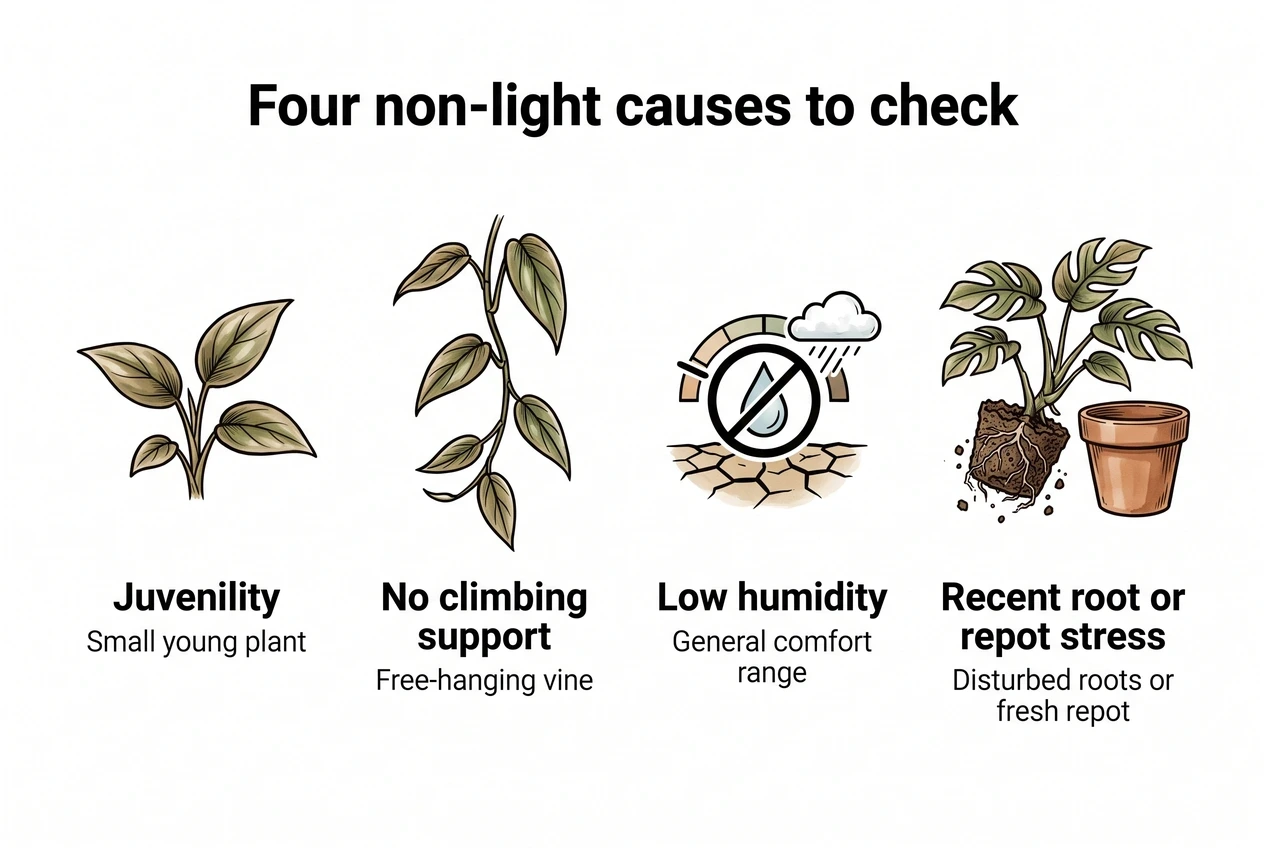
Light is one common suspect, but several other factors also produce entire leaves, and misreading them wastes effort.
Check them alongside light rather than after it, and try to hold them steady while you trial a light change.
True juvenility comes first. A fresh propagation in its juvenile phase makes small entire leaves by design until it sizes up.
A missing climbing surface is next. A free-hanging vine tends to grow and display less well, though whether that alone changes leaf division is not established.
Low humidity can slow growth generally, and recent repotting or root disturbance can stall a plant while it recovers.
There is no proven humidity threshold that switches splitting on or off, so treat a comfortable range as a general aim.
Before leaning hard on light as the answer, confirm the plant is past juvenility, has support if it is vining, sits in a reasonable humidity range, and has recovered from any repot, and then measure the light it actually receives.
| Cause of entire leaves | How to rule it out |
|---|---|
| Low light at the leaf | Measure tip PPFD/DLI over a few days, then brighten gradually |
| Juvenility | Check plant size and growth phase. Wait if still juvenile |
| No climbing support | Add a support pole if the plant is vining |
| Low humidity | Measure and aim for a comfortable range, balancing mold risk |
| Repot or root stress | Allow full recovery before judging |
Why Do Monsteras Have Holes in Their Leaves
The Ultimate Mini Monstera Care Guide
Key Takeaways
Leaf shape is largely set inside the furled leaf. An already-open leaf will not gain holes or lobes later, and a previously divided plant that now makes plain leaves is responding to conditions, not youth.
No published study gives a species-specific light threshold for Mini Monstera leaf division, so there is no honest floor number to hit.
Light plausibly matters, but so do maturity, support, roots, humidity, and recovery, so measure before you blame the light.
Judge light by what actually reaches the leaf, using DLI = PPFD times hours times 0.0036, with a quantum meter for a direct reading or a lux app times 0.0185 as a rough daylight gauge.
If a spot reads low, brighten it gradually by repositioning, extending the photoperiod, and adding a grow light, and treat support and comfortable humidity as general growing aids, not proven split triggers.
Change one thing at a time and log several successive leaves, treating any before/after as a clue about your plant rather than proof of a threshold.
Affiliate Disclosure
This article contains Amazon affiliate links. As an Amazon Associate I earn from qualifying purchases. If you use these links, the site may earn a commission at no extra cost to you. Product availability, price, and specifications can change. Check the current listing before buying.