
Frogbit vs Salvinia vs Duckweed: Growth & Control
Compare frogbit, Salvinia, and duckweed by growth, roots, shade, removal, and legal risk, then use a 25–50% coverage and thinning routine.
Samuel Reed · Published 2026-06-15 · 27 min read
Key Takeaways
- Floaters surge in warm water and long light periods. In an indoor tank the trigger is temperature and the timer, not the calendar, and duckweed can double in days.
- Identify the plant by size and roots. Tiny fronds with a rootlet suggest duckweed, bristly oval leaves suggest Salvinia, and large leaves with long roots suggest frogbit. Joined egg-beater hairs require extra caution because they can indicate invasive S. molesta.
- A thick floating mat can push light at the substrate below a carpet plant’s compensation point, causing a gradual decline in light-demanding plants.
- Use 25 to 50% surface coverage with weekly thinning as a starting heuristic, more often for duckweed, then adjust from plant response and light readings.
- Heavy floaters suit fry, shrimp, and low-light tanks. Contain or strip them in high-light carpet tanks, check local rules, and never release aquarium plants.
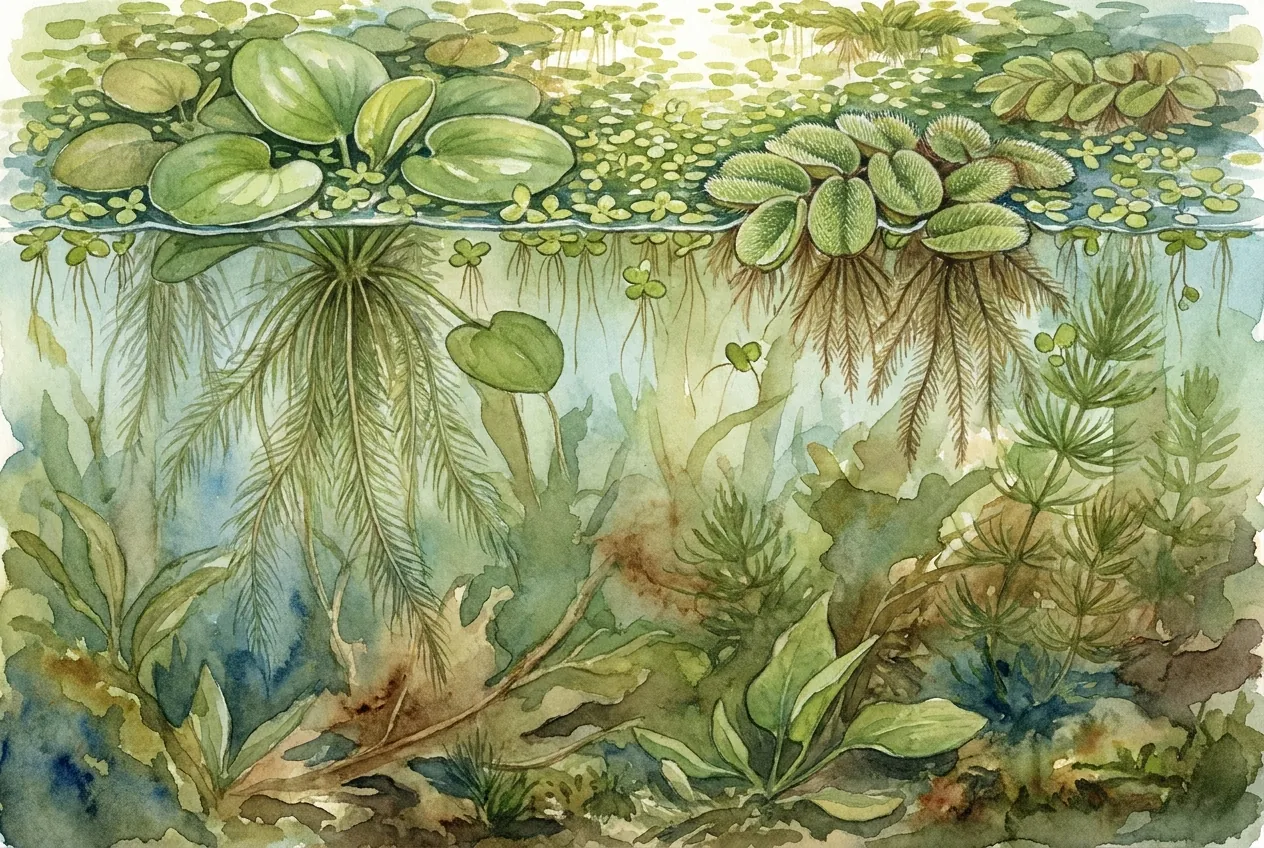
In summer, floating plants can shift from a tidy green accent to a thick surface cover. Warmer water and, in tanks that track seasonal daylight, longer days push floaters to grow faster, and a mat that gave your shrimp cover last month can shade out your carpet this month.
In a tank on a fixed LED timer with a heater, the trigger is really water temperature and light, not the calendar, so watch your own conditions rather than the date.
If the tank is already running above its target temperature, choose a fan or chiller from the aquarium cooling guide before treating faster floater growth as the only summer problem.
Control starts with three decisions. Identify the floater, preserve enough open surface for light and gas exchange, and thin on a schedule the tank can sustain.
Why do floating plants explode in summer?
What Drives the Summer Surge
Floating plants surge when warm water and, in tanks exposed to seasonal daylight, longer photoperiods rise together.
Duckweed is among the fastest-growing flowering plants known. A standardized study measured doubling times of 1.34 to 4.54 days across many clones under controlled conditions.
In a warm tank with plenty of light, the population can compound week over week, though the exact rate depends on the species, clone, and conditions, not just the season.
The mechanism is straightforward. A floating leaf sits at the surface with easy access to atmospheric carbon dioxide and strong, largely unshaded light.
Relatively little shades it, and its gas supply is rarely the bottleneck, so its growth is capped mainly by temperature, nutrients, and total light received.
In an artificially lit indoor tank, that light comes from your fixture and timer, not the sun.
I overlay a simple grid on a top-down photo and record occupied squares before removing floaters. Counting handfuls is inconsistent because wet plant mass and root length change through the season.
For each harvest, I clear one quarter of the occupied grid squares and photograph the open water afterward. A fixed quarter creates a visible change without resetting the entire surface, so I can compare regrowth without counting every plant.
To see what changes under the mat, I compare PPFD and dissolved oxygen beneath its densest section with readings from open water. I take each pair at the same time, once before lights-on and once late in the light period. These are local clues, not a direct measurement of gas exchange.
How fast does each floater actually double?
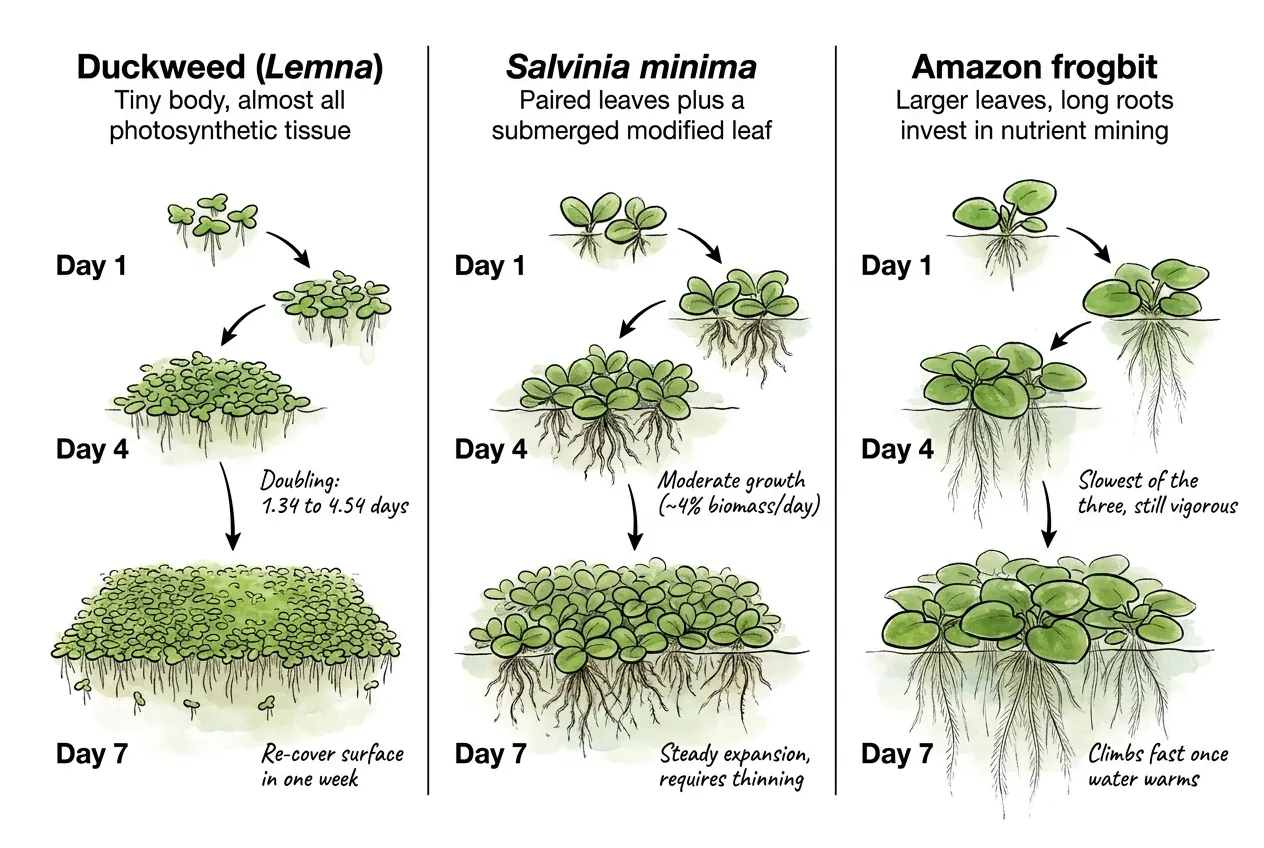
These three have not been measured side by side in one experiment, so any ranking is approximate. Duckweed can double in days under controlled conditions, while one nutrient trial found slower growth for Salvinia minima. No directly comparable frogbit figure establishes a reliable order for a home tank.
Practical growth consequence
A very fast duckweed population can re-cover a parted surface within a week or so, so it usually needs the most frequent thinning, while the larger floaters climb more gradually.
Your own tank’s pace depends on species, nutrients, temperature, and starting density.
Frogbit, with its larger leaves and long trailing roots, still grows steadily once the water warms.
| Floater | Typical doubling speed | Why |
|---|---|---|
| Duckweed (Lemna) | Fastest. Doubling 1.34 to 4.54 days (lab) | Tiny body, almost all photosynthetic tissue |
| Salvinia minima | Slower. A few % fresh weight/day (one trial) | Paired leaves plus a submerged modified frond |
| Amazon frogbit | No directly comparable figure. Grows steadily | Larger leaves, long roots take up water-column nutrients |
Relative in vitro growth rates of duckweeds (Lemnaceae) – the most rapidly growing higher plants
Physiological Responses of Salvinia minima to Different Phosphorus and Nitrogen Concentrations
Why does warm water plus long days accelerate floaters more than rooted plants?
Warm water and long days favor floaters partly because they sit where light and atmospheric carbon dioxide are most available. Photosynthesis and cell division are enzyme-driven, and within a plant’s tolerance band, biological rates generally rise with temperature. The rough idea that rates double for each 10 °C increase is only a simplification because whole-plant growth also depends on respiration, nutrients, and heat stress. Duckweed grows across a wide temperature range, roughly the low 60s to low 90s F, with a best zone in between.
Longer light periods add to this. At the same intensity, extending the daily light period from 10 to 14 hours delivers about 40% more total light, though the resulting growth increase is not necessarily proportional.
In an indoor tank, this depends on your timer setting rather than the season.
Rooted plants below receive less surface light once floaters cover it. (Submerged plants draw on dissolved carbon in the water, which is a separate pool from the atmospheric CO2 the floaters use, so the two are not simply competing for the same gas.)
Intrinsic growth rate – effects of temperature, photoperiod and phosphorus-nitrogen on duckweed growth
Relative in vitro growth rates of duckweeds (Lemnaceae) – the most rapidly growing higher plants
How do I tell frogbit, salvinia, and duckweed apart?
Use Size and Roots First
Tell them apart by size and roots.
Duckweed fronds are typically 1 to 8 mm with a single hair-like rootlet. Salvinia has paired 5 to 20 mm oval leaves with water-repellent bristly surfaces and no true roots, although it has a submerged modified frond that resembles a root.
Amazon frogbit, whose accepted botanical name is Hydrocharis laevigata, is still widely sold under the synonym Limnobium laevigatum. Its round leaves are roughly 1 to 3 cm across, and its long roots can trail well down into the water column.
Treat these sizes as typical ranges rather than hard limits.
The quickest field clue is the root check. Long roots dangling into the column point to frogbit or water lettuce (which look similar and are told apart by leaf shape and texture).
Water beading on a bristly, hairy leaf points to Salvinia, and tiny confetti-sized fronds point to duckweed, though other tiny floaters like Azolla or Wolffia can look similar, so these clues narrow it down rather than confirm a species.
What makes each species easy or impossible to remove?
Larger Floaters Lift in Pieces
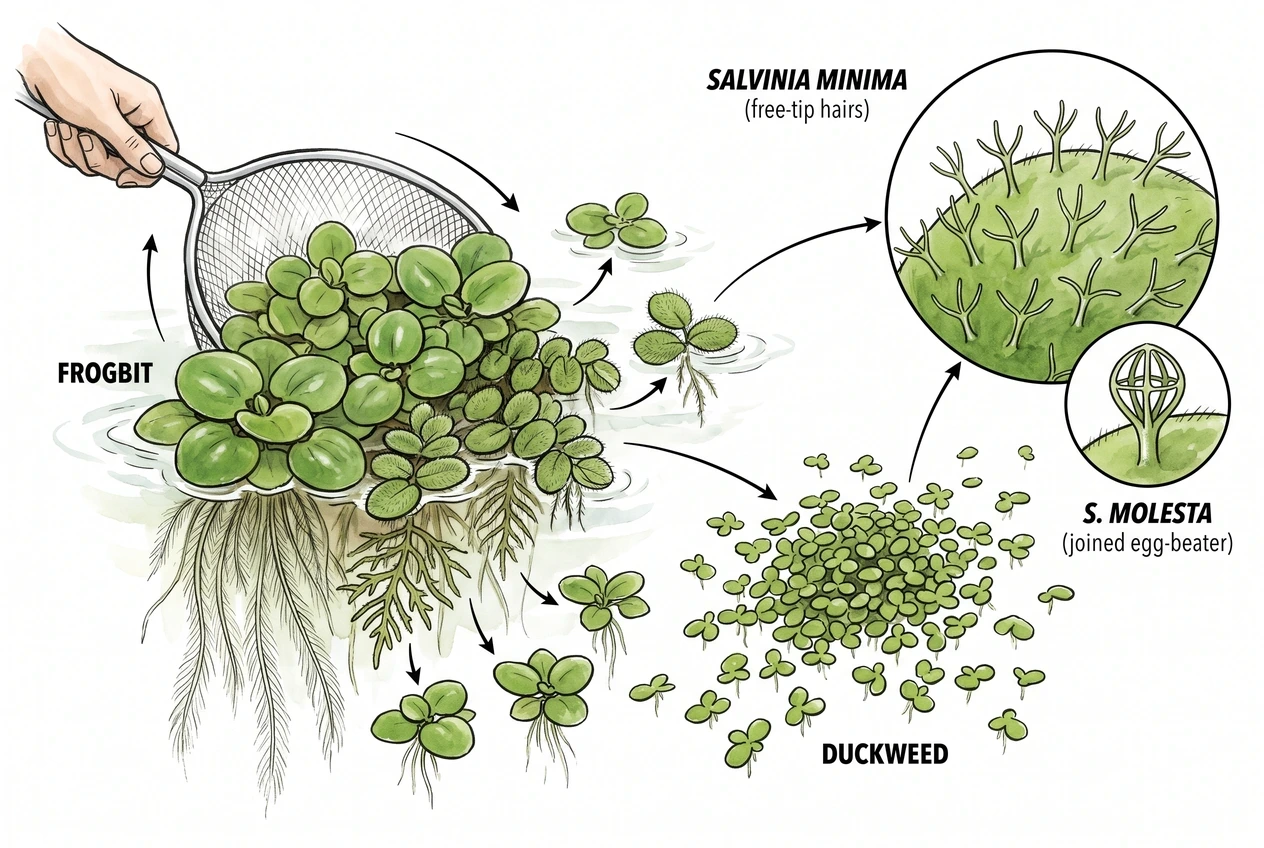
Removability matters as much as looks, and it separates the three. Frogbit and Salvinia tend to form cohesive mats you can lift in pieces, while duckweed scatters into thousands of individuals, and any viable frond or bud left behind can regrow the population.
(Frogbit and Salvinia are not immune. Detached daughter plants and broken runners can escape a net too.)
Salvinia’s Hair Clue
Salvinia leaves carry dense water-repellent hairs (trichomes) that trap air and make the leaf highly hydrophobic, which is why Salvinia beads water and resists being pushed under.
Note the shape is an identification clue. In Salvinia minima the four branches of each hair stay separate at the tips, while in the invasive giant salvinia (S. molesta) the tips join into a closed egg-beater cage.
If the hairs form joined egg-beater cages, you may have S. molesta, which is a federally regulated noxious weed in the US (identify it carefully).
Duckweed Scatters and Regrows
Duckweed reproduces by budding daughter fronds that detach freely, so every missed viable frond can restart the outbreak (fast at first, then slowing as nutrients and space run out).
| Trait | Duckweed | Salvinia minima | Amazon frogbit |
|---|---|---|---|
| Leaf size | 1 to 8 mm | 5 to 20 mm, paired | 1 to 3 cm, round |
| Roots | One tiny rootlet | No true roots (submerged modified frond instead) | Long, trailing |
| Growth speed | Fastest | Moderate | Slowest of three |
| Removability | Scatters. Regrows from any missed viable frond | Lifts in cohesive pieces | Lifts in cohesive pieces |
| Best for | Nutrient uptake, but hard to fully remove | Controllable cover | Fry cover, nutrient uptake |
Floating aquatic plants for total nitrogen and phosphorus removal from treated swine wastewater
Frogbit vs Water Lettuce vs Duckweed
What is the shade-out crash and why are my carpet plants dying?
How a Floating Mat Cuts Light
Surface Light Interception
The shade-out crash is the gradual decline of rooted plants when a floating mat intercepts their light at the surface. A dense canopy can substantially reduce substrate light, though the exact reduction depends on species, mat thickness, and fixture. When light at a carpet plant stays below its compensation point, it slowly loses tissue.
Light Attenuation Through Water
The mat is the first thing incoming light hits, so it absorbs and reflects light that would otherwise reach the bottom.
Light passing through water and leaf tissue is attenuated roughly exponentially, with each layer removing a fraction of what remains.
Coverage Pattern Matters
A thick, near-continuous mat blocks much of the light to the plants below, though how much depends on leaf transmittance, mat thickness, gaps, and fixture position. It is not perfectly opaque.
What is the light compensation point and when do plants cross it?
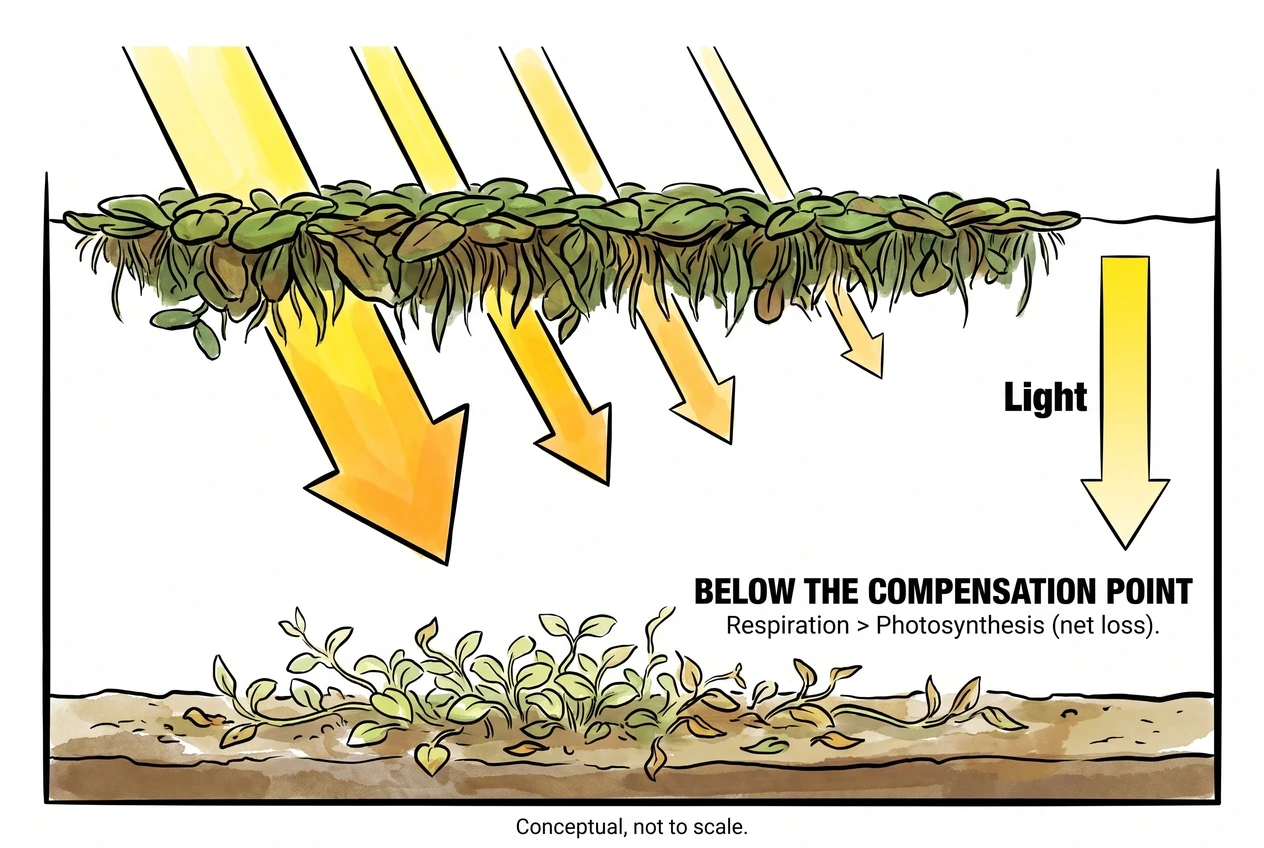
The light compensation point is where photosynthesis exactly equals respiration and net growth stops.
Below it, the plant burns stored sugars faster than it makes them and slowly declines. Many shade-adapted submerged plants survive on a small fraction of full sunlight (older hobby sources put it around 1 to 4%, roughly 20 to 80 umol/m2/s PAR) but the exact compensation point varies by species and has not been measured for every aquarium carpet.
Light-demanding carpets like dwarf hairgrass and Monte Carlo generally need more light than low-light plants like Anubias and Java fern, so they tend to feel a thickening mat first.
If your foreground melts while Anubias and Java fern under the same mat shrug it off, that difference points toward shade, but it does not rule out other causes.
Root-zone nutrition, CO2, planting stress, substrate, and algae also differ between demanding foreground plants and tough epiphytes, so check those too rather than assuming shade alone.
If the affected area is being replaced by dark filamentous tufts instead of simply thinning, use the black beard algae diagnosis to check flow and CO2 before blaming the floating canopy.
Why does the crash take weeks to show up?
The crash is gradual, which is exactly why keepers misdiagnose it. Shade-stressed plants first acclimate by raising chlorophyll and stretching toward light, which buys time.
Only after reserves are exhausted does tissue die back.
That lag separates cause from symptom. The mat may have thickened a couple of weeks before the carpet visibly melts, though the exact delay varies with the species and how much reserve the plant had.
So when you diagnose carpet decline, look back at how fast the mat grew, not just at today’s water parameters, while also checking light, CO2, nutrients, and recent maintenance.
Vertical optical complexity shaped by submerged macrophytes
Differential photosynthetic and morphological adaptations to low light affect depth distribution of two submersed macrophytes
A Plant Physiologist’s Basic Aquatic Plant Article
How much surface coverage is too much?
Start With a Coverage Band
As a starting heuristic for a planted tank with light-demanding rooted plants, a roughly 25 to 50% coverage band is a reasonable target, with heavy coverage above about 70% worth watching closely.
These are rules of thumb, not measured thresholds. The real limit is the coverage at which under-mat light falls below your rooted plants’ compensation point, which varies with fixture, depth, and species.
Adjust the band based on how your plants actually respond.
Coverage Is Not Linear
Coverage and average shading are not necessarily linear. As coverage approaches 100%, the few remaining gaps carry much of the direct light that still reaches the substrate.
So closing that last bit of open surface can cut average bottom light more than the small change in coverage suggests, depending on leaf opacity and fixture geometry.
Keeping coverage near half preserves large open windows where light still reaches the bottom.
How do I measure how much light the mat is stealing?
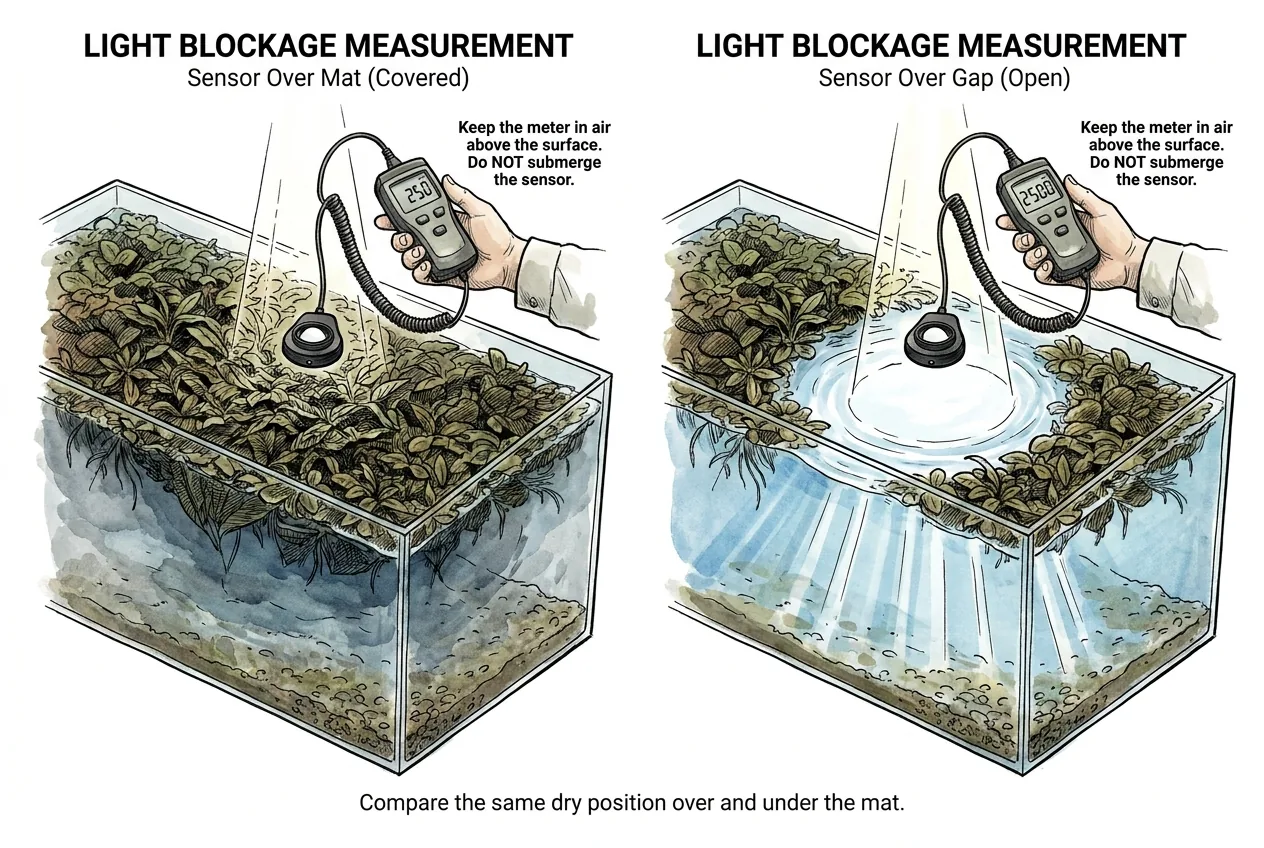
Comparing a reading over a covered spot with one over an open gap is more informative than coverage percent alone, because two tanks at the same coverage can have very different outcomes depending on fixture strength, depth, and water clarity.
What matters is the light actually reaching the plants.
The two-reading method
Take one reading at the surface directly above the mat, then part the mat over the same spot and take a second reading.
The relative difference is a rough gauge of how much light the floaters are intercepting at that one spot and moment.
If parting the mat roughly doubles the reading, the mat is removing about half the light at that point.
That is a useful trend signal, but whether a light-demanding carpet is actually below its limit depends on the absolute light level, photoperiod, and the specific plant. A single doubled reading does not decide it on its own.
Is a lux meter worth buying?
Buy a lux meter only if you run one fixed LED and want repeatable, week-to-week shading trends from the same dry measuring position.
Skip it if you need underwater PPFD, a plant’s compensation point, or a fair comparison between fixtures with different spectra. Those jobs require a calibrated waterproof quantum sensor, which is usually more sensible to rent.
Dr.meter LX1330B Light Meter
The Dr.meter LX1330B light meter suits repeatable, same-fixture shading trends from a dry position above the water. It is not a PAR meter or an underwater sensor, so keep it dry at the same height for both readings and never put it in the tank.
Lux versus PAR, and the immersion limit
Lux is weighted for human vision, not for photosynthesis, so it does not directly measure PAR (PPFD) and cannot confirm a species’ light compensation point.
Under one fixed LED, a lux meter can show whether shading is getting worse week to week. It cannot compare different fixtures or spectra, and it is not a substitute for a calibrated PAR meter in a high-tech tank.
Does a full mat hurt anything besides light?
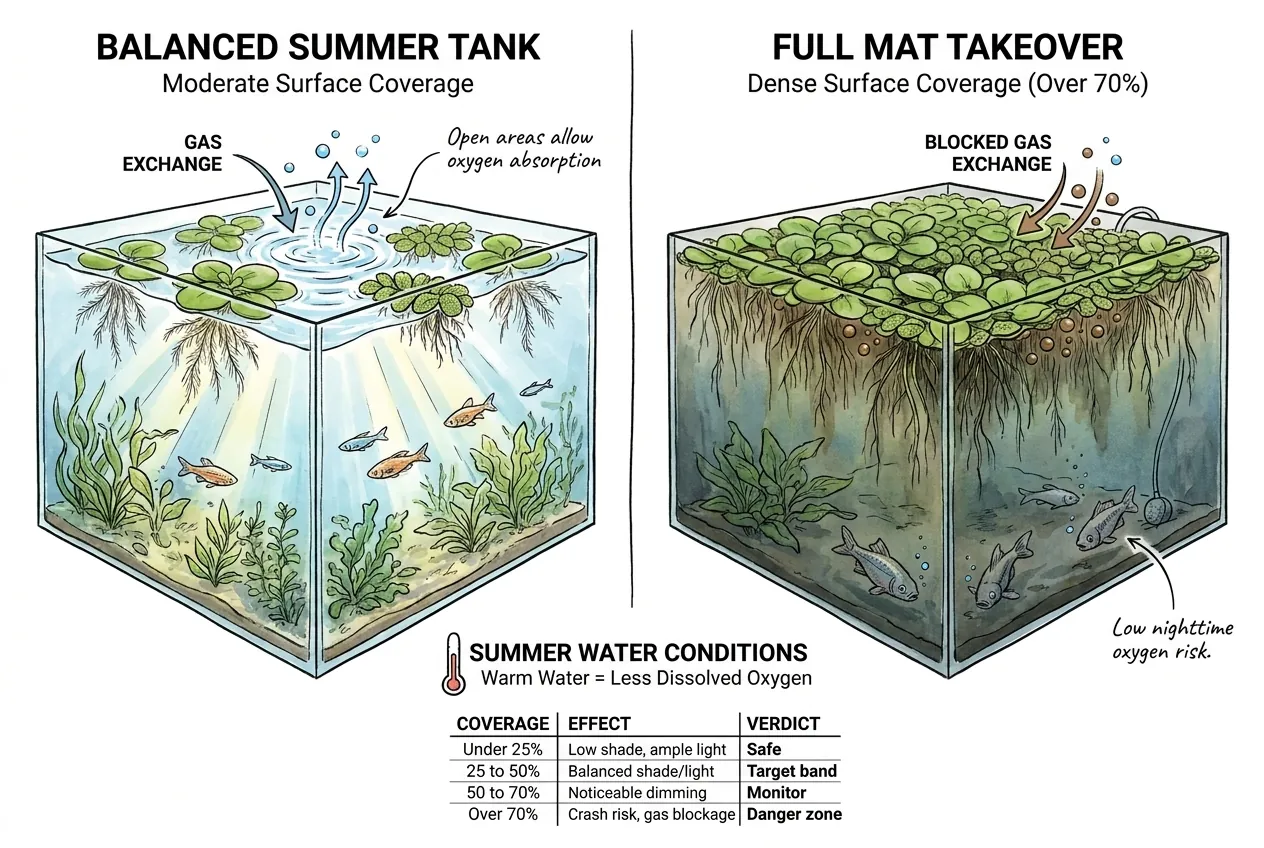
Surface Gas Exchange
Yes, a sealed surface can also slow gas exchange. A continuous mat suppresses surface agitation and covers the air-water interface, which can lower nighttime oxygen.
Warm water already holds less dissolved oxygen, so in a warm, heavily stocked tank these effects add up.
Oxygen enters largely through the agitated surface film, and a full mat damps ripples and covers that film, slowing reaeration.
Photosynthesis, water changes, and filter circulation also add oxygen, so the surface film is not the only source.
Nighttime Oxygen Risk
At night, with no photosynthesis and high summer respiration, dissolved oxygen can sag under a near-sealed surface, especially in a warm, well-stocked tank.
Whether it reaches a dangerous level depends on stocking, flow, and temperature. Watch for fish gasping at the surface in the morning.
As a precaution, keep an open lane for surface movement, or run an air stone overnight when coverage is high in warm weather.
The aquarium surface-film guide shows how to distinguish a floater barrier from an organic film and restore surface movement without overcorrecting circulation.
| Coverage | Effect | Verdict |
|---|---|---|
| Under 25% | Low shade, ample bottom light | Usually low-risk |
| 25 to 50% | Balanced shade and light | Suggested target band |
| 50 to 70% | Noticeable bottom dimming | Monitor closely |
| Over 70% | Higher shade and gas-exchange risk | Watch carefully |
A Plant Physiologist’s Basic Aquatic Plant Article
Vertical optical complexity shaped by submerged macrophytes
Are floating plants stealing nutrients from my other plants?
How Floaters Change the Water Column
Nutrient Uptake and Export
Yes, fast-growing floating plants are strong nutrient users, and that is both a benefit and a hidden cost.
In engineered floating treatment wetlands, plant uptake has accounted for a large share of nitrogen removal in some studies, for example 57 to 68% of total nitrogen in one stormwater system planted with an emergent species (not an aquarium floater).
Duckweed is often described as favoring ammonium, though how strong that preference is depends on conditions.
Treat these wastewater-system figures as evidence that floaters can take up a lot of nitrogen, not as a removal rate for your tank.
Floating plants suspend their roots (or, in Salvinia, a modified submerged frond) in the water column and take up dissolved nitrogen and phosphorus, and a fast-growing mat has a correspondingly high nutrient demand.
Harvest Is the Export Step
So a fast-growing mat draws nitrate and phosphate out of the water, which is why keepers add floaters to help fight algae and high nitrate.
The nutrients are only truly exported when you remove the biomass from the tank. Decay returns part of that stored load to the water.
When does floater uptake starve my rooted plants?
Floater uptake can outcompete rooted plants when a fast mat draws down the shared water-column pool faster than a slower stem plant.
Water-column nutrients are finite and shared, so a high-growth-rate mat can pull nitrate, phosphate, and potassium down quickly, though rooted plants also feed from the substrate, so the water column is not their only source.
Where a deficiency shows up depends on the nutrient. A shortage of mobile nutrients like nitrogen and potassium usually shows in the older, lower leaves first, because the plant moves those nutrients up to new growth. A shortage of less-mobile nutrients like iron tends to show in the new tips.
So pale tips alone are not a reliable sign of a nitrate-stripped column. Read the symptom together with your test kit.
If you confirm a water-column shortage, pale stem plants, low nitrate on a reliable test, and no obvious algae or planting-stress cause, the options are to raise water-column dosing or thin the floaters to free the pool.
Check the substrate and feeding load too, since a heavy fish load may already supply much of the nitrogen.
Use the aquarium water-test kit guide to choose a liquid kit, KH/GH tests, or screening strips before changing fertilizer from a single uncertain reading.
What fertilizer fixes a stripped column?
If you have confirmed a water-column shortage, an all-in-one liquid restores both macros (nitrogen, phosphorus, potassium) and micros in one dose, which helps when the column is short on several nutrients at once rather than just nitrate.
Aim to keep a small measurable residual rather than chasing zero, and don’t assume a deficiency from pale tips alone (rule out algae, test error, and a heavy fish load first).
NilocG Thrive C fertilizer is a sensible buy only for a low-tech planted tank after tests and plant symptoms point to a water-column macro or micronutrient shortage.
Do not buy it to treat pale tips from an uncertain cause, a tank whose fish load already keeps nutrients available, or a high-light CO2 carpet tank that needs a richer formula.
Use it only at the rate on its current label and calculate from actual water volume. Retest after dosing instead of adding more from pale tips alone, and make sure soft or RO water has the calcium and magnesium the tank needs.
Matching the formula to your tank
Thrive C is formulated lean for low-tech, low-light tanks. A high-light CO2 carpet tank has a higher nutrient demand and may need a richer high-tech formula.
Rather than simply dosing more, match the formula to your light and CO2 level and adjust based on measured consumption, since over-dosing can feed algae.
Improving Urban Stormwater Runoff Quality through Floating Treatment Wetlands and Vegetation Harvest
The contribution of plant uptake to nutrient removal by floating treatment wetlands
How do I get rid of duckweed and contain the floaters I want?
Start With Repeated Removal
Duckweed is very hard to eradicate once established, so the realistic goal is ongoing containment rather than a one-time cleanup.
It doubles in days and regrows from any viable frond or bud left behind, and some species also form starch-heavy turions that sink.
Frogbit and Salvinia, by contrast, tend to lift off in cohesive pieces and corral more easily.
A single pass of physical removal usually leaves some viable fronds behind, so it rarely clears duckweed in one go.
Because each frond is an independent plant, there is no single stem to cut. Removal is a repeated, thorough job.
Plan on several passes with a fine net or skimmer, checking filter intakes and quiet corners each time, since any missed frond can restart the population.
Why does duckweed keep coming back?
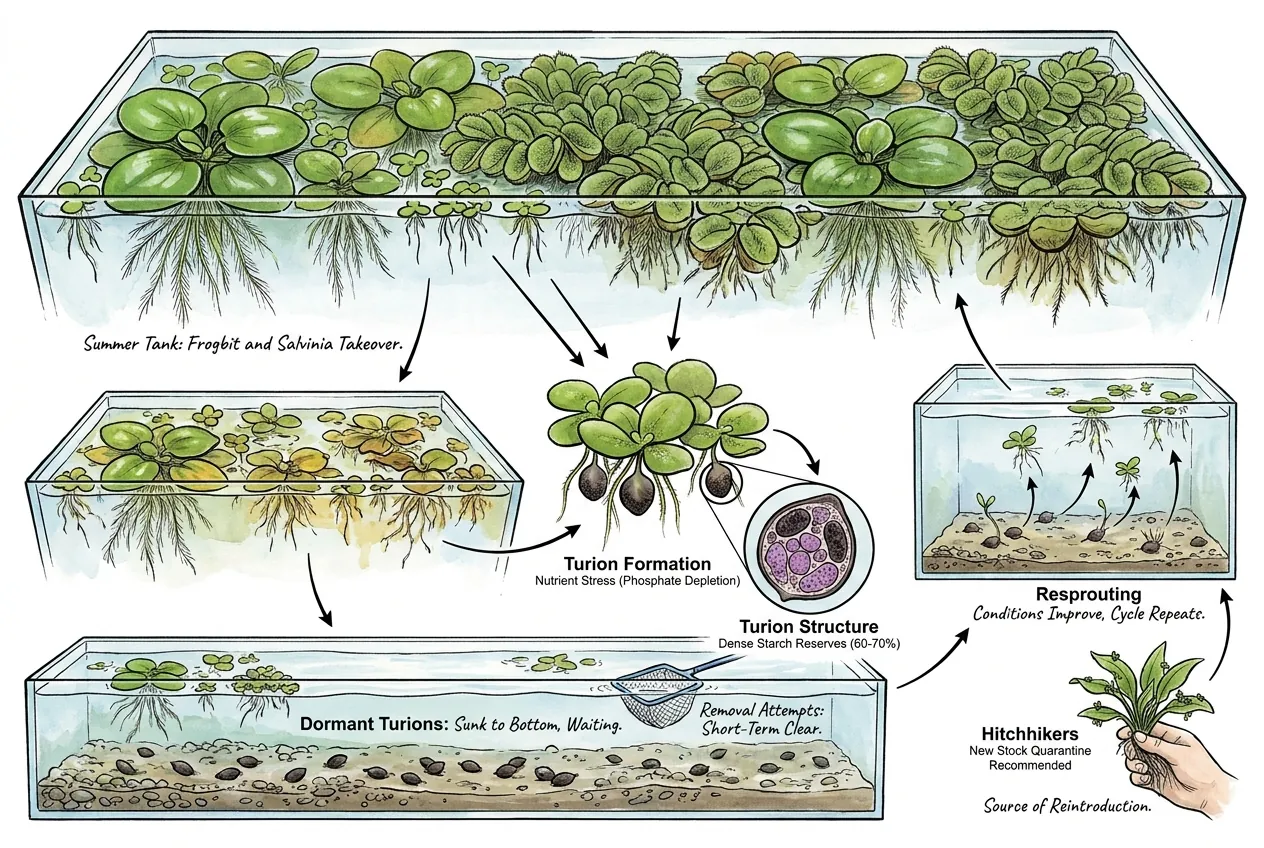
Resting Turions
Some duckweed species make resting buds called turions under stress. These sink and can resprout later, so a tank may look clear while viable material remains below the surface. Not every duckweed forms turions.
Where turions are involved, this life cycle can defeat short-term removal, because a tank that looks clear may still harbor sunken buds.
If you are dealing with a non-turion duckweed, the rebound comes instead from missed floating fronds.
Either way, expect a rebound and keep skimming. Quarantine all incoming plants because duckweed hitchhikes on new stock, and never release aquarium plants into the wild.
How do I keep frogbit and salvinia where I want them?
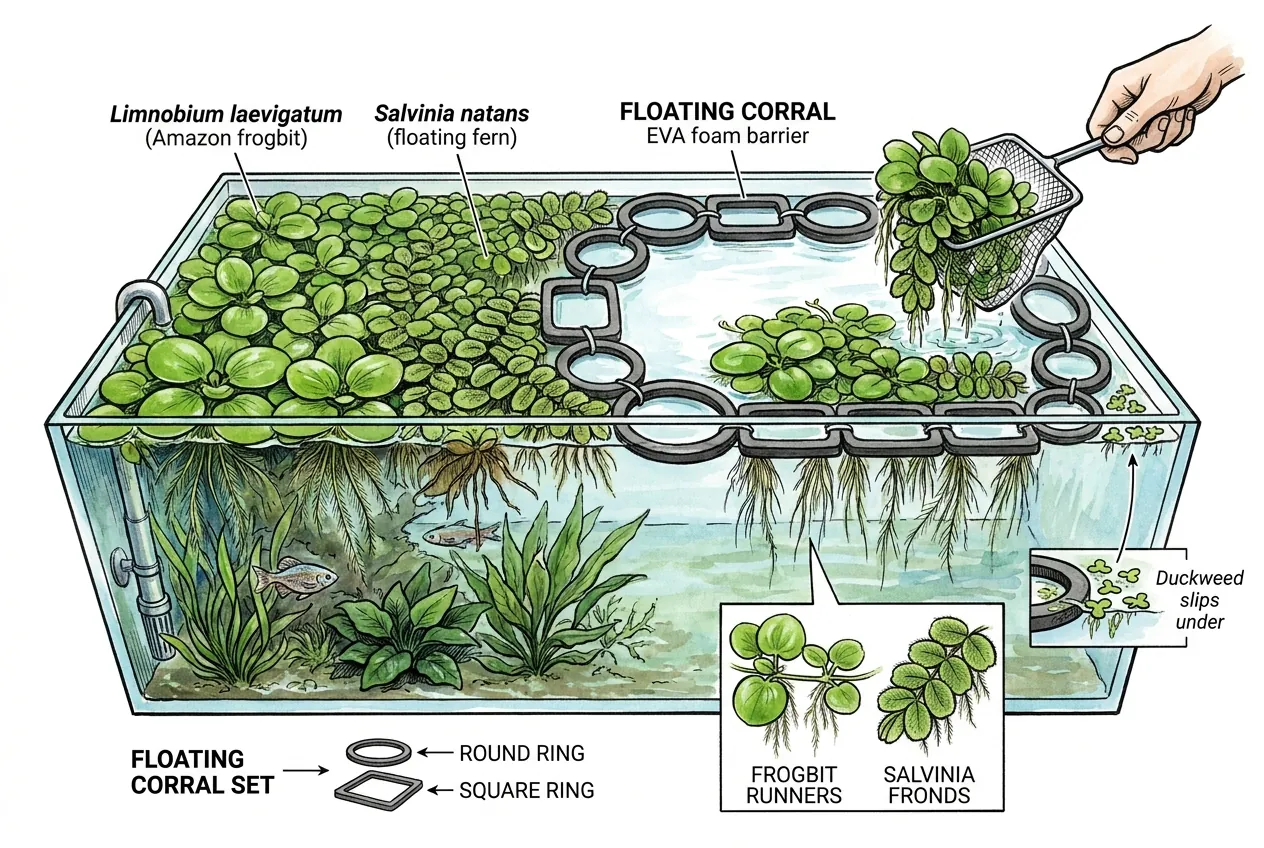
Corral them with a floating ring, since their larger leaves and connected runners are harder to slip under a barrier than tiny duckweed fronds.
The interconnected mat mostly stays inside the ring, and a net or hand then lifts the excess.
It is not a perfect seal. Detached daughter plants and strong current can still carry some pieces past the ring.
Is a fixed floating corral worth buying?
Buy a fixed corral when frogbit or Salvinia repeatedly drifts into the filter, heater, or feeding lane and water-level changes make a static barrier awkward.
Skip it for a small feeding window that a loose airline ring can handle, a tank whose rim or brace blocks the mounts, or a duckweed infestation that needs repeated skimming or a deeper barrier.
The HOZOE floating plant corral suits keeping larger frogbit or Salvinia in one part of a low-flow tank. It is not a seal against duckweed or loose fragments, and strong current can overwhelm it. Measure the mounting area and confirm the brackets or suction cups suit the tank before buying.
Where a ring helps and where it does not
A ring is most useful for the larger, controllable floaters. It does little to contain duckweed, whose tiny fronds drift under and around a shallow ring, so for a duckweed problem repeated skimming, a surface skimmer, or a deeper submerged tube barrier are better tools.
Even for frogbit and Salvinia, a ring reduces spread rather than sealing it completely.
The Developmental Cycle of Spirodela polyrhiza Turions – A Model for Turion-Based Duckweed Overwintering?
Relative in vitro growth rates of duckweeds (Lemnaceae) – the most rapidly growing higher plants
What is the weekly thin-out protocol?
Set the Target Band
A workable summer routine is to keep coverage in a 25 to 50% band, then thin roughly once a week (more often for fast duckweed) back toward the bottom of the band.
Use a light reading as one check that bottom light is holding up. These cadences are heuristics (adjust them to how fast your tank actually regrows).
Periodic harvesting is what keeps a floater system exporting nutrients, a principle borrowed from floating-wetland research. The routine itself usually takes only a few minutes.
Because floater growth is roughly exponential while there is room, thinning back to the lower end resets the population and buys time before it returns to the top of the band.
Exactly how long that takes depends on the species and conditions.
If you only trim to the top of the band, it can overshoot again within days, so it is usually better to thin closer to the floor.
What is the step-by-step weekly routine?
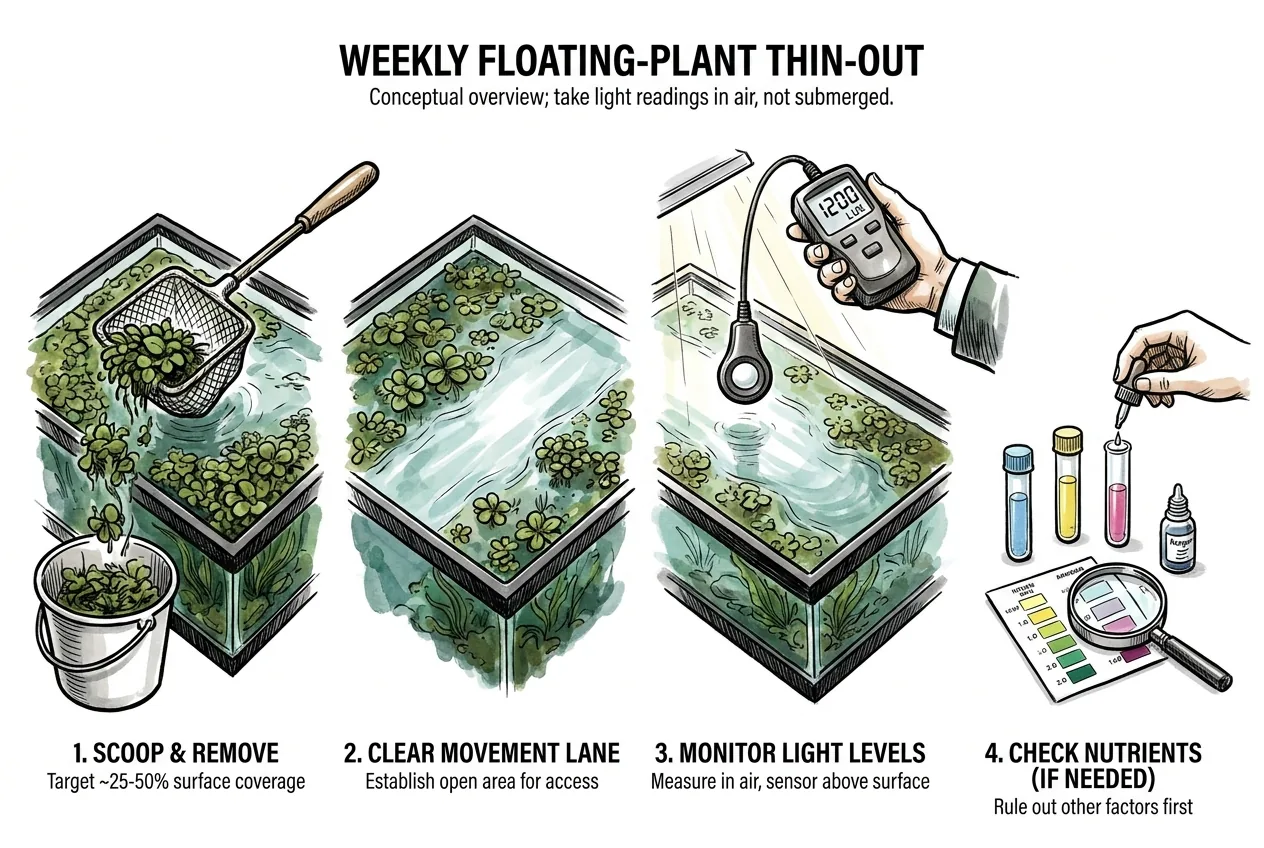
Step 1 – Thin to the band floor
Each week, scoop floaters back down to roughly a quarter of the surface covered (the bottom of the 25 to 50% coverage band, leaving about three-quarters of the surface open).
For duckweed, add a mid-week skim because it doubles every few days.
Step 2 – Open a surface lane
Leave a clear lane for surface movement, especially in warm weather. This protects overnight oxygen under what remains of the mat.
Step 3 – Take a light reading
After thinning, take a lux reading with the meter held in air above the surface rather than submerged. A stable or rising reading week to week suggests bottom light is not getting worse. It is a trend indicator, not proof your plants are above their compensation point, so also watch how the plants respond over the following weeks.
Step 4 – Check nutrients if needed
If nitrate reads near zero on a reliable test and rooted plants look starved, consider an all-in-one dose so floaters and rooted plants are not competing over an empty column, but first rule out a heavy fish load, test error, or algae as the real cause.
| Floater | Cadence | Target band |
|---|---|---|
| Duckweed | Twice weekly | 25 to 50% |
| Salvinia | Weekly | 25 to 50% |
| Frogbit | Weekly | 25 to 50% |
Improving Urban Stormwater Runoff Quality through Floating Treatment Wetlands and Vegetation Harvest
A Plant Physiologist’s Basic Aquatic Plant Article
When is explosive floater growth actually a good thing?
Heavy floater growth is a feature in the right tank. It gives fry and shrimp cover, removes nitrogen when you harvest the biomass during heavy summer feeding, and dims the tank to help suppress algae.
Match Coverage to Livestock
Heavy floaters tend to suit fry, shrimp, and low-light tanks, while high-light carpet tanks usually call for containing or stripping them. Weigh surface-breathing fish, filter access, oxygen, and local invasive-species rules before deciding.
The dangling roots and dense surface of frogbit and Salvinia give fry and shrimp refuge and a biofilm-rich foraging surface.
Biofilm on submerged roots is a good early food for many newly hatched fry and shrimplets, though it usually supplements rather than replaces regular feeding.
Some fish are calmer under dimmer, covered surfaces, which can suit a breeding tank, but this varies by species, and there is no controlled evidence that a heavy mat lowers illness across all breeding tanks.
Which tanks benefit most from a heavy mat?
Fry, shrimp, and low-light tanks tend to benefit most because little below them needs high light. A fast-growing mat also takes up nitrogen and phosphorus during heavy feeding, but that becomes true export only when you remove the biomass. Left in place, the mat stores the nutrients, and decaying plant material returns them while adding an oxygen demand. Harvest and discard the growth to pull nutrients out.
The risk is the mirror image of the benefit. The same shading that suppresses algae can also push light-demanding carpets below their compensation point.
So decide by what grows below. If the rooted plants tolerate low light, heavy floaters generally help, if they are light-demanding, the same canopy can crash them, while still checking oxygen and surface access for your livestock.
| Tank type | Keep, contain, or strip? | Why |
|---|---|---|
| Fry or shrimp breeding | Keep (upper band) | Cover and biofilm outweigh shading |
| Low-light planted | Keep or contain | Shade plants tolerate the canopy |
| High-light carpet / high-tech | Contain or strip | Protects carpet and overnight oxygen |
Improving Urban Stormwater Runoff Quality through Floating Treatment Wetlands and Vegetation Harvest
Vertical optical complexity shaped by submerged macrophytes
Dispose of floating plants responsibly
Check Regulations Before Buying or Removing Floaters
Several of these plants are regulated. Salvinia minima is treated as high-risk and is restricted in some US states, giant salvinia (S. molesta) is a federally listed noxious weed, and frogbit is managed as invasive in some regions (for example California).
Because S. minima and S. molesta are easy to confuse, identify carefully, and if you are unsure or it may be S. molesta, do not transport it.Check your local and state regulations before acquiring these plants, and dispose of trimmings responsibly. Never release, flush, or compost aquarium plants or pour rinse water into a storm drain or natural waterway.
Instead, dry them out or seal them in a bag and put them in the household trash, and follow any disposal guidance from your local authority.
Affiliate Disclosure
This article contains Amazon affiliate links. As an Amazon Associate I earn from qualifying purchases. If you use these links, the site may earn a commission at no extra cost to you. Product availability, price, and specifications can change. Check the current listing before buying.