
Aquarium CO2 System Product Chooser for Planted Tanks
Aquarium CO2 system product chooser: match a dual-stage regulator, diffuser, and 4 dKH drop checker, and find the lowest dose that helps submerged plants without stressing your livestock.
Priya Patel · Published 2026-07-22 · 35 min read
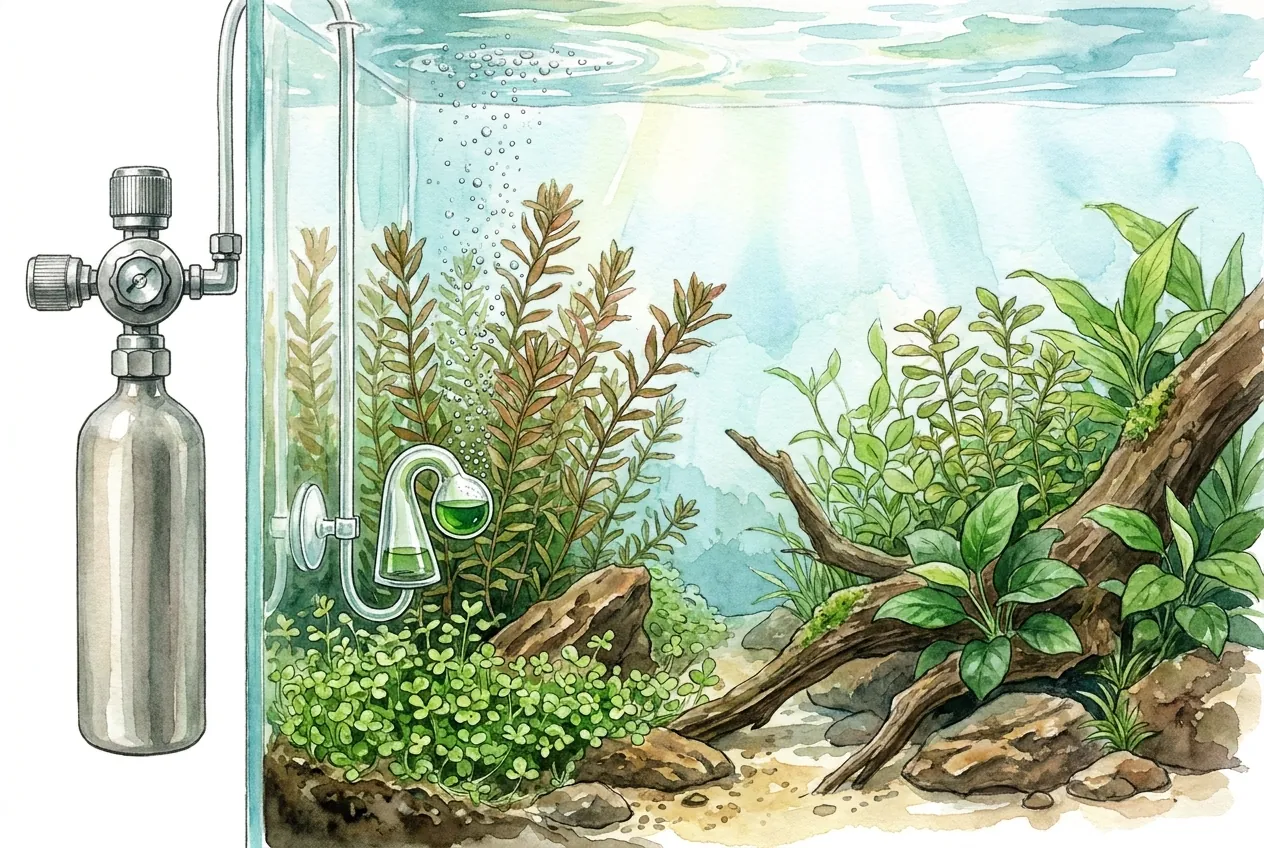
Key Takeaways
- Choose among pressurized CO2, no injection, and liquid carbon according to the tank’s actual need. Pressurized injection is the controllable way to hold dissolved CO2 for submerged plants.
- Buy to the system specification. Use a dual-stage solenoid regulator, a diffuser sized to the tank, and a drop checker charged with a known 4 dKH reference rather than tank water.
- Use CO2-proof polyurethane tubing and a correctly oriented check valve. Silicone airline is more CO2-permeable and the check valve limits back-siphoning.
- Tune slowly toward stable green and stop at the lowest effective dose. Gate the solenoid to the lights and treat yellow checker fluid or gasping fish as a hard stop.
- CO2 injection is supported for submerged plants, while liquid carbon is only a supplement. A pH controller can also mask KH drift because it reads pH rather than CO2.
Buying a CO2 system for a planted tank is one decision with three branches. Build a pressurized rig, run a low-tech tank with no injection, or dose liquid carbon, which is a glutaraldehyde-based supplement rather than an equivalent dissolved-CO2 source.
Choose by tank need and safety margin, not brand. The goal is to give submerged plants the lowest stable dose that helps them without stressing the livestock.
Pressurized CO2 is for water, not a room or terrarium. Underwater plants can be carbon-limited, while venting a cylinder into air is inefficient and creates an asphyxiation risk.
What is the minimum viable CO2 build, and who should skip it entirely?
A typical minimum pressurized build is a short chain of parts. A regulator with solenoid, needle valve, and (usually) a bubble counter feeds a diffuser or atomizer through CO2-proof tubing and an inline check valve.
A drop checker charged with a known 4 dKH reference solution reports the result, and a cylinder feeds the whole chain.
Some builds fold in variants such as an integrated reactor or controller, so treat this as the common core rather than the only valid arrangement.
I weigh the connected cylinder after installation and record the gauge readings, bubble setting, and room temperature together. The weighing is repeated at the same time each day during the first week. A slow leak may appear as unexplained mass loss before it becomes obvious on a gauge.
The weight log never replaces a proper leak test or cylinder inspection. It is an extra trend that tells me to shut the system down and recheck every connection before an unexpectedly empty cylinder becomes a livestock risk.
What Each Part Does
Each link fixes a failure of the one before it. The regulator steps cylinder pressure, which can exceed 800 psi, down to working pressure.
The solenoid lets a timer gate injection to the lights. The needle valve and bubble counter set a slow rate, the check valve stops back-siphoning, the diffuser makes a fine mist, and the drop checker reports whether you hit the target.
You are not buying a kit but a controlled way to hold a chosen dissolved-CO2 level steady, which sorts every part into deliver-it, meter-it, or report-it.
The drop checker does not meter CO2 directly. It reports a lagging color estimate a couple of hours behind the tank.
Who should NOT inject CO2 at all?
Skip pressurized CO2 if your plants are low-light and slow-growing, your livestock is sensitive or heavily stocked, your tank is a nano under roughly 10 gallons, or you will not monitor it.
Injection is not a universal upgrade. It only pays off once light and nutrients are already high enough that carbon has become the limiting factor (Liebig’s law of the minimum).
A low-light tank of Anubias, Java fern, Cryptocoryne, mosses, and Vallisneria can be kept growing steadily without injection, so for many keepers CO2 adds cost and a nighttime-safety liability without a payoff they need.
These plants are not necessarily free of any carbon response, but in a low-light setup carbon is usually not the first bottleneck.
Roughly 50% of about 80 tested freshwater angiosperm species in one review could use bicarbonate. The review did not find bicarbonate use in the mosses and ferns it tested, so treat grows fine without CO2 as a husbandry observation rather than proof of no carbon limitation.
With sensitive or overstocked livestock, pushing dissolved CO2 up to feed plants moves it toward the level that stresses fish, so any nighttime overshoot is dangerous.
There is no single number that is safe for every species. Set your ceiling from your own livestock’s behavior, not a fixed target.
For a traveler who will not check a drop checker daily, a build with no solenoid timer is a livestock hazard.
What are the two safety rules to internalize before buying?
Yellow Checker Fluid Is a Hard Stop
A yellow drop checker means danger, so act now. Green through a 4 dKH reference corresponds to roughly 30 ppm and is a common working target, but it is an approximate, lagging color, not a safety certificate.
A slide toward yellow means CO2 is climbing past that working range toward the fish-stress zone.
Nighttime Injection Is a Safety Risk
Running injection 24/7 is a nighttime hazard. Plants stop consuming CO2 in the dark and respire, so continuous injection stacks CO2 while oxygen falls.
That is why a solenoid on a timer is a safety device, not a luxury.
Many hobbyists also associate unstable CO2 and flow with Black Beard Algae, though algae outbreaks are multi-factor (light, nutrients, organics, and maintenance all play a role). The flow-and-CO2 angle is covered in the Black Beard Algae flow guide.
Your KH and hardscape choices matter too, as explained in the Iwagumi stones and KH guide.
Underwater Photosynthesis of Submerged Plants
Carbon dioxide. Waste and nutrient (Global Seafood Alliance)
Why does CO2 injection actually work underwater but not for houseplants?
Submerged plants can be carbon-limited because gas moves far more slowly in water than in air. Injection raises the dissolved CO2 they can use, and circulation helps carry it to every leaf. This benefit does not transfer directly to plants growing in air.
How much extra growth does CO2 really buy?
Plants respond differently according to species, light, temperature, circulation, and planting density. Bicarbonate-using plants often gain less from injection than plants that depend on free CO2.
Past the point where your plants stop responding, more CO2 mostly adds livestock risk. Find the lowest dose that works for your own tank instead of treating 30 ppm as a universal finish line.
Which plants benefit most, and why do some not need CO2?
Plants that depend mostly on free CO2 benefit most, because they cannot draw much on the bicarbonate pool.
Carbon strategy varies by species rather than by common-name group, so confirm a given plant rather than assuming every demanding stem or moss behaves the same.
Where the review measured it, the efficiency gap was wide. Strong CO2-dependent users extracted only a small percentage of the dissolved inorganic carbon pool, while capable bicarbonate users extracted a much larger share.
That is why Vallisneria, Egeria, and hardwater specialists persist in un-injected tanks while obligate users struggle.
In alkaline hard water an obligate user is carbon-starved despite abundant bicarbonate, and injection directly relieves that.
Why the underwater benefit is specific
The strong carbon-limitation case rests on the plant being underwater. For three terrestrial wetland species, mean underwater photosynthesis was only about 9% of their photosynthesis in air, a penalty caused by being submerged that disappears in air.
That is why aquarium CO2 injection is well supported for a planted tank. It does not mean plants in air are unresponsive to CO2 (controlled greenhouse enrichment can raise their growth), but you should not vent an aquarium CO2 cylinder into a room or terrarium. It is an inefficient way to reach plants and a serious human-asphyxiation hazard.
Underwater Photosynthesis of Submerged Plants
Responses of Ottelia cordata to variable CO2
A perspective on underwater photosynthesis in submerged terrestrial wetland plants
How do I measure CO2, and why is 30 ppm the target?
Direct dissolved-CO2 instruments do exist (titration kits, membrane-NDIR sensors, and infrared methods), but they are more than most hobbyists want to buy.
In the tank you usually infer CO2 from the carbonate equilibrium that links pH, carbonate hardness (KH), and free CO2.
That is why a drop checker is charged with a known 4 dKH reference solution rather than tank water.
CO2 lowers pH, so carbonate chemistry can provide a useful estimate only when the reference alkalinity is known. Non-carbonate acids and buffers make tank-water pH and KH charts unreliable, which is why the checker uses a separate 4 dKH reference rather than tank water.
Why must a drop checker use a 4 dKH reference and not tank water?
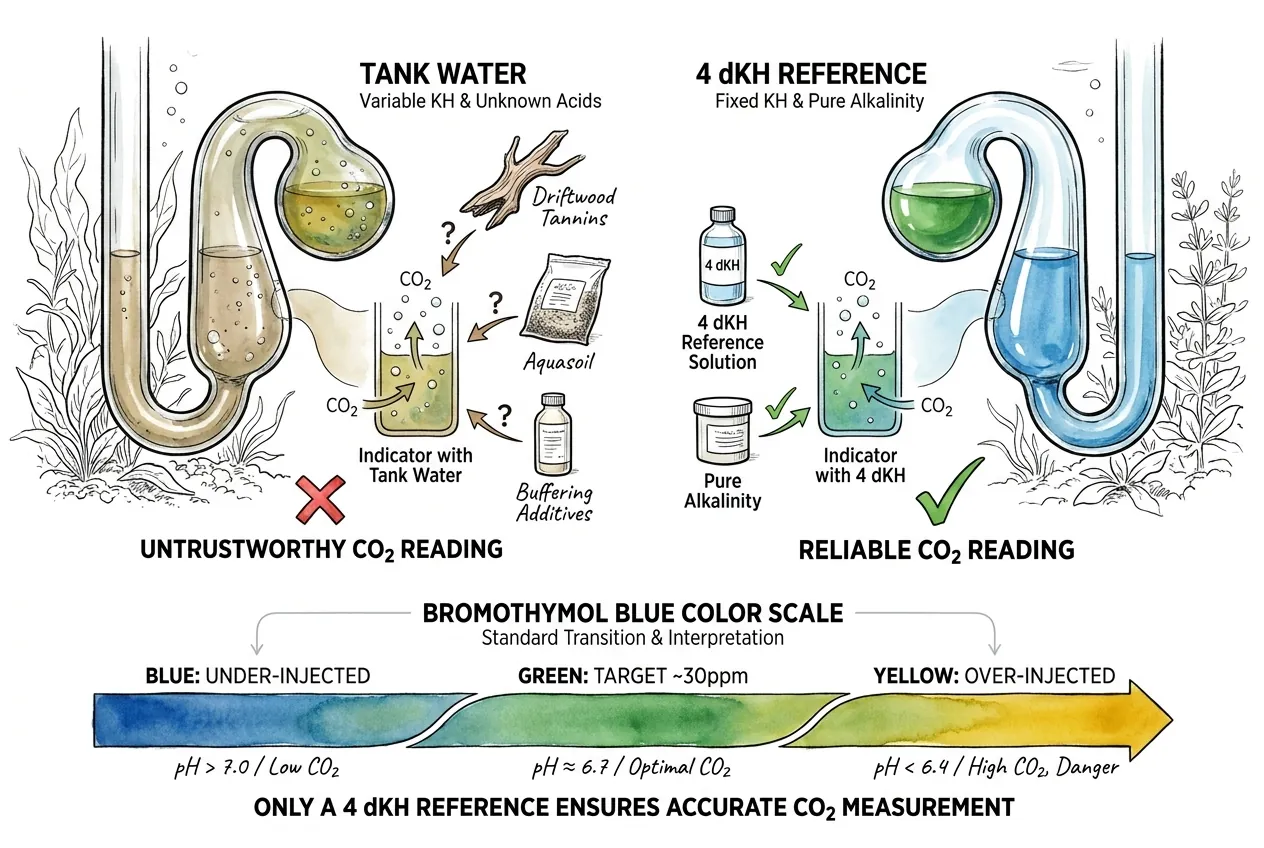
A drop checker is a small air-gap chamber holding an indicator of known alkalinity. CO2 diffuses out of the tank water, across the air gap, and into the reference until the partial pressures equalize, and the reference changes color.
Charge it with tank water and you re-introduce the one unknown the method was designed to remove.
Tank KH varies with aquasoil, driftwood tannins, buffering additives, and water changes, and can carry non-carbonate acids that break the pH-to-CO2 mapping, so a reference-charged checker is the more interpretable choice.
It is still an approximate reading affected by reagent age, temperature, placement, and how you perceive the color.
Reading the bromothymol-blue color scale
With a 4 dKH reference, blue suggests low CO2, green is a common approximate working range, and yellow signals over-injection. Reagent age, placement, and lighting affect the color, so use it as a lagging safety signal rather than a precise meter.
Yellow is not a slight overshoot to fine-tune. Cut the bubble rate, add surface agitation, and watch the livestock.
Why is 30 ppm a livestock ceiling, not just a plant target?
A plant-helpful CO2 level can sit close to a livestock-stress level. Sensitivity varies by species, temperature, oxygen, stocking, and water movement, so a fixed ppm target cannot replace watching the animals.
Excess CO2 makes it harder for fish to release CO2 from the blood and use oxygen efficiently. That is why an overdose can leave fish gasping even when the water appears well aerated.
Why the 1.0 pH drop equals 30 ppm rule is unsafe
The popular shortcut of assuming a 1.0 unit pH drop equals 30 ppm CO2 is only an approximation, and it becomes unreliable when non-carbonate acids or buffers are present.
Tannins, organic acids leached from fresh aquasoil, and phosphate buffers all contribute to pH without adding CO2, so any carbonate math that treats all pH change as CO2 can over-report it.
Studies of acidic, organic-rich water show that pH-and-alkalinity calculations can badly overstate CO2 when other acids are present. That is a warning about the shortcut, not proof that every relative pH-drop estimate is wrong. In a blackwater or fresh-aquasoil tank, verify with a known-reference drop checker and livestock behavior instead of trusting pH alone.
In a blackwater, botanical, or fresh-aquasoil tank, do not rely on the pH-drop number alone.
The air-gap drop checker helps here because it re-equilibrates against gaseous CO2 rather than the tank’s dissolved organic acids, though it is still a lagging, approximate reading.
If you run aquasoil, the ammonia and organic-acid leaching in the first weeks is real, as detailed in the aquasoil ammonia leach guide.
Water Quality Impacts on Fish and Shrimp, Part 2 (Global Seafood Alliance)
SRAC 464 Interactions of pH, Carbon Dioxide, Alkalinity and Hardness in Fish Ponds (Wurts and Durborow)
Bromothymol Blue pH Indicator, transition range pH 6.0 to 7.6
Impact of Water Quality on Fish and Shrimp, Part 1 (Global Seafood Alliance)
Root Effect Haemoglobins in Fish
Large overestimation of pCO2 calculated from pH and alkalinity in acidic, organic-rich freshwaters
What specs should I compare across each product role?
Each role has a short list of numbers that change outcomes, and the table below gathers them in one place as a starting point for comparison.
| Product role | Minimum spec | Metric that matters | Why it matters |
|---|---|---|---|
| Regulator | Dual-stage body, both cylinder and working gauges, 12V DC solenoid, fine needle valve | Adjustable working pressure that clears 30 psi. Holds 1 bubble per 3 seconds | Dual-stage suppresses end-of-tank dump. Solenoid gates to the photoperiod. The needle valve gives nano-fine control |
| Diffuser or atomizer | Fine ceramic membrane, rated to tank volume. Inline units need canister return | Manufacturer tank-volume range and roughly 30 psi minimum for inline | Finer bubbles dissolve more CO2. An undersized or coarse unit vents gas out the surface |
| Drop checker | Ships a known 4 dKH reference plus bromothymol blue | Green near 30 ppm. Roughly 1 to 2 hour read lag | A cheap, lagging CO2 proxy that isolates the reading from the tank’s own variable KH. It trends, not measures |
| CO2-proof tubing | Polyurethane, not silicone airline | Pressure rating in psi. Lower CO2 permeability than silicone airline | Silicone airline is more CO2-permeable and can bleed gas through its wall. Denser PU tubing holds more of it |
| Check valve | CO2-rated, one-way, fits your tubing ID/OD | Low cracking pressure. Holds against back-siphon | Stops tank water siphoning into the regulator when pressure drops |
Read the specs in order. The regulator’s working-pressure ceiling dictates whether you can run an inline atomizer, so buy the regulator first and match the diffuser to it.
What regulator should I buy for a planted tank?
Buy a dual-stage regulator with a 12V DC solenoid, both a cylinder-pressure and a working-pressure gauge, a fine needle valve, and an adjustable working pressure that clears the roughly 30 psi many inline atomizers need (some require 40 psi, so check your diffuser).
A key failure mode a dual-stage regulator helps prevent is end-of-tank dump.
What is end-of-tank dump, and how does dual-stage fix it?
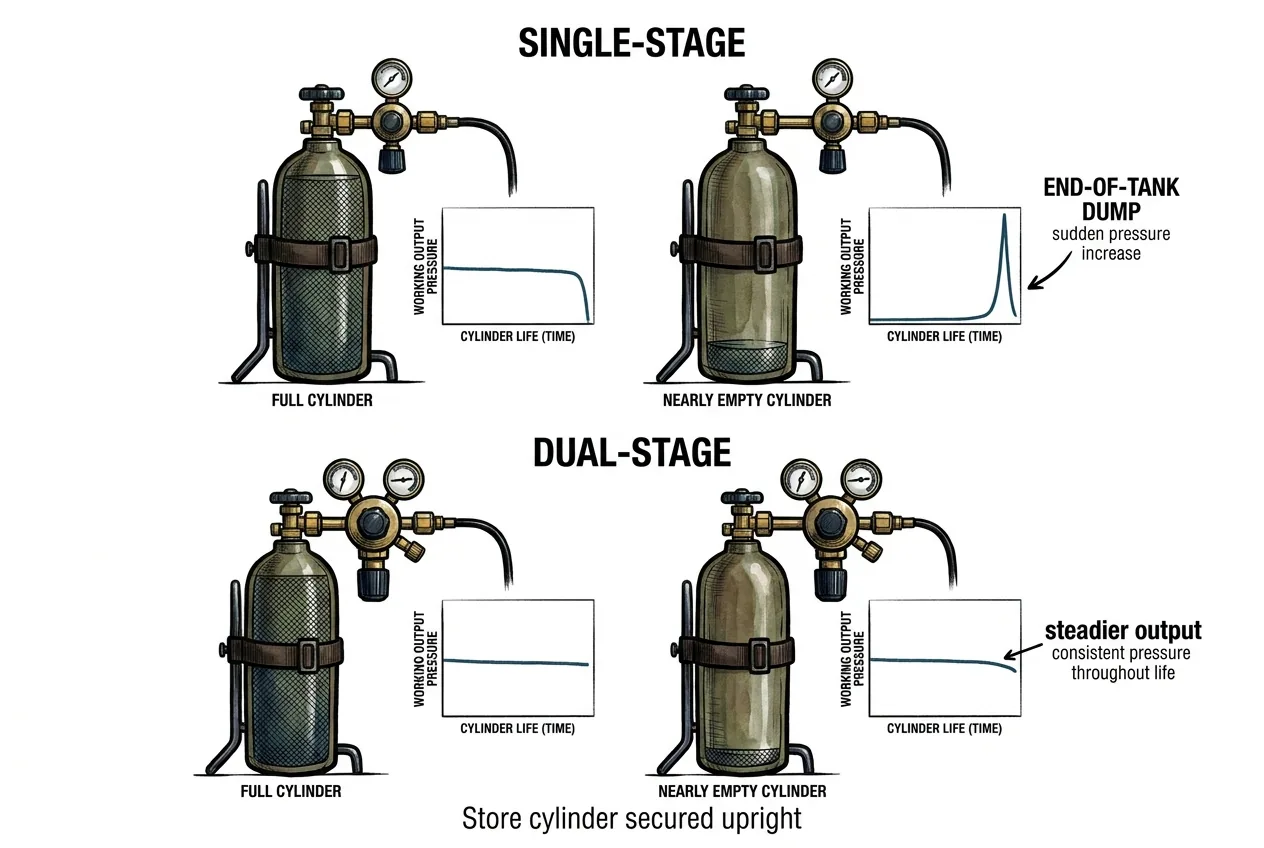
As a CO2 cylinder empties, a single-stage regulator can raise its output. In the hobby, that pressure spike is called end-of-tank dump.
A dual-stage regulator keeps its output steadier as the cylinder empties, making it the safer choice for an unattended, timer-run tank.
Which regulators meet the spec?
FZONE Pro CO2 Regulator
The FZONE Pro CO2 regulator suits a timer-run canister tank using an inline atomizer, provided its current regulated-pressure range clears that atomizer’s requirement. Its listed dual-stage design is intended to reduce end-of-tank dump, but independent regulation-stability data is not published. It is more hardware than a simple small tank with a ceramic diffuser needs.
Skip it for a simple nano ceramic-disc setup, where a full industrial body is more than you need.
A well-documented alternative is the CO2Art PRO-SE Dual Stage, whose manufacturer says the dual-stage design guards against end-of-tank dump. That is a manufacturer claim rather than an independent test result.
PRO-SE CO2 Regulator
The PRO-SE CO2 regulator suits a mid-size dual-stage build when clear manufacturer documentation and warranty matter. Confirm the current plug, voltage, and regulated-pressure range for your region and diffuser. Skip it for a high-back-pressure atomizer if its current pressure range leaves too little margin.
FZONE Mini V3 Regulator
The FZONE Mini V3 regulator suits a small nano where compatibility with different cylinder formats matters. The manufacturer listing has described its stage design inconsistently, so confirm the current model, stock, cylinder fit, and pressure range before buying. Skip it for a large high-flow tank that needs a clearly documented regulator with ample atomizer pressure headroom.
Skip it for a large high-flow tank, where a demanding inline atomizer wants more pressure headroom and a more clearly documented regulator.
Managing Supply Pressure Effect in Regulators (Swagelok)
Single-Stage versus Two-Stage Regulators (Air Liquide)
Which CO2 diffuser or atomizer fits my tank?
Match the diffuser to your filter and tank volume. A ceramic-disc diffuser sized to your gallons for nano and hang-on-back tanks, or an inline atomizer on a canister return line for mid and high-tech tanks.
The job is to break gas into a fog-fine mist that dissolves before reaching the surface.
Why do finer bubbles dissolve more CO2?
A diffuser introduces the gas into the water and controls how it does so. Its main lever is bubble size, and smaller bubbles help on two fronts.
They have more surface area per unit volume and rise more slowly, so each spends longer underwater exchanging gas.
In general, finer bubbles carry a higher gas-to-water mass-transfer efficiency than coarse ones, though the actual amount dissolved also depends on tank depth, flow, and how much the bubbles merge.
If bubbles race to the surface and pop, whatever CO2 is left in them can vent to the room, since atmospheric CO2 is only about 0.04%.
Bubble appearance is a useful troubleshooting cue rather than a full measurement. A dense cloud that dissolves before reaching the surface is a good sign, while large bubbles popping at the top suggest you are wasting gas.
The bubbles also lose CO2 and pick up other gases on the way up, so judge overall dosing by the checker and your plants, not the mist alone.
Ceramic disc versus inline atomizer
A ceramic-disc diffuser sits inside the tank, runs at modest pressure, and is sized to volume.
Place it low and under the filter flow so the current carries the mist across the tank.
An inline atomizer installs on the output line of a canister filter, so the pump distributes an already-fine mist and the hardware stays hidden.
The tradeoff is pressure. Inline atomizers typically want a minimum around 30 psi (some models 40 psi) and CO2-rated tubing, so always check the specific unit’s stated pressure and tie it to your regulator choice.
Aquario Neo CO2 Diffuser
The Aquario Neo CO2 Diffuser suits a small tank when placed low in the filter flow. Skip it for a canister-filtered high-tech tank, where an inline atomizer often distributes CO2 more evenly. Its ceramic membrane needs periodic cleaning.
Pollen Glass CO2 Diffuser
The Pollen Glass CO2 Diffuser suits a small tank that needs an in-tank ceramic diffuser. Soak the ceramic as the current instructions direct before first use. Skip it if you need a rugged part, because glass is easier to break during cleaning than acrylic.
Inline CO2 Diffuser
The Inline CO2 diffuser suits a canister-filtered tank where you want the diffuser hidden and the filter return to distribute the mist. The listing does not provide a stable first-party specification for this exact unit, so confirm hose fit, required pressure, seals, and replacement parts before buying. Do not use it with a sponge or hang-on-back filter.
Music Glass CO2 Diffuser
The Music Glass CO2 Diffuser suits a larger tank where a small diffuser is undersized. In a much smaller tank, a compact diffuser is usually easier to place and control.
A diffuser only puts CO2 into solution locally. Tank flow does the distribution.
If a tank has dead spots, plants far from the diffuser starve even when the nearby checker reads green.
That is a flow problem, and the fix is covered in the Iwagumi rock layout and flow guide.
Interactions between gas-liquid mass transfer and bubble behaviours (Royal Society Open Science / PMC)
Henry’s Law, CHEM101 (Lumen Learning)
What measurement and delivery hardware do I need beyond the drop checker?
You need three cheap parts most buyers get wrong. A drop checker that ships a known 4 dKH reference, CO2-proof polyurethane tubing instead of silicone airline, and a CO2-rated inline check valve.
Each removes one specific failure.
The drop checker that ships its own reference
A drop checker is only valid when charged with a known 4 dKH reference, so buy the kit that includes the solution rather than improvising with tank water.
FZONE CO2 Glass Drop Checker
The FZONE CO2 Glass Drop Checker suits a tank that needs a checker supplied with a known reference solution rather than tank water. Place it away from the diffuser output and refresh the reference on the manufacturer’s schedule. Treat its color as a delayed trend, not an exact CO2 reading or a reason to change the bubble rate immediately.
Skip running any injection at all if you will not glance at it daily, since the roughly 1 to 2 hour lag makes it a trend gauge, not an instant meter.
Why silicone airline leaks CO2, and what to use instead
Standard silicone airline can leak CO2 through its wall over a long run. Purpose-made polyurethane CO2 tubing is generally the lower-leak choice, although the real difference still depends on the tubing, line length, pressure, and fittings.
Aquarium CO2 Proof Tubing
The Aquarium CO2 Proof Tubing suits the run from regulator to diffuser when its current connection and pressure rating match the system. The seller figures are not independent certification, so verify them before buying. Soften a stiff end only as the manufacturer directs before fitting it.
Skip relying on the bundled black check valves for a high-pressure inline-atomizer setup, where a dedicated stainless valve is more durable.
The check valve that protects your regulator
A CO2-rated inline check valve permits flow toward the tank only. It guards against tank water back-siphoning into the regulator and solenoid when line pressure drops.
Whether a siphon actually starts depends on line pressure and the height of the tank relative to the regulator, but the valve is cheap insurance against it after the solenoid closes or on a power loss.
E-outstanding CO2 Check Valve
The E-outstanding CO2 Check Valve suits a system that needs a separate valve to limit back-siphon toward the regulator. Its working pressure and internal seal are not documented in a first-party sheet, so verify both before using it on a high-pressure line. Install it with the arrow toward the tank and inspect it at each cylinder swap.
A metal body is not automatically more reliable than a CO2-rated polymer valve. The seal, cracking pressure, and rated pressure matter more than the housing material.
PDMS/MgO Mixed-Matrix Membrane for CO2 Separation
Gas Permeability of Polyurethane-Based Membranes
How do I set up and tune CO2 without killing my fish?
Follow a simple runbook. Leak-check every fitting before running, start the bubble rate low, ramp it up over days while watching livestock, gate the solenoid to the photoperiod, and add night surface agitation to degas CO2.
Rushing the ramp-up is the most common way to stress or lose fish, so take it slowly.
Step 1. Leak-check before you run
Before opening the needle valve for real, pressurize the system and brush every threaded joint, the regulator-to-cylinder face, the bubble counter, and the check valve with a leak-detecting solution.
Persistent, growing bubbles mark a leak. A product-rated, non-corrosive leak detector is the safest choice. A soapy-water solution works on the same principle if you rinse afterward.
If you smell or hear a major leak at the cylinder valve itself, close the cylinder, ventilate the room, keep any open flame away, and have a trained service handle it rather than forcing the fitting.
A small leak may not show quickly on the working gauge, so a slow, unexplained pressure loss or a cylinder that empties faster than expected is worth chasing. A pressure-decay check or weighing the cylinder can confirm it.
Avoid ammonia-containing soaps, which can embrittle brass fittings.
Step 2. Ramp up slowly and watch livestock
Start the bubble rate low and increase it in small increments over several days, letting the drop checker settle toward green between changes.
Watch livestock, not just the color. Fish gasping at the surface with flared gill covers, in a tank where CO2 is running, points to CO2 stress and demands an immediate response.
(Gasping can also come from low oxygen, heat, toxins, or gill disease, so rule those out too.)
If CO2 is the cause, the fix is to cut the injection at once and add strong surface agitation or aeration, doing a partial water change if needed.
Aeration is not just adding oxygen. Increasing gas exchange at the surface actively drives dissolved CO2 out of the water, which is exactly what you want.
The reason to also drop the CO2 is that with hypercapnia the fish’s blood may not carry the oxygen already present, so raising oxygen alone is not enough on its own.
Aim for a stable drop-checker green, roughly 30 ppm as a starting point, and back off toward the lower end if livestock look stressed.
Respect the roughly 1 to 2 hour lag. The checker reports where CO2 was one to a few hours ago, so make at most one adjustment per day and never chase the color in real time.
Step 3. Gate the solenoid to the photoperiod
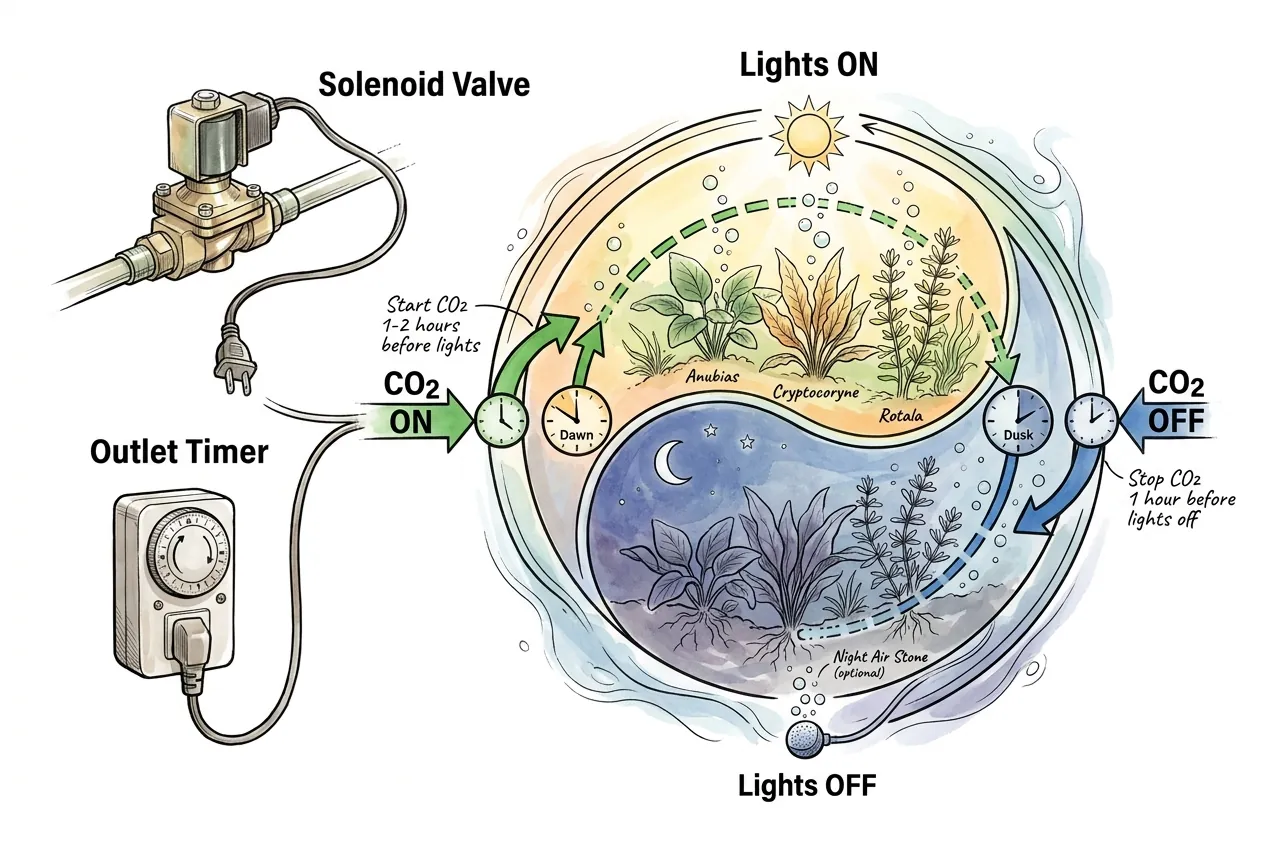
Put the solenoid on an outlet timer. A common starting point is ON about 1 to 2 hours before lights-on, so CO2 is near target when photosynthesis starts, and OFF about 1 hour before lights-off, so the tank degasses before dark.
Tune those lead times to your own tank. Volume, flow, reactor or diffuser, and surface exchange all change how quickly CO2 rises and falls, so check the drop checker around lights-on and adjust.
A 12V DC solenoid runs off its compatible AC adapter, and that adapter is what you plug into the mechanical or digital timer. Confirm the adapter voltage and plug for your region.
Running CO2 24/7 stacks injected CO2 on top of the tank’s own nighttime respiratory CO2. Dissolved oxygen bottoms out around dawn while CO2 peaks, so 24/7 injection hits livestock at the worst possible hour.
Optionally add a night air stone or more surface ripple after lights-out to drive off CO2.
Step 4. Anticipate end-of-tank dump
A liquefied-CO2 cylinder holds a constant vapor pressure, about 860 psi at 22°C, until the last liquid boils off, and then the pressure collapses fast.
That makes the cylinder gauge a poor fuel gauge. It reads near-full for almost the whole bottle life and then plummets.
Do not tune the tank to the edge of livestock tolerance, so a dump has margin to fail into safely.
Keep a spare cylinder on hand, and once the high-pressure gauge starts to sag, treat the cylinder as nearly done and swap it soon.
NPTC Tools of the Trade. Identifying Gas Leaks (Alabama Cooperative Extension)
The impact of water quality on farmed fish and shrimp, Part 1 (Responsible Seafood Advocate)
The Daily Dissolved Oxygen Cycle, Explained (FishSens Magazine)
Who should NOT buy each product class, and what are the alternatives?
Not every planted tank needs pressurized CO2, and some product classes are a poor fit for certain buyers. Here is a practical gate for each.
Who should skip pressurized CO2 entirely?
You can skip the whole pressurized system if you run only low-light, slow-growing, or bicarbonate-using plants under a stock light.
Many of these species grow faster with CO2 but can be kept well without it.
A common low-tech, no-injection list includes Anubias, Java fern, Bucephalandra, Java and Christmas moss, and Cryptocoryne, alongside known bicarbonate users like Vallisneria and Elodea.
(Mosses and ferns are not documented bicarbonate users, so they belong on this list as hardy, low-demand plants rather than as proof that carbon never limits them.)
A low-light tank of such plants in moderately hard tap water can grow steadily for a long time on liquid fertilizer alone, though the actual result depends on light, substrate, stocking, and maintenance.
Also skip it if you travel and cannot respond to a stuck solenoid or empty cylinder. And skip it if you keep very sensitive livestock in a small volume, where a minor overshoot swings pH and oxygen hard.
Why liquid carbon is not a CO2 substitute
Liquid Carbon Is Not Pressurized CO2
Do not buy liquid carbon expecting it to replace pressurized CO2. Seachem markets Flourish Excel as a source of bioavailable organic carbon, and the product is widely described as glutaraldehyde-related. Seachem does not publish an exact glutaraldehyde CAS number for it, so treat that attribution as common usage rather than a confirmed ingredient list.
Either way, it is a supplement, not the inorganic dissolved CO2 that carbon-limited submerged plants respond to most.
Plants fix inorganic CO2 through RuBisCO in the Calvin cycle, which is why gas CO2 is the direct route to relieving carbon limitation.
Peer-reviewed ecotoxicology finds generic glutaraldehyde moderately toxic to aquatic organisms above roughly 1 mg/L. That generic finding does not pin down Excel’s exact concentration or mechanism, but it is consistent with reports that some sensitive plants (Vallisneria, mosses, Anacharis) react badly to overdosing or direct application.
Seachem itself notes that gas CO2 gives more growth.
Seachem Flourish Excel
The Seachem Flourish Excel may suit a lower-demand tank, but it is not a substitute for pressurized CO2 or a product to use as an algaecide. Follow the current label rather than spot-dosing, especially around sensitive plants.
Skip it as a stand-in for a demanding carpet, which needs real dissolved CO2 from a pressurized or paintball build.
Nano tanks (paintball, not a big cylinder)
In a small tank, fine metering matters more than cylinder capacity, because the same absolute CO2 error is a much larger concentration error in a small volume.
A paintball-mount regulator with a fine needle valve and solenoid is one convenient option there, but the priority is regulator and needle-valve quality, secure mounting, and dose control, not the cylinder format itself. A paintball cylinder is not inherently safer than a larger one.
FZONE Paintball Regulator
The FZONE paintball regulator suits a desktop nano where a small cylinder format is practical. Confirm current stock and compatible fittings, use it with a small ceramic diffuser, and turn CO2 off at night. Start very low and let the drop checker and livestock response guide the rate instead of copying another tank’s bubble count. Skip it for a large high-tech tank.
Why a pH controller can mask a KH problem
A pH controller is appealing because you set a target pH and walk away, but it does not measure CO2.
It measures pH, and pH only maps to CO2 when KH is known and carbonate-only. If KH drifts with aquasoil, tannins, or water changes, the same target pH corresponds to a different CO2 concentration, so the controller can over- or under-dose without flagging it.
On stable, well-buffered water with regular calibration it can add a useful safety layer. The masking is a failure mode to guard against, not a certainty.
Milwaukee MC122 pH Controller
The Milwaukee MC122 pH Controller can serve as a low-pH safety cutoff on a stable, carbonate-buffered tank, always alongside a drop checker. Calibrate and store the probe as directed, and protect the switched circuit appropriately. Do not rely on it for aquasoil or blackwater tanks, where pH no longer maps reliably to CO2.
Skip it on aquasoil or blackwater tanks, where drifting KH and non-carbonate acids break the pH-to-CO2 mapping and the controller masks the real problem.
Toxicity of glutaraldehyde to several aquatic organisms
Calvin-Benson-Bassham cycle and RuBisCO carbon fixation
Underwater Photosynthesis of Submerged Plants
How do I maintain the system and handle failures?
A CO2 system degrades predictably. Diffuser pores clog, indicator fluid ages, and check valves embrittle.
Folding the maintenance into your weekly water change, and following the manufacturer intervals for regulator, solenoid, and cylinder, keeps it running reliably.
What is the maintenance cadence?
Refresh the drop-checker reference on its maker’s schedule (about every 30 days for the FZONE kit above) and sooner if the color looks off, since aged indicator drifts.
Clean the ceramic diffuser every 2 to 4 weeks. Soak the disc about 15 minutes in warm water with vinegar or citric acid, then rinse thoroughly in dechlorinated water.
The manufacturer cleaning guide keeps to that acid soak, if a stubborn buildup ever needs more, follow the maker’s exact instructions rather than improvising a bleach concentration, because household chlorine cleaners are easy to over-dose.
Never mix bleach with vinegar or any acid, because the combination releases toxic chlorine gas, if you ever use two different soaks, rinse fully in between.
Never scrub the disc either, because that damages the delicate ceramic membrane.
Inspect the check valve at each cylinder swap. Some plastics and elastomers stiffen or degrade with prolonged CO2 exposure while others hold up well, so watch for hardening or water creeping up the line toward the regulator, and replace at any sign of a failed seal.
How should I handle the cylinder?
Handle a CO2 cylinder the way compressed-gas guidance advises. Secured upright at all times, valve protection cap in place when the regulator is off and stored, never dropped or struck, kept in a ventilated space, and away from open flame or heat sources.
Keep it cool, since its pressure tracks temperature. The exact heat limit is on the cylinder’s label or safety data sheet (commonly around 50°C), so follow that rather than an arbitrary figure.
Refill or exchange when the high-pressure gauge begins to fall, not on a fixed calendar. Because the gauge reads near-full while liquid remains and then drops, a sagging needle is a late warning. Weighing the cylinder against its stamped tare weight tells you the remaining CO2 more directly.
Common failure modes and fixes
Overnight fish losses despite a fine-looking tank at bedtime often point to CO2 running too late into the night, when oxygen hits its daily minimum, so shut the solenoid off before lights-off and add night surface agitation.
Also rule out other overnight failures (a heater fault, a stalled filter, low oxygen, a toxin, or a power cut), since they can look the same in the morning.
A bubble rate that mysteriously climbs near a full-reading cylinder is end-of-tank dump, so swap the cylinder, back down the needle valve, and verify the livestock.
A diffuser making big lazy bubbles has clogged ceramic pores, so soak and rinse it as above.
Water siphoning toward the regulator means a failed or absent check valve. Replace it with stainless and confirm the arrow points toward the tank.
A drop checker reading green while fish look stressed is usually charged with tank water or has aged fluid, or you are reading it inside its 1 to 2 hour lag.
Recharge with 4 dKH reference, refresh the fluid, and trust the fish over the color.
Guide to CO2 Diffuser Cleaning (CO2Art)
29 CFR 1926.350 Gas welding and cutting, compressed gas cylinder handling (OSHA)
Frequently asked buyer questions
Do I actually need CO2 for my planted tank?
Mainly if you run high-demand plants under strong light and are willing to monitor a drop checker.
Carbon usually becomes the limiting input after light and nutrients are already sufficient.
A tank of Anubias, Java fern, Crypts, and mosses under a stock light generally does not need CO2, and for that setup injection mostly adds cost and monitoring effort for little benefit rather than guaranteeing an algae problem.
Can I just use DIY yeast CO2?
Most DIY yeast setups have no solenoid and no pressure control, so you cannot easily gate them to the photoperiod or hold a stable rate, and output fades unpredictably as the yeast tires.
Watch for a blocked or over-pressurized bottle, which is a real hazard with sealed reactors.
It can work as a hobby experiment on a tiny low-stakes tank, but it cannot provide the same night shutoff or stable delivery as a solenoid regulator. A paintball regulator with a solenoid is the lower-cost path to controlled injection.
Should I run CO2 24/7?
No. Plants only consume CO2 in the light, so nighttime injection has no photosynthetic benefit and only stacks CO2 onto the tank’s respiratory CO2 while oxygen is at its daily low.
Gate the solenoid to the photoperiod with an outlet timer. A typical starting point is ON about 1 to 2 hours before lights-on and OFF about 1 hour before lights-off, then adjust from your tank’s measured response.
What is the cheapest safe way to start?
The cheapest safe start is still a solenoid regulator, a drop checker with a 4 dKH reference, CO2-proof tubing, and a check valve, on a small cylinder.
Dropping the solenoid or the drop checker is exactly where safety disappears. A budget build can pair a solenoid paintball or small-cylinder regulator, the FZONE drop checker, PU tubing that bundles check valves, and a small ceramic diffuser to cover all four roles.
Confirm each item’s current specs and stock first, and remember that even a good build still needs slow tuning and livestock-watching, no kit guarantees safety on its own.
Key Takeaways
- The decision is three-way. Pressurized CO2, no CO2, or liquid carbon. Pressurized injection is the controllable way to hold a steady dissolved-CO2 level for submerged plants. Aim for the lowest dose that helps, not a fixed number, since the safe ceiling depends on your species, temperature, oxygen, and stocking.
- Buy to the specs that matter. A dual-stage regulator with a 12V DC solenoid helps reduce end-of-tank dump, a diffuser sized to your tank dissolves the gas, and a drop checker charged with a known 4 dKH reference (never tank water) gives a lagging, approximate read, not an exact meter.
- Prefer CO2-proof polyurethane tubing over silicone airline, which is more CO2-permeable, and fit a CO2-rated check valve arrow-toward-tank to protect the regulator.
- Tune slowly toward a stable drop-checker green, gate the solenoid to the photoperiod, and treat gasping fish or a yellow checker as a hard stop. Cut the CO2 and add strong surface aeration, which also degasses CO2, because hypercapnia can leave fish struggling for oxygen even in aerated water.
- Skip pressurized CO2 for low-light or bicarbonate-using plant lists, sensitive livestock in small volumes, or absentee keepers. Liquid carbon is a glutaraldehyde-based supplement, not a gas-CO2 substitute, and a pH controller can mask KH drift because it reads pH, not CO2.
Affiliate Disclosure
This article contains Amazon affiliate links. As an Amazon Associate I earn from qualifying purchases. If you use these links, the site may earn a commission at no extra cost to you. Product availability, price, and specifications can change. Check the current listing before buying.