
Iwagumi Rock Layout: Stop Flow Dead Spots
Iwagumi layouts can trap detritus when stones form hidden dams. Plan rock hierarchy, substrate slope, and filter flow together, and keep maintenance access, so debris is easier to spot and remove.
Elena Vargas · Published 2026-07-13 · 18 min read
Key Takeaways
- Use the Oyaishi angle and circulation loop as a starting heuristic, not a proven rule. Observe and adjust rather than assume.
- Leave one visible low lane so detritus is easier to spot and siphon.
- Keep a service path behind major stone groups so a baster or siphon can reach. Access helps maintenance but does not guarantee no dead spots.
- Tune the existing filter outflow before adding pumps. Add small adjustable flow only if needed and sized to the tank.
- Test ammonia and nitrite after deep-cleaning a hidden pocket. Act promptly if either is detected.
An Iwagumi rock layout is easier to keep clean when debris has somewhere to go and you can reach it.
Plan the rock hierarchy, substrate slope, filter return, and maintenance lane together before the carpet plants go in, rather than fighting hidden pockets afterward.
A common pitfall is building a rock arrangement that looks quiet from the front while mulm collects out of sight behind the Oyaishi, under Suteishi, and inside the carpet edge.
A cleaner approach guides debris toward a visible low lane or into mechanical filtration, where you can see and remove it.
How do you arrange Iwagumi rocks without trapping detritus?
Start with the standard Iwagumi hierarchy, and keep maintenance access in mind while you place stones.
The Oyaishi still leads the layout, Fukuishi and Soeishi still support it, and Suteishi still finish the rhythm.
I place one 3 mm square of untreated white tissue at the front, rear, left, and right of each dry rock base. From 30 cm away, I aim a rubber camera blower along the intended flow direction and give three full squeezes. Fixed positions, distance, and puffs make layouts comparable while revealing sheltered pockets before substrate and water make the stones difficult to move.
Every dry test particle comes out before filling. Before adding livestock, I crush one 5 mm fish-food flake into 250 mL of tank water and release the suspension with a 1 mL pipette 2 cm in front of the outlet. I film for 60 seconds from the fixed top and front views, then siphon every settled fragment. One ordinary food flake supplies visible particles without dye, while the fixed dose and release point make stone layouts comparable.
Tracer movement is filmed from the same top and front positions before and after I move one stone. A beautiful opening from the front may still be blocked behind the main rock.
Leave a service gap
Leave a gap behind support stones where water and a baster tip can pass.
ADA describes Iwagumi as a composition in which the Oyaishi sets the visual direction of the layout.
That is an aesthetic principle about how the arrangement reads, not a rule about where your filter current should go.
Test the circulation direction
If the main stone visually leans left to right, try aiming the main circulation left to right across the stone backs and returning along the foreground.
Treat this as a starting point to observe, not a guarantee, since real flow depends on outlet, intake, tank shape, and rock geometry.
How should the main stone point the water?
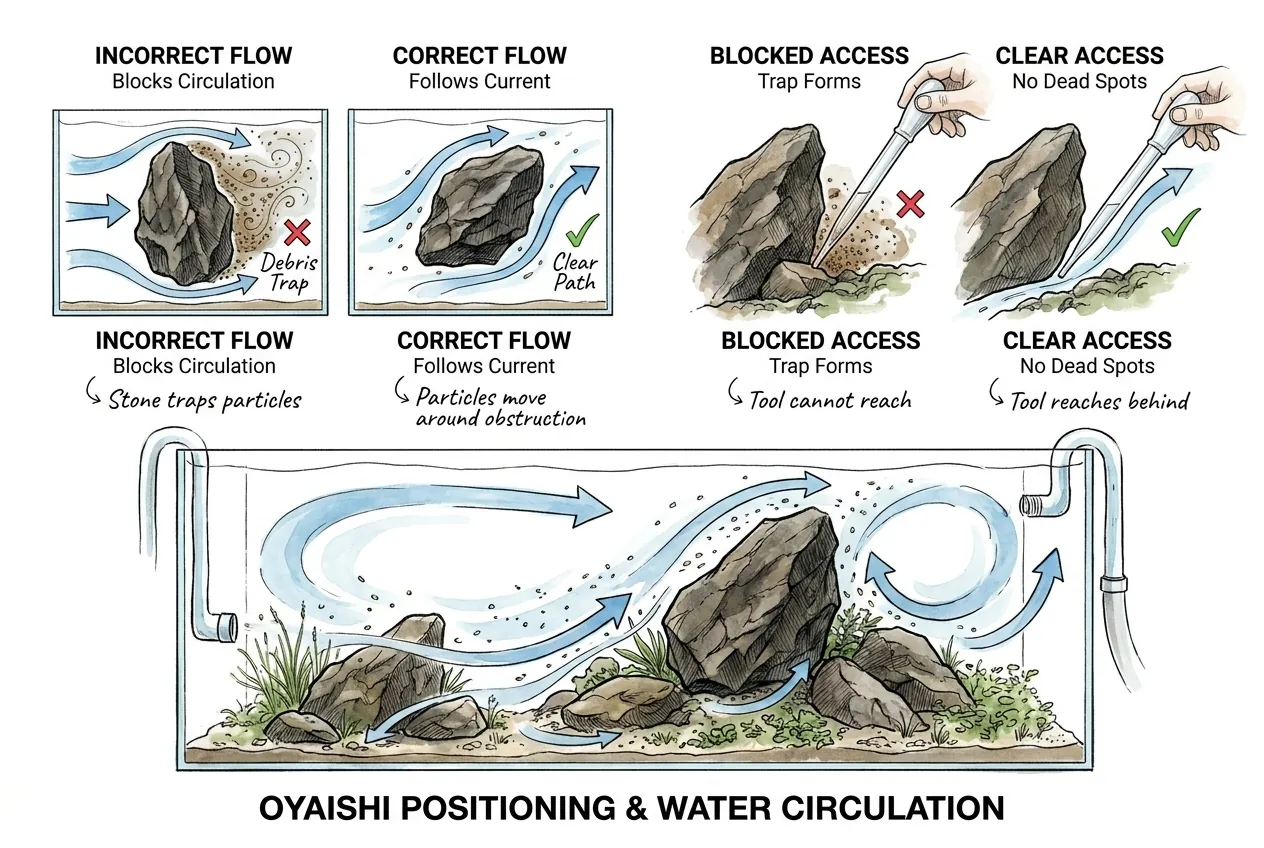
Aiming the Oyaishi so it faces the same way as a broad circulation loop is one option some aquascapers like, because it reads as directional to the viewer and keeps a path open around the largest obstruction.
It does not by itself prove particles will not settle there.
Place the Oyaishi first, then imagine a slow particle moving around it. This is a rough thought experiment for spotting obvious pockets, not a substitute for watching the real tank. A light particle does not behave like the actual flow field.
Rotate the stone a few degrees, or adjust the intake and return plan before adding more rocks.
Check tool access before planting
Pass a chopstick, turkey baster tip, or narrow siphon tube behind the Oyaishi.
If a cleaning tool cannot reach a pocket, then any debris that does settle there will be hard to remove later.
Good tool access makes maintenance possible. It does not on its own prove the spot will or will not collect debris.
ADA SUIKEI Words. Iwagumi Layout Composition
Where do supporting stones become debris dams?
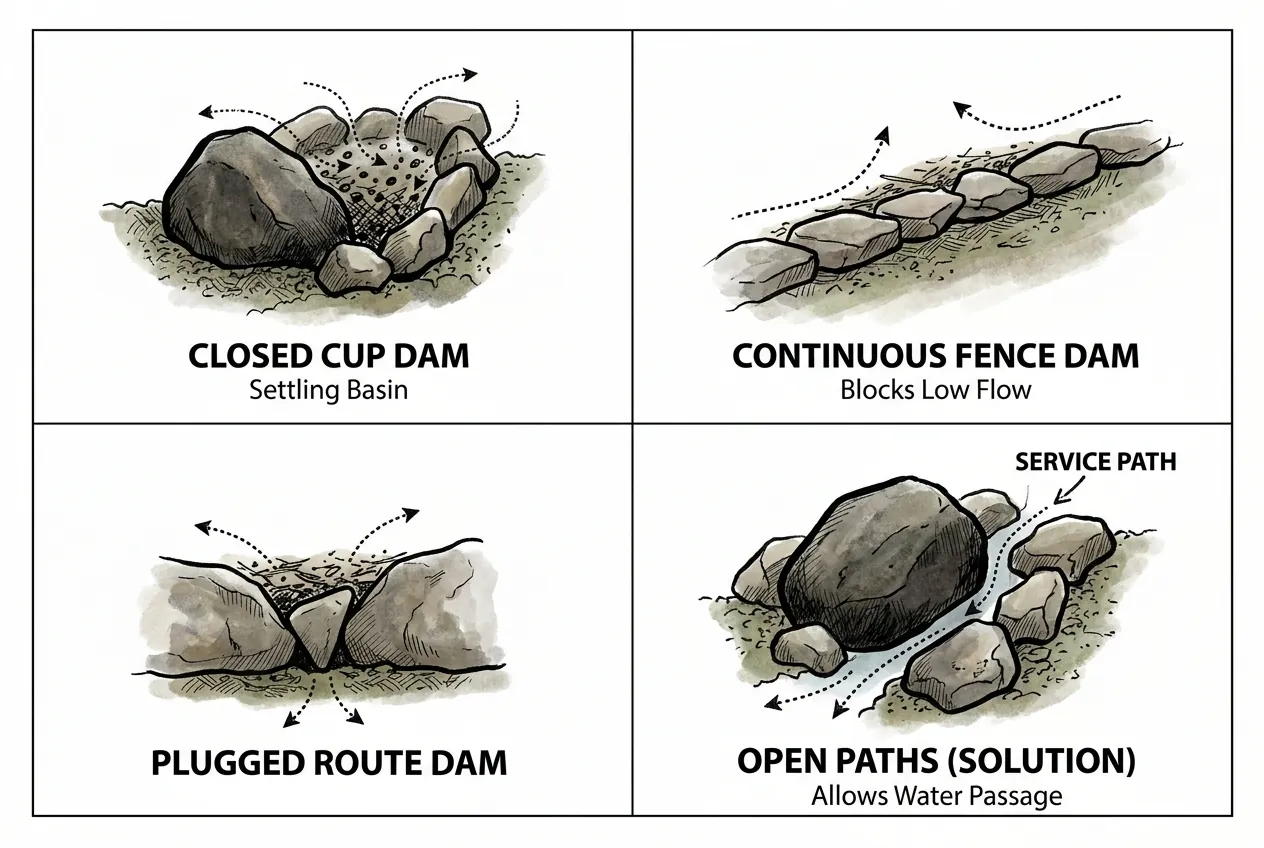
Supporting stones become debris dams when they form a closed cup around the main stone. The visual group may look natural, but the hidden rear curve acts like a settling basin.
Avoid a continuous stone fence at substrate level. Stagger the Fukuishi and Soeishi so water can pass between them.
Use Suteishi as visual punctuation, not as plugs in the only low route.
A simple spacing habit helps on most home tanks. Leave at least one narrow service path behind each major group, sized to your own tools and tank.
It only needs to fit a baster tip or airline tube, but keeping it continuous makes cleaning easier.
Where do dead spots form in an Iwagumi aquarium?
Dead spots form behind large rocks, inside V-shaped support groups, and at the edge where carpet plants meet buried stone feet.
These are the places where water slows enough for mulm to settle.
Mulm itself is not automatically bad. In planted aquariums, decomposed organic matter can become part of the nutrient cycle.
The problem is hidden accumulation that cannot be seen, siphoned, or moved into filtration.
What is aquarium mulm, and should you remove it?
Aquarium mulm is decomposed organic material from fish waste, plant leaves, leftover food, microorganisms, and biofilm.
You remove it when it smothers a carpet, clouds the water, or appears with ammonia or nitrite problems.
Leave a light dusting in planted substrate if water tests are stable and the carpet is not covered.
Consider clearing large hidden pockets behind rocks. Some of that material may mineralize and feed roots, but a thick pocket where flow is weakest also concentrates oxygen demand and organic load out of sight, where you cannot monitor it.
In a cycled, stable tank, scattered surface mulm is often mainly an aesthetic issue, though it can still add oxygen demand or release nutrients locally.
If ammonia or nitrite appears after disturbing a pocket, a stored-waste pocket is one possible cause, but not the only one. Source water and chloramine, filter disturbance, test timing and color reading, conditioner interference, and normal baseline variation can all contribute.
Retest and look at the trend before concluding the biofilter was overloaded.
What is Mulm or Detritus in Aquariums?
Ammonia in Aquatic Systems
How do you find the hidden dead spot before it becomes ugly?
Use a baster test. Puff water gently behind each rock and watch whether dust exits the pocket, circles back, or settles again in the same place.
Surface ripples are not enough. A tank can have strong surface movement and still have a quiet rear pocket behind the Oyaishi.
Watching fine particles near the substrate can reveal these low-flow spots, though particle size and density affect what you see, so treat it as a repeatable observation rather than a precise measurement.
Run the test before planting, after filling, after the first trim, and after any flow change.
As a rule of thumb, early checks matter most while the carpet is not yet strong enough for aggressive cleaning.
If the same brown crescent returns after every water change, do not clean harder first. Fix the path that keeps delivering debris to that crescent.
What substrate slope keeps debris visible instead of buried?
A substrate slope can help guide where debris settles and where you look for it. A front-low, back-high slope only makes a visible lane useful if stones do not block the route and if flow actually carries particles that way. Slope alone will not pull waterborne debris downhill by gravity.
The goal is not a sterile aquarium floor. A little visible detritus is normal in a planted tank.
A visible foreground or side lane shows some of what the tank is shedding and lets you clean it without tearing up the composition.
It is a convenient sample, not a complete picture of everything settling in the layout.
Where should the lowest collection lane be?
The lowest collection lane should sit where you can see it and siphon it. In many Iwagumi layouts, that means the front glass line or one front-side corner.
Do not fill this lane with decorative crumbs. Tiny stones look natural for the first photo, then become a rake that catches food dust, trimmed carpet bits, and fish waste.
The lane can be narrow. It only needs enough open substrate for gentle siphoning and enough flow for particles to arrive there instead of hiding behind the main stone.
How deeply should you bury rock bases?
Bury rock fronts enough to look natural. Where it does not compromise stability, a stone need not have its whole rear foot sealed in, so it does not become a retaining wall for waste.
On the rear or downstream side, a slim gap can leave room for flow, a baster, or airline tubing later.
Do not force such a slot on every stone. A filter jet aimed into an open gap can wash out aquasoil and undermine the rock's support, so favor structural stability over a wash-through channel wherever the two conflict.
Structural safety comes first, especially for a heavy Oyaishi. Do not rely on erodible aquasoil slope, friction against small stones, or a wall of visible stones to hold it.
Give a large stone a stable base that spreads its load, sits below the working substrate, and is tested so it will not tip, roll, or slide.
Keep hard points off the glass and silicone seams, allow for digging livestock and long-term settling, and check that it stays firm as the tank matures.
If a stone in an established tank is unstable, treat that as an immediate hazard and address it before worrying about the ideal aesthetic order.
ADA SUIKEI Words. Iwagumi Layout Composition
How should filter flow move through an Iwagumi layout?
One broad loop around the rock backs and toward the intake is a common starting pattern. Aim to avoid both blasting the carpet and leaving the rear hardscape completely untouched.
Not every tank needs a single loop, and the right pattern depends on tank depth, rock shape, plant growth, and how loaded the filter is.
A helpful way to think about circulation is a gentle sweeping route rather than a strong current.
The idea is to keep at least some flow reaching the spots where debris collects, so particles can move toward the filter or the visible cleaning lane.
You confirm this by observing the tank over time, not from a single diagram.
How should filter outflow cross the layout?
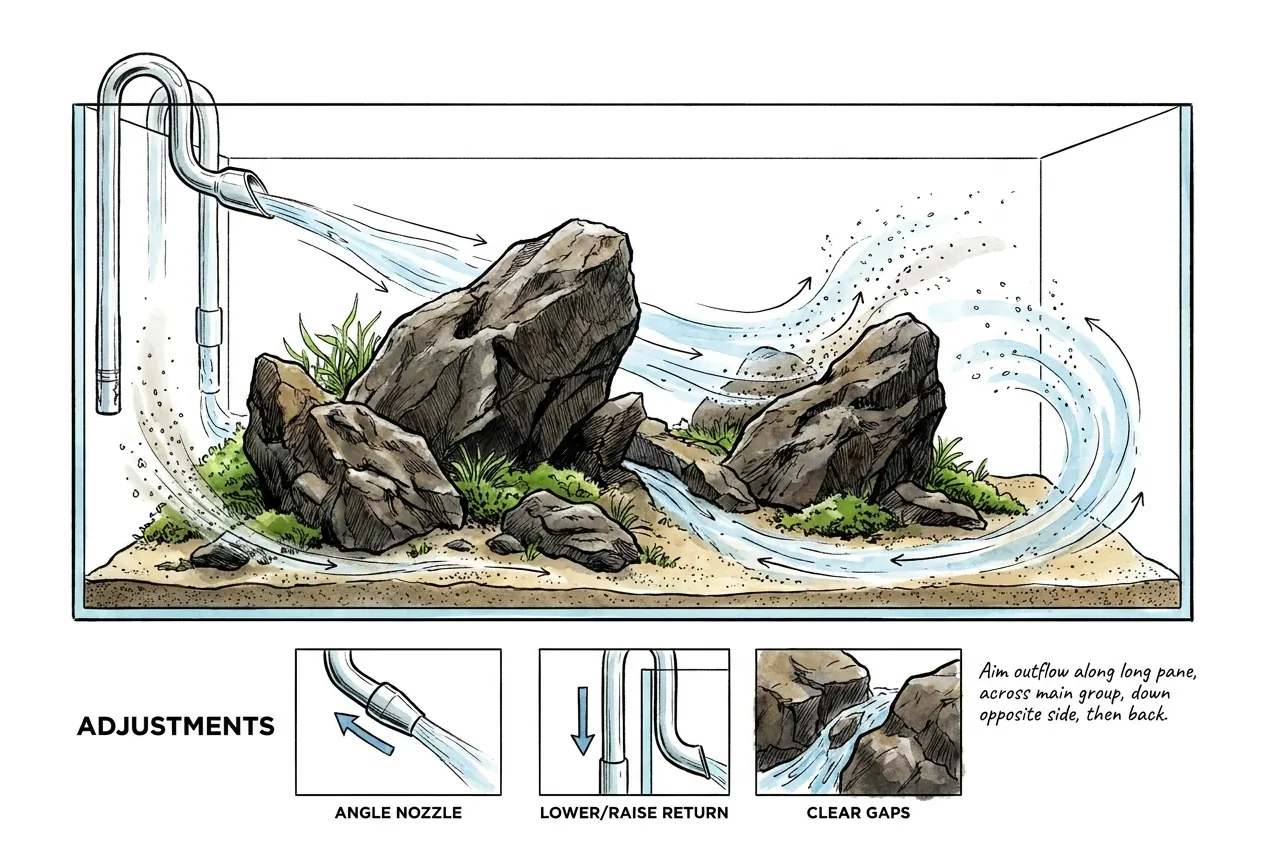
One pattern to try. Aim the outflow along the long pane, across or behind the main stone group, down the opposite side, then back along the foreground, so both the rear pocket and the front lane get some flow.
Then check the result, since vertical recirculation, intake height, and hardscape wake can change the actual path.
A lily pipe, spray bar, or hang-on-back return can all work. The deciding factor is not the hardware style. It is whether fine particles behind the rocks eventually move.
Use small adjustments before adding equipment. Change nozzle angle, lower or raise the return slightly, and clear support-stone gaps.
Add auxiliary flow only when geometry and filter placement cannot solve the pocket.
For any added pump or controller, use aquarium-rated equipment on a GFCI-protected outlet with a drip loop.
Keep plugs and controllers away from splash paths, and unplug gear before moving it.
What is Mulm or Detritus in Aquariums?
When does extra circulation help instead of hurt?
Extra circulation helps when one visible pocket keeps collecting debris after you have tuned the filter return.
It hurts when the new pump uproots carpet, stresses livestock, blows soil into the foreground, drives off CO2, or draws small fish and shrimp toward the intake.
Choose adjustable, modest flow for spot correction. Nominal pump flow does not predict velocity at the carpet because head, guards, plumbing, and placement all change delivery.
Size and tune the pump against tank volume, observed debris movement, carpet stability, intake safety, and the needs of the inhabitants. Start at the lowest setting and stop if the carpet lifts or livestock struggle.
If shrimp or fry are present, fit a sponge or guard over any auxiliary pump intake and keep the flow within a range the species tolerates.
There is also a visual cost. Every added pump competes with the minimalist Iwagumi look. Hide it behind the hardscape only if you can still clean the intake and see what it is doing.
EHEIM Pumps
Aquarium Co-Op Hillstream Loach Care
How do plants and carpet choices change detritus control?
Carpets make detritus control more important because low leaves catch fine particles. The fix is not skipping carpet plants.
The fix is leaving service edges and trimming before the carpet becomes a debris mat.
Iwagumi often uses a restrained plant palette, so a dirty edge is easy to spot. That visibility is helpful.
A repeatedly dirty edge is a cue to check flow and layout, though light, feeding, and algae can also play a part, so confirm the cause rather than assuming it is only hydraulics.
Which carpet edges need open space?
The front edge, the base of the Oyaishi, and the inside corner between support stones are common places for debris to snag, so open space there helps.
This is a guideline, not a rule that every edge must be bare, since planting and plant health matter too.
Plant the carpet in small portions rather than packing every millimeter. Leave the cleaning lane bare or trimmed very short.
Once the carpet matures, keep that edge clipped so water can skim the surface.
After trimming Monte Carlo, dwarf hairgrass, or similar carpets, remove large fragments first.
Then baster-lift the fine bits and let the filter collect what remains. Trimming is a debris event, not just a haircut.
How does lighting make hidden detritus more visible?
Bright carpet layouts make dirt easier to see because light reaches the foreground and makes brown mulm obvious against green leaves. That visibility is useful feedback.
Tropica's lighting guide suggests comparing light by lumens per liter rather than only wattage, because different light sources are not directly comparable by power draw.
Tropica notes this is a consumer rule of thumb based on T5 experience, and lumens (weighted for human vision) do not fully capture the photosynthetic photon flux, spectrum, or daily light integral plants actually receive.
Lighting does not measure detritus. It just makes existing accumulation more visible on a brighter foreground.
If the carpet is growing fast, plan for faster trimming and more post-trim particle removal.
Algae has several possible drivers, including light, CO2, nutrients, and species, so if it appears where debris collects, address organics and flow as part of the picture rather than assuming they are the sole cause.
What maintenance routine keeps an Iwagumi layout clean?
Use a light routine that repeats the same checks each time. Baster-test the pockets, siphon the visible lane, clean up after trims, check filter flow, and test water after major disturbance.
The routine should protect the carpet and the biofilter. Deep-cleaning every hidden pocket at once can release organics and disturb bacteria. Clean the cause, not just the symptom.
How do you clean trap zones without wrecking the carpet?
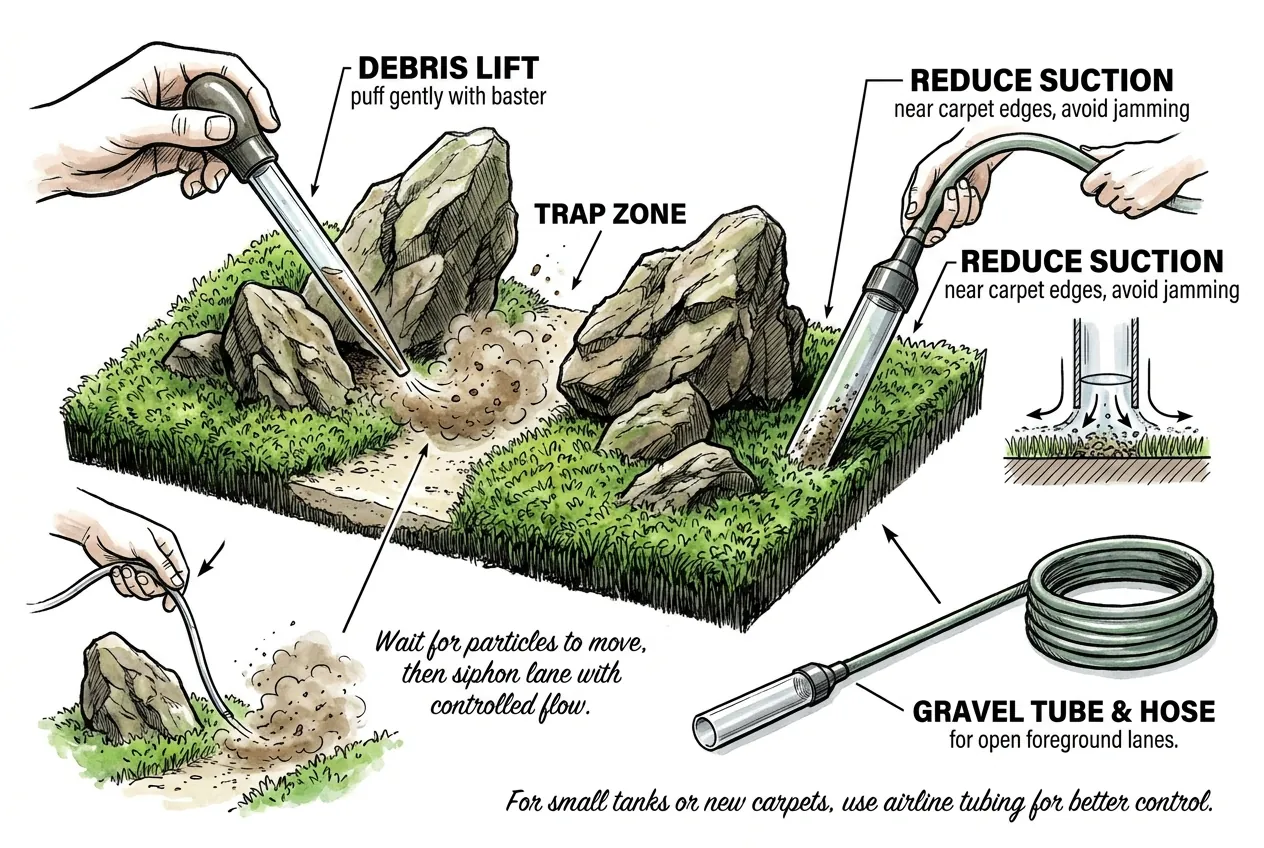
Lift debris before siphoning it. Puff the rock backs gently with a baster, wait for particles to move into the visible lane, then siphon the lane with controlled flow.
Screen or watch the tube end so shrimp and fry are not pulled in.
For small tanks or new carpets, use airline tubing or pinch the hose. A full gravel vac moves water fast and can pull up shallow roots, though a careful vac does not always uproot plants.
Faucet-connected water changer
A faucet-connected water changer can help with water changes on tanks that sit far from a drain, since it runs off a faucet and avoids carrying buckets.
Before relying on one, check that it fits your faucet threads, the sink-to-tank distance, how much tap water it uses while running, and how you will dechlorinate and temperature-match refill water, plus a secure connection and a plan for leaks, overflow, and hose storage.
Use reduced suction near carpet edges, and avoid jamming the tube behind newly planted stones.
A wide gravel tube is not automatically gentler on a delicate new carpet than a narrow airline siphon, which can be more precise for spot-cleaning.
The tradeoff is extra storage and setup time compared with a simple bucket siphon.
What is Mulm or Detritus in Aquariums?
What should you test after disturbing old debris?
Test ammonia and nitrite after deep cleaning, moving stones, or releasing an old hidden pocket.
If either is detected, treat it as an active problem rather than something to wait out. Retest to confirm, reduce or pause feeding, and do a partial water change (commonly 25–50% in a small tank) with dechlorinated, temperature-matched water.
Check and boost aeration and dissolved oxygen, avoid another major disturbance, and verify filter function.
Because a standard kit reads total ammonia nitrogen, the more toxic un-ionized fraction depends on your pH and temperature, so check those and your source water and watch livestock for signs of stress.
Liquid freshwater test kit
A liquid freshwater test kit is useful after deep cleaning or moving stones.
Look for one that covers pH, high-range pH, ammonia, nitrite, and nitrate. Many such kits do not test GH, KH, chlorine or chloramine, temperature, or dissolved oxygen, and the ammonia reading is total ammonia nitrogen, which you interpret alongside pH and temperature.
Use it to compare results with the tank baseline after major maintenance, not after every tiny baster puff.
It is slower than test strips and needs careful shaking (the nitrate reagent especially), timing, and attention to reagent age and storage. Color-card reading is also affected by lighting and eyesight, so keep your conditions consistent.
In a stable, stocked freshwater tank, aim for ammonia and nitrite at zero, or at the kit's detection limit, keeping in mind the method's uncertainty rather than treating near zero as an acceptable target.
If you are still deciding what to use, you can compare test kits by the parameters they cover.
Nitrate interpretation depends on plants, water changes, tap water, and feeding, so watch trend changes against your own tap baseline and your species' tolerance instead of reacting to a single number.
Ammonia in Aquatic Systems
What pre-fill checklist prevents detritus traps?
Pre-fill checklist
Dry-build the rocks, confirm tool access, imagine the flow loop, add substrate slope, test with particles after fill, then plant.
It is easier to catch problems now than to plant first and rework the layout later.
This step matters because once roots knit through aquasoil and the Oyaishi settles, a major rock change stirs up the tank and clouds the water.
What should you test before planting?
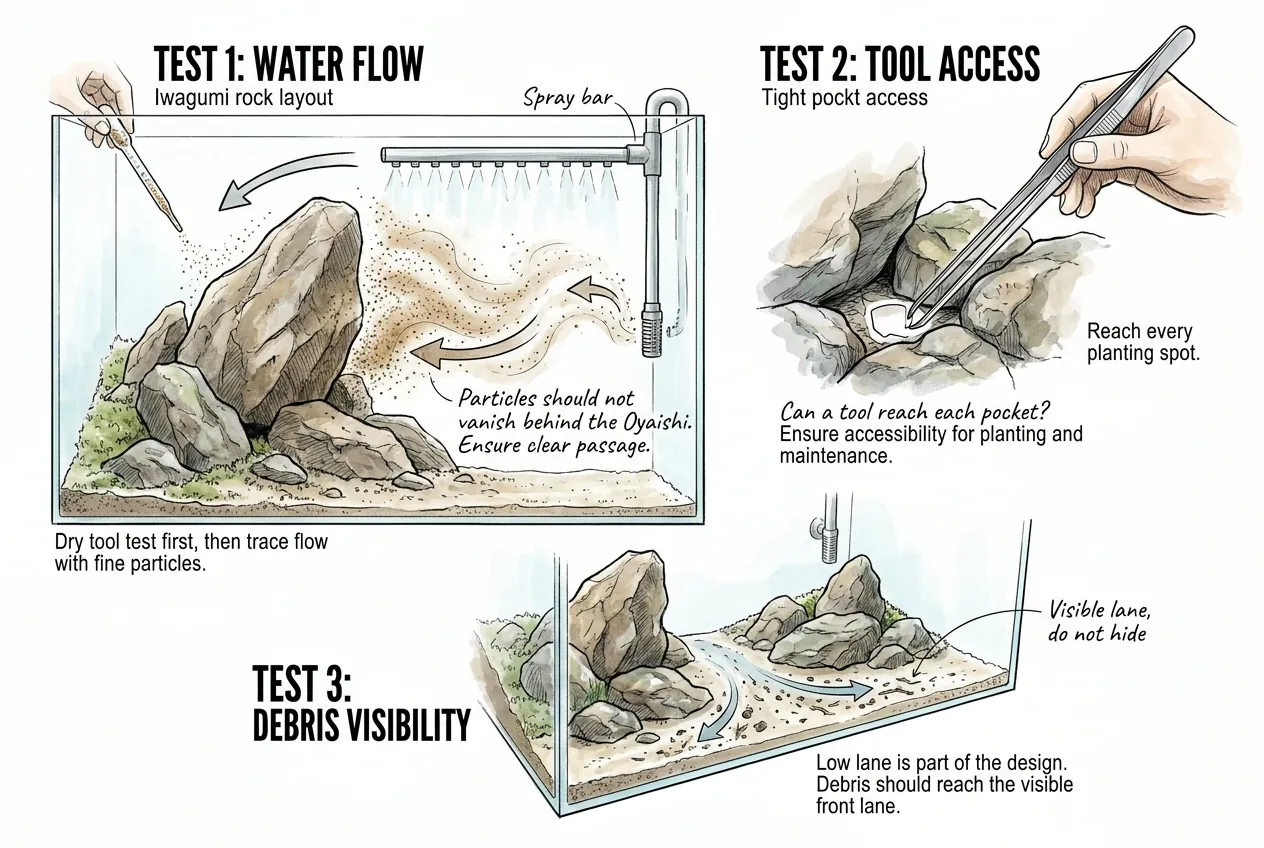
Before planting, check whether a tool can reach behind each major stone and whether an open lane exists for you to siphon later.
Visual inspection tells you about access. It cannot confirm exactly where water passes.
If a pocket is unreachable, fix the hardscape. Use a dry tool test first, then fill slowly and observe.
If you want to watch flow, use a safe, retrievable indicator such as a few suspended fine particles, and observe at several heights and times.
Avoid using fish food as a tracer. It floats or sinks depending on size, density, and how it swells, so it does not follow the water, and it adds organic and ammonia load and may not be recovered.
If material keeps collecting in the same pocket across repeated checks, solve that before livestock and carpet roots make the layout expensive to change.
A single instance of particles disappearing from view is not proof of a failed layout. They may have been trapped, settled, or caught by the filter.
This is also the time to decide what stays visible. A clean Iwagumi should not hide every maintenance clue. The low lane is part of the design.
What if the tank is already built and collecting debris?
Fix the smallest thing first. Tune the outflow, clear a carpet edge, remove one small Suteishi, or open one rear channel before touching the Oyaishi.
If the same pocket returns, note it (using a livestock-safe marking method) and watch it through the next maintenance check. A recurring pile suggests the layout is guiding debris there.
One dirty day after trimming usually just means the tank needs post-trim cleanup.
The main stone should be the last thing you move for aesthetic reasons. In a mature Iwagumi, moving it can collapse slope, release buried organics, and damage the visual structure you were trying to save.
The exception is safety. If a stone is unstable or at risk of tipping onto the glass, remove that hazard right away rather than saving it for last.
A clean Iwagumi is not a high-flow Iwagumi. It is a readable stone layout where, as far as you can arrange it, pockets have a path out, low points can be seen, and cleaning tools have a route in. Verify that with observation over time rather than assuming it from the design alone.
Confirm fit, compatibility, and safety for your own tank before adding any new gear.