
Aquarium Water Test Kit Product Chooser (2026)
Aquarium water test kit product chooser: start with one liquid master kit plus a KH/GH test, use strips to screen, and add digital tools when your tank needs them.
Marcus Hale · Published 2026-07-22 · 29 min read
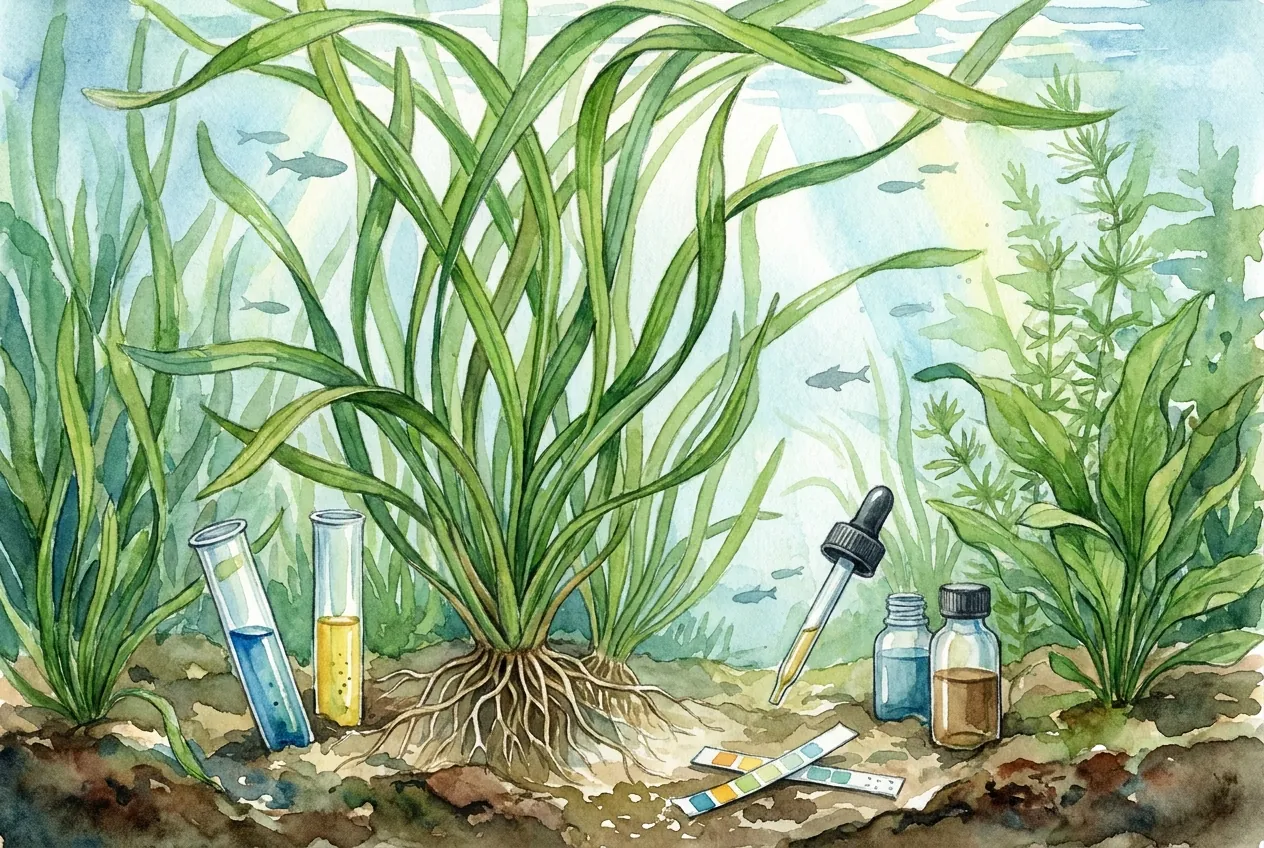
Key Takeaways
- One liquid master kit plus a KH/GH test covers the nitrogen cycle and hardness for most freshwater tanks. Specialty and low-KH tanks may need a different set.
- Use strips for screening and confirm close decisions with a liquid or titration test. A river-water study found Hach nitrate strips matched the exact lab bin 54 to 66 percent of the time and tended to read high.
- Always read ammonia with pH and temperature. NH3 is roughly 100 times more toxic than NH4+, and its share climbs steeply with pH.
- Add digital tools only when they answer a specific question. Use a pH pen for small CO2 or aquasoil changes, a TDS meter for RO mixing, and an ammonia badge during risky monitoring gaps.
- Date consumables when opened and replace them by the printed expiry. Seachem rates its ammonia badge to last over a year.
The same total-ammonia reading can be fairly safe in one tank and dangerous in another, because pH and temperature set how much of it is the toxic un-ionized form.
That is a big part of why a testing kit alone is only half the picture, and it shapes which tools are worth buying.
Choose testing tools according to the question you need to answer. You may be checking routine cycling, hardness and buffering, a controlled pH change, RO mixing, or early warning for valuable livestock.
What water test kit should I buy first?
For most freshwater tanks a sensible starting pair is two products. One liquid-reagent master kit plus one dropwise KH/GH titration test.
Everything else is a situational add-on, and specialty or unusual source water can change even this baseline.
The master kit covers four core parameters (ammonia, nitrite, nitrate, and pH). The KH/GH kit covers the buffering and hardness that master kits leave out.
Together they answer most of the water-chemistry questions in day-to-day care, though survival also depends on oxygen, temperature, disease, and husbandry.
Digital instruments are add-when-you-need-them upgrades, not baseline gear. Match each to a real diagnostic question.
A digital pH pen is most useful when a small pH change drives a decision, chiefly CO2 or aquasoil tanks.
A TDS meter helps when you mix RO water or track a source over time. A continuous ammonia badge helps during cycling or when a monitoring gap poses a welfare risk.
I run a known reference solution or a recently verified laboratory sample beside the tank water when a result will trigger a major change. A crisp color card match means little if the reagent, vial volume, lighting, or my reading technique is wrong.
Both tubes go into one photograph against the same white background, alongside the reagent lot and opening date in my notes. When a familiar tank suddenly produces an implausible result, I check the reference before dosing the aquarium to chase it.
The strip-versus-liquid verdict
For decisions that turn on small differences, lean on a liquid kit rather than paper strips.
The strongest published data is narrower than the hobby often claims, so it is worth stating exactly what it shows.
A 2025 Frontiers study compared Hach colorimetric nitrate strips against paired laboratory analysis on 50 cold (about 10 to 16°C) UK river samples.
The strips landed in the exact same result bin only 54 percent of the time, rising to roughly 66 percent when laboratory uncertainty was included.
Every reading, though, fell within one adjacent bin, and the authors concluded low-cost strips are still useful when their sensitivity and protocol are respected.
In that river sample the strip error skewed high (toward over-estimation). A high bias tends to trigger false alarms and needless water changes rather than hide a problem. Whether other pads, brands, or warmer aquarium water behave the same is not established by this study.
Liquid reagents drive a color reaction to a defined endpoint in a fixed water volume, which helps repeatability at the low end.
Because that study tested only Hach river strips, not aquarium strips or liquid kits, treat the claim that liquid is always more accurate as untested rather than proven.
The practical takeaway holds regardless. Use strips for a fast screen, and confirm any concerning read on a liquid or titration test before you dose or do a large water change.
Reliability of low-cost colorimetric phosphate and nitrate tests used by citizen scientists
Why do these parameters matter, and what are the safe ranges?
Much of the testing case rests on the nitrogen cycle, which produces invisible toxins whose harm depends on pH and temperature.
KH, GH, chlorine, and TDS answer separate questions, but understanding the nitrogen cycle explains why the core tools matter.
The cycle runs ammonia to nitrite to nitrate. A new biofilter builds ammonia-oxidizing bacteria first, then the nitrite-oxidizing bacteria.
That order is why early tanks accumulate the two most toxic forms with zero visual cue.
Why the same ammonia reading can be safe or deadly
Ammonia in water splits into two forms. Un-ionized NH3 and ammonium, NH4+. The NH3 fraction crosses gill membranes far more readily, so UF/IFAS puts it at roughly 100 times more toxic than NH4+. The dominant hazard, though NH4+ is not harmless.
That fraction is set by pH and temperature, not by the total ammonia number your kit reports.
Across the low-fraction range typical of most tanks it climbs roughly 10-fold for every one-unit rise in pH, and it rises with temperature too.
The multiplier flattens as the fraction saturates at high pH, so treat 10 times per pH unit as a rule of thumb, not an exact law.
The numbers are stark. At pH 7.0 and 25°C, about 0.57 percent of total ammonia is the toxic NH3 form.
At pH 8.5 and 25°C, about 15.3 percent is toxic. The same kit reading is roughly 25 times more dangerous.
UF/IFAS extension puts the action lines plainly. Above 0.05 mg/L un-ionized ammonia, fish tissue damage can begin.
Around 2.0 mg/L un-ionized ammonia, sensitive fish typically die. The practical target is no detectable ammonia.
This is why a kit that reads only total ammonia gives you half an answer. Read pH alongside it, using the high-range card (or a pen) when the tank sits above 7.6 so the pH figure feeding your NH3 estimate is right.
Ammonia in Aquatic Systems (UF/IFAS Extension, FA031)
Calculation of Un-ionized Ammonia in Fresh Water (Florida DEP methods manual, Thurston et al.)
EPA Aquatic Life Ambient Water Quality Criteria for Ammonia, Freshwater 2013
Why nitrite is a separate poison the cycle produces
Nitrite is deadly at low ppm through a different mechanism than ammonia. It is taken up across the gills in competition with chloride, then oxidizes hemoglobin into methemoglobin.
Methemoglobin cannot carry oxygen, so the fish suffocates in oxygen-saturated water. The blood turns brown, which is why this is called brown-blood disease.
As methemoglobin climbs past roughly 50 percent of total hemoglobin, most fish are in serious danger, though the exact clinical point varies by species and exposure.
Aim to keep nitrite at zero within your kit’s detection limit, and treat a nitrite test as essential during cycling.
Chloride is the protective factor here, not hardness itself. A nitrite spike in low-chloride water (often soft planted or shrimp tanks) is more dangerous than the same spike where chloride is higher.
Nitrite influence on fish. A review
Why nitrate is the safe end product, but only relatively
Nitrate is the cycle’s end product and crosses membranes far more slowly than nitrite. It takes chronic exposure and much higher concentrations to cause harm.
For sensitive animals, though, the peer-reviewed bar sits low. Camargo, Alonso and Salamanca proposed a maximum of 2 mg NO3-N/L to protect the most sensitive freshwater species. That is a protective value for those species, not a single safe limit for every community tank.
Freshwater animals are more sensitive to nitrate than marine ones.
Watch the unit here. 2 mg NO3-N/L is roughly 9 mg/L measured as the nitrate ion, the form most aquarium kits report. Multiply NO3-N by about 4.43 to compare.
The practical rule is a weekly nitrate check to schedule water changes, not an emergency test.
Sensitive shrimp and soft-water keepers should hold it well below typical fish-tank comfort zones.
Tracking nitrate as one input among many helps, though algae outcomes depend on light, CO2, several nutrients, grazing, and biomass together, not on nitrate alone.
Stable, tracked parameters still beat spike-chasing for problems like black beard algae.
Nitrate toxicity to aquatic animals. A review with new data for freshwater invertebrates
Why KH and GH matter, and what the numeric bands are
KH is the pH shock-absorber and GH is the mineral floor. Master kits omit both, which is the whole reason for a second titration kit.
KH mostly measures carbonate and bicarbonate, the ions that neutralize acid before pH can crash.
In productive fish ponds, low-alkalinity water can swing from pH 6 to above 10 while high-alkalinity water holds around 7.5 to 8.5. A home tank behaves similarly in direction, though the exact swing depends on your setup.
Extension aquaculture sources put a total alkalinity of 75 to 200 mg/L CaCO3 as a productive, pH-stable band in fish ponds. Planted-tank targets are often set lower on purpose.
Note that adding or removing CO2 shifts pH but does not by itself consume alkalinity. What lowers KH is active aquasoil (ion exchange and acid release) and nitrification, while leaching limestone hardscape raises it.
GH is an operational measure dominated by dissolved calcium and magnesium. USGS classes water as soft at 0 to 60 mg/L CaCO3 and moderately hard at 61 to 120.
It calls 121 to 180 hard, and anything above 180 very hard. These are general water-use bands, not livestock targets.
Those minerals matter especially for animals that molt. More than 80 percent of the calcium in crustaceans sits in the exoskeleton.
That is one reason shrimp draw on more calcium than fish to rebuild a shell after each molt, though diet, species, and other minerals all play a part alongside water GH.
Total Alkalinity (Mississippi State University Extension)
Interactions of pH, Carbon Dioxide, Alkalinity and Hardness in Fish Ponds (Wurts and Durborow, SRAC 464)
Hardness of Water (USGS Water Science School)
How do the five tool classes compare on measurable specs?
A tool is worth buying only if it resolves the change you need to see. The table below compares the five tool classes across the specs that decide which one you need.
Compare each tool on accuracy, resolution, measurement range, calibration burden, shelf life, and read speed, and remember these are manufacturer-stated figures rather than independent accuracy tests.
If a tool does not resolve the change you care about, it will not help your decision.
Selection-criteria comparison (manufacturer-stated specs)
| Spec | Liquid master kit | KH/GH titration | Digital pH pen | TDS/EC meter | Ammonia alert badge |
|---|---|---|---|---|---|
| Accuracy | color-chart categorical | 1 drop = 1 dKH/dGH | ±0.01 pH (Apera) to ±0.2 pH (Hanna) | ±2 percent | color bands |
| Resolution | 0.25 ppm step on the low ammonia scale. Coarser per analyte | 1 dKH / 17.9 ppm per drop | 0.01 pH (display) | 1 ppm to 999, then 10 ppm | detects under 0.05 mg/L free NH3 |
| Range | TAN 0-8, NO2 0-5, NO3 0-160 ppm. PH 6.0-7.6 + 7.4-8.8 | whole degrees | −2.00 to 16.00 pH (Apera) | 0-9990 ppm (±2% to 5000) | Safe 0.02 / Alert 0.05 / Alarm 0.2 / Toxic 0.5 |
| Calibration | none | none | 2-3 point buffers | factory, field-adjustable | none |
| Shelf life | per printed expiry | per printed expiry | probe drift, KCl storage | battery-limited | over 1 year (Seachem) |
| Read speed | about 5 minutes | minutes | seconds | seconds | continuous, about 15-min lag |
The bottom line is that colorimetric chemistry and digital electrodes answer different questions.
A colorimetric card cannot resolve a 0.1 pH move, and no colorimetric test reads TDS at all. Match the spec to your actual need before you spend.
Which products fill each testing role?
Each product below has a different job. Add it only when that job affects a real decision in your tank.
Which liquid master kit resolves ammonia, nitrite and nitrate?
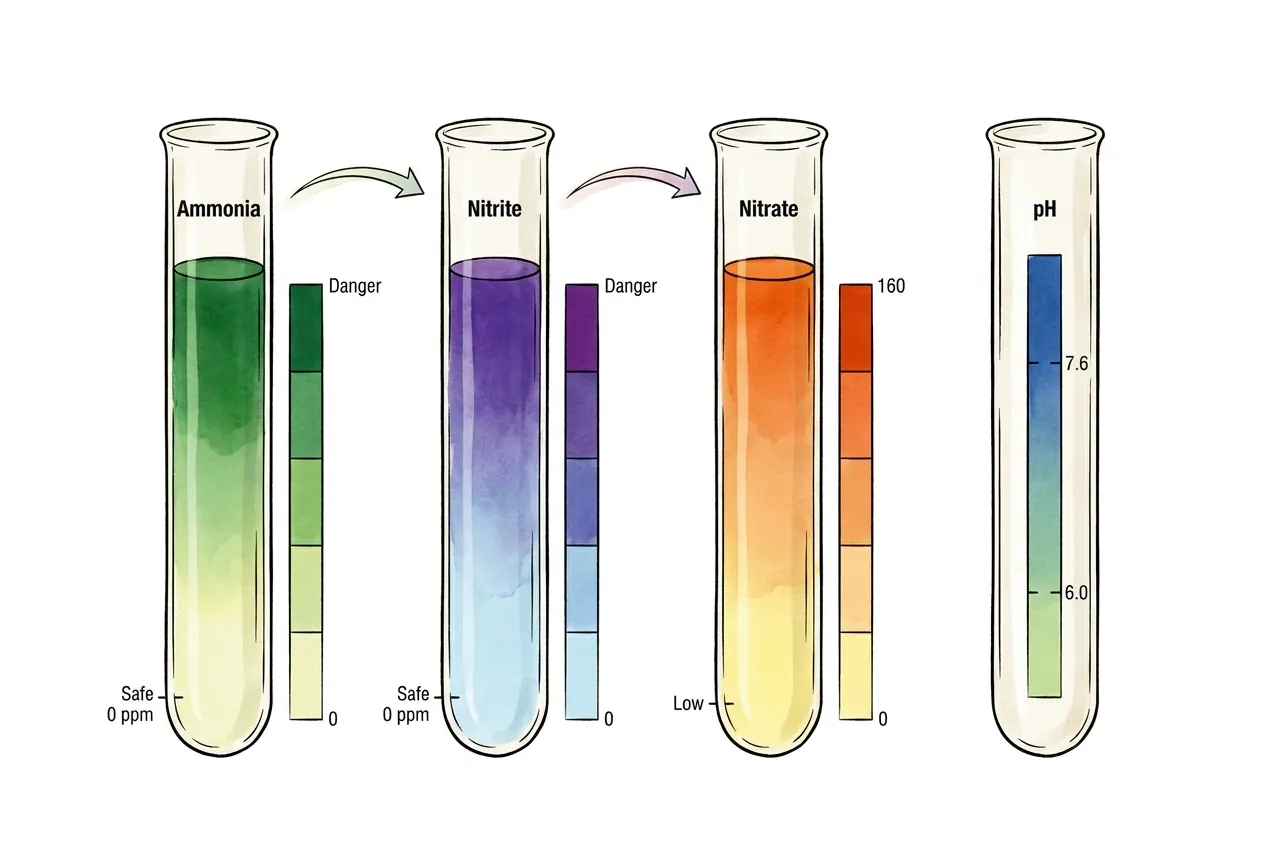
The backbone purchase is a liquid-reagent master kit. It is the only single low-cost tool that shows the entire ammonia-to-nitrite-to-nitrate cascade plus pH.
The spec you need is near-zero resolution on ammonia and nitrite, since the dangerous end of those scales is at the bottom, not the top.
API Freshwater Master Test Kit
The API Freshwater Master Test Kit suits a freshwater keeper who needs the core cycling checks in one box. Use the high-range pH test when the normal card is near its upper limit, and follow the printed timing and shaking steps exactly because reagent technique affects the result.
The tradeoffs are real. Color-matching is subjective under poor light, the low-range card tops out at 7.6 so you switch to the included high-range card above that, and there is no KH or GH test.
Reading total ammonia also means you must interpret it against pH and temperature.
The missing hardness tests are what the KH/GH kit fills. A pH pen is a separate upgrade for resolving small changes, not a fix for a range the kit cannot read.
Salifert Nitrate Test
If you need a dedicated nitrate cross-check, the Salifert nitrate test is a separate option. Confirm the current instructions in the box and use the same method each time before comparing a trend.
The tradeoffs are that it tests nitrate only, one parameter at a time, and at a higher cost per test. Whether a dedicated nitrate kit is worth it depends on your livestock and how precise a low-end number you actually need.
sera Aqua-Test Box
If you would rather buy one box that also covers hardness, the sera Aqua-Test Box suits an owner who wants broad coverage in one place. It is a poor fit if you only need a few core tests or want the lowest-cost way to replace heavily used reagents.
API Freshwater Master Test Kit official product page (Mars Fishcare)
When is a KH/GH titration or a fast strip the right call?
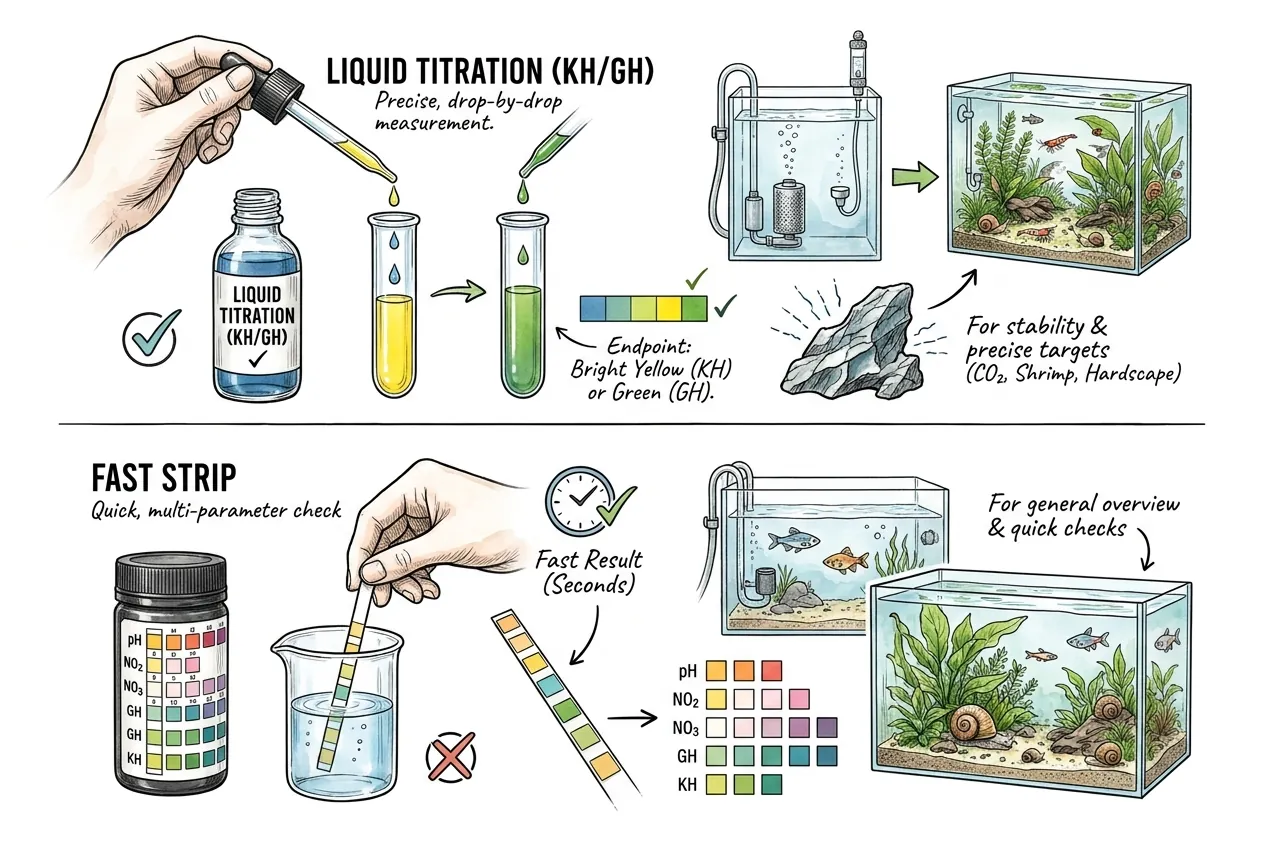
A dropwise KH/GH titration is the common add-on the master kit leaves out, worth adding whenever buffering or hardness drives a decision.
The spec you get is discrete, repeatable whole-degree resolution, which can be coarse in very soft, low-KH water.
You need it because you are dialing CO2 against KH or remineralizing a shrimp tank to a target GH.
API GH and KH Test Kit
The API GH & KH Test Kit is useful when buffering or mineral content determines the next step, such as CO2 use, shrimp keeping, or hardscape that leaches minerals. Follow the endpoint color in the current instructions and compare results over time. The iwagumi stones raising KH guide explains the hardscape case.
The honest tradeoff is that it is manual and tests one parameter at a time, and the endpoint color judgment is user-dependent.
Watch KH during cycling, since nitrifying bacteria consume alkalinity and a KH that drops to zero can stall the cycle and let pH swing.
Some soft-water, blackwater, and active-soil tanks run deliberately low KH, so judge it by your pH trend, ammonia and nitrite readings, water-change routine, and species rather than a single fixed floor.
For a fast whole-panel glance, a multi-parameter strip fills the speed role. Strips trade resolution for speed, so use them to screen and then confirm a concerning read on the liquid or titration test.
API 5-in-1 Test Strips
The API 5-in-1 Test Strips suit a quick screen on a stable tank. Keep the container closed and follow the timing exactly, then confirm any result that would change dosing or trigger a large water change with a liquid or titration test.
Tetra EasyStrips 6-in-1 Test
A cross-brand alternative, the Tetra EasyStrips 6-in-1 Test, is useful when checking total chlorine matters as well as routine values. It is still a screen, not a substitute for a more precise confirmation before major treatment.
Choose the Tetra strips when you want to flag chlorine. The most useful check is testing source tap water before it goes in, with a post-change residual check as a backup.
They carry the same screening role as any strip rather than replacing a titration.
Managing High pH in Freshwater Ponds
When does a digital pH pen beat a colorimetric card?
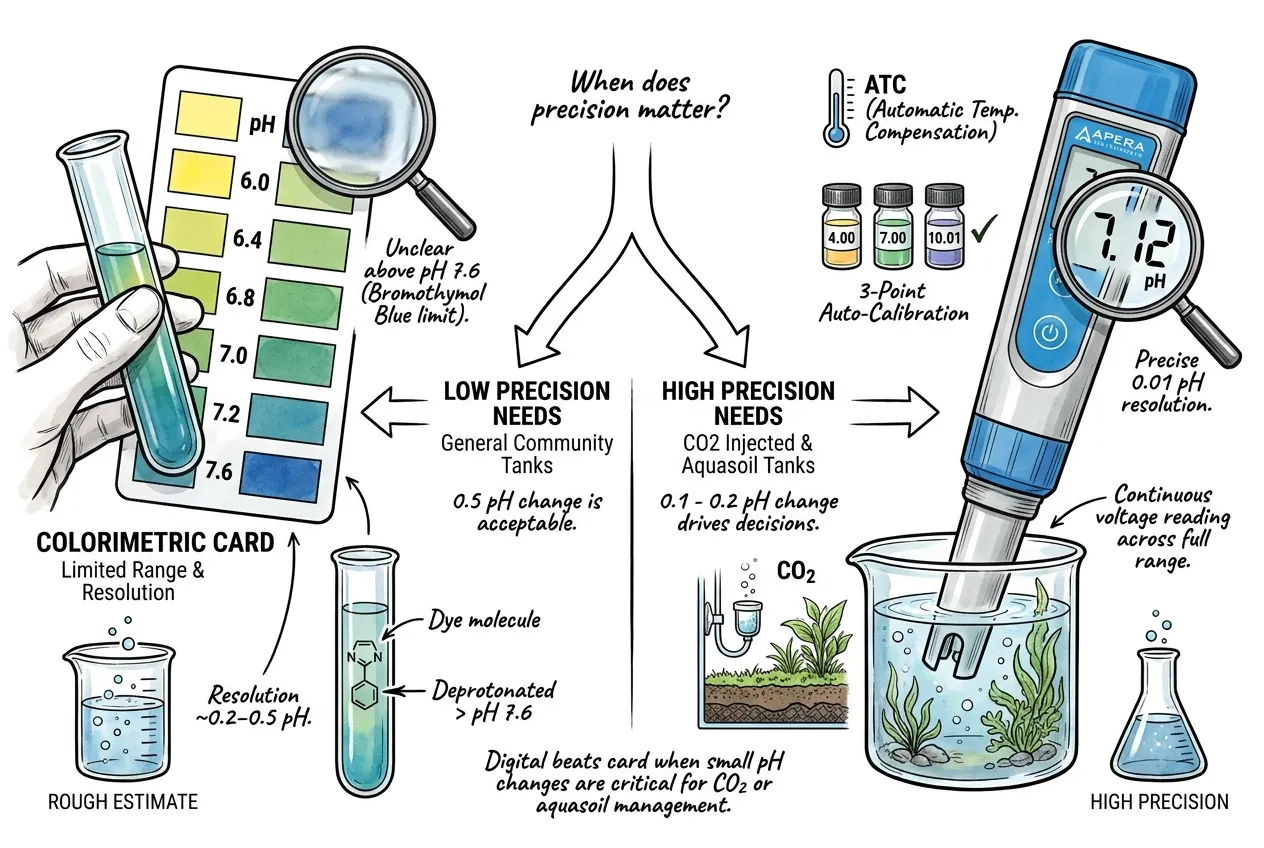
A digital pH pen earns its place when a 0.1 to 0.2 pH change drives a decision, most often on CO2 or aquasoil tanks, and also for breeding, alkaline or blackwater diagnostics, and source-water checks.
A single colorimetric card cannot reliably resolve that small a move.
The bromothymol blue used in many pH cards has a transition window of only pH 6.0 to 7.6, so a low-range card alone blurs everything above roughly 7.6.
That is exactly why the API kit ships a separate high-range card for 7.4 to 8.8. The pen’s advantage is finer resolution within a range, not reading a range the cards cannot.
For its own reported field data, USGS requires the glass-electrode method and treats the colorimetric method as suitable only for rough estimates.
That is a measurement-protocol standard for regulatory reporting, not a claim that only a meter is valid for every aquarium decision.
An electrode digitizes a continuous voltage, so a good meter can display 0.01 pH across the scale.
Display resolution is not the same as accuracy, which depends on calibration, slope, junction condition, and temperature.
Apera PH60 Pocket Tester Kit
The Apera PH60 Pocket Tester Kit suits a CO2 or aquasoil tank where a controlled pH change affects a decision. Calibrate it with fresh buffers and store the probe as the manufacturer directs. The Cryptocoryne wendtii pH-drop guide covers that use case.
Its probe is replaceable and the kit ships with 3M KCl storage solution, which keeps the glass membrane hydrated.
The tradeoff is recurring consumables. Buffers, KCl, and an eventual replacement probe.
Hanna HI98108 pHep+ pH Tester
The Hanna HI98108 pHep+ pH Tester is an alternative for following day-to-day pH drift. Its display precision does not remove the need for calibration and careful probe storage, so skip a pen altogether if you will not maintain it.
With a ±0.2 pH accuracy, it is well suited to tracking day-to-day drift on one tank, if you need tighter cross-tank comparisons, choose a tighter-accuracy meter and calibrate carefully.
Store a glass pH probe wet, never dry and never in distilled or RO water. Most pens use a KCl storage solution (the Apera ships with 3M KCl), but follow the concentration your specific probe manual specifies.
A dehydrated junction is the fastest way to kill a pen, so skip the pen if you will not maintain it.
USGS TWRI Book 9, Section 6.4. pH Field Measurements
Bromothymol Blue indicator, pH 6.0-7.6 (Sigma-Aldrich)
When do a TDS meter and a continuous ammonia badge earn their place?
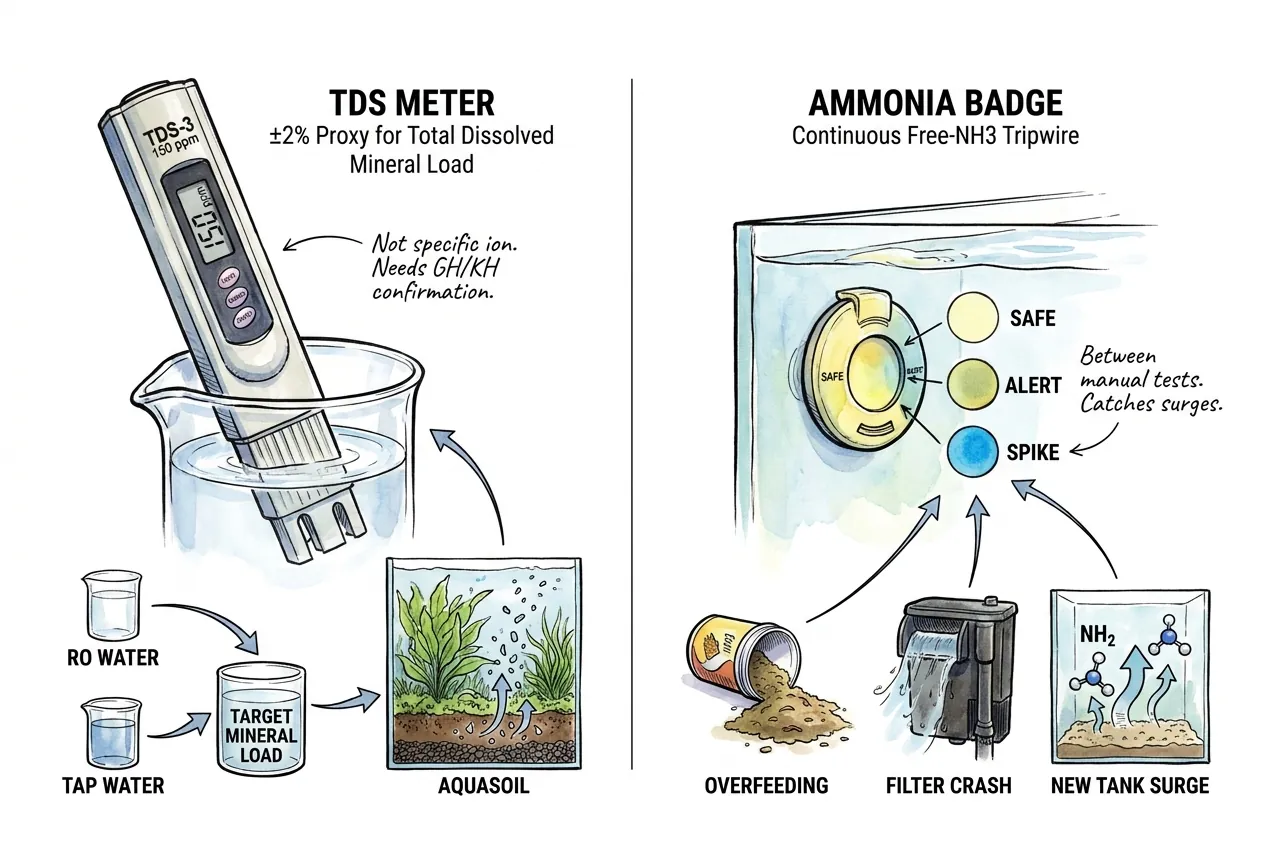
These two instruments are cheap between-titration tools, not backbone kits. A TDS meter tracks total dissolved mineral load, and an ammonia badge is a standing tripwire for spikes.
HM Digital TDS-3 Meter
The HM Digital TDS-3 Meter is useful for checking whether RO output and a remineralized batch stay consistent. It does not identify the ions in the water or replace GH, KH, or pH testing.
Read that ±2 percent as display repeatability, not true-TDS accuracy. Because the meter converts conductivity with a fixed factor, it cannot tell you which ions changed, so a GH or KH titration must confirm the actual parameter.
The badge fills a different gap. A continuous free-NH3 sensor catches an overfeeding, filter-crash, or new-tank surge between manual tests.
That is exactly the aquasoil break-in described in the week-1 ammonia leach cycle.
Seachem Ammonia Alert
The Seachem Ammonia Alert can add a between-test warning in a stocked tank, but it does not replace manual tests during cycling or a proper fishless cycle before adding livestock.
It reads free NH3 only, not total ammonia or nitrite, so it does not replace the daily manual tests during a fish-in cycle.
It lags about 15 minutes on the rise and about 4 hours falling back to safe. Below about pH 7 it reads low simply because almost no free NH3 exists there, which is chemistry rather than a sensor fault.
Seneye Home Aquarium Monitor
For high-value livestock, the Seneye Home Aquarium Monitor suits a keeper who genuinely needs trend logging and remote alerts. It brings recurring consumable and connectivity requirements, so skip it when a regular manual test routine is enough.
HM Digital TDS-3 official specification page
Seachem Ammonia Alert official product page
Specific conductance as a proxy for salinity and TDS (USGS, McCleskey et al.)
How do I set up a testing routine and calibrate my tools?
Testing cadence is a step-function, not a fixed habit. Test densely during a cycle, sparsely when stable, then densely again after any problem.
Sample the same way every time. Draw a mid-water sample before feeding, at the same clock time on each test.
This matters because pH can swing over the day with the CO2 and photoperiod cycle, sometimes by a full unit or more depending on CO2, alkalinity, and planting.
Rinse the vial in tank water, fill to the line, and read the color against white paper in indirect daylight.
Testing Schedule by Tank State
This is a starting heuristic, not a fixed rule. Tune the intervals to your bioload, species, water-change routine, and source stability.
| Tank state | Ammonia and nitrite | Nitrate and pH | KH and GH |
|---|---|---|---|
| New-tank cycle | daily (fish-in), every 1-2 days (fishless) | weekly | weekly |
| Stable, established | weekly | weekly | every 1-2 weeks |
| After a problem | daily until 3 clean reads | weekly | as needed |
During a fishless cycle only, you can confirm the biofilter with a 24-hour double-zero test. Never dose ammonia into a tank that holds livestock.
Use a known ammonium chloride source to a defined target (commonly around 2 ppm total ammonia) rather than household ammonia, whose concentration varies batch to batch and cannot be reproduced.
If both ammonia and nitrite read zero 24 hours after dosing that target, the biofilter is processing the load.
Note that visible nitrate on its own is not proof, since it can also come from source water, and plant uptake or denitrification can mask it.
Never read ammonia alone. Pair every ammonia reading with the tank pH and temperature.
Then enter total ammonia, pH, temperature, and freshwater into a free online aquarium ammonia calculator, or use a printed NH3 fraction chart, to find the free-NH3 share.
Treat a free-NH3 result above 0.05 mg/L as a conservative action line, worth responding to even though exact harm depends on species and exposure time.
At the same temperature, 1 ppm total ammonia carries roughly six times more free NH3 at pH 9 than at pH 8, which is why the same kit reading is not the same risk.
For calibration, bracket your expected water pH with the buffers your meter’s manual specifies. 4.00 and 7.00 for acidic tanks, or 7.00 and 10.01 for alkaline ones.
Calibrate before any critical reading and at least monthly for routine use, and use fresh buffer each time rather than reusing a pot a set number of times, since contaminated buffer degrades the calibration.
Important Water Quality Parameters in Aquaponics Systems (NMSU Extension, CR680)
Nitrate/Nitrite and Brown Blood Disease (Purdue University Animal Disease Diagnostic Laboratory)
Who should NOT buy each tool?
Knowing what to skip matters as much as the recommendations. Buying a tool before you have a question for it usually adds cost and maintenance without improving your decisions.
Skip the digital pH pen if your tank is stable low-tech
Without pressurized or liquid CO2 and without active soil, pH usually moves little, so a pH card (matched to the right range) is often adequate when pH sits steadily and you are not chasing a 0.1 change.
Watch for source-water shifts, low KH, or new hardscape, which can move pH even on a low-tech tank.
If you are not going to store and calibrate a pen, it will sit in a drawer while its probe dries and its buffers expire, so the card is the better fit.
Skip the TDS meter if you run straight conditioned tap
A TDS meter earns its keep tracking change, such as RO-tap mixing ratios and aquasoil EC leaching.
On a single unchanging tap-water source there is little to track, and it still cannot tell you GH.
Buy it when you start mixing water, not before.
Skip test strips for accuracy-critical decisions
Strips read fast but coarse, so the gap between meaningfully different values can look nearly identical on the chart.
If you are cycling, keeping sensitive livestock, or dosing on small differences, the money belongs in a liquid master kit.
Reserve strips for triage only.
Skip the ammonia badge on a long-cycled stable tank
The badge is spike insurance that earns its keep during fish-in cycling, after a filter crash, or when a monitoring gap poses a welfare risk.
On a mature tank with months of clean readings, a weekly manual test usually covers you, though heavy stocking or long absences can still justify it.
Weigh it by risk, not by a fixed rule.
Skip both the pen and the TDS meter as a new budget keeper
The liquid master kit plus a KH/GH test covers the nitrogen-cycle and buffering picture that day-to-day testing turns on. Everything else is an add-when upgrade tied to a specific need. CO2 adds the pen, RO mixing adds the meter, shrimp add the GH focus.
Remember that water tests are one input. Oxygen, temperature, chlorine, and disease matter too.
How do I maintain each tool and when do I replace it?
Every consumable here has an expiry, and an aged part can fail quietly. Date each item on opening and replace it by its printed expiry rather than a fixed calendar, since failure modes differ across reagents, strips, probes, and batteries.
Liquid reagents
Liquid reagents drift as they age, so go by the printed lot and expiry on each bottle rather than a single fixed interval.
Store them cool, upright, capped, and out of sunlight, and re-verify an old kit against a known reference before trusting it.
For the API nitrate test specifically, shake bottle #2 hard for about 30 seconds, then shake the filled tube for a full minute and wait about 5 minutes, since a settled reagent reads low.
Test strips
Strips degrade quickly once exposed to humidity, so store them sealed and dry and follow the printed expiry rather than a fixed guess.
Discard any that were left open, stored damp, or read off their timing.
pH probe
A pH probe fails from a dried or fouled junction. Store it wet in the storage solution your manual specifies (often KCl), never dry or in distilled water, and re-calibrate with buffers that bracket your water’s pH when readings drift.
If drift persists after a fresh calibration with good buffer, suspect a fouled or aging junction, but also rule out contaminated or expired buffer, a bad slope, temperature, and inadequate rehydration before replacing the probe or fiber.
Ammonia alert badge
Seachem rates the free-NH3 badge to last over a year. It responds within about 15 minutes on a rise but takes about 4 hours to fall from Toxic back to Safe.
So treat it as a categorical alarm, not a precise log, and replace it on the manufacturer’s indicator as a recurring cost.
Common failure modes to catch
Watch for the reads that mislead. The classic traps are a total-ammonia number read without pH, an uncalibrated pen that has drifted, and reading a low-range pH card above 7.6 instead of switching to the high-range card.
A contaminated sample vial and a TDS proxy misread as a specific value round out the list. You avoid each one by pairing the tool with the right context.
Frequently asked questions
Are test strips accurate enough?
For speed and spotting big problems, yes. For decisions on small differences, confirm on a liquid or titration test.
In one study of Hach nitrate strips on cold river water, they matched the exact lab bin 54 to 66 percent of the time and skewed high, though every read fell within one adjacent bin.
Use strips to screen, and lean on a liquid kit for cycle confirmation or sensitive livestock.
Do I need a digital pH meter?
Mainly if your pH actually moves or you need to resolve small changes. A CO2 or aquasoil tank benefits from resolving a 0.1 to 0.2 pH swing that a card reads only coarsely.
A low-range card tops out near 7.6, but the API kit’s separate high-range card reads 7.4 to 8.8, so use the right card for your range.
On a stable tank where a suitable card meets your needed precision, the pen is optional.
How long do liquid reagents last?
They expire, and aged reagents can drift or read off-color, which is a real accuracy failure and not user error.
Check the printed lot and expiry, store cool and capped, and re-verify against a known reference if a kit is old.
Go by the printed expiry on each bottle rather than a single fixed number, since it varies by brand and reagent.
Why does my ammonia read zero but my fish look stressed?
A true zero total ammonia reading means the un-ionized NH3 fraction is zero too, since NH3 is part of that total.
So if the fish look stressed while ammonia reads zero, the cause is usually something the master kit does not show.
Check nitrite first, then chlorine or chloramine after a water change, dissolved oxygen, temperature, excess CO2, and disease.
Also rule out a test-procedure issue, since a zero can mean below the kit’s detection limit rather than a real absolute zero.
The separate trap worth knowing is a low-but-nonzero total at high pH. Because the toxic NH3 share climbs steeply with pH, a small total that reads near zero on a coarse card can still carry enough NH3 to matter, which is why you pair every ammonia read with pH.
Is a TDS meter the same as a GH test?
No. A TDS meter estimates total dissolved solids from conductivity and lumps in sodium, chloride, and nitrate.
A GH test measures only calcium and magnesium hardness. Two tanks can share a TDS but have very different GH, so shrimp keepers must confirm GH, not TDS.
Is a continuous ammonia alert badge worth it?
Situationally. It reads free NH3 continuously and catches spikes that manual tests miss, which is genuinely valuable during fish-in cycling or with high-value shrimp.
On a long-cycled stable tank it is largely redundant with a weekly test, so buy it for the risky window.
Dietary Calcium and Magnesium in Crustacean Molting
Key Takeaways
A practical backbone for most freshwater tanks is one liquid master kit plus one KH/GH titration test.
Add instruments when your water source, CO2, or livestock changes the question. Specialty and low-KH setups may want a different mix.
Confirm strip reads on a liquid or titration test for close decisions. In one cold river-water study, Hach nitrate strips matched the exact lab bin 54 to 66 percent of the time and skewed high, though every read fell within one adjacent bin, and that study did not test aquarium strips or liquid kits.
Read ammonia with pH and temperature, never alone. The un-ionized NH3 fraction is roughly 100 times more toxic than NH4+ (which is not harmless). Its share climbs steeply with pH, and above 0.05 mg/L it can damage tissue.
Match each add-on to a real need. A pH pen when small pH moves matter, a TDS meter for RO mixing, and an ammonia badge as between-test spike insurance during risky windows.
Date consumables on opening and replace them by their printed expiry, not a fixed calendar. Store reagents cool and capped, keep strips sealed and dry.
Seachem rates the ammonia badge to last over a year, while a pH probe needs wet KCl storage and regular calibration against buffers that bracket your water.
Affiliate Disclosure
This article contains Amazon affiliate links. As an Amazon Associate I earn from qualifying purchases. If you use these links, the site may earn a commission at no extra cost to you. Product availability, price, and specifications can change. Check the current listing before buying.