
Aquasoil Ammonia Leach Week 1: Bucephalandra-Safe Cycle
Fresh aquasoil can push your ammonia reading to several ppm within days. Here is how to read that number in terms of actual toxicity, and a cautious water-change routine for keeping ammonia-sensitive Bucephalandra alive through week 1.
Marcus Hale · Published 2026-06-05 · 27 min read
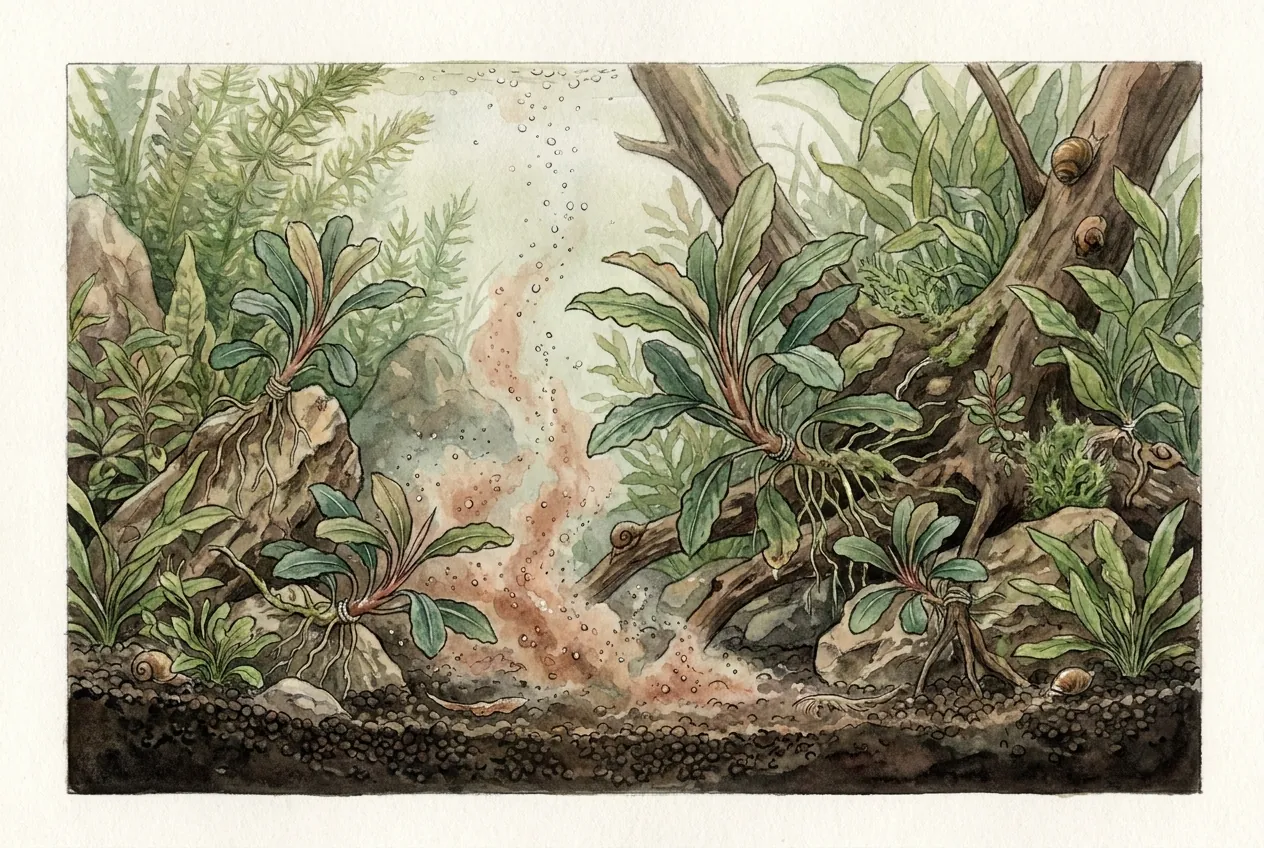
Fill a tank with fresh aquasoil and your API kit can read green-yellow at several ppm Total Ammonia Nitrogen within a day or two.
The usual advice is to wait it out, run partial water changes, and assume the plants will be fine.
For most robust stem plants that is true. For ammonia-sensitive Bucephalandra, an uncontrolled ammonia peak in an uncycled tank is one plausible cause of the leaf melt that hobbyists report during a new setup.
Read ammonia together with pH and temperature, then use the trend in your own tank to size water changes. The specific numbers below are working examples, not published Bucephalandra thresholds. Test your own water and adjust rather than following a recipe blindly.
What is actually leaching out of aquasoil in week 1?
Active aquasoils such as ADA Aqua Soil-Amazonia (currently sold as Amazonia and Amazonia Ver.2) are granulated soil that carries organic material.
The exact composition is proprietary, so treat any recipe of clay plus bark, peat, and humic ferments as a general model rather than a confirmed spec.
The practical point is that the granules don't hold pre-formed ammonia. Organic nitrogen in the granule is mineralized into ammonium once the substrate is wet and colonized by microbes.
As decomposition proceeds, the released NH4+ also exchanges onto and off of the negatively charged cation-exchange-capacity (CEC) sites in the soil.
The result is that a fresh active soil can keep contributing ammonium for several weeks rather than releasing it all at once.
ADA's own Ver.2 material, for example, shows measurable NH4 in the first weeks that falls to undetectable by roughly six weeks (the exact curve depends on the product, batch, soil depth, and source water).
Hobbyists report first-week TAN readings that vary widely (commonly a few ppm for ADA Amazonia, and generally milder for products marketed as gentler starters).
These are uncontrolled anecdotes, not standardized measurements. Peak height depends on soil mass, water volume, temperature, source water, and how the kit is read.
There is no published, apples-to-apples ranking of week-1 ammonia by brand, so use the numbers below only as rough expectations and confirm with your own test kit.
Because the substrate keeps releasing ammonium, a single large water change lowers the column reading but the level can partially rebound as the soil re-equilibrates.
Water changes still genuinely reduce exposure. They just don't stop the underlying release.
Active soils also tend to lower pH and KH as they release organic acids, so a tank that started near the tap baseline may drift down over the first days.
How far and how fast depends on your source water's alkalinity and the soil mass. A lower pH happens to reduce the toxic fraction of any given ammonia reading, as the next section explains, but it is a side effect to measure, not a lever to force.
I keep a covered container of the same source water beside the cycling tank and test both on the same schedule with the same kit. The blank shows whether ammonia, pH, or conductivity changed before the water ever touched aquasoil.
Beside each tank result, I immediately record the water-change volume and time. Without that dilution history, a falling reading can look like biological cycling when it mostly reflects replaced water.
Why does aquasoil keep leaching for weeks instead of all at once?
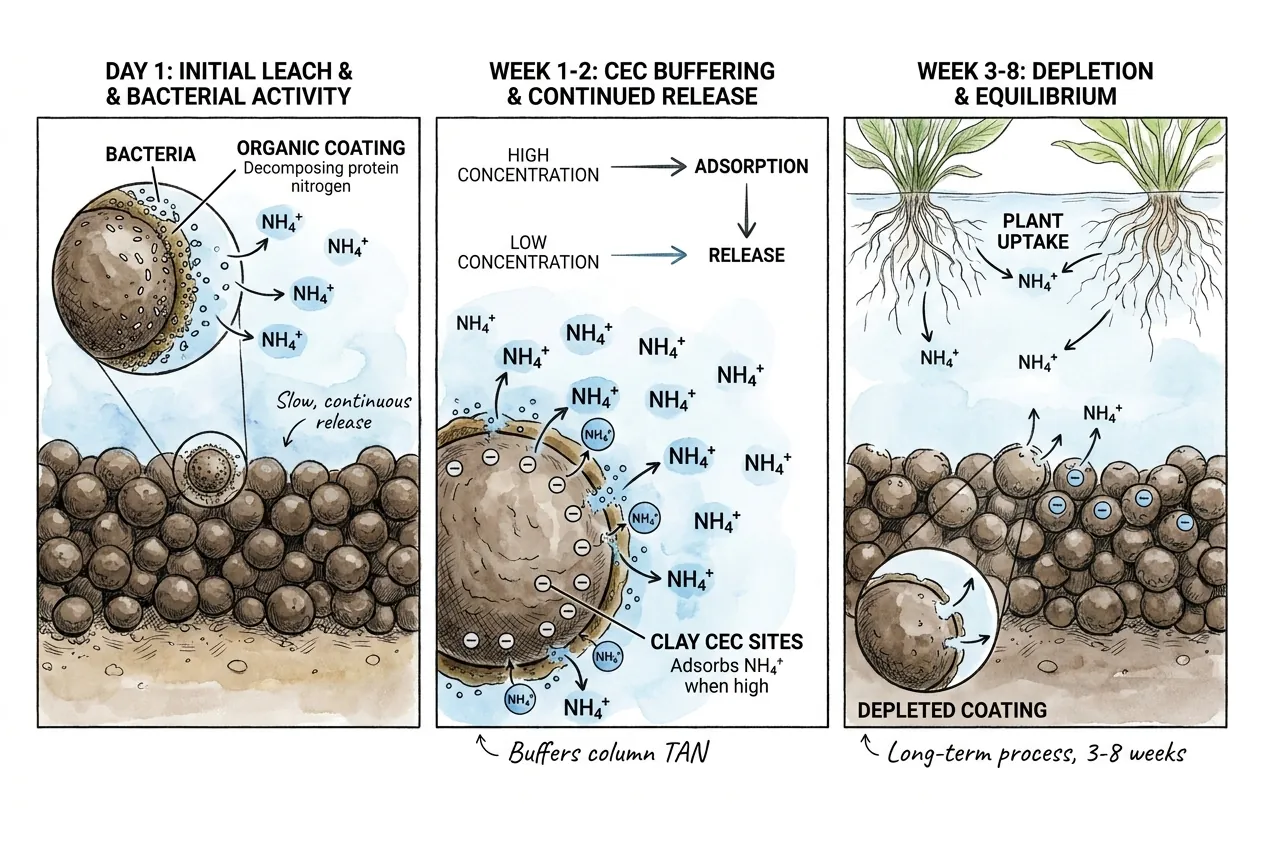
The release is largely bacterial mineralization of organic nitrogen, not a single-shot dump.
As microbes break down the organic material in the granules, ammonium is freed gradually rather than all at once.
The soil's CEC also buffers the column reading. Adsorbing NH4+ when concentrations are high and releasing it when concentrations drop.
This is part of why a large water change doesn't permanently reset the level. Some ammonium re-enters the fresh water from loaded exchange sites and continued mineralization.
The exact rate depends on the soil, its equilibrium state, and flow, so treat it as a tendency rather than a fixed number.
Cycling Approach
Because the release continues for weeks, wait until it stops, then plant is only one option, and not always the most practical.
Planting from day 0 alongside water changes is a common approach, but it is not the only valid one. Pre-soaking or rinsing the soil, running the tank fishless with water changes, seeding with mature filter media, or staging the more delicate plants until the tank is stable are all reasonable depending on your situation.
How aggressive is the ammonia release from a fresh ADA Amazonia batch?
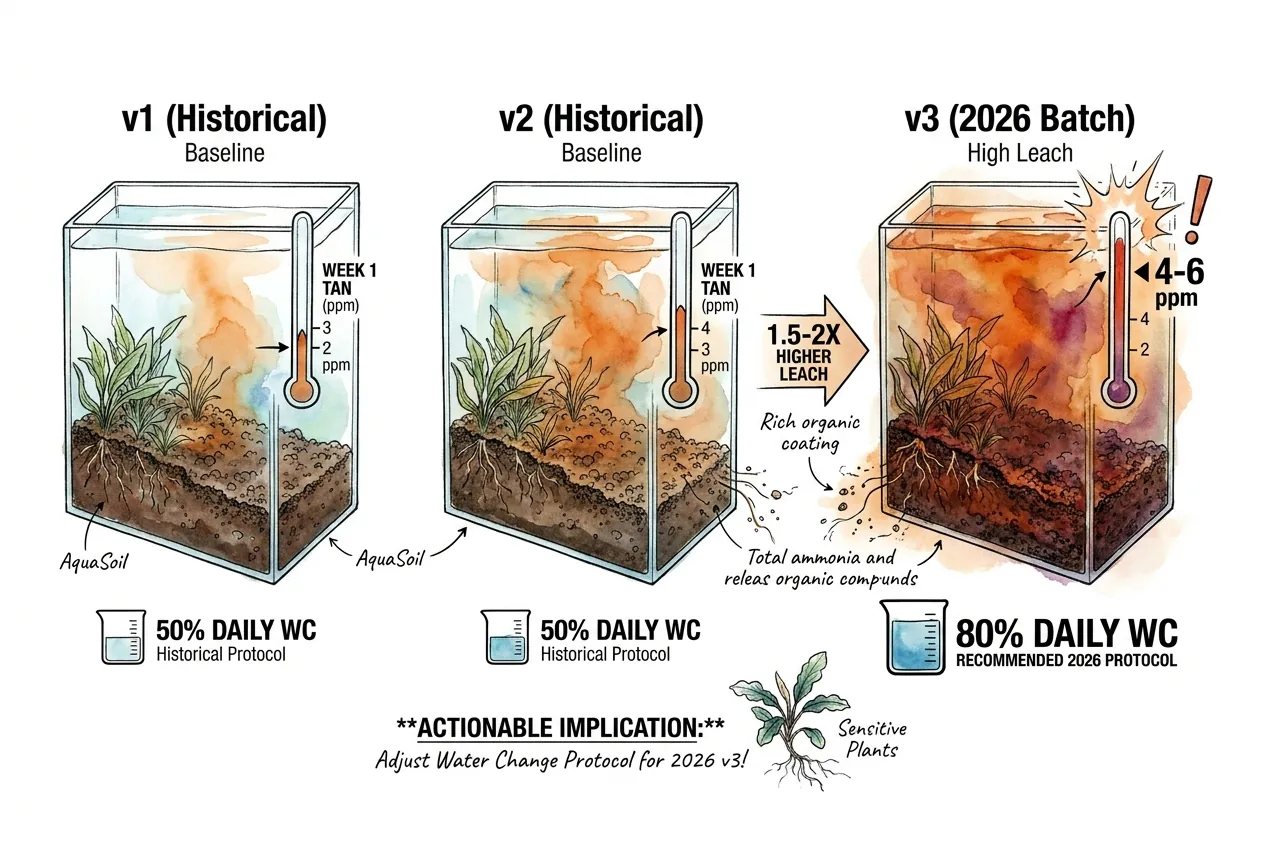
ADA Amazonia has a reputation for a stronger initial ammonia release than milder starter soils, and hobbyists sometimes report first-week readings that stay elevated even with daily partial water changes.
Batch-to-batch variation is real, but there is no verified public dataset breaking this down by formulation version or purchase year, so treat any specific this batch peaks at X ppm claim as anecdote.
The practical takeaway does not depend on the exact number. If you are starting an ammonia-sensitive scape on a strong-release soil, drive your water-change schedule off your own measured readings rather than a fixed calendar, and expect to change more water, more often, than on a mild soil.
The chart above is illustrative of the general shape, not a measured curve.
Why does TAN reading mislead and what should you measure instead?
The number on an ammonia test kit is Total Ammonia Nitrogen, which includes free NH3 and ionized NH4+.
Free NH3 is the more acutely harmful form, but high ammonium can still stress plants. The free-NH3 share rises as pH and temperature rise, so the same kit reading can call for a different response in two tanks.
The same total-ammonia reading can be much more urgent in warm, near-neutral water than in cool, acidic water. Check a reliable ammonia calculator with your own pH and temperature before deciding how much water to change.
Animal-focused ammonia criteria are not Bucephalandra limits. Use them only to understand why pH and temperature matter, not as a plant-safe target.
Free-Ammonia Caution
Read total ammonia, pH, and temperature together before making a large change. Free NH3 rises as pH and temperature rise, so no single ammonia number means the same thing in every tank.
Aquatic Life Ambient Water Quality Criteria for Ammonia – Freshwater (2013). EPA
Calculation of Un-ionized NH3 in Fresh Water. Florida DEP SOP
What fraction of TAN is free NH3 at typical aquascape pH and temperature?
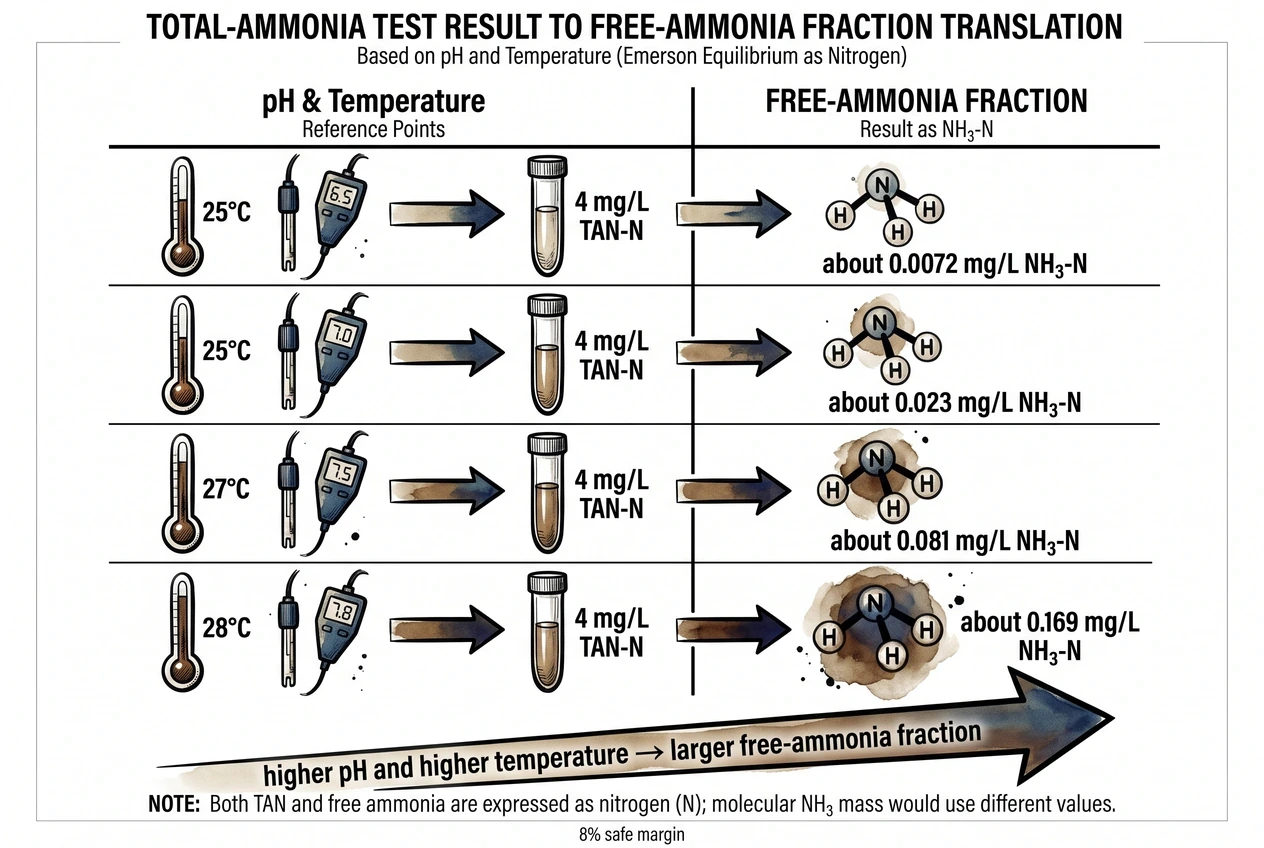
Use a reliable ammonia calculator or the figure above to check how pH and temperature change the result before reacting. Do not turn the output into a fixed Bucephalandra limit, because no published tissue-level free-NH3 threshold exists for this genus.
A high reading in cool, acidic water may be less urgent than a lower reading in warm, near-neutral water, but prolonged ammonium exposure can still stress plants.
How Does a Water Conditioner Handle Ammonia?
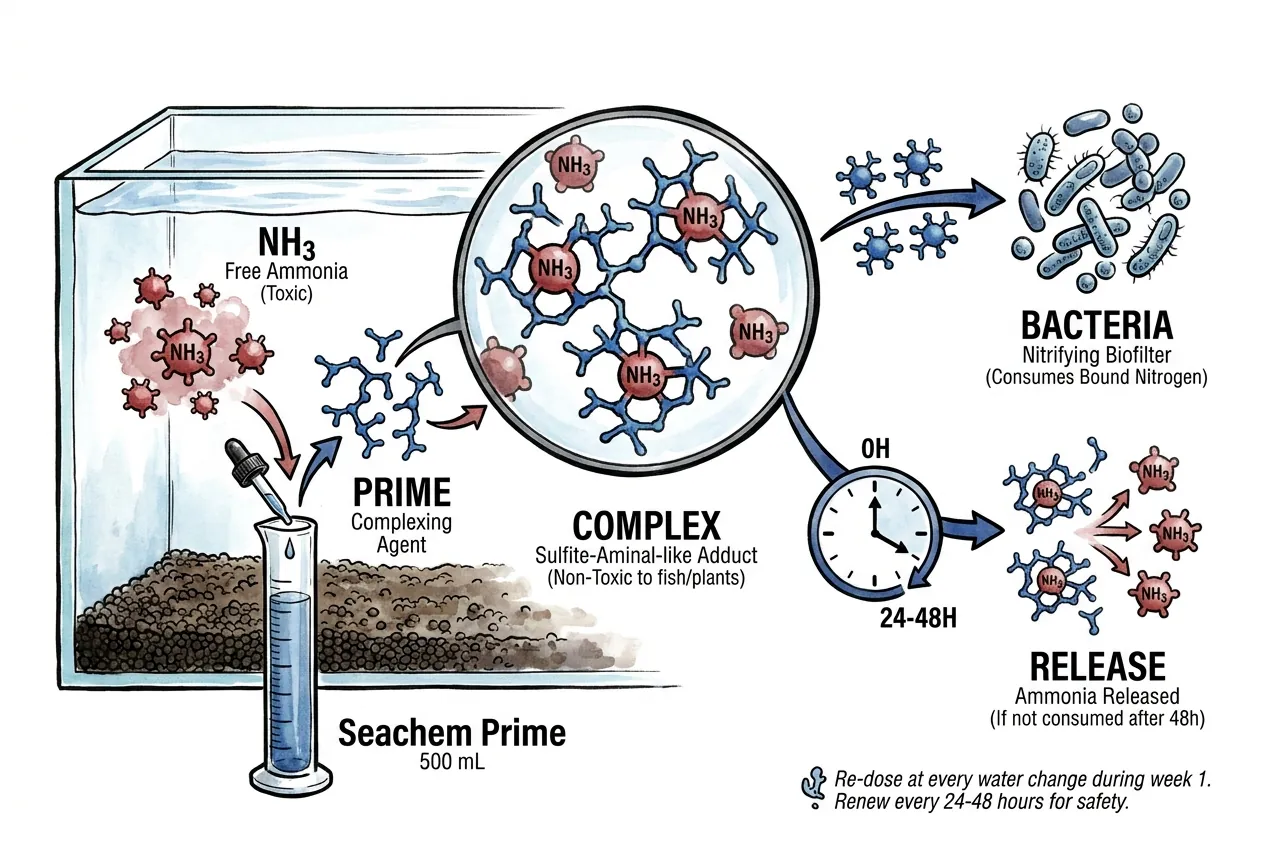
Seachem Prime Water Conditioner
Seachem Prime Water Conditioner is useful when the replacement water contains chlorine or chloramine, and its label also describes temporary ammonia protection. It does not remove nitrogen from the tank or replace water changes and maturing filtration.
Use it with each replacement-water dose as the label directs. Do not use a conditioner to postpone a large ammonia correction, especially when the reading remains high after a change.
When Prime Is Useful
If your source water contains chlorine or chloramine, you need a dechlorinator anyway, and a conditioner that also temporarily detoxifies ammonia can be useful during a new-tank spike. Follow the label for the water you are adding.
Prime is a short-term safeguard, not a way to remove nitrogen or skip water changes. If the source water is chlorine-free and you are already diluting the tank with matched water while the biofilter matures, it is optional rather than essential.
API Freshwater Master Test Kit
For testing you need total ammonia, nitrite, nitrate, and pH. The API Freshwater Master Test Kit keeps those routine checks in one place, which suits a new setup where you need to watch a trend rather than chase one result. Follow its printed wait time exactly. When Prime is in the water, interpret any ammonia result cautiously because the test chemistry can be affected.
The kit is less useful when you need a very precise low-pH reading, since color cards are difficult to distinguish in that range. A calibrated pH pen is the better addition when pH accuracy will change your decision.
FAQ. How long does Seachem Prime stay bound? Seachem Support
5.5.3.2.1 Prime, Safe and Ammonia. Aquarium Science
Why is Bucephalandra so sensitive to a fresh aquasoil setup?
Bucephalandra is a genus of Borneo-endemic rheophytic aroids that grow along fast-flowing forest streams.
Habitats vary by species and locality, including blackwater, limestone, sandstone, and shale streams, so it is a simplification to pin the whole genus to a single water chemistry.
What they broadly share is flowing, relatively nutrient-poor stream conditions, which is quite different from a stagnant, freshly filled, high-ammonia tank.
Specific figures for wild TDS, ambient ammonia, or turnover are not well documented, so treat any exact number as an estimate.
Bucephalandra has a reputation among hobbyists for melting when moved into unstable or high-ammonia conditions, and for being slow to recover.
There is no published, species-specific study establishing an exact free-NH3 or TAN limit, or a day-by-day damage timeline, so the sequence of edge translucence, leaf melt, and eventual rhizome rot is a commonly described pattern rather than a measured schedule.
Once a rhizome has fully rotted it generally will not recover, but a partly affected rhizome can sometimes be salvaged (see the troubleshooting section).
Why is Bucephalandra more ammonia-sensitive than other common aquascape plants?
Bucephalandra comes from flowing, low-nutrient habitats and is slow to recover after a rough transition. A fresh, high-ammonia tank is therefore a poor place to test an expensive rhizome, even though no species-specific ammonia threshold has been published.
At higher pH, free NH3 can stress plant cells. Treat leaf melt as a warning to improve the tank conditions, not as proof that ammonia alone caused the damage.
Fast-growing starter plants can help take up nitrogen during cycling, but they do not make a high ammonia reading safe for Bucephalandra.
Which Bucephalandra cultivars survive an aquasoil cycle?
Hobbyists generally describe some Bucephalandra varieties as tougher and more forgiving than others, and often keep the more delicate or expensive varieties for stable, established tanks.
There is no controlled trial ranking cultivar ammonia tolerance, and trade names are not always consistent, so treat the grouping below as a summary of common community reputation rather than measured survival data.
| Reputation tier | Examples often cited | Typical community advice |
|---|---|---|
| Reputedly hardier | Wavy Green, Kedagang, Red Mini | More often tried early. Expect some leaf loss |
| Mid | Brownie Phantom, Lamandau Mini Red | Many prefer to add once the tank is settling |
| Reputedly delicate | Pygmaea Bukit Kelam, Velvet, Theia, Black Pearl | Commonly saved for a stable, cycled tank |
If you want Bucephalandra in early, a reputedly hardier variety like Wavy Green tissue culture is a lower-risk starting point, and some leaf loss during transition is common regardless.
It is generally sensible to hold the pricier, more delicate varieties until the tank is stable. Premium rhizomes can cost considerably more, and losing one to an unstable startup is an expensive mistake.
What does early NH3 damage on Bucephalandra look like vs nutrient deficiency?
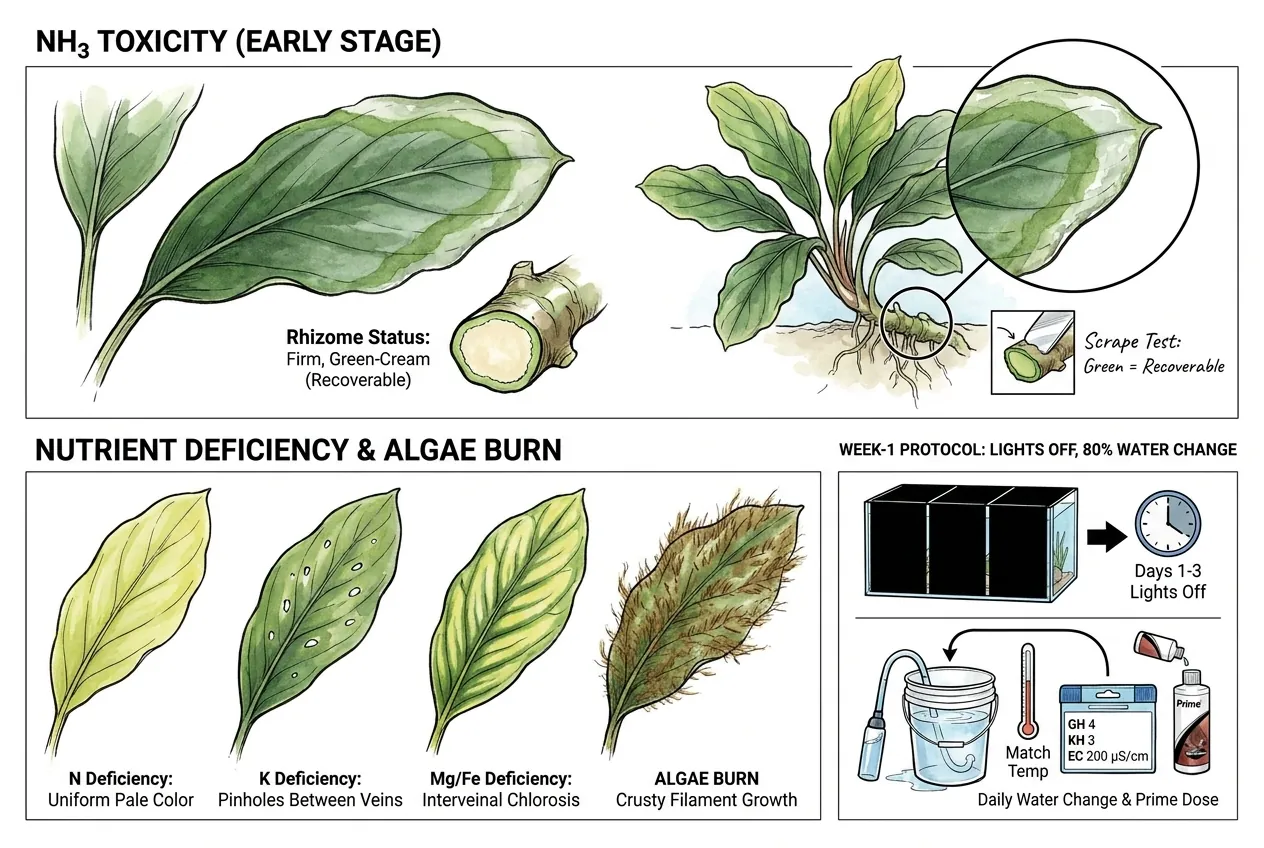
Ammonia-related damage is often described as starting at the leaf edge (a translucent band that progresses inward) while the rhizome stays firm and pale during the early phase.
Bear in mind these visual signs are not specific to ammonia. Transition melt, temperature shock, physical damage, and disease can look similar, so a symptom alone does not confirm the cause.
Nutrient deficiency tends to produce pale, more uniform leaf color with nitrogen deficiency, pinholes between veins with potassium deficiency, or interveinal chlorosis with magnesium or iron deficiency rather than edge translucence. These patterns can still overlap.
Algae favored by high light and low CO2 appears as filaments or a film on the leaf surface, not as a change inside the tissue.
To judge whether a struggling plant is still viable, the usual check is whether the rhizome is firm and pale inside versus brown and mushy.
Note that scraping the rhizome creates a wound and an entry point for infection, so do it sparingly and only when you already suspect rot. A firm, pale rhizome is a good sign, brown mush is rot.
What is the week-1 Bucephalandra-safe protocol?
Run the filter from day 0, use measured ammonia, pH, and temperature to size water changes, and keep the refill water closely matched. Keep lights low for the first few days only when algae is a concern, and use a conditioner at each change if the source water needs it.
If you plant Bucephalandra from the start, a steady routine is usually less stressful than moving it to another unstable tank. A genuinely stable, cycled holding tank is the exception when it removes the plant from the ammonia source.
Keeping lights low early can slow algae that would otherwise exploit the ammonium pulse. The trade-off is that it also slows the plants' own uptake and photosynthesis, so it is a judgment call, not a rule. Watch for algae and reintroduce light gradually.
A larger change lowers the water-column reading more at that moment, although the soil can release ammonium again afterward. When readings rebound quickly, larger or more frequent matched changes keep exposure lower than waiting for one fixed day of the week.
Whatever volume you choose, match the refill's temperature, pH, GH, KH, and EC to the tank so the change itself doesn't become a shock. A large swap of mismatched water can stress plants more than the ammonia does.
How much water change per day during week 1?
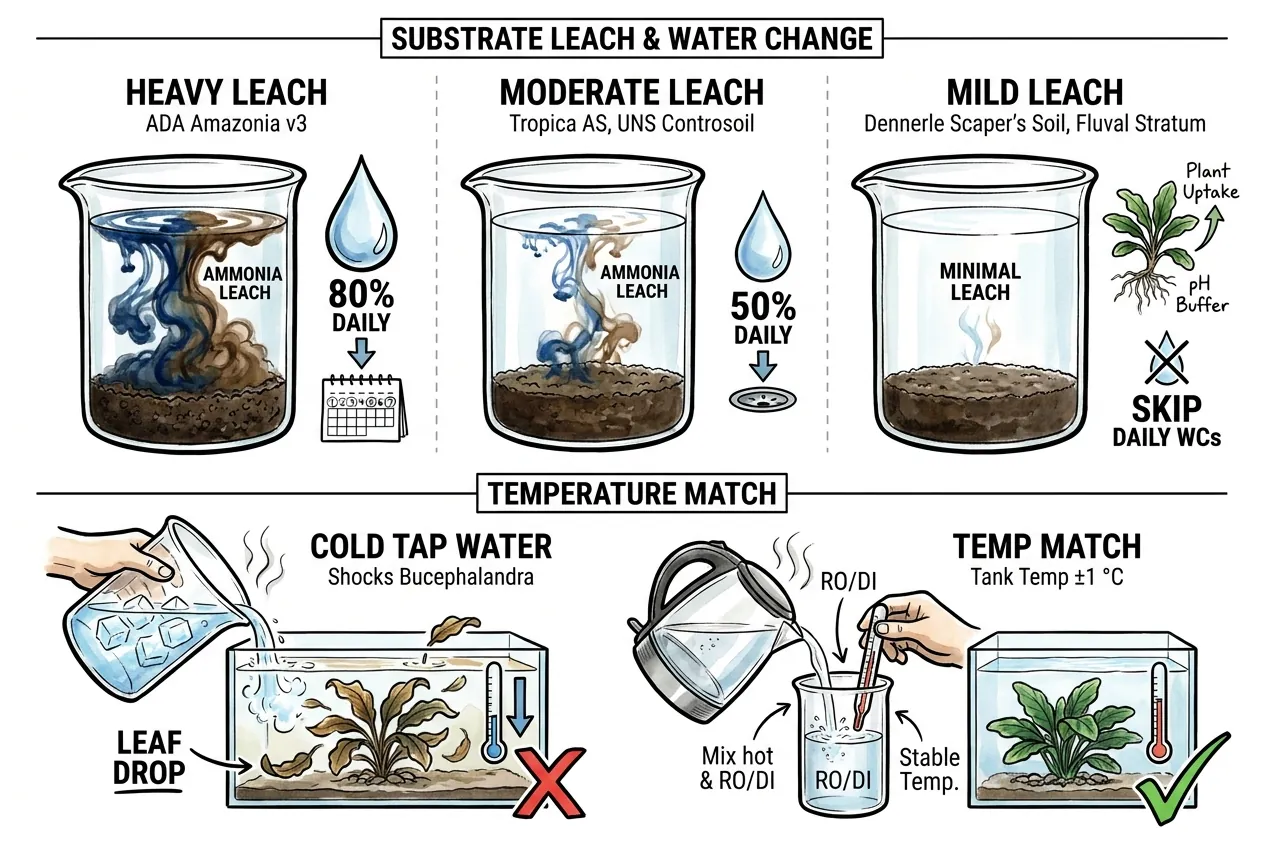
Drive the volume off your measured readings, not the brand on the bag. On a strong-release soil like ADA Amazonia you may need large (roughly 80%) daily changes while the reading is high. On a milder soil, smaller or less frequent changes may be enough, and if your readings stay low, you may not need daily changes at all.
The point is to test first. Even a soil sold as gentle can show some ammonia, so confirm rather than assuming you can skip.
Match temperature when you change water. Sudden temperature swings stress plants independent of ammonia, so aim to land the refill within about ±1 °C of the tank.
Warm the water in a separate container and mix and measure it before adding. Don't pour hot water directly into the tank near the plants or livestock.
(A specific 4 to 5 °C triggers leaf drop figure is not established. The general advice to avoid abrupt swings is what matters.)
What does the day-by-day plan look like?
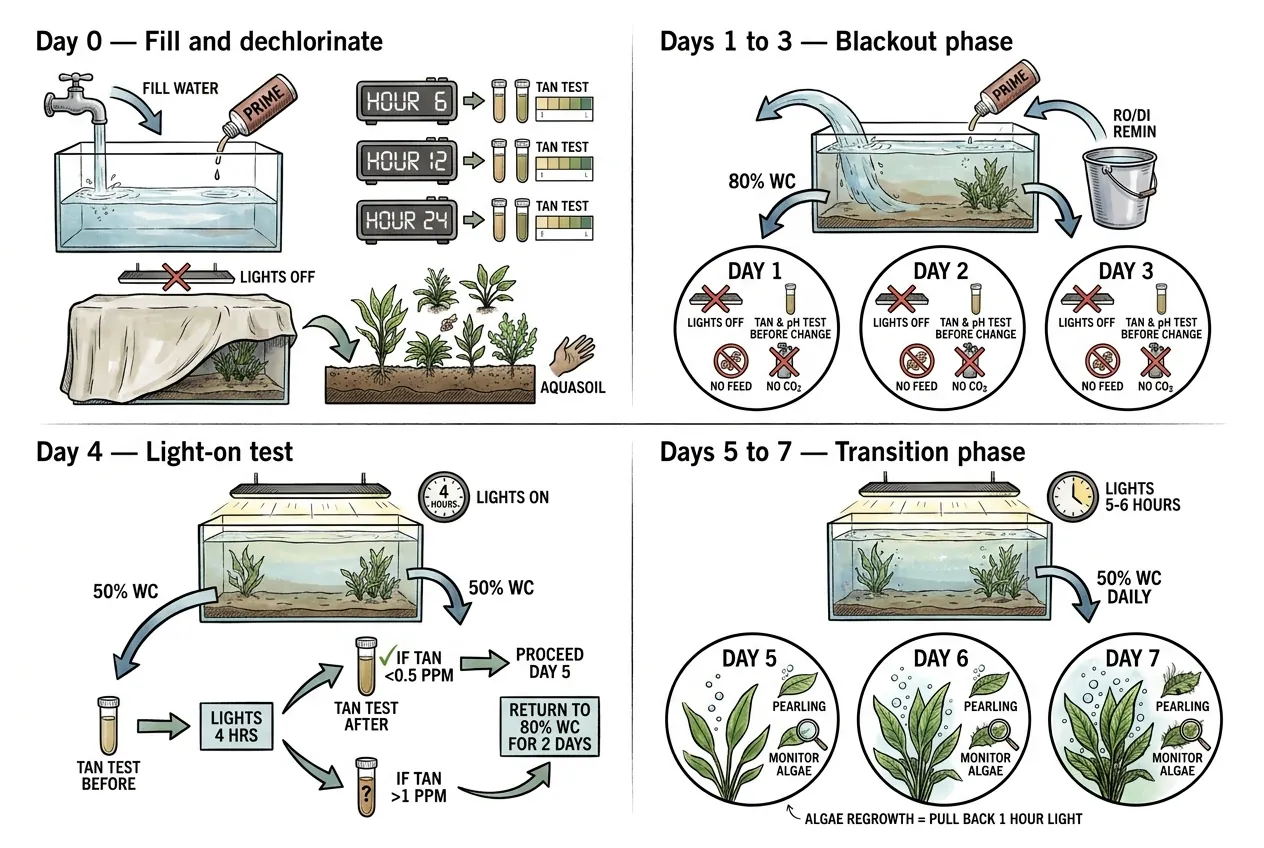
Use this fishless-start schedule as a check on what to monitor, then adjust the timing and volume to the readings in your own tank.
Day 0. Fill and start the system
- Fill the tank and start the filter running from day 0 for circulation and oxygen
- If your source water has chlorine or chloramine, dose a conditioner to the new water according to its label
- Keep lights low or off early if algae is a concern. Cover the sides only if that helps
- Test ammonia (and pH and temperature) periodically over the first day
- Plant, if planting from the start
Day 1 to 3. High-reading phase
- Large (roughly 80%) daily water change with temperature-matched, remineralized water while the reading is high
- Re-dose conditioner at each change if your source water needs it
- Keep lights low. Keep the filter running
- Test ammonia, pH, and temperature before each change, and note the kit's wait time so you can estimate free NH3
- Hold off on CO2 and, in a fishless tank, there is nothing to feed
Day 4. Reassess
- Water change sized to the current reading
- Bring lights up gradually (e.g. A short first photoperiod)
- Test before and after. Remember light shifts pH, which changes the toxic fraction
- Judge readiness from free NH3 (reading plus pH and temperature), not the raw ammonia number alone
- If the reading is still high, continue larger daily changes
Day 5 to 7. Transition phase
- Taper water-change size as readings fall
- Extend the photoperiod gradually
- Watch for algae regrowth (pearling is just photosynthesis, not proof the tank is cycled or safe)
- If algae reappears, pull the photoperiod back and check nutrient and CO2 balance rather than assuming light alone is the cause
How Should You Choose a Water-Change Volume?
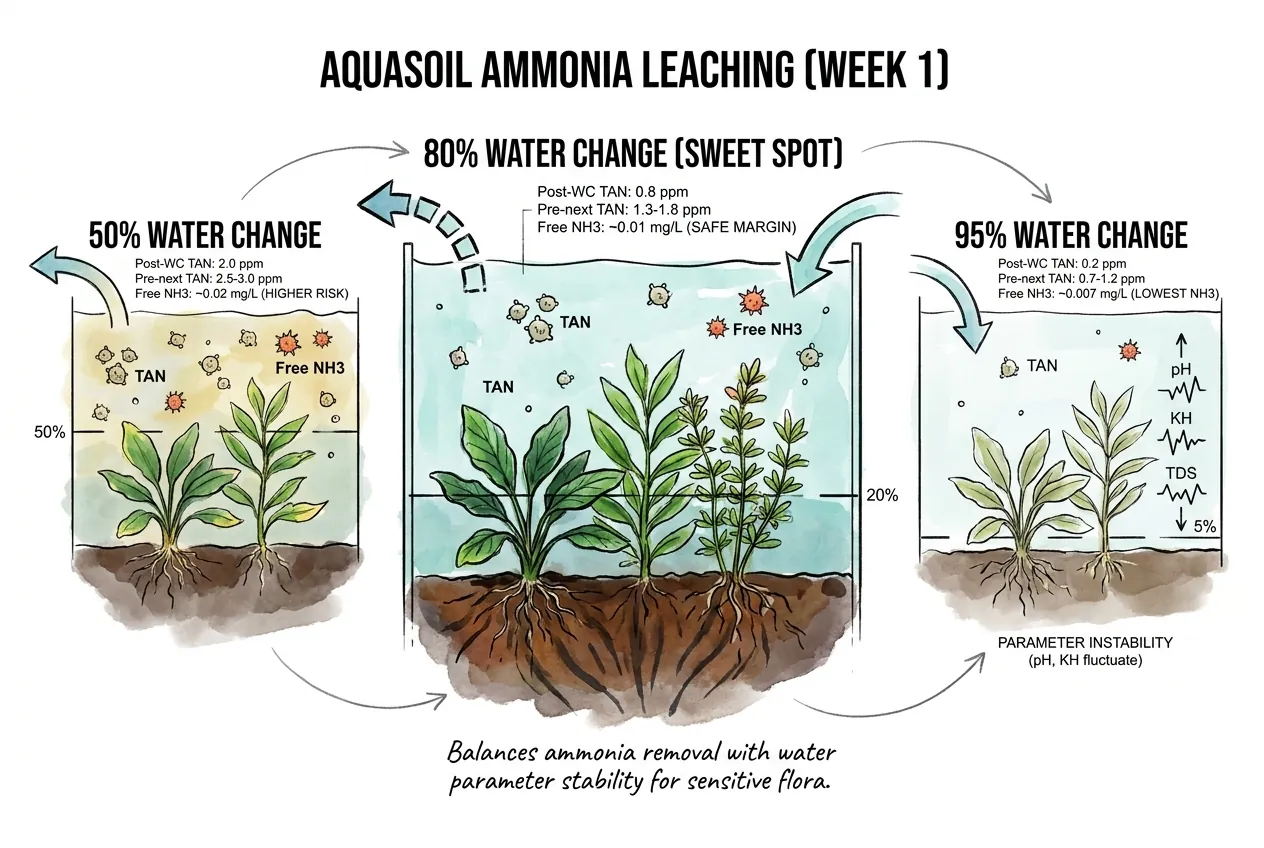
A larger change removes more of the ammonia in the water column at that moment, but soil can keep releasing ammonium afterward. The right volume is therefore a balance between the current reading, how quickly it rebounds, and how well you can match the refill water.
For a strong-release setup, a large change can be reasonable when the refill matches temperature, pH, GH, KH, and EC. A smaller or less frequent change can be enough when readings stay low. The volume itself is not a magic threshold. Mismatched refill water is what creates the avoidable shock.
Can you cycle a planted tank with no fish and no pure ammonia?
Often, yes. Fresh active soil can supply the ammonia that starts a fishless cycle, while plants use some of the ammonium in the water. Whether the soil supplies too little, enough, or too much depends on the product and setup, so verify with tests rather than assuming a fixed reading.
Plants and nitrifying microbes can both help reduce the ammonia load, but neither makes a new tank instantly stable. Seeded filter media can speed the process, while a densely planted tank gives the ammonium another place to go.
N Preference of Aquatic Plants. Diana Walstad (biofiltration synthesis)
Why Fast-Growing Plants Can Help
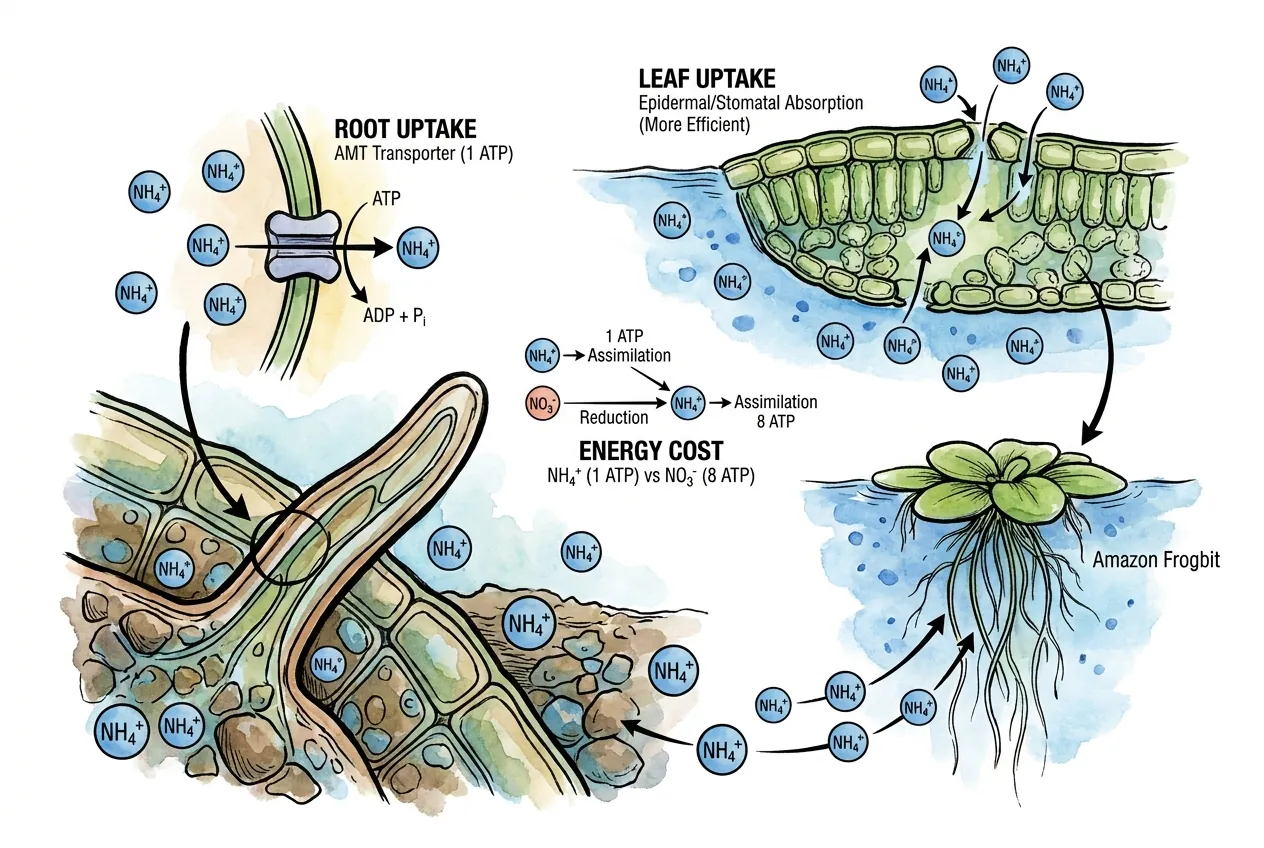
Plants can take up ammonium directly, which is why fast growers are often useful during cycling. That does not make them a replacement for testing or water changes, because uptake depends on plant mass, light, and the amount of nitrogen available.
Floating plants such as frogbit, red root floater, or water lettuce can help because they grow quickly and have access to air. Keep enough open surface for gas exchange and remove excess growth rather than letting a dense mat shade the tank.
How long does Nitrospira take to colonize fresh aquasoil at 25 °C?
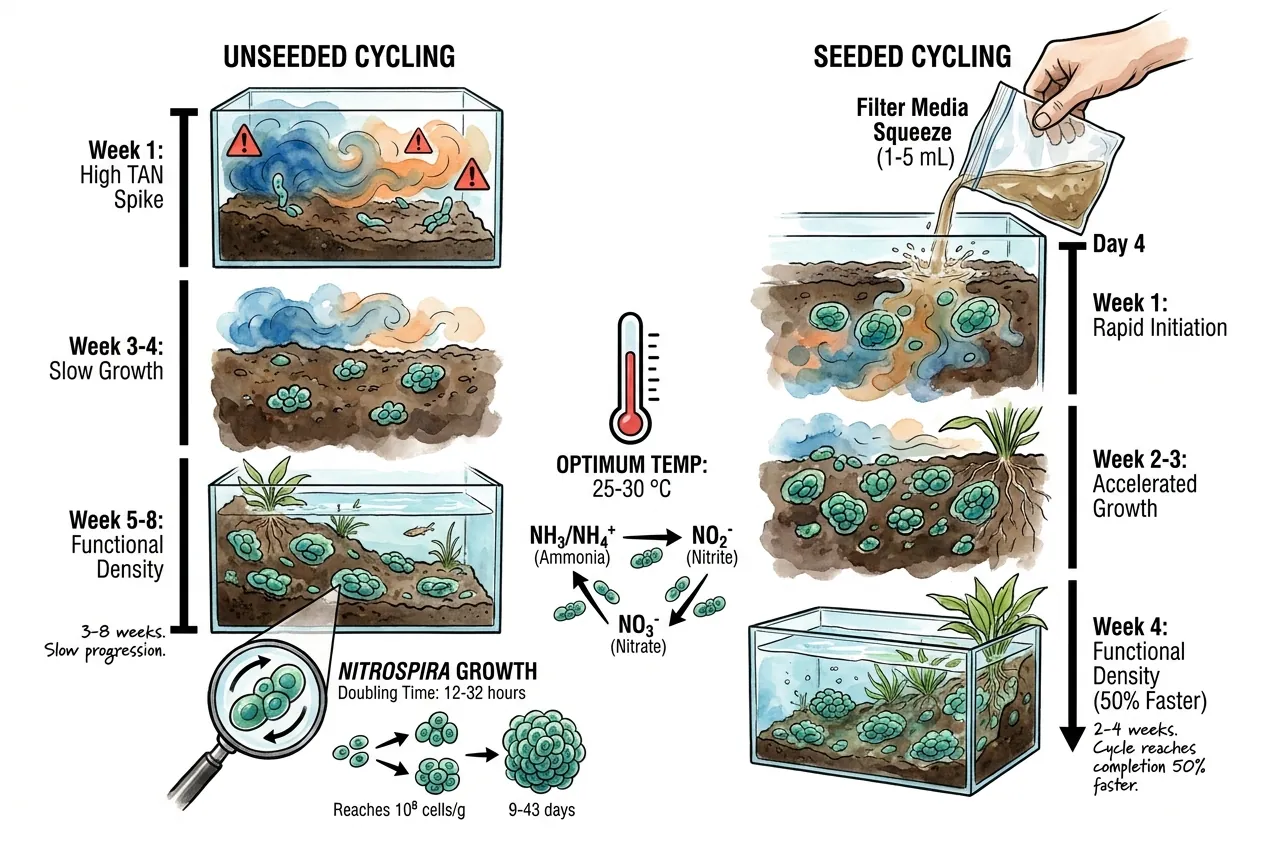
Roughly a few weeks unseeded, and often faster if you seed with mature filter media from an established, healthy tank.
Exact timing is variable and depends on temperature, the microbial community, and how much viable inoculum you add.
There is no dependable day when a filter becomes fully cycled. Real tanks do not follow an ideal laboratory growth curve, so look for falling readings and stable behavior rather than relying on a calculation.
Seeding with mature media is a reasonable accelerator. If you can get filter floss or sponge squeezings from an established tank, add them early.
Be aware you may also transfer pests, snails, algae, or pathogens along with the beneficial microbes, so use a source you trust.
Run the filter (seeded or not) from day 0, not partway through the week (it provides circulation, oxygen, and colonizable surface from the start, and delaying it only slows things down).
Seeding can shorten the cycle, but the exact speed-up is setup-dependent rather than a fixed percentage.
Should you dose pure ammonia or Dr. Tim’s on top of an aquasoil cycle?
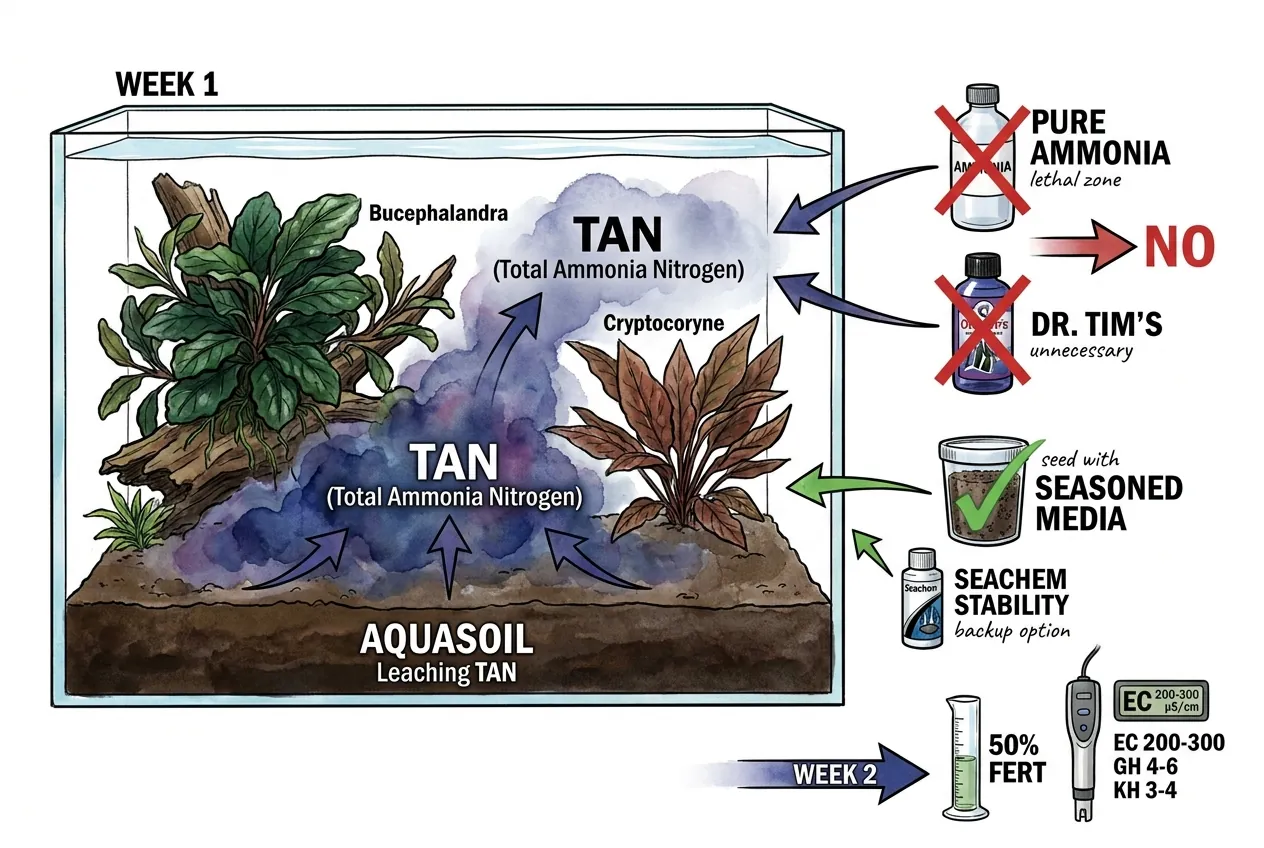
Usually not. If your soil is already producing plenty of ammonia (which you should confirm by testing) adding more from a bottle just raises free NH3 further, which is the opposite of what you want with ammonia-sensitive plants in the tank.
The exception is a setup where the soil releases very little. There, a controlled ammonia source or a fishless-cycle product can still make sense.
Bottled bacteria are optional if you can seed with mature media, but they are a reasonable choice when you can't.
If you use Seachem Stability, follow the label. The standard dosing is 5 mL per 40 L on the first day, then 5 mL per 80 L daily for the next seven days, not a full dose every day.
Its effectiveness relative to seasoned media varies by setup.
What about week 2 (when do you fertilize and what EC do you target?)
Frequent large water changes can leave the column low in K, Mg, and Ca, especially if the refill is under-remineralized, and a fresh high-CEC soil can also adsorb cations as it equilibrates.
Note that if you remineralize each refill to a target GH and EC, you are adding those ions back, so cations don't automatically fall to near-zero. Measure GH and EC rather than assuming a fixed drop.
Week 2 Adjustment
Once readings settle, common adjustments include the following.
- Reduce water changes (for example 30 to 50% every other day) once ammonia is trending down
- Begin dosing fertilizer conservatively (starting around half the manufacturer's planted-tank dose is reasonable because the soil still contributes some nitrogen) then adjust to your plants, light, and CO2
- Aim for a stable, modest EC rather than a specific number. More dissolved fertilizer raises EC but does not by itself prove the plants are getting the right nutrients
A soft-but-buffered profile in the rough range of GH 4 to 6 °dGH and KH 3 to 4 °dKH is a commonly used target for Bucephalandra tanks, but individual species and any livestock have their own needs, so treat it as a starting band rather than an optimum.
When should you start dosing macro fert again?
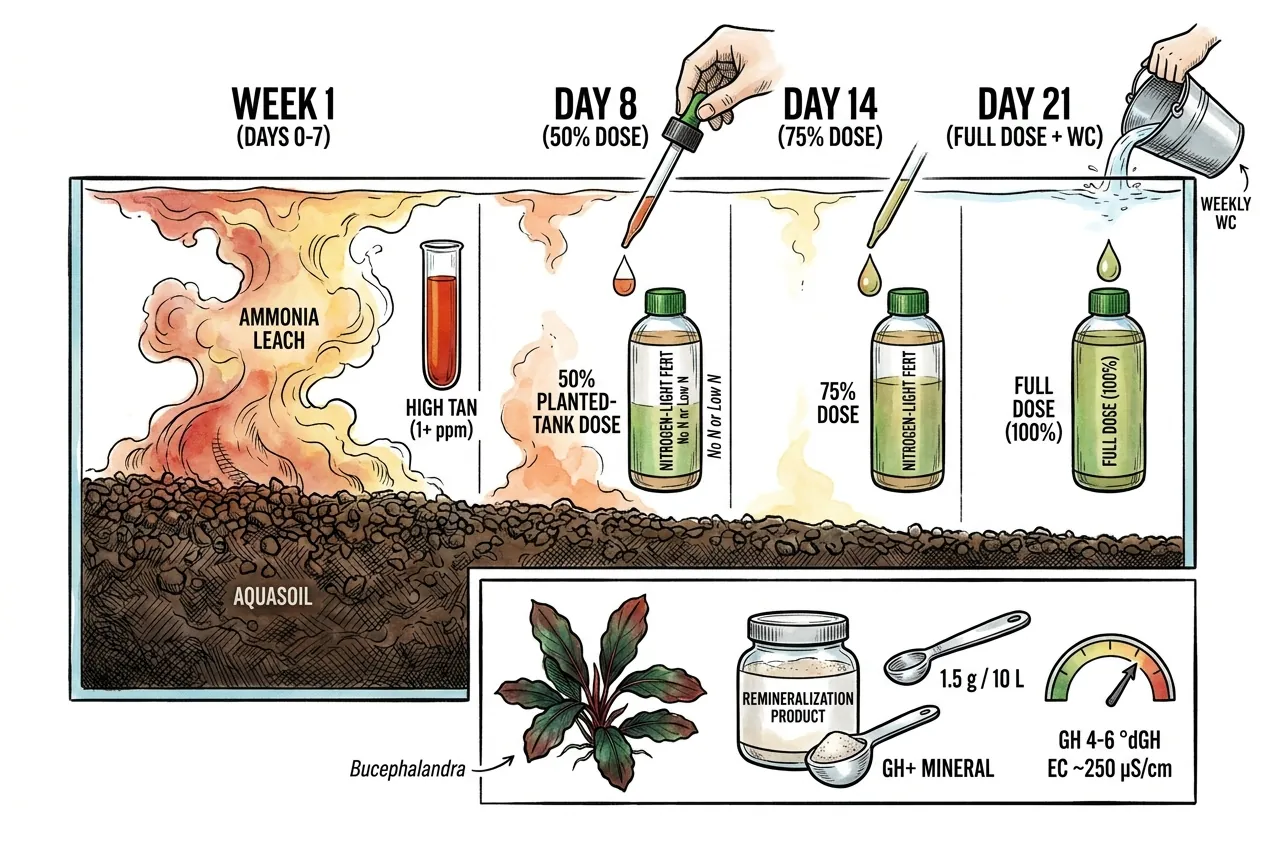
A conservative start (around half the planted-tank dose once ammonia is falling) is reasonable, then ramp up over the following weeks as the plants respond and readings stay clean.
Let the plants' growth and your nutrient tests drive the ramp rather than fixed calendar percentages. The soil still contributes some nitrogen early on, so a full dose can overshoot at first.
A nitrogen-light fertilizer can make sense while the source water or soil is already nitrogen-rich. Choose from the label analysis rather than a brand name. A nitrogen-free option is the safer starting point until the soil’s nitrogen release tapers off.
How to Set GH and KH for Bucephalandra Recovery
Use a GH remineralizer when RO/DI or very soft refill water needs calcium and magnesium. Test the prepared water and make small adjustments rather than dosing the tank from a spoon measure.
How Salty Shrimp GH+ Fits
Salty Shrimp GH+ suits RO/DI water where you need GH without deliberately raising KH, especially in a shrimp-oriented or soft-water setup. It is not the right single product when you also need more alkalinity, because KH must be managed separately. Mix the refill water first, test it, then add it gradually.
A general-purpose plant remineralizer can be a better fit when its mineral balance and alkalinity behavior match your livestock and source water. They are not interchangeable, so compare the label and the resulting GH, KH, and EC rather than treating either as a universal recipe.
For KH, a target around 3 to 4 °dKH from a separate buffer or a crushed-coral mesh bag gives a soft-but-buffered profile.
Keep in mind there is a tension here. An active soil is designed to lower KH, and a low-KH remineralizer like this one is designed to leave KH low, so continually adding buffer to hold KH up can shorten the soil's active life and complicate its pH behavior.
Some keepers accept a lower, drifting KH instead.
If KH falls very low and pH drifts down further than you want, you can raise KH with a small dose of sodium bicarbonate. Roughly 1/4 teaspoon per 10 gallons lifts KH by about 1 °dKH, but spoon measures vary, so weigh the dose if you can and re-test afterward.
Make changes gradually, since sudden KH or pH swings stress shrimp and more delicate plants.
What happens if EC stays low at day 10?
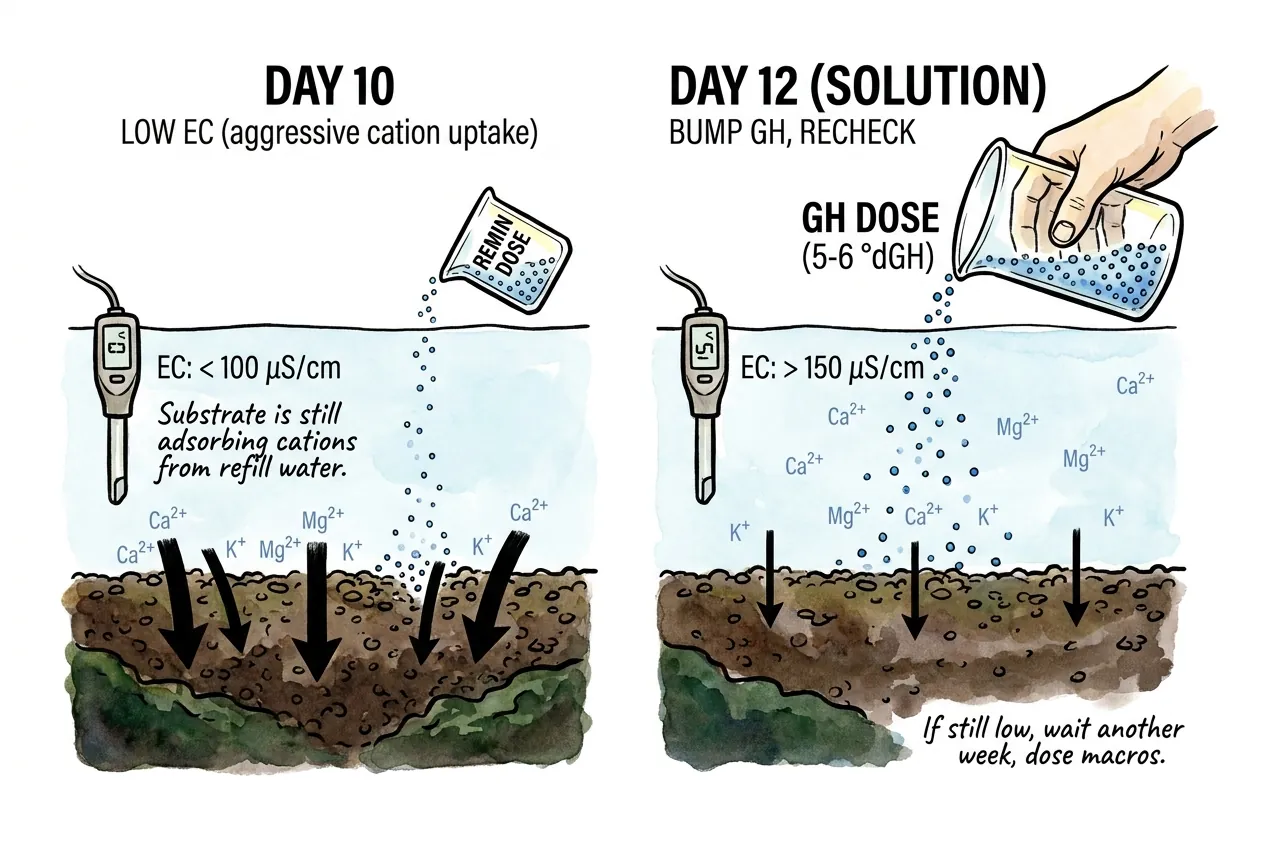
Low EC on its own doesn't prove any single cause. Before adding more minerals, rule out the simple explanations. A fresh water change dilutes the column, your meter may need calibration or a different conversion factor, the refill may be under-remineralized, and plants are also consuming nutrients.
A high-CEC soil adsorbing cations is one possibility among several, not a confirmed diagnosis.
If GH and EC genuinely read low after you've checked those, nudge GH up modestly with more remineralizer and re-test after 24 hours rather than dosing heavily at once. Over-adding is easy to do and hard to undo.
Keep fertilizer conservative in the meantime.
Which substrate should you pick for a Bucephalandra-heavy scape?
ADA Amazonia has a strong reputation for growth but a stronger initial ammonia release, so it asks more of your early routine.
Soils marketed as gentler starters tend to make an early Bucephalandra planting easier. The broad trade-off is between growth potential and how much early water-change work you take on, but confirm any given soil's behavior by testing, because there is no standardized public comparison.
The table below summarizes general tendencies, not measured data. Ammonia behavior varies by batch, soil mass, and setup, and packaged sizes differ between brands (some sold by liter, some by weight), so the safe on day 1 and price columns are rough guidance rather than controlled, like-for-like figures.
Check current prices and package sizes yourself.
| Substrate | Typical early ammonia | Easy Bucephalandra on day 1? | Notes |
|---|---|---|---|
| ADA Amazonia | Stronger release | No (plan on active water changes) | Test-driven routine needed |
| Tropica Aquarium Soil | Moderate | Marginal. Mild routine | Vendor suggests frequent early WCs |
| UNS Controsoil | Moderate | Marginal | Confirm by testing |
| Fluval Stratum | Milder (but not zero) | Often, if readings stay low | Vendor notes a slight ammonia rise is possible |
| Dennerle Scaper's | Milder | Often, on gentler batches | KH/pH-lowering soil |
Should you mix substrates to create a low-TAN refuge for Bucephalandra?
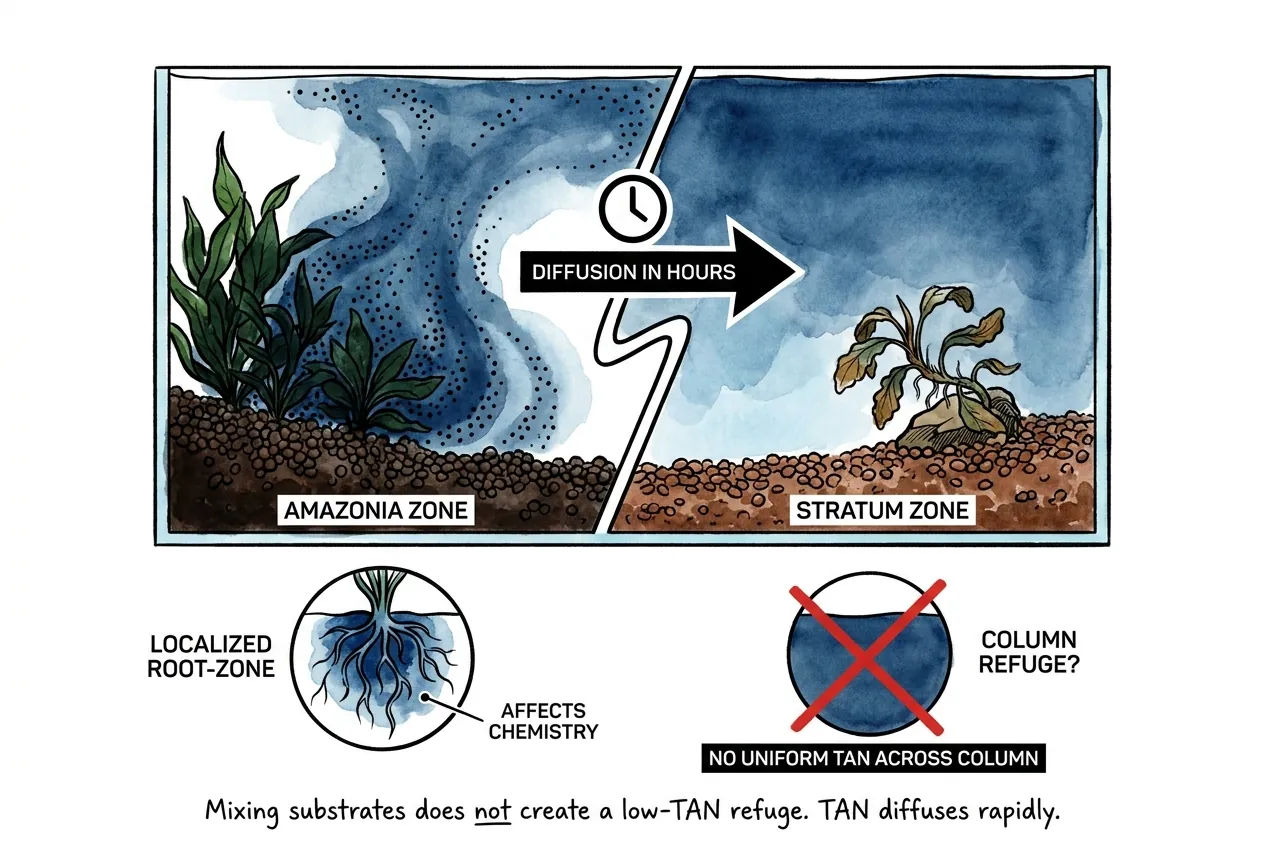
Generally no, at least not in the open water. In a circulated tank the water column mixes fairly quickly, so a mild-soil zone in front of an Amazonia zone ends up at a similar column ammonia level. You can't expect a low-ammonia refuge floating in the same shared water.
Exact timing depends on flow and tank geometry.
Substrate placement can still affect localized root-zone chemistry, but that is different from creating a column refuge.
It's usually simpler to pick one substrate that matches how much early maintenance you want to do.
The exception is dosing local root tabs into an inert substrate. That does create localized fertilization without TAN release. But that’s a different choice than running aquasoil at all.
Why does ADA Amazonia still get picked despite the early ammonia?
Its reputation for strong, sustained plant growth, a substrate color many aquascapers like, and a granule that many find durable through replanting.
These are widely held impressions rather than independently measured performance claims, so exact figures for longevity or compaction resistance aren't something to state as fact.
For demanding stem plants (Rotala, Ludwigia, Tonina), Amazonia is a popular, well-regarded choice, though final growth depends heavily on light, CO2, water-column dosing, and maintenance, not the soil alone, so beats everything else overstates it.
For a Bucephalandra-and-Anubias scape mounted on hardscape with no carpeting, a rich soil like Amazonia is arguably more than you need.
A milder soil can do the job with less early maintenance, since epiphytes on rock aren't relying on the substrate for nutrients.
Troubleshooting Common Week 1 Problems
Several issues commonly come up in week 1.
- The kit reads ammonia even while dosing Prime
- Ammonia won't drop as expected by day 7
- Bucephalandra melt progresses toward rhizome rot
- Other stressors that can mimic ammonia damage, including temperature or pH mismatch during water changes, low oxygen or flow, testing error, contamination, and ordinary transition melt
A common mistake is panic-moving Bucephalandra mid-cycle into a hastily set-up hospital tank with unfamiliar, unstable parameters, which can add stress rather than remove it.
That said, moving the plant is not always wrong. A genuinely stable, cycled tank that removes it from the ammonia source can be the better option.
Weigh the specific parameters and the plant's condition rather than following a blanket rule.
Why does my API kit show ammonia when I’m dosing Prime?
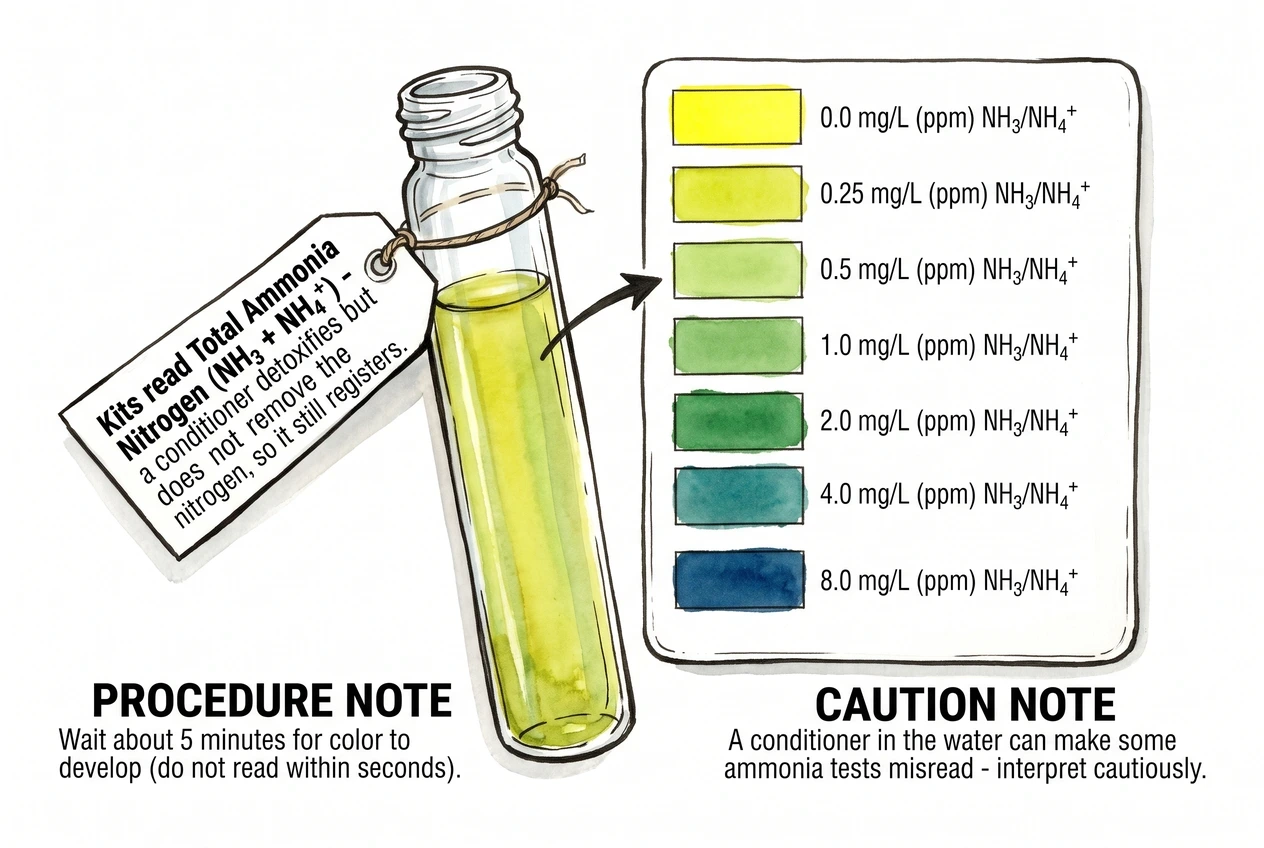
Often it's reading real total ammonia. Ammonia test kits measure Total Ammonia Nitrogen (NH3 + NH4+), and even after a conditioner detoxifies part of it, the nitrogen is still present and can still register.
Seachem's own position, though, is more cautious than always accurate. Nessler-based tests can read falsely high with Prime, and even salicylate tests can be affected because the complex can break down during the assay.
So a reading taken while Prime is present may or may not reflect toxic ammonia (interpret it carefully rather than treating it as a clean measurement).
If you use the API master (salicylate) kit, follow its instructions, which call for a roughly 5-minute color-development wait, not a 60-second read.
When in doubt, retest your source water separately and watch the trend over several days rather than trusting a single number.
What if TAN won’t drop below 1 ppm by day 7?
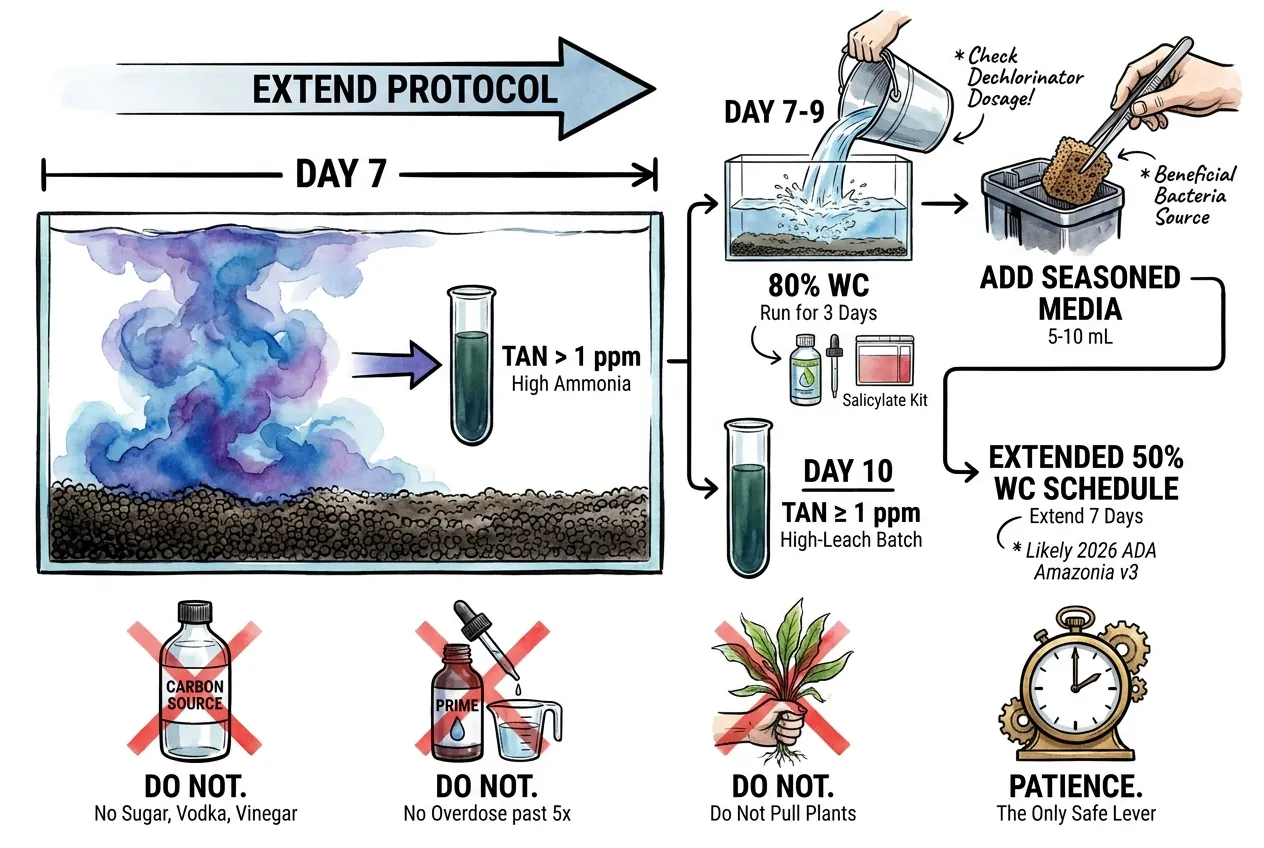
First, check the obvious causes before assuming the soil is at fault. Residual chloramine in your source water can register as ammonia, so verify your conditioner dose and test the source water on its own.
Also confirm your kit's procedure and timing, and check for decaying organic matter in the tank.
If those are clean, continue larger water changes and add seasoned filter media if you can get it.
A persistently high reading may mean a strong-release batch (in which case keep diluting and give the biofilter time) but confirm the diagnosis rather than assuming it.
Avoid Cycling Shortcuts
Don't dose a carbon source (sugar, vodka, vinegar) hoping to force the cycle, and don't heavily overdose the conditioner past label guidance.
There is no evidence a specific multiple of the normal dose is a safe ceiling.
Patience and continued dilution are the main safe levers, but they aren't the only ones. Correcting a measurement error, treating the source water, improving filtration and oxygenation, sizing a matched larger water change, removing decaying material, or using a stable holding tank are all legitimate steps depending on the cause.
How do I diagnose Bucephalandra rhizome rot vs a normal melt-and-recover?
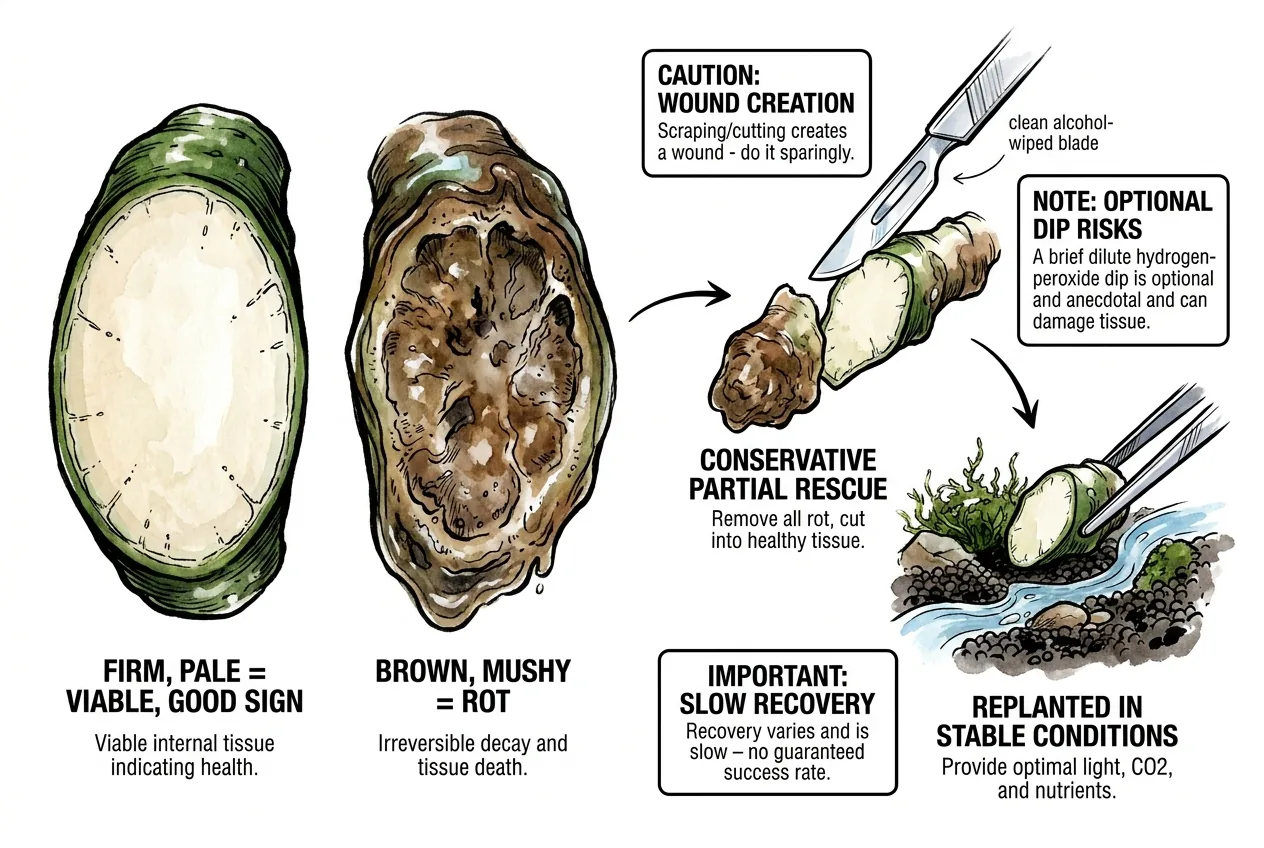
Lift the plant gently. A rhizome that is firm and pale inside is a good sign. Brown and mushy tissue indicates rot.
If you do check by scraping, remember that creates a wound, so be conservative. Once healthy, replant and keep parameters stable. New leaves can take several weeks to appear, and Bucephalandra recovers slowly, so don't expect a fixed timeline.
A foul, sulfurous smell can accompany rotting tissue, but odor alone isn't a definitive test (anoxic substrate can also smell sulfurous) so judge viability from firm-versus-mushy tissue rather than smell by itself.
If most of the rhizome is healthy and only a small section is rotted, a partial rescue is sometimes possible.
- Cut back into clearly healthy tissue with a clean blade (wipe with alcohol. Note a quick wipe isn't full sterilization)
- Some keepers dip the cut surface briefly in dilute hydrogen peroxide, but this is anecdotal and can also damage tissue, so it is optional and not a guaranteed step
- Replant the healthy portion in stable conditions and watch it over the following weeks
Success varies widely and depends on how much of the rhizome is affected and whether the underlying cause has been removed. There is no reliable published success rate, so don't count on any specific percentage.
What if my Bucephalandra leaves are coming in deformed or stunted week 3?
Deformed new growth has several possible causes, transition stress, physical damage, pests, CO2 issues, or a shortfall in one of several nutrients, so don't treat it as certain evidence of a specific deficiency.
A calcium or micronutrient shortfall after heavy early water changes is one plausible contributor.
If GH is genuinely low, raising it modestly is reasonable, but note that a GH remineralizer mainly supplies calcium and magnesium and does not necessarily contain boron, so bump GH to fix boron doesn't follow.
A complete trace fertilizer at a conservative dose can help if a micronutrient shortfall is really the issue, but confirm your water and substrate situation first rather than dosing blindly.
Improvement, if it comes, usually shows over a few weeks. (If you keep shrimp, be cautious with copper-containing traces, which shrimp are sensitive to.)
Pale or yellowing leaves can point to magnesium or iron, but the pattern and leaf position (new versus old growth) matter, and chlorosis has overlapping causes.
Test or reason it through before adding both magnesium and iron at once (dosing everything together risks creating an imbalance rather than fixing one).
Key Takeaways
- Fresh active aquasoil releases ammonium gradually through microbial mineralization rather than as a single dump. ADA Amazonia in particular has a reputation for a stronger early release, but exact per-batch ppm figures are not verified, so test your own water.
- What matters is free NH3, not the raw reading. The toxic fraction rises with pH and temperature, so compute it for your conditions rather than reacting to the total-ammonia number alone.
- A cautious week-1 routine uses the filter, matched water changes, and measured readings. Run the filter from day 0, keep lights low early if algae is a concern, and use a conditioner if your source water needs it.
- Larger water changes keep average exposure lower. A change around 80% is a practical balance, but there is no validated fixed safe threshold, so let readings guide you.
- You can often cycle with plants and seeded filter media instead of adding pure ammonia. Verify that the soil is actually supplying enough nitrogen, and test rather than reacting to a single reading.
Affiliate Disclosure
This article contains Amazon affiliate links. As an Amazon Associate I earn from qualifying purchases. If you use these links, the site may earn a commission at no extra cost to you. Product availability, price, and specifications can change. Check the current listing before buying.