
2025 Nano Aquascaping Trends for Vivarium Design
The 2025 AGA nano winners decoded: forced perspective and depth tricks, hardscape chemistry (lava vs. Seiryu), rheophyte planting, and how to scale nano techniques to big vivariums, with the claims kept to what the contest data actually supports.
Jordan Cole · Published 2025-12-12 · 10 min read
Key Takeaways
- The 2025 AGA nano (0–45L) top three winners share a design language built from dense, texture-driven diorama-nature layouts and forced perspective. That look contrasts with the minimalist open-water Iwagumi style, which is absent from these placements.
- Depth is an optical trick created by steep substrate banking, a backlit misty background, fractal planting with the same leaf shape shrinking toward the back, and a narrowing sand path.
- Hardscape safety is a measurement question, not a slogan. Seiryu stone is a carbonate rock that can raise pH and hardness, so in an enclosure with sensitive amphibians, test the actual water and match each species' published range rather than assuming any stone is safe or fatal. Lava rock is a lighter, porous, glue-friendly alternative.
- Use rheophytes and amphibious plants such as Bucephalandra, emersed stem plants, and fine mosses for humid vertical gardens. Build slopes on an egg-crate-and-foam armature designed for drainage and inspection rather than piled soil.
- To scale up, reuse the same small plants in greater numbers rather than switching to larger plants. Treat the landscape-ratio idea such as ~1/100 as an aesthetic guideline, not a fixed rule.
1. The 2025 AGA 0–45L Winners (What the Top Entries Share)
A 0–45 L aquarium cannot rely on large plants or massive hardscape. The strongest layouts create scale with a narrow focal path, dense small foliage, and a clear foreground-to-background plan.
Use a few repeated small textures, a path or opening that narrows toward the back, and hardscape that frames rather than fills the view.
I view a nano layout through a black paper aperture cut to the final front-glass dimensions and place a ruler-sized plant marker where the mature canopy will sit. The aperture removes the distracting room and exposes whether the scene still reads clearly at its true small scale.
Before adding substrate, I photograph the dry layout from normal seated and standing positions. If the composition works only from a low contest-photo angle, I rebuild it for the viewpoint I will actually use every day.
1.1 Structural Deconstruction of Top-Ranked Works
The top three entries answer the same space limit in three ways, using a vanishing perspective, a color-led narrative, and a fine-textured composition.
1.1.1 First Place. Green Path by Wasin Lertpornchaimongkol (Thailand)
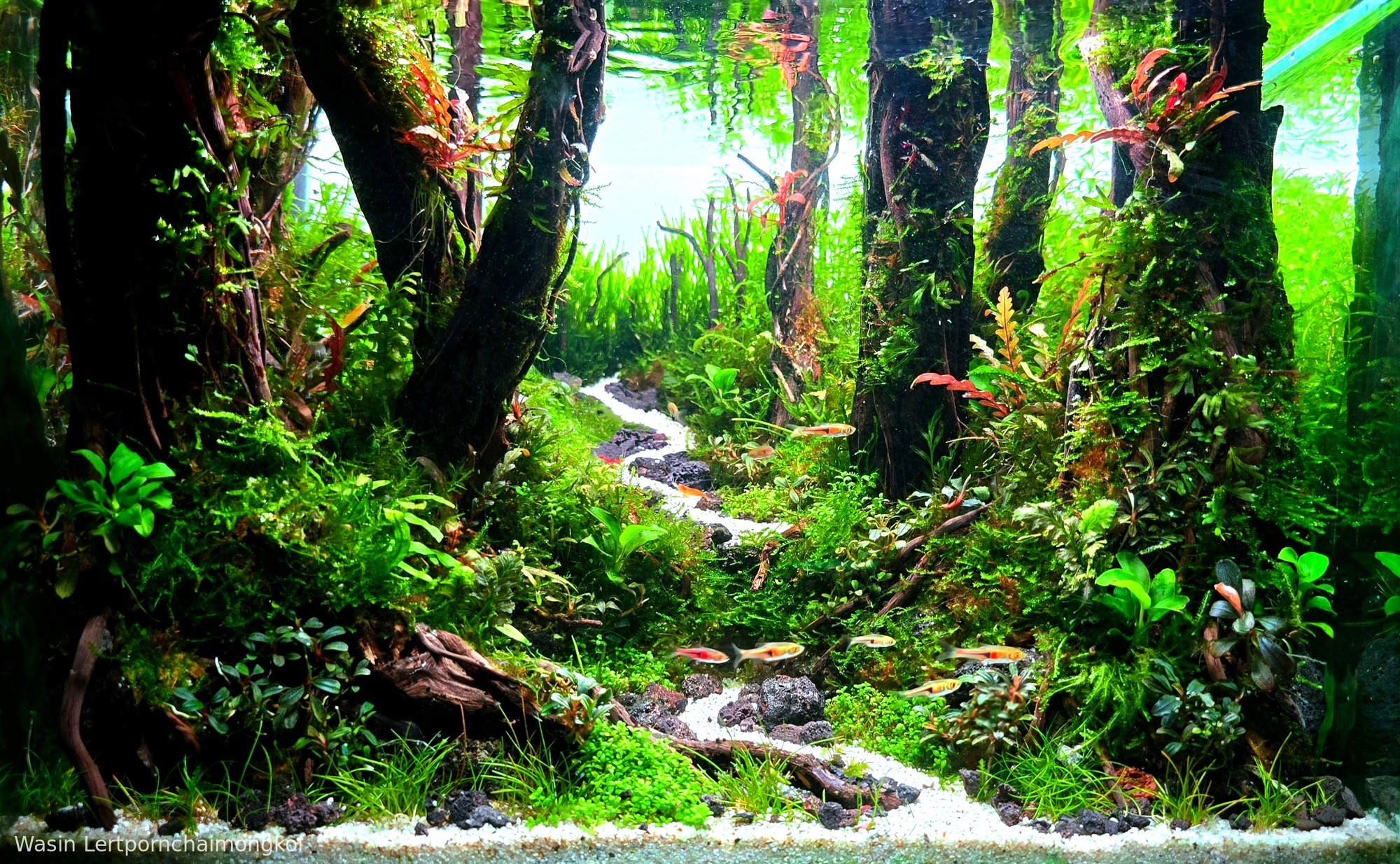
Green Path is the case study for infinite depth in nano volumes. In a tank only 36×30×25 cm (~27 L), it creates the illusion of a forest trail receding for meters.
The hardscape is the defining feature. Lava rock and wood build a concave layout where the sides rise to frame a central void, filled with a rising path of cosmetic sand that acts as a leading line toward a backlit horizon.
Lava rock matters here because its porosity and rough texture let epiphytes (Bucephalandra, mosses) attach in vertical orientations, creating cliffs rather than rock piles in a 25 cm-tall tank.
The planting is extremely dense, 13 species in a tiny volume, including Hygrophila pinnatifida, Crepidomanes, narrow-leaf Microsorum, and mosses, and uses fractal planting, with similar leaf shapes becoming progressively smaller toward the back to simulate distance.
One judge flagged the linear foreground as too parallel with the front glass. Horizontal lines parallel to the frame act as a visual barrier, so a display reads better when something breaks the front plane, such as roots or rocks that touch or obscure the glass and invite the viewer in.
1.1.2 Second Place. Jade's-Path by Ivo Adams Caricio De Menezes (Brazil)
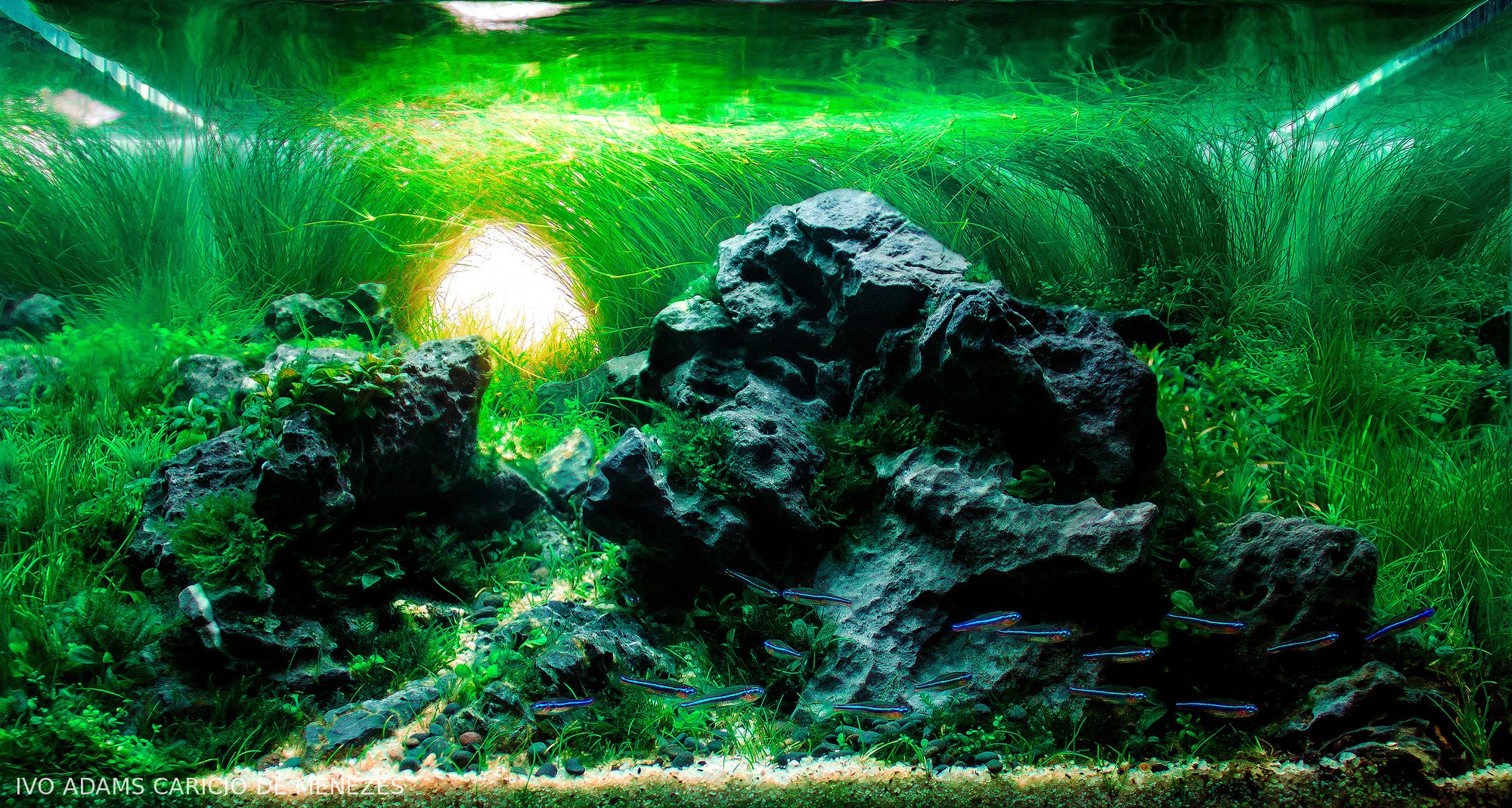
Jade’s Path uses cyan and cool green to create a mood instead of copying a natural color palette. Choose stone, plants, and light for how their colors work together, not only for their texture.
It leans toward fantasy scaping while keeping dense, tightly-groomed planting. The entry runs in the general Aquatic Garden class, and AGA has a separate Dutch category, so read Dutch-influenced as a description of the look, not its classification.
Choosing stones and plants for how their hue interacts with the lighting, not just their texture, is a technique vivarium designers, who often default to neutral cork bark and brown backgrounds, can borrow to modernize a display.
1.1.3 Third Place. Mushroom by Clayton Medeiros (Brazil)
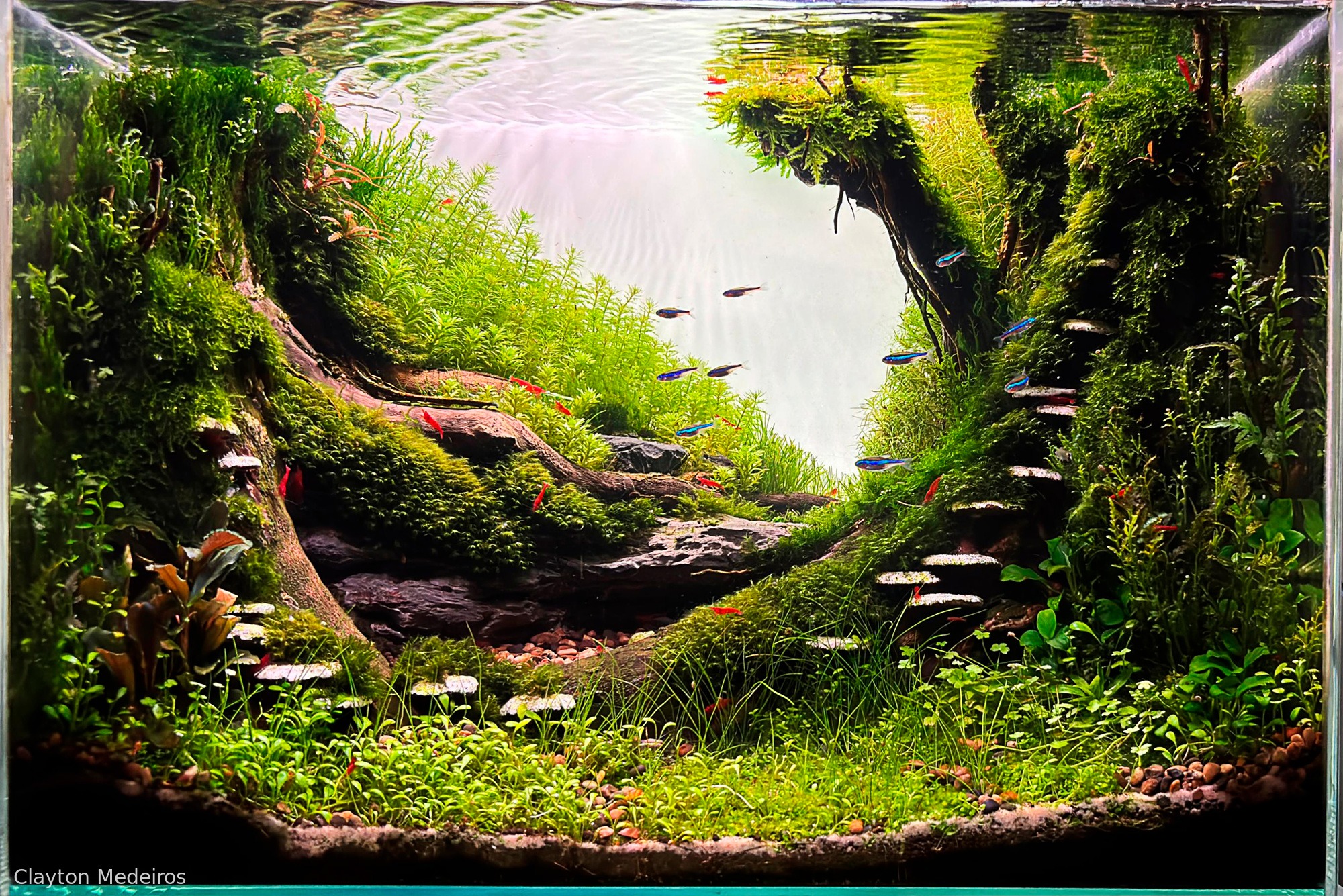
If Green Path is dense, Mushroom is restrained (a concave, valley-like composition where wood and fine planting on the sides frame a brighter, open center, with meticulously groomed fine-leaved plants like Myriophyllum sp. ‘Guinea’, Hottonia palustris, and weeping moss).
Fine, needle-like plants can suggest miniature trees, but they need frequent pruning to keep that effect.
Reflections on the back glass reveal the tank boundary. A matte background or polarizing filter helps preserve the sense of depth.
1.2 What the Top Tier Has in Common
For a dense nano style, combine rough stone or wood with a limited palette of small plants. Leave a deliberate open route through the layout so the scene does not become a flat wall of foliage.
2. Visual Mechanics (The Photographer's Perspective)
Depth Comes From Several Optical Cues
Depth depends on what the viewer sees from the front. Build the substrate higher at the back, use smaller details as the layout recedes, and keep the main view free of visual barriers.
A frosted, backlit rear panel can make the background appear farther away. An air-filled vivarium usually needs a steeper slope and smaller back planting than an aquarium to achieve a similar effect.
Choose light that keeps plants healthy first. Then adjust its color and direction for the display, remembering that photographs can make plant colors look more intense than they do in person.
Terrestrial vivariums lack the dancing caustics of agitated water. A photographer who wants that AGA energy can add artificial shimmer through point-source lighting with sharper shadows or a water feature that reflects light onto the canopy.
3. Hardscape Engineering (The Paludarium Artist's Perspective)
The structural backbone of these layouts is the hardscape, and material choice affects not just looks but water chemistry and biological stability.
3.1 The Seiryu Stone Dilemma
Hardscape Chemistry Is a Measurement Question
Seiryu stone is prized for its jagged, mountainous texture and grey-blue color, but it's a carbonate rock (largely calcium carbonate). In water it can leach and raise pH and carbonate hardness.
Whether that actually harms your animals depends on the species you keep, how much stone you use, the water volume, your starting pH/KH/GH, and your water-change routine, so measure the real water rather than assuming.
Many amphibians, including a number of Dendrobates dart frogs, do best in soft, near-neutral to slightly acidic conditions, so match the published husbandry range for the exact species you keep.
If you'd rather avoid the variable entirely, keep the stone in the dry zone or choose an inert rock.
Note that acid-washing only dissolves surface carbonate. It doesn't turn a carbonate rock inert, so don't treat acid-washed as a safety guarantee.
3.2 Lava Rock (The Bio-Active Engine)
Lava Rock as the Lower-Risk Structural Option
Lava rock (a vesicular volcanic rock, usually basaltic) transfers well to vivarium design.
It's lighter than granite or Seiryu, so it stacks with less load on the tank. Its porous, rough surface gives beneficial bacteria and epiphyte roots something to grip, and it takes cyanoacrylate readily.
One caveat is that commercially sold lava rock varies in porosity, density, and sharpness, so treat these as general tendencies rather than guarantees, and rinse it well before use.
For bonding lava rock and wood into those structures, a thick cyanoacrylate (CA) gel is a common choice because gel stays put on vertical joints better than a thin liquid.
Choosing a cyanoacrylate gel
A cyanoacrylate gel can bond small inert pieces, but a general-purpose formula is not automatically rated for aquarium use, prolonged submersion, or animal contact. Keep an unverified product to dry, above-water stone-and-wood joints. Before adding water or livestock, wait for the full cure time stated on the exact tube.
Cyanoacrylate is strong but brittle under shear, so do not use it for load-bearing flex joints. For documented enclosure use, compare aquarium-safe glues, silicone, and foam before committing.
3.3 Engineering the Infinite Slope
Build a Drainable, Inspectable Slope
To build a Green Path–style slope at large scale, piling soil won't hold. It compacts, can go anaerobic, and slumps.
Builders often cut light-diffuser (egg-crate) panels and zip-tie them into a stepped terrace armature, then cover it in mesh and expanding polyurethane foam carved to resemble rock (or coated in silicone and coco fiber).
Done well, this gives a lightweight, steep slope with vertical walls and overhangs (the tunnel effect of the nano tanks without the weight of real stone).
Whatever you build, design it so water can still drain and the structure stays inspectable, use materials rated for animal contact, and let foams, silicone, and epoxies fully cure and off-gas before adding livestock.
4. Botanical Trends (The Plant Specialist's Perspective)
Plants that naturally grip rock in wet, moving water can suit a humid vertical layout. Match each plant to its actual moisture zone instead of treating it as a universally wet-tolerant terrarium plant.
Bucephalandra
This is the defining genus of the modern nano scape. These slow-growing Bornean aroids offer metallic blues, purples, and reds with reflective stardust speckling under RGB light.
Because they are amphibious, Bucephalandra suit a vivarium's splash zone around waterfalls. In the wild, they grow on rocks that are alternately submerged and exposed.
How well a particular plant performs still depends on the variety, whether it is adapted to emersed growth, and the humidity, airflow, and temperature. In some setups, Bucephalandra can tolerate wet and dry cycles better than delicate terrestrial ferns or miniature orchids, but they are not universally tougher.
Many contest stem plants also have emersed (terrestrial) forms. Grown out of water in high humidity, Myriophyllum Guinea can tighten into a compact, conifer-like form (useful for a scale-correct forest floor that large-leaved terrarium plants can't achieve) and Rotala can sometimes be acclimated to provide a vertical purple accent.
Emersed conversion varies by plant and conditions, so expect to acclimate slowly and lose some pieces.
For moss, aquatic species often brown out in vivariums unless kept saturated, so terrestrial analogs that mimic the look are usually easier. Thuidium delicatulum (fern moss) suits lacy draping mats, while Leucobryum glaucum (cushion moss) forms rounded mounds.
The popular moss-slurry technique, which blends moss with buttermilk or beer and paints it on wood, carries a caveat. The sugars and dairy readily feed mold in a warm, humid enclosure.
A plain-water slurry plus good airflow (or simply pinning moss fragments in place) avoids that and is usually the safer route to getting moss to attach without a fungal bloom.
5. Applying Nano Trends to Larger Vivariums
Reuse Small Plants at Larger Scale
These techniques also work in a larger vivarium. Treat the enclosure as a larger version of the same scene, not an excuse to use oversized foliage everywhere.
Keep the leaf scale small and repeat it in clusters. Large plants can still work as accents, but they should not erase the depth created by the smaller foliage.
If a 45L tank uses one Anubias Petite to read as a bush, a much larger tank can use a cluster of them to keep the same visual scale.
Treat numbers like 50 or the 1/100 ratio as illustrations of the idea, not prescriptions, and check that the plant actually suits its position, since Anubias needs its rhizome in the right moisture zone rather than simply high ambient humidity.
The trees become large driftwood branches, but the leaves on them should be tiny Marcgravia or Ficus pumila Quercifolia, not big philodendron leaves.
The vanishing Green Path also helps with the black box problem of deep vivariums. Build a cosmetic-sand path that narrows toward the back as a visual highway, install a frosted rear panel backed by an LED strip for the backlit void, and add a fogger to hint at atmospheric perspective.
If you run a fogger, treat continuous fog as something to stage for photos, not a husbandry default. Put misting on a timer matched to the species' needs, keep real ventilation and drainage, and target the humidity your animals and plants actually require.
Recreating any of this, including precise planting, pruning fine species, and attaching epiphytes, is easier with long aquascaping tools than fingers in a deep tank.
Long aquascaping tool sets
A basic aquascaping tool set, long tweezers, curved scissors, and a spatula, covers most hobbyist tasks.
Check each tool’s listed length against the reach from your tank opening to the farthest planting point. Sets vary, and a length copied from one listing does not describe the category. In a deep or top-restricted enclosure, measure the working depth before buying.
Stiffness, hinge quality, edge retention, and corrosion resistance matter as well. Premium steel mostly pays off for heavy daily trimming. Whichever set you buy, dry the tools after use to prevent spotting.
6. Conclusion
Build the slope on a light, drainable, inspectable armature instead of piled soil, then use small-leaved plants in groups to make the layout read deeper.
Test water chemistry against the needs of the actual animals you keep, and balance plant-safe light with the visual effect you want.