Summary
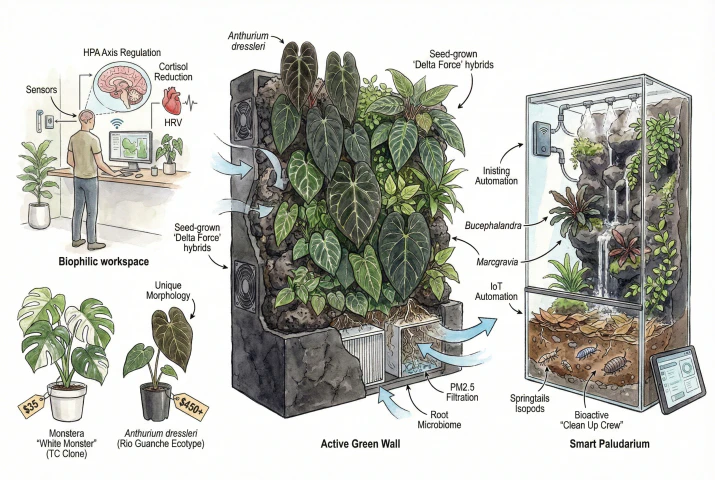
- Health & Science: In late 2025, indoor botany has evolved from a hobby to a public health necessity, with new research from the “Greenin” Initiative proving that plants and “Active Green Walls” are critical for filtering PM2.5 in airtight homes and regulating human stress hormones.
- Market Dynamics: The speculative “rare plant” bubble has burst due to the industrial scaling of tissue culture, crashing prices for cultivars like the Monstera ‘White Monster’ and shifting the high-end market toward unique, seed-grown Anthurium morphology that cannot be mass-cloned.
- Tech & Innovation: The hobby has matured into “bio-engineering,” where enthusiasts use IoT automation and bioactive principles to create complex, self-sustaining paludariums that replicate specific rainforest hydrological cycles.
Key Points
1. The Biophilic Health Revolution
- The Ventilation Paradox: Modern Net Zero homes trap particulate matter (PM2.5) from cooking and VOCs. 2025 research confirms that passive plants assist via leaf impaction, but Active Green Walls (forcing air through the root microbiome) are necessary for clinical-grade filtration.
- Physiological Impact: The Zandi and Wung systematic review (2025) provides clinical evidence that biophilic design directly regulates the HPA axis, significantly lowering cortisol (stress) levels and improving Heart Rate Variability (HRV).
- Biotic Furniture: Plants are now viewed as essential infrastructure for cognitive resilience and “attention restoration” in hybrid work environments.
2. Economic Restructuring & The Tissue Culture Crash
- Commoditization: The price of the Monstera ‘White Monster’ collapsed (~94% drop) due to the mass availability of tissue-cultured clones, democratizing access to formerly “rare” plants.
- The Shift to Texture: High-end collectors have pivoted away from variegated plants (which are easily cloned) to structural morphology. The new status symbols are dark, velvet-textured aroids like Anthurium dressleri and ‘Delta Force’ hybrids, valued for their unique, seed-grown genetics.
- Sustainability: There is a strong market movement toward peat-free substrates, utilising volcanic mineral mixes (Vulkaponic) and renewable fibers.
3. Engineered Ecosystems (Paludariums)
- Techno-Naturalism: The dominant trend is the “High-Concept Paludarium,” characterized by vertical “dripping walls” that support rheophytic plants like Bucephalandra and Marcgravia.
- Bioactivity: “Sterile” setups are obsolete. Modern enclosures rely on a living “Clean Up Crew” (Springtails and Isopods) to process waste and close the nutrient loop.
- Botanical Discovery: The hobby is fueled by new scientific discoveries, such as the critically endangered Thismia selangorensis and the “nano” Ovicula biradiata, which highlight the fragility and complexity of the micro-habitats enthusiasts attempt to replicate.
1. The Biophilic Health Revolution: From Aesthetics to Clinical Necessity
The reclassification of indoor plants from decorative objects to essential components of public health infrastructure represents the most significant academic and practical development of 2025. This shift is driven by a convergence of environmental urgency—specifically regarding indoor air quality (IAQ) in increasingly sealed buildings—and new psychophysiological data that links biophilic exposure directly to hormonal regulation.
1.1 The “Greenin” Initiative and the Particulate Matter Crisis
In December 2025, the release of findings from the “Greenin” Initiative marked a watershed moment in environmental health research. This multi-disciplinary project, designed to evaluate the efficacy of green infrastructure in residential settings, highlighted a growing invisible crisis: the accumulation of fine particulate matter (PM2.5) in modern homes.
1.1.1 The Ventilation Paradox in Net Zero Architecture
The drive toward Net Zero carbon emissions has revolutionized construction standards. Homes built or retrofitted in the mid-2020s are characterized by high-performance insulation and rigorous air-sealing to prevent heat loss. While beneficial for energy efficiency, this engineering approach has created what researchers term the “Ventilation Paradox”.
The “Greenin” data revealed that in these airtight environments, pollutants generated indoors cannot escape, and outdoor pollutants that infiltrate via HVAC systems are trapped and accumulate. The study found that PM2.5 levels—microscopic particles capable of entering the bloodstream—exceeded World Health Organization (WHO) safety guidelines on 41% of all monitored days in energy-efficient housing.
The sources of this pollution are primarily anthropogenic and ubiquitous:
- Combustion Events: High-temperature cooking, particularly frying and roasting, was pinpointed as a massive generator of carbonized particulate matter.
- Volatile Organic Compounds (VOCs): Off-gassing from synthetic furniture, cleaning agents, and building materials remains a persistent issue, compounding the particulate load.
1.1.2 Botanical Filtration Mechanisms: Physics Over Chemistry
While early research, such as the NASA Clean Air Study of 1989, focused on the chemical breakdown of VOCs in sealed chambers, the 2025 discourse centers on the physical mechanics of particulate deposition. Plants function as passive biological filters through the complex physics of the leaf surface boundary layer.
In the relatively stagnant air of an indoor room, a boundary layer of air adheres to the leaf surface. Particulate matter moving through the room eventually collides with this layer. The filtration occurs through two primary mechanisms:
- Impaction: Larger particles carry enough momentum to break through the boundary streamline and collide directly with the leaf surface, where they adhere to the waxy cuticle.
- Interception: Smaller particles are trapped by the leaf’s micro-topography—specifically the trichomes (hairs) and the rough ridges surrounding stomata (pores).
However, the “Greenin” findings emphasize the limitations of this passive process. A single potted plant, or even a cluster, is insufficient for clinical-grade air purification in a highly polluted environment. The data suggests that while plants can reduce certain pollutants by 20–50% in controlled settings, they cannot fully counteract severe outdoor PM2.5 infiltration without the assistance of mechanical aids like HEPA filters.
1.1.3 The Rise of Active Green Walls
To bridge the gap between passive biological potential and the urgent need for filtration, 2025 has seen the proliferation of “Active Green Walls.” These are not merely vertical gardens but integrated HVAC components. In an active system, fans force air through the root zone of the plants rather than just over the leaves.
This mechanism exploits the rhizospheric microbiome—the dense colony of bacteria and fungi living on the plant roots. These microorganisms are the true engines of VOC degradation, breaking down complex toxins like formaldehyde and benzene into harmless byproducts such as water and carbon dioxide. By actively circulating air through this biological matrix, active green walls increase the filtration efficiency by orders of magnitude compared to passive systems, effectively turning the plant installation into a biological air scrubber.
1.2 The Neuropsychology of Biophilia: Cortisol and Stress Regulation
Parallel to the physical health research, late 2025 has witnessed a breakthrough in understanding the psychological effects of indoor plants. The field has moved beyond subjective surveys of “happiness” or “satisfaction” to measurable, quantitative biomarkers of stress.
1.2.1 The Zandi and Wung Systematic Review (2025)
A landmark systematic review published in Frontiers in Physiology by Zandi and Wung in December 2025 has become the focal point of academic discussion. This review analyzed 124 studies regarding biophilic interventions in confined settings, ranging from hospitals and eldercare facilities to high-density urban apartments.
The review provided robust statistical evidence linking biophilic exposure to the regulation of the Hypothalamic-Pituitary-Adrenal (HPA) axis—the body’s primary stress response system.
- Cortisol Reduction: Exposure to biophilic design elements (plants, natural light, organic textures) is statistically linked to significantly reduced levels of salivary cortisol. Cortisol is the “stress hormone,” and chronic elevation is associated with anxiety, sleep disruption, and immune suppression. The finding that passive exposure to indoor nature can lower these levels provides a clinical basis for interior landscaping.
- Autonomic Nervous System Balance: The presence of greenery facilitates a shift from sympathetic arousal (the “fight or flight” response) to parasympathetic dominance (the “rest and digest” state). This is quantifiable through improved Heart Rate Variability (HRV), a key indicator of physiological resilience and cardiovascular health.
1.2.2 Attention Restoration Theory in the Hybrid Workplace
With a significant portion of the global workforce continuing to operate in remote or hybrid models in 2025, “work-from-home” fatigue has become a documented occupational health issue. The application of Attention Restoration Theory (ART) has gained renewed traction as a mitigation strategy.
ART posits that “directed attention”—the type of focus required for analyzing spreadsheets, writing reports, or attending virtual meetings—is a finite cognitive resource. When depleted, it leads to mental fatigue, irritability, and reduced impulse control. Nature provides what psychologists term “soft fascination”—stimuli that engage the mind without requiring effortful focus. The gentle movement of leaves in an airflow, the complex fractal patterns of a fern, or the slow growth of a vine offer a restorative experience that allows the mechanisms of directed attention to replenish.
Clinical Implications for Productivity:
Studies cited in the 2025 literature indicate that visual access to plants in the workspace can have profound effects on cognitive performance.
- Concentration: Participants in biophilic environments demonstrated concentration scores up to 28% higher than those in sterile environments.
- Mental Fatigue: Reported levels of mental fatigue were reduced by 39% in spaces with integrated greenery.
These findings have led to a new standard in interior design: plants are no longer treated as optional decor but as “biotic furniture,” essential for maintaining cognitive performance and emotional equilibrium in high-stress environments.
1.3 Biophilic Design Patterns for 2025
The practical application of these physiological and psychological findings has crystallized into specific design trends for late 2025. Architects and designers are employing a nuanced understanding of “nature in the space” versus “natural analogues.”
| Biophilic Pattern | Mechanism of Action | 2025 Implementation Trends |
|---|---|---|
| Visual Connection | Reduces cortisol via “soft fascination” and lowers blood pressure. | Strategic placement of large-leafed Monstera and Ficus in the direct eyeline of workstations to interrupt screen fatigue. |
| Non-Rhythmic Sensory Stimuli | Mimics the unpredictable, calming nature of the outdoors; engages “soft fascination.” | Integration of gentle airflow systems to create leaf movement; use of water features in paludariums to provide auditory cues. |
| Material Connection | Haptic engagement reduces sympathetic arousal; grounds the user in the physical environment. | Shift away from plastic pots to unglazed terracotta, cork, and bioactive substrates; use of stone and wood in hardscapes. |
| Dynamic & Diffuse Light | Regulates circadian rhythms and melatonin production. | Use of smart lighting systems that mimic the color temperature shift of natural daylight (cool blue AM to warm amber PM). |
The integration of these elements creates environments that are not just visually green but physiologically restorative. The “biophilic” home or office of 2025 is a machine for health, using the ancient biological connection between humans and nature to counteract the stressors of modern technological life.
2. The Economic Restructuring: Scarcity, Abundance, and the Tissue Culture Crash
The second major topic dominating the plant community in December 2025 is a dramatic economic correction. The “rare plant” market, which saw exponential, speculative growth during the COVID-19 pandemic (2020–2022), has undergone a fundamental restructuring. This “bubble burst” has democratized access to formerly exclusive species while simultaneously shifting the high-end collector market toward traits that cannot be easily mass-produced, such as unique morphology and texture.
2.1 The “White Monster” Crash: A Case Study in Commoditization
The defining economic event of late 2025 is the market collapse of the Monstera deliciosa ‘White Monster’. This cultivar, characterized by its unique “minty” white variegation and notoriously slow growth, was considered the “holy grail” of aroid collecting as recently as 2024.
2.1.1 The Valuation Collapse
Market data from December 2025 illustrates a precipitous drop in value, reminiscent of historical economic bubbles like Tulipomania, though accelerated by modern biotechnology.
Table 1: The ‘White Monster’ Price Crash (2023 vs. 2025)
| Plant Form | Peak Valuation (Est. 2023/2024) | Dec 2025 Price (Observed) | Percentage Drop |
|---|---|---|---|
| Rooted Cutting | $2,500 – $3,000 | $150 – $180 | ~94% |
| Mature Plant | $5,000+ | $300 – $450 | ~92% |
| TC Plantlet | N/A (Not available) | $35 – $73 | N/A |
This collapse is not unique to the ‘White Monster’; similar corrections have been observed in other formerly rare cultivars like the Monstera ‘Thai Constellation’, which has become a staple in big-box retail stores, available for as little as $32.
2.1.2 The Mechanism: The Industrialization of Tissue Culture
The driver of this crash is the industrial scaling of plant tissue culture (TC). Tissue culture, or micropropagation, is a biotechnological process where plant cells (explants) are grown on a sterile nutrient medium under controlled laboratory conditions to produce clones.
The Micropropagation Process:
- Initiation: A small piece of plant tissue, often the meristem, is sterilized and placed on an agar gel containing specific plant hormones (cytokinins and auxins).
- Multiplication: The hormonal balance triggers the tissue to produce multiple shoots rather than roots or leaves. This exponential growth allows a single explant to yield thousands of genetically identical clones in a matter of months.
- Rooting and Hardening: The shoots are transferred to a rooting medium and then moved to soil (ex vitro) to acclimatize to ambient humidity.
By 2025, the global tissue culture market has grown to an estimated $570 million, with a projected Compound Annual Growth Rate (CAGR) of nearly 9% through the next decade. Laboratories in Thailand, the Netherlands, and Indonesia have perfected protocols for recalcitrant aroids, allowing them to bypass the slow linear growth of traditional propagation (cuttings). Furthermore, TC plantlets can be shipped internationally in sterile flasks (agar) without soil, bypassing many of the strict agricultural quarantine restrictions that apply to potted plants. This created a flood of supply that rapidly outstripped the demand of the high-end collector market, erasing scarcity premiums.
2.2 The Shift to “Designer” Anthuriums: Texture over Variegation
As variegation becomes commoditized—available at garden centers and supermarkets—the “high-end” collector market has pivoted to maintain exclusivity. The new status symbols in December 2025 are not defined by color mutations (which can be cloned) but by morphology (shape), texture, and unique genetic lineage.
2.2.1 The “Dark and Velvety” Trend
The trend has moved decisively toward the genus Anthurium, specifically species with dark, velvet-textured leaves. Unlike Monstera, which are hemiepiphytes that scramble up trees, many sought-after Anthuriums are terrestrial or lithophytic, offering a structural presence.
- Key Species: Anthurium dressleri (specifically the “Rio Guanche” ecotype) and Anthurium papillilaminum are the new benchmarks. A. dressleri is prized for its deep, almost black, velvet appearance and reddish-purple emergent leaves. A. papillilaminum offers a variability in leaf shape that fascinates collectors.
- Phenotype Hunting: The market in 2025 is driven by seed-grown hybrids. Because Anthuriums are propagated sexually (via pollination), each seedling is genetically unique, unlike a clone. When two high-quality parents are crossed (e.g., A. papillilaminum x A. dressleri), the offspring display a range of traits (phenotypes). Collectors now engage in a “phenotype hunt,” paying premiums for individual seedlings that display the darkest colors, widest lobes, or most prominent veining. This uniqueness acts as a hedge against the tissue culture commoditization that destroyed Monstera values; a specific, unique seedling cannot be instantly mass-produced without years of cloning work.
2.2.2 The ‘Delta Force’ Benchmark
The hybrid Anthurium ‘Delta Force’ (A. clarinervium x A. pedatoradiatum) exemplifies this trend. Its stiff, deltoid (triangular) leaves offer a structural, architectural aesthetic that differs from the common heart-shaped anthuriums. While ‘Delta Force’ is now entering tissue culture (causing its own price correction to ~$112), it established the “geometric” aesthetic that dominates 2025 design trends. The market now seeks new hybrids that can replicate this structural appeal.
2.3 Sustainability and the Substrate Revolution
The maturation of the market is also evident in the shift toward sustainable cultivation practices. The use of peat moss, a non-renewable resource with a high carbon footprint, is increasingly stigmatized. In 2025, the standard for high-quality substrates involves complex, peat-free mixes.
Sustainable Substrate Components:
- Vulkaponic: A mineral substrate of volcanic origin (pumice, lava rock, zeolites) that is sterile, reusable, and provides excellent drainage. It is gaining traction as an eco-friendly alternative to soil.
- Biochar and Coco Coir: Renewable organic amendments that improve water retention and soil structure without the environmental cost of peat extraction.
- Fernwood Tree Fern Fibre: A sustainable byproduct that has become a staple for epiphytic aroids, offering superior aeration for root systems.
This shift reflects a broader consumer demand for “provenance” and sustainability. Collectors in 2025 are not just buying a plant; they are buying into an ethical framework that values seed-grown diversity and environmentally responsible horticulture.
3. The Renaissance of the Enclosed Ecosystem: Paludariums and Vivaria
The third major topic is the technological and artistic evolution of the “arium”—specifically Paludariums (enclosures with both land and water) and Vivariums (enclosures for animals). In December 2025, the hobby has matured from keeping plants in pots to engineering complex, self-sustaining biomes. This “Techno-Naturalism” combines high-level engineering with deep biological understanding.
3.1 The “SerpaDesign” Influence and the Paludarium Aesthetic
The “High-Concept Paludarium” has become the dominant artistic trend, heavily influenced by content creators like Tanner Serpa (SerpaDesign). His December 2025 showcase, the “Dripping Moss Jungle Cliff Peninsula Paludarium,” has set the standard for the community.
3.1.1 Engineering the Vertical Wetland
The 2025 aesthetic is defined by extreme verticality and the “Dripping Wall” technique. This design mimics the seepages and vertical cliff faces found in tropical rainforests, creating a habitat that is neither strictly aquatic nor strictly terrestrial.
- Hardscape Engineering: Hobbyists achieve gravity-defying structures using “super glue composite bonding.” This technique involves using cyanoacrylate adhesive combined with cigarette filters or cotton pads to instantly bond heavy rocks (like Seiryu or Dragon stone) into large, stable arches and overhangs. This allows for the creation of intricate three-dimensional landscapes that maximize surface area.
- Hydrology and the “Splash Zone”: The defining feature is the integration of hidden water pumps that lift water from the aquatic section to the top of the hardscape. The water is distributed via spray bars or drip lines, allowing it to trickle down through mosses and rocks. This process ensures 100% saturation and high oxygenation, replicating the “splash zone” of a waterfall. This specific microclimate is critical for supporting rheophytic plants.
3.1.2 Biota Trends: The Micro-Jungle
The plant selection for these setups has shifted toward “micro-epiphytes”—plants that stay small but offer complex textures, creating the illusion of a vast landscape in a small footprint (the “nano” aesthetic).
- Bucephalandra: A rheophyte from Borneo, highly favored for its iridescent leaves and ability to bloom underwater. It thrives in the high-flow, high-humidity zones created by the dripping walls, anchoring itself to rock surfaces.
- Marcgravia: Shingling vines that climb flat against the glass or rock, creating living green walls. Their overlapping leaves provide a scale-like texture that visually anchors the background.
- Aquatic/Terrestrial Interface: Plants like Anubias and Cryptocoryne are used at the waterline, capable of growing both submerged and emersed, blurring the line between the two worlds.
3.2 Bioactivity and the “Clean Up Crew”
A non-negotiable standard for 2025 terrariums is bioactivity. This refers to the inclusion of a living “Clean Up Crew” (CUC) that processes waste, creating a closed nutrient loop. A “sterile” terrarium requires constant cleaning; a “bioactive” terrarium cleans itself.
3.2.1 The Nitrogen and Waste Cycles
- The Aquatic Cycle: In the water section, beneficial bacteria (Nitrosomonas, Nitrobacter) colonize the filter media and substrate. They convert toxic ammonia (from animal waste) into nitrites and then nitrates, which the aquatic plants absorb as fertilizer.
- The Terrestrial Cycle: On land, the CUC breaks down decaying leaves, mold, and animal waste.
- Springtails (Collembola): Specifically Folsomia candida (“Temperate White”). These minute hexapods are the first line of defense against mold. They consume fungal hyphae, preventing rot in the high-humidity environment.
- Isopods (Oniscidea): Woodlice that serve as the “heavy lifters” of decomposition. In 2025, “designer isopods” (like “Dairy Cows” or “Rubber Duckies”) have their own sub-market, but the functional focus remains on waste management. Trichorhina tomentosa (“Dwarf White”) is the industry standard for its ability to burrow and aerate the substrate.
3.3 New Discoveries Fueling the Narrative
The allure of the “jungle in a box” is heightened by real-world botanical discoveries in late 2025. Two specific discoveries have captured the community’s imagination, reinforcing the sense that the natural world is still largely unexplored and worthy of preservation.
3.3.1 Thismia selangorensis (The Fairy Lantern)
In December 2025, the scientific description of Thismia selangorensis made waves in the botanical community.
- The Plant: A mycoheterotroph, meaning it does not photosynthesize. Instead, it parasitizes fungi in the soil to obtain nutrients. It lacks chlorophyll and appears as a small, intricate lantern-like flower, often colored peach or brown to blend with leaf litter.
- Ecological Niche: Discovered in the Sungai Tekala Recreational Forest in Selangor, Malaysia, it occupies a hyper-specific niche in the moist, shaded soil near tree buttresses.
- Significance: Its discovery in a popular picnic area highlights the biodiversity hidden in plain sight. Critically endangered due to its limited range and sensitivity to trampling, it serves as a potent symbol for the fragility of the micro-habitats hobbyists attempt to replicate.
3.3.2 Ovicula biradiata (The Wooly Devil)
A new genus and species discovered in Big Bend National Park, Texas, described in February 2025 but trending in discussions in late 2025.
- The Plant: A “belly plant,” visible only when lying prone on the ground. It is a tiny member of the sunflower family (Compositae), characterized by its densely white-woolly foliage and maroon ray florets that look like “devil horns.”
- Significance: It is the first new plant genus discovered in a U.S. National Park in 50 years. This discovery resonates with the “nano” trend in terrariums—the appreciation of the minute, the detailed, and the resilient. It underscores the vastness of what remains unknown even in well-surveyed environments.
3.4 Technological Integration: The “Smart” Vivarium
Finally, the maintenance of these complex systems has been revolutionized by IoT (Internet of Things) integration. The “Smart Vivarium” of 2025 is a semi-autonomous robot for life support.
- Automated Hydration: Systems like MistKing are standard for high-end builds. They use high-pressure pumps and precision nozzles to deliver a fine mist (50 microns) that mimics cloud cover. Timers can set cycles down to the second (e.g., 12 seconds every 4 hours) to maintain the critical 70-90% humidity range required for tropicals without saturating the soil.
- Feedback Loops: Advanced controllers (e.g., GOcontroll Moduline) use sensors to create feedback loops. If the humidity sensor drops below a set threshold, the controller triggers the misting system. If the temperature rises, it triggers ventilation fans. This allows for the “Forever Ecosphere” concept—systems that can run for weeks or months without human intervention, maintaining stability through algorithmic control.
- Lighting Physics: The understanding of Photosynthetically Active Radiation (PAR) has improved. Hobbyists now use full-spectrum LED lights that can be programmed to simulate a “sunrise” and “sunset,” gradually ramping up intensity. This not only benefits plant photosynthesis but also regulates the circadian rhythms of the animals (like dart frogs or geckos) living within the enclosure.
Conclusion: The Maturity of the Indoor Jungle
The state of indoor botany in December 2025 is defined by a newfound depth. The hobby has successfully navigated the post-pandemic market correction, emerging as a diverse ecosystem of its own.
- Health: Plants are no longer just decor; they are recognized biological components of a healthy indoor environment, essential for mitigating the stress of modern confinement and filtering the particulate matter of energy-efficient homes.
- Economics: The market has corrected. Tissue culture has democratized beauty (making the ‘White Monster’ accessible), pushing true collectors toward the un-cloneable uniqueness of seed-grown genetics and morphology. The bubble has burst, but the foundation is solid.
- Ecology: The terrarium has evolved into the paludarium—a complex, automated, bioactive machine that replicates the hydrologic and nutrient cycles of nature. This engineering is fueled by a deep appreciation for biodiversity, constantly renewed by scientific discoveries like Thismia selangorensis that remind us of the wonders still hiding in the leaf litter.
For the enthusiast and the general public alike, 2025 offers a stable foundation: plants are more accessible, the technology to keep them alive is more advanced, and the science proving we need them is stronger than ever. The indoor jungle is no longer a trend; it is a permanent, functioning part of the modern human habitat.


Leave a Reply