
Bioactive Terrarium Guide: Layers, Plants & Cleanup Crew
Build a bioactive terrarium with the right enclosure, drainage, substrate, plants, springtails, and isopods. Learn airflow, cycling, and maintenance limits.
Samuel Reed · Published 2025-12-07 · 18 min read
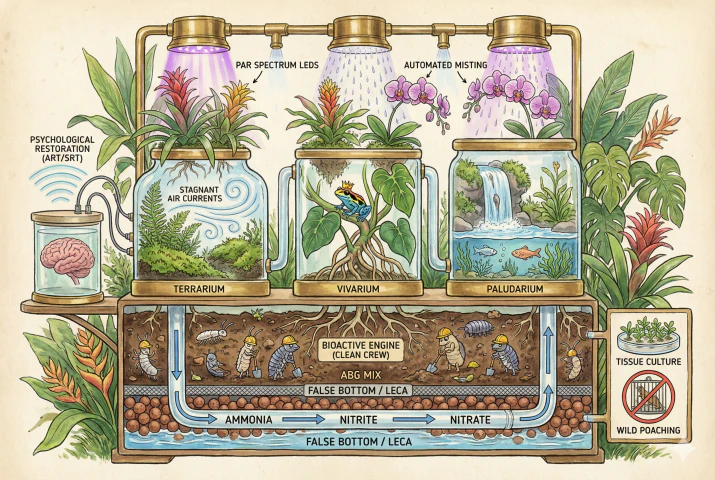
Key Takeaways
- Choose the enclosure by what it must support. A terrarium centers on a land planting, a vivarium houses animals whose needs change the setup, and a paludarium or riparium adds a managed water section. Any animal enclosure needs species-specific husbandry.
- Indoor plants do not replace ventilation or reliably purify a room. A re-analysis found that matching normal ventilation would require roughly 10–1,000 plants per square meter. Their better-supported benefits are mostly psychological, while a sealed terrarium recirculates its own moisture.
- Near-saturated humidity can slow transpiration and nutrient movement. Gentle airflow may help, but the response depends on species, leaf temperature, and fan placement, so test the result instead of assuming a fan is a cure.
- A bioactive cleanup crew reduces some routine work but does not make an enclosure maintenance-free. Springtails and isopods fragment waste while microbes do most mineralization, yet keepers still spot-clean, remove waste, and test water where needed.
- Build the root zone so water can drain away from the substrate. Use an open, compaction-resistant mix over a managed reservoir, keep soil out with a mesh barrier, and rely on an air gap rather than mesh alone to break capillary contact. Prefer verified nursery-propagated or tissue-cultured plants over wild-collected stock.
A Bioactive Build Is a Managed System
A bioactive enclosure can be a rewarding planted display, but it is not a set-and-forget project. Its plants, substrate, water, and any animals all need regular observation and maintenance.
Build around the needs of the plants or animals you intend to keep, then make drainage, airflow, safe equipment access, and routine maintenance easy to manage.
I draw the drain, false-bottom access, electrical exits, feeding area, and removable planting pockets on a photograph of the empty enclosure. Beside each one I write how it can be reached after the plants mature.
That image stays with the build records. When water rises or a pump stops months later, I can reach the correct access point without probing blindly through roots and substrate.
Choose the Enclosure Type by Its Job
Terrarium, vivarium, and paludarium often overlap in everyday hobby use. Useful working labels describe their common structural priorities rather than a settled taxonomy.
Terrarium (Land Planting and Water Cycle)
A terrarium is usually a land planting of plants, mosses, and the microbes that live with them. A closed design recycles moisture as water evaporates, condenses on the glass, and returns to the substrate.
Match the planting to the enclosure. Cool-growing mosses and ferns need different conditions from tropical plants, while succulents need open air and a fast-draining root zone. A glass vessel without a drainage hole can still drown roots, so use the condensation guide alongside careful watering and an open mix.
Vivarium (Animal Needs Come First)
A vivarium is an enclosure built around animals, most often amphibians or reptiles. Their needs determine the setup.
A planted terrarium is arranged for plants. In a vivarium, animal welfare comes first, even where that limits the planting. A poison dart frog enclosure needs humidity, secure barriers, ventilation, drainage, and sanitation. An arid reptile enclosure needs a heat gradient and, for many species, UVB, so only drought-tolerant plants will suit it. Use the VPD and airflow guide to understand how heat and humidity interact, but confirm the required temperature, lighting, UVB, and sanitation routine for the exact animal before building.
In practice the difference is one of emphasis rather than a hard line. Planted terrariums may also use fans, heat, and lights, and animal enclosures still rely on natural processes in the substrate.
Paludarium and Riparium (Add a Water Zone)
| Enclosure Type | Usual Focus | Key Build Challenge | Common Inhabitants |
|---|---|---|---|
| Terrarium | Land planting | Drainage, humidity, and mold control | Tropical plants, mosses, ferns |
| Vivarium | Animals | Species-specific heat, sanitation, and escape prevention | Reptiles, amphibians, invertebrates |
| Paludarium | Land and water zones | Separating land and water, filtration, and electrical safety | Semi-aquatic amphibians, crabs, fish |
| Riparium | Shoreline plants above water | Anchoring plants and maintaining water quality | Fish and marginal plants |
Land and Water Balance
Adding a significant water volume creates the most demanding enclosures. The paludarium (palus, marsh) has both a terrestrial zone and an aquatic zone. A rough 50/50 split is one common arrangement, but there is no standard ratio. What matters is the usable land and water depth for the intended inhabitants.
Construction and Safety
Its challenges are several. Keeping the land mass from collapsing into the water, managing the water chemistry of a heavy-bioload aquatic section, and (because power and glass sit next to standing water) containing leaks and wiring electrical equipment safely.
Riparium at the Water’s Edge
The riparium (ripa, shore) is a related style, not a formal subcategory. Instead of building a land mass, it simulates a water’s edge, often with marginal plants in rear-glass planters, roots submerged and foliage in the air.
Why Ripariums Still Need Maintenance
Removing the soil land mass drops one failure mode (soil wicking and turning anaerobic), but ripariums are not automatically easier. You still manage plant anchoring, water quality for any fish, hydroponic-style nutrients, evaporation, and root rot.
Keep Wellbeing Claims Proportional to the Evidence
A planted enclosure can make a room more enjoyable to spend time in. Treat that as a personal benefit, not a medical treatment or a guarantee of better concentration.
Attention Restoration Is Plausible, Not Guaranteed
Looking at a calm, living display may give your attention a gentle break from a demanding task. Studies of indoor plants suggest possible mood and restoration benefits, but they do not show that a complex terrarium works better than a simple healthy plant.
Choose an enclosure because you enjoy caring for it, not because you expect it to improve concentration or treat stress.
Stress-Reduction Studies Use Mixed Exposures
Studies of nature views, plants, and aquariums use different settings and measure different outcomes. They cannot tell you that a home terrarium will lower stress or improve recovery.
Water and greenery may make a display more appealing to you. That is a good enough reason to include them if you can maintain them safely.
Interaction with indoor plants may reduce psychological and physiological stress by suppressing autonomic nervous system activity in young adults
Terrariums Do Not Replace Ventilation
Laboratory Results Do Not Equal Room Air
Plants can take up some volatile compounds in sealed laboratory chambers. That does not mean a few plants will clean the air in a lived-in room.
Why Building Ventilation Wins
Normal ventilation exchanges indoor air far faster than houseplants remove volatile compounds. A re-analysis estimated that matching it would take roughly 10 to 1,000 plants per square meter, depending on the plant and compound.
What Terrariums Actually Contribute
Use room ventilation and source control for air quality. A sealed terrarium neither replaces them nor meaningfully regulates room humidity. Its most realistic benefit is being a pleasant living display. See the broader indoor-plant evidence guide for the limits in more detail.
Potted plants do not improve indoor air quality. A review and analysis of reported VOC removal efficiencies
Manage Humidity Without Stagnant Leaves
Very humid, still air can leave leaves wet for too long and slow the movement of water from roots to new growth.
Low VPD Slows Transpiration
The Leaf Boundary Layer
Each leaf holds a thin layer of still air around it. In a closed enclosure that layer becomes thicker, so water vapor and gases move more slowly.
VPD Controls Transpiration
Humidity and leaf temperature together determine how readily a plant can release water. When the enclosure stays near 100% humidity, that flow can slow enough to affect new growth. A humidity reading alone does not show the whole picture, so watch the plants as well as the meter.
When Airflow Helps
Very low airflow can contribute to weak new growth, leaf-edge damage, and rot on susceptible plants. In a large enclosure, a small fan can help if it moves air gently rather than drying animals or blasting leaves. Watch for drying, condensation, and plant damage after changing it. Any fan or pump near water needs wet-location-rated equipment, a drip loop, and GFCI/RCD protection.
Aroid Roots Still Need Water and Nutrients
Aerial Roots Follow Moisture
Many Araceae (Philodendrons, Anthuriums, Monsteras) are popular partly because of aerial roots that help them climb and take up water and nutrients from wet surfaces they contact (damp bark, moss, and canopy debris).
Humidity Does Not Supply Nutrients
Humidity can encourage aerial roots, but it does not feed them. Give mounted aroids a real source of moisture and nutrients, such as damp moss or an appropriate substrate. Bare driftwood in humid air is not enough on its own.
Vertical Planting Needs a Root Source
That flexibility still makes many aroids well suited to vertical, background planting (provided their roots reach moisture and nutrients, and you account for mature size and pruning).
Bromeliad Needs Vary by Species
| Plant Group | Useful Starting Point | Watch For |
|---|---|---|
| Aroids | Keep roots supplied with moisture and nutrients without saturating the substrate. | Root rot in still, waterlogged media |
| Bromeliads | Match light and watering to the exact species. Tank species use their central cup differently from terrestrial types. | Assuming every bromeliad needs high light |
| Ferns | Maintain even moisture with enough airflow to keep foliage healthy. | Drying or persistent leaf wetness |
| Begonias | Keep water off leaves and provide gentle air movement. | Rapid rot on wet foliage |
CAM Is Not Family-Wide
Many tank bromeliads hold water in a central cup, while others grow in soil or take up moisture differently. Do not apply one watering or lighting rule to every bromeliad. Check the requirements of the exact plant.
Light Still Depends on Species
A tank habit does not tell you how much light a bromeliad needs. Set the light for the species, not for its plant family.
Colour Change Needs Context
Faded color or stretched growth can indicate insufficient light, but temperature, nutrition, and genetics also affect color. Change conditions gradually and watch the whole plant rather than reacting to color alone.
Build the Living Cleanup Layer
One popular approach is the shift from sterile setups to bioactive ones, a living soil food web that helps process waste and return nutrients to plants.
It is not universally better. For some animals or disease situations, a bare, easily cleaned quarantine enclosure is the safer choice.
Microbes Drive the Nitrogen Cycle
The Simplified Nitrogen Cycle
Microbes do most of the work of breaking down fallen leaves, waste, and dead insects. They turn those materials into forms plants can use, while springtails and isopods help by shredding and grazing. This process needs oxygen. A compacted, waterlogged substrate can become harmful instead of helpful, so keep the root zone open and remove excess waste.
Cycling Does Not Remove Maintenance
Without adequate cycling, ammonia can build up to levels toxic to amphibians and damaging to roots. Note that a terrestrial substrate is not the same as an aquarium. Waste concentration and exposure route differ, and aquatic ammonia test kits measure the water column, not the soil.
A bioactive substrate does not remove the need for spot cleaning, stocking limits, and, where there is standing water, water testing and changes.
Choose Springtails and Isopods by Climate
Springtails Graze but Do Not Cure
Springtails and isopods make up most cleanup crews. They break up waste and graze organic debris, making it easier for microbes to finish the job. They are helpers, not a replacement for good drainage and cleaning.
Springtails may graze some surface mold, but they will not solve a wet substrate, poor airflow, too much food, or contaminated materials. Correct those causes first.
Springtail Cultures Need Time
A springtail colony needs suitable moisture, temperature, food, and time to establish. It can also decline after pesticide exposure or unsuitable conditions. Seed it before adding animals, but use stable enclosure conditions and species-specific husbandry rather than the calendar alone to decide when the enclosure is ready.
Starter Springtail Cultures
A starter culture adds live springtails to an enclosure. Confirm that the species and care directions suit your temperature and moisture range. It seeds a cleanup crew, not an immediate mold treatment. For an active outbreak, use a mold-control approach that addresses the cause.
Choose Springtails for Humid Temperate Enclosures
You are seeding one or two humid, temperate bioactive enclosures, can receive a live shipment promptly, and can allow the culture time to reproduce.
Skip Springtails for Arid or Active Mold Problems
You have an arid enclosure, need an immediate cure for an active mold outbreak, live outside the seller’s service area, or have pesticide residue that could kill the colony. Because these are live animals, confirm the seller, shipping range, weather hold policy, and live-arrival terms before ordering.
Isopods Need Their Own Climate
Isopods handle larger debris, but their behavior and climate needs vary by species. Check that a species is safe with your plants and animals before adding it, and offer supplemental food where required. Dwarf white isopods are commonly used in warm, humid tropical substrate, not in arid setups. For any live culture, confirm the stated count, shipping range, weather policy, and live-arrival remedy before ordering.
Cleanup Crews Need Establishment Time
Seed cleanup crews before adding animals, keep a small amount of leaf litter available, and continue normal hygiene. They cannot repair a saturated substrate or compensate for overstocking.
For exact layers, recipes, and ratios, use the terrarium substrate and soil mix guide alongside this cleanup-crew overview.
Soil Allies. Exploring the Combined Potential of Folsomia candida and Trichoderma against Fusarium oxysporum
Separate Drainage From the Root Zone
A terrarium’s longevity comes down to managing water. Unlike a flowerpot, a closed vessel has no drainage hole, so water stays inside, recondensing on the glass and cycling back, until it is taken up by plants or slowly lost.
Use an Open, Slow-Compacting Mix
What the ABG Mix Provides
Choose a mix that stays open when wet and does not break down quickly, because replacing it disrupts the enclosure. ABG-style mixes commonly combine tree-fern fiber or a substitute, moisture-holding material, charcoal, and orchid bark. Adjust the ingredients for the plants and animals you keep, then check that they are safe if ingested, provide drainage, and come from responsible sources.
Why Ingredients Vary
Coarse materials such as bark help keep air spaces in the mix. Charcoal is not a cure for poor water management, and no ingredient prevents rot if the substrate stays saturated. Check the sourcing and legal status of tree-fern fiber or choose a suitable alternative.
An Air Gap Stops Reservoir Contact
Wicking Is the Failure Mode
To keep soil out of standing water, build a false bottom from LECA or an egg-crate grid on PVC supports. Wicking is a common failure mode. If the substrate remains in contact with reservoir water, capillary action can pull water into the root zone.
A false bottom does not prevent this by itself. Roots can still sit wet if the reservoir reaches the substrate or if you cannot see and drain the water level. Water can also perch at the boundary between fine and coarse material.
Mesh Separates Soil but Does Not Stop Wicking
A synthetic mesh barrier (fiberglass window screen) between the false bottom and the substrate mainly separates soil particles so they don’t fall into the reservoir. It does not by itself break capillary flow, because wet substrate touching the mesh touching the water will still wick. What actually keeps the soil moist-but-aerated is an air gap. Keep the reservoir’s water level below the substrate (a raised platform helps), and add a way to see and remove the water, a drain port or a siphon/turkey-baster access point, so the level never rises into the soil.
Cycle and Filter the Water Section
A small water section changes faster than a large aquarium. Temperature, pH, and ammonia can swing quickly, especially with heavy stocking or weak filtration. Measure the actual water volume and test its condition instead of assuming the land section will stabilize it.
Confirm the Cycle With Water Tests
New Tank Syndrome
The water section needs the same biological cycle as an aquarium. Adding animals before it is established can cause a dangerous ammonia or nitrite rise.
Test the Full Cycle
Use a fishless cycle and a reliable water test kit instead of following a fixed number of days. Add livestock only after tests consistently show zero ammonia and zero nitrite following a measured ammonia dose, with nitrate present and the water conditions suitable for the species. Add animals gradually. An ammonia binder may offer short-term relief in an emergency, but it does not replace a water change, aeration, reduced feeding, or repair of the underlying filtration problem.
Keep Soil and Animals Out of the Intake
Protect the Filter Intake
Filtration is harder here because the land section sheds soil, moss fragments, and peat dust into the water, clogging standard filters.
Use retention barriers (rock or foam) to separate soil from the water edge, and coarse pre-filter sponges on pump intakes to protect the impeller, and keep those sponges accessible for cleaning, guard intakes against animals, and protect the pump from running dry.
Plants Supplement Filtration
In riparium setups marginal plants can do a lot of the nutrient uptake. With access to atmospheric CO₂ (far more available than dissolved CO₂), they often grow quickly and draw down nitrate and phosphate.
How much they remove depends on species, biomass, light, and which nutrient is limiting, and they don’t handle solids, ammonia spikes, nitrite, or pathogens, so plants supplement, rather than replace, mechanical and biological filtration and regular water changes.
Automate With Failure Safes
Build Failure Safes
Many keepers are moving from analog timers to app-driven controllers. Sensor feedback loops can trigger misting when humidity drops below a setpoint, or ventilation fans when temperature climbs, and log data over time to reveal instability behind plant or animal failures. Automation also adds failure modes. A drifting hygrometer, clogged nozzle, stuck relay, empty reservoir, failed fan, network outage, or power cut can harm plants or animals.
If you rely on it, add a calibrated backup sensor, high/low alarms, a maximum mist runtime, a manual override, and a plan for power loss, especially in an animal enclosure.
Measure Light at the Plants
LED wattage and a spectrum label do not show how much light reaches the leaves. Measure light at the plants when possible, then adjust distance and daily runtime for the species. Full-spectrum output, light intensity, and day length matter more than a simple blue-versus-red marketing claim.
Design for Structural Safety
Aesthetically, some builders integrate these systems into the home as wall-mounted biospheres or room-divider paludariums. These are appealing but structurally serious. Water, glass, hardscape, and substrate are heavy, so check floor and wall load ratings, level and secure support, plan for leak containment and humidity damage, keep access for maintenance, and review electrical safety and any building code or insurance implications before committing.
Source Plants and Hardscape Responsibly
Prefer Verified Propagation
Prefer nursery-propagated plants with clear provenance over wild-collected stock. Tissue culture can reduce pressure on wild populations, but it does not make a plant pest-free or disease-free. Inspect and acclimate every new plant, and choose sellers that can explain where it came from.
Check Collection Rules
For materials that cannot be lab-grown, such as driftwood, certain rocks, and local mosses, responsible collection starts with the law, landowner permission, the species’ protected status and ability to regrow, and biosecurity.
Rules of thumb about taking only a small share of a patch are not scientific thresholds. There is no universal percentage that is safe for every plant, moss, or wood, and even a small take can do real harm, so do not treat a number as permission to collect without checking rights and rules first.
Protected Species Need Current Guidance
Some carnivorous plants such as Sarracenia are legally protected, and unauthorized collection can carry serious penalties. The specifics depend on the species and subspecies, state, land ownership, permits, trespass, and whether the plant is being sold. Check the current law for your species and jurisdiction, and avoid displaying wild-collected protected species.
Bioactive Terrarium FAQ
How long should a bioactive terrarium cycle before adding animals?
There is no single calendar date. A few weeks is a common minimum for the microfauna to establish, but that is a floor, not a finish line. Confirm that springtails and isopods are active and reproducing, plants are establishing, and temperature, humidity, drainage, and any standing-water chemistry remain stable for the intended species. Readiness comes from those observations and species-specific husbandry, not elapsed time alone.
Do springtails prevent all terrarium mold?
No. Springtails graze some fungi and organic debris, but they cannot correct saturated substrate, poor airflow, excess food, or contaminated materials. Remove large outbreaks, reduce the moisture or food source that caused them, and treat the cleanup crew as one control among several.
Does drainage mesh stop terrarium soil from wicking water?
No. Mesh keeps soil particles out of the reservoir. Keep the water level below the substrate with an air gap, provide a way to inspect and drain the reservoir, and prevent roots or loose media from bridging the gap.
Are bioactive terrariums maintenance-free?
No. The cleanup crew reduces some waste, but keepers still spot-clean, prune, monitor moisture and equipment, remove excess waste, and test or change standing water. Animal enclosures also need species-specific sanitation, health checks, and veterinary care.
Keep the System Measurable and Maintainable
A successful bioactive enclosure stays safe, measurable, and easy enough to maintain.
A moss jar can be a low-stakes planting project. Keeping protected or endangered amphibians is not. It requires lawful captive-bred provenance, permits where applicable, quarantine and disease screening, species-specific care, and veterinary and animal-welfare expertise. Automation and a bioactive substrate do not make that responsibility disappear.
A living, animal-holding system is never fully self-sustaining. Continue measuring, cleaning, and making species-specific care decisions, and arrange veterinary support before you keep animals.