
Do Houseplants Clean the Air? Myth vs. Reality
The indoor plants air quality myth, debunked: why the NASA study doesn’t apply to your home, what the Cummings & Waring review really found, and what the evidence does and doesn’t say about soil microbes, stress, and attention.
Jordan Cole · Published 2025-12-22 · 15 min read

Key Takeaways
- At home scale, houseplants are not meaningful air cleaners. The famous NASA results came from small sealed chambers. In a real, ventilated room a single plant’s equivalent clean-air rate for VOCs is tiny next to an open window or HVAC.
- The Cummings & Waring review put a number on it. To match a typical building’s roughly one air change per hour you’d need on the order of 10–1,000 plants per square meter of floor (a wide range, but far more than a decorative collection in most rooms).
- The more interesting benefits are biological and psychological, but the evidence is early. Living soil is microbially diverse, and the much-cited Mycobacterium vaccae work is a mouse stress model using injected, heat-killed bacteria, not proof that touching or smelling potting soil boosts human serotonin.
- Plants may help with attention and short-term stress in some studies. Their visual complexity can offer soft fascination, and one small trial found garden-style hands-on tasks lowered a stress-related measure versus computer work. That is a modest individual effect, not a treatment.
- Grow them with real light and sensible care. A clean-up crew like springtails can help manage mold in humid setups, grouping plants can raise local humidity, and a touch-test watering habit beats a fixed calendar. Wash your hands after handling soil.
Do Houseplants Clean Room Air?
In a normally ventilated home, a few houseplants do not remove indoor gases fast enough to replace source control, fresh-air ventilation, or the right air-cleaning equipment.
That does not make plants pointless. Many people enjoy the routine and the view, and some studies suggest modest short-term attention or stress benefits. Those effects are not medical treatment, and the microbiome claims often attached to them remain early and uncertain.
Why the NASA Claim Does Not Translate
Where the Air-Cleaning Claim Came From
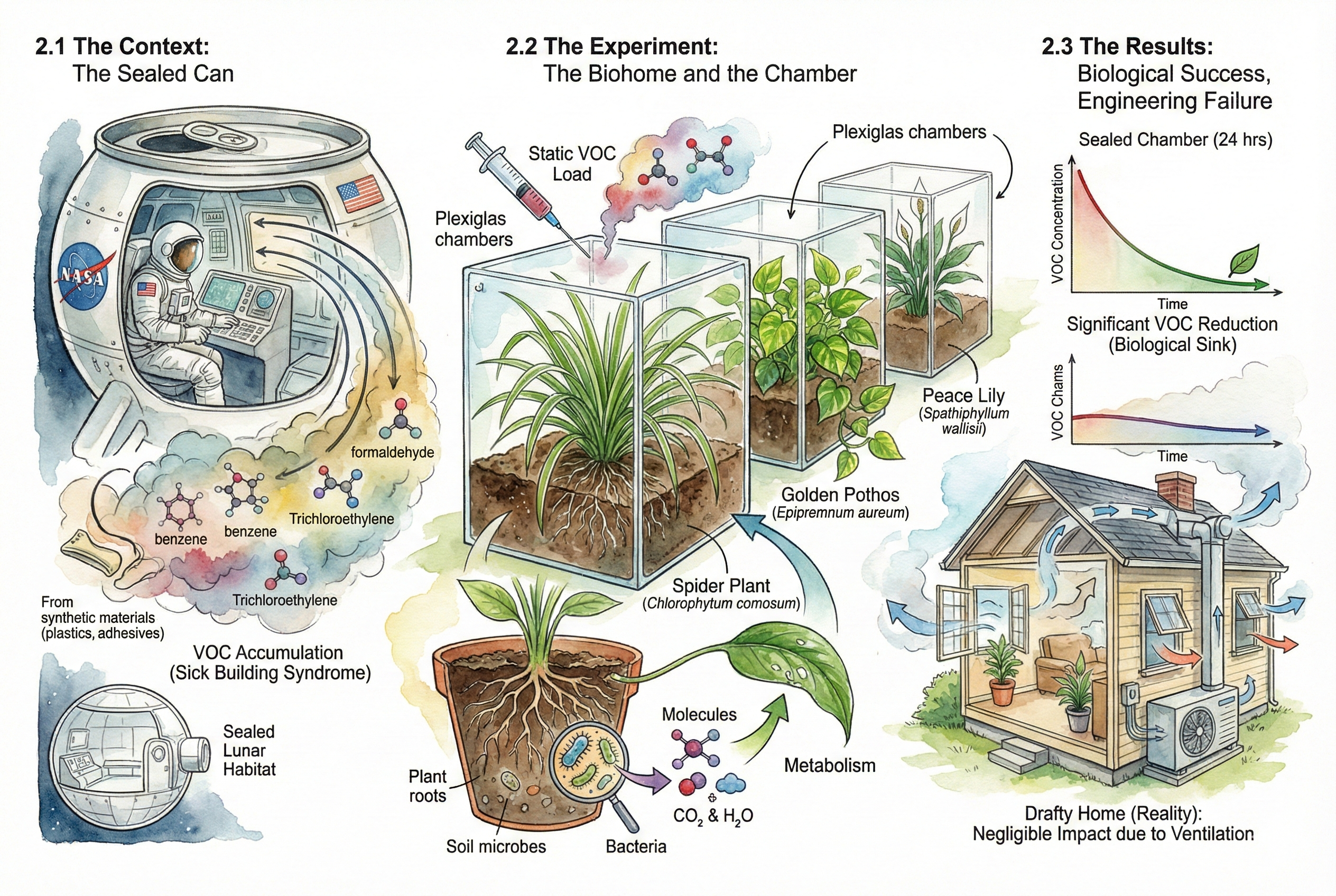
The familiar claim began with NASA experiments in small sealed chambers. That setting matters because real homes exchange air through windows, doors, vents, and HVAC.
What the Chamber Test Measured
- Researchers added a measured amount of one volatile organic compound to a small sealed chamber.
- They compared the concentration over time with and without plant systems, including common houseplants and growing media.
What the Result Means
In the chambers, VOC concentrations fell faster with plant systems present than in empty control chambers.
The report also tested activated-carbon/root-bed setups that pulled air through the growing medium, which removed gases more aggressively than a passive potted plant on its own.
The plants, and, importantly, the microbes in the growing medium and root zone, appear to have taken up and, in part, metabolized the compounds.
How completely each compound was broken down (versus adsorbed or stored) varies by chemical and system, and a drop in measured concentration alone doesn’t prove full conversion to carbon dioxide and water.
A plant-and-soil system can remove some pollutants in a sealed, low-air-exchange space. A normal room adds continuous emissions and constant air exchange, so the chamber result cannot be used as a home air-cleaning claim.
What Room-Scale Analysis Found
How the Review Reframed the Question
A review of 12 chamber studies converted plant VOC removal into a building-scale estimate. It did not add a new room trial, so its result is only as strong as the underlying chamber evidence.
Its useful question was practical. Can passive potted plants clear gases quickly enough to matter beside ordinary ventilation?
Potted plants do not improve indoor air quality. A review and analysis of reported VOC removal efficiencies
The Scale
The review estimated a median equivalent VOC clean-air rate of about 0.023 m³/h for one plant. This is a gas-removal estimate, not the particle CADR printed on a HEPA purifier box, so the two should not be treated as the same test.
Ordinary air exchange removes and dilutes VOCs far faster than passive plant uptake in a typical room.
To match the review’s roughly one-air-change-per-hour benchmark, the estimate was about 10 to 1,000 plants per square metre of floor area. The range is broad and not a prescription for any room. Its practical message is that a decorative collection cannot replace ventilation.
Why a Passive Pot Is Slow
Why Plant Uptake Is Slow
Leaves exchange gases through microscopic pores, but they do not pull room air through the plant like a fan. A water-stressed or poorly lit plant also exchanges less gas.
The growing medium can contribute to pollutant removal, yet room air has little contact with the small soil surface in an ordinary pot. Systems that actively force air through a root zone are a different technology from a plant on a shelf.
Benefits Worth Keeping in Perspective
Plants Still Have Value
Plants can still make a home feel pleasant and give people an enjoyable routine. The human-health evidence is more mixed than the air-quality evidence. Small studies find some short-term effects, while reviews also report small samples and many null results.
Enjoy plant care if it helps you unwind, but do not treat a plant, potting mix, or bioactive substrate as a treatment for stress, anxiety, or illness.
I separate owning plants from actively spending time with them. In a simple weekly note, I mark the days I watered, propagated, or quietly inspected plants. I record my concentration and mood before and after the session without changing the room ventilation.
This does not turn a personal log into a clinical study. It helps me compare the care ritual, visual setting, and time away from a screen. I never interpret feeling better as evidence that the leaves cleaned the room air.
Soil Microbes and Health Claims
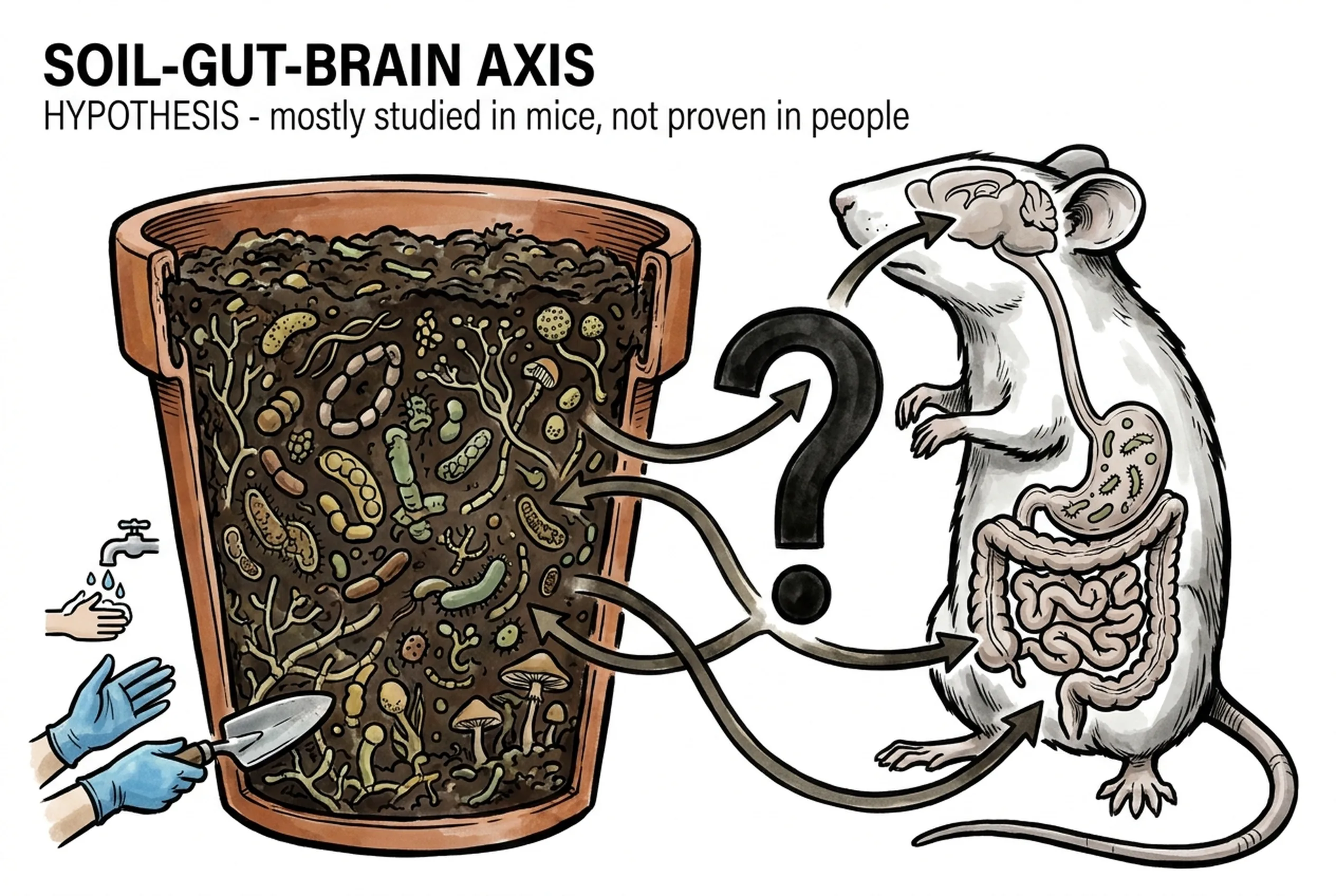
The proposed soil–gut–brain link is an active research topic, not an established benefit of keeping a houseplant. Most direct evidence comes from animal work, and allergies and autoimmune conditions have many causes.
6.2 Mycobacterium vaccae (What the Research Actually Shows)
Mycobacterium vaccae is often promoted as a reason to touch or smell soil. The most cited studies injected heat-killed bacteria into mice in measured doses. They did not test houseplant care, human serotonin, anxiety treatment, or a dose from ordinary potting mix.
Do not deliberately inhale or smell potting soil for a supposed health benefit. Handle it as a gardening material and follow ordinary dust-safety guidance.
Mycobacterium vaccae immunization, stress resilience, and the gut microbiome
6.3 Bringing the Microbiome Indoors
Plants can change the mix of microbes found in a home. That association does not show that the plants caused the change, that the microbes reach the body in a useful way, or that they improve health. More microbial diversity can also include molds, allergens, and pathogens.
Safety note. Handle potting soil sensibly
Plants, Attention, and Stress
Attention-restoration theory proposes that natural scenes can hold attention gently without demanding the effort of a task. A plant may offer that kind of visual break for some people, but indoor-plant evidence is limited.
One small trial found different short-term stress-related measures after hands-on transplanting and computer work. It did not show that every plant task works, that plant care is better than looking at plants, or that it treats anxiety.
Are visual nature elements mandatory for attention restoration?
7.3 Active Interaction (The Transplant Effect)
If tending plants feels calming, keep it as a small enjoyable routine rather than expecting a proven therapeutic effect.
Bioactive Setups at Home
Substrate matters a lot for plant health. Many common problems trace back to poor drainage, compaction, and watering habits rather than sterility as such.
One approach borrowed from the reptile and terrarium hobby is a bioactive substrate, most at home in humid, enclosed setups. Understand its limits before applying it to an ordinary pot.
8.1 What is Bioactive?
A bioactive setup is a living ecosystem. It is not just dirt in a pot. It is a food web.
- The substrate. A chunky, aeration-friendly blend rather than plain peat, such as an ABG mix with tree fern fiber, sphagnum moss, charcoal, orchid bark, and peat. ABG is a terrarium-oriented recipe, not a validated best mix for every plant, and it does not replace matching the medium to a species’ water and drainage needs. Tree fern fiber and peat also carry sustainability and sourcing tradeoffs.
- The clean-up crew (CUC). The setup is seeded with small detritivores.
Springtails (Collembola)
Tiny hexapods, typically about 1–4 mm, that graze on some molds and fungi (though they have food and substrate preferences and don’t control every fungus).
- Isopods (woodlice). Small crustaceans that eat decaying organic matter such as dead leaves. They do not cure root rot, and when underfed they can nibble living tissue.
8.2 Why Go Bioactive?
- Mold help. Mold is driven by moisture, organic material, temperature, and airflow rather than by a pot being sterile. In a well-established, humid setup, springtails can graze down some surface mold, which reduces how often it becomes visible. That is a supporting tool, not a guarantee or substitute for good watering and ventilation.
- Nutrient cycling. Isopods and other detritivores break down dead leaves into frass that bacteria process into plant-available nutrients. This recycles some nutrients, but a pot still gains and loses material through fertilizer, leaching, and plant growth, so it is not a closed fertility loop.
- Microbial diversity. Bioactive substrates tend to host diverse bacteria. Whether that includes M. vaccae specifically, or delivers any human health benefit, isn’t guaranteed (see the caveats above).
How to Add Springtails
Springtails do best where it stays humid. They can be added to potted plants, but a Monstera that dries out between waterings may not keep a culture going, so this works better for moisture-loving plants or enclosed setups.
A layer of leaf litter gives them habitat and food. If you use collected leaves, be aware they can also introduce pests or pathogens. Nursery-sourced, pesticide-free leaf litter is safer than wild-collected material.
A starter culture can help graze surface mold, but it’s a supporting tool, not a cure (you still control moisture and airflow).
Springtail Care and Limits
Folsomia candida is a commonly sold temperate springtail, but confirm the species, culture medium, and care directions with the supplier. A starter culture is not a set-and-forget supply. Keep it under the species-appropriate moisture and feeding conditions, then wait for sustained activity and reproduction before harvesting from it rather than relying on a fixed buildup time. Keep live invertebrates contained, never release them outdoors, and check local rules because some species are restricted or can ship only within certain regions.
Practical Care
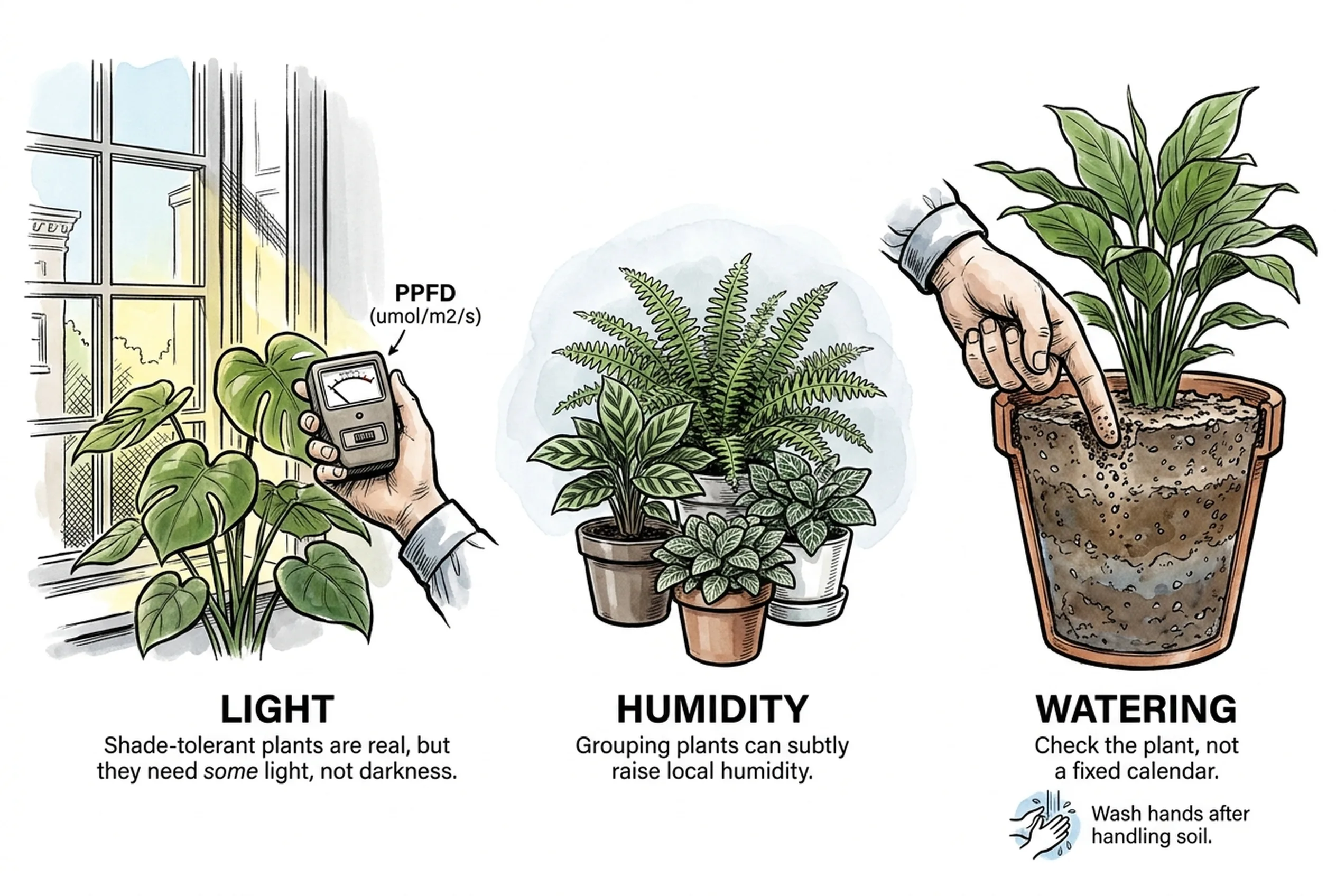
Good basic care helps plants grow well, but it does not turn them into room-scale air cleaners.
9.1 Light (The Fuel for the Machine)
Light drives photosynthesis, which in turn supports growth, transpiration, and root activity.
(Plants still respire and stay alive in dim conditions. They just grow slowly.)
- The nuance. Low-light plants are real shade-tolerant understory species that cope with modest light. Extension horticulturists put low-light foliage plants at roughly 50–150 µmol·m⁻²·s⁻¹ PPFD. What no plant tolerates is true darkness. Low light and no light are different conditions.
- The reality. Our eyes are poor at judging usable plant light. A spot that looks bright to us can be much dimmer for a plant, and the difference depends on window orientation, season, glazing, and shading. Measure PPFD at the leaves rather than relying on a distance rule.
- The fix. To push more active growth, add a grow light. It doesn’t have to be purple. Warm-white LEDs (3000K–4000K) can work and look like normal home lighting, but color temperature alone doesn’t tell you if a light is strong enough. What matters is the photon output (PPFD) at the plant, the coverage area, the distance, and the daily light hours.
In a room that already gets good daylight, supplemental light may not be needed at all. It’s most useful in genuinely dim spots.
A screw-in grow bulb on a compatible base is a simple supplemental option for a small area. Compare the exact bulb’s published PPF and PPFD at stated distances, then measure at the leaves because output changes quickly with distance, reflector, and surrounding surfaces.
High-output bulbs can run hot and be heavier than ordinary household bulbs, so use a secure socket and fixture rated for the bulb’s electrical load, weight, heat, and enclosed-fixture restrictions. Add a timer if needed, then set the photoperiod from measured PPFD and the plant’s target DLI rather than copying one universal duration. Do not stare into the bulb. To match a light to a plant’s needs, use the general horticultural lighting guide.
It is a supplement, not a requirement for every room.
9.2 Humidity (The Real Air Conditioning)
Plants don’t filter gases meaningfully, but they do add some moisture to the air through transpiration.
- The physics. Plants transpire much of the water they take up. A figure like 95–97% is a broad crop-physiology proportion, not a fixed rate for every houseplant (how much moisture actually reaches your room air depends on species, leaf area, light, and how fast the room exchanges air).
- The context. Heated winter air can be dry (often in the 20–30% range in many homes), which can irritate skin, eyes, and nasal passages. Some mouse-model and epidemiological work links very dry air to weaker airway defenses, but this is not settled for the home. The WHO rates the evidence that adjusting indoor humidity reduces flu transmission as very low certainty, and CDC/ASHRAE do not recommend humidity settings specifically to control viruses.
- The reality. One plant’s effect on room humidity is usually negligible. Some studies find even that. Grouping plants can raise humidity right around them under low-air-exchange conditions, but there’s no guarantee it lands at a specific 40–50%. And note that excess local moisture on cold surfaces with poor airflow can invite mold and condensation, so more isn’t automatically better.
EPA guidance for controlling mold and moisture is to keep indoor RH below about 60%, ideally 30–50%. That is useful building advice, not proof that a plant corner delivers a medical sweet spot.
9.3 Watering (The Touch Test)
Overwatering is a common way to lose houseplants, and rigid schedules such as watering every Monday are part of the problem.
- The idea. How much water a plant needs shifts with light, temperature, humidity, its size, the pot, and the season, so a fixed calendar rarely fits. Check the plant, not the clock.
- The touch test. For many foliage plants, feel the top inch or so of soil. If it’s still moist, wait, if it’s dried out, water thoroughly and let excess drain.
Treat this as a starting point, not a universal rule. Surface feel doesn’t tell you what’s happening deeper in the pot, and species differ a lot. Succulents want to dry out well below the surface, while moisture-sensitive plants like Fittonia and many ferns shouldn’t dry out completely.
Match watering to the species, pot depth, drainage, and medium.
Basic Soil Hygiene
Wash your hands after handling soil. Touching soil is not a measured dose of any bacterium or a therapy. It is simply part of caring for the plant.
Keep Plants for Joy, Not Air Cleaning
What Houseplants Are Actually Good For
The takeaway is clear. At realistic densities, a houseplant’s equivalent clean-air rate for VOCs is very small.
Relying on plants as your air-purification strategy doesn’t match the numbers.
If you’re worried about indoor pollutants, start with the source. Identify and remove or isolate what’s off-gassing, choose lower-emission products, follow manufacturer ventilation guidance, and increase fresh-air ventilation.
Beyond that, a HEPA purifier helps with particles (not gases), and gas removal needs an adequate activated-carbon stage suited to the specific compound.
Opening a window helps when the outdoor air is cleaner than indoors, but not if it’s smoky, high in pollen, or full of traffic exhaust.
The Cummings & Waring review answers one question. Passive potted plants are not practical VOC cleaners. It does not make plants useless or settle every indoor-air question.
Plants aren’t HVAC equipment. They’re living things you tend, and for a lot of people that’s reason enough to keep them.
Keep the evidence in proportion.
- They don’t meaningfully clean the benzene, but many people find caring for them calming.
- They don’t filter formaldehyde, but a green, complex view may offer some attention relief for some people.
- They change the indoor microbial mix in measurable ways, though whether that helps human health is still unknown.
- They’re not a chemical fix for your air, and they’re not a medical treatment either.
So keep that Spider Plant and enjoy it.
Watch it grow, and appreciate it for what it is (pleasant, low-stakes, and worth the small routine of care).
If you want to try a bioactive layer with springtails, go for it in a suitable humid setup.
Just handle the soil sensibly (and wash your hands), and don’t count on any plant to deal with paint fumes (that’s a job for source control and ventilation).
The Scale at a Glance
The review supports one useful comparison. A single plant’s median equivalent VOC clean-air rate is very small beside ordinary air exchange in the same room.
| Mechanism | Approximate clean-air rate | What it means |
|---|---|---|
| Single houseplant (VOC uptake) | ~0.023 m³/h (median across studies) | Practically negligible at the room scale. |
| Normal home air exchange (~1 air change/hour) | Tens to hundreds of m³/h, depending on room size | Dwarfs passive plant uptake. |
Two cautions matter when comparing the numbers. First, the plant figure is a VOC gas rate, while the consumer CADR shown for a HEPA air purifier, often about 100 to 400 m³/h, is a particle rating. The pollutant and mechanism differ, so this is not a like-for-like comparison.
Second, the clean-air rate from an open window or HVAC system varies with room size, wind, temperature difference, opening area, and outdoor air quality. It cannot be reduced to one CADR value.
The reliable conclusion is directional. Ordinary ventilation clears indoor gases far faster than a passive potted plant.