
Platycerium Ridleyi: Stop the Rot (Care & Mounting)
Prevent Platycerium ridleyi rot with an airy mount, loose sphagnum, crown-safe watering and steady airflow. Diagnose black spots before treating.
Jordan Cole · Published 2025-12-22 · 23 min read
Key Takeaways
- Ridleyi rot is usually a water-and-air problem, so use an open mount that drains quickly and lets air reach the roots.
- Brown shield fronds are normal protective growth, while soft black tissue, foul odor and spreading lesions need diagnosis rather than automatic treatment.
- Water the whole mount, then let it dry appropriately, and avoid leaving warm water in the crown or dense moss behind the shields.
- Bright indirect light supports metabolism and dry-down, but light cannot compensate for a chronically waterlogged mount.
- Use low-salt water and light feeding, and verify any disease before applying a disinfectant or fungicide.
Why Ridleyi Develops Rot
Platycerium ridleyi, known as Ridley’s Staghorn, has a reputation for being harder to keep alive than the more common staghorns. Rot is the usual reason it fails.
A healthy plant is a corrugated green sculpture. When rot sets in, the center can turn to dark mush and develop a foul smell. That is one of several ways it can go wrong, not the only one.
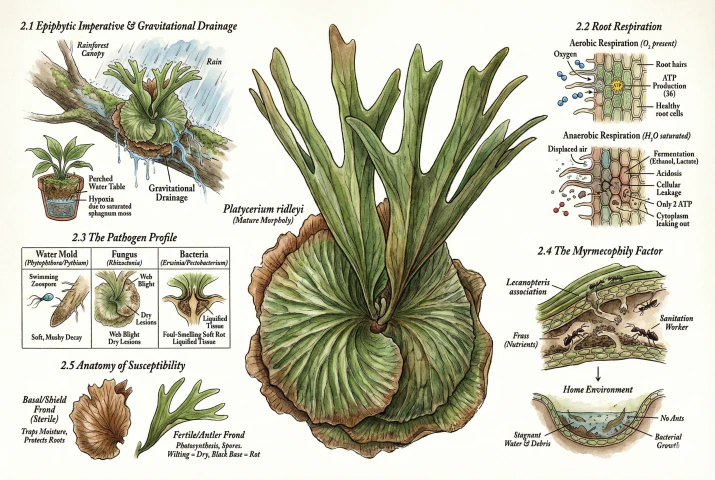
Most rot on this fern is preventable when you treat it as an epiphyte adapted to good drainage and moving air. Platycerium ridleyi comes from the rainforests of Southeast Asia and is not adapted to standing water at the roots.
You are probably here because these ferns aren’t cheap and you want to protect your plant, or because you are already looking at a dark, soft spot on a shield.
At the shield’s edge, I slide a five-millimeter strip of uncoated white blotting paper one centimeter into the moss gap for 60 seconds without touching living tissue. I call the hidden zone dry-ready only when the strip shows no translucent wet mark. The fixed strip and contact time reveal water that dry-looking surface moss can hide.
I compare three watering cycles before changing frequency. If the hidden zone remains wet more than 24 hours after exposed moss dries in all three cycles, I improve angle or airflow first. Repetition keeps one unusually humid day from forcing the whole mount drier.
After each soak, I drain the mount vertically for 30 minutes before recording its wet weight. I reweigh it at the dry-ready endpoint defined by the paper strip. The fixed drain clears fast runoff, and I reset both weights after new shields or roots change the baseline.
Start With Water and Air
Before you reach for the watering can, understand how water, air and the root zone interact.
Keep the Roots Airy and the Crown Dry
Ridleyi is not a terrestrial fern. Build its care around the conditions of an airy tree branch instead of a wet pot.
It does not grow in soil, and its roots are not adapted to sit in standing water. It is an epiphyte that lives with its roots exposed to air, buffered by the moisture its own fronds capture and store.
Treat Ridleyi as an Epiphyte
Treat Ridleyi as an Epiphyte
Platycerium ridleyi is an epiphyte. Kew records it as native from Peninsular Thailand across western Malesia, and NParks lists it from rainforest and freshwater swamp forest in Thailand, Sumatra, Peninsular Malaysia, Singapore and Borneo, growing on tree trunks and branches. It is not a parasite and takes nothing from the host tree but physical support.
Drainage matters, but the plant is not simply a surface that water runs straight off. Its clasping nest (shield) fronds provide support and store water, and its erect, gutter-like fertile fronds help channel rainwater toward the plant.
So rather than water passing through instantly, some is captured and held. The plant lives between wet and dry rather than in one or the other.
Because the roots normally sit in a fairly open, well-aerated mass rather than a saturated one, they are adapted to an environment where air can reach them.
When a ridleyi is potted in dense soil or mounted in sphagnum that stays waterlogged, the air spaces fill with water.
Oxygen then diffuses to the roots far more slowly, and the root zone can become low in oxygen (hypoxia).
Protect Root Oxygen
Roots need oxygen as well as water. When a dense mount stays saturated, water fills the air spaces and roots cannot produce enough energy for normal uptake and defense. Long periods of saturation lead to root injury and make rot more likely.
Mechanisms of Waterlogging Tolerance in Plants. Research Progress and Prospects
2.3 The Pathogen Profile (Fungi and Bacteria)
Diagnose Before Naming a Pathogen
The organisms below are common root- and crown-rot agents on ornamental plants in general. Two are documented on Platycerium at the genus level. The American Phytopathological Society’s foliage-plant host list records bacterial blight caused by Pseudomonas species and aerial blight caused by Rhizoctonia solani on staghorn ferns. The oomycetes and soft-rot bacteria are included because they cause similar damage on many houseplants, not because they have been confirmed as the pathogen on your ridleyi. A diagnostic lab, not smell or color, is needed to establish which organism is responsible.
| Pathogen Type | Organism Name | Documented on Platycerium? | Typical Mechanism | Common Symptom | Favored Conditions |
|---|---|---|---|---|---|
| Bacteria | Pseudomonas spp. (bacterial blight) | Yes, at genus level (APS) | Infects leaf and crown tissue, often through wounds or water films. | Water-soaked spots or lesions on fronds. | Persistent leaf wetness, warm conditions. |
| Fungus | Rhizoctonia solani (aerial blight) | Yes, at genus level (APS) | Attacks the stem/rhizome interface. Forms web-like blight. | Sunken brown/black lesions on basal fronds. Web-like mycelium. | Warm, humid, stagnant conditions. |
| Water Mold (Oomycete) | Phytophthora, Pythium | Not listed for Platycerium. General root-rot agents | Motile zoospores swim through wet substrate to infect root tips. | Soft, mushy, dark roots with melting decay. | High moisture, low oxygen. |
| Bacteria | Pectinolytic soft-rot bacteria (e.g. Erwinia, Pectobacterium, Dickeya) | Not listed for Platycerium. General soft-rot agents | Pectinolytic enzymes dissolve the tissue that holds cells together. | Foul-smelling, slimy soft rot. | Standing water in the crown, high heat. |
The pectinolytic soft-rot bacteria were once grouped under Erwinia. Several were later reclassified into Pectobacterium and Dickeya, but the genus Erwinia still exists, so saying that Erwinia is now Pectobacterium is an oversimplification.
Without culturing or molecular testing, you cannot attribute a soft rot to any one of these by name.
Rot is rarely just water. It usually involves microorganisms that take advantage of wet, low-oxygen tissue. Which organism is involved is a matter for diagnosis, not assumption.
Bacterial soft rot
This is a plausible risk for P. ridleyi because its cabbage-like shape can trap water in the center.
If water sits on the growth bud without airflow, bacteria can multiply. A fishy or rotten-vegetable smell often points to bacterial decay, but a foul odor alone is not proof of a specific pathogen. Anaerobic breakdown of the medium and other microbes can smell similar.
Because a solitary plant has a single growing point, losing it can be fatal. If you suspect the crown is affected, the priority is to isolate the plant, inspect it, and get a diagnosis rather than to assume a fixed timeline for how fast it will collapse.
Do Not Let Water Sit in the Shield
The deep shield fronds can trap water and debris. In still indoor air, that moisture can keep the crown wet for too long. Keep air moving and avoid leaving water in the center, but do not assume that ordinary top-watering is automatically fatal.
2.5 Anatomy of Susceptibility (Shield vs. Antler)
Separate Shield and Antler Fronds
The plant possesses two distinct frond types, and understanding their function is critical to preventing rot.
Shield Fronds Protect the Root Ball
These round, plate-like leaves at the base turn brown and dry with age. This is a normal physiological process. They eventually become brown and papery and act as a shield that protects the root ball and a sponge that holds moisture.
Ridleyi shields have a trade-off. They are tight, rigid, and deeply veined, so they hold moisture well, which is part of their normal job.
The risk appears when the moss behind a shield stays saturated for long periods because the shield slows evaporation and the rhizome then stays wet.
The goal is not to fight the shield’s water-storage function but to make sure the medium behind it can dry out between waterings.
Antler Fronds Drive Growth
These upright, forked leaves photosynthesize and bear spores. The green shields photosynthesize too.
Reading the antlers. Limp antlers often mean the plant is dry, and yellowing or blackening at the base can mean rot has moved up from the rhizome.
Both are signals worth investigating rather than definitive diagnoses (wilting can also follow root damage, and discoloration can have several causes) so check the root zone before acting.
On the selective advantage of coloniality in staghorn ferns (Platycerium bifurcatum)
3. Build a Rot-Resistant Environment
Choose an Airy Mount
The real issue is not the container itself but the medium, drainage and how wet things stay. An open orchid basket, a fern-root slab or a shallow airy container can all provide good drainage and gas exchange. Standard potting soil in a closed pot is the setup to avoid because it holds water and starves roots of air unless substrate aeration and watering are carefully managed.
Mounting is a good default because it keeps the plant vertical, lets gravity assist drainage, and exposes more surface area to moving air.
It is not the only workable method, but it makes the wet-dry cycle easier to manage. Use the staghorn fern mounting guide for the board, tie, and orientation workflow.
The following sequence establishes a Platycerium ridleyi that resists rot from day one.
3.1 The Materials Checklist
You need materials that are rot-resistant and promote gas exchange.
Mount Material
Western Red Cedar is naturally rot-resistant, cork bark is a natural epiphyte host, and a slatted teak basket can keep the root zone open. Avoid treated lumber and soft pine because chemicals or rapid decay create avoidable risks.
Substrate Material
A mix is better than pure moss.
Long-Fiber Sphagnum Moss
Long-fiber sphagnum holds water while staying relatively open if it is not packed tight.
Coco Husk Chips
Coco adds structure and air space and breaks down more slowly than moss. It also holds water and can carry salts, so it is not purely an aeration additive.
Perlite
Perlite can add drainage, though it tends to work loose and fall out of a vertical mount.
3.2 The Substrate Strategy (Porosity is King)
Keep the Mix Porous
Avoid pure peat and standard potting soil. The medium needs enough air space for water to drain and air to reach the roots.
Starting Mix Ratio
- Use mostly long-fiber sphagnum moss, roughly two parts, because it holds water but stays fluffy when packed loosely.
- Add about one part medium coco husk chips or perlite by volume to keep air pockets open.
- Sphagnum packed tightly can turn into a dense, soggy mass. Chunkier material keeps the mix open and slows the kind of waterlogging described earlier. Treat the ratio as a starting point and adjust to your plant size, mount, and how fast things dry. Perlite and coco behave differently in water retention, salt content, and breakdown, so they are not interchangeable one-for-one.
Long-Fiber Sphagnum Option
Look for long-strand sphagnum that stays open when packed loosely. Moss grade, strand length, and packing matter more than country of origin. Sphagnum still holds water, so use a light hand and follow the sphagnum replacement guide when it compacts or breaks down.
Coco-Husk Option
Coco husk chips low in EC, or salinity, matter because high salt levels can stress fern roots. Any low-EC figure on a bag is a manufacturer claim rather than a tested figure for a given batch, so rinse coco before use and, if in doubt, check EC. Use it for the structural chunkiness it adds to the mix.
3.3 The Mounting Protocol
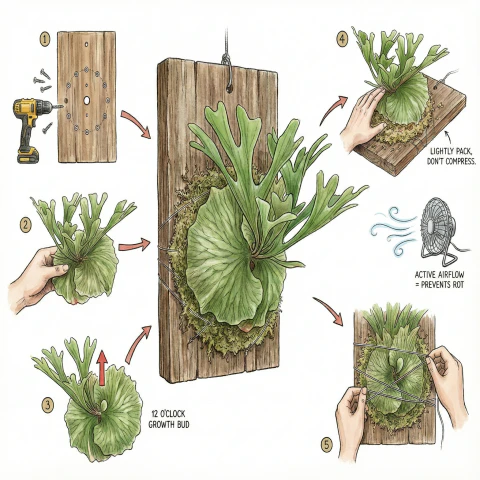
If your ridleyi is in a plastic nursery pot packed with heavy, dense soil, moving it to a mount or an airier medium is usually a good idea, but transplanting is a stress on any plant, so work gently, keep your tools clean, and don’t rush a plant that is already struggling.
Step 1. Prep the board
If using a flat board, drill several holes in the area where the plant will sit so air can reach the back of the rhizome and help it dry.
Install screws in a circle slightly larger than the plant’s shield diameter as anchor points for your line.
Step 2. Free the roots carefully
- Gently remove the plant from its pot. Loosen and remove the nursery soil you can, but don’t tear the fine roots to get every last bit out. It is fine to leave some original medium in place if removing it means ripping roots.
- If the roots are in a dense, sponge-like plug that stays waterlogged (common in tissue-cultured imports), tease it open a little rather than shredding it. The aim is to let air in without destroying live roots.
- Locate the growth bud (the fuzzy center point where new fronds emerge). Orienting it upward (12 o’clock) follows the plant’s natural growth direction and keeps the gutter-like fronds working with, not against, gravity.
- Mounting it sideways is not automatically fatal, but keeping the existing growth axis upright avoids the plant having to reorient new fronds and reduces spots where water can pool in bent leaf bases.
- The shield fronds usually have a seam or opening near the top, and the bud sits just below it.
- Place a bed of your moss/chip mix on the board.
- Place the fern on top.
- Pack more moss lightly around the roots and behind the shields if they are open.
- Do not pack the moss too tight. Compressing sphagnum destroys its air pockets. It should be firm enough to hold the plant but springy like a firm sponge rather than a brick.
- Tie your fishing line to a screw.
- Zig-zag the line across the plant, catching the screws.
- Go over the brown shield fronds (they are tough) but be extremely careful near the green shield fronds and the center bud. Do not slice the tissue.
- Pull tight enough to immobilize the plant (if it wiggles, roots won’t attach) but not so tight you crush it.
3.4 The Airflow Mandate
In the wild, ridleyi lives in the breezy part of the forest. In your home, air is typically stagnant. Stagnant air + Wet Moss = Rot.
- Add gentle air movement around the plant. A small USB fan aimed near the plant, rather than blasting it point-blank, helps break up the still, humid layer around the fronds. That encourages excess water to evaporate from the leaf surface and crown, which makes conditions less favorable for rot. Air movement is a preventive measure that keeps surfaces from staying wet. It does not directly switch off any pathogen.
4. Practical Care and Daily Management
Balance Hydration and Air
Ridleyi can be lost in dry climates and in greenhouses alike. In most cases the issues come back to water management and light, though temperature, medium, sanitation and any pathogen present also matter. The balancing act is keeping the plant hydrated without keeping the roots waterlogged.
4.1 The Watering Squeeze
How to Mount Staghorn Fern (Platycerium) on Board by Aloneinoasis (2023). It demonstrates general Platycerium board-mounting technique. It is not specific to P. ridleyi rot control.
Water by Mount Weight
Stop watering on a schedule because a once-a-week rule can kill this fern. Watering needs change with temperature, light and humidity.
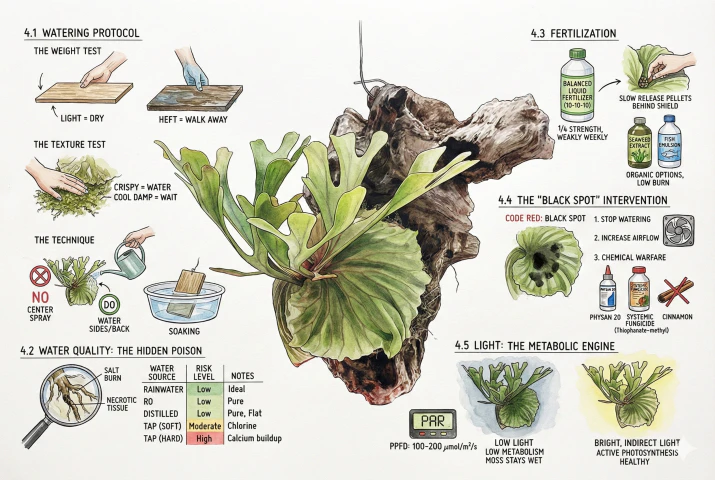
- Lift the board. If it feels light like balsa wood, it’s dry. If it has heft, wait before watering.
- Touch the moss at the bottom of the mount. Crispy dry means water, while cool and damp means wait. These checks read only the surface. On a larger mount the core can still be wet when the outside feels dry, so factor in plant size, temperature, humidity, and airflow.
Water the Whole Root Mass
Try not to pour water so that it pools and sits in the center of the cabbage-like shield for long periods, since standing warm water in the crown is a rot risk.
A brief splash of clean water reaching the center as it would in rain is different from stagnant water left sitting there.
- Prefer watering from the sides or back so it runs through the moss behind the shield and wets the whole root mass, not just the surface.
- If the mount is very dry, dunk the board and moss, keeping the foliage mostly out of the water, in room-temperature water until the medium is rehydrated. A few minutes works for a small mount. A large, bone-dry one may need longer. Check the weight rather than watching the clock.
4.2 Water Quality (The Hidden Poison)
| Water Source | General Risk | Notes |
|---|---|---|
| Rainwater | Usually low | Often low in dissolved salts, but pH and cleanliness depend on your air quality and how it is collected. It is not automatically ideal. |
| Reverse Osmosis (RO) | Low | Very low in dissolved solids. Add nutrients over time, since it also removes beneficial minerals. |
| Distilled | Low | Very pure. Dissolved oxygen equilibrates with air like any water, so it is not meaningfully flat. |
| Tap Water (soft) | Varies | Distinguish naturally soft water from sodium-softened water, which adds sodium. Chlorine or chloramine may or may not be present. |
| Tap Water (hard) | Varies | Higher in calcium and magnesium. Whether it is a problem depends on the actual levels, alkalinity, and sodium or chloride. Test rather than assume. |
Test Water Quality Before Changing It
Ferns can be sensitive to salts, and tap water may contain chlorine or chloramine plus dissolved minerals. These are separate issues with separate fixes rather than a single mechanism.
- Hardness mainly reflects calcium and magnesium, while TDS estimates total dissolved ions from conductivity. They are not the same number, and there is no single threshold such as 200 ppm at which water calcifies roots. Moderate hardness is fine for many plants. If you suspect a water-quality problem, test for hardness, alkalinity, EC, sodium, and chloride rather than relying on a TDS reading alone.
- Concentrated salts in the medium can lower the water potential around the roots, making it harder for the plant to take up water and, over time, damaging root tissue. Damaged tissue is more vulnerable to opportunistic organisms, but that is a risk factor, not a diagnosis.
- Rainwater, distilled, or RO water sidesteps most tap-water concerns, although you must add nutrients with RO or distilled water. Letting tap water stand can reduce free chlorine, but per the EPA it does not remove chloramine. Check what your utility uses and treat only the problem you actually have.
4.3 Fertilization (Go Light)
Feed Lightly to Limit Salts
Over-fertilizing raises salt concentrations in the moss. As the medium dries, those salts become more concentrated and lower the water potential around the roots, which draws water out of root cells through osmotic stress and can damage them. This is osmotic stress, not reverse osmosis, which is a water-purification process.
Liquid Feeding
A balanced liquid fertilizer diluted well below the label rate, applied during active growth, is a conservative approach. Exact rate depends on the product. More frequent feeding tends to build up salts, so many growers feed lightly and monthly rather than weekly, and flush the mount with plain water periodically. Follow the product label for concentration.
Slow-Release Feeding
Some growers tuck a few pellets of slow-release fertilizer behind a shield frond. This is not automatically safer. Release depends on temperature and moisture, and concentrating pellets in one spot can raise salt levels near the roots, so use the label rate and do not overdo it.
Organic Feeding Options
Seaweed extract and fish emulsion are low-strength options, not a cure for a weak or rotting plant. Whatever you choose, follow the label rate and rinse off residue.
4.4 Responding to a Black Spot
Diagnose Black Spots Before Treating
A black watery spot on a shield or near the bud is worth acting on, but a black spot has several possible causes including normal shield senescence, a physical bruise, cold or chemical injury and bacterial or fungal infection. Start by diagnosing rather than reaching for chemicals.
- Isolate the plant so a possible infection doesn’t spread, and photograph the spot to track whether it grows.
- Inspect. Check the root-zone moisture and the texture of the affected tissue (firm and dry vs. Soft and slimy). Feel and smell can suggest whether it is likely dry senescence or wet rot, but they are not a definitive identification.
- Adjust conditions. If the medium is waterlogged, let it dry appropriately and improve airflow. Do not cut the plant off from water entirely. An already stressed or dehydrated plant can be made worse by desiccation.
- Sanitize tools before removing any clearly dead tissue with a clean blade, and dispose of it away from other plants.
If a spot is spreading and you suspect disease, get a diagnosis from Extension or a plant-diagnostic lab before choosing a treatment. The staghorn fern disease-treatment guide explains why product choice must follow that diagnosis.
Chemical Treatment Boundaries
Older care guides often reach for chemicals quickly. Pesticides and disinfectants are governed by their labels and are not interchangeable cures.
- Disinfectants (quaternary-ammonium products). Labeled for some fern diseases at specific dilutions. It is a surface disinfectant, not a cure for established root rot, and wiping fronds can strip the protective trichomes. If you use it, follow the label’s rate, method, and safety instructions exactly.
- Systemic fungicides (e.g. Thiophanate-methyl). Only appropriate for specific, diagnosed fungal diseases, and useless against bacteria and oomycetes. A web-like growth or a black spot is not enough to confirm Rhizoctonia. Use only per label, with the required protective equipment.
- Etridiazole (Terrazole and similar). The current U.S. EPA label restricts it to commercial nurseries and greenhouses and prohibits use in residences and other indoor plant sites. It is not an appropriate home treatment for this plant, so it is not recommended here.
- Cinnamon. Often suggested as a home remedy. It has only weak antifungal activity and will not stop a bacterial soft rot. Don’t rely on it for a serious infection.
4.5 Light (The Metabolic Engine)
Use Light to Support Dry-Down
Rot is often influenced by metabolism and how quickly the mount dries.
Low Light Slows Dry-Down
In dim light the plant photosynthesizes less, uses less water, and the moss stays wet longer. Adequate light helps the mount dry between waterings.
Ridleyi Light Requirement
Ridleyi does well in bright, indirect light. It can take gentle morning sun, but harsh midday sun can scorch it. The amount depends on your window, glass, and leaf temperature.
Use Measured Light as a Starting Range
A moderate light level in the low-to-mid hundreds of µmol/m²/s (PPFD) is a reasonable target for bright indirect light, but this is a general figure rather than a species-specific tested value, and daily light integral matters too. Light helps, but it does not compensate for a chronically waterlogged mount.
5. Troubleshooting and Common Misconceptions
A few widely repeated pieces of fern advice are worth a closer look, because some of them can encourage the conditions that lead to rot.
Should I mist Platycerium ridleyi every day?
Separate Mist From Ambient Humidity
A quick mist does not raise room humidity for long. It mostly leaves water droplets on the fronds. That is different from raising ambient humidity, and mixing up the two goals is where this advice goes wrong.
If droplets sit on the leaves or roll into the bud crevices and don’t dry, prolonged leaf wetness can favor some diseases. Care guides such as NParks do list occasional misting, and daily misting for plants on fern-root slabs, so misting is not always wrong. The key is that surfaces dry out afterward.
Use Early Misting Carefully
For steady humidity, an ambient humidifier does more than a spray bottle. If you mist, do it early so it dries during the day rather than sitting overnight. A humidifier needs its own care, including cleaning, suitable water and condensation checks.
Should I remove brown shield fronds?
Better not to. The brown shields are part of the plant’s structure. They protect the root ball, help hold the plant to its mount, and break down slowly to feed it. Browning with age is a normal process, not a sign the tissue should be removed.
Leave the Shields in Place
Peeling brown shields exposes the delicate rhizome to dry air and mechanical damage. Leave them in place as a protective mulch-like layer.
Can I water Platycerium ridleyi with ice cubes?
Not recommended. Ridleyi is a tropical fern. Ice-cube watering delivers water unevenly and chills the root zone, and cold stress can damage roots. You don’t need an exact temperature threshold to conclude that near-freezing water on a warm-climate plant is a poor idea.
Use Room-Temperature Water
Room-temperature water hydrates the whole mount evenly without cold shock.
Is a mushroomy smell normal?
It depends on the smell. Fresh, healthy moss can have an earthy, even faintly mushroomy odor from harmless saprophytic fungi and decomposing organic matter. A sour, ammonia-like, or rotting-vegetable smell is more concerning and can point to anaerobic decay or soft rot, but odor alone is a warning sign, not a diagnosis.
Check the Roots When Odor Turns Foul
If the medium smells foul and stays wet, check the roots. Unmount if needed, cut away mushy blackened roots with a clean blade and remount in fresh airy moss. Some growers use a dilute hydrogen-peroxide rinse on tools or mildly affected media, but strong solutions can harm live roots, so treat it as optional rather than a guaranteed fix.
Are Platycerium trichomes just dust?
They aren’t. The fine white fuzz on ridleyi is a coat of trichomes (star-shaped hairs).
What Trichomes Do
They help reduce water loss and buffer the leaf against intense light.
Don’t wipe them off. Wiping removes this layer from that frond, and it doesn’t regrow on an existing leaf (new fronds do produce their own trichomes). A frond that has lost its trichomes is more exposed to water loss and strong light, so leave the fuzz alone.
Symptom Diagnostic Table
Most of these symptoms are nonspecific because the same look can come from watering, salts, cold, physical damage, or disease. Treat the possible-causes column as a starting point and inspect before acting.
For anything you suspect is an active disease, a plant-diagnostic lab or extension service can confirm the organism.
| Symptom | Possible causes to consider | First steps |
|---|---|---|
| Base of antlers turning black/brown | Rot moving up from the rhizome. Also possible. Cold or chemical injury | Check root-zone moisture and smell. Improve airflow. Inspect the rhizome before deciding on treatment. |
| Tips of antlers browning/crisping | Dry conditions, low humidity, or salt buildup | Check whether the mount is dry. Soak if needed. Raise ambient humidity. Review water quality. |
| Soft, slimy, foul-smelling spot on shield or crown | Bacterial soft rot is one possibility. Also anaerobic decay of wet medium or secondary microbes | Isolate the plant. Remove clearly dead tissue with a clean blade. Keep the crown from staying wet. Seek a diagnosis if it spreads. |
| White fuzz on moss | Usually saprophytic mold on wet medium, not necessarily a pathogen | A sign the mount is too wet with poor airflow. Let it dry and improve air movement. |
| White crusty residue, scorched root tips | Salt/mineral buildup, often from hard water or over-fertilizing | Flush the mount with low-salt water (rain/RO) and review your water and feeding. |
| Firm, papery brown shield fronds | Normal senescence | Leave them in place. |
| Yellowing of the oldest fronds | Natural senescence | Normal. No action needed. |
| Yellowing of new fronds | Root problems or nutrient issues | Inspect the roots and review watering and feeding. |
Keep Ridleyi Healthy
Keeping a Platycerium ridleyi alive and rot-free is mostly about giving the roots air, keeping water moving, and letting the mount dry between waterings.
You are approximating a rainforest tree branch indoors, which takes some attention but is very doable.
- Mount it thoughtfully. Keep the growth bud oriented upward, use a porous medium, and attach the plant securely (allowing for the weight of a soaked mount).
- Keep air moving. Stagnant, humid air keeps surfaces wet. Gentle air movement helps them dry.
- Water thoroughly, then let it dry. A wet-and-dry rhythm suits this fern better than constant moisture.
- Protect the crown. Avoid letting warm water sit in the central bud for long periods. It is the most vulnerable point.
Follow these basics and a healthy ridleyi will reward you with its distinctive upright antlers.
And if a plant does succumb despite good care, that happens with difficult species. It is not a personal failing.