
Slow-Release Fertilizer for Vegetables: CRF Guide
Choose and dose slow-release fertilizer for vegetable containers and raised beds. Compare SRF vs CRF, coating duration, crop timing, labels and salt-burn risks.
Marcus Hale · Published 2026-01-02 · 20 min read
Key Takeaways
- Controlled-release fertilizer follows temperature, not plant demand. Warmer soil generally speeds nutrient release, so supply may broadly track the growing season. The coating does not sense what the plant actually needs.
- Slow-release and controlled-release are different categories. Slow-release materials can depend on solubility, hydrolysis, or soil microbes, while controlled-release products use an engineered coating with a rated duration. A CRF is usually more predictable under the same conditions.
- Biodegradable coatings are promising research rather than a guarantee for home gardens. Lignin and vegetable-oil coatings are being tested to reduce persistent residues, but field-trial and early-commercial results do not establish universal performance.
- Trial results cannot be copied directly into a garden. A pre-plant CRF matched a soluble-fertilizer program at a lower nitrogen rate in specific field conditions, but the result depends on the site, crop, product, and measurement.
- More fertilizer is not better. Follow the label rate, match coating longevity to the crop and soil temperature, and check a soil or medium test before adding nutrients.
Soluble vs. Slow-Release Feeding
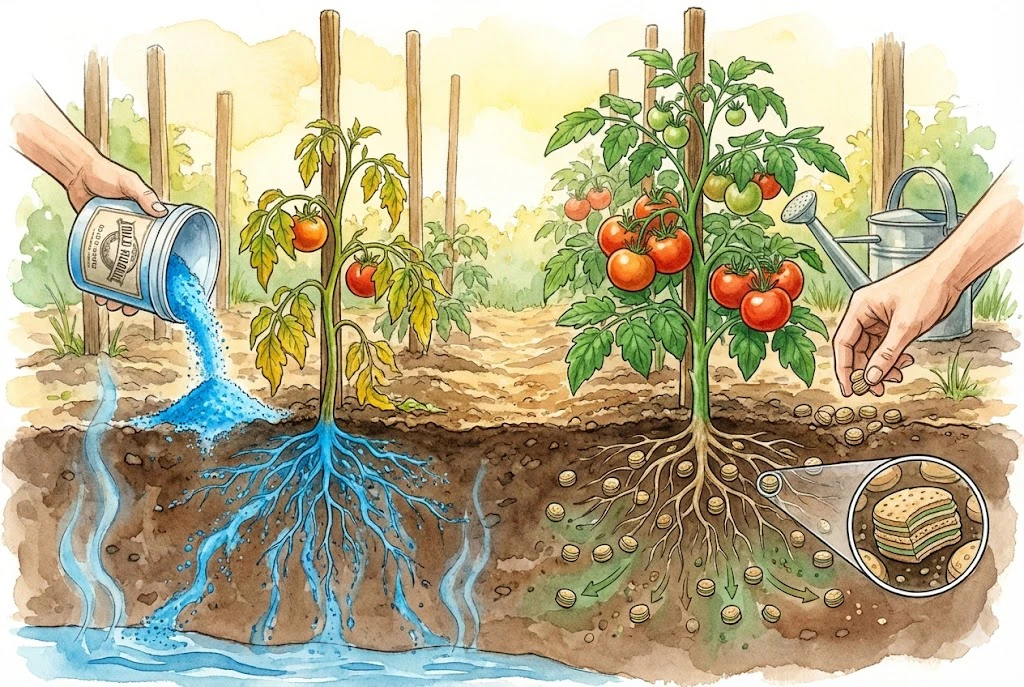
Many gardeners scatter a water-soluble powder on the soil, see the plants green up, and move on. That quick response is real but short-lived, so soluble feeding usually requires frequent reapplication.
When you apply more nitrogen than the crop can take up at once, some can be lost through leaching, ammonia volatilization from surface urea, denitrification, or runoff. Some is immobilized by microbes or held as residual soil nitrogen. The amount and route depend on soil, weather, timing, and placement.
Slow-release and controlled-release products spread nutrient supply over weeks or months instead of releasing it all at once. Newer coatings use materials such as lignin and vegetable oils, and their release is driven largely by soil temperature. That can broadly follow warm-season growth, but the coating does not sense the plant’s actual demand.
Some of these newer coatings are also being developed as biodegradable options to address the microplastic concern with older polymer coatings.
The useful questions are how these products work, where the evidence is solid, and how to choose and dose one for containers and raised beds.
How Slow Release Fertilizer Works
The Mechanics of the Coated Bead
To see why coated products behave differently, start with conventional water-soluble fertilizer. Ammonium nitrate separates into ions as soon as it dissolves, while urea dissolves as an intact molecule and must be converted by urease before plants take up most of its nitrogen. Once nutrients are in the soil solution, some is still immobilized, sorbed, transformed, or lost before roots can use it.
Soil is also variable. Rainfall, irrigation, and biological activity all shift how much of a soluble feed the crop actually uses.
Nitrogen-use efficiency for conventional fertilizer is often cited in the range of about 30–50%, but that figure comes from broad crop-system studies and depends heavily on the crop, scale, metric, and recovery period. It is not a fixed number for a single pot or bed.
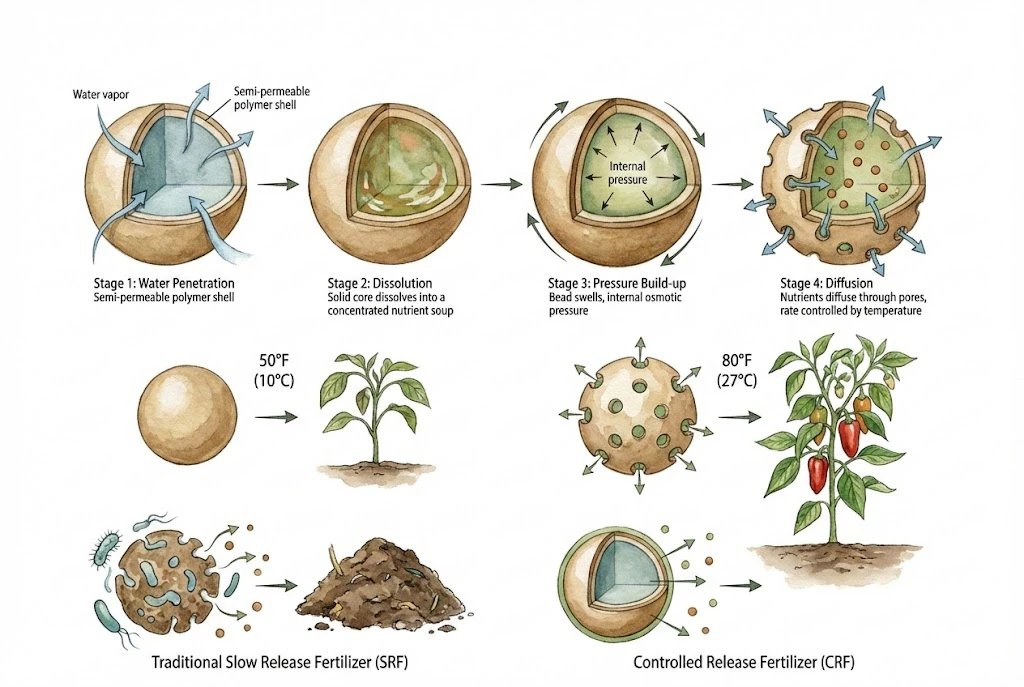
A controlled-release fertilizer (CRF) works differently. It wraps the nutrient in a coating that slows how fast it enters the soil solution.
For one common type, a polymer-coated soluble core, release generally follows three stages. Sulfur-coated and resin-coated products differ in the details.
1. Moisture Enters the Coating
Water or soil moisture moves through the semi-permeable coating.
2. The Nutrient Core Dissolves
The moisture inside dissolves the solid core and creates a concentrated nutrient solution.
3. Dissolved Nutrients Diffuse Out
Dissolved nutrients move out through the coating by diffusion through the membrane, pores, micro-cracks, or a rupture. Defective or damaged coatings can release nutrients much faster than intended.
For polymer-coated products, temperature is the main driver of release rate, so warmer soil generally speeds it up. Plant growth also responds to temperature, which creates a rough seasonal match. The coating does not sense plant demand, however, and supply and demand can fall out of step.
In cool soil, growth of warm-season crops such as peppers slows and nutrient demand is lower. At those temperatures a polymer coating also releases more slowly, so supply and demand are loosely aligned.
As soil warms, established plants can grow and set fruit faster, and coated release generally speeds up as well.
Where Seasonal Matching Breaks Down
Temperature creates a rough correlation rather than true synchronization. Under heat or drought stress, release can accelerate while plant uptake falls, leaving nutrients exposed to salt buildup or leaching. Development stage, day and night soil temperature, and water availability all change the real match between supply and demand.
Slow Release Fertilizer vs. Controlled Release (The Distinction)
Bags labeled slow release and controlled release are not using interchangeable terms.
Slow-release fertilizer (SRF)
Slow-release fertilizer is a broad category that includes low-solubility compounds, materials broken down by chemical hydrolysis, and materials decomposed by soil microbes. Release therefore depends on the specific material. For microbially decomposed materials such as manure and compost, soil biology and moisture control the rate, which is hard to time precisely. Sulfur-coated urea releases mainly as the sulfur shell cracks and water reaches the core, not simply because bacteria consume it.
Controlled-release fertilizer (CRF)
Controlled-release fertilizer uses an engineered coating designed to release over a rated window, often listed as 3, 6, or 9 months. That rating is measured at a reference temperature, commonly around 21°C or 70°F. Release finishes sooner in hotter soil and lasts longer in cooler soil. A CRF is usually more predictable than a biology-dependent product under the same conditions, but coating damage, storage, placement, irrigation, and salinity still affect real-world release.
Controlled Release Fertilizers. A Review on Coating Materials and Mechanism of Release
The Microplastic Concern
When the Coating Becomes the Problem
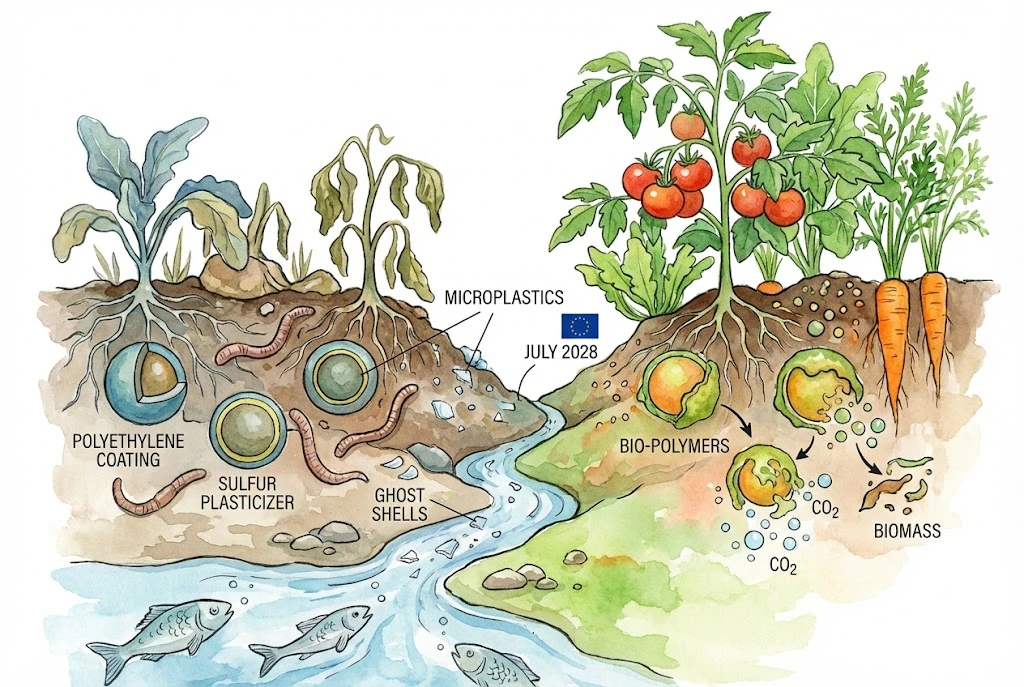
Conventional CRF coatings have used polyethylene and other polyolefins, alkyd or other resins, polyurethane, and sulfur-polymer combinations. A common concern is what happens to the coating after the nutrient is gone.
For persistent polymer coatings, the empty shell can remain in the soil. How long it lasts, how it fragments, and where it moves depend on the polymer, the soil, and time.
These coating residues are one source of soil microplastics that can accumulate in soil and wash into waterways. Their scale, persistence, and ecological effect vary and are still being studied.
What the Regulation Actually Requires
Under EU microplastics restriction Regulation (EU) 2023/2055 and related fertilising-products rules, coatings on affected products must meet specified biodegradability criteria rather than being banned outright. The relevant transition date is 17 October 2028. The exact scope and compliance route differ for EU fertilising products versus national or non-EU products.
That requirement has pushed research toward coatings that protect nutrients for months and then break down. Manufacturers describe end products such as carbon dioxide, water, and mineral salts under set test conditions, but a manufacturer degradation claim is not the same as independently verified field mineralization. The most active research here is on bio-based polymers.
Biodegradable Coatings in Research (Lignin and Oils)
Lignin (A Pulp Byproduct as a Coating)
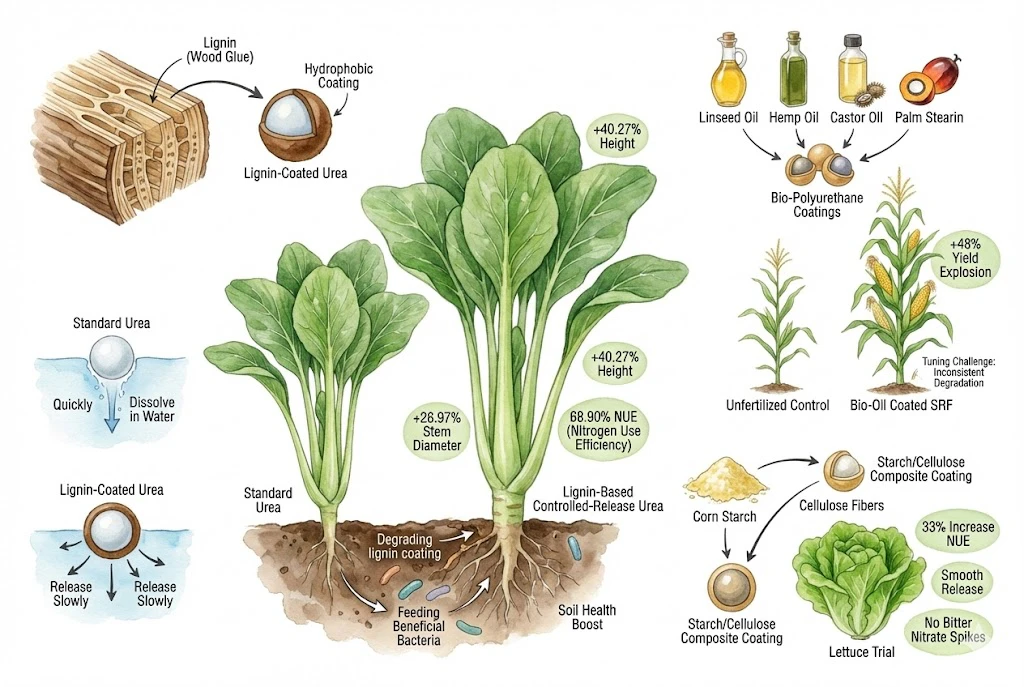
One material under study is lignin. Lignin is a structural aromatic polymer in plant cell walls (it helps make wood rigid) and the pulp and paper industry produces large amounts of it as a byproduct.
Lignin is heterogeneous, and its hydrophobicity and biodegradability depend on how it is modified and cross-linked. That makes modified lignin a candidate coating material, but calling lignin biodegradable does not by itself mean a finished coating is fully biodegradable or EU-compliant.
A two-season field trial in Guangzhou, China, published in Frontiers in Plant Science in 2024, tested lignin-based controlled-release urea on transplanted choy sum with fixed phosphorus and potassium. Averaged over both seasons and compared with conventional urea at 150 kg N/ha, the full-dose treatment raised plant height by 40.27%, stem diameter by 26.97%, and above-ground dry weight by about 38.6%. These are results for an experimental product in a subtropical field, not for home lettuce or commercial lignin products generally.
Nitrogen-use efficiency in that trial is easy to misread. The reduced-urea version at 127.5 kg N/ha had an absolute NUE of about 68.24% versus 40.40% for conventional urea and 64.29% for full-dose LCRU. The reported 68.90 percent is a relative increase over conventional urea rather than an absolute NUE. The paper’s abstract and conclusion are inconsistent on this point, so read the results table rather than repeating one number.
The trial also sampled soil bacteria late in the season and reported shifts in diversity and community composition that correlated with treatment, with LCRU15 showing higher diversity than conventional urea. It did not show that the coating fed specific beneficial bacteria or that any microbial change caused the growth benefit.
Lignin-based controlled-release urea improves choy sum growth by regulating soil nitrogen nutrients and bacterial diversity
Vegetable-Oil Coatings
Researchers are also studying vegetable oils, such as linseed and hemp oil, as the basis for biodegradable coatings, though each formulation uses different cross-linkers and shows different degradation behavior.
A three-year field trial in Poland tested urea and compound fertilizer coated with linseed- and hemp-oil-based materials on silage corn. The highest treatment reached about 98.8 t/ha, roughly 48% above the unfertilized control at 66.9 t/ha. That gap reflects fertilizer plus coating versus no fertilizer, not the effect of the coating itself. When coated and uncoated fertilizer at the same rate were compared directly, the difference was much smaller, up to about 11 t/ha, and varied by year.
The study measured silage fresh-matter yield and composition, not home sweet-corn ears or grain. The authors also noted that bio-based coatings can be inconsistent, degrading faster than synthetic plastics and potentially releasing nitrogen earlier. That is a proposed explanation for the variation rather than a coating-degradation curve measured directly in the trial.
What the Field Trials Actually Show
These are promising research materials whose real-world consistency, especially under variable weather, is still being worked out.
Assessment of the Impact of Biodegradable Coated Fertilizers on Corn Yield
Composite Coatings (A Lettuce Trial)
Other coatings combine several materials. In one lettuce trial, a composite coating made of lignin, paraffin, and epoxy resin was applied to urea and improved dry matter and nitrogen-use efficiency. Because it includes paraffin and epoxy resin, the finished coating cannot be described as a simple biodegradable matrix.
Check the Measured Endpoints
The study reported growth and efficiency, not tissue nitrate levels or the taste of the lettuce, so it cannot support claims about bitterness or nitrate.
Nano-Fertilizers – An Experimental Frontier
Shrinking the Payload
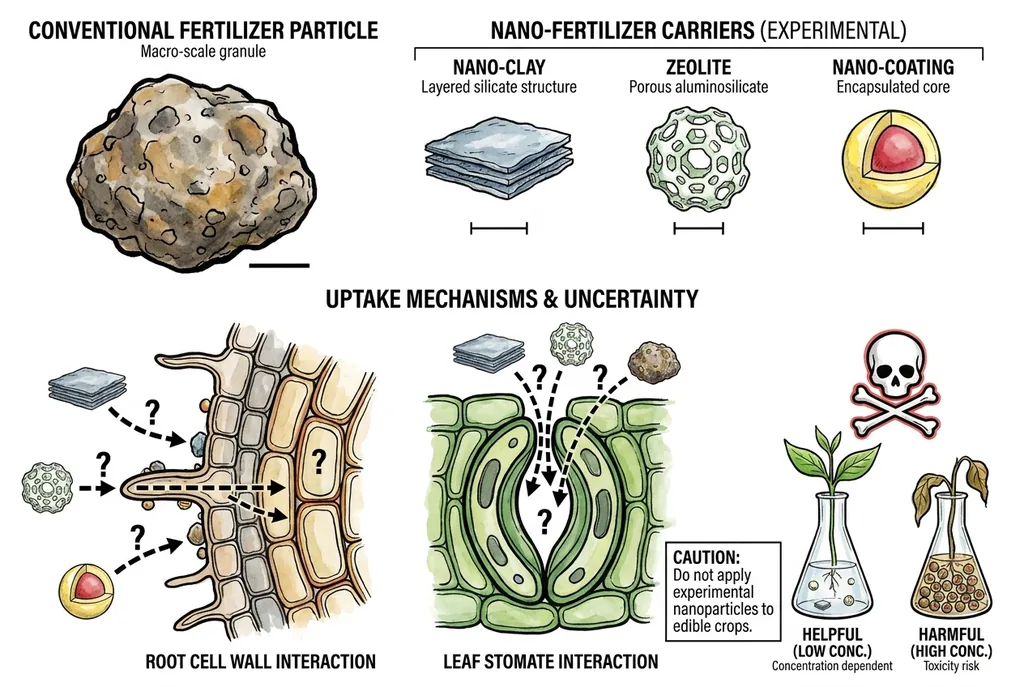
Where bio-based coatings modify existing products, nano-fertilizers are a more experimental direction. The term covers nanoscale nutrients, nano-carriers, and nano-enabled coatings, so it is not a single category and not every particle falls in the 1–100 nm range. Smaller particles can have a larger surface-area-to-volume ratio, but they are not automatically hyper-reactive. Aggregation, dissolution, and the surrounding matrix all change how they behave.
How Nano-Carriers Are Meant to Work
In field crops, nutrient uptake is often limited by how well roots reach the nutrient. Phosphorus, for example, binds to soil and moves little, so roots have to grow into it. A real limitation that a nano carrier does not automatically solve.
The idea behind nano-fertilizers is to carry nutrients in tiny carriers such as nano-clays or zeolites and protect them from being locked up by soil chemistry. Whether such particles cross root cell walls or enter through leaf stomata when sprayed is uncertain. The outcome depends on particle size and charge, aggregation and dissolution, surfactants, humidity, and the apoplastic or symplastic pathways involved. Entry is not guaranteed, and the fate and safety of the particles matter.
The Yield Numbers
A 2025 review compiled reported yield increases that vary by crop, including roughly 20–55% for wheat, 20–35% for potato, 20–40% for maize, and 13–25% for rice. These are not a single pooled range. The studies used different comparators, and a narrative review is not a meta-analysis, so these figures are not an expected effect size for a garden.
Some studies report that nano-chelated calcium can improve fruit firmness or raise calcium in fruit tissue. That is not the same as preventing blossom end rot, and the review does not establish blossom-end-rot prevention. Do not treat a nano-calcium product as a fix for that disorder.
Treat the higher figures as best-case research conditions, not a guarantee.
Emerging trends and perspectives on nano-fertilizers for sustainable agriculture
Toxicity and Uncertainty
Reported yield gains do not mean these materials are safe to apply to food crops. Some nanoparticles can help plants at low concentrations and harm them at higher ones, but the dose and effect depend heavily on the specific particle, its coating, the growing medium, and the crop.
Zinc oxide (ZnO) nanoparticles are a common example in the literature, and studies report different results at different concentrations and in different media, so there is no single low-vs-high curve that applies everywhere.
There is an important distinction between registered commercial nano products sold with label directions and experimental nanoparticle suspensions used in research. Home gardeners should not apply experimental nanoparticles to edible crops. Established, labeled slow-release or controlled-release products are the safer practical choice.
Slow-Release Strategies by Crop
Tomatoes (A High Nitrogen Demand)
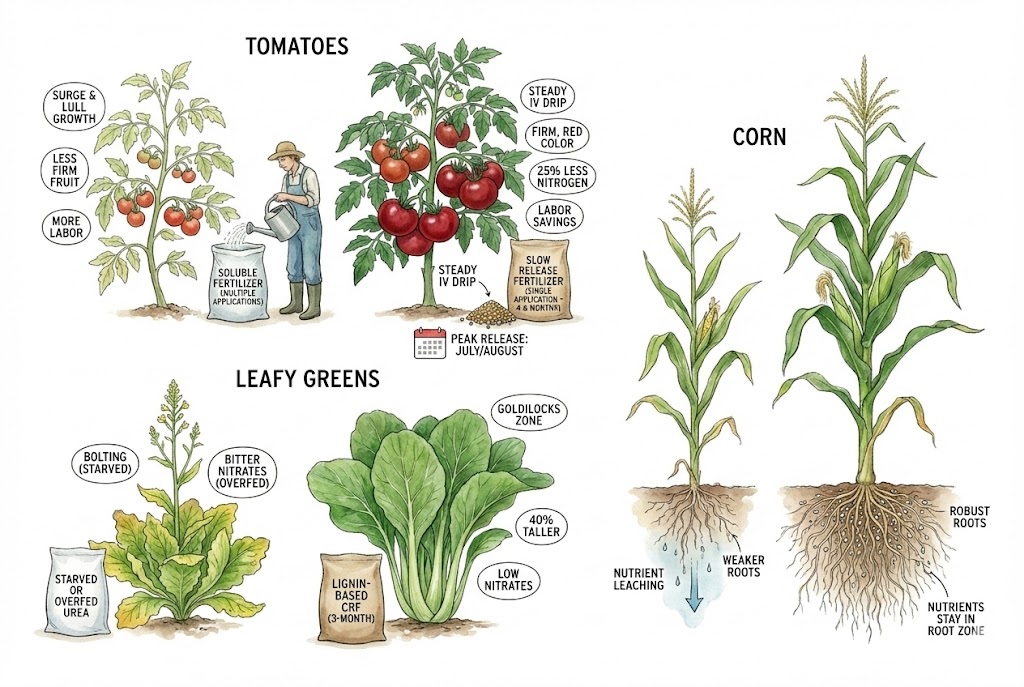
Tomatoes have a high nitrogen demand. Use the tomato fertilizer guide for the rest of the crop plan. A Florida field study of fall crops in 2011 and 2012 compared pre-plant treatments in sandy soil with seepage irrigation and polyethylene mulch. The controlled-release treatments combined coated urea with soluble nitrogen rather than using polymer-coated urea alone. The comparison was against pre-plant soluble fertilizer, not repeated soluble feeding through the season.
In that trial, a 168 kg total-N hybrid produced marketable yield comparable to the 224 kg recommended soluble rate, which was about a 25% reduction in nitrogen under those conditions. Fruit-quality differences were year-dependent. Some firmness and red-color differences appeared in 2011, but total marketable yield showed no treatment difference in 2012, so this is not a consistent multi-year effect.
The study did not directly measure soil-nitrogen release over time, so it does not prove that a steadier supply caused the quality differences. It also used managed irrigation and hybrid soluble nitrogen rather than a set-it-once approach.
For home tomatoes, choose a 4- to 6-month product and follow its label for placement, checking that the label allows contact with transplant roots. Distribute it evenly rather than concentrating it in a planting-hole pocket, which can create a salty hot spot. Warmer summer soil generally speeds release, but planting date, rated duration and temperature, cultivar, and season length determine whether supply lines up with fruit load.
Effect of Controlled-release and Soluble Fertilizer on Tomato Production and Postharvest Quality in Seepage Irrigation
Leafy Greens (Steady Nitrogen Demand)
Lettuce, spinach, and choy sum are leaf crops, so they use nitrogen to build foliage. Nitrogen is not the main driver of bolting or bitterness, however. Heat, long days and high light, variety, maturity, and water stress matter more than nitrogen starvation alone.
Excess nitrogen can raise nitrate levels in leafy vegetables, and this can happen with over-application generally rather than only with soluble urea. Nitrate concentration is not itself a direct cause of bitter taste.
The choy sum trial measured growth, nitrogen-use efficiency, and soil bacteria. It did not measure tissue nitrate or taste, so it cannot support a claim of no excess nitrate.
For short-season greens such as lettuce, a 3-month product usually covers the crop. Radishes are a root crop with different nitrogen and potassium needs, so treat them separately. With a short crop, nutrient remaining at harvest can carry over to a succeeding planting rather than simply being wasted. How much remains depends on the product’s rated temperature and release curve.
Corn (A High-Nitrogen Crop)
Corn is a grass with a high nitrogen demand. The corn fertilizer guide covers rate, timing, and return-on-input questions beyond coating choice. The silage-corn trial reported yield results for coated versus uncoated fertilizer, but it did not measure root systems or field nitrogen leaching. It therefore cannot support claims that roots were more robust or that the coating kept nitrogen in the root zone.
Choosing a Slow-Release Fertilizer
Resin and Polymer-Coated Products
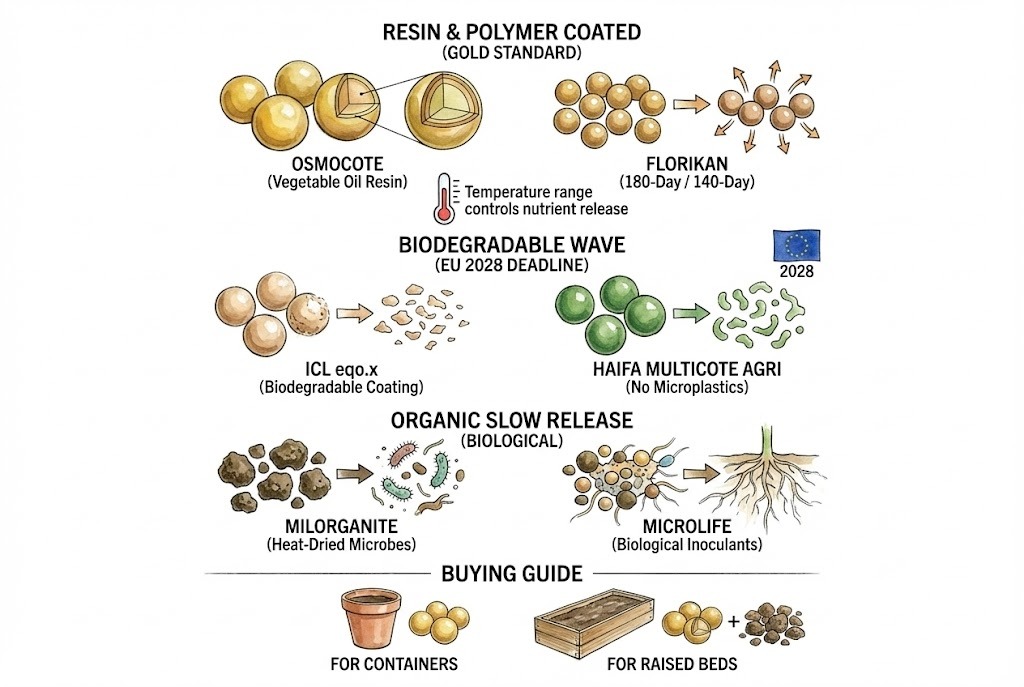
Established controlled-release product families use polymer or resin coatings with temperature-driven release. Many offer duration ratings such as 140 or 180 days that help match a product to season length. The best option depends on formula, use case, temperature curve, and label rather than brand reputation alone.
Balanced-NPK coated products
A balanced-grade coated product supplies nitrogen, phosphate, and potash in the proportions on its guaranteed analysis. Grade, stated feeding interval, application rate, placement, coating behavior, and crop suitability all belong to the exact product. If a soil test or potting-mix label already shows adequate phosphorus and potassium, a balanced grade adds nutrients you do not need, so check the medium before defaulting to it.
Check the exact coating material and biodegradability evidence before assuming an environmental benefit, because a bio-based feedstock does not make a finished coating biodegradable. Match the stated release duration and temperature assumptions to the crop and season, and follow the labeled rate and placement for the container or bed.
The New Biodegradable Wave (ICL, Haifa)
Several manufacturers are developing coatings aimed at EU rules. ICL says its eqo.x technology received EU fertilising-products biodegradability certification in 2025, with degradation stated to occur within a set period after the coating’s functional life. It is being introduced across certain product lines, so not every product from that maker uses it. Haifa Multicote Agri’s current official materials describe a temperature-controlled polymer coating but do not document biodegradable or no-microplastics certification. Both descriptions rest on manufacturer sources rather than independent field verification.
Biosolid Slow Release
These products are not polymer-coated. Soil biology breaks them down and releases their nutrients.
Heat-dried biosolid fertilizer
A heat-dried biosolid fertilizer is made from microbes and organic solids in wastewater treatment, not a live microbial inoculant. Guaranteed analysis, nitrogen forms, trace nutrients, and stated feeding interval vary by product, so read the current label instead of treating one familiar municipal biosolid as the class standard.
Before using one in an edible garden, note that a biosolid is not necessarily a USDA-organic-approved input, so organic in this context does not mean certified organic. Check its potassium and phosphorus analysis against a soil test rather than assuming every biosolid contains no potash. Biosolids can also contain trace PFOA or PFOS, and one product disclosure does not establish a category average. Check the current manufacturer disclosure and local guidance before use. Follow the labeled crop rate, and if you combine it with another fertilizer, add the N-P2O5-K2O contributions from both against the soil test.
Dosing – Don’t Burn Your Plants
Commercial research reports pounds of nitrogen per acre, which is not directly useful for a patio pot. For containers, follow the product’s label rate for the container or bed. If the label does not give a per-pot-size rate, use its area or volume rate and your soil or medium test rather than guessing. More fertilizer is the trap that causes salt burn.
Placement and longevity
Follow the specific product’s label for placement. Some products are incorporated into the top few inches, while others are topdressed or banded, and these methods are not interchangeable. Distribute granules evenly rather than piling them in a pocket against the roots, which can create a salty hot spot.
Match longevity to the crop and soil temperature. A 3-month product can suit short-season greens, while a 4- to 6-month product can suit tomatoes and peppers as planning examples. The right choice also depends on rated temperature, local season, and crop succession. For crops especially sensitive to excess nitrogen timing, use the carrot and onion fertilizer guides. Follow the label range and use visible crop response and, where relevant, an EC or soil or tissue test to decide whether to top-dress.
I label each container with the product name, application date, stated release period, and the temperature basis printed on that product. Later soluble feeds go into the same record. Warm media can shorten a coated fertilizer’s useful period, so the number of months on the bag is not a calendar promise.
Empty-looking shells do not trigger a redose, and intact-looking prills do not prove that nutrients remain. I use plant response, media EC where appropriate, and the recorded temperature and feeding history together before adding more.
Slow-Release Fertilizer FAQ and Myths
Do eggshells supply quick calcium to vegetable roots?
No. Eggshells break down slowly, especially if not finely ground, so they are not an immediate calcium source. How fast they release depends on grind, soil pH, and decomposition rate.
Blossom end rot is a disorder of calcium transport within the fruit rather than usually a lack of calcium in the soil. Uneven moisture, root damage, salinity, excess nitrogen, and rapid growth can contribute. Adding more calcium or fertilizer often does not fix it and can make it worse. Manage it mainly with even moisture, mulch, root protection, and avoiding over-fertilizing. A with-micronutrients label does not guarantee that the product supplies calcium.
Are coffee grounds a complete nitrogen fertilizer?
No. Coffee grounds are misleading as a primary fertilizer. They contain nitrogen, but it releases slowly as microbes break the material down. Composting them first is a safer route. If used directly, keep the layer thin and mixed in, and watch for matting and mold.
Does fertilizer kill soil microbes?
Not at normal label rates. Mineral fertilizer does not sterilize soil, but heavy, high-salt applications and long-term rate and source can shift pH, salinity, and the microbial community. The lignin-coated CRF study reported soil bacterial shifts under different treatments. It did not measure a soluble salt shock or prove that a coating feeds microbes, so it should not be cited as evidence for either.
The Environmental Impact
Beyond yield, one reason to consider controlled-release products is leaching. In sandy soils water moves quickly, so nitrogen can move below the root zone, though how much depends on soil texture, irrigation, rainfall, crop uptake, nitrate timing, and rooting depth.
A figure sometimes quoted as roughly 30 percent comes from a two-year Wisconsin study of bare-root red-oak nursery stock. Equal-rate coated urea had about 30 percent lower calculated potential nitrogen leaching than a conventional source, but this was not measured groundwater flux and is not a general figure for vegetable gardens or containers. A lower fertilizer rate produced a much larger reduction in the same study, so the number depends on system, rate, and metric. Controlled-release products can lower concentration in the soil solution, but heavy rain or over-irrigation can still leach released nutrients.
On the coating, a bag slogan is not enough to identify the material. Check the guaranteed analysis, the slow-release fraction, the coating type, and, where available, a technical sheet or SDS and any biodegradability certification.
Fewer Feedings When You Test First
The practical upside of a controlled-release product is that it can reduce how often you feed, which for many crops means fewer applications than a soluble program. That is not true for every crop or system because fertigation, correcting a deficiency, and short crops can still call for soluble feeding.
Temperature-driven coatings broadly track the warm-season growth curve, but they do not sense the plant, and their environmental benefit depends on rate, timing, irrigation, and soil conditions rather than being automatic.
A workable protocol starts with a soil or medium test and the crop’s nutrient needs. Pick a product by grade, slow-release fraction, and rated duration and temperature. Follow its label for rate and placement, manage irrigation, and monitor the crop. Top-dress only if a deficiency shows. Weigh persistence against biodegradability using information you can verify on the label.