
Sowing Seeds Indoors: BSG & LED Science (2025)
Use brewer’s spent grain only as a small, stabilized trial ingredient for seed-starting mixes, learn when to avoid it, and give seedlings even white light before fine-tuning spectrum.
Elena Vargas · Published 2026-01-03 · 13 min read
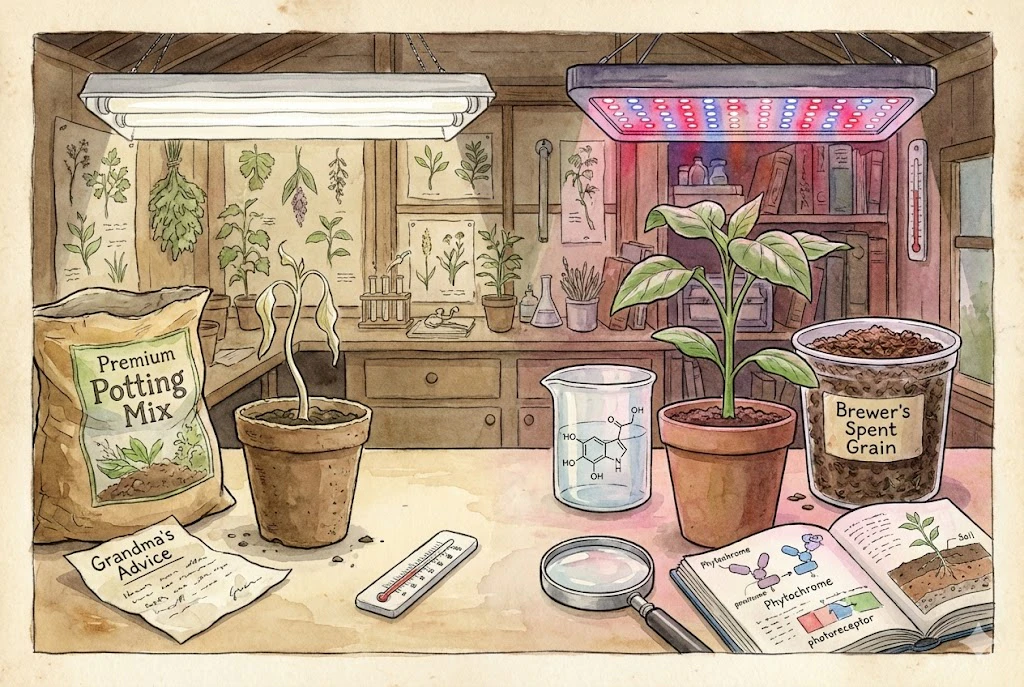
Key Takeaways
- Use brewer’s spent grain (BSG) only as a small, stabilized part of a trial mix, not as a ready-made seed-starting medium. The supporting study grew rooted ornamental sage cuttings, not seedlings, and all pots received fertilizer.
- A moderate BSG blend performed well in that one trial. It is a sensible starting point to test in a few pots, not a proven recipe for every seed.
- Dry or properly ferment fresh BSG before it goes near roots. Wet grain spoils quickly and can make a seedling mix airless and unsafe.
- For ordinary seedlings, adequate, even white light is the dependable baseline. A blue-rich light can help limit stretching, while added far-red can make plants stretch.
- Keep BSG away from salt-sensitive plants and animal enclosures. It can raise salinity, and this research did not test vivarium or animal safety.
Start With a Small, Separate Trial
Before using BSG for seeds, test a small batch beside your usual mix and keep the grain out of vivariums. Fresh grain spoils quickly, and the one encouraging greenhouse result was for fertilized, rooted sage cuttings rather than sown seeds.
A 2025 study found that BSG could replace part of peat without harming ornamental sage at a moderate rate. That supports a cautious trial, not a universal seed-starting formula.
LED spectrum can influence seedling shape, but intensity, even coverage, and a suitable day length matter more than chasing a color recipe. Treat the spectrum guidance as a way to adjust an already adequate setup.
I record the spent-grain percentage by volume and compare that medium with a standard seed-starting mix using the same seed lot, cell count, light, and watering. The outcome log tracks emergence, damping-off, odor, surface growth, and usable seedlings instead of only the fastest germination.
The trial stays physically separate from production trays and stops if heating, sour odor, or uncontrolled mold develops. An experimental byproduct is not worth spreading a sanitation problem.
I record temperature inside the amended medium as well as in the room. Active decomposition can create a root-zone condition the thermostat never reports.
The Substrate (Rethinking Peat)
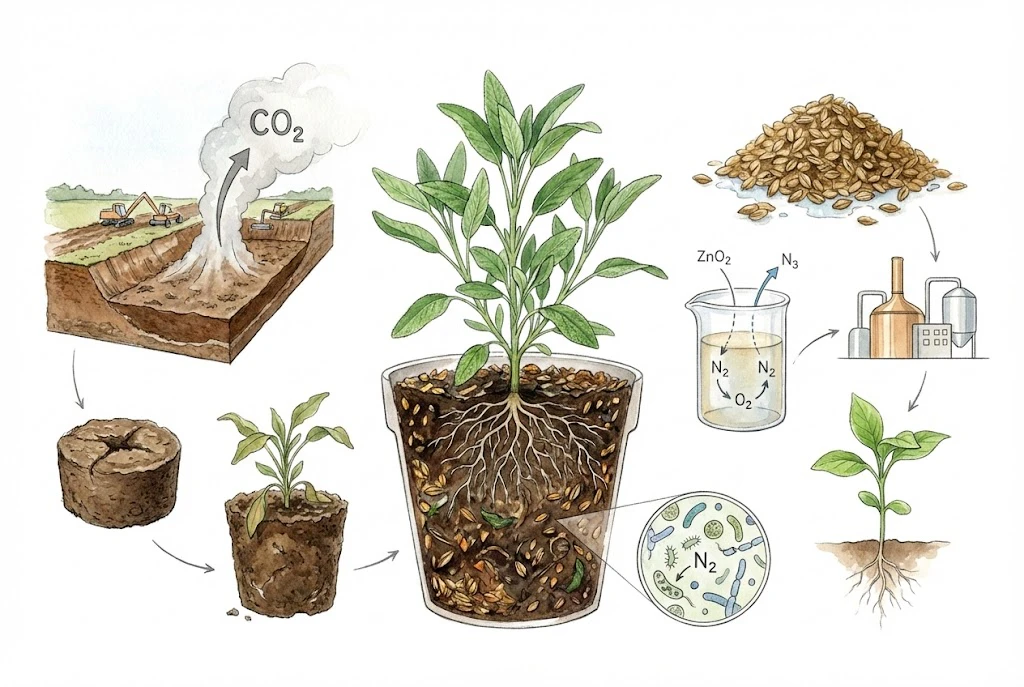
Looking Beyond Peat
Peat is popular in propagation mixes because it is light and holds water. It also needs careful watering and usually needs nutrients and pH adjustment. Growers looking to reduce peat use often test a partial replacement rather than replacing the entire mix.
Brewer’s spent grain, or BSG, is the wet fibrous material left after brewing. Its texture and salt level vary with the grain bill and handling, so one brewery batch will not behave exactly like another.
Never put fresh, wet BSG straight into a seed tray. It spoils quickly. Dry or properly ferment it first, then test a small mix alongside the medium you already trust.
Partial Replacement of Peat. Effects on Substrate Properties and Sage Growth
What BSG Brings to a Potting Mix
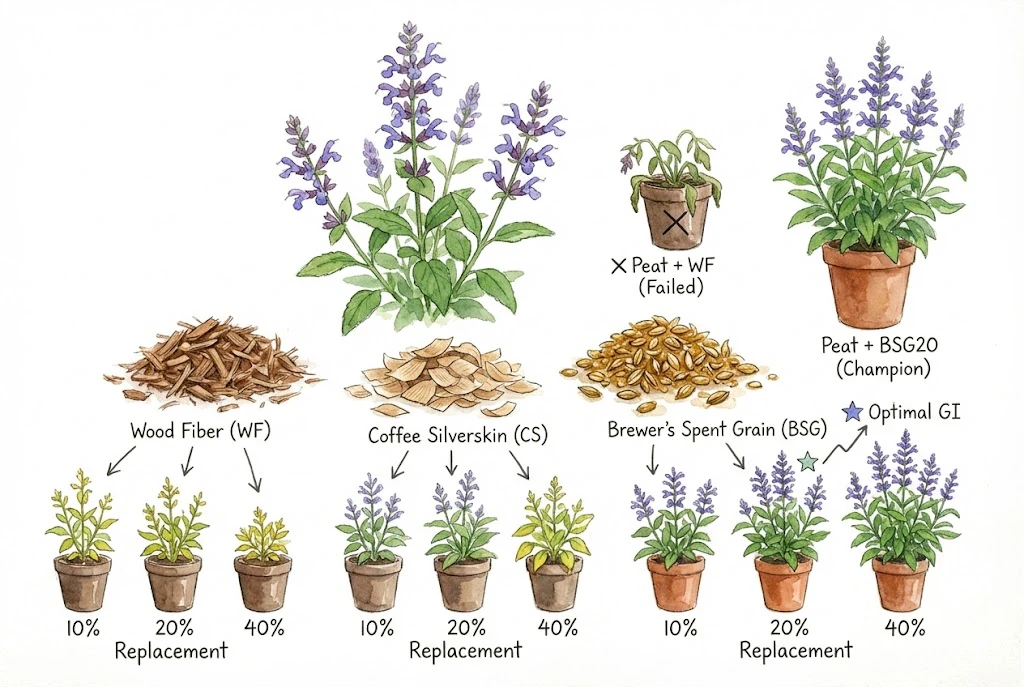
Brewer’s spent grain is the wet, fibrous material left after brewers extract sugars from malted grain. Its makeup changes with the grain bill and brewing process, so two batches will not behave exactly alike.
BSG adds fiber and organic material, which can change drainage, density, and salinity. Its nutrient content is not predictable enough to replace a crop-appropriate fertilizer.
It leaves the brewery wet and may still be warm. That moisture and organic material make it prone to mold and spoilage unless it is stabilized promptly.
What a Greenhouse Trial Suggests
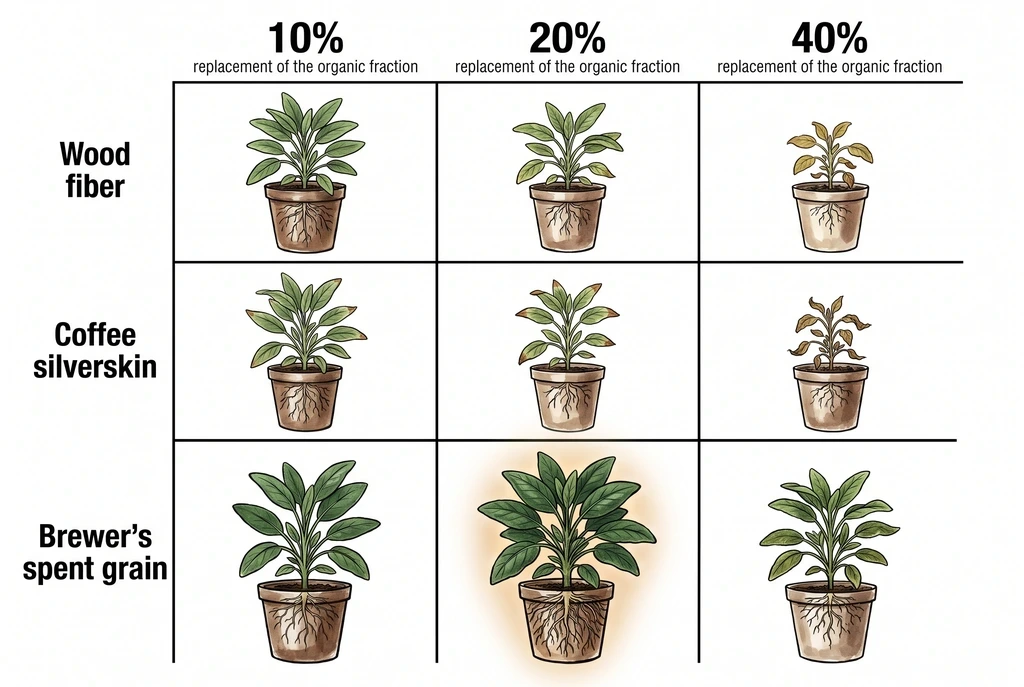
One greenhouse trial grew fertilized ornamental sage cuttings in mixes with different by-products. Its moderate BSG treatment performed well, while higher BSG rates made the mix denser and saltier.
This is a useful reason to test a modest amount of processed BSG, not proof that it is a seed-starting formula. The trial did not test seed germination, root health, animal enclosures, or every crop.
Keep the Trial Rate Modest
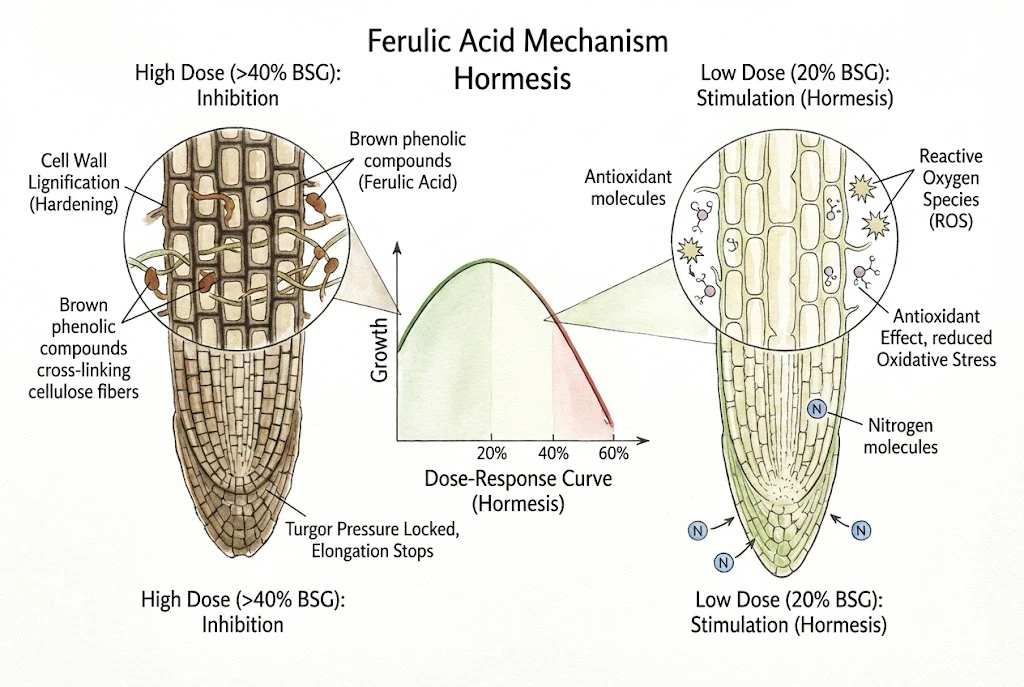
The BSG treatment often cited as “20%” replaced about 17% of the complete experimental mix and every pot received fertilizer. Use that result as an upper starting point for a small comparison, not as a reason to make a rich or dense BSG mix.
Use It as a Trial Ingredient, Not a Recipe
Do not grow seeds in 100% BSG. A mix containing roughly one fifth processed BSG is a reasonable small-scale starting point, but it needs a side-by-side germination test against your usual medium before you rely on it.
Keep the Mix Open, Not Dense
A seed mix needs both moisture and air. If it becomes dense and soggy, roots can fail. If it is too coarse, seeds dry too quickly.
Density and Porosity
BSG is denser than peat, and the trial mix became denser as the BSG rate increased. That is a practical reason to keep the share modest and include an aerating component such as perlite.
Water Retention
BSG changes how a mix holds and releases water, but it does not simply make every mix better at holding moisture. Pot size, particle size, plant type, and room conditions decide whether that shift helps.
Judge the mix by whether it drains and re-wets evenly, not by a promise that it will extend the time between waterings. The study did not test terrariums, isopods, or springtails, so it cannot establish enclosure moisture behavior.
How the By-Products Compared
For a home grower, the comparison is simple. Do not assume that another food-processing by-product will behave like BSG. Test one material at a time with your usual seed mix as the control.
Avoid Spoilage and Salt Stress
Do not treat BSG as free fertilizer for seed trays. Fresh, wet grain can spoil, crowd out air around roots, and raise the salt level of a mix. The risk changes with the rate, plant, and handling.
Why More Is Not Better
Keep BSG modest because dense, salty mixes are harder on young roots. The exact cause of a poor result can vary by batch and crop, so do not try to solve it by adding more grain or more fertilizer.
Salinity (Electrical Conductivity – EC)
Spent grain can raise the salt level of a mix, especially as its share increases. EC is the meter reading commonly used to track dissolved salts.
- High EC can mean salt stress. Roots may struggle to take up water even when the mix is moist. The problem level depends on the crop, growth stage, and water quality.
- Plants differ in salt tolerance. Sage tolerated these substrates in this trial. Plants adapted to lean, acidic conditions, many ferns, mosses, and carnivorous plants such as Venus flytraps, are generally far less salt-tolerant, though the safe level varies by species and by water quality.
Avoid BSG-amended substrates for carnivorous plants and other salt-sensitive species. They normally need a nutrient-poor, low-salt medium and low-mineral water.
Do Not Count on BSG as Fertilizer
BSG contains nitrogen-containing material, but plants cannot use it on a predictable schedule. Microbes, moisture, oxygen, and the batch itself decide what becomes available.
Use the fertilizer appropriate for the crop instead of assuming spent grain will feed it. The encouraging greenhouse trial included fertilizer, so it does not show that BSG can replace it.
If wet grain breaks down without enough air, it can form ammonia and other spoilage products that damage roots. A strong unpleasant smell is enough reason to discard it.
Use Light to Prevent Stretching
Once seedlings emerge, give them even overhead light before changing the color balance.
Start with adequate, broad white light. Use blue-rich light only when seedlings are stretching, and be cautious with far-red. Crop, intensity, and day length all change the response, so check the seed packet and watch the plants rather than following a universal spectrum recipe.
White Light vs. Tuned Spectra
Broad-spectrum ‘full-spectrum’ white LEDs are widely used for seed starting and generally work well.
Adequate intensity, a sensible photoperiod, and good coverage usually matter more than the exact spectrum.
The balance of colors can still influence plant shape. Blue, red, and far-red light can shift growth, but their effect changes with the crop and intensity.
Red and Blue Light
- Blue light (roughly 400–500 nm). Often associated with more compact growth. It tends to inhibit stem elongation and supports stomatal opening and chlorophyll. In some crops, though, high blue can also reduce stem diameter, so ‘more blue = stockier’ is not universal.
- Red light (roughly 600–700 nm). Efficient for photosynthesis. Effects on shape depend on the mix. Pure red is different from a red-heavy white fixture, and stretching or leaf curl is not a guaranteed outcome.
Blue-rich light can help limit stretching in some seedlings, but too much can also slow or alter growth. Start with an even white fixture and adjust height, duration, and spectrum only after you observe the crop.
Whatever the spectrum, a dedicated LED fixture gives more consistent, top-down light than a windowsill, which can be dim or one-sided depending on orientation, season, and latitude.
A window can still work, especially as a supplement (assess your own light before assuming it’s inadequate).
A fixed-spectrum shelf light can be a practical general-purpose choice. Set its intensity by changing fixture height or count, then judge it at canopy level rather than trusting a claimed output. Use the general grow-light selection guide to match a fixture to the crop’s light target.
Far-Red and Shade Avoidance
Far-red light can encourage stretching. It may have a place in a deliberately tuned setup, but it is not the first adjustment for ordinary seed starting.
Check the seed packet for germination light requirements. After emergence, prioritize even overhead light and compact growth before experimenting with far-red.
UV-A (A Mild Stressor)
UV-A is not needed for ordinary seedlings. It can affect plant growth and is a human eye and skin hazard, so do not add it without a purpose-built fixture and a clear safety plan.
How Different Spectra Tend to Act
For most indoor seed starting, broad white light is the reliable default. Blue-rich light may help compactness, far-red may increase stretching, and UV-A needs a separate safety decision.
Raise intensity gradually as seedlings develop. Follow the crop’s own light and temperature needs rather than a generic spectral recipe.
| Stage | Light | Goal |
|---|---|---|
| Germination (early) | Species-specific. Some seeds need light, some dark. Keep warm (many warm-season crops like ~75°F / 24°C) | Moisture and warmth |
| Cotyledon | Even white or cool-white light at a gentle, non-stretching level | Compact, stocky growth |
| True leaf | Increase even white-light intensity gradually as the crop tolerates it | Leaf expansion and biomass |
A Cautious Home Trial
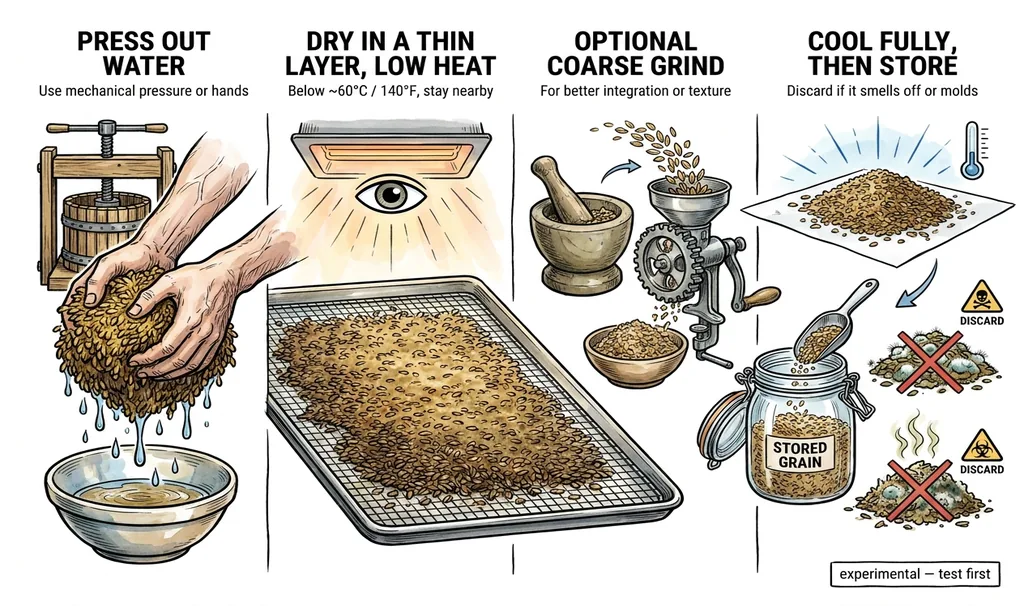
These steps are a home trial, not a proven seed-starting system. Compare a few seeds in the BSG mix with the same seeds in your usual medium before using it for an important crop.
Processing Your Spent Grain
Key point
Don’t use fresh, wet grain as-is in a seed tray. It spoils quickly, and anaerobic breakdown can produce ammonia and other products that are hard on roots.
Drying and controlled fermentation are two ways to stabilize it. Neither makes the material automatically safe for seed starting, so test germination before relying on it.
Method 1 (Oven Drying)
Suited to small amounts you can spread thinly.
- Press. Squeeze out as much water as you can first. Clean equipment helps avoid contamination.
- Dry. Spread it in a thin layer and use a low oven setting. Higher heat may dry it faster but increases odor, energy, and fire risk. Watch it closely and never leave an oven running unattended.
- Grind (optional). Keep it coarse enough that the finished mix still drains and re-wets evenly. Do not try to turn it into flour.
- Cool and store. Let it cool completely before sealing, or trapped moisture can cause condensation and mold. Storage life depends on how dry it truly is. Discard if it smells off or shows mold.
Method 2 (Bokashi Fermentation)
An alternative to drying. Bokashi is a controlled anaerobic fermentation. Done right, the acidifying, lactic-fermentation conditions are very different from the uncontrolled anaerobic spoilage that produces ammonia.
Follow your bran product’s directions for the details below.
- Inoculate. Mix wet grain with Bokashi bran, following the product’s inoculum ratio and moisture guidance.
- Pack and seal. Press into a bucket rated for the purpose to exclude air, and manage any leachate and gas per the instructions.
- Ferment. Keep it in the recommended temperature range. A pickled smell suggests it’s going well. A putrid smell, or visible non-white mold, signals failure. Don’t use it.
- Cure in soil, then test. Mixing the fermented grain into soil to age is a common next step, but a calendar alone doesn’t prove it’s seed-safe. Before sowing into it, check maturity with a simple germination test and, if you can, EC and pH. Young or acidic material can harm seedlings.
An Experimental BSG Seed Mix
Important
This is not a proven seed-starting recipe. The encouraging trial used fertilized peat-based pots and rooted cuttings, so keep your first seed test small.
For a simple comparison, replace no more than about one fifth of your usual seed-starting mix with fully processed BSG. Keep the rest of the mix familiar and well-draining. Sow the same seed in an unamended control tray and compare germination, smell, drainage, and early root health.
Do not add worm castings or other fertilizer by default just because the BSG is present. Seedlings can be sensitive to excess salts. Use the feeding plan that fits the crop after it has established.
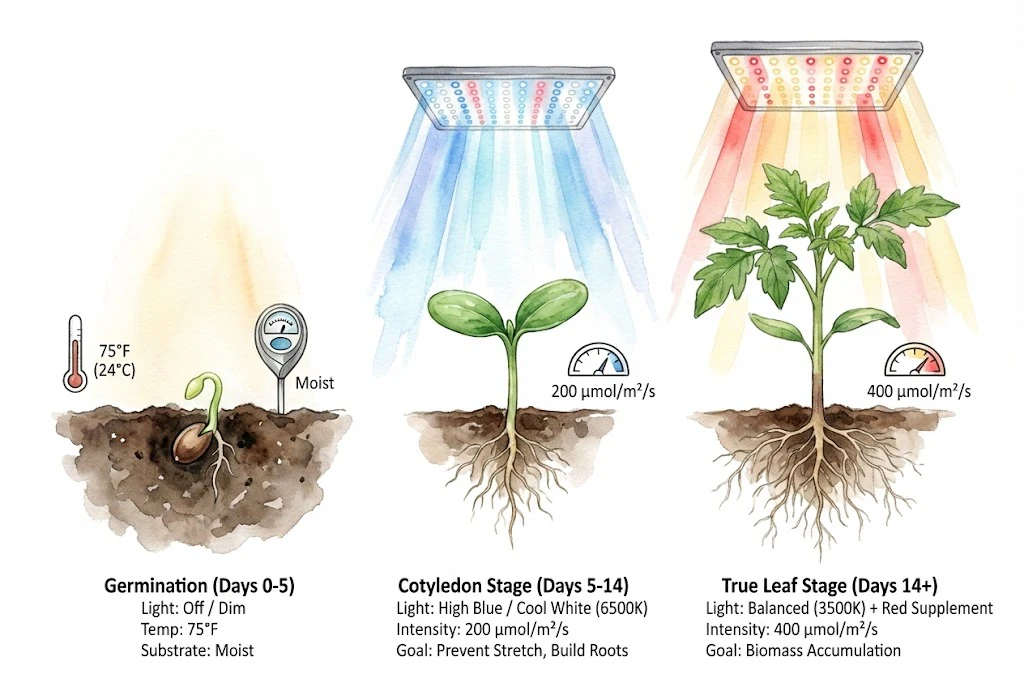
A General Lighting Framework
Organize lighting by the seedling’s stage rather than a fixed number of days. Increase light gradually as seedlings acclimate, and check the seed packet for crop-specific light and temperature preferences.
- Germination. Light requirement is species-specific (some seeds need light, some darkness). Keep the medium moist but not soaked and warm. Many warm-season crops do well around 75°F (24°C), but cool-season crops prefer cooler, so check the seed packet.
- Cotyledon stage. Use even, overhead white or cool-white light at a level that limits stretching without bleaching the leaves.
- True-leaf stage. Increase even light gradually as the crop tolerates it. The goal is sturdy leaf growth, not forcing the highest possible intensity.
A Caution on Vivariums and Animals
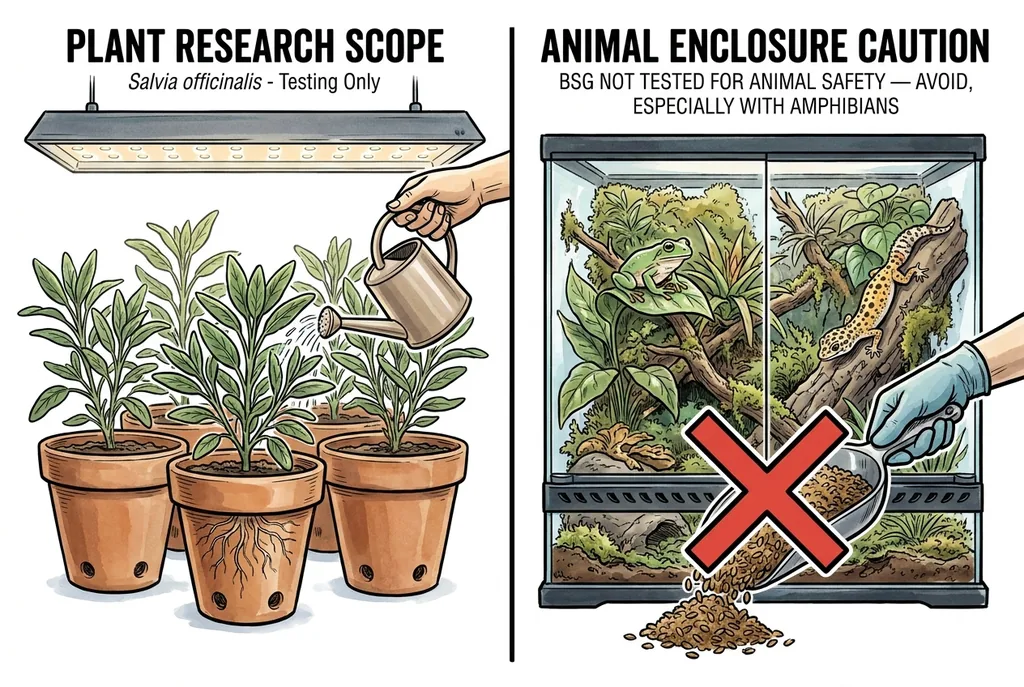
Do not use BSG in a bioactive terrarium with animals. No source here establishes that it is safe for an enclosure or its occupants, and a fixed waiting period cannot make it safe by default.
Why the Boundary Matters
In a warm, humid tank, a nutrient-rich material can grow mold and alter air or water chemistry. A busy springtail or isopod population does not prove it is safe for a gecko, frog, or other vertebrate. Amphibians are especially sensitive to those changes.
Start Small and Test the Mix
Start with a small amount of processed BSG, compare it with your usual seed mix, and use even white light before fine-tuning spectrum. A greenhouse trial supports BSG as a moderate peat replacement for fertilized, rooted sage cuttings, not as a finished system for every seedling.
The home mixes, stabilization methods, and animal-enclosure uses were not tested in that trial. Use plant response rather than a fixed recipe to guide adjustments.
Start small, stabilize the grain first, keep the rate modest, and test the mix before committing valuable seedlings to it.
A Note on Sourcing
Malted barley flour or sprouted barley are not substitutes for brewer’s spent grain. Mashing removes much of the soluble sugar and starch, so the materials differ in composition and spoilage risk.
A local brewery is the usual source. In some places brewers give spent grain away or pay to have it hauled off, though that varies by region and by feed contracts, so it’s worth asking rather than assuming.
If you do get grain from a brewer, ask about the grain bill, any cleaning-chemical residues, and how long and how warm it has been stored, since fresh grain spoils fast.