
Anthurium Hybridization Genetics: Breeding & Cultivars
A practical guide to anthurium hybridization: ploidy basics and the protogynous flowering cycle, how to store pollen, pollinate during stigmatic receptivity, clean and sow seeds, and what the published research does and does not say about intersectional crosses and induced polyploidy.
Priya Patel · Published 2026-01-26 · 15 min read
Key Takeaways
- Pollinate during the female phase, when the spadix glistens with stigmatic fluid. Anthuriums are protogynous, so a dry spadix usually means the receptive window has passed.
- Clean seeds by removing the slippery berry pulp without scrubbing the seed coat. Removing the mesocarp improves sowing hygiene, while hard scrubbing can damage a normally smooth seed coat.
- Use fresh pollen when you can. If the parents bloom out of sync, refrigerate an irreplaceable sample without letting it condense, and keep drying or freezing to a labelled spare aliquot, since neither is a validated method for Anthurium. Then test stored pollen before trusting it for an important cross.
- Check ploidy before planning a cross. Most species are diploid, while induced tetraploids and their triploid offspring can show altered growth and reduced fertility, so confirm pollen and seed set with records.
- Harvest by ripeness signs and label every cross. Berries can take several months to develop, and the exact timing varies by species, cross, and growing conditions.
Breeding Anthuriums means making a planned cross, raising the seedlings, and seeing which traits appear. Success depends most on receptive flowers, viable pollen, compatible parents, and careful records.
Choose Parents with Realistic Expectations
A basic grasp of what happens inside the cell nucleus helps you plan crosses and read your results, rather than guessing.
Chromosomes and Ploidy Explained
Most Anthuriums Are Diploid
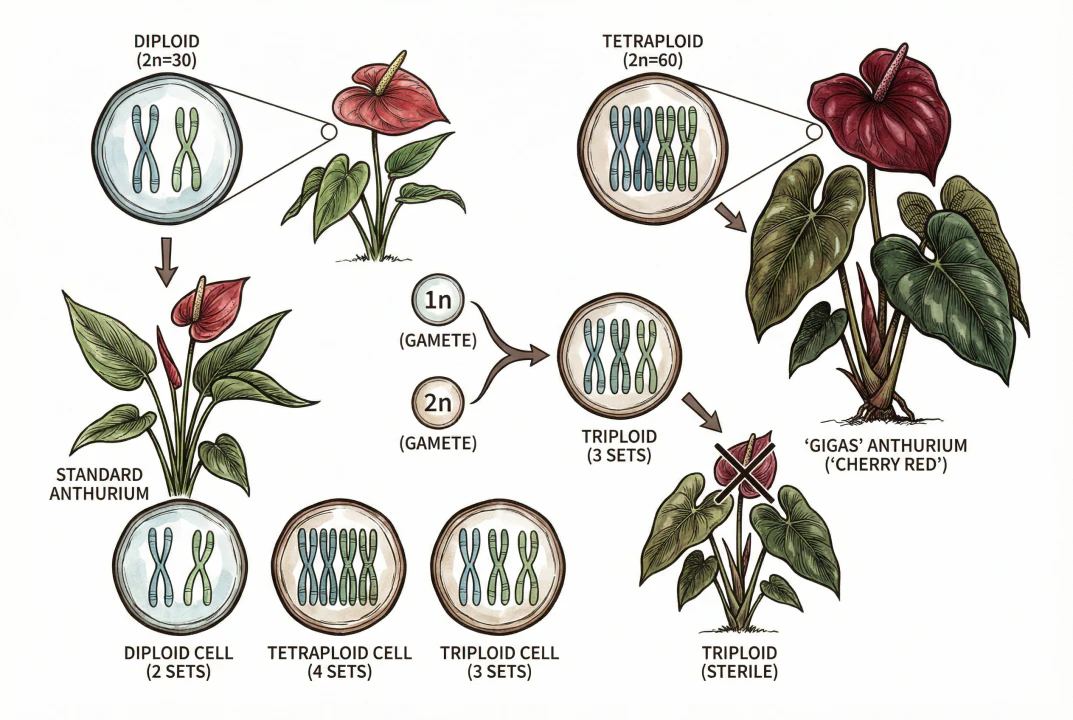
Most Anthurium species are diploid, meaning they carry two sets of chromosomes, one from each parent.
Chromosome Counts Vary
The most common count is 2n=30, roughly 15 pairs, but it is not universal. Cytogenetic studies also report counts such as 2n=26, 28, 32, 36, and 40, along with polyploid series and occasional supernumerary (B) chromosomes.
If ploidy matters for a specific cross, confirm the count or ploidy of the actual parent plants rather than assuming 2n=30.
Tetraploids Carry Four Sets
Sometimes a plant carries four sets of chromosomes. This is called a tetraploid (in the 2n=30 lineage, that is roughly 2n=60).
What Ploidy Changes
Induced tetraploids can show larger-organ traits, including thicker leaves, sturdier petioles, and in some lines larger or longer-lived spathes.
But polyploidy is a trade-off, not a free upgrade. The same and related studies also report reduced survival, lower stomatal density, abnormal spathes, and in one diploid-versus-tetraploid comparison shorter, more compact growth with reduced root traits.
Effects vary from line to line.
The tetraploid described in one 2014 study was a specific variant found within A. andraeanum Cherry Red, not evidence that every plant sold under that name is a tetraploid.
Check the ploidy of the individual clone you plan to breed.
When you breed a diploid with a tetraploid, you often get a triploid (three sets). Triploids frequently have reduced or irregular fertility because they cannot form balanced gametes, so many produce little or no viable seed.
That is not the same as guaranteed sterility (confirm fertility with actual pollen and seed-set tests before writing a triploid off as a dead end).
Induction of Anthurium andraeanum Arizona tetraploid by colchicine in vitro
Inheritance of Traits
Traits Are Usually Polygenic
It is tempting to predict what a cross will look like, but honest inheritance patterns in Anthurium are mostly unknown at the hobby level.
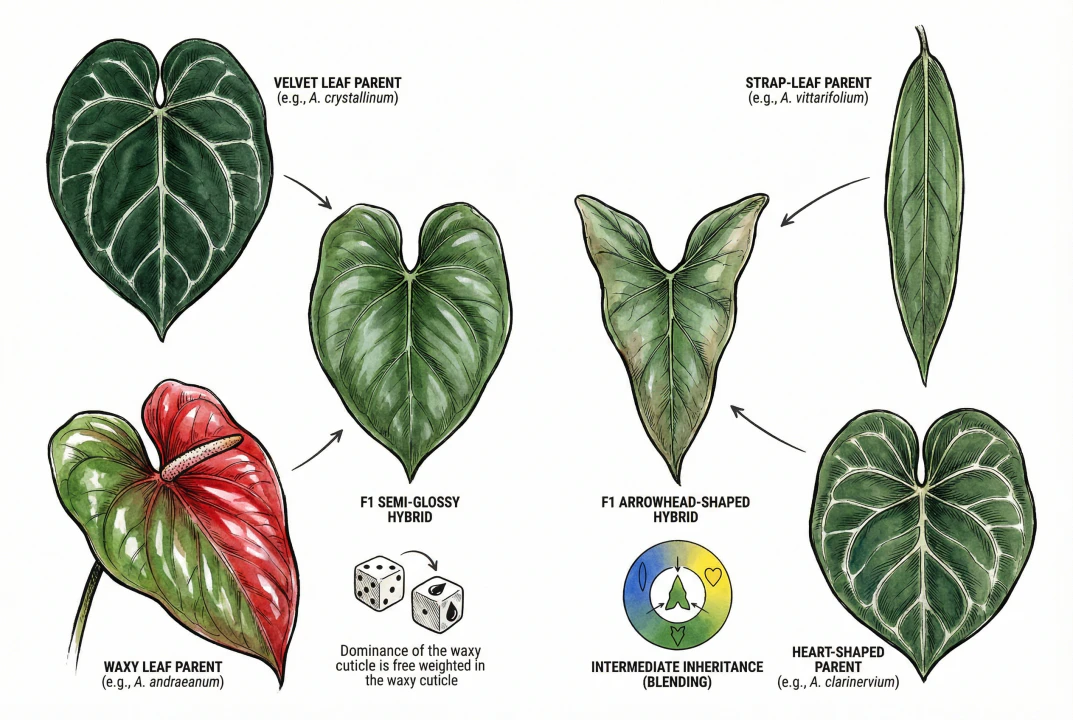
Traits like velvet texture and leaf shape appear to be influenced by several genes plus developmental stage and growing conditions, so simple dominant-and-recessive rules rarely hold up.
Hobby Rules Need Testing
You will often see hobby claims stated as fact, such as velvet texture being recessive, a waxy cuticle dominating velvet, or a strap-leaf parent crossed with a heart-shaped parent producing an arrowhead leaf.
Treat these as untested expectations, not established genetics. None of them come with a published pedigree, progeny count, or trait-scoring data, and some of the parent pairs would first need their crossability confirmed at all.
Use Reciprocal Crosses and Records
If you want to test one of these ideas, do it properly. Make the cross in both directions (reciprocal crosses), record how many seedlings you raise, score the trait consistently, and note the growing conditions.
That is the only way to tell a real inheritance pattern from a lucky-looking single result.
Know When a Flower Can Be Pollinated
Successful breeding depends on matching pollen release to the receptive stage of the flower. The Anthurium inflorescence separates female receptivity from male pollen release, which often encourages cross-pollination without making self-pollination impossible.
The Protogynous Lifecycle
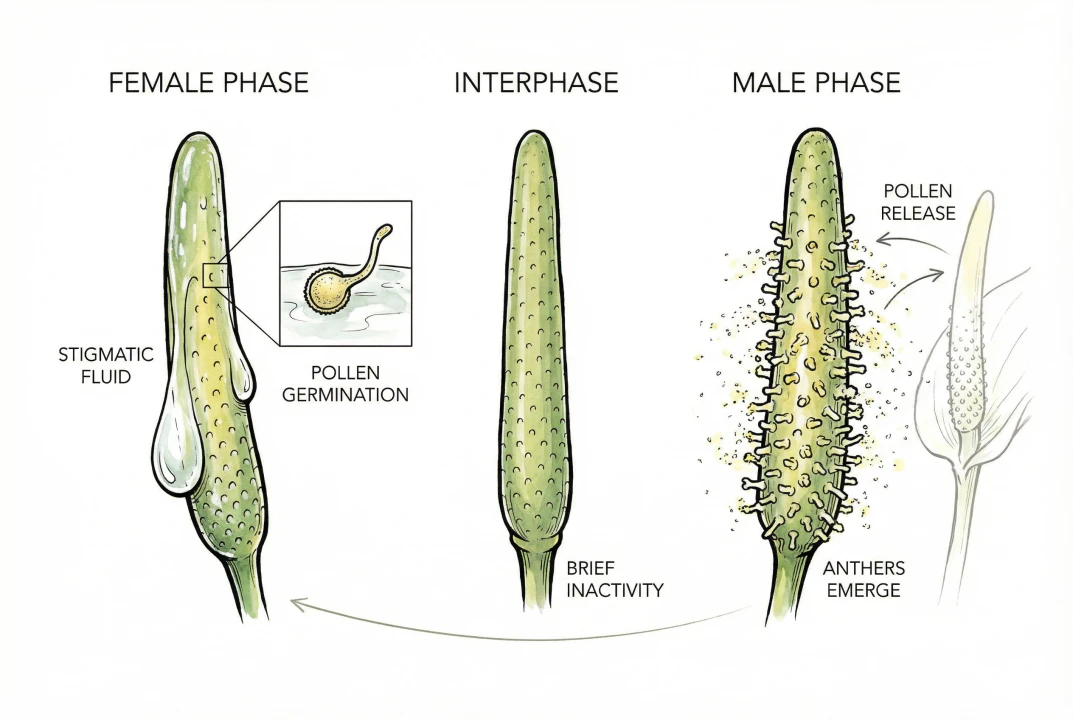
Anthuriums are protogynous. The female part of the flower (the stigma) becomes receptive before the male part (the anthers) releases pollen on the same spadix.
This time gap strongly favours cross-pollination, but it does not make selfing impossible.
In some species the stigmatic fluid and pollen can overlap, and pollen from a second inflorescence on the same plant can still land on a receptive spadix, so treat protogyny as a bias toward outcrossing rather than a guarantee against selfing.
Female Phase
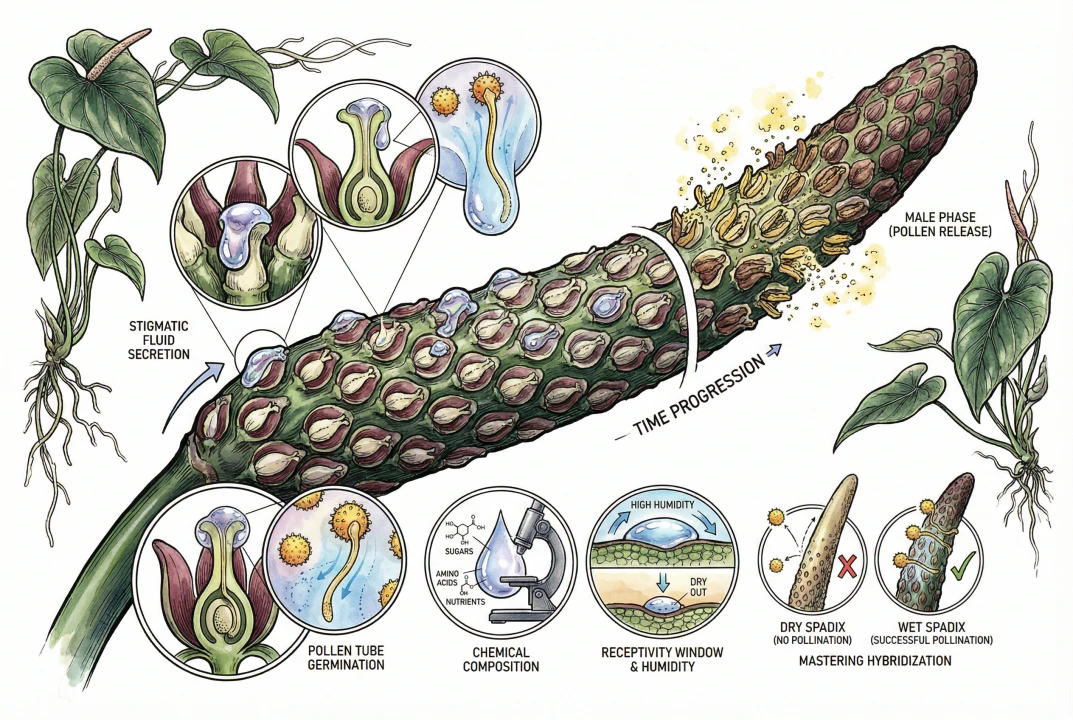
The spadix (the spike) may look glossy or wet. This is the secretion of stigmatic fluid, a practical sign that the stigmas are receptive. The fluid is sticky and holds moisture, which helps pollen adhere and hydrate.
Interphase
During this interphase, the stigmatic fluid dries and the spadix transitions from female receptivity toward pollen release.
Male Phase
The anthers emerge from the fleshy spadix and release white or yellow powdery pollen. By this time, the female stigmas on the same spadix are usually dry and unreceptive.
Stigmatic Fluid Mechanics
Visible Fluid Is a Receptivity Cue
Visible stigmatic fluid is a useful practical cue that the spadix is receptive. Receptivity commonly starts near the base of the spadix and moves upward over a few days.
Fluid Function Is Not Fully Documented
The fluid is often described as a medium that helps pollen adhere, hydrate, and germinate on the stigma. Its exact composition and role in supporting the growing pollen tube have not been well documented for Anthurium specifically, so treat the feeding-and-navigation description as a general model rather than a measured fact.
A Dry Spadix May Have Passed Receptivity
In practice, a dry, unglistening spadix usually means the receptive window has passed, so pollen applied then is unlikely to take.
That is an observational signal, not proof that the fluid is the single molecular reason a pollination fails.
Make and Track the Cross
Label every cross and record the result. Fruit set, viable seed, germination, true hybridity, and fertile adult plants are separate milestones.
Collecting and Storing Pollen
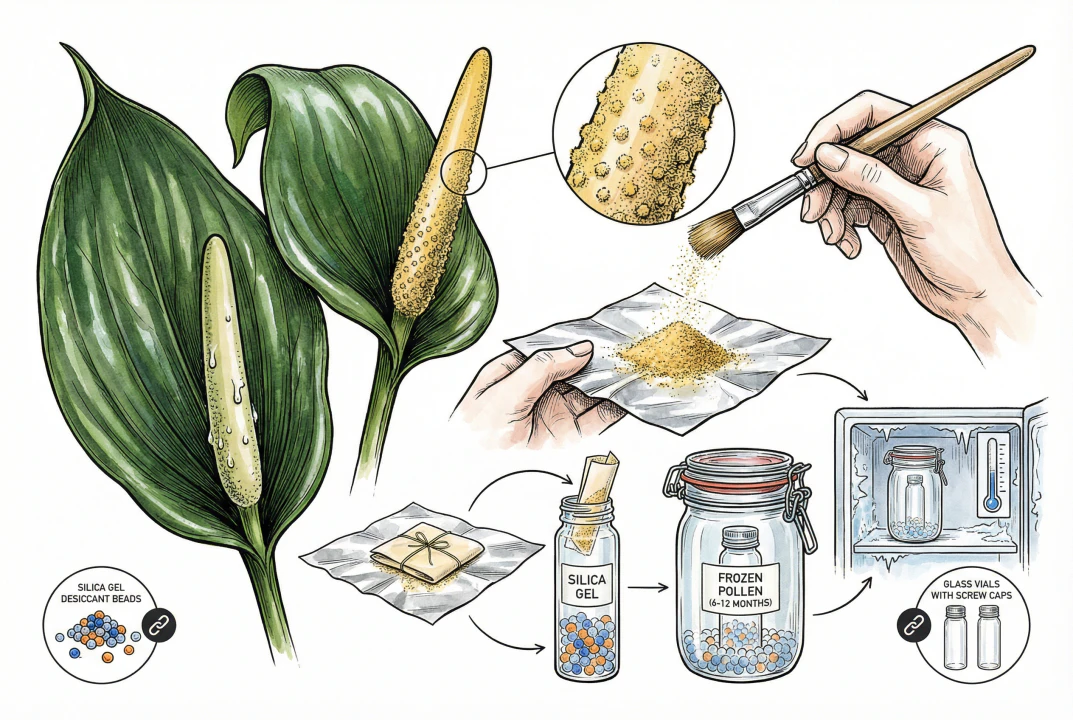
Two plants rarely bloom in sync, so it helps to collect and store pollen from the earlier bloomer to use later.
The Method
- Wait for the spadix to look dusty during the male phase.
- Use a clean, dry paintbrush or a piece of foil to gently rub the spadix.
- Collect the pollen as it falls off as fine dust.
Storage
Treat Pollen Storage as an Experiment
Fresh Anthurium pollen is the safest default. If no receptive spadix is available, favor a short refrigerator hold for pollen you cannot replace, keeping it cool and humid but physically separated from liquid water or condensation.
Drying and freezing are not validated defaults for Anthurium. A related aroid, Caladium, lost almost all germination after a day at −20 °C even when drying was tested, so use a spare aliquot for any dry or frozen trial rather than committing the only sample. Keep each portion in a small, airtight, labelled container and record the method, temperature, and time.
Test Stored Pollen Before an Important Cross
How long that pollen stays usable is genuinely uncertain for Anthurium. Cold, dry storage extends pollen life in many plants, and hobby sources often quote 6–12 months, but no published Anthurium study is available here to confirm that range, and viability depends on species, drying, and storage temperature.
Do not assume a fixed shelf life. Before relying on stored pollen for an important cross, test a small amount by pollinating a receptive spadix and watching for fruit set.
Color-Indicating Silica Gel
Color-indicating silica gel is optional equipment for a controlled drying trial, not a proven Anthurium storage requirement. Its colour shows moisture exposure in the beads, not pollen viability, and this genus has no validated target humidity.
Use only a small amount outside a spare pollen packet, then compare it with fresh or conservatively refrigerated pollen. The Anthurium pollen-storage chooser explains why both desiccation and freezing remain experimental.
The Pollination Ritual
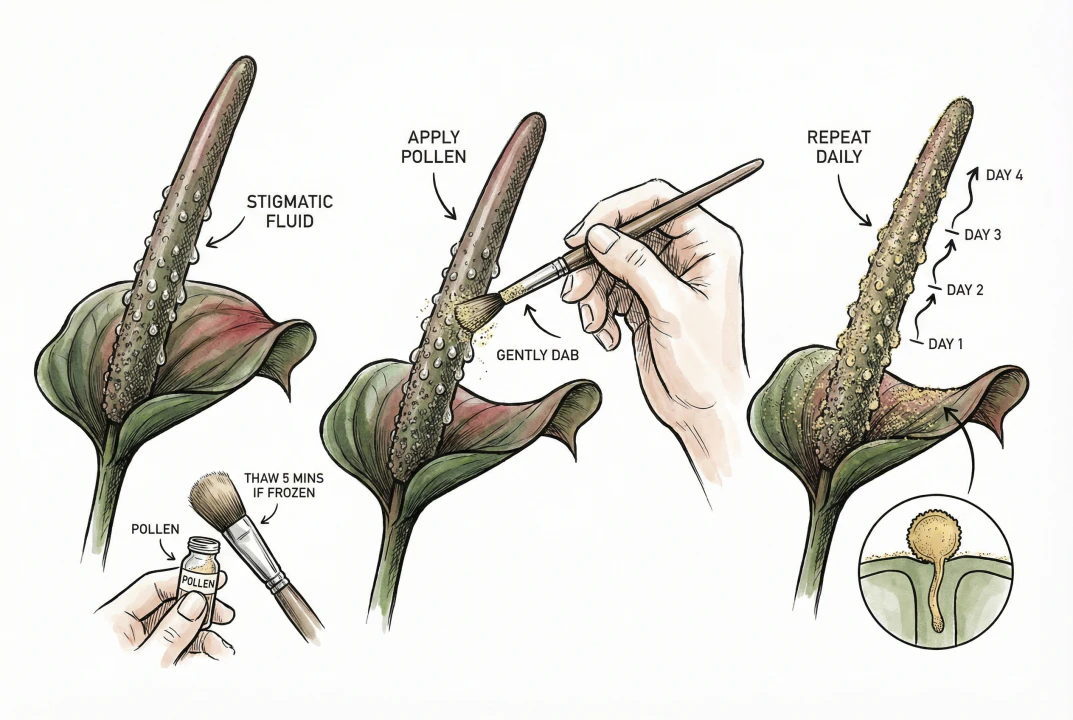
Timing matters. Check the seed-parent plant daily, and treat the glistening droplets of stigmatic fluid as your cue that the stigmas are receptive.
The Technique
Handle an Experimental Frozen Aliquot Carefully
If you are testing a frozen spare aliquot, let the sealed packet warm to room temperature before opening it so moisture condenses on the outside rather than on the pollen. This handling step reduces condensation risk, but it does not make freezing a validated Anthurium storage method.
Apply Pollen Without Scrubbing
Dip a soft brush into the pollen.
Gently dab the fluid-covered spadix so pollen grains stick to the droplets. Do not scrub.
Repeat While the Stigmas Are Wet
Because receptivity tends to move up the spadix over several days, it is reasonable to repeat the application on the days the stigmas still look wet.
Go by the visible exudate rather than a fixed number of days, since the exact window varies by species and plant.
Harvesting and Cleaning Seeds
Harvest by Berry Signs
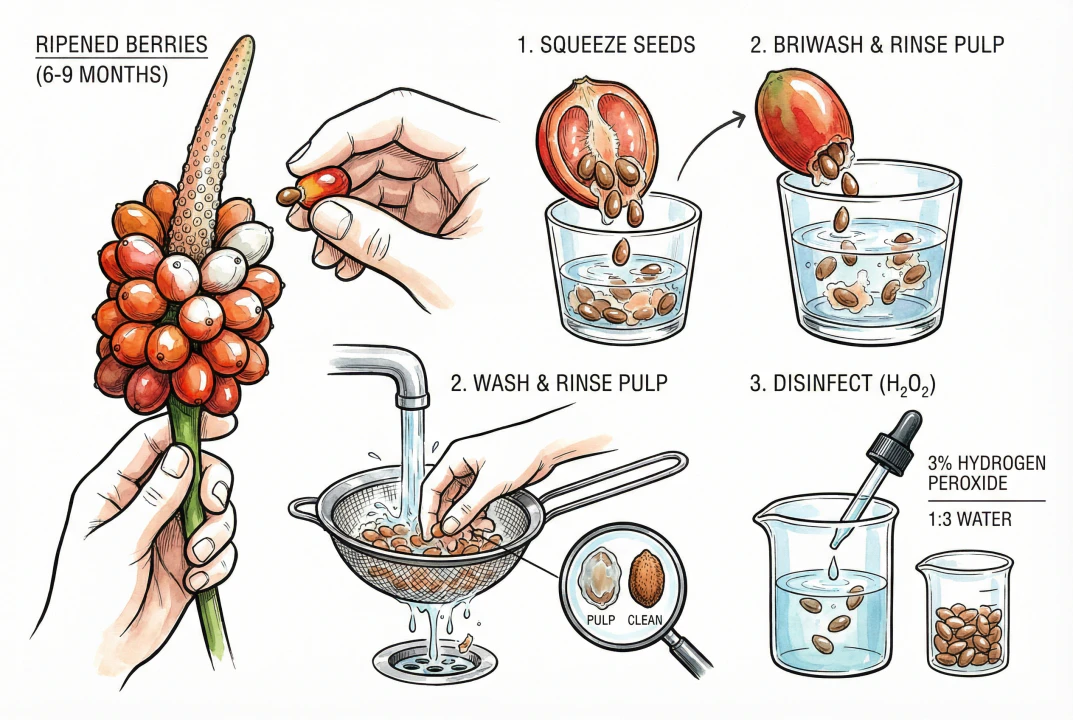
Harvesting seed takes patience. Ripening time varies with species, cross, and growing conditions (different sources quote anywhere from several months to about a year) so harvest by ripeness signs, not a fixed timeline.
Ripe berries bulge out and change colour (often orange, red, or white).
Clean and Sow the Seeds
1. Squeeze
Pop the seeds out of the berry pulp into a cup of water.
2. Wash
Remove every trace of the slippery pulp, called the mesocarp. Leftover pulp sugars can encourage mould, so cleaning helps with sowing hygiene. Anthurium pulp is sometimes said to contain germination inhibitors, but the specific compounds and their effect are not documented here. Treat that as unverified. The clear benefit is removing pulp, not neutralising an inhibitor.
3. Rinse
Rinse and wipe gently until the seeds are smooth and slime-free. The seed coat is normally smooth, so do not scrub for roughness. Roughness is not a cleanliness indicator, and hard scrubbing can damage the seed coat or embryo.
4. Sow Promptly
Sow the clean seeds onto fresh, clean medium in a clean container. Household hydrogen-peroxide dips are sometimes suggested, but there is no verified Anthurium recipe for concentration, contact time, and rinsing. An unrefined dip can harm germination as easily as help it. If you want to disinfect, work out the concentration, time, and rinse against your own controls rather than following a generic claim that a quick rinse kills spores.
Keep Records
The single most useful habit in breeding is record-keeping. Without it, you cannot tell whether a seedling came from the cross you intended or from stray pollen.
For each attempt, note the seed (pod) parent and the pollen parent by clone or accession, the pollination date, and whether you bagged or isolated the inflorescence to prevent contamination.
Then track the outcomes as separate results, including fruit set, seed count, germination, whether the seedlings really look like hybrids, and eventually whether the adult plants are fertile.
Treating berry formation as success is misleading. Fruit set, viable seed, germination, true hybridity, and fertile adults are different milestones, and heteroploid or intersectional crosses in particular can produce empty seed or aborted embryos.
I assign a short cross code before pollen touches the spadix, then put it on the plant tag, pollen packet, and eventual seed container. A same-side photograph of the labeled inflorescence joins the record on every application day. A tag can fall off months later, but the repeated code and photo sequence still let me reconstruct the cross.
Failed attempts stay in the ledger instead of being deleted. When the reciprocal direction works and the original direction repeatedly does not, that pattern is far more useful than a notebook containing only successful berries.
Advanced Work Needs Specialist Support
Intersectional crossing and polyploidy work have a much higher uncertainty and safety burden than ordinary hand pollination.
Intersectional Compatibility
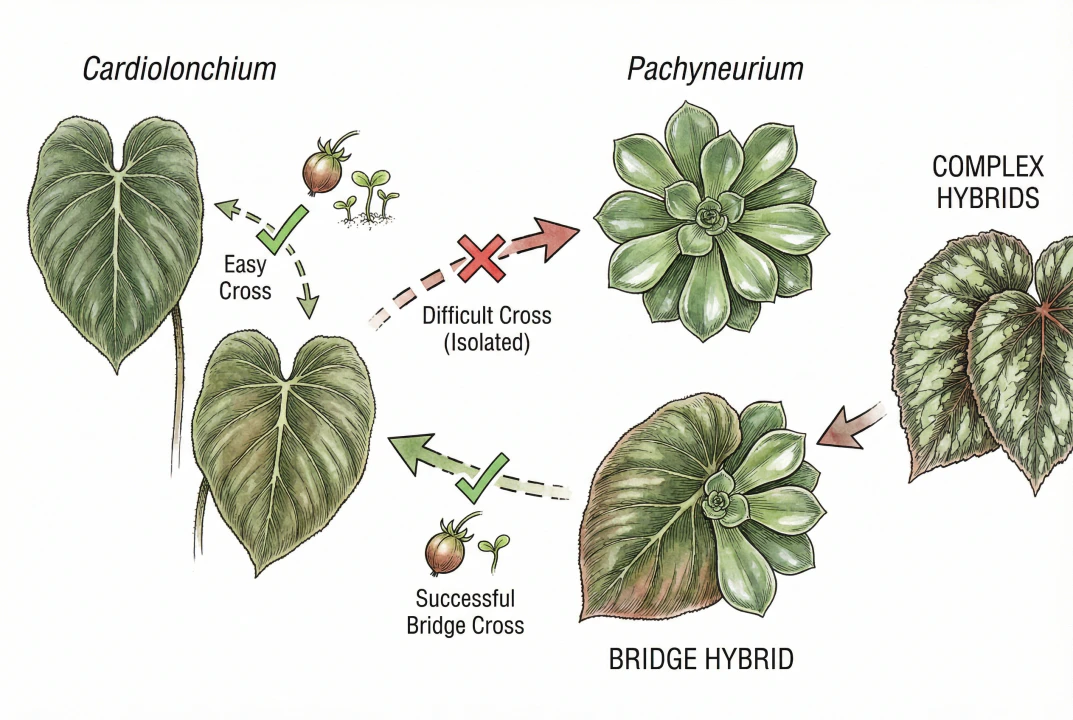
Sections Are Compatibility Heuristics
Anthuriums are grouped into sections such as Cardiolonchium, Pachyneurium, and Calomystrium.
These are morphology-based classifications and a useful rule of thumb, but they are not fixed genetic compatibility units. Recent phylogenomic work finds that the traditionally defined Pachyneurium is not even monophyletic.
Crossability depends on the specific species pair, the direction of the cross, ploidy, and the individual plants, not on the section name alone.
Same-Section Crosses Can Still Fail
Crossing within a section is often more compatible than crossing between sections, but a same-section cross is not automatically easy.
In Croat’s revision of section Pachyneurium, 433 attempted cross-pollinations yielded fruit in only 33 cases, about 7.4 percent, and viable seed in 28, about 6.3 percent.
Even same-section crosses can therefore fail far more often than they succeed.
Between-Section Crosses Need Evidence
Crossing between sections is generally harder still, which supports the idea that sections tend to be reproductively isolated.
Complex hybrids that already mix sections are sometimes described as bridge parents that accept pollen a pure species would reject, but there is no verified Anthurium pedigree or success rate here to support that claim.
In every case, your own directional cross records, including attempts, fruit set, and viable-seed rate, are more reliable than a general compatibility chart.
Polyploidy Induction
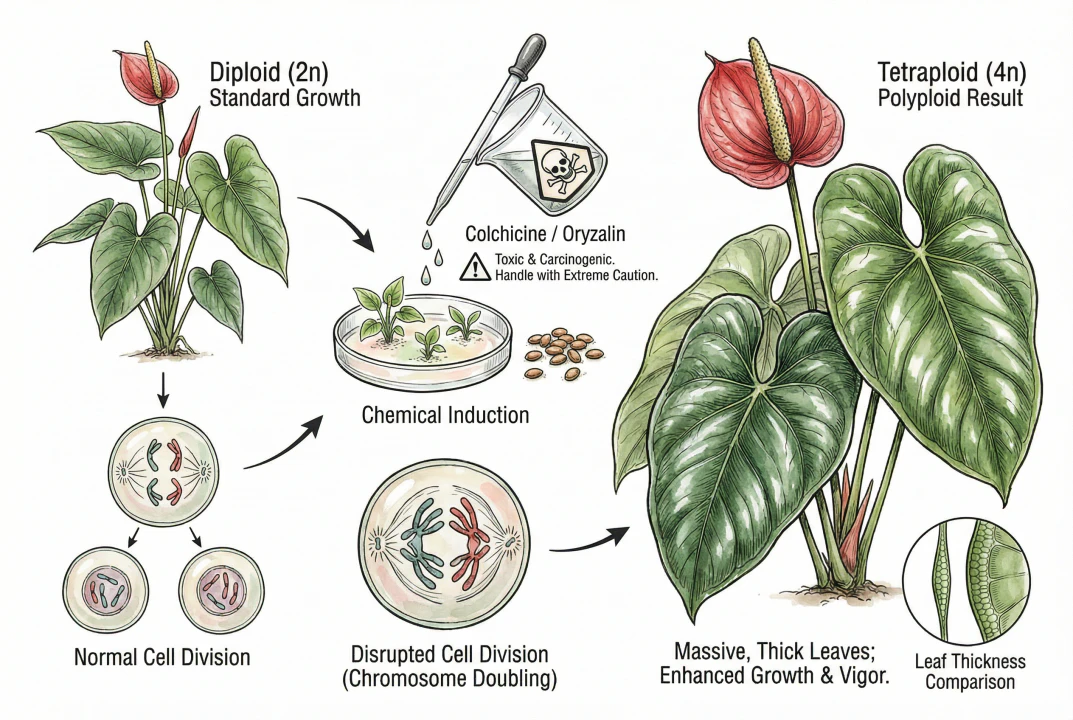
Polyploidy Induction Is Laboratory Only
Doubling a plant’s chromosome set (polyploidy) can be induced with anti-mitotic chemicals such as colchicine or oryzalin, which interfere with cell division so a cell keeps all its chromosomes instead of splitting, becoming tetraploid.
This is a controlled laboratory technique done on sterile tissue in vitro, not something you brush onto seeds or ordinary plantlets on a kitchen table.
Polyploidy Trade-Offs Go Beyond Size
It is also not a shortcut to a bigger, faster plant. In a 2025 diploid-versus-tetraploid comparison in A. andraeanum Pink Champion, the tetraploids were actually shorter and more compact. Leaf length, petiole length, plant height, root number, total root length, and root-hair growth rate all decreased, while widths, thickness, and root diameter increased.
Tetraploids can produce some thicker, larger organs, but they also come with slower or reduced growth, abnormal flowers, lower survival, mixoploidy, and low induction success, not a doubling of size or speed.
Handle Mitotic Inhibitors as Lab Chemicals
Colchicine is acutely toxic and genotoxic, and oryzalin has also been assessed by the EPA for carcinogenic potential. These are different hazards and should be evaluated from each chemical’s current safety data rather than treated as one generic label.
Both are hazardous mitotic inhibitors, not hobby supplies. Nitrile gloves, eye protection, and general ventilation are not sufficient on their own. Safe handling needs each chemical’s specific safety data sheet, engineering controls such as a fume hood, spill procedures, and disposal of contaminated solids and liquids as hazardous waste per local regulations.
If you are not equipped to handle regulated lab reagents, this step is not for you.
In vitro induction and characterization of Anthurium andraeanum ‘Pink Champion’ tetraploids
Troubleshooting Your Breeding Program
Not every cross takes. Here are two common problems and how to think about them.
Pollination Failure
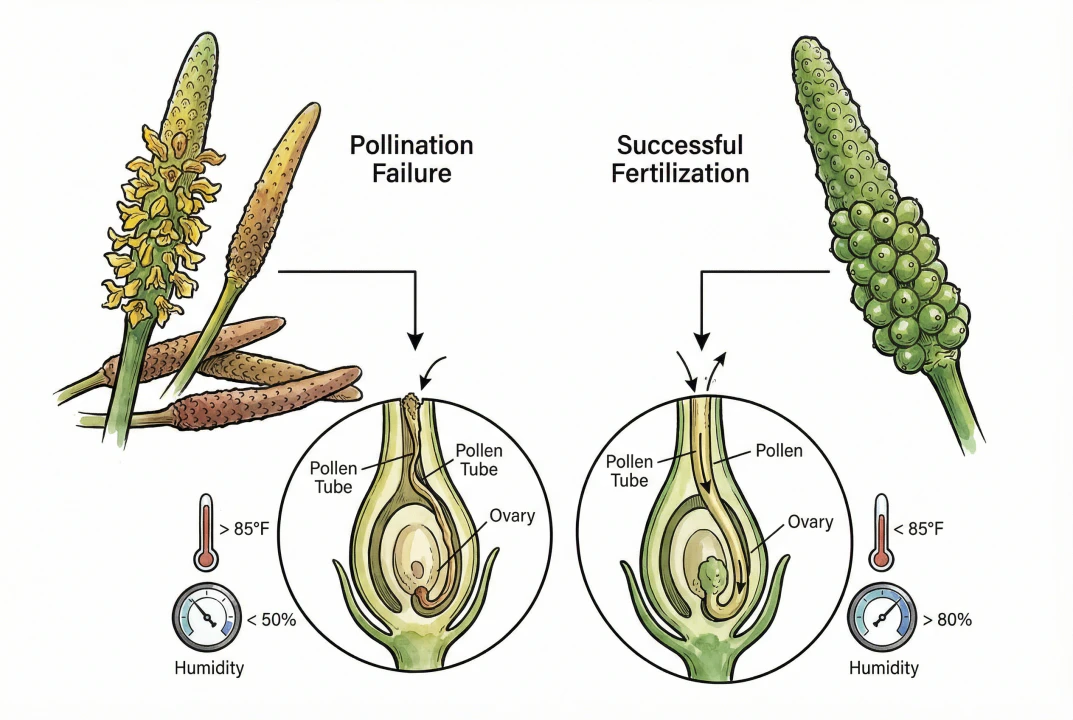
What to Look For
The spadix yellows and drops a few weeks after pollination.
What It Can Mean
Failure or abortion has many possible causes, and you usually cannot tell them apart from the spadix alone.
They include genetic incompatibility between the parents, low pollen viability, missing the receptive window, ploidy mismatches, plant stress, contamination, and post-fertilisation embryo or fruit abortion.
What You Can Reasonably Do
Very hot, dry air can lower pollen viability and pollination success in general, so keeping conditions moderate is sensible.
There is no verified Anthurium evidence for rigid humidity or temperature cutoffs, so treat any precise hobby threshold as unverified.
Note too that pushing humidity very high has its own downside, since prolonged surface wetness encourages disease.
Rather than chase a single humidity target, record your conditions as one of several diagnostic clues, keep pollen fresh and correctly timed, and confirm both parents are actually compatible.
Seed Mold and Damping Off
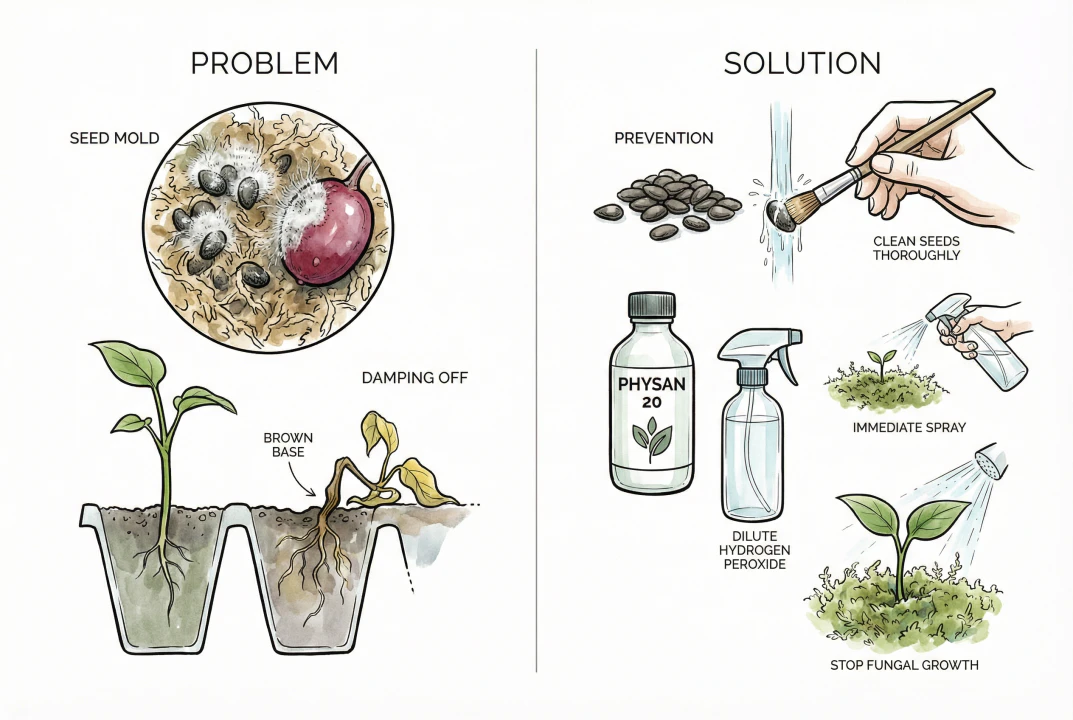
What to Look For
Fuzzy white growth on the sowing moss, and seedlings that turn brown at the base and fall over.
What It Can Be
Damping-off is not one disease. It can be caused by true fungi such as Rhizoctonia and Fusarium, water moulds such as Pythium and Phytophthora, or several pathogens acting together. Pythium and Phytophthora are oomycetes rather than fungi, which matters because treatments do not work the same way on both groups.
Fuzzy mould on the moss surface may also be a harmless saprophyte. Check seedlings for basal lesions, collapse, and root damage. For a valuable batch, consider a lab diagnosis rather than guessing.
How to Manage It
There is no instant cure. The effective approach is integrated and mostly preventive. Use fresh, clean medium and containers, sow into well-drained conditions and avoid overwatering, clean the seeds well, and remove and isolate affected seedlings promptly.
Leftover pulp sugars can feed general surface moulds, but soilborne pathogens like Pythium and Phytophthora are not controlled simply by removing berry sugar, and cleaning the seed does not remove contaminated medium, water, tools, or resting structures. Removing pulp helps hygiene but does not by itself stop an outbreak.
If you choose to use a disinfectant, follow the current product label exactly.
Quaternary-Ammonium Disinfectant
If you consider a quaternary-ammonium disinfectant, use only a product whose current label explicitly covers seeds or ornamental seedlings and the problem you are treating. Some products in this chemical class are surface disinfectants only. Soak and spray directions are not interchangeable, and rates from one concentrate must not be transferred to another.
Follow the selected label and safety data sheet for concentration, contact time, protective equipment, disposal, and state restrictions. Concentrated products can be corrosive and may require protective eyewear, chemical-resistant gloves, clothing, and footwear.
No label identified here establishes safety for Anthurium seedlings or sphagnum moss, so sanitation, clean medium, drainage, and removal of affected seedlings remain the safer first-line measures.