
2026 Horticulture Trends: Orbit Revive & Anthuriums
The 2026 horticulture trends: the official Orbit Revive vintage-futurist look, velvet- and strap-leaf collector Anthuriums (warocqueanum, veitchii, King of Spades), 2026 color forecasts, and new commercial ribbon- and cup-shaped Anthurium blooms.
Samuel Reed · Published 2026-01-16 · 10 min read
Key Takeaways
- Orbit Revive is an official 2026 horticulture style trend with a vintage-futurist look. Pairing specific Anthuriums with it is a styling idea, not a measured shift in demand.
- Many foliage collectors prize the leaf as much as the flower. Velvety and corrugated species stand out for texture and silver veins.
- Deep, near-black foliage and silver-veined hybrids can contrast well with soft-neutral interiors. That styling fit does not establish wider demand.
- Commercial breeders offer Anthurium blooms beyond the classic heart shape. Official pages describe ribbon-twisting, cup-shaped, and large-format forms with their flower and transport traits.
- Crossing, selection, and tissue culture are separate steps. None reliably produces variegation or cold tolerance on demand without a documented pedigree and trial.
From Office Decor to Living Sculpture
For many people, the Anthurium is still the waxy red heart of Anthurium andraeanum, the flowering pot plant seen in lobbies and on windowsills. That familiar image is only part of a large genus.
Alongside those flowering cultivars, the genus includes foliage species prized for leaf texture rather than blooms, including velvet-leaf types with crystalline veins and strap-leaf epiphytes. Some hobbyist collectors seek these plants, though long-run production and sales figures do not show the size of that interest.
Commercial breeders have also introduced flowering varieties in shapes beyond the classic red heart. Choose them for the form you enjoy and the conditions you can provide, not because a trend forecast promises lasting popularity.
Before buying plants to match a forecast color palette, I place paper swatches and temporary forms behind the plants I already own for a full week. I look at them in daylight and under the room lighting, because a fashionable color can turn muddy beside real foliage at night.
I also mark the mature width of any candidate plant on the floor or wall. If the design works only while the plant is juvenile, I change the container or placement before paying a premium for a trend name.
The 2026 Design Trends
Published 2026 design forecasts offer a useful starting point for pairing plants with an interior. They do not measure which Anthuriums people are buying.
The Orbit Revive Aesthetic
Orbit Revive is one of four style trends published for 2026 by the Plants & Flowers Foundation Holland with Dutch horticulture partners.
It is described as a vintage-futurist look that merges the space-age optimism of the 1960s to 1980s with contemporary technology.
The official brief moves away from sterile minimalism toward organic shapes, soft textures, chrome, and a palette of natural, brown, olive, red/orange, and silver tones.
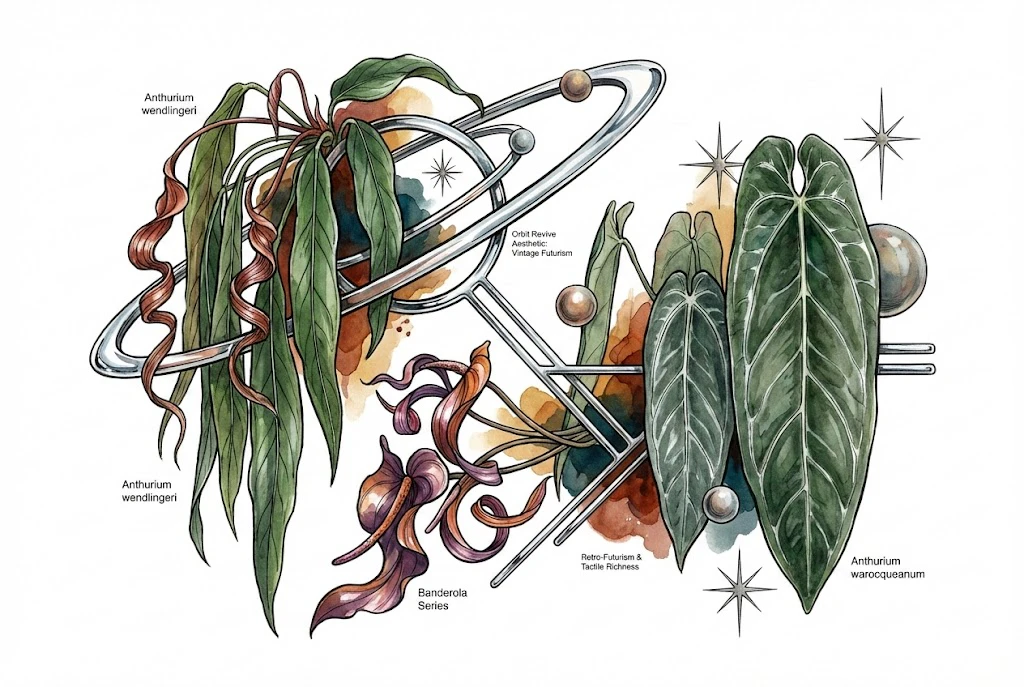
Plants with sculptural qualities, such as the cascading leaves of Anthurium wendlingeri or the twisting blooms of the Banderola series, can suit this look. The official trend does not name specific Anthuriums, so use those pairings as styling ideas rather than a buying rule.
The Orbit Revive interior is characterized by the following visual cues.
Retro-Futurism
A blend of chrome, metallic accents, and deep, warm organic tones.
Visual Movement
Plants that break static lines. The trend favors asymmetric arrangements with distinct height differences, similar to 1980s floral design.
Tactile Richness
The velvet texture of Anthurium warocqueanum complements the soft furnishings central to this look.
Three 2026 Color Forecasts
Several organizations published 2026 color forecasts. They are independent picks rather than one agreed palette, but they can make a useful mood board.
- Pantone named Cloud Dancer its 2026 Color of the Year (a soft off-white neutral).
- Dulux chose Rhythm of Blues, a family of three blues (Free Groove, Mellow Flow, and Slow Swing) rather than a single indigo.
- Orbit Revive's own palette leans warm, with browns, olive, red/orange, pink-red, and silver.
Against soft neutrals and blues, the warmer tones of many Anthuriums can stand out. Use these pairings as visual starting points.
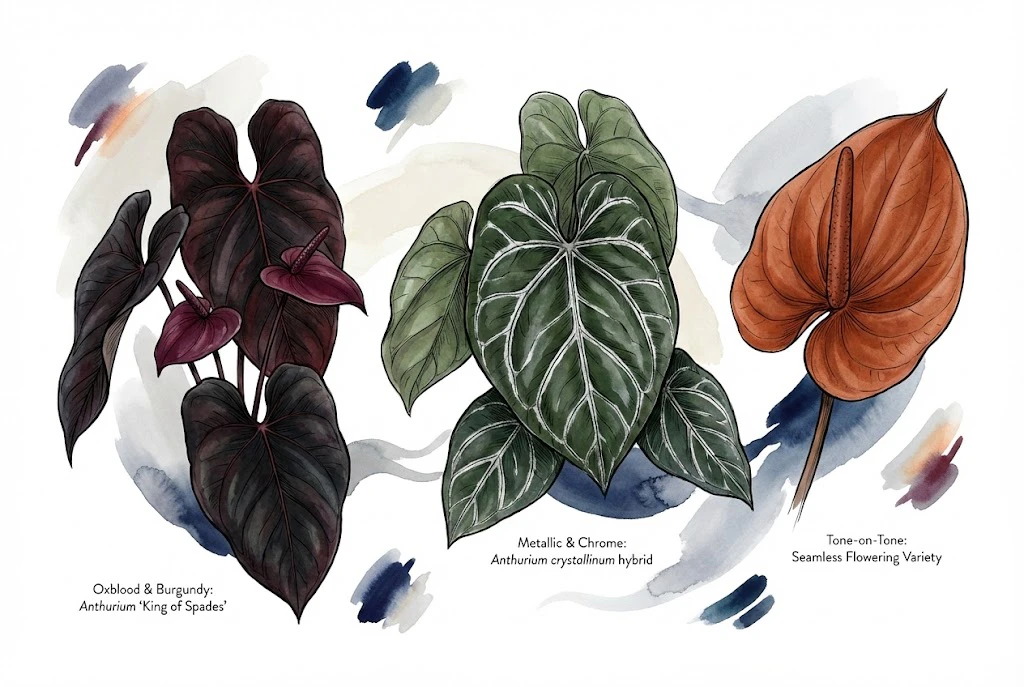
Oxblood and burgundy
Deep, near-black reds such as Anthurium King of Spades read as a dramatic silhouette against lighter walls.
Metallic and chrome
The silver veins of Anthurium crystallinum and its hybrids act as natural metallic accents that echo chrome fixtures.
Tone-on-tone
Some flowering varieties carry a spadix that matches the spathe for a seamless, single-color look.
How Hybrids and Tissue Culture Actually Work
It helps to keep three separate steps straight, because they are often blurred together.
- Controlled crossing pollinates one plant with another and forms seed, combining the parents' genes. Which traits appear, and how consistently, depends on the specific parents and shows up only after the seedlings grow out.
- Selection is choosing the individual seedlings worth keeping.
- Tissue culture then multiplies an already-chosen plant under sterile conditions. It is mainly a propagation method for increasing supply.
So tissue culture can make an existing clone more available, but it does not create variegation, cold tolerance, or new forms on demand. Occasional variation in culture is unpredictable. Treat claims about a cross producing patterned, hardier, or easier plants cautiously unless the seller documents the parentage and trials.
Varieties Worth Knowing
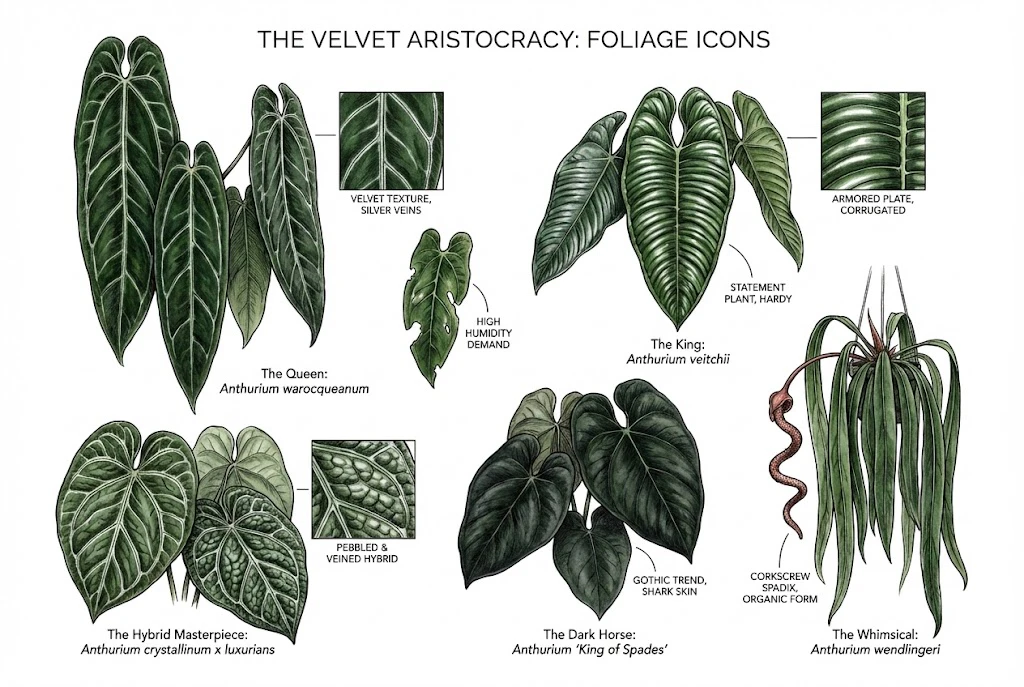
The genus Anthurium (in the aroid family, Araceae) is large. The plants below are a small selection that suits the 2026 looks, split into foliage-focused species and newer flowering cultivars.
Foliage Collectors' Favorites
These plants are valued among foliage collectors for their leaf texture, often velvety or corrugated, and their structure.
The Queen (Anthurium warocqueanum)
The Queen Anthurium is a demanding foliage plant from Colombia’s humid forests. Its dramatic leaves make it a collector plant, but it needs a stable setup rather than occasional high humidity.
Appearance
It produces long, pendant leaves that resemble heavy velvet tapestries. The blades are narrow and deep green, highlighted by contrasting silver veins.
Care Requirements
This species does best with high, stable humidity and good airflow, and sudden humidity swings can mark the leaves. Leaf quality is not set by humidity alone (root oxygen, watering, temperature, light, air movement, and disease pressure all matter). Growers can maintain humidity with an enclosed cabinet or terrarium, a controlled room, or careful acclimation. A humidifier is one option, not the only one.
Room humidifiers
A large-tank cool-mist humidifier with app or auto control can raise room humidity, but it does not guarantee flawless velvet leaves. Empty and dry the tank daily, clean it regularly, and follow the maker’s guidance and public-health advice. Keep a lived-in room at or below about 50 percent humidity to limit condensation and mold. Reserve much higher humidity for a sealed cabinet. For an enclosed grow space, match a humidity control kit to the cabinet volume instead of humidifying the whole room.
When grown well over time, the leaves can become long. Hobbyist reports of three to four feet exist, but that is a mature best case, not a guarantee.
Collector Interest
Some collectors seek darker or narrower-leaved forms. That is a collector preference rather than a market-wide measurement.
The King (Anthurium veitchii)
The King Anthurium offers a distinct aesthetic with a robust structure.
Appearance
The leaves are glossy, lance-shaped, and defined by deep, horizontal ridges that give the plant a strongly textured, architectural look.
Appeal
Its large, corrugated leaves make it a striking statement plant. Some growers find it more forgiving than the Queen, but no controlled comparison establishes greater leaf toughness or damage resistance.
Both of these epiphytic Anthuriums do best in a coarse, well-aerated aroid mix rather than dense potting soil.
Aroid potting mixes
A good aroid mix balances air, drainage, and some moisture retention at the roots. Root rot comes from staying saturated too long through a combination of pot, watering, temperature, and pathogens, not from one water-holding ingredient alone. Check ingredients and particle sizes, then match water retention to your room, pot, and watering habits. If you would rather build or compare mixes, choose an aroid mix by its bark, perlite, and pumice ratio.
A Popular Cross (Anthurium crystallinum × luxurians)
This hybrid combines traits from two sought-after species.
Genetics
A. crystallinum contributes the heart shape and silver veins, while A. luxurians contributes a pebbled texture.
Result
Leaves tend to be deep and textured, though seedlings vary and no single seedling's look is guaranteed.
The Dark One (Anthurium King of Spades)
This dark, heart-leaved collector plant fits the current gothic plant look. It is usually sold as an Indonesian hybrid. Its exact parentage is not published, and claims tying it to A. huallagense (or to a crystallinum × magnificum cross) are unverified.
Appearance
The leaves are typically broad, heart-shaped, and a very dark green that can look nearly black, with a texture sometimes compared to shark skin. Plants sold under this name are propagated as seedlings and clones, so individuals differ. The near-black color and texture are not fixed in every plant.
Trend Alignment
Its dark foliage anchors a collection and contrasts strongly against white walls or metallic accents.
The Cascading One (Anthurium wendlingeri)
This species is favored for its unusual form.
Appearance
It features extremely long, strap-like leaves. The flower is particularly notable for its long, corkscrew spadix.
Trend Alignment
This plant fits the sculptural requirement of current design trends. When hanging from a basket, its cascading form breaks vertical lines in a room.
New Commercial Blooms
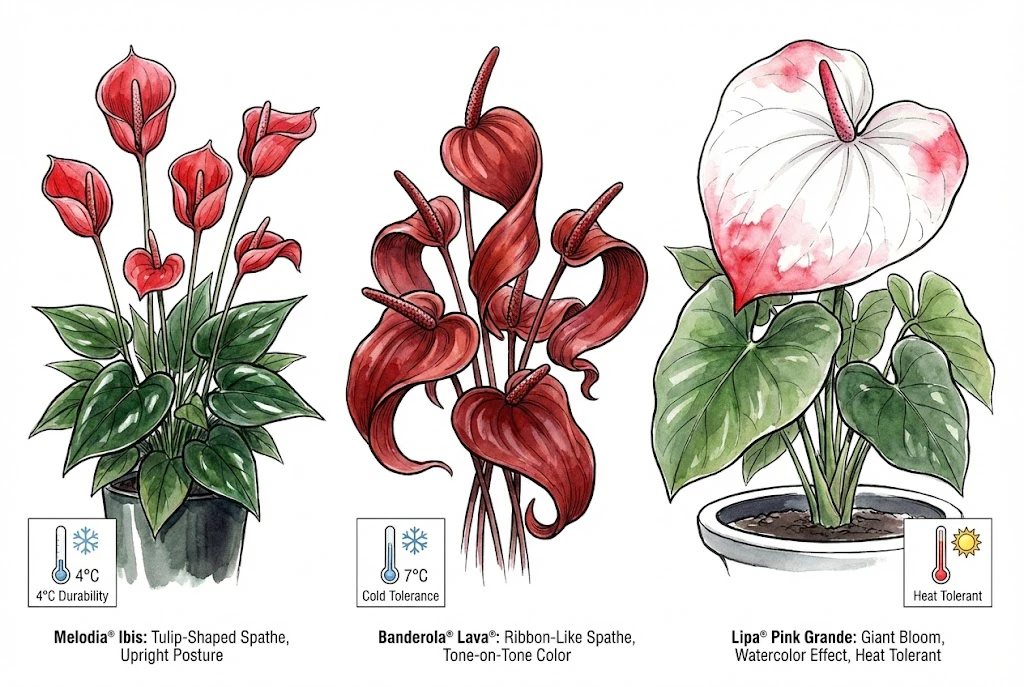
Several commercial breeders have introduced pot Anthuriums that move beyond the classic heart-shaped flower.
The Ribbon (Banderola® Lava®)
This variety introduces a significant structural change.
Innovation
The spathe is ribbon-like rather than heart-shaped, twisting and curling.
Color
It features a deep lava red, with the spadix matching the spathe for a unified, tone-on-tone look.
Resilience
The breeder describes a high flower count and a 7 °C cold-tolerance figure. That figure is a 48-hour transport/supply-chain test, not a temperature the plant can be grown at continuously. Keep this tropical Anthurium in normal warm indoor conditions.
The Tulip (Melodia® Ibis)
Named after the Scarlet Ibis, this variety changes the flower’s posture.
Form
The spathe is cup-shaped and holds itself upright, resembling a tulip.
Durability
Like the Banderola, it is described as long-lasting with good transport resilience. Its 4 °C and 7 °C figures are also 48-hour transport tests, not year-round growing temperatures.
The Large-Pot One (Lipa® Pink Grande)
The Lipa Pink Grande is a large-format cultivar.
Scale
It is grown for large pot sizes (14/17 cm). Note that the breeder lists its flower size as Medium, so giant refers to the plant's pot format, not oversized blooms.
Color
A white spathe tipped with pink/red gives a softer look.
Climate
The breeder notes good results in warmer climate conditions. No specific temperature limits are published, so treat it as suited to warm growing rather than broadly heat-tolerant.
Banderola Lava. Anthurium pot plants (Anthura)
Melodia Ibis. Anthurium pot plants (Anthura)
Lipa Pink Grande. Anthurium pot plants (Anthura)
Choose Conditions Before Style
Orbit Revive is one official 2026 style trend, and the colors and forms above can help you style a room. They cannot tell you whether a plant will suit its growing conditions.
Choose an Anthurium for the light, airflow, humidity, space, and care routine you can actually provide, then use its form and color to shape the room. Breeders’ low-temperature figures are transport tests, not growing temperatures, and claims about parentage, variegation, or cold tolerance need documentation.
A room humidifier and a well-aerated aroid mix can help in the right setting, but neither replaces a stable routine matched to the room, cabinet, pot, and watering schedule.