
Root-Bound Plants: What a Snug Pot Really Does
A snug pot, a severely root-bound one, and a girdled root ball are not the same thing. Extension guidance suggests Hoya, Clivia, and peace lilies often do fine slightly pot-bound. What they mainly need is airy media, the right light, and, for Clivia, a cool rest.
Samuel Reed · Published 2026-01-17 · 23 min read

Key Takeaways
- Root-bound covers very different states. A slightly snug pot is not the same as a severely bound root ball with no soil left, and not the same as a girdled crown. Only the severe cases clearly harm the plant.
- Severe binding can limit water and nutrient uptake. Heavy flowering in a crowded pot is not proof of reproductive stress. It can also reflect ordinary maturity, season, or cultivar.
- Hoya generally wants airy, fast-draining media and good light. A pot much larger than the root ball dries slowly and can raise root-rot risk, so up-pot in modest steps.
- Clivia rebloom depends mainly on a cool rest on a mature plant. Aim for roughly a month or more of nights below 50°F (10°C) but above freezing, followed by several weeks of very little water. Extension guidance also notes Clivia tends to do well slightly root-constricted.
- Peace lily bloom depends on maturity and bright, indirect light. Nursery plants are often forced with gibberellic acid, while Clemson suggests keeping them slightly pot-bound and up-potting only 1–2 inches when roots circle the surface or drainage holes.
What Root-Bound Actually Means
In gardening, the phrase ‘likes to be root-bound’ is used for genera such as Hoya, Clivia, and Spathiphyllum.
Taken literally it sounds like the plant has a preference, but in practice it is usually shorthand for a more mundane idea. Keep the ratio of root ball to wet soil volume on the conservative side, because that helps control moisture.
The trouble is that ‘root-bound’ lumps together several very different states, and they shouldn’t be judged the same way.
- A slightly snug pot. Roots fill most of the pot but soil remains. Several extension services suggest this is fine, and sometimes convenient, for these genera.
- A severely bound root ball (a dense knot with little soil left, water running straight through or pooling on top). This can genuinely limit uptake and calls for repotting.
- A girdled crown (roots wrapping and compressing the stem). This is mainly a documented problem in container-grown woody trees, and is less established for these clumping houseplants.
Gardeners sometimes point to plants flowering heavily in a crowded pot and read it as proof the tight container is good.
But heavy flowering by itself doesn’t tell you whether a plant is thriving or stressed. It can equally reflect ordinary maturity, season, or cultivar.
Stress-induced flowering (SIF) is a real category, in which some stressed plants shift energy toward reproduction.
But the same reviews note that stress can just as easily delay or suppress flowering, that the response varies by species and cultivar, and that Hoya, Clivia, and Spathiphyllum in containers were not directly tested.
So SIF is one possible explanation for crowded-pot blooming, not a confirmed diagnosis.
Choose a pot that gives the healthy roots a little room without leaving a large volume of wet mix around them. Match the increment and watering to the species.
Stress-induced flowering. The third category of flowering response
A Crowded Pot Does Not Reliably Trigger Flowers
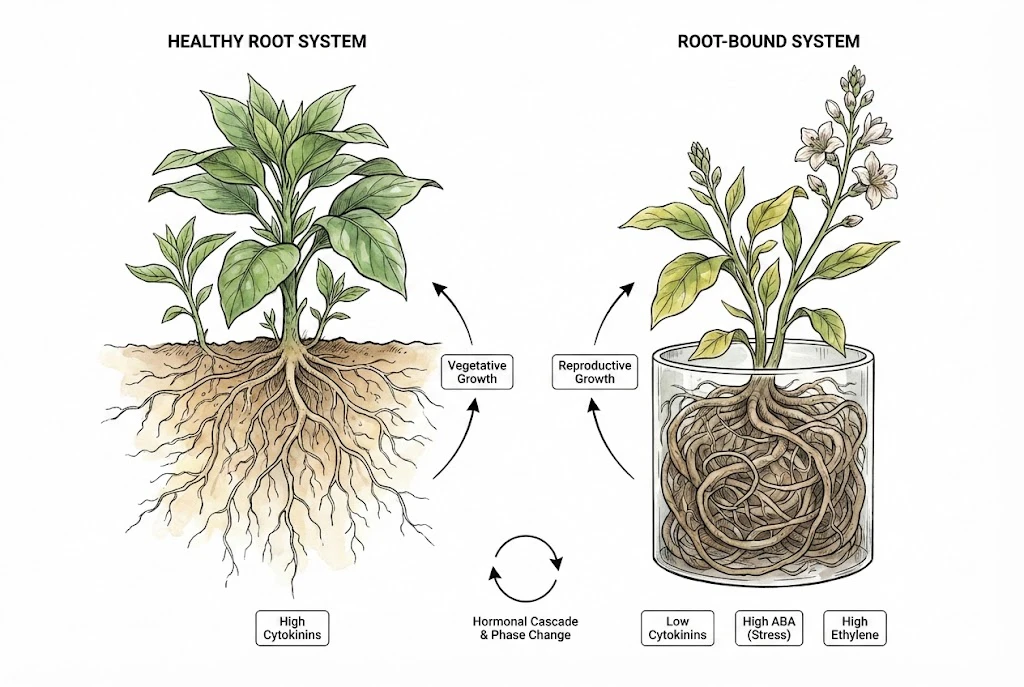
Roots respond to a tight container, but there is no measured hormone pattern that proves a root-bound Hoya, Clivia, or peace lily will bloom because it is stressed.
Flowering also depends on maturity, season, light, temperature, and cultivar. Treat a crowded pot as a moisture-management issue, not as a bloom switch.
Flowering time. From physiology, through genetics, to mechanism
Restriction Usually Reduces Vigor
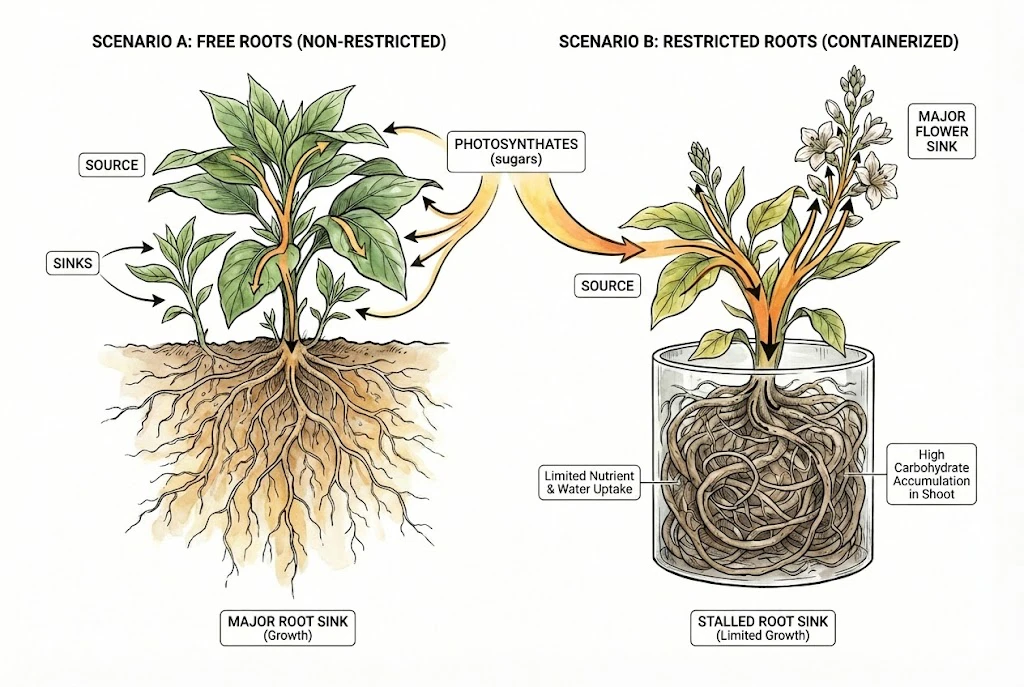
A severely restricted root system can limit water and nutrient uptake. It does not leave a reliable surplus that the plant sends into flowers.
Repot to restore healthy growth when the root ball is severely matted, rather than trying to use root restriction as a flowering technique.
Effect of root restriction on growth, photosynthesis, and source-sink relations in chilli
The Risks of Girdling and Hydraulic Failure
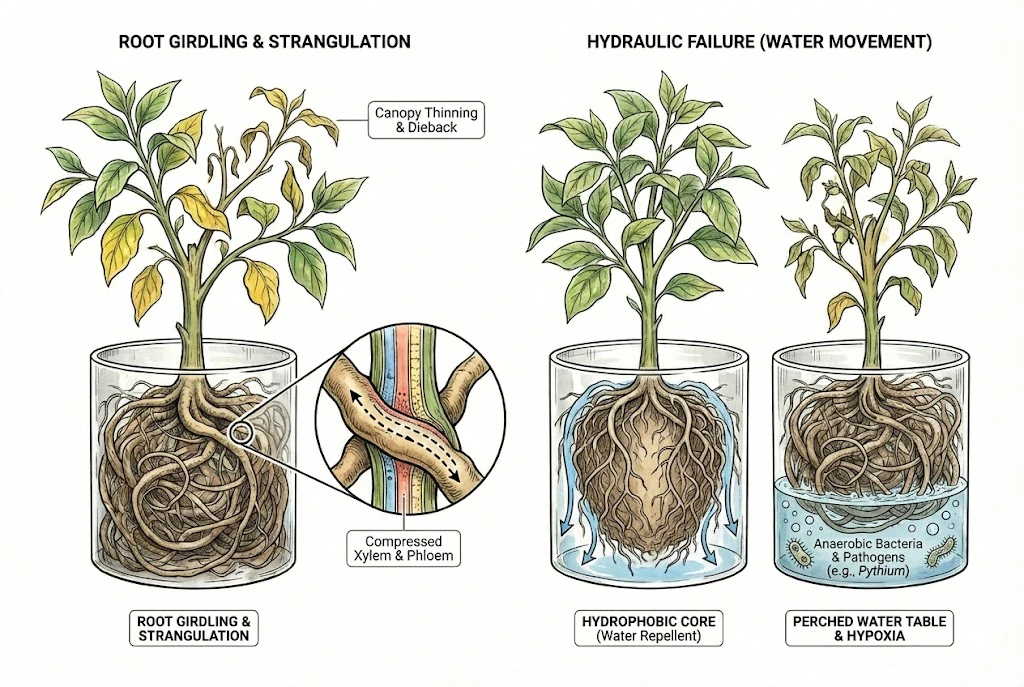
Severe root binding can create physical risks, though how often each one appears varies by plant.
As roots circle a pot they can thicken, and in some cases girdling roots wrap and compress the stem, restricting water and nutrient transport and causing slow decline.
This is best documented in container-grown woody trees. For clumping herbs like Clivia and peace lily, and across the many Hoya species, stem-girdling is much less established as a routine outcome, so treat it as a possibility to check for rather than an inevitability.
A dense root mass can also change how water moves in the container. Dry peat- or bark-based media can turn hydrophobic and shed water down the sides, a media property more than a property of the roots themselves, so fast run-through can mean either a full root ball or simply dry media, and isn’t proof of root-binding on its own.
Where media stays wet and low in oxygen, root-rot organisms such as Pythium can take hold. Pythium is an oomycete (a water mould), not a bacterium, and not every case of oxygen-starved, damaged roots is an infection. Over-wet conditions can injure roots directly.
Genus Profile (Hoya)
The genus Hoya, or wax plants, is a common example of plants said to ‘love’ tight pots. Bear in mind that Hoya is large and varied, over 500 species ranging from the Himalayan foothills to Japan, Australia, and Fiji, and while many are epiphytic or lithophytic, some are terrestrial or hemi-epiphytic, with differing water and temperature needs.
The generalisations below fit many popular Hoya but not every species.
Ecological Context (The Canopy Dweller)
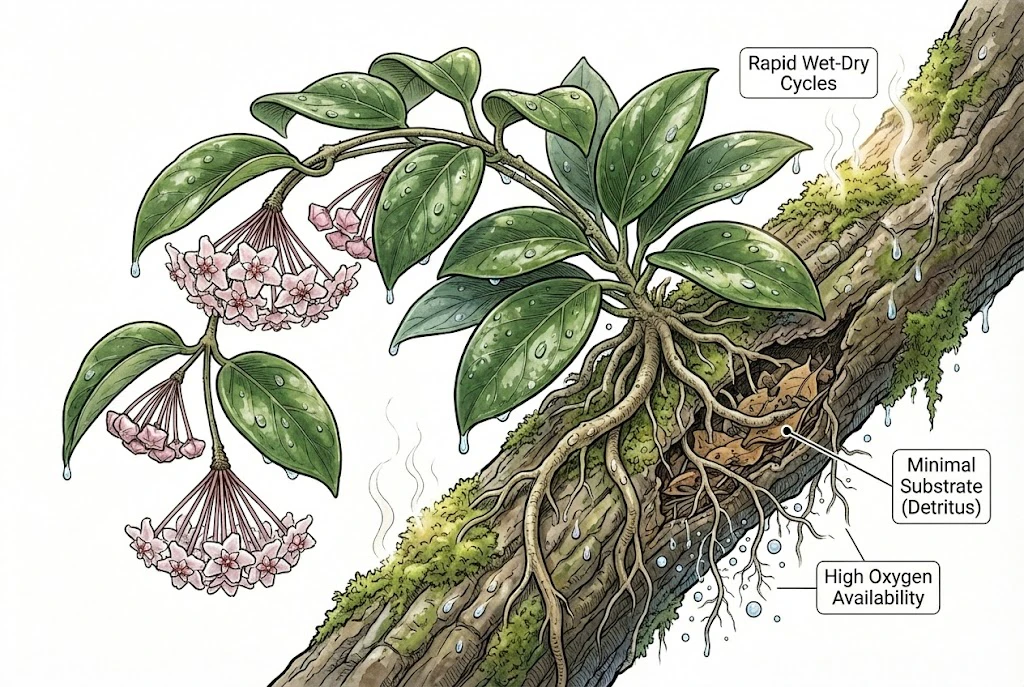
Many Hoya grow on trees or rocks rather than in deep soil, clinging to bark and crevices. For those species, roots are typically adapted to air, quick wet-dry cycles, and small pockets of organic debris.
Good Root Aeration
Exposed to air, epiphytic Hoya roots generally benefit from an airy, well-aerated root zone.
Wet-Dry Cycles
In many canopy microhabitats they are wetted by rain and dry out again, though damper niches (cloud forest, humus pockets, ant nests) also exist.
Little Substrate
They often grow with very little soil, drawing nutrients from decaying debris in crevices as well as rain and canopy runoff.
Where the Snug-Pot Advice Comes From
When a Hoya is potted in a large container of standard, dense soil, roots can rot, not because the plant dislikes space, but because the extra soil holds more water and stays wet, lowering oxygen at the root zone.
Keeping the pot on the small side is a simple way to manage moisture. Less soil dries faster. That is the practical logic behind ‘keep them tight.’
The Takeaway
What most Hoya actually favour is an airy root zone that dries reasonably quickly, not confinement for its own sake.
A larger pot with a well-draining mix can work, but a pot much bigger than the root ball still stores more water and dries slowly. Clemson Extension warns this can raise root-rot risk.
So up-pot in modest steps and match watering to the pot, rather than assuming any size is safe.
The True Flowering Triggers
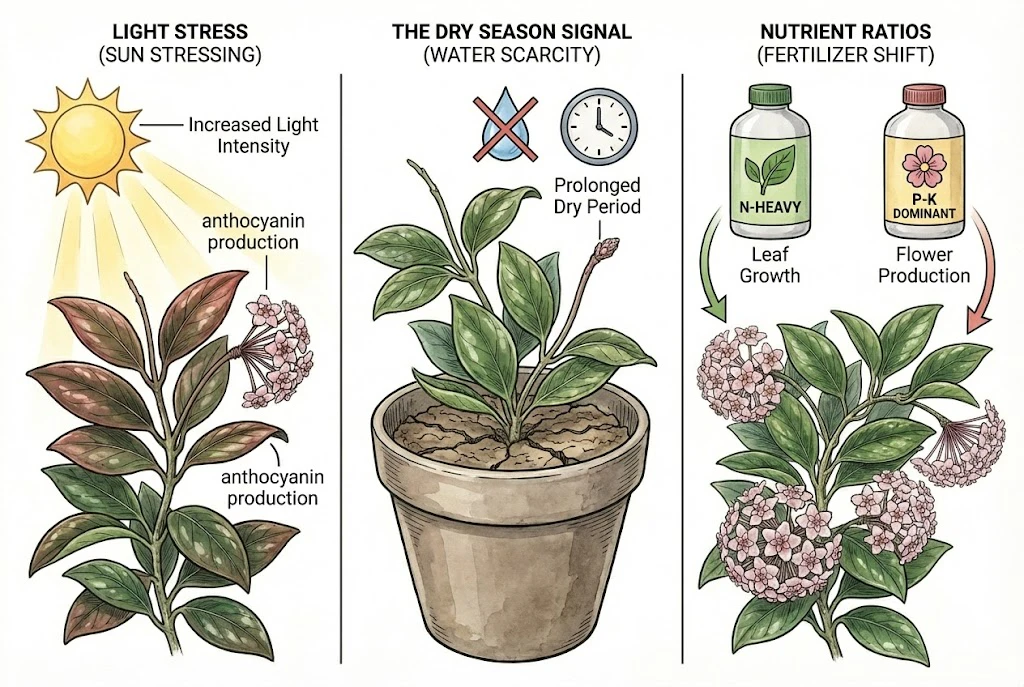
Rather than relying on root restriction, culture that reflects the plant’s natural conditions is a more reliable way to support blooming.
Adequate Light
Many Hoya bloom better with brighter light. Increasing light can help, but do it gradually. A reddish tint from anthocyanin is a high-light acclimation response in some species, not a universal bloom target, and pushing too far risks leaf scorch and photoinhibition.
Watch the plant rather than aiming for red leaves.
Where a bright window isn’t available, a full-spectrum grow light can supplement light. Whether it helps depends on distance, coverage (footprint and PPFD), daily photoperiod and DLI, existing light, and the specific Hoya, so treat it as one option to set up and measure rather than a guaranteed trigger. If you’re unsure what to buy, use the general grow-light guide to compare measured PPFD and DLI rather than wattage alone.
Full-spectrum supplemental bulb
A compatible full-spectrum bulb can provide supplemental light, but choose it by published PPF and measured PPFD across the area rather than by wattage or color temperature alone. Work out mounting distance, coverage, and photoperiod for your plant, use a fixture rated for the bulb’s load and heat, and acclimate the leaves to avoid injury.
A bright window can also do the job depending on aspect, latitude, season, glazing, and distance.
Watering Rhythm
Some Hoya come from areas with a seasonal dry period. Letting the mix dry out between waterings is standard care and avoids constantly wet roots, but there is no species-specific source here showing that a forced dry spell reliably induces flowering, and bone-dry stretches can cost fine roots.
Water when the mix has dried, without forcing prolonged drought.
Fertiliser
A common belief is that switching to a high-phosphorus or ‘bloom booster’ feed triggers flowers. Extension guidance does not support this. NDSU notes high-phosphorus fertilisers don’t increase flower numbers (and can cause problems without a confirmed deficiency), and Clemson suggests a roughly balanced N-P-K ratio such as 2/1/2 or 3/1/2 for Hoya.
Feed for overall health, not to force blooms.
Genus Profile (Clivia)
Clivia miniata grows in southern African woodland and forest. It has a strong reputation for needing to be pot-bound, sometimes with anecdotes of plants that won’t bloom until they crack their pots.
Those stories are unsourced, so treat them as folklore rather than a care rule.
Ecological Context (The Drought Survivor)
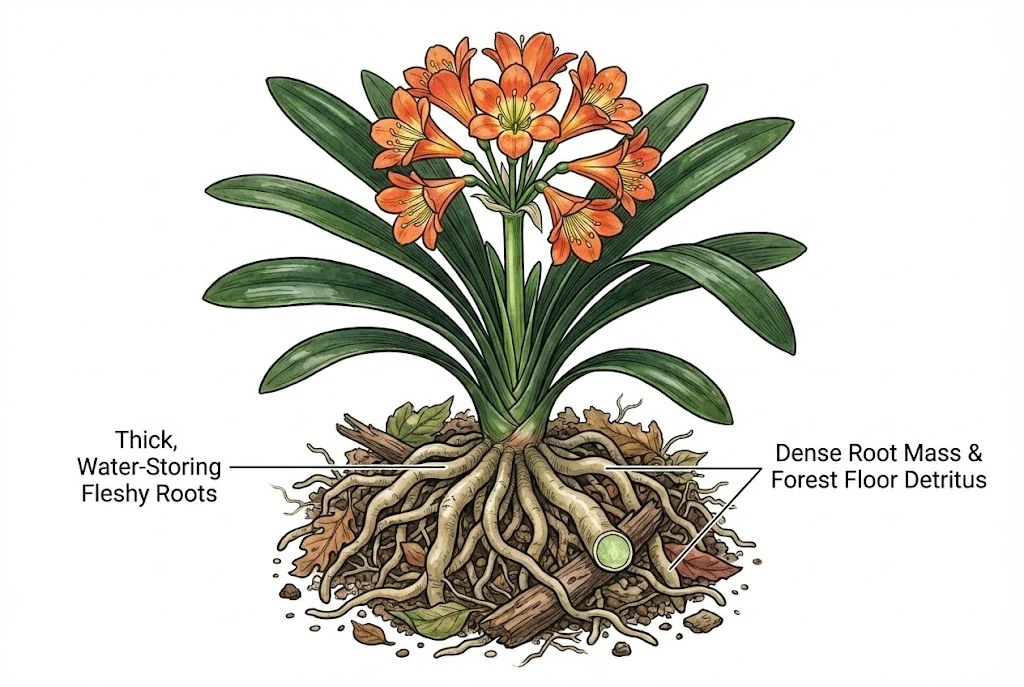
Clivia roots are thick and fleshy and help store water through cool, dry periods. In the wild they form dense clumps.
Root density on its own is not established as the cause of flowering, there’s no comparison trial here showing crowding drives blooms, and Wisconsin Extension notes Clivia tends to grow well slightly root-constricted.
The Mechanics of the Stuck Scape
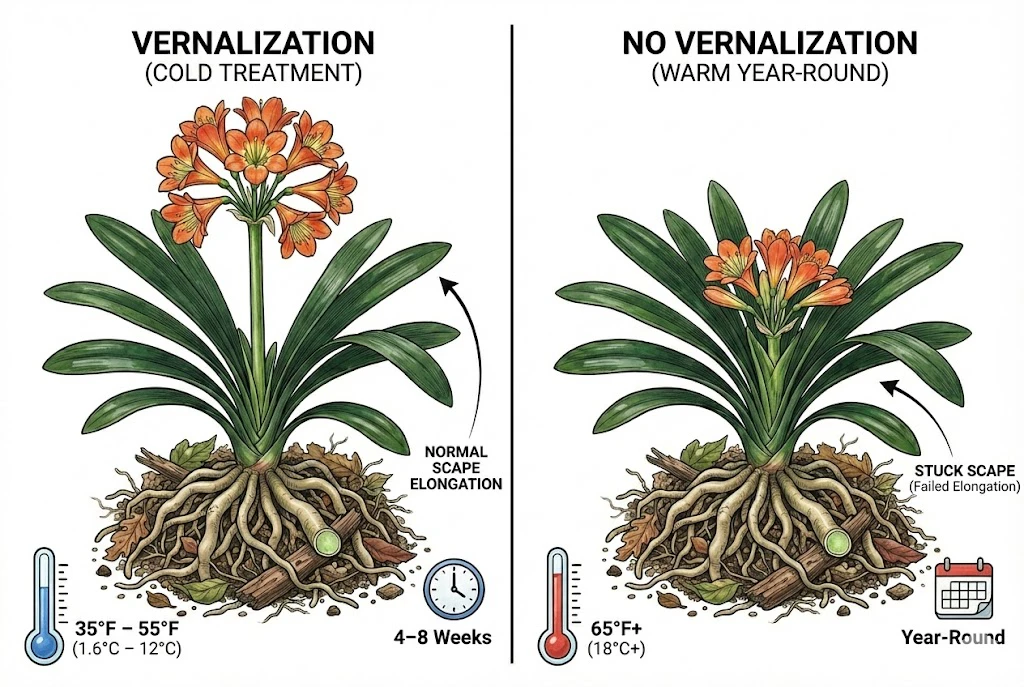
A common reason a mature Clivia fails to rebloom is a lack of cool rest rather than a lack of root restriction.
It helps to separate the steps a cool period influences, including flower-bud initiation, scape emergence, and scape elongation.
Maturity, light, and the stage of any existing buds all matter too, so a stuck or absent bloom isn’t explained by cold alone.
The Cool Rest
Home guidance (for example Wisconsin Extension) suggests a mature Clivia needs at least about a month of nights below 50°F (10°C) but above freezing, followed by several weeks with very little water.
Note that 55°F is about 12.8°C, so any wider ‘35–55°F’ figure is an approximate range, not a single tested value.
The Consequence
With insufficient chilling, a Clivia may still initiate flowers but open them low among the leaves (a stuck scape).
This depends on maturity and cultivar, so a warm year-round plant won’t always behave this way.
Scheduling flowering in Clivia miniata for different markets
Why Pot-Bound Helps (Indirectly)
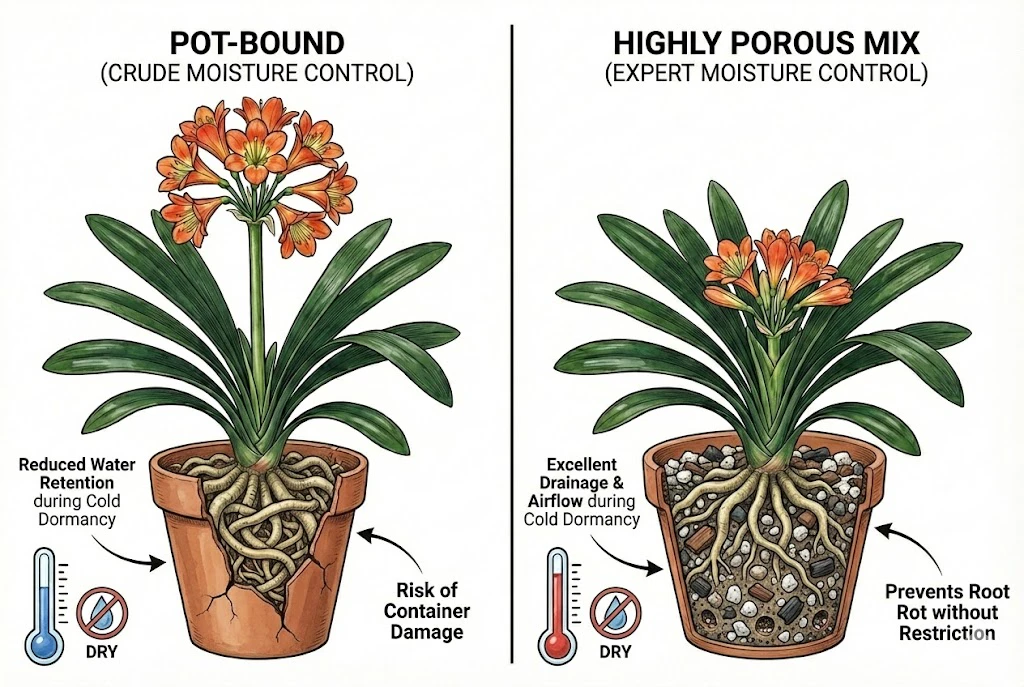
One reason keeping Clivia slightly root-constricted can help is moisture. Fleshy roots are prone to rot if kept wet and cold, and a pot with less spare soil holds less water, so it dries a bit faster during the cool rest.
That’s a plausible indirect benefit, not proof that crowding is required.
A Balanced Approach
You don’t need to keep the plant severely restricted to get this effect. Use a porous, well-drained mix (see the recipes below), keep the pot only modestly larger than the root ball, and cut back watering through the cool rest.
Repot when roots visibly circle the surface or drainage holes, moving up just an inch or two at a time.
Genus Profile (Spathiphyllum)
The peace lily (Spathiphyllum) is an aroid from the tropical forest understory. Unlike Hoya and Clivia, it prefers consistently moist soil (moist but not soggy, rather than either bone-dry or waterlogged).
Because it doesn’t store much water, letting a peace lily get severely root-bound is riskier here. That said, Clemson notes peace lilies also do fine slightly pot-bound, so the goal is a modest pot, not a cramped one.
Ecological Context (The Thirsty Aroid)
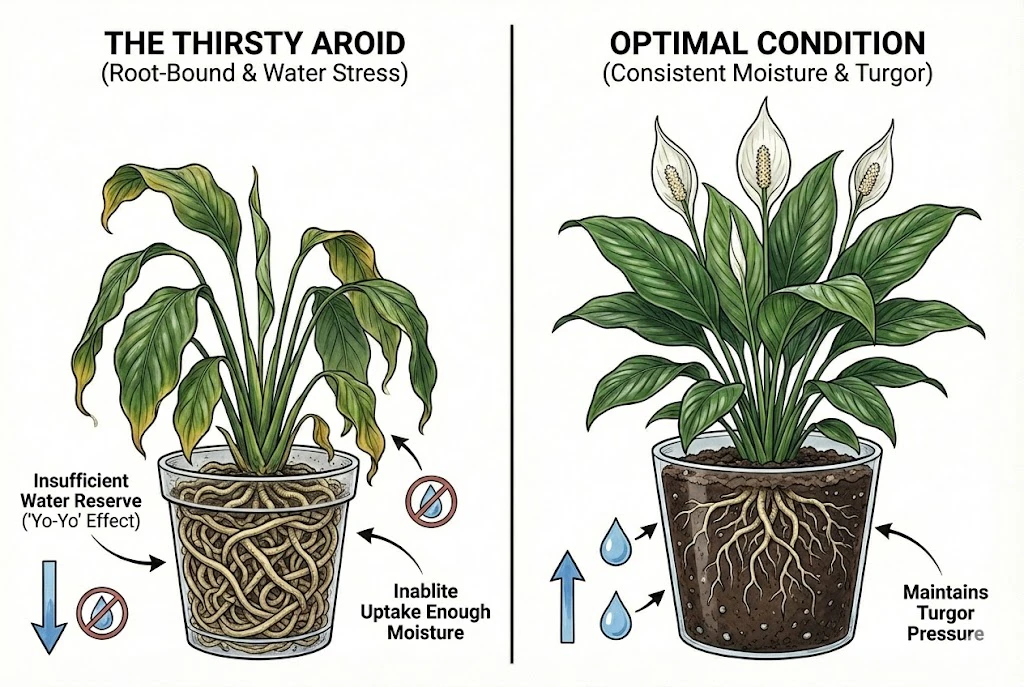
Spathiphyllum relies on water pressure (turgor) to stay upright. When severely root-bound, the small remaining soil volume can dry out quickly (how quickly depends on plant size, pot material, media, humidity, and temperature).
Repeated severe wilt-and-recover cycles are stressful. But a single wilt that recovers after watering isn’t enough to diagnose root-binding on its own. Watering habits, heat, and root rot can produce similar symptoms.
Nursery Forcing with Gibberellic Acid
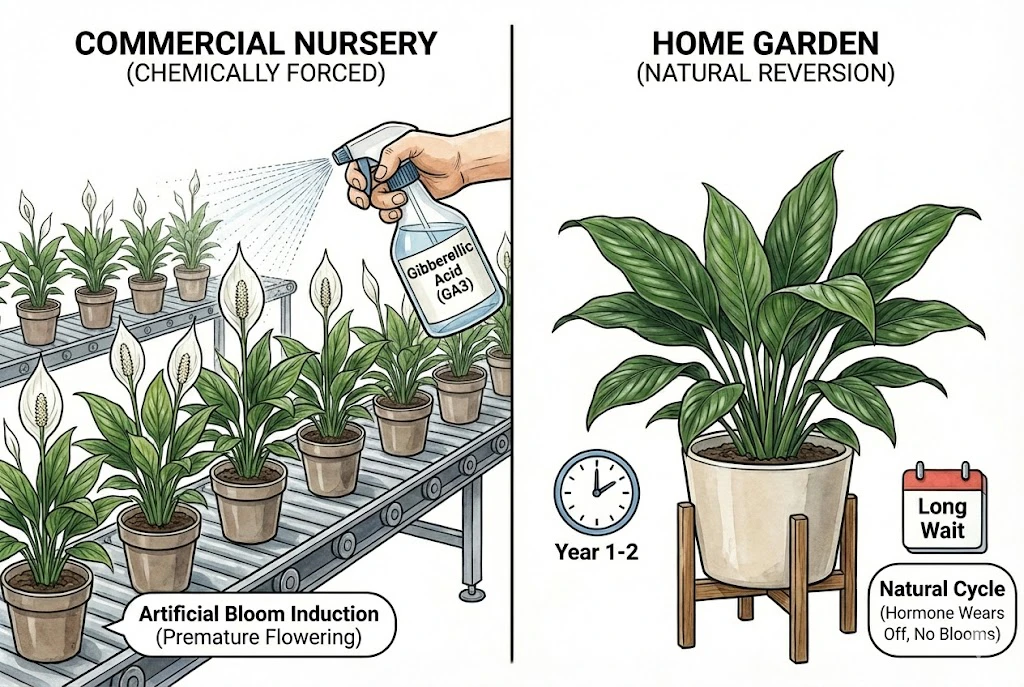
Peace lilies can be hard to rebloom at home partly because many nursery plants are forced. Commercial growers apply gibberellic acid (GA3) as a foliar treatment to induce flowering. UF/IFAS reports a single application can bring flowering within roughly 9–15 weeks.
Response, and the risk of distorted or narrow leaves, varies by cultivar, and there are dose and label considerations, so it’s not something to replicate casually at home.
What This Means at Home
After a GA3-induced flush, whether the plant blooms again depends on maturity, cultivar, season, light, and care (it’s not that a residual chemical ‘wears off’ and then blocks blooming).
Untreated mature peace lilies can still flower seasonally. Crowding the roots doesn’t reproduce the hormone. A modest pot with good light and a mature plant is what supports rebloom.
Light and Maturity
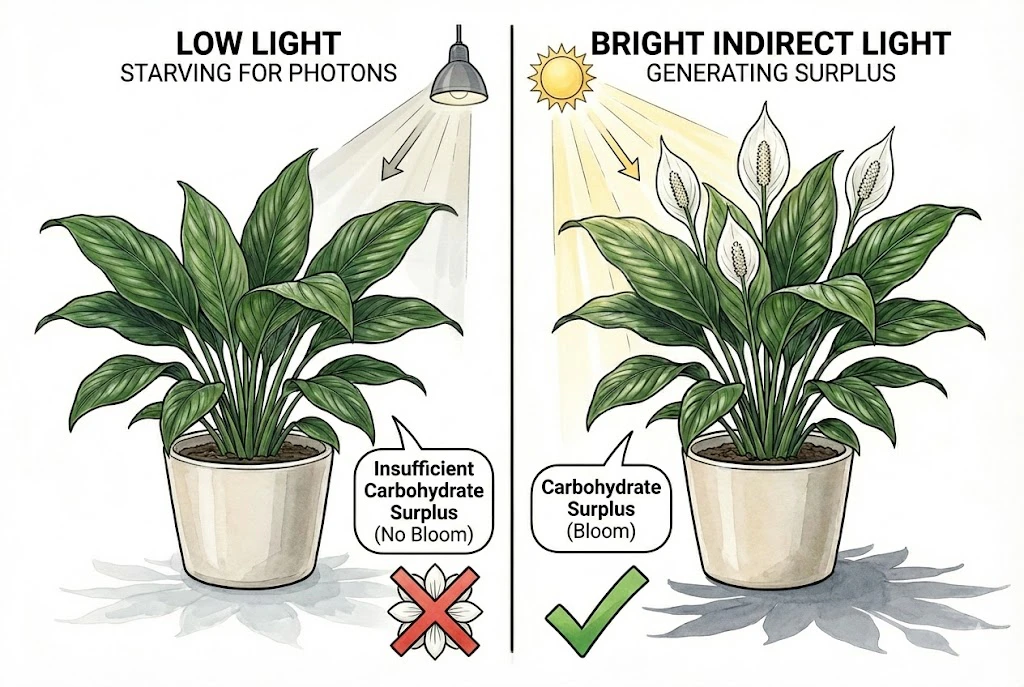
Without chemical forcing, peace lilies flower based on maturity, light, and season. Although often sold as ‘low light’ plants, they rarely bloom in deep shade.
Bright, indirect light helps a mature plant produce enough energy to flower, and insufficient light is a common reason for non-bloom.
Light matters, but it isn’t the only factor (maturity, cultivar, and season count too, and better light doesn’t guarantee blooms on its own).
Use the Mix to Manage Water
Media choice is a major tool for managing water retention, working alongside, not instead of, sensible pot sizing and watering.
A more open mix can reduce the risk of a larger, wetter root zone, using hydraulic conductivity and macroporosity.
It doesn’t eliminate that risk, though. Species, root mass, container height and material, and watering all still matter.
Why a Coarser Mix Helps
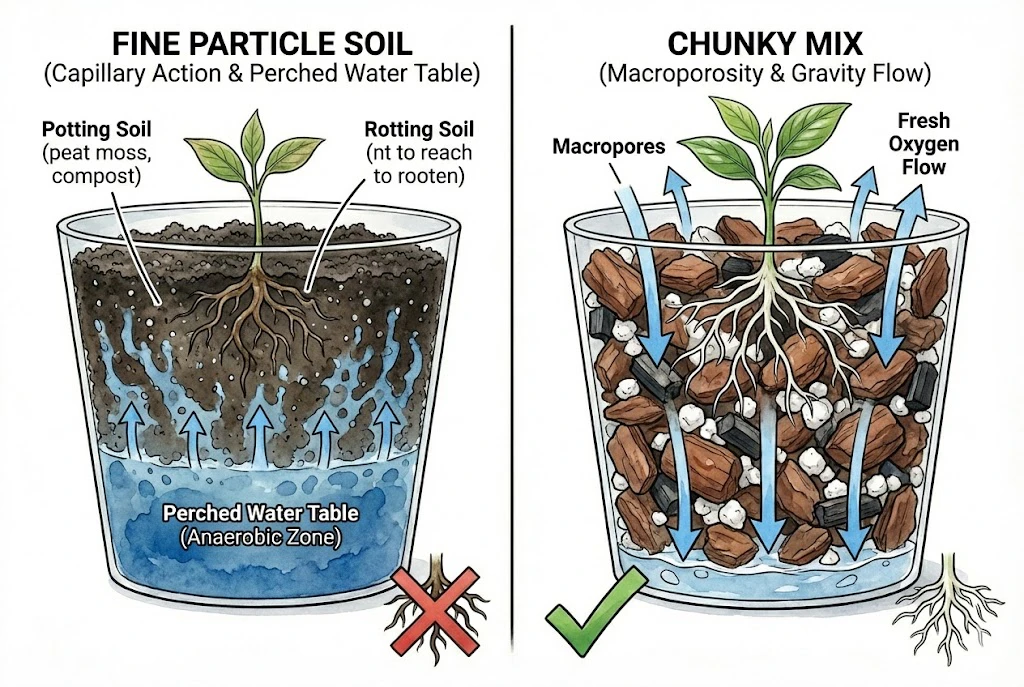
Fine media hold more water and can stay saturated near the bottom of a pot. A larger or deeper pot can extend that wet zone, especially when the mix is fine and the plant has few roots.
Coarser Particles
A coarser mix raises air-filled porosity and drainage. Larger particles hold less water against gravity, though they aren’t truly water-free. Bark and coir particles retain water internally, and the overall air/water balance depends on the whole particle-size distribution and how the mix is packed.
A Rough Guide
As a general tendency, a larger or deeper pot can benefit from a somewhat coarser mix, but this isn’t a universal rule and no single ratio guarantees safety.
Whether, say, a 5-gallon pot with plenty of bark and perlite is appropriate still depends on the plant and root size, the rest of the mix, the container’s height and drainage holes, and how you water.
Situation-Specific Soil Recipes
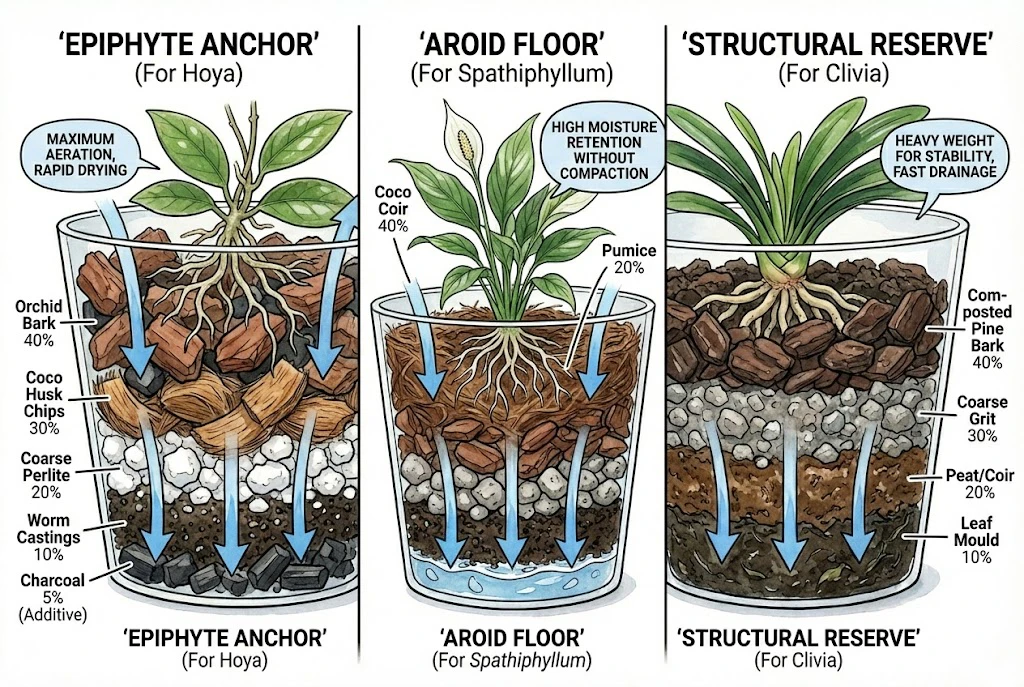
Treat these as starting points to adjust, not exact formulas. Combine the ingredients into a uniform, well-mixed blend (not distinct layers, which can raise a perched water table at the boundary), use pots with drainage holes, and expect to tweak ratios for your component grade, climate, and watering.
Note too that these mixes don’t on their own address pH, salts/EC, or your fertiliser plan.
Recipe A. The Epiphyte Anchor (For Hoya)
| Component | Volume Ratio | Function |
|---|---|---|
| Orchid Bark (Medium/Large) | 40% | Fir or pine bark. Provides structure and air pockets. Breaks down over time. |
| Coco Husk Chips | 30% | Holds some water internally while staying relatively airy. |
| Coarse Perlite or Pumice | 20% | Inorganic aeration that doesn’t decompose. Supports drainage. |
| Worm Castings | 10% | A little organic nutrition. Keep the proportion low, as fine material can reduce air porosity. |
Ratios are a starting point (they total 100% before any optional additive). If you like, a small amount of horticultural charcoal can be added, but treat it as optional rather than essential.
Target
An airy, fast-draining mix with little standing water.
Best For
Humid conditions, frequent waterers, or larger pots.
Chunky bark is the backbone of an epiphyte-style mix, helping a pot drain and stay aerated. It supports giving roots more room, but it doesn’t on its own make any pot size safe (pot-to-root ratio and watering still matter).
Graded fir orchid bark
A graded western fir bark is a reasonable candidate for the bark component of a custom mix.
It is one ingredient, not a finished Hoya mix, and it doesn’t by itself validate any particular recipe or large-pot setup.
Bark decomposes and eventually needs refreshing, but how fast depends on climate, particle size, watering, and feeding, so there’s no fixed replacement interval.
Recipe B. The Aroid Floor (For Spathiphyllum)
| Component | Volume Ratio | Function |
|---|---|---|
| Coco Coir (Buffered) | 40% | Holds moisture and rewets more easily than dried-out peat. |
| Orchid Bark (Fine/Medium) | 30% | Opens up the coir texture so it doesn’t pack into dense mud. |
| Pumice | 20% | Adds aeration and doesn’t float during heavy watering. |
| Worm Castings | 10% | A little organic nutrition. Optional. Peace lilies do not need heavy feeding. |
Ratios total 100% and are a starting point. Clemson advises only light feeding for peace lilies, so keep any castings modest and adjust with a balanced fertiliser rather than relying on rich media.
Target
Good moisture retention without compaction.
Best For
Typical indoor humidity (roughly 30–50%).
Recipe C. The Structural Reserve (For Clivia)
| Component | Volume Ratio | Function |
|---|---|---|
| Composted Pine Bark | 40% | Partially broken-down bark holds a little more water than raw bark. |
| Coarse Grit (well-graded) | 30% | Adds weight for stability under top-heavy leaves and improves drainage. Use a coarse grade. Fine sand can fill pores and reduce drainage. |
| Coir or Peat | 20% | Buffers water retention. |
| Leaf Mould | 10% | Adds organic matter, echoing forest litter. |
Ratios total 100% and are a starting point. How long any organic mix lasts before it breaks down depends on your conditions, so refresh it when it compacts rather than on a fixed schedule.
Target
Enough weight for stability plus good drainage.
Best For
Large, top-heavy Clivia.
Diagnostic Methods and Remediation Protocols
Reading a plant’s signals helps, but these signs overlap and none is decisive on its own. Use the table below as a screening aid, then confirm by inspecting the root ball.
Timings vary widely with species, pot, media, and environment, so treat them as loose tendencies, not cut-offs.
Reading the Signs
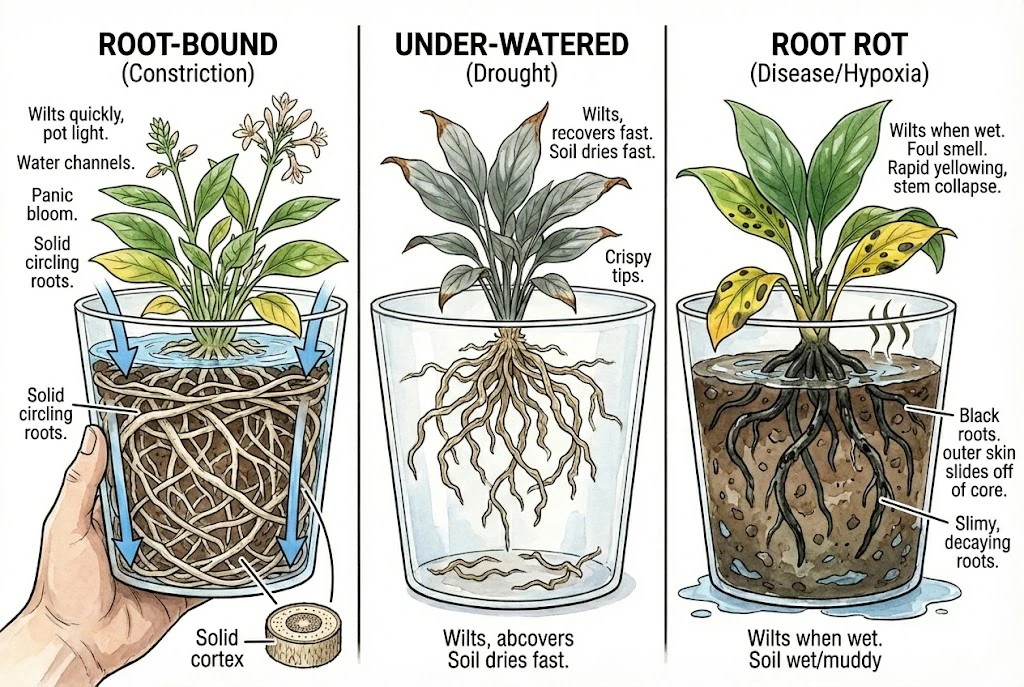
| Symptom | Root-Bound (Constriction) | Under-Watered (Drought) | Root Rot (Disease/Hypoxia) |
|---|---|---|---|
| Wilting Pattern | Tends to wilt soon after watering. Pot feels light. | Wilts, then recovers fairly quickly after watering. | Wilts even when soil is wet. Slow or no recovery after watering. |
| Leaf Color | Gradual yellowing of oldest leaves. | General dullness/graying. Crispy brown tips. | Faster yellowing of lower leaves. Dark spots. |
| Water Behavior | Water may run straight through or pool on top (also seen with dry, hydrophobic media). | Soil absorbs water but dries out fast. | Soil stays wet for a long time. Sour or swampy smell. |
| Growth Habit | Stunted new leaves. | Slowed or stopped growth. | Leaf drop, stem collapse. |
| Root Inspection | Firm, pale roots densely circling the pot (normal root color varies by species, and bark can stain roots). | Roots look dry, shriveled, or brittle. | Soft, brown, slimy roots. Outer skin slides off the core. Often a bad odor. |
These states overlap and can occur together, so root-bound symptoms are easily confused with underwatering or rot.
Root firmness, smell, and a direct look at the root ball are more reliable than color or timing alone. Where a pathogen is suspected, a diagnostic lab can confirm it.
Note that heavy flowering is not a reliable sign of root-binding. A plant can bloom heavily for many reasons.
I record the prewatering pot weight, then apply water at 250 milliliters per minute and note the volume and time at first steady drainage. The test is repeated only when the pot returns to the same prewatering weight. Fixing the starting weight and flow rate keeps a drier root ball or faster pour from masquerading as lost pore space.
That trend is paired with wilting speed, water channeling, and visible roots. One root at a drainage hole does not trigger a repot for me, but several changing signals justify sliding the root ball out for a direct check.
Remediation (The Art of Root Pruning)
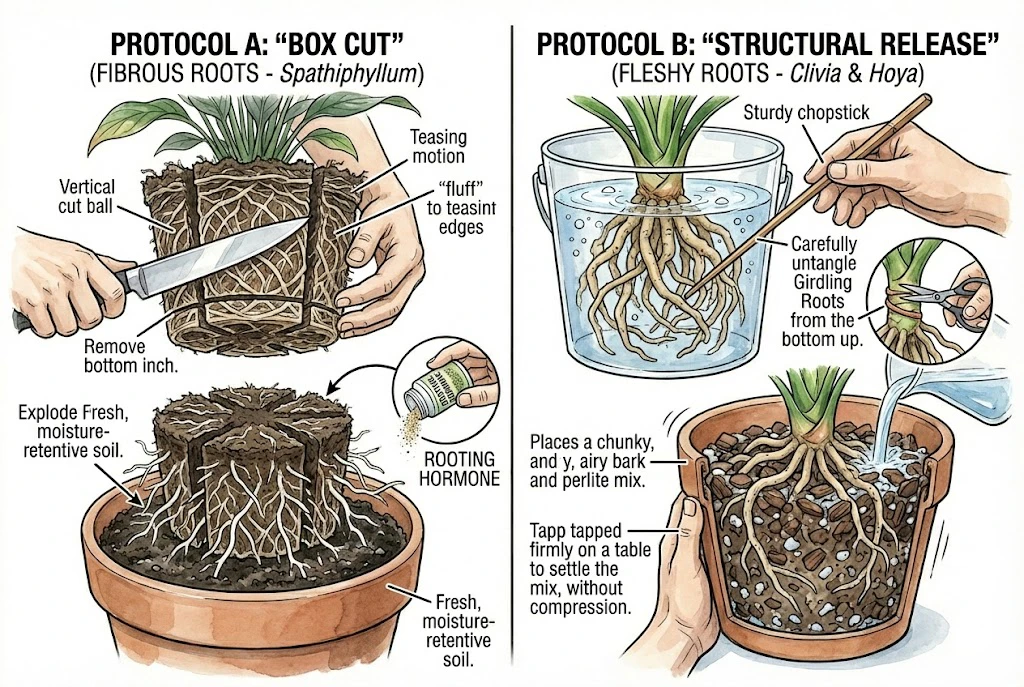
When a plant is severely root-bound (a dense knot with little soil left, or clearly circling roots), simply moving it to a larger pot may not be enough, because a tightly matted ball can slow new roots from establishing outward.
Root tolerance for disturbance varies by species, so adjust the approach and go gently.
For Fibrous Roots (e.g. Spathiphyllum)
Peace lilies have a fibrous, adventitious root system, not a taproot, so this is about loosening a matted ball rather than removing a taproot.
Use a clean, sharp knife, wipe it with alcohol, and let it dry. Do not soak living tissue in alcohol. Trim a thin slice off the very bottom of the matted ball, and make a few shallow vertical cuts down the sides. How much depends on root-ball size and how much of the root is healthy, so err on the conservative side.
Gently loosen the cut edges to encourage new lateral roots to grow outward.
Repot into a container about an inch or two wider (adjust for how much root you removed) using the peace-lily mix, and be gentle with recovery. Avoid repotting a struggling plant in poor conditions.
For Fleshy Roots (e.g. Clivia)
Clivia has thick, fleshy, water-storing roots that don’t recover well from cutting and can rot if large wounds are left open.
(Hoya roots differ widely across the genus, so don’t assume the same handling. Treat each plant on its own.)
If the ball is dry and hard, a soak can help soften old media and ease untangling. Work gently with a chopstick or similar tool, remove clearly dead roots, and disturb living roots as little as possible.
If you find a living root genuinely wrapping and compressing the stem, it may need cutting, but distinguish true stem-girdling (mainly a woody-plant problem) from normal clumping root architecture before you cut, so you don’t remove healthy structural roots.
Place in the new pot using the appropriate mix above. Hold the plant at its original height, pour the mix around the roots, and tap the pot to settle it rather than pressing down.
How Much Larger to Pot
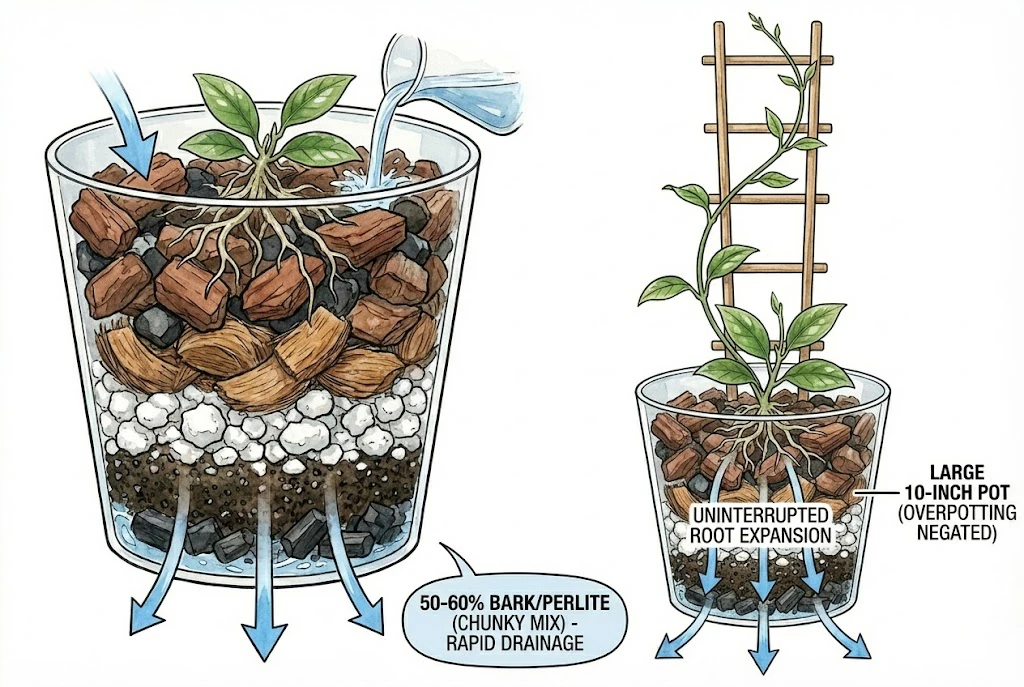
A more open mix reduces the risk of jumping up a pot size, but it doesn’t remove it. A pot much larger than the root ball still stores more water overall, and Virginia Tech, Clemson, NC State, and the RHS all caution that an over-large pot can keep the root zone too wet.
So the mix helps, but it isn’t a licence to overpot.
A Conservative Default
A common conservative starting point is to move up about 1–2 inches beyond the root ball for a small plant (2–3 inches in larger sizes), then adjust for the species, root health, media, and how you water.
A larger rooting volume can genuinely support more growth (a 65-study meta-analysis found doubling pot volume raised biomass by about 43% on average), but that research pairs volume to plant size rather than showing any small plant is safe in any large pot.
If you do want a Hoya to climb a tall trellis, a bigger pot can work with a very porous mix, but choose the pot to suit the root size and watering rather than assuming rapid drainage alone prevents waterlogging (component water retention, watering frequency, and container shape all still count).
Situation-Based Response Manual
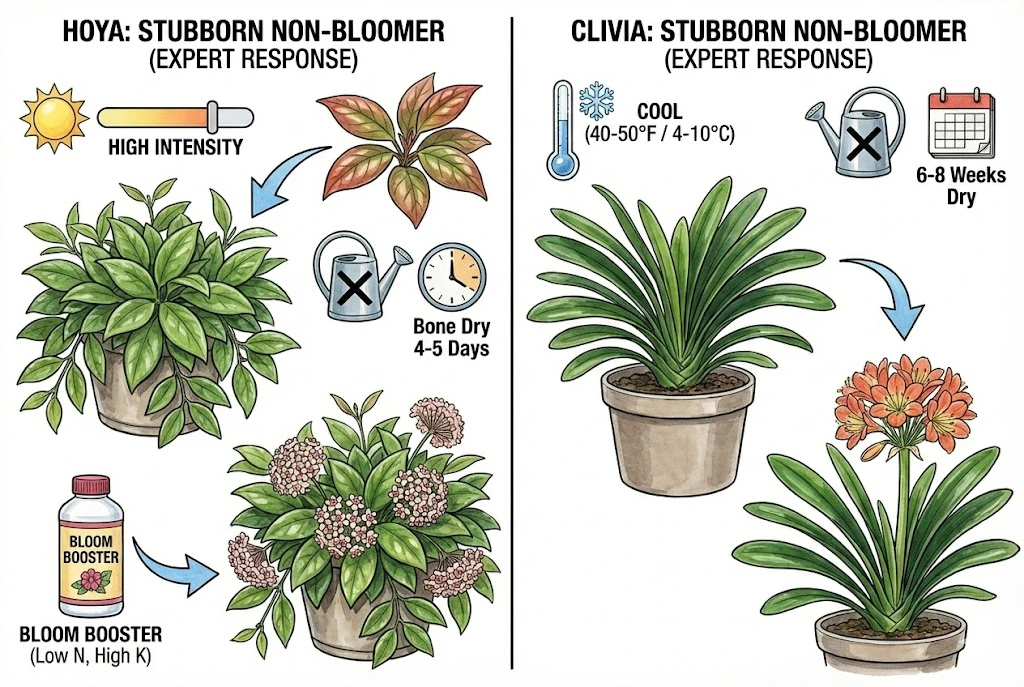
Here are practical plans for common scenarios. Hoya and Clivia have quite different needs, so they’re handled separately.
Scenario 1 (The Stubborn Non-Bloomer)
First, check the basics
Before changing anything, look at the whole picture. Species and cultivar, maturity, whether it’s the active growing season, root health, current pot fit, and light history.
A non-bloom alone isn’t a reason to repot or not repot. Repot if roots are clearly circling the surface or drainage holes, and otherwise focus on light and season.
For a non-blooming Hoya
Give it more light gradually so it acclimates without scorching. Bright indirect light, not a forced ‘red-leaf’ target.
Water when the mix has dried rather than keeping it constantly wet, and feed with a balanced fertiliser.
Keep Hoya in warm conditions (Clemson suggests above about 60°F). Do not give a tropical Hoya a near-freezing cold-and-dry rest, which risks cold injury.
For a non-blooming Clivia (mature plant)
Provide bright, diffuse light, and in autumn give the cool rest. Aim for at least about a month of nights below 50°F (10°C) but above freezing, in a spot that stays above freezing.
Reduce watering during this rest, not to bone-dry, but just enough to keep the leaves from wilting. This cool rest supports rebloom in a mature plant, though maturity and existing bud stage still matter, so it isn’t guaranteed.
Scenario 2 (Suspected Root Rot)
Context
A Spathiphyllum is collapsing, wilting even though the soil is wet, with soft, dark, foul-smelling roots.
Response
Soft, brown, smelly roots plus wilt in wet media point toward root rot, though overwatering, poor drainage, or abiotic root death can look similar. A diagnostic lab can confirm the cause if needed.
Extension guidance centers on reducing moisture and on sanitation, not on chemical dips.
- Remove the old, contaminated media, protecting the fragile surviving roots and disposing of the old mix rather than reusing it.
- Trim away roots that are soft, dark, or foul-smelling, using a clean, sterilized tool and judging by firmness and odor as well as color.
- Repot into a clean container sized to the remaining healthy root mass (smaller if you removed a lot), using fresh, well-draining mix with drainage holes.
- Correct the underlying moisture problem. Water less, and make sure the pot and mix drain freely.
Some sources suggest a dilute hydrogen-peroxide root dip or sealing the plant in a plastic bag. Both are left out here.
Peroxide can oxidize living root tissue and beneficial microbes and isn’t a standard root-rot treatment, and a sealed humidity tent over a diseased plant can worsen leaf disease.
If you choose to try either, research proper concentration, contact time, ventilation, and safety first.
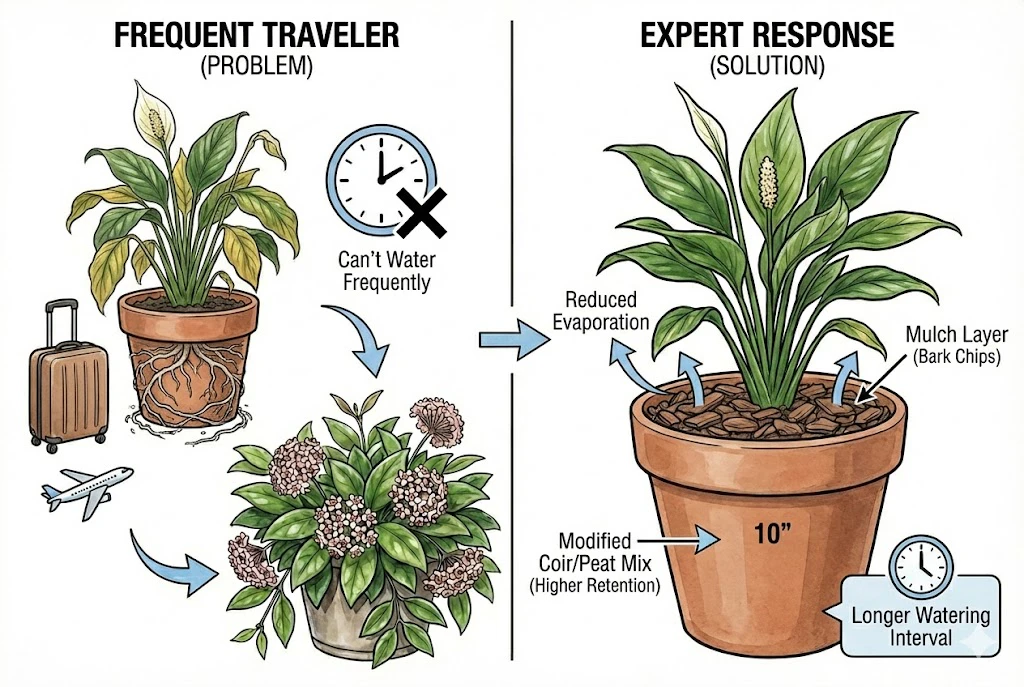
Scenario 3 (The Frequent Traveler)
Context
You travel often and struggle to water a small pot that dries quickly.
Response
Rather than stacking several water-holding changes at once (which together can cause overwatering), start by measuring how fast the plant actually dries and considering simpler options, a self-watering pot, a wick, an irrigation timer, or a plant sitter, matched to the species and trip length. If you do adjust the setup, change one variable at a time and check the mix between waterings.
- Move up modestly in pot size (an inch or two), sized to the root mass rather than jumping to a much larger pot.
- Slightly increase the moisture-holding fraction (a bit more coir or peat), checking that it doesn’t leave the mix soggy for the species. Grade and salt/pH vary, so adjust gradually.
- If using a surface mulch, keep it thin (about an inch or less), hold it an inch away from the stem, and don’t let it hide the soil moisture. Bark and stone aren’t interchangeable (they differ in weight, heat, and how they show algae or salts).
Match Mix and Water Over Pot Size
Hoya generally want an airy root zone and good light, Clivia want a cool rest on a mature plant, and peace lilies want steady moisture, maturity, and bright indirect light.
Matching the mix, the light, and the watering to each of these matters more than the ‘root-bound’ question by itself.
The practical middle path is to avoid severe root binding and avoid a pot so much larger than the plant that it stays wet (using conservative pot increments and species-appropriate watering).
A slightly snug pot can be perfectly fine, and heavy flowering isn’t a simple sign of either thriving or struggling.