
Hoya Kerrii Not Growing? How to Tell If It Can Vine, Then Diagnose Slow Growth
Why a Hoya kerrii may not grow: the “blind leaf” no-node trap, brighter light, a chunky airy mix, watering to a wet-dry cycle, and how to check for hard-to-see flat mites before treating.
Elena Vargas · Published 2025-12-11 · 16 min read
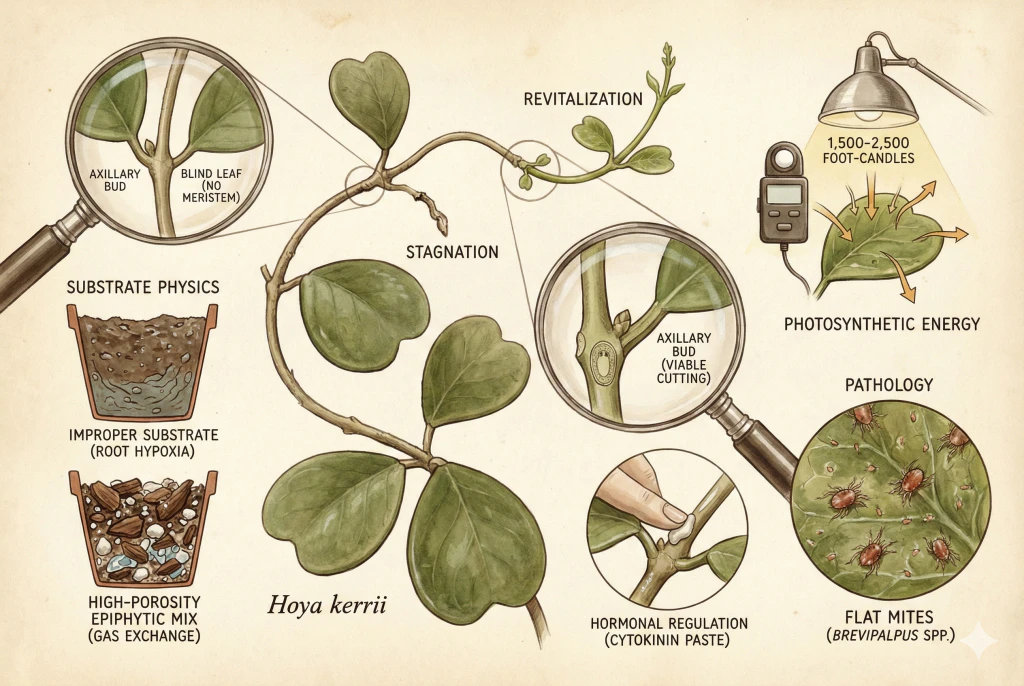
Key Takeaways
- Check the anatomy before treating the environment. A single heart-shaped leaf often has no node, so it can root and live for a long time without ever producing a vine. Look at the base for a short woody stem segment.
- If a node is present, brighter light is usually the biggest lever. Hoya kerrii wants bright, indirect light well above typical low-light conditions, so an under-lit plant commonly stalls.
- Keep roots airy and let the mix dry between waterings. Use a chunky, fast-draining mix with bark, pumice, and a little coir instead of dense soil that stays wet.
- Support a long, leafless vine before cutting it. The shoot may be searching for something to climb, and it can leaf out as it climbs. Light pruning for size is fine.
- Check stalled growth points for pests before using a pesticide. Flat mites are one possibility when tiny nubbins repeatedly die back without webbing, but confirmation under magnification matters. New growth can take several weeks after a limiting factor is corrected.
A Hoya kerrii that sits unchanged for a long time is a familiar frustration (alive, green, and turgid, yet not producing a single new leaf). The cause is often more than one thing, and the first question is whether the plant is even capable of growing at all.
Check the anatomy first, then work through light, roots, watering, feeding, and pests in that order.
1. The Enigma of the Sweetheart Hoya
Hoya kerrii is a climbing plant from warm tropical forests. Indoors, it responds best to bright filtered light, an airy root zone, and watering that lets the mix dry between drinks.
Its thick, semi-succulent, heart-shaped leaves store water through dry spells. That background helps explain the care it wants, including bright but filtered light, an airy root zone, and watering that lets the mix dry between drinks.
During repotting, I photograph the buried base from several angles and mark any stem tissue, node, or axillary bud before covering it again. A rooted leaf can remain alive without possessing the structure needed to produce a vine.
If no node is visible, I treat continued leaf survival as the likely outcome rather than escalating fertilizer. If a node exists, the photo gives me a fixed point for tracking actual bud swelling.
Each month, I place a ruler beside the node and photograph it under the same light. Tiny callus or root changes can look like a shoot from memory, while a measured sequence shows whether aboveground growth is really beginning.
2. The Blind-Leaf Problem (Why a Single Leaf Often Can’t Vine)
Check for a Node Before Changing Care
Before looking at the environment, rule out an anatomical cause. One that traces directly to how these plants are often sold.
In Hoyas, a new vine normally grows from meristematic tissue at a node (where a leaf attaches), and specifically from the axillary bud tucked in the leaf axil.
A leaf blade and petiole can grow roots on their own, but they generally lack the bud tissue needed to start a whole new shoot.
Some dicots can regenerate shoots from leaf tissue, but for Hoya propagation in practice, a node is what you want.
Why Single-Heart Leaves Are Sold
To offer an inexpensive plant around Valentine’s Day, growers root individual leaves, often dipping the cut petiole in a rooting hormone.
The semi-succulent leaf has enough reserves to live and photosynthesize, but with no node it generally cannot make a stem.
This is commonly called a blind leaf. It can persist for a long time as a single heart without ever producing a vine.
To check, first look, without unpotting, at the base of the leaf where it meets the soil. If you can see a short woody segment of vine stem attached (often a small T shape perpendicular to the leaf stalk), a node is present and a vine is possible.
If you need a closer look, you can gently ease the plant from the pot and rinse the very base of the petiole, but only unpot if you were going to repot anyway or suspect rot. Needless unpotting can damage healthy roots.
If roots emerge directly from the cut end of the leaf stalk with no stem tissue, it is very likely a blind leaf.
It is hard to be completely certain. Occasional reports describe single leaves eventually producing a shoot, but it is unclear whether these had a hidden sliver of nodal tissue rather than truly forming a shoot from scratch, so it is not something to count on. Treat a confirmed blind leaf as a living ornament rather than a future vine.
3. Light (Usually the Biggest Lever on a Node-Bearing Plant)
Set the Light Before Other Fixes
If a node is confirmed (or you have a multi-leaf vine that simply stopped), light is one of the first things to check.
A plant uses the energy it captures for maintenance and repair before it has any left for new leaves, so a plant that is only just breaking even in dim light can stay alive and turgid without ever pushing new growth.
More light is often what tips it back toward growing.
Use a Bright, Filtered Window
The phrase bright indirect light is vague, and many indoor spots are dimmer than they look. Hoya kerrii wants bright, filtered light. An east window with gentle morning sun is ideal, while harsh midday sun from a south or west window can scorch the leaves unless it is diffused.
If you want to compare spots objectively, a light meter or a phone lux app used as a rough guide is more reliable than eyeballing it. Published targets for finished greenhouse Hoyas run high, but there is no validated foot-candle threshold specific to a home-grown H. kerrii, so treat any single number as a ballpark rather than a rule.
Distance Changes Light Intensity
Light also drops off quickly with distance, a plant set back from a window gets far less than one right beside it, so moving a stalled plant closer to the light, or adding a grow light, is often what makes the difference indoors.
White LEDs Need Leaf-Level Checks
White LEDs are convenient at home because they render colour naturally for pest inspection and living space.
Rather than trusting a colour-temperature number on the box, aim for a bright spot and a sensible day length. Many growers run supplemental lights for about 12 hours, but measure light at the leaves if you want to dial it in.
Barrina T8 LED Grow Light
Barrina T8 LED Grow Light is useful for a plant shelf where several strips can cover multiple plants. It is more than a single Hoya needs, so adjust the number of strips and mounting height from the light and warmth at the leaves.
4. The Edaphic Environment (Soil Physics and Root Health)
Why Oxygen Matters to Hoya Roots
Even under good light, growth stalls if the roots can’t breathe. As an epiphyte (and sometimes lithophyte), Hoya kerrii grows its roots in coarse, airy material, bark, moss, leaf debris, and rock crevices, rather than dense mineral soil.
In a heavy, water-retentive mix, water can fill the pores and push out air, and roots starved of oxygen work poorly or die back, which stalls top growth.
Waterlogged roots are also more vulnerable to rot organisms such as Phytophthora and Pythium, though these need the pathogen to be present too. Soggy soil raises the risk rather than guaranteeing infection, and you shouldn’t assume a specific disease without confirming it.
Build a Chunky, Airy Root Zone
Choose Airy Mix Components
The practical goal is a chunky, fast-draining mix that holds some moisture but drains and re-airs quickly. Use orchid bark for large air pockets, a little coir for moisture, and perlite or pumice for lasting aeration.
Some growers also add a bit of horticultural charcoal and worm castings. These are optional rather than essential.
Adjust the Mix to Drying Speed
A common starting point is roughly one part coir (or a quality potting mix), one part medium orchid bark, and one part coarse perlite or pumice, adjusted to your conditions. Use more chunky material if you tend to overwater or your home is humid, less if it dries out fast.
Pumice is a useful amendment because, unlike perlite, it doesn’t float to the surface as readily.
Horticultural Pumice for Plants
Horticultural Pumice for Plants adds a little weight and cost, but it holds its shape and keeps air in the mix over time. Blend it through the mix rather than layering it.
This is one common option. A local equivalent may be cheaper, so compare particle size and cleanliness where you can.
Choose the Next Pot by Root Volume
The idea that a Hoya must be root-bound before it will grow is overstated. A plant does need enough roots to support a bigger canopy, but a much larger pot is the more common problem. A big volume of mix around a small root system stays wet longer than the roots can use, and prolonged wetness is what rots roots.
Keep the new pot only 1–2 inches wider than the root ball. Rather than repotting on a fixed schedule, repot when the roots have filled the pot, the mix has broken down and drains poorly, or the plant clearly needs it. Many Hoyas are content in the same pot for a long time.
5. Water Relations (The Turgidity Balance)
Water by Root-Zone Condition
Turgor pressure (water pushing against cell walls) is part of what expands new cells, so a badly dehydrated plant won’t put out new leaves well.
A common watering mistake is going by the calendar rather than by the plant and the mix.
Check Moisture at Root Depth
The most reliable check is at root depth. Lift the pot to feel its weight, or push a wooden skewer to the bottom and see whether it comes out dry.
As a secondary clue, some growers gently fold a mature leaf along its midrib, since firm leaves suggest full water reserves and soft, pliable ones suggest they are low.
Treat leaf firmness as a hint rather than a rule. Leaf texture varies with age and thickness, and a firm leaf can still sit over a dry root ball, so check the mix before deciding.
Let the Mix Dry Substantially
Many Hoyas use CAM (or facultative CAM) photosynthesis and tend to open their stomata at night.
Either way, the practical point is the same as for most epiphytes. Let the mix dry out substantially between waterings rather than keeping it constantly wet, which stresses the roots.
Hold Moderate Humidity
The foliage prefers moderate to high humidity. Something in the range of 50–70% is a reasonable target, and it will tolerate drier air.
Very dry indoor air can make it harder for tender new growth to develop, so if your home is very dry, raising humidity may help.
Use a Humidifier Carefully
For steady humidity a humidifier is easier to control than misting, which is short-lived. If you use one, keep it clean and monitor actual humidity with a sensor, and watch for excess condensation and poor airflow, which can encourage mold.
6. Nutritional Drivers (Fertilization for Vegetative Vigor)
Match Feeding to Active Growth
In the wild, an epiphytic Hoya gets a dilute, on-and-off supply of nutrients from rain washing over decaying debris. In practice, light and regular feeding during active growth tends to suit potted plants better than occasional heavy doses, but match it to how the plant is actually growing, your mix, and your water, rather than feeding on a fixed weekly schedule regardless.
Know the Main Nutrients
Nitrogen supports leaf and vine growth. Phosphorus supports energy transfer and roots. Potassium helps regulate stomata, and calcium supports new tissue.
Calcium moves poorly within the plant, so shortages tend to show in the newest growth, but deformed or blackened new leaves and tips have several possible causes (including watering issues and pests), so treat it as one possibility, not a diagnosis.
A balanced complete fertilizer with micronutrients covers the main bases.
Dyna-Gro Foliage Pro
Dyna-Gro Foliage Pro is a complete 9-3-6 fertilizer, now sold under the SUPERthrive brand, that includes calcium, magnesium, and micronutrients, which makes it a reasonable all-round choice.
Follow the label rate and dilution, and dose to your water and how the plant is growing rather than to any claimed ideal ratio.
In a fast-draining chunky mix, nutrients flush through quickly, so lighter, more frequent feeding during active growth works well. Reduce feeding when growth slows in low-light months, and resume when it picks up again.
7. The Long Vine Phenomenon (Thigmotropism and Pruning)
Support a Searching Vine Before Cutting
A Leafless Vine May Be Searching
The Hoya may send out a long, leafless vine that looks leggy, but the bare shoot may simply be searching for something to climb.
Climbing plants use thigmotropism, growth in response to touch, and circumnutation, a slow searching sweep of the tip, to find support.
Often such a shoot will leaf out more as it climbs and matures, so giving it a support first is usually better than cutting it.
Whether that shoot fills in also depends on light, the plant’s maturity, and its root and nutrient status, not on support alone.
Guide the Vine Before Pruning
So rather than cutting a searching vine, offer it a trellis or hoop and guide it in whatever direction it is already twining (twining direction varies by plant, so follow the plant rather than forcing a particular way).
Keeping the growing tip roughly upright as you train it is sensible. That said, light pruning to control size or remove damage is fine. There is no need to treat the vine as untouchable. Just avoid cutting healthy tips or flowering spurs (peduncles), which bloom again year after year.
8. Hormones, Bud Dormancy, and the Limits of Keiki Paste
How Bud Hormones Interact
Bud growth is shaped in part by plant hormones. Auxins (associated with the growing tip) tend to suppress side buds, the basis of apical dominance, while cytokinins are associated with releasing buds to grow.
The full picture is more tangled than two opposing arrows, though. Sugar supply, light, other hormones such as strigolactones, and local signaling all play a part, so hormones are one influence rather than a simple on/off switch.
What Cytokinin Paste Can and Cannot Do
Some hobbyists use a cytokinin-based paste, typically containing 6-benzylaminopurine or BAP, on a bare node to try to push a dormant bud into growth.
This is an advanced, experimental step rather than a routine fix. The evidence base is mostly from unrelated plants such as Arabidopsis, not from Hoya, so results are not guaranteed.
If you try it, get the environment right first, treat only one node, follow the specific product’s instructions and safety data, and be aware that wounding a node to aid absorption creates an infection and phytotoxicity risk.
Because the exact ingredients and concentration of these consumer pastes are often not clearly disclosed, many growers reasonably skip this step entirely and rely on light, watering, and patience instead.
Cytokinin Targets Auxin Transport to Promote Shoot Branching
9. Hard-to-See Pests (Flat Mites and Mealybugs)
Confirm the Pest Before Treatment
One easily missed cause of a stall is flat mites (Brevipalpus spp.), also called false spider mites.
Unlike common spider mites, they spin no webbing, and they are very small. A hand lens or loupe (roughly 60–100×) helps, but even then confirming the culprit is difficult.
Inspect Growth Points Closely
They can feed in the crevices of nodes and the folds of developing buds, damaging tender new tissue, so growth points may fail before they visibly develop.
Tiny nubbins or black specks at growth points that never develop, along with a corky, scabby stem texture, are worth investigating, but they are not proof of flat mites.
Similar symptoms can come from scale, thrips, edema, scarring, rot, or mechanical damage. Before treating, examine the plant closely (checking leaf undersides and nodes), and if you can, have the pest identified by a local extension service or a knowledgeable grower rather than assuming.
Use Pesticides With Label Caution
Because flat mites are arachnids rather than insects, some insecticides are less effective against them.
Micronized sulfur is one product sometimes used against mites, but it is not automatically safe for home use. Sulfur products carry real cautions, and university sources note it can also harm beneficial arthropods, so it is not a casual whole-plant spray.
If you decide to use any pesticide, confirm the pest first, then read and follow that product’s label completely for your situation and review the cautions below before buying anything.
Bonide Sulfur Plant Fungicide
Bonide Sulfur Plant Fungicide is a poor fit for a single indoor Hoya unless its current label specifically covers the confirmed pest, plant, and use site. Sulfur can irritate skin and lungs, burn foliage in heat, and must not be used close to an oil spray. Read the label, use the required protection, and spot-test before treating any compatible plant.
Mealybug Follow-Up
For sap-suckers like mealybugs that also hide in crevices, wiping with diluted alcohol and repeated horticultural-oil sprays can help in many cases, but no method handles every infestation. Follow each product’s label, test a small area first for sensitivity, and repeat on the interval the label specifies.
Keep in mind the sulfur and oil timing caution above so you do not combine them. Soil-applied neonicotinoid systemics are sometimes used for stubborn indoor cases, but they are toxic to pollinators, so consider the label carefully, keep them away from edibles, pets, and children, dispose of them properly, and avoid moving a treated plant outdoors while it may flower.
A False Spider Mite, Brevipalpus phoenicis (UF/IFAS Featured Creatures)
10. Seasonal Dormancy and the Virtue of Patience
Adjust to Seasonal Light
Finally, set realistic expectations for the time of year. Hoya kerrii is a tropical evergreen with no fixed calendar dormancy, but in the Northern Hemisphere the shorter, dimmer days of roughly October to February often slow it down simply because there is less light.
A plant kept warm and well lit can keep growing, so watch the actual growth, temperature, and how fast the mix dries rather than the date.
Reduce Inputs During Slow Growth
When growth is slow, ease off heavy watering and feeding. A barely-growing plant uses less, and constantly wet soil raises the risk of root rot.
Let the mix run drier between waterings and reduce feeding until conditions and growth pick up again, rather than stopping completely by the calendar.
Expect Delayed Recovery
And when you do correct a problem (say, moving a dim plant under a grow light), the response isn’t instant. The plant has to recover and build up reserves before pushing new leaves.
How long that takes depends on the plant’s roots, the season, and what you changed, so give it several weeks and watch for gradual improvement rather than an overnight change.
Confirm a Node, Then Fix Care
First confirm that the plant has a node. Then correct bright filtered light, root-zone air, watering, and feeding one at a time before treating for pests.
A confirmed blind single leaf will generally stay a single heart no matter how good the care, while a node-bearing plant can resume growth once its limits are removed.
Affiliate Disclosure
This article contains Amazon affiliate links. As an Amazon Associate I earn from qualifying purchases. If you use these links, the site may earn a commission at no extra cost to you. Product availability, price, and specifications can change. Check the current listing before buying.