
Philodendron Gloriosum Stunted Growth: Dormant or Stressed?
Is your Philodendron gloriosum dormant or stressed? Work through a checklist of likely causes of stunted growth, root rot, pests, a pot-bound rhizome, or low light, and confirm each before you act.
Jordan Cole · Published 2025-12-10 · 12 min read
Key Takeaways
- Prolonged stalling indoors is worth investigating, but a slow-down by itself is not a diagnosis. Winter's low light and dry air normally slow a Philodendron gloriosum, and a recent move, repot, or propagation can do the same.
- Growth has many possible causes, including light, cold, watering, root condition, nutrition, and pests. Check the plant's history and roots rather than relying on any single symptom or points total.
- If roots are involved, unpot and look. Soft, brown, sloughing roots and a foul smell are clues to rot. Trim only clearly dead tissue with a sterile tool, use fresh well-draining medium, and correct watering. No home cure guarantees recovery.
- This species has a creeping stem, so a long planter can be easier to manage than a round pot. Confirm the cause of small leaves before assuming it is pot shape.
- Deformed or silvery new leaves can point to thrips or mites, but confirm the insect before treating. Use only a pesticide whose label matches the plant, pest, and indoor site.
When a Philodendron gloriosum slows down indoors, the cause is often ordinary. Winter's shorter days, lower light, and drier air routinely slow tropical houseplants, and a plant that was recently bought, moved, repotted, or divided commonly pauses while it re-establishes.
A slow-down by itself is not a diagnosis. Prolonged stalling is what warrants a closer look.
Slow growth can come from many directions at once, light, temperature, watering, root condition, nutrition, or pests, so extension diagnosticians recommend weighing the plant's history, the pattern of symptoms, and the roots and environment together rather than pinning it on one sign.
Use the checklist below as an ordered set of things to observe and record, not as a score to add up.
Terminology note
Dormancy, quiescence, and ecodormancy are technical terms from the seed, bud, and meristem literature, and their use is inconsistent even among specialists.
There is no species-specific study establishing what, if any, dormancy Philodendron gloriosum has. Treat a stalled houseplant as a plant to observe rather than as a plant in a defined physiological state.
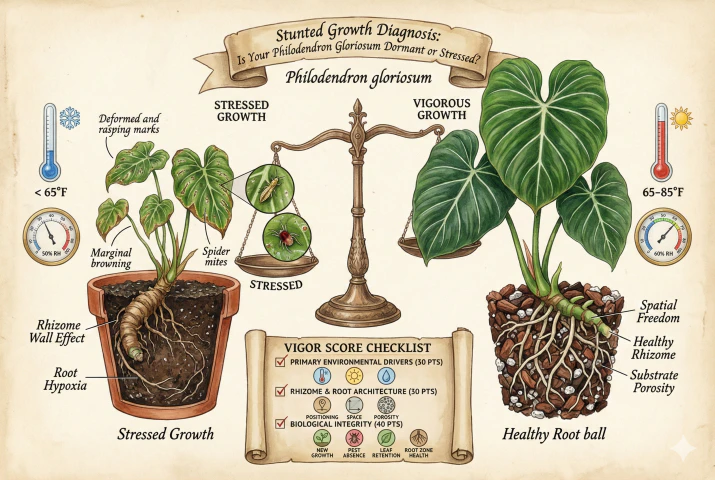
A Diagnostic Checklist (Things to Check, Not a Score)
Work through these in order. The first group is a set of red flags to rule out before anything else. The rest are conditions to measure and record.
If you can't confirm a cause, unknown or mixed causes is a legitimate conclusion. Keep observing rather than forcing a fix.
With a ruler in frame, I photograph the active rhizome tip and mark the distance between the newest nodes. A plant can be growing too slowly to notice day to day without being truly dormant.
Node advance, leaf size, and hardening interval are compared together. One stalled leaf after damage is less concerning than the whole sequence shrinking.
Substrate and air temperature stay in the same log through the night and light cycle. A cool floor or wet long planter can keep the horizontal root zone colder than the canopy sensor suggests.
Red flags to rule out first
Root zone
If the plant wobbles, smells musty, or you suspect wet, compacted medium, unpot it and inspect. Firm, pale roots are a good sign. Soft, brown, sloughing roots are not. Do this before any other step.
Pests
Look under leaves and on new growth with a hand lens for insects, webbing, or dark frass. Confirm a live organism rather than treating on symptoms alone.
Environment to measure and record
Temperature
Note the day and night range and any cold drafts. As a conservative guide, tropical houseplants are usually kept above roughly 65 °F (18 °C) and away from drafts, but treat this as warmth guidance, not a stress threshold.
Light
Measure light at the leaf, not just the room. Where possible, record photoperiod and estimate daily light integral (DLI), plus window direction, distance, and season. Foot-candle readings vary by light source and do not translate directly between daylight and LEDs.
Humidity
Record the ambient level. Modest local humidity around the plant can help, but for the occupied room follow indoor-air guidance, which caps whole-room humidity well below the levels some plant guides suggest.
Container and medium
Stem position
The thick horizontal stem, or growing crown, should not be buried deep. Keep the growing point at the surface while the roots stay in stable contact with the medium.
Room to advance
A creeping stem needs somewhere to go, so note how close the growing tip is to the pot edge when planning a repot. This is a convenience for planning, not a biological cutoff.
Drainage
A well-aerated, freely draining medium matters more than any single ingredient ratio. Judge it by how the mix packs, how much water it holds, and how fast it dries in your pot and watering routine rather than by a fixed chunk percentage.
Growth and history
Recent history
Note recent purchase, moves, propagation, or repotting, along with the plant's age, normal leaf interval, and how the newest leaves are unfurling.
Visible symptoms
Deformity, rasping, tearing, or sticky residue can have several different causes such as abiotic damage, pests, mechanical injury, or sap. Treat each as an observation to explain, not a verdict.
The sections below walk through the likeliest causes in the order you should rule them out (critical problems first).
Working Through the Likely Causes
Critical Problems (Root Rot and Pests)
Rule these out first. Root loss and an active infestation are the failures most likely to halt growth, and they need confirming rather than assuming.
Root Loss and Root Rot
Philodendron gloriosum is a terrestrial plant that prefers a loose, freely draining root zone.
Saturated, poorly aerated medium is a common setup for root problems, and several soil-borne organisms (Pythium and Phytophthora among them, but also Rhizoctonia and Fusarium) can cause root rot under wet conditions, as can non-infectious root death from overwatering alone.
Wet medium doesn't confirm a specific pathogen. Only inspection, and sometimes a lab, can.
Root damage can reduce the plant's uptake of water and nutrients, including calcium, which is important for new cell walls and moves poorly within the plant once delivered.
That is general physiology, though. A hooked or stuck new leaf is not a specific signature of root rot.
Leaf hooking and sticking also track with humidity and vapor-pressure deficit, mechanical damage, nutrient imbalance, pests, and normal developmental variation, so it should be read as one clue among several.
A wobble and a musty smell are screening clues, not a diagnosis. To actually check the roots, unpot the plant and look. Note the color, firmness, and distribution of the roots and whether the outer layer (cortex) is sloughing off.
Also review the moisture history and how well the container drains.
If you find clearly dead, mushy roots, careful cleanup is a reasonable salvage step, but keep it to the minimum necessary, because a weakened plant can't spare healthy tissue.
Remove only tissue that is plainly dead using a sterilized tool, discard the old contaminated medium rather than reusing it, repot into fresh well-draining aroid mix, and correct the watering that caused the problem.
Do not soak living roots in household hydrogen peroxide or other disinfectants. There is no evidence establishing a safe, effective dose for this on Philodendron gloriosum, and a study on orchids found even a short 3% dip set roots back.
Root rot is often not salvageable depending on the organism and extent, so also consider taking a clean cutting to propagate, discarding badly affected plants, isolating the plant, and checking nearby plants.
A well-aerated mix, one with a good share of coarse material such as bark, perlite, or pumice, helps keep the root zone from staying waterlogged, echoing the forest floor.
What matters is the finished mix's air-filled porosity, water retention, and drying behavior in your pot and routine, not a brand of potting soil being good or bad.
Perfect Plants Aroid Mix
This mix may suit a plant that needs a more open root zone, but its drying speed still depends on pot size and watering. No mix prevents rot by itself. Use it with drainage, measured watering, and a check for new root or leaf growth.
Thrips and Mites
If the roots look healthy but new leaves emerge deformed, pests are worth checking, but they are one possibility, not the default.
Thrips feed by rasping and sucking cell contents from developing leaves, which can leave scarred, silvery, distorted tissue. Spider mites pierce cells and feed on the contents, causing fine stippling.
Abiotic damage, mechanical injury, and developmental variation can look similar, so confirm the organism before concluding it's a pest.
To confirm, inspect with a hand lens, tap foliage over white paper to dislodge moving insects, look for dark frass, and check leaf undersides repeatedly over several days.
Silvering and webbing are useful clues, but the identification rests on seeing the actual insect and its life stages, not on symptoms alone. If you can, photograph the organism for identification.
Rinsing the foliage and wiping the leaves is a sensible low-risk first step that reduces the population and lets you inspect. Isolating the plant from others also helps.
If confirmed pests still warrant a pesticide, use a product only when its label lists your plant, your pest, and an indoor site, and follow that label exactly (application rate, timing, maximum number of applications, and PPE).
Do not build a treatment schedule from an active ingredient's reputation.
Captain Jack's Deadbug
This product does not fit indoor use on this houseplant because its current label is for outdoor residential use. Do not adapt a greenhouse or outdoor interval into an indoor treatment schedule. For any pesticide, use only the exact label’s listed plant, pest, site, safety directions, and application limit.
Because some thrips feed inside leaf sheaths where sprays can miss, systemic products are sometimes mentioned for severe cases, but a soil-applied systemic is not actionable without a specific active ingredient, product, target-pest efficacy, an indoor ornamental site on the label, and a rate.
Many are neonicotinoids (such as imidacloprid), whose labeled targets are typically mealybugs, soft scale, aphids, and whiteflies rather than spider mites, and which persist in the plant.
Keeping a treated plant indoors does not remove pollinator risk. If it is later moved outdoors or flowers, that residue can reach pollinators. Consider systemics only with expert, label-based guidance.
Anthurium Diseases. Identification and Control in Commercial Greenhouse Operations (UF/IFAS Extension)
Thrips in Home Gardens (University of Maryland Extension)
Structural and Environmental Limits
If the roots and pests check out, look next at the container, light, and environment. Constraints that can slow a plant without any disease being present.
The Creeping Habit and Pot Shape
Philodendron gloriosum has a creeping, decumbent stem rather than a climbing one. (Botanical records list its habit in more than one way, so this is about how it grows in cultivation, not a rigid category.)
When the growing stem runs out of room in a round pot, a long, rectangular planter can give it a runway to keep advancing, which is often easier to manage.
Small leaves have several possible causes, though, root confinement, uneven water distribution, a depleted root zone, low light, or recent propagation, so treat a long planter as one option, not a guaranteed fix.
There is no established evidence that the plant detects the pot edge and down-regulates to make smaller leaves.
Check the measured stem direction, root volume, drainage, and the surface the planter will sit on before repotting.
The Bloem Dayton Window Box is one example of a long, drained planter. Check its dimensions, drainage, catchment, and loaded weight against your plant and shelf before buying.
Low Light
If new leaves are small and held on long, stretched petioles, low light is one likely cause (plants tend to elongate toward light) though root stress, recent propagation, nutrition, and genetics can produce a similar look, so don't treat petiole length alone as proof.
In winter, supplemental light is often helpful. Rather than chasing a single foot-candle number (readings depend on the light source and don't transfer between daylight and LEDs), measure light at the canopy and aim for a sensible photoperiod and daily light integral, adjusting for window direction, distance, and season.
SANSI 36 W Grow Bulb
This bulb suits a small supplemental-light zone when a screw-in fixture is practical. Measure at the canopy rather than judging by wattage, acclimate the plant gradually, and confirm the fixture’s heat rating, stable mounting, and distance from water.
Fine-Tuning a Healthy Plant
If nothing above turns up a problem and any slowing looks minor and seasonal, two things are worth optimizing, but note that a plant looking fine on the surface does not rule out a hidden root or pest issue, so keep checking rather than assuming.
Humidity and leaf expansion
Low humidity (high vapor pressure deficit) as a leaf unfurls can affect how fully the blade expands, which is a plausible direction.
The specific claim that the cataphyll hardens and mechanically restricts the blade, and a precise 60–80% optimum, aren't established for this species.
More importantly, running a whole occupied room at 60–80% conflicts with indoor-air guidance. The U.S. EPA advises keeping indoor humidity below 50% with a home humidifier (ideally 30–50%), because higher levels encourage condensation, mold, and dust mites.
Favor local humidity around the plant, a tray, grouping, or a small enclosure, over saturating the room.
Levoit Classic 300S Humidifier
This humidifier can raise humidity near the plant, but do not use it to hold an entire room at 60–80% RH. Use low-mineral water, keep the tank clean, and watch cold surfaces for condensation. Airflow does not remove the building risks of excessive room humidity.
Feeding
Nutrients can leach from a coarse mix, but a slow-looking plant is not necessarily hungry (over-fertilization and salt buildup also injure roots and stunt growth, so distinguish deficiency from excess before adding more).
If you do feed, do it while the plant is actively growing and follow the specific fertilizer's label for dilution and rate. Nitrogen supports growth and magnesium is part of chlorophyll, but feeding does not guarantee larger leaves.
Observe Methodically Instead of Assuming Dormancy
Diagnosing stunted growth shifts you from passive worry to active observation. Rather than assuming dormancy, check what the plant and its roots are actually doing, and accept that unknown or mixed causes is sometimes the honest answer.
Work the order. Rule out the critical problems first (root rot and confirmed pests), then look at structural and environmental limits like pot shape and light, and only then fine-tune humidity and feeding.
Working through it methodically won't guarantee recovery (some damage is irreversible and some causes are mixed) but it gives you the best chance of restoring healthy, creeping growth.
Affiliate Disclosure
This article contains Amazon affiliate links. As an Amazon Associate I earn from qualifying purchases. If you use these links, the site may earn a commission at no extra cost to you. Product availability, price, and specifications can change. Check the current listing before buying.