
Pseudomonas syringae on Philodendron: ID & Treatment
Pseudomonas syringae bacterial leaf spot on philodendron: how to recognize the warning signs, why visual ID is not conclusive, and when to confirm with a plant-disease clinic.
Priya Patel · Published 2026-05-31 · 32 min read
Key Takeaways
- A water-soaked margin, yellow halo, and angular vein-bounded shape point toward bacterial leaf spot, but they do not confirm a specific pathogen. Several bacteria and some fungi can look similar.
- Fungal-targeted products are not the treatment for a bacterial spot. The practical priority is isolation, dry foliage, sanitation, and a proper diagnosis.
- Copper bactericides are preventive protectants, not cures. Follow the specific product’s EPA label for crop, rate, and interval.
- Sanitation comes first. Isolate suspect plants, keep foliage dry, avoid splash, and disinfect tools between plants.
- Only a plant-disease clinic can confirm the pathogen. Home inspection is triage, not identification.
A water-soaked margin, a yellow halo, and an angular vein-bounded edge.
That combination on a philodendron leaf is a reasonable reason to suspect a bacterial leaf spot, and Pseudomonas syringae is one candidate. It is not proof of any single organism. Several bacteria, and some fungi, can produce a similar look.
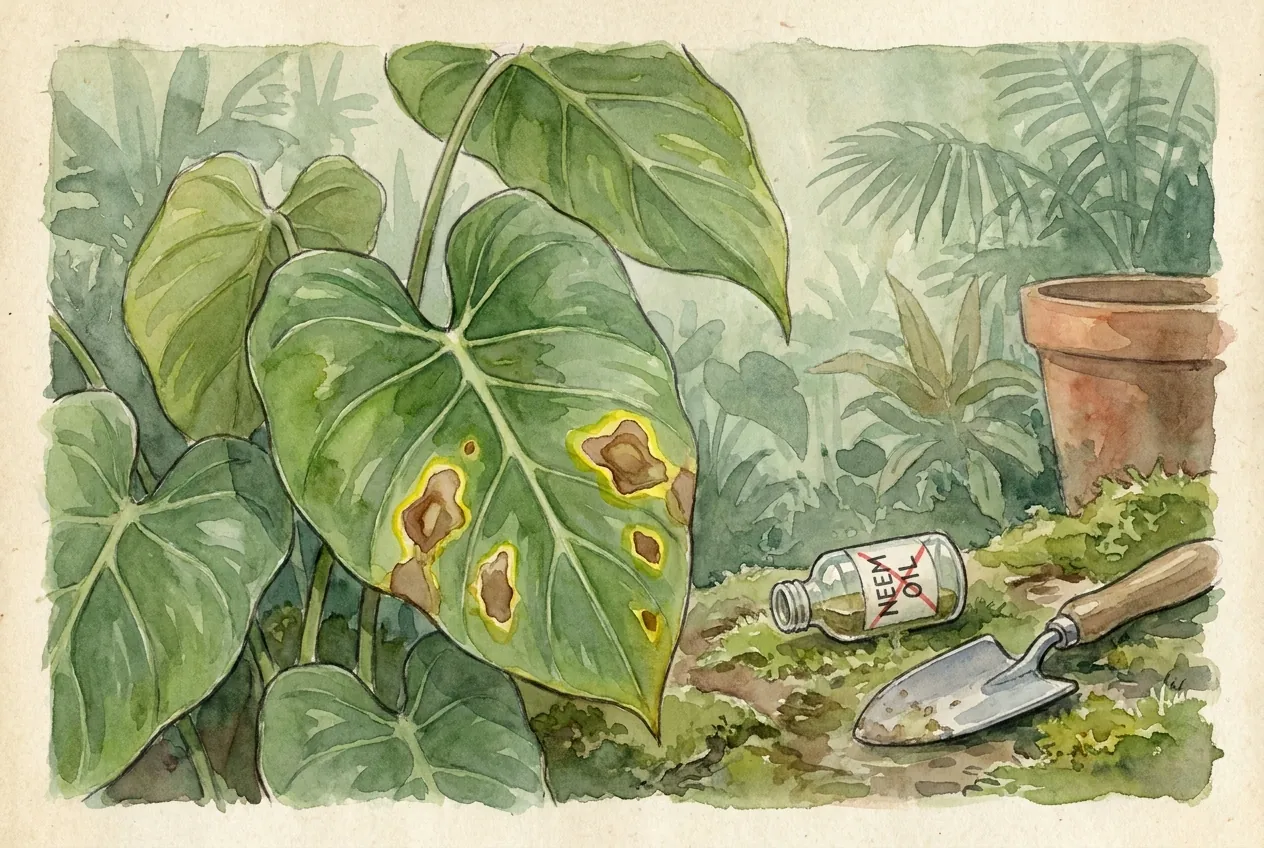
Hobbyists often default to neem oil or chlorothalonil for any leaf spot. Those are fungal-targeted products, so they are not the right choice for a bacterial spot, but reaching for the wrong category also delays the things that actually help, like isolating the plant and keeping the foliage dry.
Use symptoms only to triage. Isolate the plant, keep foliage dry, and use a plant-disease clinic to confirm a spreading, valuable, or uncertain case before committing to treatment.
What is Pseudomonas syringae pv. syringae on philodendron?
Pseudomonas syringae pv. syringae is a gram-negative, flagellated bacterium that commonly lives epiphytically on leaf surfaces.
Cool, damp conditions and prolonged leaf wetness tend to favor infection, though the exact temperature and wetness thresholds vary by host and strain rather than following one universal switch.
It was recorded on heart-leaf philodendron (Philodendron scandens) in a 2018 Serbian study. A single laboratory-confirmed first report, not evidence that any water-soaked spot on a philodendron is this pathogen.
The bacterium is thought to enter mainly through natural openings such as stomata and hydathodes and through wounds, rather than by breaching intact cell walls.
Once inside, it can multiply in the apoplast, the intercellular space, and some strains produce toxins that damage host cells.
On a whole-plant photograph, I mark the first lesions and draw recent watering, misting, fan, and neighboring-leaf contact routes around them. A splash pattern across facing leaves is different evidence from isolated old mechanical damage.
Before handling, the plant goes into isolation, and I disinfect tools between samples. The map keeps me from recreating the suspected spread route during inspection.
Lesion margins are traced by date, with water-soaking, halo, texture, and underside appearance noted separately. I use the sequence to support a professional diagnosis rather than naming the pathogen from one final brown spot.
How does the bacterium actually damage a leaf?
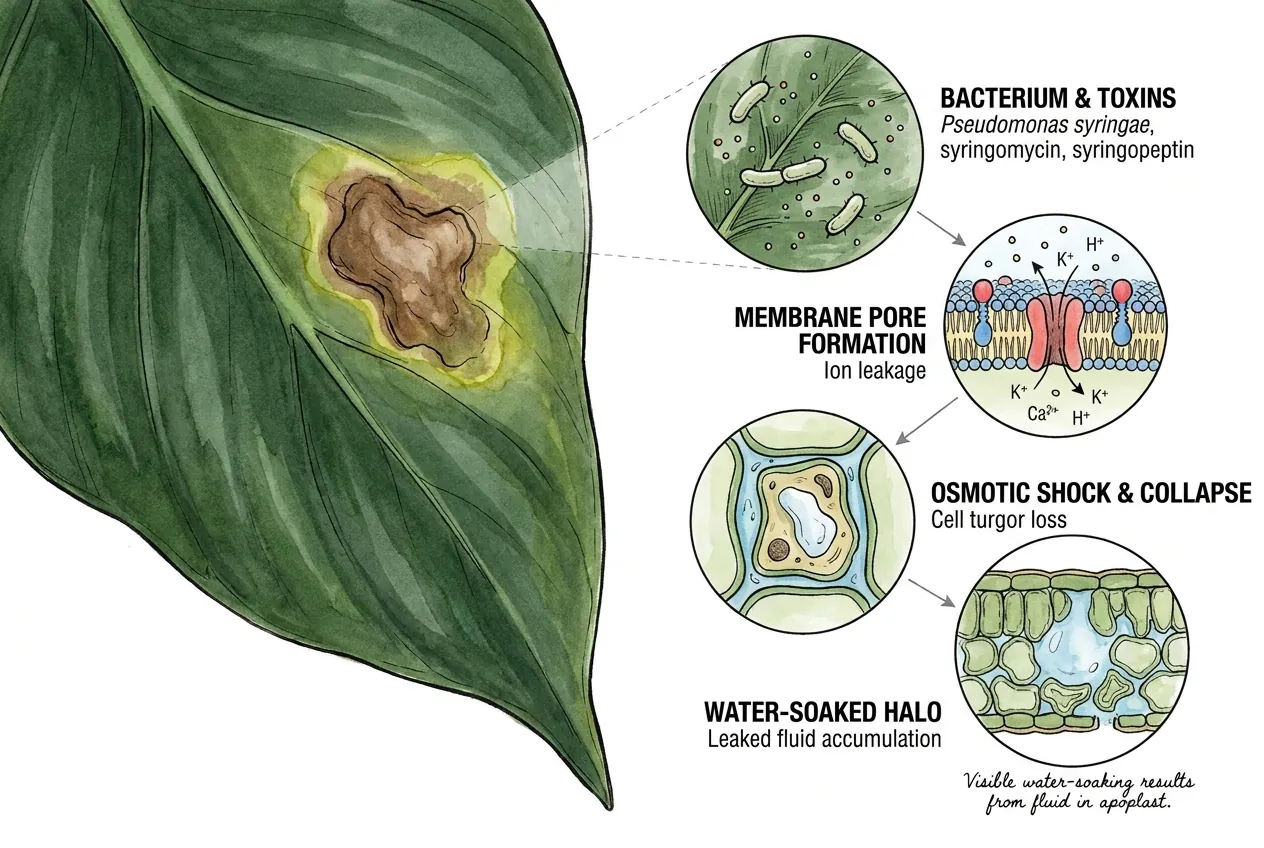
Two lipodepsipeptide toxins associated with this pathovar, syringomycin and syringopeptin, can insert into plant cell plasma membranes.
Not every strain produces both, and their contribution to any given lesion varies.
In the described mechanism, these compounds form ion-permeable pores in the membrane.
That can disturb cell turgor and let intracellular fluid leak into the apoplast.
Water-soaking around a lesion is consistent with this kind of intercellular fluid accumulation, but a translucent margin can arise several ways and does not by itself prove which toxin or organism caused it.
The general mode of action is described in the literature. The amphipathic lipopeptide structure of syringomycin inserts into membrane lipid bilayers to form cation-permeable pores. That is review-level biology and is separate from what any one home lesion demonstrates.
Why do cool, damp conditions trigger outbreaks?
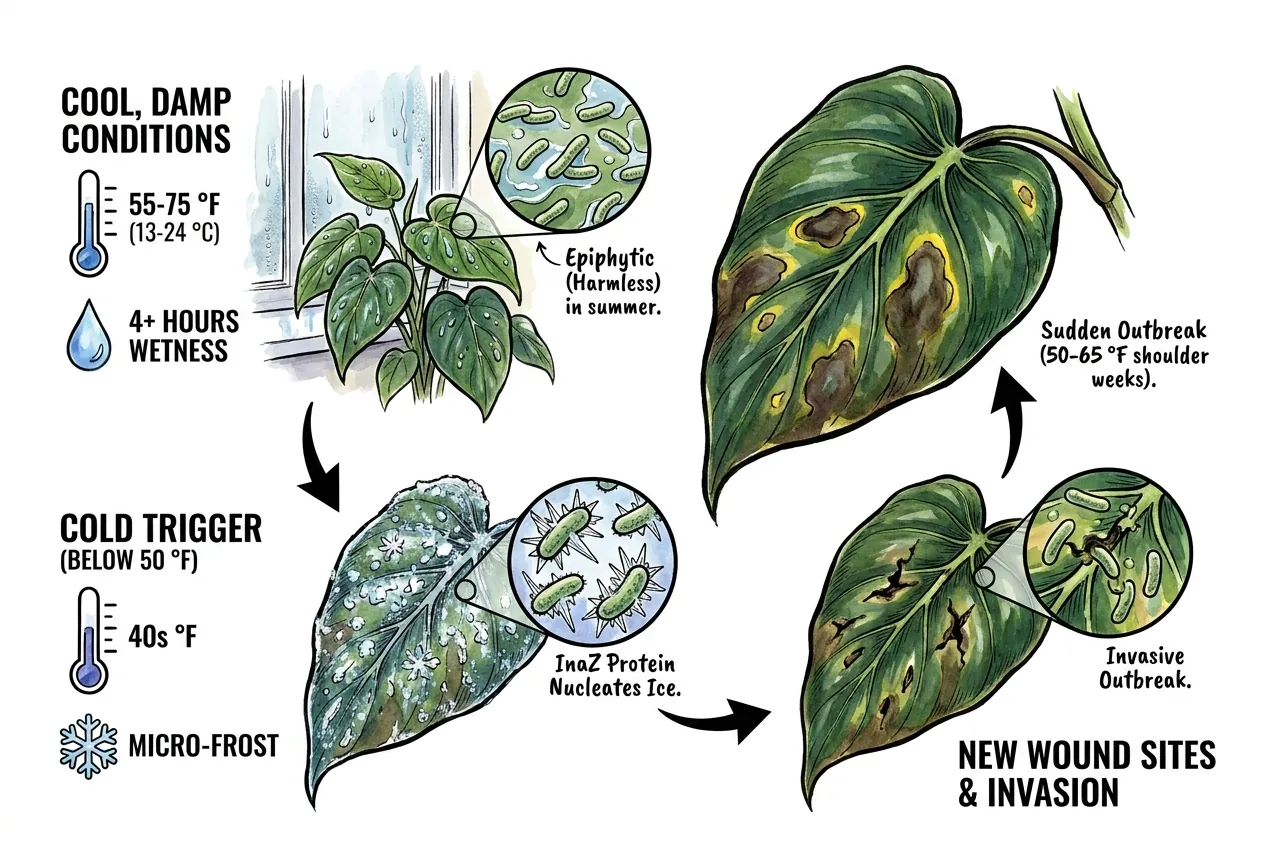
Cool, moist conditions with extended leaf wetness generally favor P. syringae diseases. The often-cited 55–75 °F, several hours of wetness ranges come from other pathosystems. The optimum for philodendron specifically has not been established, so treat these as rough tendencies, not a fixed rule.
Cold Wet Stress Versus Freezing Injury
Cold, wet stress can weaken tissue and keep leaves wet longer. True freezing injury only happens below the freezing point.
Some P. syringae strains carry an ice-nucleation protein (InaZ) that can trigger ice formation at temperatures somewhat warmer than the point where clean water supercools (reported around −2 °C, not at above-freezing temperatures).
At 40–50 °F (roughly 4–10 °C), no ice forms and there is no micro-frost. Those temperatures are well above freezing.
How cool, wet spells raise the risk
A philodendron by a cold, single-pane window in spring or fall can sit in conditions that favor infection, leaving the foliage chilled and wet for long stretches.
Window condensation can leave a water film on nearby leaves, and cool air slows evaporation, so that film lingers.
Longer leaf wetness gives an epiphytic population more time to establish through natural openings and wounds.
That is a plausible predisposing pattern, not a claim that the leaf froze at 40 °F.
If you do see genuine frost damage, that is a separate problem that requires actual sub-freezing exposure, and it is uncommon for an indoor plant.
References
Leaf spot disease on Philodendron scandens, Ficus carica and Actinidia deliciosa caused by Pseudomonas syringae pv. syringae in Serbia
What does a Pseudomonas syringae lesion look like on philodendron?
A classic bacterial-spot lesion shows three features together. A water-soaked translucent margin, a yellow chlorotic halo, and angular geometry that follows minor leaf veins. Seeing all three raises suspicion of a bacterial cause, but there is no validated accuracy figure for identifying the species by eye, and these features overlap with other bacteria and some fungi.
Treat them as clues that guide triage. Atypical or older lesions may show only one or two of these, and their absence does not rule bacteria out.
What is the water-soaked margin?
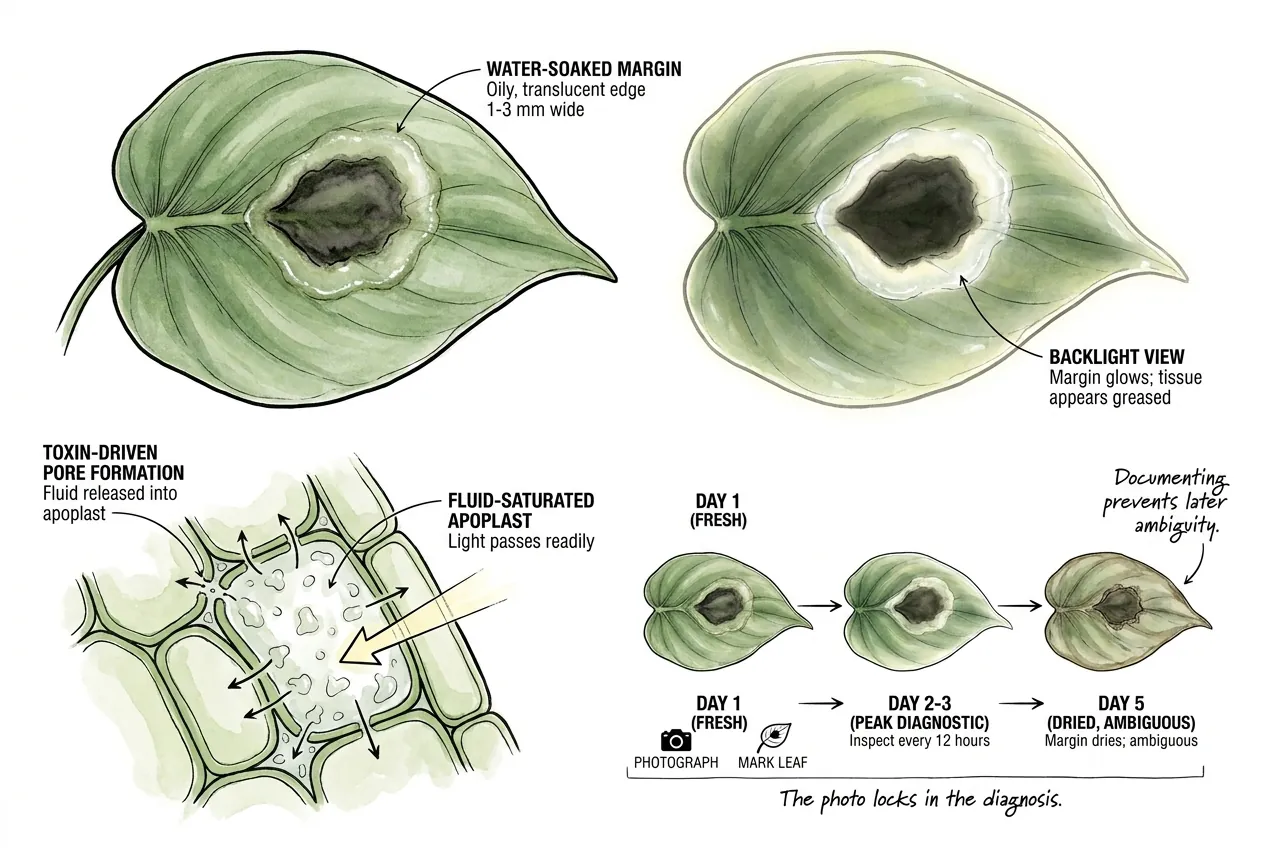
It is an oily, translucent edge, often just a couple of millimeters wide, around the dark center of a fresh lesion.
Hold the leaf to backlight and the margin can glow as if the tissue were greased. Exact width varies with cultivar, leaf age, and humidity.
The translucency reflects fluid-saturated tissue in the intercellular space. Light passes through it more readily than through dry tissue. Water-soaking has more than one possible cause, so it points toward a bacterial spot rather than confirming a specific toxin or organism.
Fresh lesions tend to show this margin most clearly. As a lesion dries over the following days it can start to resemble fungal lookalikes. How fast that happens depends on the environment, not a fixed clock.
What to do while the lesion is fresh
Photograph every suspect lesion with backlight and tag the leaf so you can track it. Re-checking every day or so while it is active gives you a useful record.
An early, dated photo preserves what the fresh margin looked like, which helps you compare later. It records the appearance. It does not confirm the organism, and if you need certainty, a fresh margin sent to a clinic is what settles it.
Why is there a yellow halo?
A diffuse yellow ring can form around the lesion where cells adjacent to the colony lose chlorophyll (chlorosis).
Toxin diffusion from the colony is one proposed contributor, but there is no direct philodendron evidence that every halo is a syringomycin field of a specific width.
As chlorophyll breaks down, underlying yellow pigments become more visible, giving the ring its color.
The ring is often a few millimeters wide, but the exact width is not a species marker and does not reliably indicate how aggressive a strain is. Halo size also changes with host response and lesion age.
Do not use a halo measurement as a treatment trigger on its own.
On dark cultivars like ‘Black Cardinal’ or ‘Pink Princess’, backlight inspection can make a faint halo easier to see.
Why is the lesion angular instead of round?
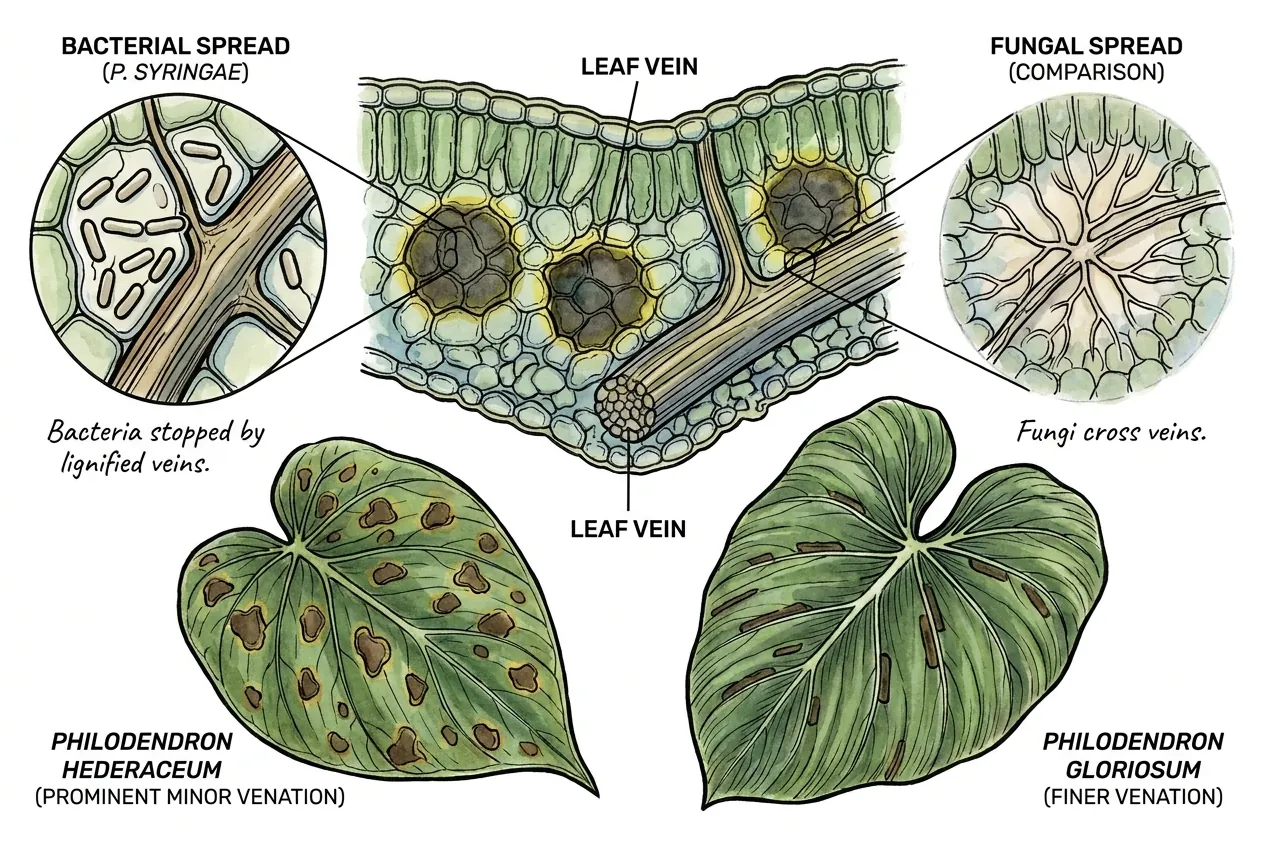
Bacterial lesions often stop at minor leaf veins because the apoplastic space the bacterium spreads through can be interrupted at the vein.
Vein tissue reinforced with suberin and lignin may slow that spread in some cases, which can give lesions an angular outline.
But shape is not a clean bacteria-versus-fungus test. Bacterial lesions can also be roundish, and some fungi produce vein-limited, angular lesions too, so angular means bacterial, round means fungal is an oversimplification.
When a lesion does follow the venation it looks like an irregular polygon bounded by the leaf’s veins. Different philodendron species have different venation, so the shape and size of these lesions vary. That variation is not a species-specific fingerprint for the pathogen.
References
How do I distinguish bacterial from fungal leaf spot?
Shape and margin moisture are useful first clues, but they narrow the field rather than name the organism.
An angular lesion with a wet margin is more consistent with a bacterial spot (such as Pseudomonas or Xanthomonas) than with a typical dry fungal spot.
A round, dry-from-the-start lesion is more suggestive of a fungal cause like Colletotrichum anthracnose or Cercospora leaf spot.
Mushy tissue with a foul smell is a red flag for soft rot (that one needs removal and isolation, not spraying).
These are overlapping categories, not a key that identifies the pathogen. Extension diagnosticians are clear that bacteria and fungi can look alike and that a clinic is the reliable way to tell them apart.
The table below is a triage aid for the pathogens hobbyists most often ask about. Use it to decide how urgently to act and whether to send a sample, not to reach a final diagnosis.
| Feature | P. syringae (bacterial) | Xanthomonas aroid blight (bacterial) | Colletotrichum (fungal) | Cercospora (fungal) | Pectobacterium soft rot (bacterial) |
|---|---|---|---|---|---|
| Lesion shape | Angular, vein-bounded | Marginal V-shape, interveinal | Round to oval | Small round (1-3 mm) | Irregular, mushy |
| Margin appearance | Water-soaked, oily | Water-soaked, marginal | Dry from day 2 | Dry, sharp border | Soft, slimy edge |
| Halo | Yellow, diffuse, 1-5 mm | Yellow, bright | Often none | Rare | None |
| Fruiting bodies | None | None | Black acervuli sometimes at center | Dark conidiophores/conidia (needs magnification. Not always visible) | None |
| Texture | Papery (late stage) | Papery (late stage) | Brittle, dry | Brittle, dry | Mushy, wet |
| Smell | Neutral | Neutral | Neutral | Neutral | Strong foul odor |
| Systemic? | Rarely | Yes (xylem, stem) | No | No | Yes (petiole, crown) |
| General approach | Sanitation first. Copper is a protectant option per label | Sanitation first. Copper is a protectant option. May be regulated in some settings | Labeled fungicide plus sanitation | Labeled fungicide plus sanitation | Remove and isolate. No spray cures it |
Every entry above is a tendency, not a rule. Symptoms overlap between these organisms, so use the table to prioritize (then confirm anything ambiguous, spreading, or on a valuable plant with a clinic).
How is Xanthomonas dieffenbachiae different?
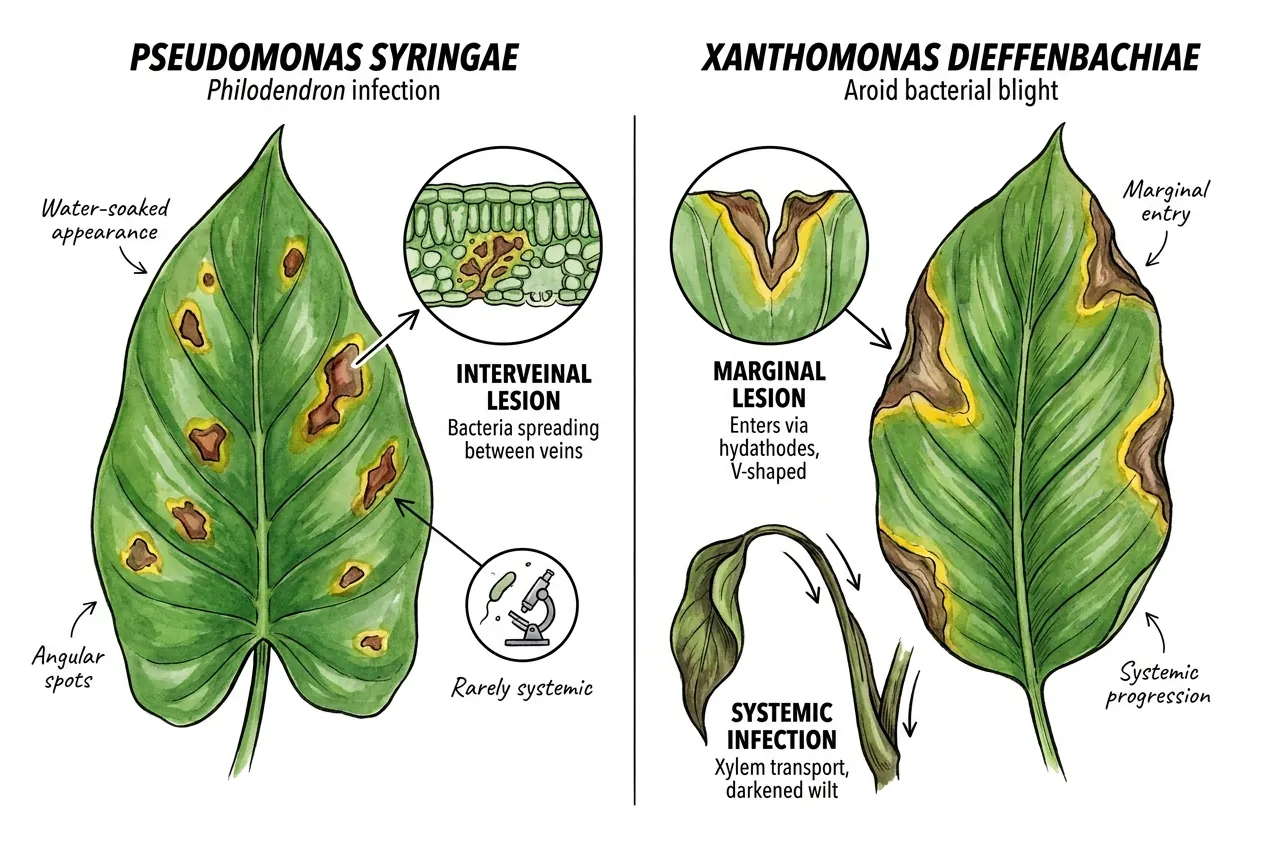
The bacterium that causes aroid bacterial blight is the closest visual lookalike. It has long been called Xanthomonas axonopodis pv. dieffenbachiae, but that is a reclassified taxon complex. The current, host-specific name should be confirmed rather than assumed from an older label.
It can infect several major aroid genera, philodendron, anthurium, dieffenbachia, and syngonium among them, though not every isolate behaves identically or belongs to the same pathovar.
It can produce marginal water-soaked lesions with yellow halos that look much like a P. syringae spot at first glance, which is exactly why visual ID is unreliable.
Some differences are described in the literature. Xanthomonas often enters via hydathodes at leaf margins, which can give V-shaped marginal lesions, and it tends toward systemic spread through the xylem.
Darkened, wilted petioles and stem collapse are a warning sign of systemic disease. That is an urgent red flag, but it is not specific to one organism, since soft rot and root or crown rots can look similar and need to be considered.
How do I rule out Colletotrichum anthracnose?
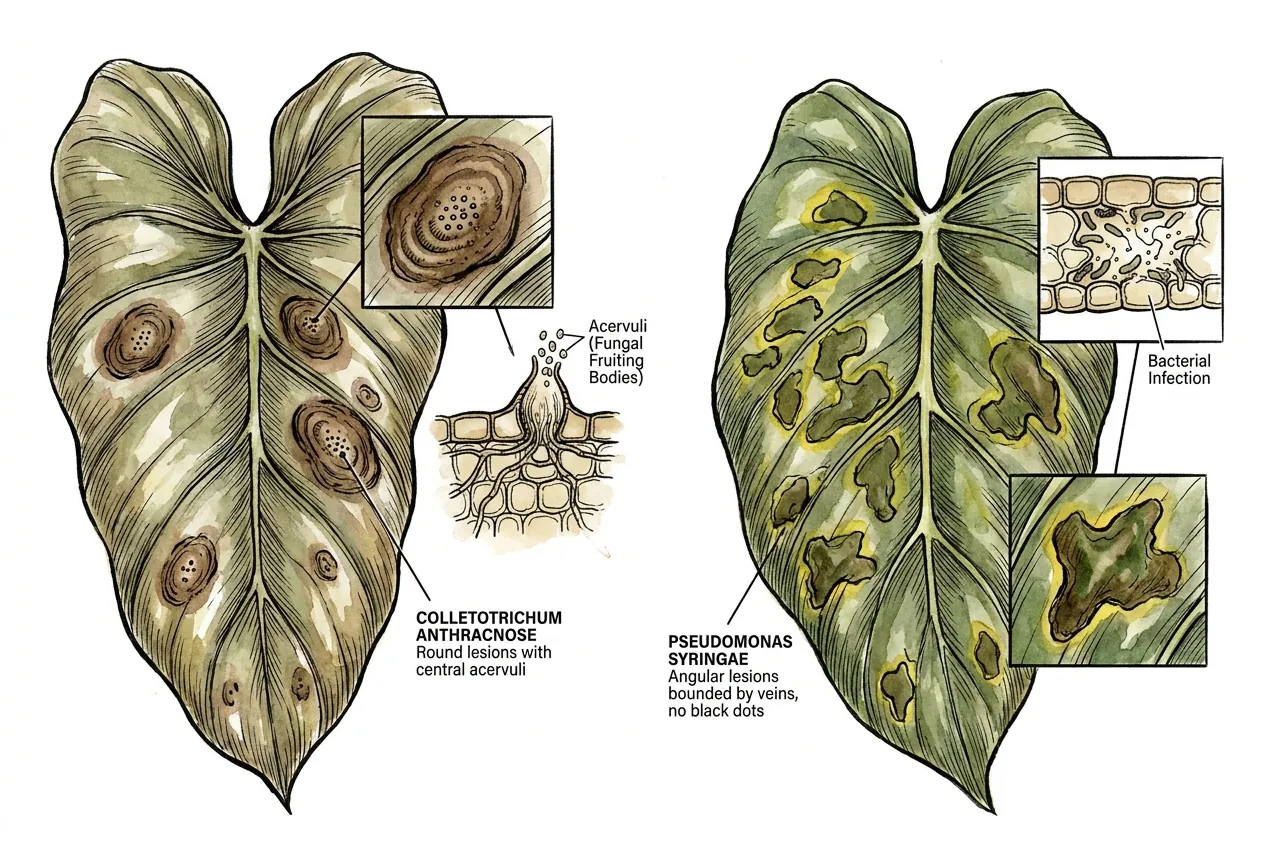
Round to oval lesions with concentric rings and tiny dark dots in the center can point to anthracnose.
Those dots may be acervuli, fungal fruiting bodies, and seeing them makes anthracnose more likely.
Colletotrichum produces conidia in acervuli. These are small. Whether they are visible with a hand lens depends on the specimen and stage, and confirming what they are usually takes higher magnification.
Central dark dots raise suspicion of anthracnose, but they are not a definitive switch. Not every black speck is an acervulus, and their presence does not by itself rule out a bacterial spot or secondary colonizers.
Anthracnose lesions are often roundish, but fungal spread is not always vein-limited and bacterial lesions are not always angular, so shape is a clue rather than a decider.
Practical Takeaway
If a round lesion shows convincing central fruiting bodies under magnification, favor a fungal cause and treat and confirm accordingly, but check under magnification, or send a sample, rather than deciding from the naked eye.
What about Cercospora and Pectobacterium soft rot?
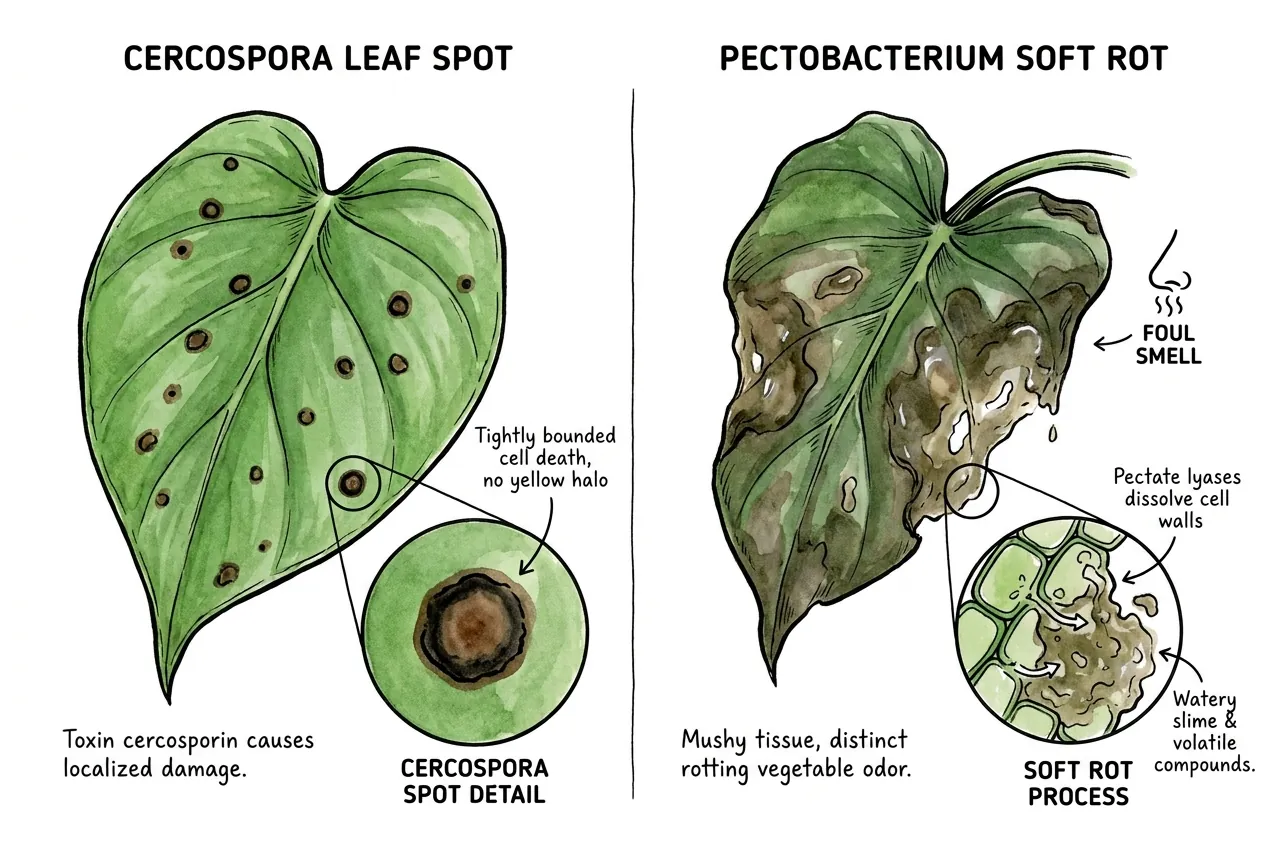
Cercospora often gives small round spots with fairly sharp dark borders and typically little diffuse halo, though size and halo vary with host and stage.
(Cercospora fruits from dark conidiophores and conidia, not pycnidia. A detail worth noting because the two are sometimes confused.)
Its toxin, cercosporin, is a light-activated compound associated with localized cell death. That does not mean every Cercospora lesion is identically bounded.
Pectobacterium (formerly Erwinia) is one cause of bacterial soft rot, which smells foul and turns tissue mushy as cell-wall-degrading enzymes break tissue down.
Other bacteria can cause similar soft rots, so the smell and texture flag the problem type rather than the exact organism.
Tissue can turn to watery slime, and volatiles give the characteristic rot smell.
If a suspect lesion is mushy and smells like rotting vegetable, treat it as a soft-rot red flag. Isolate the plant and remove affected tissue promptly.
How far back to cut depends on how far the rot extends and whether the petiole or crown is involved. There is no universal safe margin, and crown or root involvement may mean the whole plant is at risk.
A surface copper spray will not reverse advanced soft rot.
References
First Report in New Caledonia of Bacterial Blight of Anthurium Caused by Xanthomonas axonopodis pv. dieffenbachiae (PubMed)
Why is bacterial leaf spot misdiagnosed as fungal?
Fungus is the more familiar word, and many hobbyists reach for a fungicide first. Fungicides are also the more visible product on most garden-center shelves, which reinforces the habit.
The bacterial-versus-fungal distinction also takes deliberate observation, and it is not something most growers are taught.
The cost of guessing wrong is difficult to quantify but real. Under favorable conditions, bacterial populations can grow quickly. Days spent treating the wrong target allow an infection to progress and spread when a prompt, correct response might have limited it.
The rate and extent depend on the plant, environment, and organism, so there is no fixed canopy-loss figure.
Why fungicides do nothing against Pseudomonas
Many fungicides act on fungal-specific structures and pathways, which is why they are not the right choice for a bacterial spot.
Some, like propiconazole, target fungal sterol biosynthesis. A pathway bacteria do not share. Neem is a complex mixture. Describing it as simply an insect/fungal membrane disruptor understates how it works.
Others are broad, multisite protectants rather than fungal-specific drugs. Chlorothalonil is a multisite, thiol-reactive protectant, and mancozeb is a metal (Mn/Zn) ethylene-bis-dithiocarbamate that acts at multiple sites, not a single fungal-mitochondrial compound.
In some crops, mancozeb is even tank-mixed with copper to help manage bacterial spot.
So the accurate statement is narrower than zero effect. These products are not the labeled, effective treatment for bacterial leaf spot on philodendron.
Whether a molecule has any activity against bacteria is a separate question from whether it is registered and effective for this use.
The gram-negative envelope does limit the entry of some compounds, but efficacy is the combined result of target, dose, formulation, and label, not a single barrier that deflects every spray.
Bottom Line
Reaching for neem oil on a bacterial lesion is the wrong category for the job, and time spent on it is time not spent on sanitation and isolation.
Why does an untreated spot spread?
Under favorable conditions, bacterial populations inside the leaf can build up substantially over several days.
Water can carry the bacterium between leaves and plants. Overhead watering and splashing move droplets around, and each droplet can move some cells to nearby foliage.
The exact dose per droplet depends on the situation and is not a fixed number.
The practical point is that a spot left to spread, or treated with the wrong product, can involve more of the plant and reach its neighbors, while prompt isolation and correct handling limit that.
This is a direction, not a predicted lesion count on a schedule.
References
How do I confirm it is bacterial at home?
You can attempt a bacterial-streaming (ooze) test, but be clear about its limits before you rely on it.
Cut a very thin section through the boundary between healthy and diseased tissue at a fresh lesion margin.
Place that thin section in a small drop of clean water on a glass slide, add a coverslip, and observe.
Extension guidance describes watching for streaming under a light microscope at roughly 100–200×, not a hand lens.
A 10–30× loupe cannot resolve individual bacterial cells (which are only about 0.5–3 µm), so it is not a tool for confirming streaming.
If it works, bacterial cells stream out of the cut tissue as a faint cloud spreading into the water. A visible stream supports a bacterial cause. It does not identify the species or pathovar.
Just as important, a negative result does not rule bacteria out. Streaming is not always visible, and tissue thickness, cut quality, water, timing, and contamination all affect what you see.
Treat this as an optional screening step at best. For an answer you can act on with confidence, especially before applying any pesticide, a plant-disease clinic is the reliable path.
What does the home setup look like?
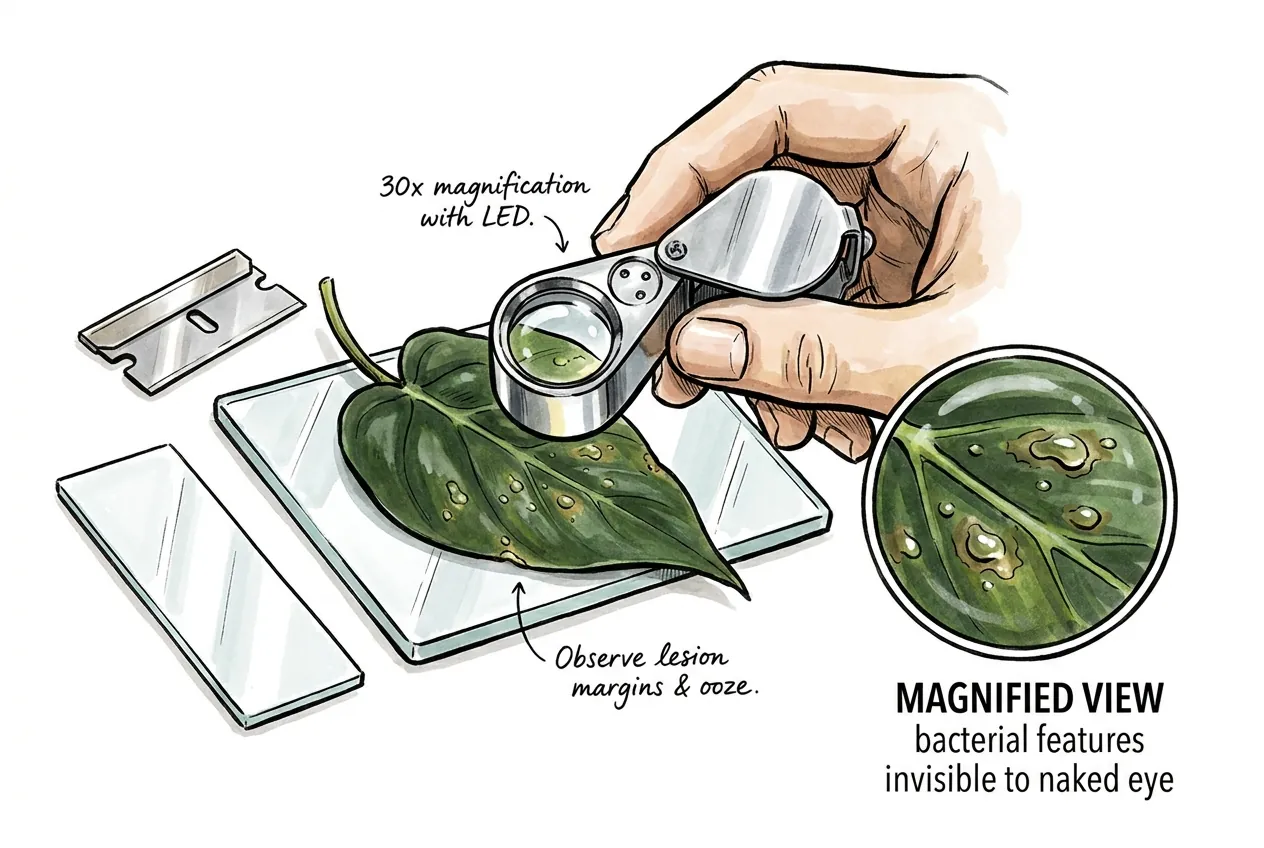
For the actual streaming test you need a compound light microscope reaching about 100–200×, a clean single-edge blade to cut a thin section, and clean water and a slide.
A hand lens is not enough to see individual bacterial cells.
A hand lens is still useful for other things, though. It helps you look at a lesion surface, larger fungal fruiting bodies, and mites, and it makes vein-bounded geometry and halos easier to study.
Just do not expect it to resolve bacteria or reveal the pathogen’s identity.
What loupe to use
For surface inspection, a useful loupe has at least 10× magnification and its own light. A folding metal housing is a portability preference, not a diagnostic feature.
Set Expectations for the Loupe
The unaided eye resolves down to roughly 0.2 mm, and bacterial cells are far smaller than that. No hand lens shows individual bacteria. That is a job for a microscope.
AC Infinity Jewelers Loupe is useful for looking closely at lesion texture, insect signs, and fungal structures. It cannot show individual bacteria or confirm a pathogen, so use it for triage rather than diagnosis.
AC Infinity Jewelers Loupe
Use it to look closely at lesion margins and surface detail. It is not a tool for confirming bacterial streaming or identifying the organism, so do not treat a loupe reading as a diagnosis.
The 60× lens has a narrow field of view, which makes it awkward for scanning. The 30× lens is the more practical one for general inspection.
Skip it if you already own a quality 10× lighted triplet.
When should I send a sample to a plant-disease clinic?
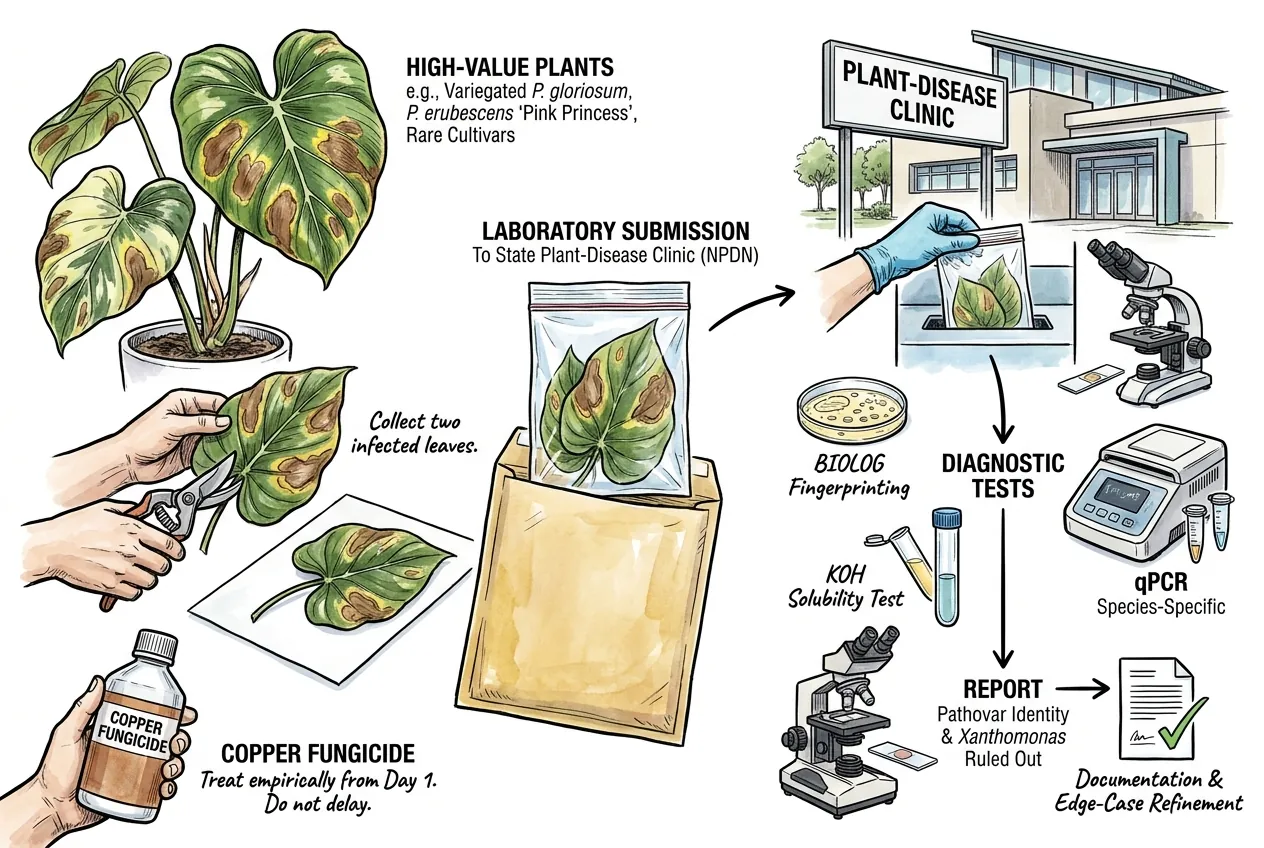
Send a sample whenever the diagnosis is uncertain, the disease is spreading, or the plant is valuable or hard to replace. Examples include a variegated P. gloriosum or a Pink Princess.
A clinic is the only way to confirm the organism.
Most US states have a plant-disease diagnostic lab connected to the National Plant Diagnostic Network (NPDN).
Coverage exists, but labs differ in what they accept from homeowners, what they charge, how long they take, and which tests they run.
Because of that variation, look up your specific lab through the NPDN directory and confirm the cost, turnaround, sample amount and type, packaging and drying steps, and shipping requirements before you send anything.
Which tests a lab uses, culturing, microscopy, biochemical methods, or molecular tools like qPCR, depends on the lab and the case, and not every lab identifies down to pathovar or reports on regulatory status.
Ask Before Applying a Pesticide
Ask the clinic before applying any pesticide. Diagnosticians generally want a representative fresh margin that includes the healthy-to-diseased boundary, and a copper or other treatment applied first can interfere with recovering the organism.
Confirm sampling and packaging with the lab first, then decide on treatment.
References
How do I treat Pseudomonas syringae on philodendron?
Start with sanitation, because that is what does the most work. Isolate the suspect plant, remove visibly infected leaves, disinfect tools between plants, keep foliage dry, and avoid splashing water around.
A copper bactericide can be added as a preventive, protectant measure. It helps reduce new infections but does not cure existing lesions or eradicate the bacterium.
Choose a product labeled for your plant and disease, and follow that product’s EPA label for the crop, rate, interval, and any temperature or pH restrictions.
Different copper products are not interchangeable.
Reduce leaf wetness and avoid overhead watering. Lower ambient humidity can help, but the right target depends on your plants and room rather than a single cutoff.
Keep cultural controls going as an ongoing practice. A stretch with no new lesions is an encouraging containment sign, not proof the bacterium is gone, so reassess diagnosis, weather, and sanitation rather than treating a fixed day count as an endpoint.
How does copper work, and what are its limits?
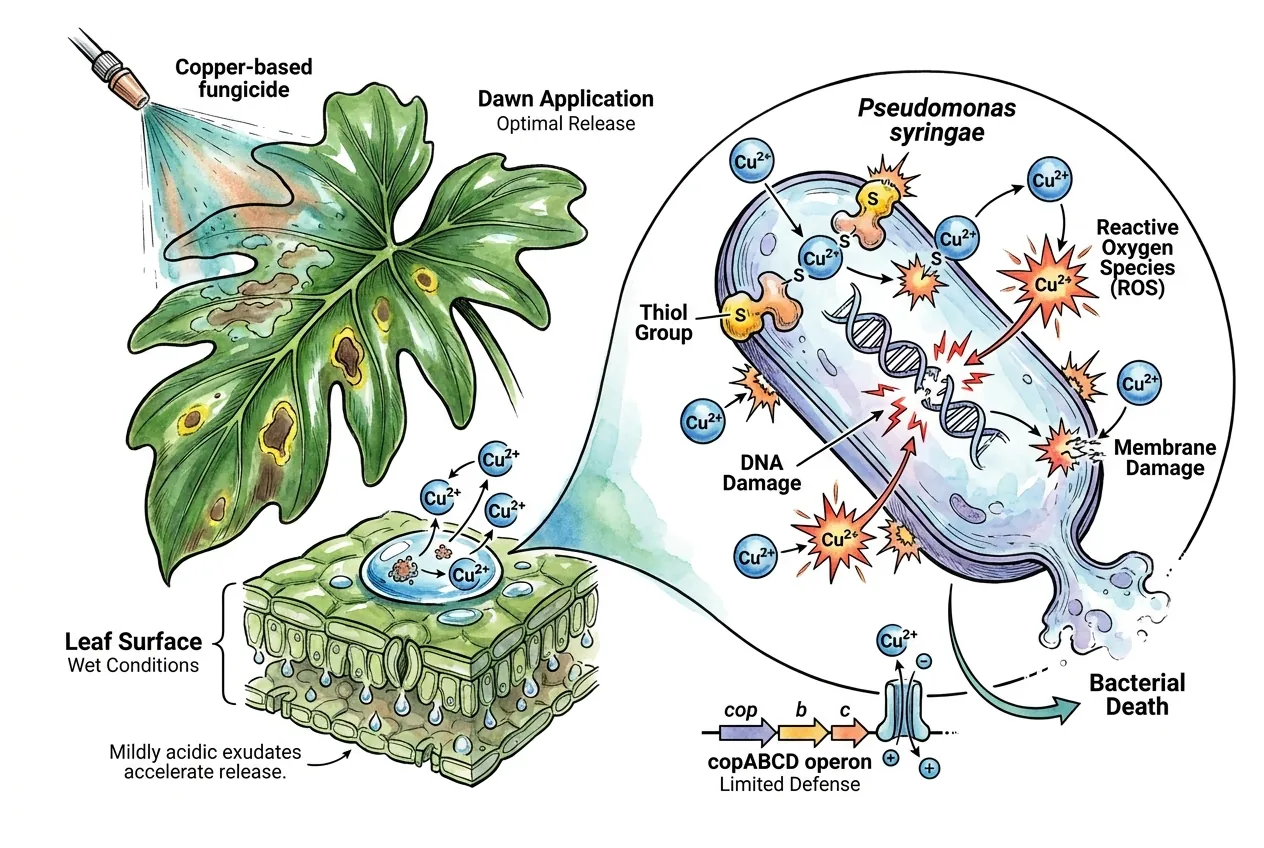
Copper works as a surface protectant. Bioavailable copper ions (Cu²⁺) can bind protein thiol groups and disrupt enzyme function in microbes on the leaf surface, and can generate reactive oxygen species.
That antimicrobial action happens where the spray sits. It does not reach and heal an infection already established inside the leaf.
Copper is also not something the bacterium is helpless against. P. syringae can carry various copper-homeostasis and resistance systems beyond the copABCD operon, and repeated use selects for less-sensitive strains.
Copper ions are the active species and are released more readily when the surface is wet and somewhat acidic.
That same wetness, though, can also favor infection and can raise the risk of leaf injury, so wetter is better is not a safe rule.
Because of that, there is no reliable spray at dawn for 30% more efficacy benefit to claim. What actually matters is following the product label’s drying-time, temperature, sunlight, and rain/irrigation guidance, and doing a small test spray on a plant before treating it broadly.
What is the right copper product?
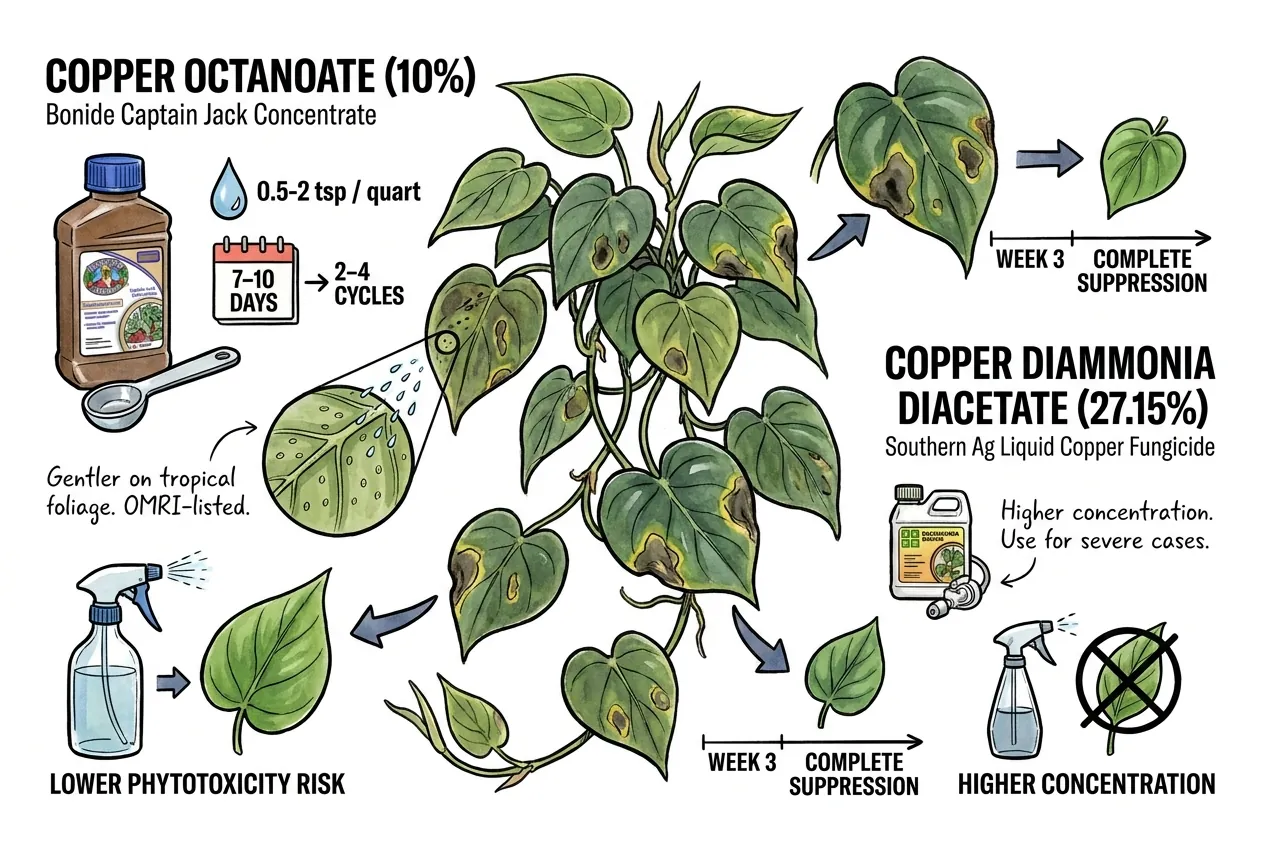
The most important step is to pick a product whose EPA label actually covers your plant and disease, then use it exactly at the labeled rate and interval.
Two products often come up for home use. They are not interchangeable, and their labels differ.
Southern Ag copper is the more directly relevant option here only when its current label lists bacterial leaf spot on philodendron. Copper protects healthy leaf surfaces. It does not heal an established lesion.
Southern Ag Copper
Follow the current label for the crop, rate, interval, annual maximum, and temperature or sunlight limits. Test a small area before broad use and do not increase the rate for a stronger effect. Copper can injure tender growth.
Captain Jack copper may fit a labeled fungal problem, but it is not a match for bacterial leaf spot on philodendron when the current label does not cover that disease. Do not substitute it because the symptoms merely look similar.
Captain Jack Copper
If you use it for a labeled fungal problem instead, follow its own label rate rather than any figure quoted here.
Labels also change, so verify the current label before buying either product for a given disease.
Whichever product you use, cover leaf undersides as well as tops, keep to the labeled interval and annual maximum, and remember copper is protecting healthy tissue, not curing existing lesions.
What does the application schedule look like?
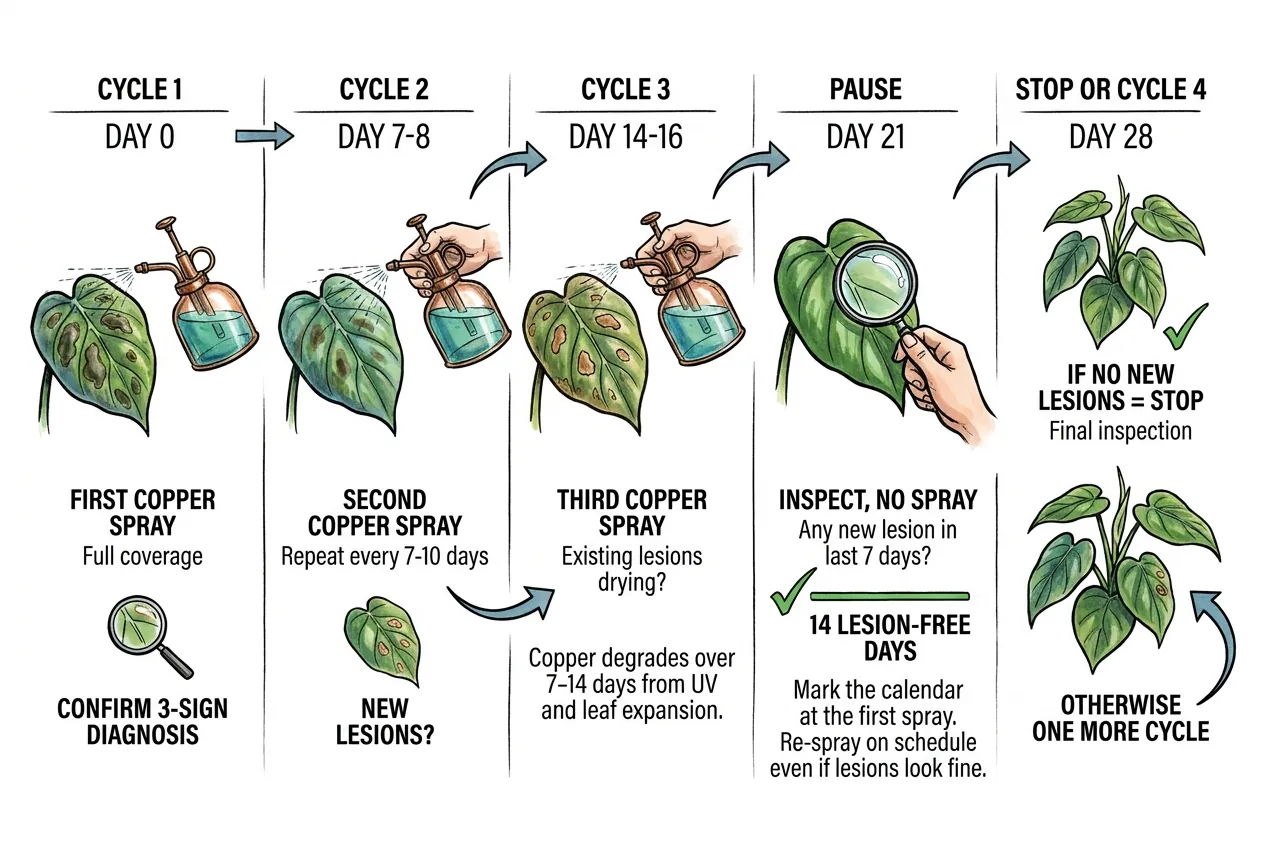
A few practical principles help, but they sit under the product label, not above it.
Start early rather than late, repeat on the label’s interval (do not exceed the labeled interval, application count, or annual maximum), and keep watching.
A stretch with no new lesions is a good containment sign, but it is not a scientific proof of eradication, and lesions that dry out are not evidence copper cured them.
The table below is one illustrative cadence. Adjust it to your product’s label and reassess the diagnosis if things are not improving.
| Cycle | Day | Action | What to inspect |
|---|---|---|---|
| 1 | 0 | First copper spray, full coverage | Re-check symptoms. Sample if uncertain |
| 2 | 7-8 | Second copper spray | New lesions? |
| 3 | 14-16 | Third copper spray | Existing lesions drying? |
| Pause | 21 | Inspect, no spray | Any new lesion in last 7 days? |
| Stop or 4 | 28 | If no new lesions = stop. Otherwise one more cycle. | Final inspection |
Mark the calendar at the first spray so you can keep to the label interval. Re-spray on the labeled schedule rather than skipping just because lesions look quiet, but never re-spray sooner than the label allows, and reassess the diagnosis if new lesions keep appearing.
Protectant coverage does wear off over time as UV, weathering, and new leaf growth reduce it, which is why label intervals exist.
What sanitation goes alongside the copper?
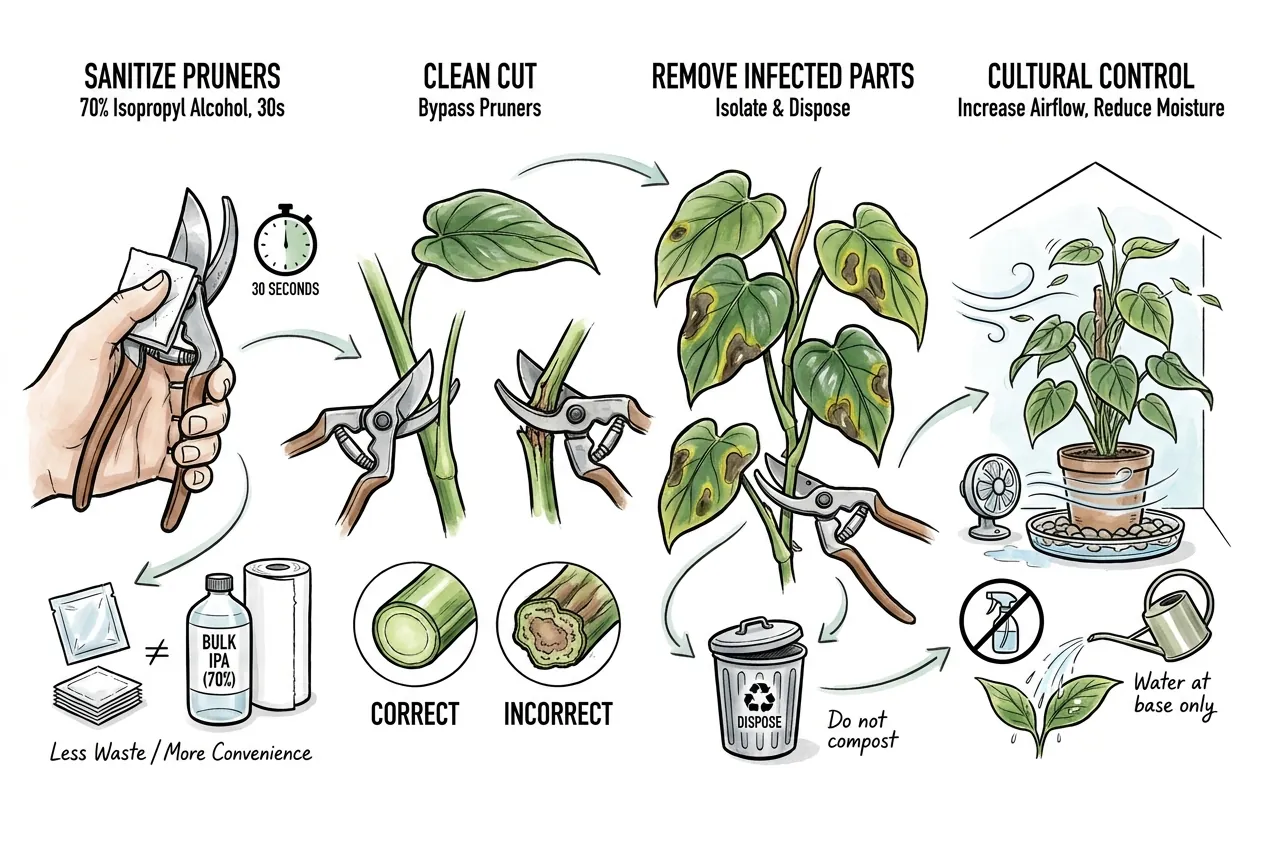
Copper alone is incomplete, and cultural controls are what carry the load. A few habits help deny the bacterium easy openings.
Disinfect Pruners Between Plants
70% isopropyl alcohol is a reasonable option, but wipe off soil and sap first and keep the blade actually wet for the contact time. A quick swipe of a dry-ish pad does not reliably disinfect a dirty blade.
Care Touch Alcohol Wipes are convenient for disinfecting a visibly clean blade between plants. Remove soil and sap first, and do not treat a quick wipe over grime as reliable disinfection.
Care Touch Alcohol Wipes
Wipe visible debris off first, then wipe the blade and keep it wet with alcohol. A single small pad may not hold enough to do that on a soiled blade.
Alcohol is flammable, so keep it away from ignition sources and let the blade dry.
These are individually wrapped, so they create more packaging waste than a refillable bottle. If that matters more to you, a labeled pump bottle of 70% IPA plus paper towels works too (used with ventilation, away from flame, and with proper towel disposal).
Make a Clean Cut
Bypass pruners cut rather than crush, which is generally gentler on tissue than anvil pruners.
Fiskars bypass pruner suits a clean cut through an aroid petiole. Keep it sharp and disinfected. It is not a solution for a spreading disease without isolation and diagnosis.
Fiskars Bypass Pruner
The bypass design (one blade slides past the other) gives a clean cut. For thin philodendron petioles, a smaller clean snip or scissors can work just as well. There is nothing philodendron-specific that makes this the only correct tool.
The blade is coated steel rather than stainless, so dry it after cleaning and store it dry to avoid spotting.
Skip it if you already own a comparable quality pruner.
Remove Infected Leaves
Handle the plant while it is dry and remove visibly infected leaves with disinfected tools. Cut back into clearly healthy tissue. How far depends on the extent of the lesion, so there is no single universal margin.
Bag the removed tissue and discard it in the trash rather than composting it, following any local disposal rules.
Fourth, isolate the plant from its collection-mates and avoid splashing water onto and between leaves.
Bottom watering is one good way to keep foliage dry, though it is not the only option and does not remove every route of spread (shared trays and runoff still need managing).
What about hydrogen peroxide?
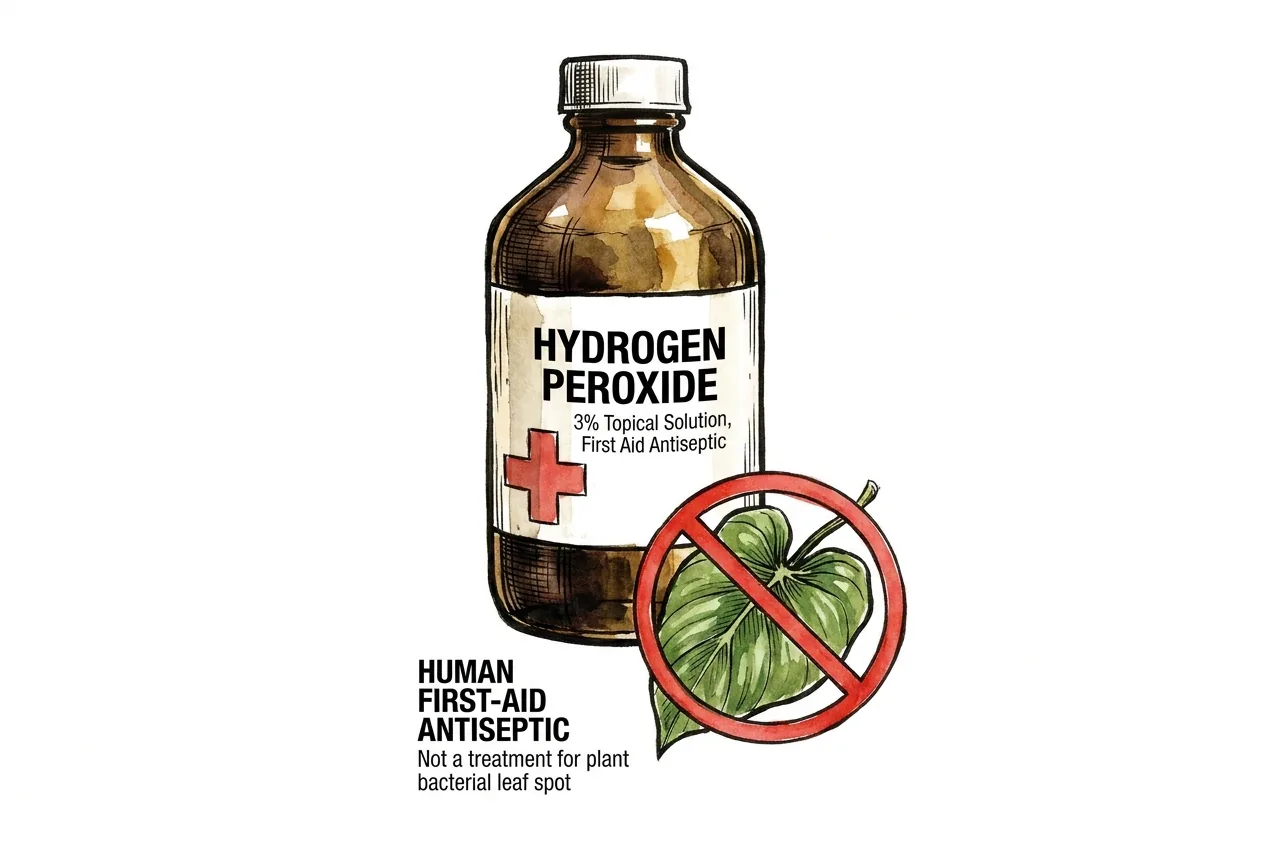
Do not dab household peroxide on lesions or dip cuttings in it to treat this disease. Swan 3% Hydrogen Peroxide is a human first-aid antiseptic, not an EPA-registered plant bactericide or propagation disinfectant. It is not a substitute for isolation, sanitation, or a labeled plant treatment.
Swan 3% Hydrogen Peroxide
A surface treatment cannot reach bacteria that are inside the leaf or living protected on it, so it will not sterilize a lesion or a cutting.
It can also injure living plant tissue. In particular, do not use it to try to clean up cuttings taken from an infected plant. That does not make them safe to propagate (see below).
Food-Grade Peroxide Is Different
High-strength food-grade hydrogen peroxide is a corrosive, hazardous material and is not the same as this 3% topical solution. Do not treat the two as interchangeable.
What about streptomycin?
For a hobbyist dealing with a suspected bacterial spot on philodendron, an antibiotic like streptomycin is not the answer.
Whether it is even legal for a given ornamental use depends on the specific product, crop, and state, so it is not something to reach for casually.
Antibiotic resistance is also a real concern. It can arise through ribosomal mutations such as rpsL or through transferable genes such as strA/strB, then spread through bacterial populations.
For home use, sanitation, dry foliage, splash control, and a labeled copper protectant are the sensible tools, alongside a proper diagnosis and, where warranted, discarding a badly affected plant.
That is not a guarantee copper solves every case. It is the appropriate, lower-risk approach at this scale.
References
How do I prevent the next outbreak?
Prevention works best when several controls are used together. No single one is a guarantee. There is no reliable figure for how much they cut risk, so treat them as sensible, layered practices rather than a quantified insurance policy.
The core practices are simple. Quarantine new arrivals, keep foliage from staying wet for long stretches, keep humidity moderate with good airflow, and disinfect tools between plants.
The right humidity target and drying time depend on your plants and room, so aim for not chronically wet rather than a fixed number.
Why does quarantine matter for new arrivals?
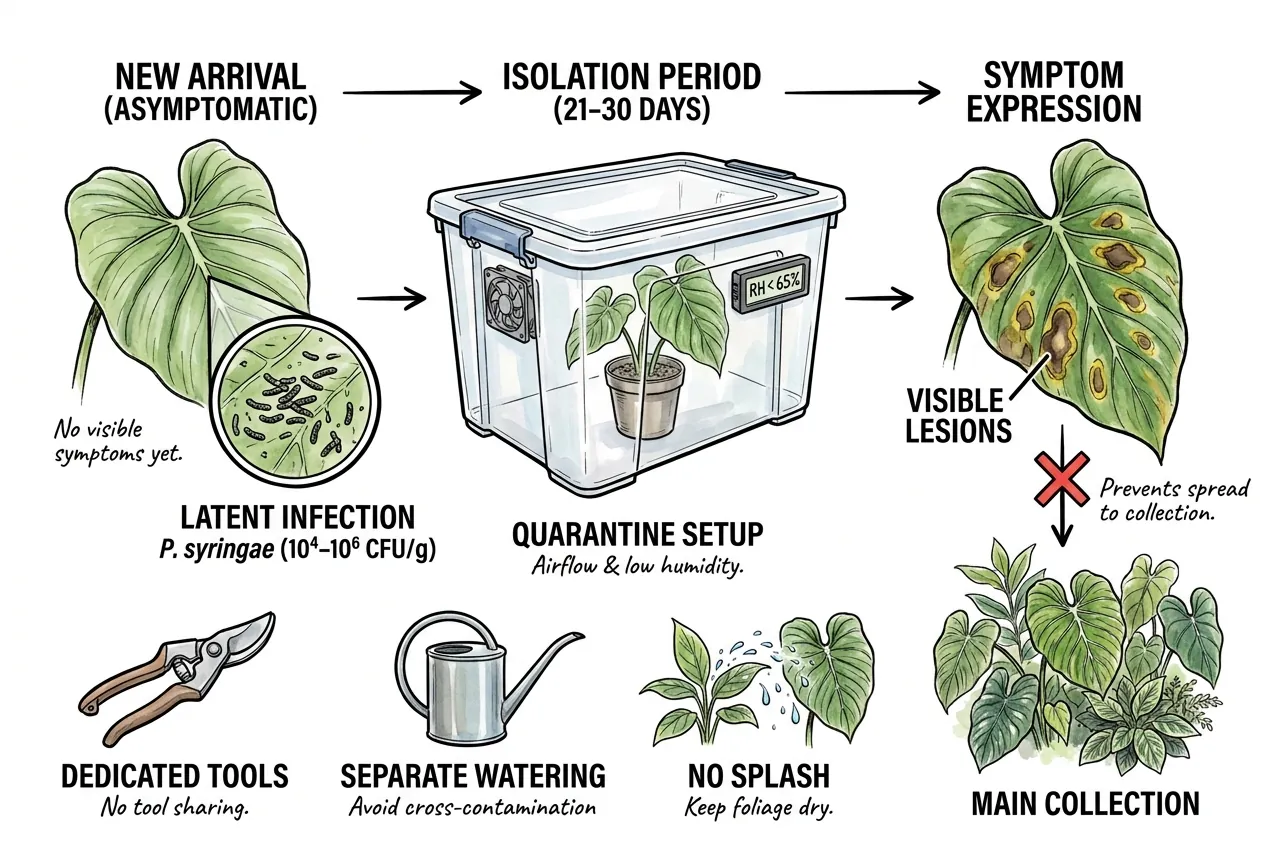
A new philodendron, especially from a humid greenhouse, may carry surface bacteria without showing symptoms, though how much, and whether this pathogen is present at all, varies from plant to plant.
Keeping new arrivals separate for a few weeks, with good airflow and moderate humidity, gives any latent problem a chance to show itself before the plant joins the collection.
Some lesions may appear in that window, but a symptom-free quarantine does not certify the plant is pathogen-free. A colonizer can stay asymptomatic.
Use the period to reduce risk, not to prove cleanliness.
A separate room is ideal. A clear tote can work as a temporary enclosure, but a sealed container plus a fan can trap condensation and recirculate humid air, so manage actual leaf wetness and ventilation rather than assuming the box is protective.
Use dedicated pruners and a separate watering can, and avoid sharing trays or tools with the rest of the collection.
What humidity and airflow setup actually works?
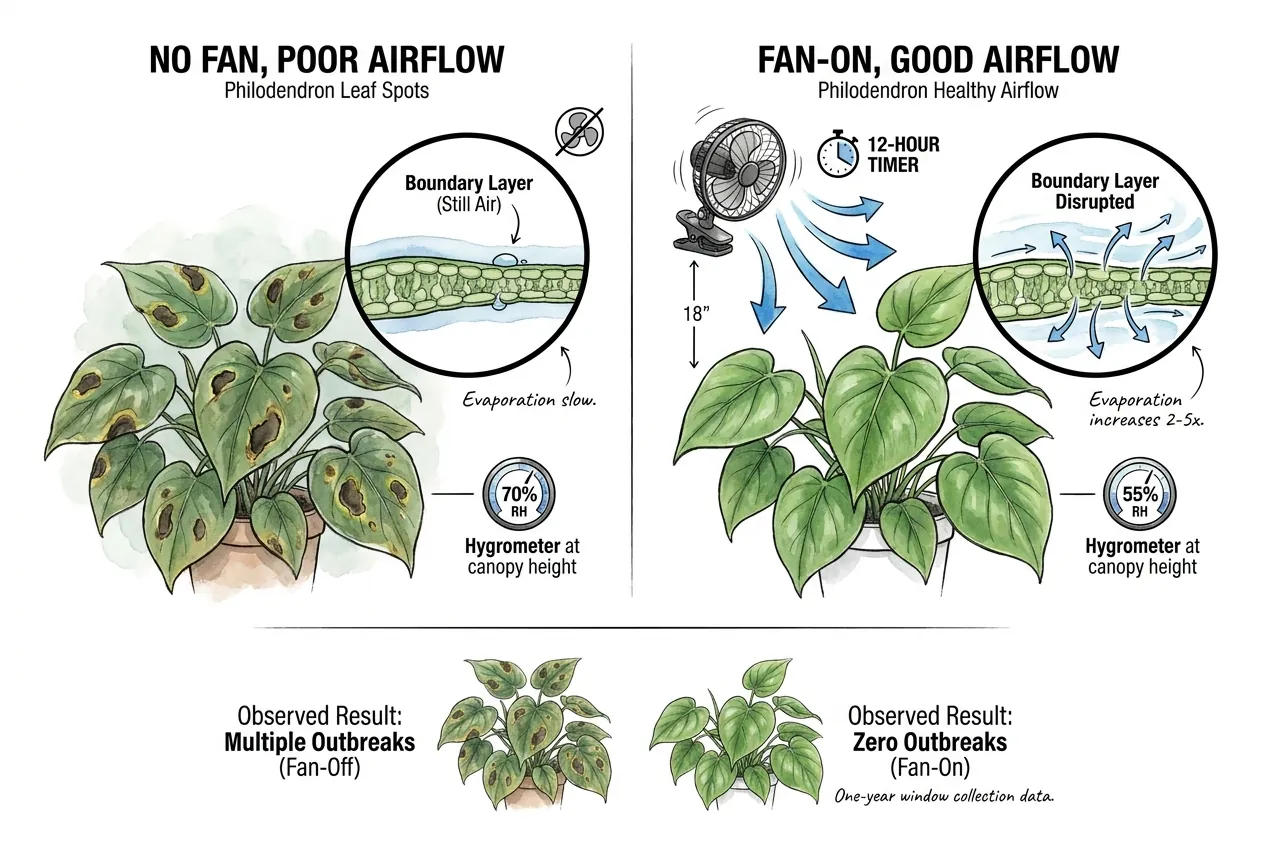
Measuring humidity at canopy height gives a more relevant reading than the middle of the room. Moderate humidity with good air movement is the aim. The exact percentage that suits your plants depends on the cultivars and environment, so there is no one universal target.
A small clip fan can help, aimed to give gentle movement across the canopy rather than a hard blast on one plant.
Run time and distance are things to tune to your fan and plants, not fixed values.
Moving air thins the still boundary layer around each leaf, where evaporation is slowest, so leaves dry faster.
How much faster depends on air speed, humidity, and leaf shape. There is no single multiplier to quote.
In practice, keeping air moving and foliage drying quickly is a reasonable, low-cost habit. Personal experience that a fan eliminated outbreaks is not controlled evidence (without confirmed diagnoses and matched comparisons it cannot be read as proof) but keeping leaves from staying wet is sound regardless.
Why does watering method matter?
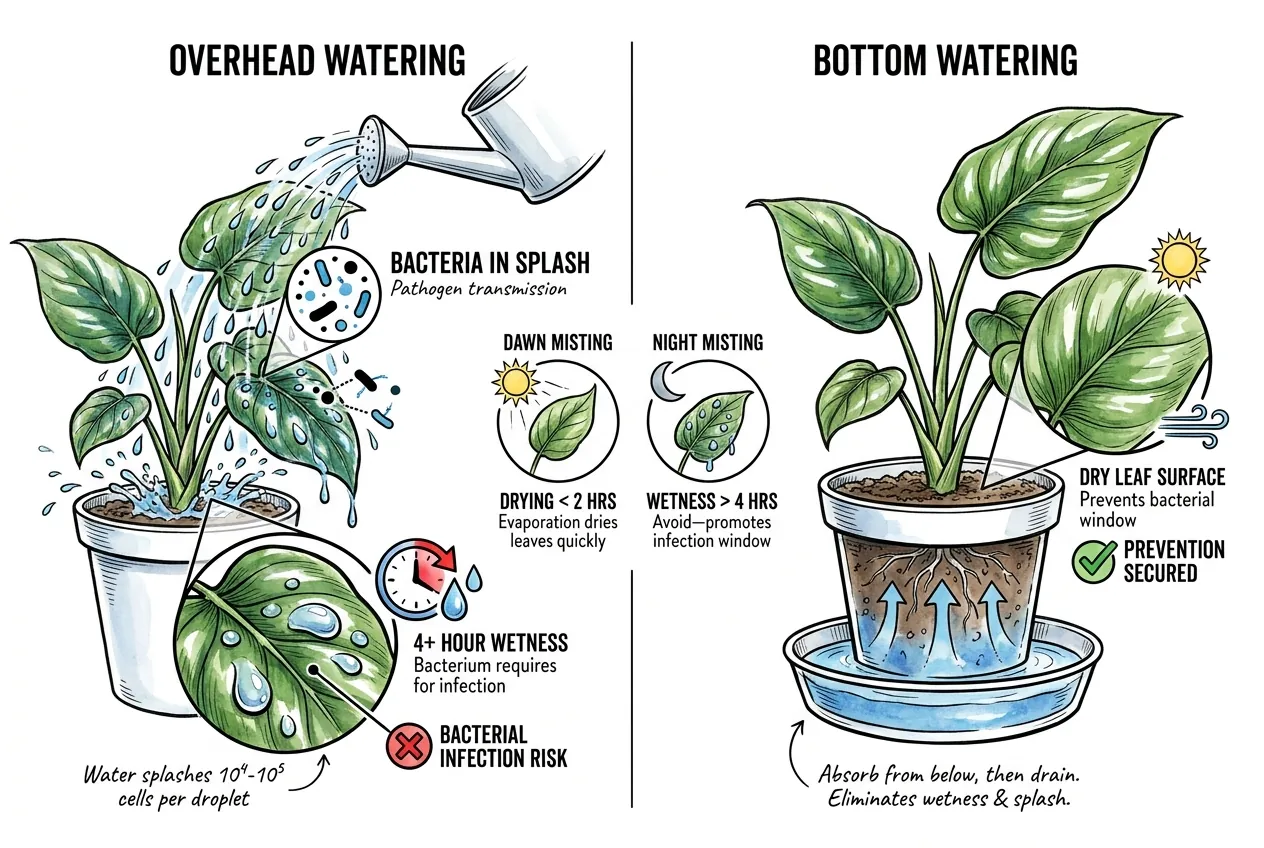
Overhead watering wets the foliage and can splash droplets (and the bacteria they carry) between leaves and plants.
Keeping leaves from staying wet, and avoiding splash, both help.
Watering from below is a good way to do that. Set the pot in a shallow tray of water, let it absorb, then drain.
It reduces leaf wetting and splash, but it does not eliminate every route (shared trays, runoff, and condensation can still move the bacterium) and soaking too long can overwater, so match the time to the pot and mix.
If you do water or mist from above, aim to have leaves dry off reasonably quickly and check that they actually do. In humid, still conditions they may not dry within a couple of hours.
You do not need to mist for humidity, and in a bacterial-spot situation it is better avoided.
Avoid misting at night, when leaves can stay wet for long stretches.
References
When should I cull the plant?
There is no single number that decides this. Weigh the whole picture. How confident the diagnosis is, whether there are systemic signs (collapsing petioles, crown or root involvement), how far it has spread, the plant’s value, the risk to the rest of the collection, and whether it is responding.
Extensive canopy loss is a warning sign, but it is not an automatic death sentence. A philodendron with a healthy crown and roots can regrow after heavy defoliation.
Conversely, you might choose to discard a plant sooner than that to protect a collection.
Collapsing petioles or crown are a serious red flag. They suggest disease that has reached tissue a surface spray cannot help, and they warrant a hard look at whether to keep the plant, and, ideally, a diagnosis, since soft rot and crown or root rots present similarly.
If copper-supported treatment keeps failing, resistance is only one possibility. Misdiagnosis, an off-label rate, poor timing or coverage, or an uncorrected environmental driver (persistent wetness, splash) are often the more likely explanations and are worth ruling out first.
What does successful recovery look like?
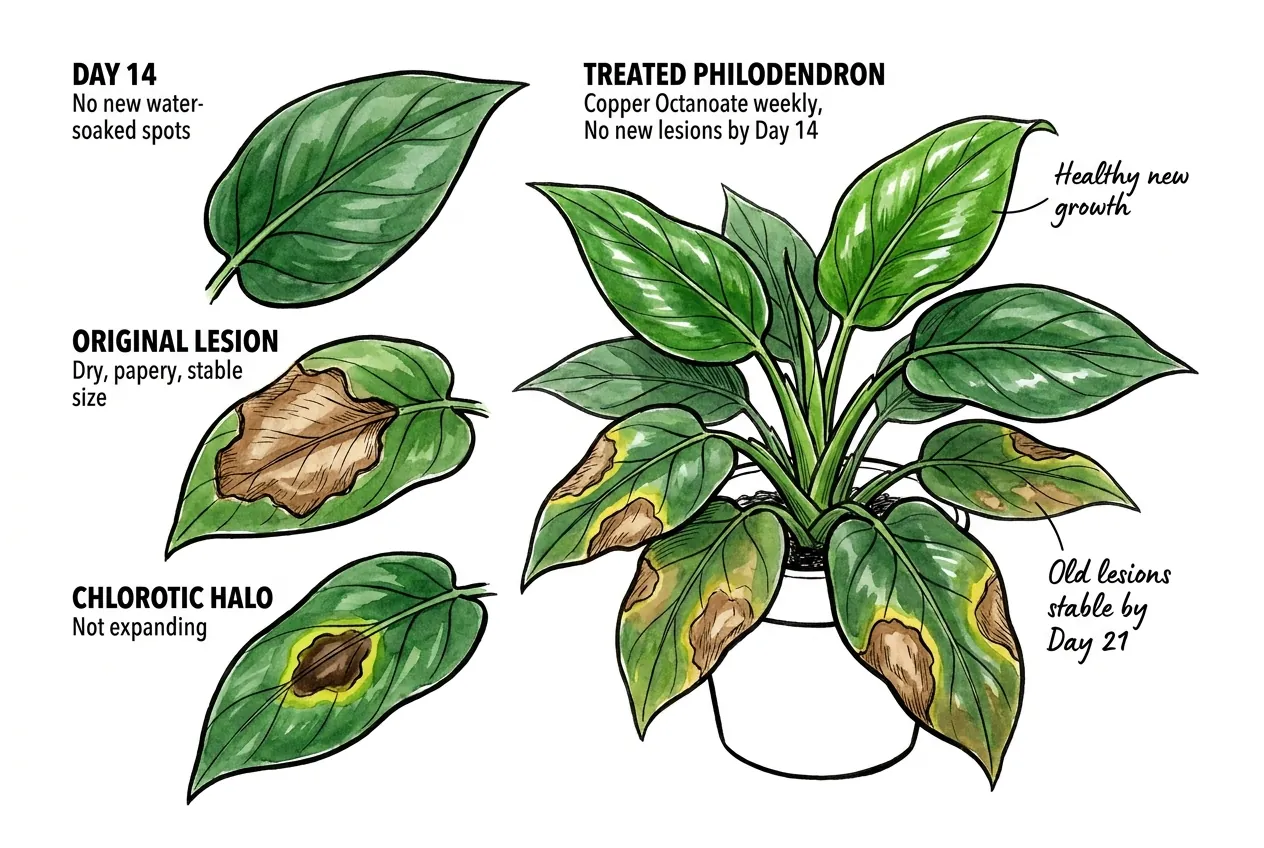
Look for a few encouraging signs, understanding they indicate containment rather than a cure on a fixed timetable.
- No new water-soaked margins appear on any leaf.
- Existing lesions become dry, papery, and stable in size.
- The yellow halo stops expanding into adjacent tissue.
These are good signs that the situation is under control. They are not proof the bacterium is eradicated, and the old lesions will not turn green again. The aim is to stop new damage, not to reverse existing damage.
How quickly you see these signs varies. There is no guaranteed day-14 milestone.
Why does the disease come back six months later?
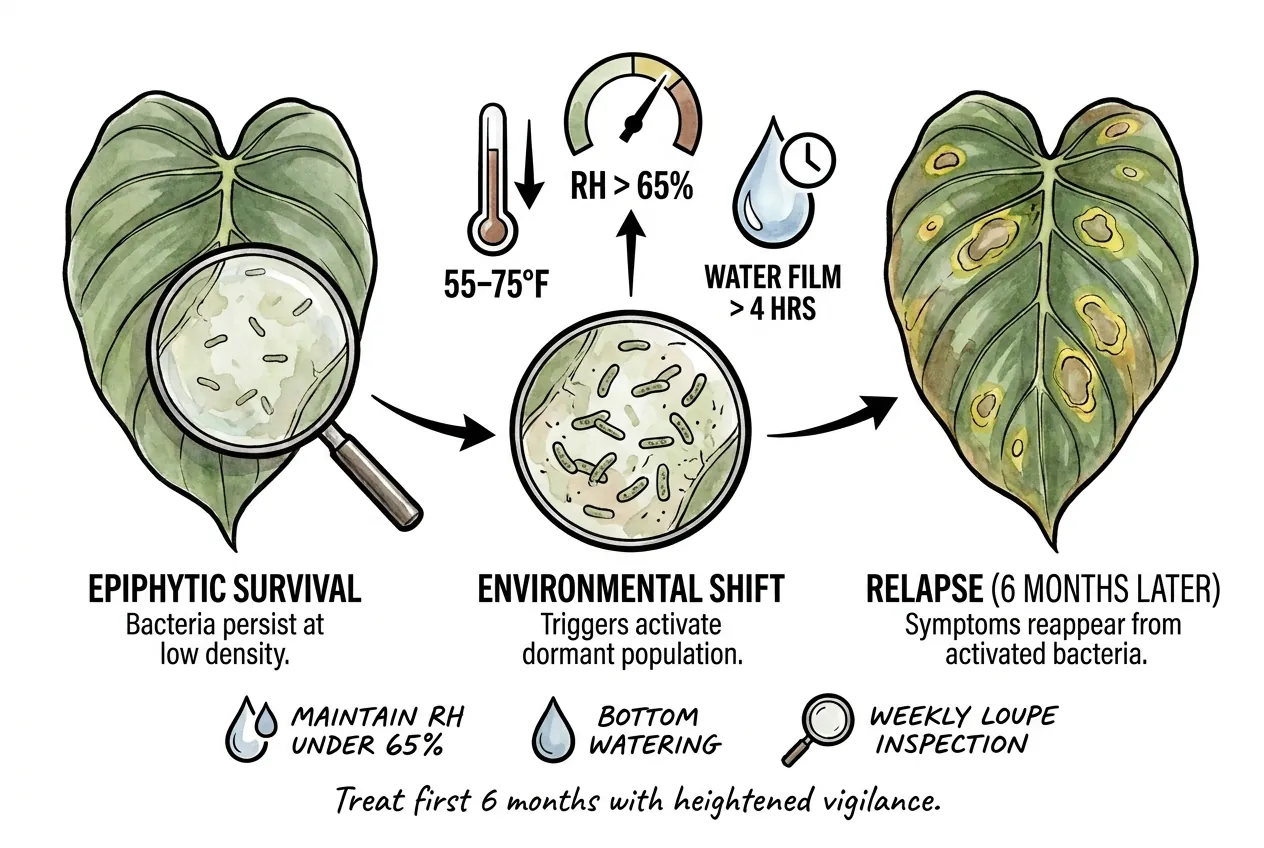
Epiphytic survival is part of the answer. Even after a case looks resolved, P. syringae can persist at low density on symptom-free leaves (possible, though not guaranteed on every treated plant).
Conditions that favor infection, rising humidity, cooler temperatures, and leaves staying wet, can let a surviving population flare up again.
There is no fixed temperature-and-hours switch that predicts this for philodendron.
It is reasonable to stay watchful after an outbreak, keeping up the same controls. Moderate humidity, watering that keeps foliage dry, and regular inspection.
How long to stay especially vigilant depends on the plant and environment rather than a set number of months.
Seasonal swings (a humid spell, or heating cycles that produce condensation) can bring symptoms back, and a recurrence can look much like the first outbreak.
If lesions return, re-examine rather than assume. New pathogens, abiotic injury, or a secondary problem are all worth reconsidering.
Can I propagate from an infected plant?
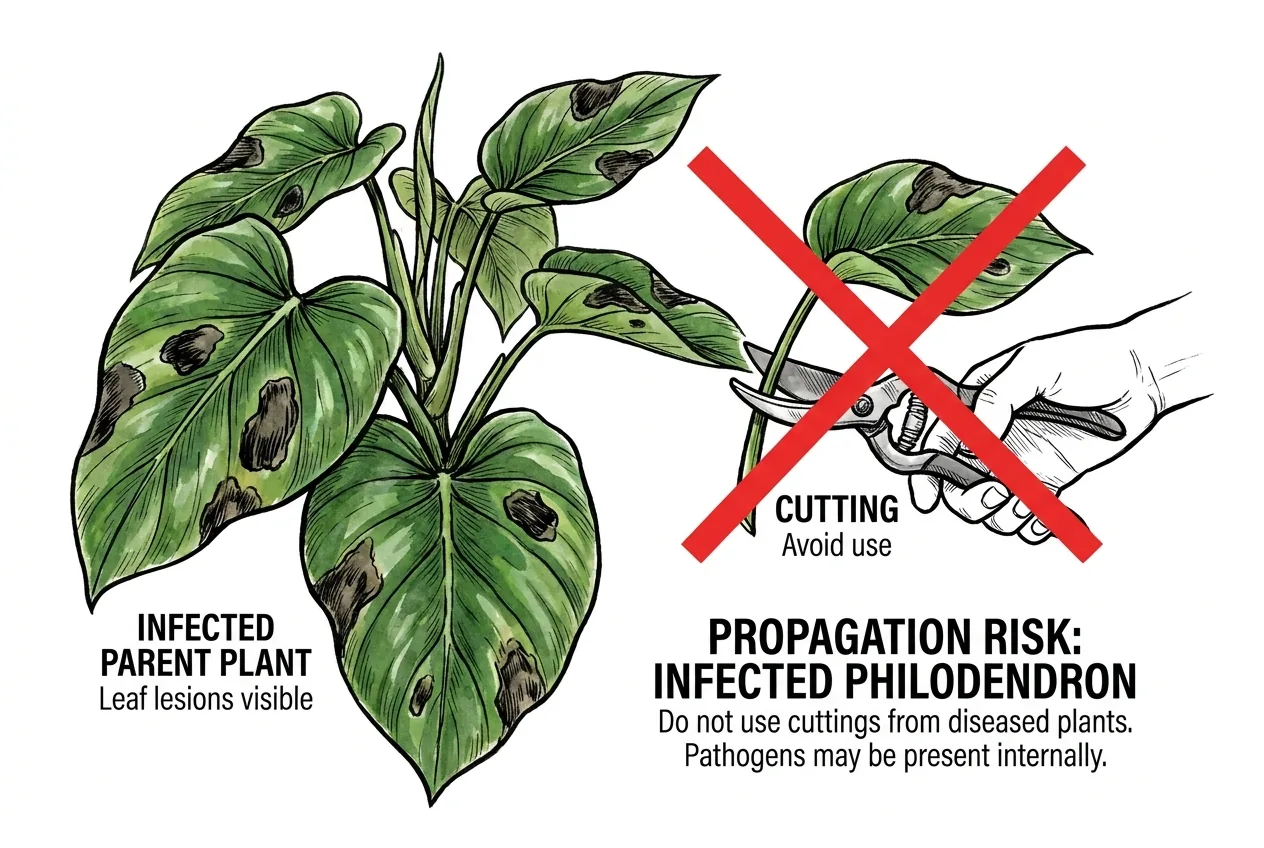
The safe answer is no. Do not propagate from a plant you believe is infected. This is one of the riskier things you can do with bacterial leaf spot, because a cutting that looks clean can still carry the bacterium.
Extension guidance is to propagate only from healthy, symptom-free (and ideally tested) stock. A node that looks fine can still harbor a latent or surface population, and cutting some inches above a visible lesion does not guarantee clean tissue.
Surface treatments do not fix this. A peroxide dip cannot remove bacteria living inside the tissue or protected on the surface, and it can injure the cutting, so it does not make an infected cutting safe to propagate.
Rooting in water will not stop spread or rot either.
If a plant is valuable, the better path is to bring the disease under control first (and confirm the diagnosis with a clinic), and take cuttings only once the plant is genuinely healthy.
If it cannot be saved, propagating from it mainly risks carrying the problem into new plants and, through shared tools and water, into the rest of the collection.
References
-
Bacteria in the Leaf Ecosystem with Emphasis on Pseudomonas syringae A review of epiphytic P. syringae biology, including its ability to survive on symptom-free leaves.
-
Diseases Caused by Pseudomonas syringae (Pacific Northwest Pest Management Handbook) Covers P. syringae diseases across multiple hosts. Not a philodendron-specific management protocol.
-
Leaf spot disease on Philodendron scandens The 2018 Serbian first report that identified P. syringae pv. syringae from heart-leaf philodendron by laboratory testing.
Affiliate Disclosure
This article contains Amazon affiliate links. As an Amazon Associate I earn from qualifying purchases. If you use these links, the site may earn a commission at no extra cost to you. Product availability, price, and specifications can change. Check the current listing before buying.