
Monstera Black Spots: Causes, Diagnosis & Treatment
Diagnose black spots on Monstera by checking lesion growth, pests, roots, watering and leaf wetness. Compare abiotic, fungal, bacterial and root causes.
Priya Patel · Published 2025-12-12 · 11 min read
Key Takeaways
- Black spots are a symptom, not one disease. Abiotic scarring, pests, fungi, bacteria, and root damage can all look similar, and more than one can be present at once, so observe before you treat.
- No single sign is proof on its own. A yellow halo, a water-soaked lesion, or a speck that wipes off can each point in a direction, but any of them can appear with several causes, so weigh them together with the rest of what you see.
- Check the root zone directly rather than by smell alone. Slip the plant out and look at root color, firmness, and whether the outer layer slips off. Waterlogged mix starves roots of oxygen, and that damage can open the way to water-mould infections (Pythium, Phytophthora), which are oomycetes, not true fungi.
- Start with cultural control. Reduce leaf wetness, improve airflow, and correct watering. Reach for a pesticide only after you have confirmed the specific pest or pathogen, and only a product whose label lists your plant and your indoor setting.
- Spreading, water-soaked, or oozing lesions warrant isolating the plant and sending a sample to a local plant clinic. Treat anything you suspect is a bacterial or oomycete disease this way before you commit to drastic action or disposal.
Black spots on a Monstera are rarely a single disease. They’re a symptom that can range from harmless mechanical scarring to root damage and infection.
Working out the cause means telling abiotic stress apart from living pathogens (fungi, bacteria, pests), because the treatments are completely different, and it is common for more than one cause to be present at the same time.
Work through the observations in order and note everything you find. If the signs conflict or lesions are spreading, water-soaked, or oozing, isolate the plant and seek a laboratory diagnosis rather than guessing. More than one factor can be present at once.
How to Observe the Spots
- Record the lesions. Photograph the spots on the front and back of the leaf, note where they sit (margin, tip, interior, along veins), and mark a couple with a dot of paint or a dated note so you can watch over the next few days whether they are growing.
Stable, non-growing marks behave very differently from spreading lesions. - Look for pests. With a hand lens, check both leaf surfaces for live insects and larvae, silvery rasping scars, and dark specks of frass.
Tapping a leaf over white paper or setting a sticky card nearby helps confirm mobile pests. A single wipe-off speck is not enough on its own. - Check the root zone. Review Monstera watering and drainage, feel whether the mix is still wet or muddy days after watering, check for a pot standing in water, then slip the plant out and inspect the roots directly. Healthy roots are firm and pale, while damaged ones turn brown and mushy or slough their outer layer.
A swampy smell raises suspicion of anaerobic decay, but its absence does not rule root problems out. - Review the recent history. Note any cold exposure or drafts, sudden increases in light, and recent fertilizer or water quality, since cold injury, sunscald, edema, and salt buildup can all produce dark or crispy patches that mimic disease.
- Decide when to escalate. If the lesions are water-soaked, greasy, oozing, or spreading quickly, isolate the plant and send a sample to a local plant clinic.
Home observation narrows the field. A clinic’s culturing, microscopy, or molecular testing is what confirms a bacterial or oomycete disease before you make an irreversible decision.
I trace lesion edges on a clear sheet held over the same whole-leaf photo and date each outline. Spots can darken without expanding, which is different from an active margin moving into healthy tissue.
Each spot is marked by whether it touches a leaf edge, vein, drip path, or contact point. Distribution often narrows the possibilities more than the final color.
Before spraying a black spot, I record pot weight, root condition, recent cold or sun exposure, and nearby affected plants. I isolate first when spread is plausible and avoid stacking treatments until the pattern is clearer.
Working Through the Causes
Abiotic Stress
Abiotic spots are not contagious. They reflect a mismatch between the plant’s biology and its environment.
They can overlap with, or sit alongside, pest and pathogen problems, so rule them in rather than assuming they are the only thing going on.
Mechanical injury
A Monstera’s big leaves brush against walls and furniture, rupturing cells. Wounded plant tissue can darken as phenolic compounds oxidize, leaving a stable, dry scar.
Many growers mistake these fixed marks for spreading fungus. Marking a spot and watching it for a few days usually confirms it isn’t growing.
Edema and salt injury
Edema appears when roots absorb water faster than leaves transpire it, bursting cells into corky raised spots, though it doesn’t always show up as a black mark.
Separately, a buildup of soluble salts from fertilizer or irrigation water can scorch leaf tips and margins.
Hard tap water alone isn’t proof of salt injury. If you suspect it, check your fertilizing history and, ideally, measure the water’s EC rather than assuming.
Measure the Environment
A logging hygrometer-thermometer that records temperature and humidity history and lets you review it as a graph is more useful for catching overnight cold or dry dips than a dial gauge that only shows one pinpoint reading. It gives you a way to measure the invisible side of abiotic stress, including nighttime temperature drops or humidity crashes when the heat turns on. Monstera tolerates a wide range of household humidity, so there is no single correct figure. Watch airflow and leaf wetness alongside the numbers, because pushing humidity high while leaves stay wet and air stagnates can favor disease.
Choose a Logging Sensor When a History Graph Helps
A low-cost history graph beside the affected plant earns its place when you can set the sensor at leaf height and mainly want to track trends over time.
Look Further When You Need Remote or Multi-Point Data
If you need to check readings away from home, want data from several canopy locations at once, or expect a device to identify disease, a single local logger falls short. One sensor reads only its own spot, and even an accurate trend cannot explain a lesion without the pest, root, and leaf checks.
Pests and Acute Shock
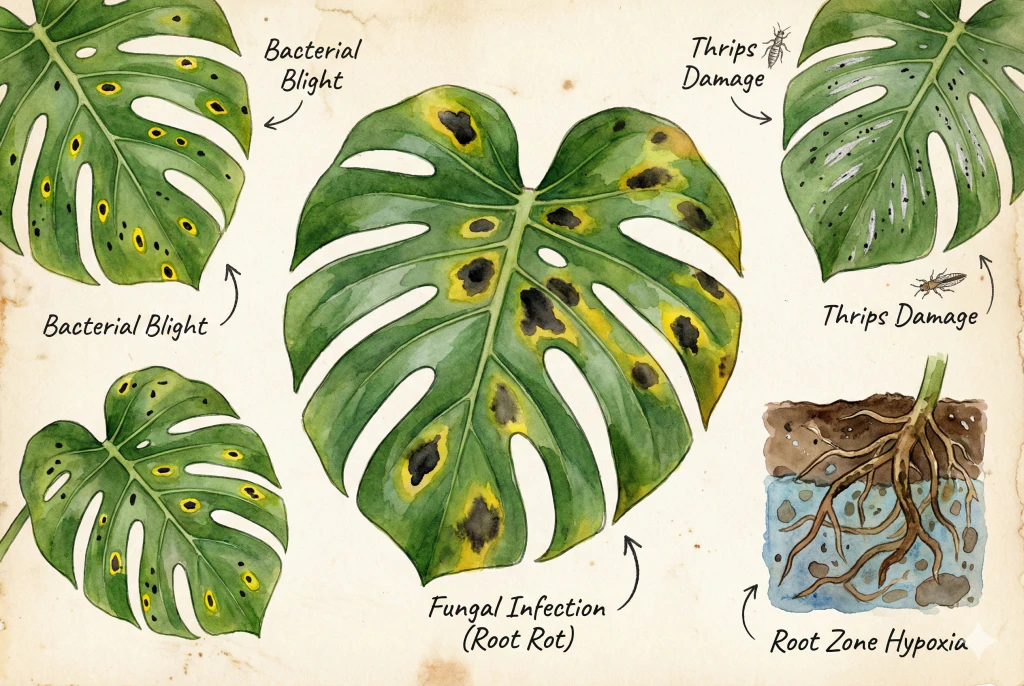
Thrips are a common culprit and easy to mistake for disease. Their tiny black droppings can wipe off, but confirm them from silvery scars and live insects on both leaf surfaces. Once confirmed, the thrips treatment schedule guide explains label-directed timing in warm conditions.
Acute Environmental Shock
Acute shock can also cause dark patches. Tropical foliage can be injured by cold (exposure around 10 °C (50 °F) or below is a reasonable line to watch, though the timing and appearance depend on the plant, how long it was chilled, and leaf conditions) while a sudden jump to intense direct sun can bleach and scorch tissue.
These are leads to check against the plant’s recent history, not a stopwatch. Symptoms don’t follow a fixed schedule.
If you have confirmed thrips, start with mechanical control (rinsing and wiping). Where that isn’t enough, Spinosad (a compound derived from soil-bacterium fermentation) works on contact and translaminarly (absorbed into the leaf surface), though it is not systemic.
Bear in mind that naturally derived does not mean risk-free or automatically cleared for indoor use. That depends entirely on the specific product’s label.
Why Spinosad Is Not an Indoor Default
Spinosad registrations differ by product and formulation. Active-ingredient concentration does not tell you where a product may be used. If the current label limits a concentrate to outdoor residential use, it does not cover an indoor Monstera application.
Use Spinosad Only When the Label Allows It
The current regional label covers the confirmed pest, plant, and outdoor setting and you can follow its dilution, protective-equipment, pollinator, runoff, storage, and application limits.
Do Not Use Spinosad When Conditions Are Unmet
The plant remains indoors, thrips have not been confirmed, or spray could reach drains or aquatic invertebrates. A homemade schedule never overrides the label.
Captain Jack’s DeadBug Brew Concentrate product label
Fungal Leaf Spot
A fungal leaf infection needs a disease triangle made up of a host, a pathogen, and moisture. Anthracnose (Colletotrichum) can produce dark lesions, sometimes with a yellow chlorotic halo or concentric rings, and it spreads in warm, wet conditions via splashing water droplets.
Appearance varies with the pathogen, host, and stage, though. A target ring and halo aren’t universal or unique to anthracnose, and a yellow halo also occurs with bacterial leaf spot and some non-living damage, so it isn’t proof by itself.
Other opportunistic leaf-spot fungi (such as Alternaria and Cercospora) can cause similar spots, but you generally can’t identify the genus from appearance alone, and doing so isn’t needed to choose a first response.
The response is mostly cultural. Reduce leaf wetness, stop misting, improve airflow, isolate the plant, and remove clearly infected leaves with clean disinfected scissors.
The aroid leaf-disease guide provides a broader fungal-versus-bacterial comparison. Copper is not a default next step for Monstera.
Why Copper Is Not a Monstera Default
Liquid copper fungicides are preventative. They protect healthy tissue rather than curing lesions that are already advanced. Formulations and registrations also differ, so use one only when its current label covers the plant, disease, and indoor or outdoor site in question, and observe its phytotoxicity warning and spot-test directions. A product that does not list Monstera is not established as safe or effective for it.
Use Copper Only When the Label Allows It
The current label explicitly covers the plant, disease, and setting and you can follow every rate, interval, spot-test, pH, protective-equipment, and disposal instruction.
Do Not Use Copper When Diagnosis Is Unclear
The plant is Monstera, the pathogen is unconfirmed, lesions are already advanced, or a safer cultural correction has not been tried. Dry foliage and airflow do more for the immediate risk without adding copper injury.
Southern Ag Liquid Copper Fungicide residential label
Anthurium and Aroid Diseases. Identification and Control (UF/IFAS Extension)
Root Damage and Bacterial Leaf Spot
Root-Zone Damage
Two different problems get grouped here, and it helps to keep them apart. The first is root-zone oxygen starvation. Waterlogged mix blocks oxygen from reaching the roots and damages them directly.
That low-oxygen damage is separate from infection by the water moulds Pythium and Phytophthora, which are oomycetes, not true fungi, even though wet, injured roots make such infections more likely.
When roots fail, the plant loses its ability to take up water and nutrients, and that decline (together with any infection that follows) is what shows up in the leaves. There is no established toxin that travels up from rotting roots to make spots.
Diagnose this by looking, not by smell alone. Slip the plant out and check root color, firmness, whether the outer layer sloughs off, and the state of the crown.
A swampy odor points toward anaerobic decay, but a healthy-smelling pot doesn’t clear root problems, and odor alone can’t name a pathogen.
For early, non-infectious overwatering damage, trimming away soft roots and repotting into fresh, airy aroid mix can help.
This isn’t a universal cure, though. With a severe or spreading oomycete infection, disposing of the plant and disinfecting the pot and tools may be the sounder choice than trying to save it, and a plant clinic can confirm what you’re dealing with before you decide.
Bacterial leaf spot
Bacterial leaf spot can cause greasy, water-soaked, fast-spreading dark spots. On Monstera it has been described with dark brown spots, yellow margins, and sticky ooze, and more than one pathogen is involved across aroids (for example Pseudomonas as well as soft-rot bacteria such as Pectobacterium/Erwinia), so don’t assume a single cause from appearance.
The home water-glass streaming check, suspending cut tissue and watching for milky strands, is a hint, not a confirmation. Reliable streaming needs a fresh lesion margin, clean or distilled water, and ideally a microscope, since decaying tissue can give false positives and a low pathogen load can give false negatives.
Because this is a leaf disease, cutting roots doesn’t treat it. Isolate the plant, remove affected tissue carefully, keep foliage dry, disinfect tools between cuts, consider disposal in severe cases, and send a sample to a plant clinic for culturing or molecular testing before any irreversible action.
Pythium (Penn State Extension)
Match the response to the cause
Before reaching for a spray, check leaf texture, pests, roots, watering, drainage, and airflow. A spray cannot correct a non-pest problem.
For serious or unclear spots, isolate the plant and seek a diagnosis. When yellowing is dominant rather than discrete lesions, use the Monstera yellow-leaves checklist.