
Anthurium Low Light Care: A Practical Guide to Shade
How to keep an Anthurium alive in low light: the science of shade tolerance, demand-based watering, aroid substrate, choosing a species for shade, and grow-light supplementation.
Priya Patel · Published 2025-12-12 · 15 min read
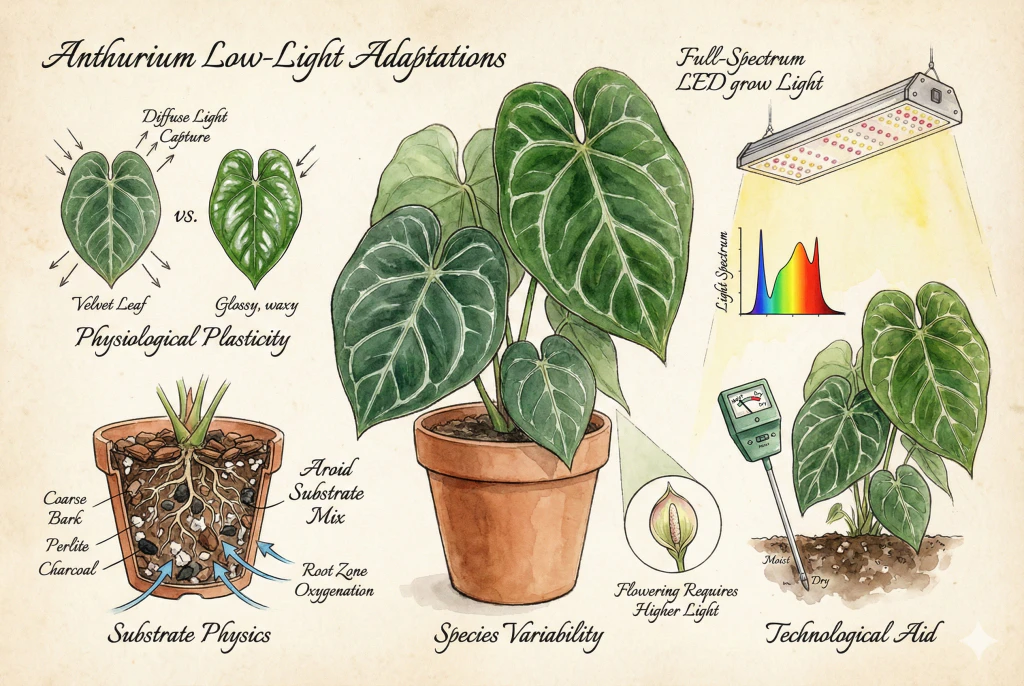
Key Takeaways
- Anthuriums are shade-tolerant, not shade-loving. A leaf can photosynthesize at low light, but that leaf-level measurement is not a whole-plant survival line, and steady flowering generally needs more light than a dim room provides.
- Low light lowers transpiration, so water by the root-zone condition rather than the calendar. Check pot weight and moisture at several depths, then water when the mix has dried enough to restore air around the roots.
- Use a chunky, high-porosity aroid mix to keep roots oxygenated. Dense, water-retentive potting mixes stay wet longer when the plant drinks slowly and raise the risk of root rot.
- Species choice matters in a dim room. Velvet foliage types are often reported to hold up better in shade than glossy flowering hybrids, but that is a common observation rather than a controlled comparison.
- Feed lightly and measure supplemental light at the leaves. Use dilute fertilizer less often, leach only when salts build up, and remember that light intensity falls sharply as a fixture moves farther away.
Anthuriums are shade-tolerant, not shade-loving. Many species grow in the rainforest understory and mid-canopy and can hold on at low light, but there’s a wide gap between surviving and thriving, and an even wider one before they’ll flower. Low light changes how Anthuriums use water and nutrients, so successful care depends on restoring enough energy for growth rather than merely keeping the plant alive.
1. The Evolutionary Ecology of Anthurium
Anthurium is the largest genus in the Araceae (recent biogeographic datasets treat it as having on the order of 1,000+ species) radiated across the Neotropics.
Many species occupy the rainforest understory and mid-canopy, where light on the forest floor can fall to a small fraction of full sun, broken by brief sunflecks and diffuse, far-red-enriched light. The exact levels vary widely by canopy and site.
Shade-adapted leaves tend toward a low Light Compensation Point (LCP) (the instantaneous intensity at which a given leaf’s photosynthesis just balances its respiration).
That leaf-level point is measured under specific conditions. It isn’t the same as a 24-hour, whole-plant carbon balance, which also depends on day length (daily light integral), root and stem respiration, and stored reserves.
But tolerance isn’t preference. It means they endure dim light, not that they prefer darkness.
Roughly two-thirds of Anthurium species are epiphytes or hemiepiphytes, rooting on tree bark rather than in soil, though many terrestrial species exist too.
Epiphytic roots are adapted to rapid water absorption during rain and to a well-aerated root zone, so those species are sensitive to hypoxia when potted in a mix that stays saturated.
Bringing an epiphyte from a well-ventilated branch to a dense pot in a dim room is a large ecological shift the grower offsets with substrate and watering choices. A terrestrial or nursery hybrid may need less adjustment.
And note the difference between a rainforest understory (where total light can be very low but arrives as sunflecks and diffuse light spread across a long day) and the artificial darkness of a hallway corner, which differs mainly in intensity, duration, and daily light integral.
I write the emergence and hardening dates of each new leaf beside its final size and leaf-level light reading, including the unit used. A plant can keep old leaves green in low light while producing progressively smaller leaves at longer intervals.
That trend signals declining performance to me before visible yellowing appears. When light increases, I judge the change from the next complete leaf rather than expecting old leaves to become larger.
2. The Physics and Physiology of Light
A light meter can tell you how much usable light reaches the leaf, but a single foot-candle-to-PPFD conversion does not work for every bulb or window. Use measurements as a guide and confirm them with the plant’s growth.
Anthuriums can tolerate lower light than many houseplants, but tolerance is not the same as long-term health. If new leaves shrink, petioles stretch, or growth stalls, move the plant closer to a window or add supplemental light instead of accepting a dim corner as adequate.
Distance Changes Light Quickly
For an idealized point source, moving a lamp from 1 foot to 2 feet does not halve the light, it reduces it to about one quarter, and 3 feet reduces it to about one ninth.
Real bulbs have lenses, reflectors, and a beam angle, and rooms add wall reflection and ambient light, so the actual falloff is gentler and less predictable than those simple fractions suggest.
Use the fractions as intuition, then measure the light at leaf level rather than calculating from distance alone.
Measure the Plant’s Actual Light
An Anthurium on a coffee table in the middle of a room, even with a window nearby, is often getting far less light than it looks.
If in doubt, measure the PPFD at the plant, or at least note that a spot several feet from the window can be a fraction of the light right at the glass.
Photosynthetic Responses of Anthurium × ‘Red’ under Different Light Conditions
3. Metabolic Responses to Shade
How Shade Changes Leaf Colour
Low Light Can Deepen Leaf Colour
In low light, shade-acclimated Anthurium leaves often increase chlorophyll content to catch more of the available light, and can appear a deeper, darker green.
The Anthurium × Red study above documented a total-chlorophyll change in that hybrid. How strongly this shows up varies by species and leaf age, so read the darker-green cue as a general tendency rather than a rule that holds equally across velvet and glossy types.
Low Light Can Cause Stretching
If light drops well below what the plant can maintain, it may etiolate. Stems and petioles elongate, producing leggy growth with blades that look small for their long petioles (a light-foraging response that, against the fixed ceiling of indoor light, tends to yield a weak, floppy plant).
The exact form (larger thinner leaves, longer petioles) varies by species and age.
Flowering Needs More Energy
Flowering is usually the first thing to suffer, because it’s energy-intensive. In low light many plants abort developing buds (they brown and drop) and stop producing new blooms.
Spathe color also depends on the cultivar’s own pigment genetics, so a muddy or green spathe can be a sign of low light in some plants but a normal trait in others. Don’t rely on spathe color alone to diagnose light levels.
Flowering Targets Vary by Cultivar
How much light Anthurium andraeanum needs to re-bloom is cultivar- and condition-dependent. Production and robust-growth targets often cited fall in the low-hundreds of µmol/m²/s, but that is not a proven universal minimum (see the flowering discussion below).
4. The Hydrology of Low-Light Environments
How Light Changes Water Demand
One of the most overlooked parts of low-light Anthurium care is that water needs change, because light and water are linked through transpiration.
Light drives stomata to open for carbon-dioxide uptake. Broadly, more light means more water pulled from the roots, and in low light photosynthesis slows and transpiration tends to drop. Temperature, humidity, vapor-pressure deficit, and airflow also matter.
Why Wet Feet Become a Risk
If you keep watering as often as you would during bright, active growth, the mix can stay saturated, water displaces air in the pore spaces, and the aeration-adapted roots go short of oxygen.
A saturated, low-oxygen root zone stresses roots and creates conditions that favor water molds such as Pythium and Phytophthora and fungi such as Rhizoctonia, which can rot roots black and mushy.
Water on demand rather than on the calendar. A fixed interval or fixed percentage dry-down rule cannot account for species, pot size, root mass, substrate, temperature, and airflow, so judge the root zone directly. Lift the pot to feel its weight, check the mix at several depths, and water when it has genuinely dried down, allowing air back into the root zone before the next watering.
Extension guidance for indoor Anthurium is simply to let the mix dry slightly between waterings and adjust frequency to your conditions.
Read Moisture Meters as Cross-Checks
Because the surface can read dry while the root zone stays wet, an inexpensive moisture meter can be a useful cross-check. Treat its reading as one input alongside pot weight and feel, not a single go/no-go rule.
XLUX Plant Soil Moisture Meter
XLUX Plant Soil Moisture Meter is a useful cross-check when pot weight and feel do not reveal whether the center is still wet. It does not give a calibrated moisture percentage and can misread a very coarse mix, so check several depths and never let one reading overrule the condition of the roots and pot. Wipe the probe after use and avoid repeatedly pushing it through the root ball.
5. Soil Physics and Substrates
With transpiration slowed, the substrate does a lot of the work of keeping the root zone aerated.
A dense, water-retentive potting mix (one that stays wet because it relies on the plant to pull water out quickly) raises the risk of root rot in low light.
This depends on the specific mix, particle size, pot height, and how you water. The point isn’t that any bagged soil is doomed, but that in dim conditions you want a mix that drains and re-admits air readily.
What an Epiphytic Mix Needs
For epiphytic and hemiepiphytic species, roots in the wild often sit in loose baskets of decaying leaves and bark. An indoor mix should therefore stay porous, air-filled, and coarse.
The indoor analog is an aroid mix built with plenty of macropores. Orchid or pine bark provides structure and air gaps, perlite or pumice resists compaction, and a smaller fraction of coco coir or peat provides water retention. Some retention is still needed, and UF/IFAS aroid mixes include a substantial peat share.
Horticultural charcoal is a common addition, though its effect on pH, salts, air space, and water retention varies with the source and particle size, so it is not a guaranteed anti-rot ingredient.
Check a Bagged Mix in Your Own Pot
A pre-formulated chunky mix is a convenient starting point. Even so, check how much water it actually holds for your pot and watering habits rather than assuming the ratios are ideal.
Perfect Plants Aroid Mix
Perfect Plants aroid mix is a convenient starting point when you want a ready-made aroid mix. It holds more moisture than a purely chunky blend, so it suits a grower who checks dry-down closely. Add coarser material or choose another mix if it stays wet too long in your dim, low-transpiration conditions.
6. Species-Specific Shade Tolerance
The genus isn’t monolithic, and species choice is one of the bigger levers for a dim home (alongside measuring your actual light and supplementing it where needed).
Anthurium andraeanum
The glossy flamingo flower from garden centers is grown commercially at high light, with production guidance in the low thousands of foot-candles, and tends to flower poorly indoors. It will usually survive as foliage but bloom weakly.
UF/IFAS reports several potted Anthurium cultivars flowering continuously at as little as 100 foot-candles indoors, so low light is not an absolute bar to all blooming. Results depend on cultivar and conditions.
Anthurium scherzerianum
Pigtail anthurium is often described as more forgiving, but I’m not aware of a controlled comparison ranking these species against each other.
Velvet-leaved foliage Anthuriums
These are popular foliage choices that many growers find more forgiving than flowering types in a dim home. Choose by the plant’s growth response and the actual light available, not an unproven theory about velvet leaf cells.
Anthurium clarinervium
Velvet cardboard is commonly grown as a shade-tolerant foliage plant. Its documented natural habitat is limestone outcrops in Chiapas, Mexico.
Anthurium warocqueanum
The queen anthurium is a Colombian wet-tropical epiphyte that per Kew/RHS wants bright indirect light and high humidity, so it often stalls in dim, dry rooms.
Anthurium crystallinum
This is a frequent choice for standard homes. Its dark leaves are attractive, but their color alone does not prove that the plant has enough light.
7. Nutritional Management
Why Nutrient Demand Falls in Low Light
Low light generally lowers nutrient demand. With slower photosynthesis the plant builds fewer carbon skeletons to pair with nitrogen, so it uses less N, P, and K. (There isn’t a precise Anthurium figure for how much, so treat this as a direction, not a percentage.)
Salts Build Faster in Dim Conditions
Fertilizing at full active-growth rates in dim conditions can let unused salts accumulate in the mix.
A high salt concentration in the root zone lowers the water potential the roots pull against and can cause fertilizer burn (brown, crispy leaf margins and tips) often misread as low humidity.
Whether that happens depends on the dose, the fertilizer, and your water’s own mineral content, so it isn’t inevitable.
Use a Measured Feeding Baseline
Feed lightly and let growth guide you rather than a fixed calendar. UF/IFAS suggests something like 20-20-20 at about 50 ppm nitrogen roughly monthly for interior Anthurium, checking the medium’s salinity or EC periodically.
In lower light you can lean toward the lighter end of that. If salts build up, shown by a white crust or a persistent EC rise, leach the pot with plain water and let it drain fully as a corrective when buildup appears, not necessarily every month.
8. Pathology and Physiological Disorders
Contain Suspected Root Rot
Root rot is a common killer of overwatered Anthuriums. Water molds (Pythium, Phytophthora) and the fungus Rhizoctonia can each produce yellowing lower leaves, wilting despite wet soil, and dark, mushy roots whose outer cortex sloughs off, though the pathogens don’t all look identical (Rhizoctonia, for instance, can girdle young stems).
The same symptoms can also come from non-living causes like abiotic root injury, so wet-soil wilt and dark roots point to a problem without confirming which one.
Respond to Suspected Root Rot
Because you often cannot tell the exact cause by eye, treat containment first. For a suspected root rot, isolate the plant from other aroids, and decide between disposal and salvage rather than reflexively repotting. Commercial UF/IFAS guidance is to discard plants with symptomatic Pythium or Phytophthora and sanitize the area.
If you do attempt to save a valued home specimen, use sterilized tools, unpot and inspect for firm healthy tissue, cut away rotted roots, discard the old medium and ideally the container, repot into fresh airy mix, and be ready to give up if healthy tissue is gone.
A low-oxygen, saturated root zone does not draw pathogens in. It weakens the roots and creates conditions those organisms exploit.
Isolate Suspected Bacterial Blight
Bacterial blight caused by Xanthomonas produces V-shaped yellow lesions that spread in from the leaf margin, and low light can make it worse because water lingers longer on foliage.
This one is serious. Infections can sit symptomless for months and spread through guttation, tools, water, and neighboring aroids, so removing a few visibly infected leaves is not enough.
UF/IFAS advises discarding an infected plant, isolating suspect plants, avoiding overhead watering, and strict sanitation of tools, containers, and water.
There is no systemic cure that clears the bacterium from a plant, though copper, mancozeb, or Bacillus-based products can help suppress spread in a collection. Manage the outbreak and get a diagnosis rather than assuming a single infected leaf can be trimmed away.
Read Yellow Leaves as Patterns
When leaves yellow, note that the cause isn’t always either simple senescence or light starvation.
The oldest leaf yellowing while the plant reclaims nutrients can be normal turnover. Widespread yellowing can come from overwatering or too little light, but also from nutrition, pH/EC problems, cold, root injury, or pests, so use the pattern as a clue, not a definitive diagnosis.
Anthurium and Aroid Diseases. Identification and Control (UF/IFAS Extension)
9. Technological Solutions (Lighting)
Why Supplemental Light Helps
For robust growth, or to try to flower Anthurium andraeanum in a dark room, supplemental light is often what makes the difference.
Full-spectrum white LEDs deliver useful PPFD at relatively low radiant heat, which helps because Anthuriums can scorch, and many growers now prefer them to older red-and-blue lamps.
LEDs still run warm at the fixture, though, so give any bulb room to shed heat rather than assuming it is heat-free.
Start With Leaf-Level Targets
As a starting target for stronger growth and a better shot at flowering, many growers aim for roughly the low hundreds of µmol/m²/s at the leaf, on the order of 10–12 hours a day, with the fixture perhaps 12–24 inches from the canopy.
Treat those as starting points, not guarantees. What a given cultivar needs to bloom varies, and the daily light integral (intensity × hours) and even coverage across the plant matter as much as a single number, so measure the PPFD at the leaves and adjust.
Measure Supplementary Light at the Leaves
SANSI 36W Grow Light
SANSI 36W Grow Light suits one or two plants when an open, stable fixture can cover their leaves. It will not guarantee flowering or evenly light a large collection. Start farther from the canopy, increase gradually, and leave room for the bulb to shed heat rather than enclosing it.
10. Conclusion
Growing Anthurium in low light means balancing the plant’s shade tolerance against its metabolic needs.
It’s more than watering less. Lean toward foliage species many growers find forgiving in shade (such as A. clarinervium) rather than flowering hybrids if blooms aren’t your goal. Use a high-porosity aroid mix so roots stay oxygenated when transpiration is slow. Water by checking the actual root zone (pot weight and feel) rather than by the calendar. Feed lightly and watch for salt buildup, and add supplemental light, measured at the leaf, if you want more than survival.
Understand a shade-adapted plant’s constraints and meet them, and these plants can be long-lived, attractive fixtures indoors (provided they get enough total light each day, whether from a window or a lamp).
Affiliate Disclosure
This article contains Amazon affiliate links. As an Amazon Associate I earn from qualifying purchases. If you use these links, the site may earn a commission at no extra cost to you. Product availability, price, and specifications can change. Check the current listing before buying.