
Anthurium Luxurians Hybrids: Care, Types & Genetics
A practical guide to Anthurium luxurians hybrids: what is known (and what is only hypothesized) about the bullate texture and dark color, how radicans, crystallinum, magnificum and papillilaminum crosses tend to differ, and sensible notes on mix, light, humidity, and feeding.
Jordan Cole · Published 2026-01-23 · 23 min read
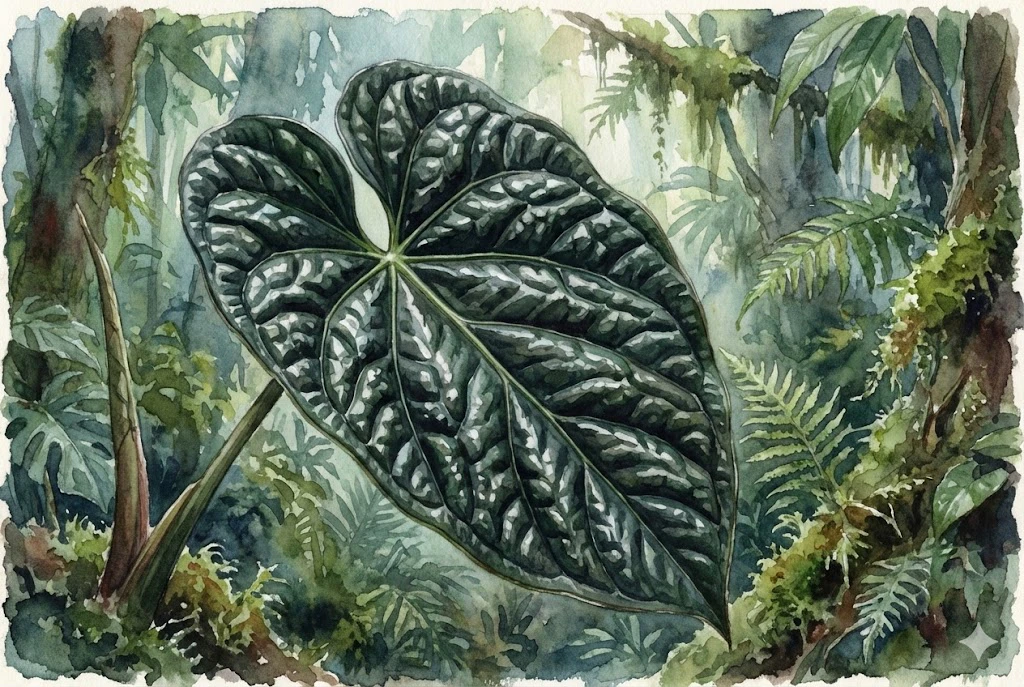
Key Takeaways
- Bullate texture may scatter light or shed water, but those functions are hypotheses rather than measurements on A. luxurians. In cultivation the deep pockets can hold water in still air, so airflow matters.
- New leaves emerge chocolate to garnet and darken as they mature. The pigment chemistry has not been directly assayed here, so provide enough light for compact, coloured leaves without scorching unacclimated foliage.
- Growth habit is a useful guide to pot choice. Radicans crosses tend to creep, while magnificum and crystallinum crosses are usually more upright, but seed-grown siblings vary.
- Luxurians is terrestrial with thick, fleshy roots that need air. A chunky, free-draining aroid mix can help, while exact proportions depend on particle sizes and pot geometry.
- Feed these slow-growing plants modestly. A well-diluted balanced fertilizer is a safe default, and Cal-Mag belongs only after checking source water and base fertilizer.
Introduction
Foliage-first houseplants have become popular in recent years, and the genus Anthurium has been part of that interest.
Anthurium luxurians is one of the textured, dark-leaved species that collectors and breeders have gravitated toward.
It is native to Colombia and, for a long time, was little known outside a small circle of growers before it became more widely available in the plant trade.
I photograph each leaf only after it hardens and label it by node, because a soft expanding leaf can look smoother or brighter than its mature texture. Comparing different stages can create a false story about hybrid traits.
The seller’s exact parent notation stays separate from my observations. Leaf texture and sinus shape may support an identification discussion, but I never let appearance silently turn an uncertain trade name into verified parentage.
The Progenitor (Anthurium luxurians)
To understand the hybrids, it helps to start with the parent species.
Anthurium luxurians is a Colombian species with distinctive textured, dark foliage. Much of what is written about its precise natural habitat is inferred rather than documented, so it is worth separating what is established from what is plausible interpretation.
Taxonomy and Discovery
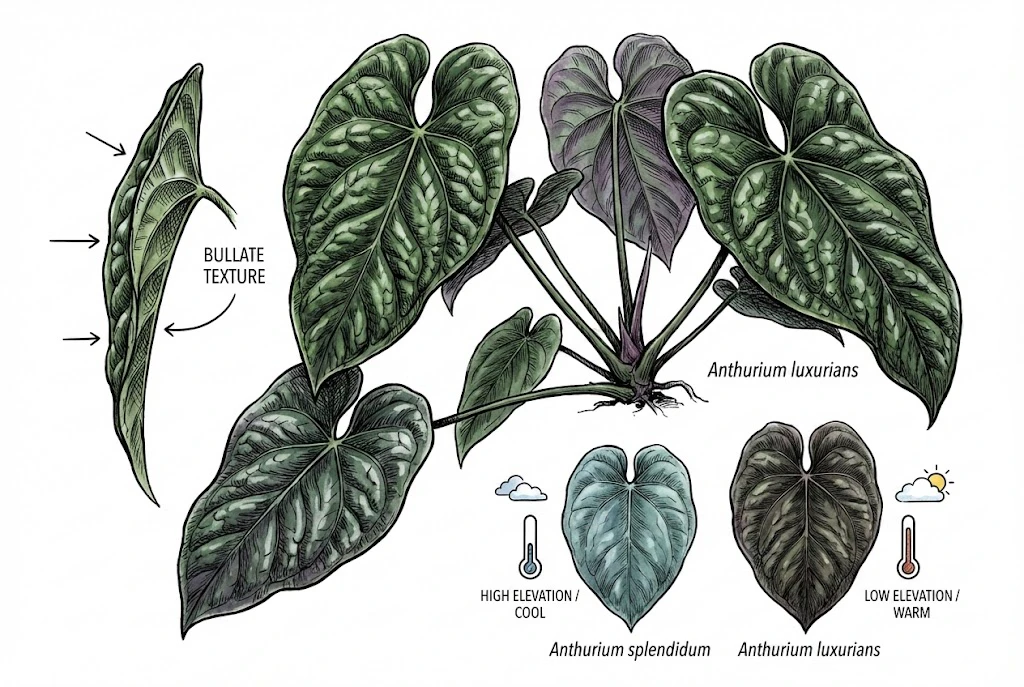
Anthurium luxurians was formally described relatively recently in botanical terms.
It was described by Dr. Thomas B. Croat and Raul N. Cirino in 2005 in the journal Aroideana.
Before that description, cultivated material circulated among growers, sometimes under other names or confused with similar bullate species such as Anthurium splendidum.
The type material itself traces to cultivated plants, and the original collection locality is not recorded.
The two species are easy to confuse because both have the bullate, blistered leaf texture.
A. splendidum is associated with cool, high-humidity cloud-forest conditions that are difficult to reproduce indoors.
A. luxurians is generally reported to tolerate warmer conditions in cultivation. Because its exact wild elevation is unknown, this is best treated as a cultivation observation rather than a confirmed contrast in native elevation.
The epithet luxurians is Latin for luxuriant or richly growing, which readers often connect to the plant’s dense, opulent-looking foliage.
The describing authors did not state a specific reason for the choice.
Geographic Distribution and Ecological Niche
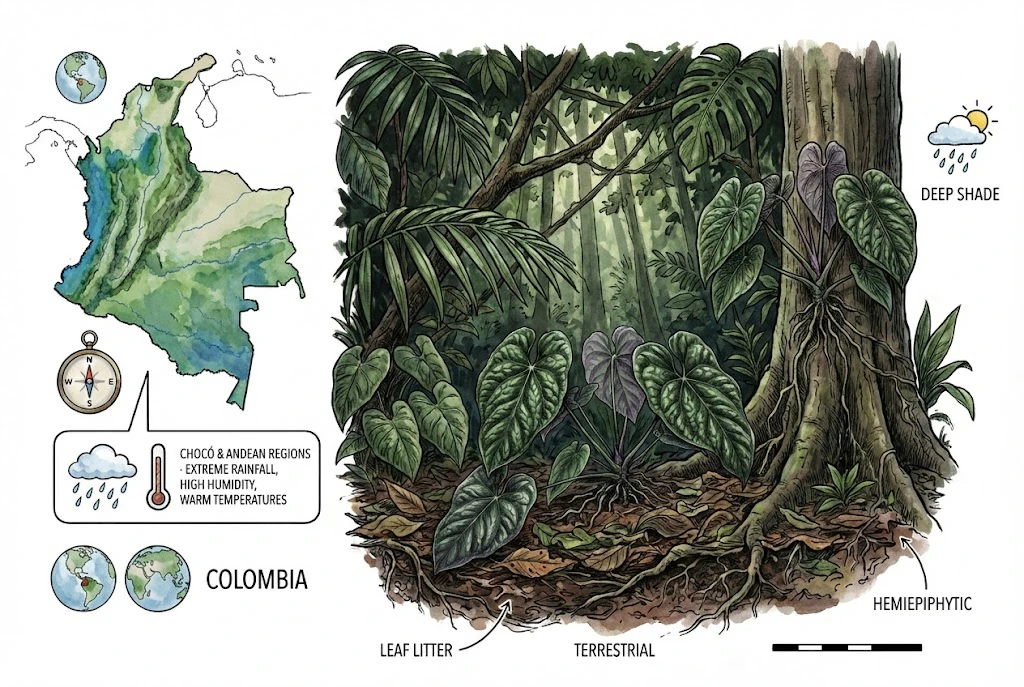
Anthurium luxurians is native to Colombia. Its exact collection locality was not recorded, so it cannot be confidently assigned to a specific region such as the Chocó or the Andes. Those are common assumptions rather than documented facts.
Because the precise wild habitat is unknown, care recommendations here are grounded in general aroid horticulture and grower experience rather than derived directly from a known native site.
The lowland Colombian forests these plants are often associated with are, in general, wet and humid, but note that this is a regional generalization, not a confirmed record of where luxurians grows.
What is documented is that A. luxurians is terrestrial. Reports of a hemiepiphytic habit are not backed by a voucher or field record, so they should be treated cautiously.
As a terrestrial plant, it grows in loose, organic material rather than as a pure canopy epiphyte.
Its roots are adapted to interacting with a loose, aerated, organic substrate. Even epiphytic anthuriums such as A. veitchii do not have purely aerial roots, because their roots interact with bark, debris, and moisture films. This is a difference of degree, not a strict divide.
It is generally grown as a shade plant. Because its native light environment has not been measured, treat a deep-understory origin as an inference rather than an established fact.
Morphological Distinctiveness
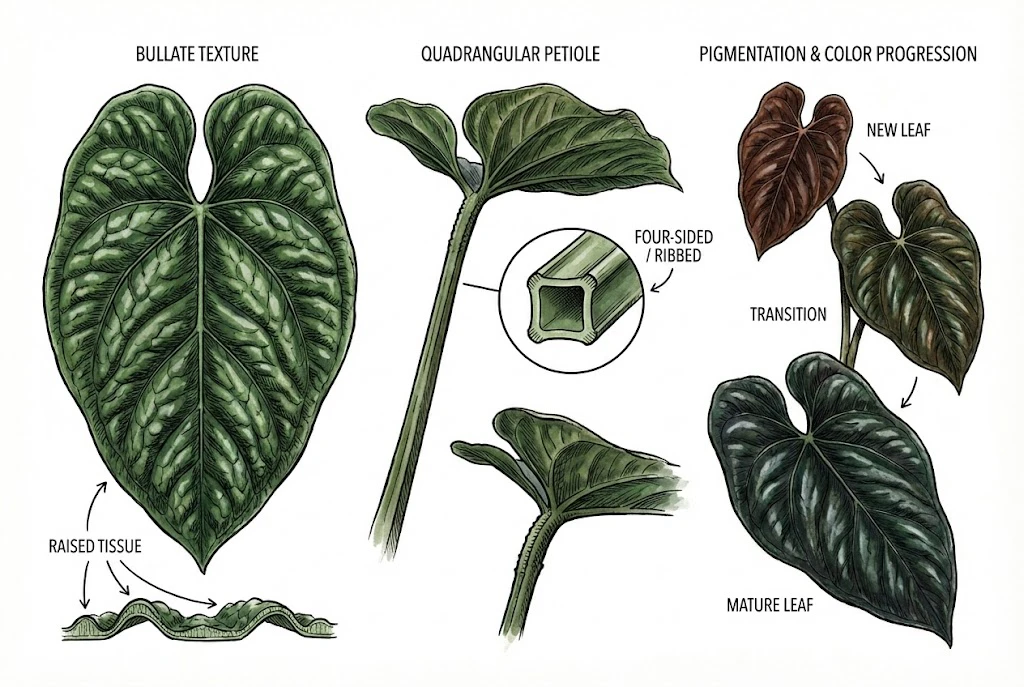
Three morphological traits are commonly used to describe A. luxurians. How strongly each appears in a given hybrid varies and is not well documented, so the notes below describe tendencies rather than fixed inheritance.
The Bullate Texture
The leaf surface has deep peaks and valleys, a trait known as bullation.
The tissue between the veins rises up, creating a quilted or pebbled appearance.
This is the species’ most recognizable feature. Textured hybrids often retain some of it, but without segregation data the degree of heritability cannot be stated precisely.
The Ribbed Petiole
The petiole (leaf stalk) of A. luxurians is not smoothly round.
The original description records a petiole that is near-cylindrical with several longitudinal ribs (roughly seven to nine around its circumference), not a distinctly square, four-sided stalk.
A square, winged petiole is characteristic of A. magnificum, and the two are easy to confuse.
The ribs add structural support to the heavy leaf blades. On their own they are not a reliable way to prove a plant’s parentage, since a single continuous trait can be produced by more than one genetic background.
Pigmentation
New leaves commonly emerge in shades of deep chocolate, rust, or garnet, then darken to a dark, metallic green as they mature, sometimes appearing nearly black in lower light.
This coloration is generally attributed to anthocyanins. The pigment chemistry of A. luxurians has not been directly assayed, so treat this as the usual explanation rather than a measured result.
Ecophysiology (The Why Behind the Design)
The exact function of A. luxurians’ textured, dark leaf has not been measured. You do not need an unproven light-capture or water-shedding theory to care for it.
What the Textured Leaf Changes in Practice
Water can linger in the deep texture after misting or rinsing. Keep the foliage from staying wet, use gentle airflow, and give bright indirect light rather than trying to recreate a guessed rainforest condition.
Anthocyanins (The Science of Dark Leaves)
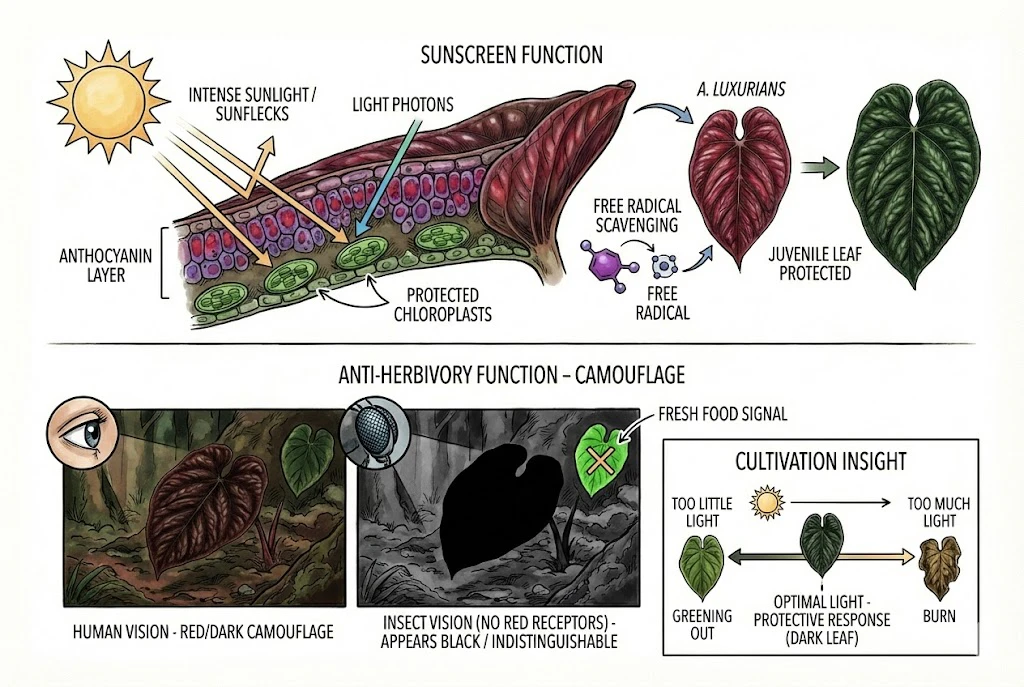
Dark-leaved plants are popular, and A. luxurians is one species breeders use when working toward dark foliage.
The dark color is usually attributed to anthocyanins and related flavonoids (water-soluble pigments that can appear red, purple, or blue depending on pH) layered over the leaf’s underlying chlorophyll.
The specific pigments in A. luxurians have not been chemically analyzed here, so this is the standard explanation rather than a measured identification.
The Sunscreen Function
Young leaves of A. luxurians often emerge red or brown.
In many plants, young leaves have a thinner cuticle and less-developed photosynthetic machinery than mature ones, which can make them more sensitive to bright light.
Whether this holds to a specific degree in A. luxurians has not been measured.
One proposed role for the red pigment is a sunscreen effect. Anthocyanins absorb some high-energy blue-green light, which could reduce the load on developing tissue during brief bursts of direct sun.
Anthocyanins are also known, in other systems, to act as antioxidants.
These are general, plausible roles observed across various plants. They have not been demonstrated specifically for A. luxurians, and the pigment’s location, concentration, and contribution in this species remain unmeasured.
The Anti-Herbivory Function (Camouflage)
Another hypothesis is that red or dark coloration in understory plants can act as camouflage against some insect herbivores.
Some insects have limited sensitivity to red light, so a dark red leaf might be less conspicuous to them than a bright green one.
Insect vision varies widely between groups, so this should not be generalized to all insects, and it has not been tested for A. luxurians.
These evolutionary hypotheses do not translate directly into an indoor lighting recipe. What can be said in cultivation is more modest. Anthocyanin production is often light-induced, so dark hybrids usually hold their color better with adequate light than in deep shade.
To keep a dark hybrid such as Ace of Spades × luxurians well coloured, growers generally aim for enough light to bring out pigment without scorching foliage that has not been acclimated to brighter conditions.
Anthocyanins and chlorophyll are not a simple either-or switch, so more light forces greening is an oversimplification.
Deliberately stressing a plant to force color is risky without measuring light and acclimating gradually, and it does not reliably improve pigment retention.
Pigment patterns and photoprotection of anthocyanins in young leaves under contrasting light conditions
Nature’s Swiss Army Knife. The Diverse Protective Roles of Anthocyanins in Leaves
The Hybridization Boom (Genetics and Objectives)
Why Breed Luxurians Hybrids
Breeders typically cite two motivations, aesthetic novelty and the hope of hybrid vigor or heterosis.
Hybridizing does not automatically produce vigor. Heterosis is a possible outcome, not a guarantee, and F1 siblings can differ widely.
Anthurium luxurians is often described by growers as slow-growing, though this has not been quantified against a defined comparison.
Growers commonly report long intervals between new leaves. This is distinct from how long a single leaf takes to harden after it emerges, which is a separate process. The two are easy to conflate.
By crossing it with faster-growing, larger, or velvety species, breeders aim for progeny that keep the luxurians texture while growing more readily.
Whether a given cross achieves this has to be judged seedling by seedling.
Inheritance Patterns (What Growers Report)
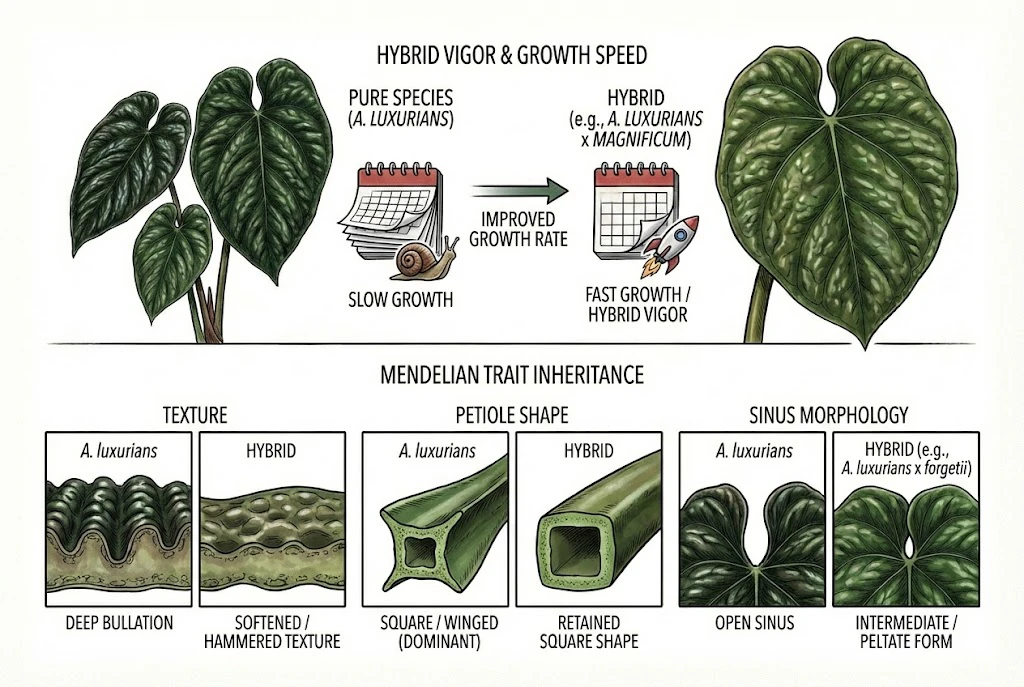
Breeding logs and collector observations describe some recurring tendencies in luxurians crosses.
These are anecdotal patterns, not the product of controlled crosses with sample sizes and segregation data, so they should not be read as established Mendelian inheritance.
Texture (Bullate vs. Smooth)
Texture often carries through, at least partly.
When luxurians is crossed with smooth-leaved species, growers frequently report that seedlings still show some texture, though it may be softer.
Without seedling counts this is a general impression rather than a measured frequency.
For example, A. magnificum × luxurians is often described as having a hammered texture rather than the sharp, deep blisters of pure luxurians.
Petiole Shape
A square, winged petiole is characteristic of A. magnificum, not of A. luxurians, whose petiole is ribbed and near-cylindrical (see above).
Because petiole shape is a single, continuous trait shaped by more than one genetic background, it is not a reliable way to confirm parentage on its own, and there is no dominance data to support treating it as a marker.
Sinus Morphology
The shape of the notch at the top of the leaf varies, and A. luxurians is generally described with a wide, open sinus.
Crossing it with a species like A. forgetii (which has little or no sinus) is often reported to produce intermediate, shield- or peltate-like leaf shapes that many collectors find attractive.
This is a plausible parent contrast, but not every F1 will be intermediate, and the frequency is not documented.
Comprehensive Profiles of Popular Hybrids
A number of luxurians hybrids are available in the trade.
They can look similar at first glance, but different crosses tend to differ in growth habit, care, and appearance.
Keep in mind that seed-grown crosses also vary among siblings, so a single plant may not match its label’s typical description.
The profiles below describe some of the more commonly encountered crosses. The traits noted are tendencies drawn from grower observation, not controlled comparisons, and one representative photo cannot capture the range within a cross.
Anthurium radicans x luxurians
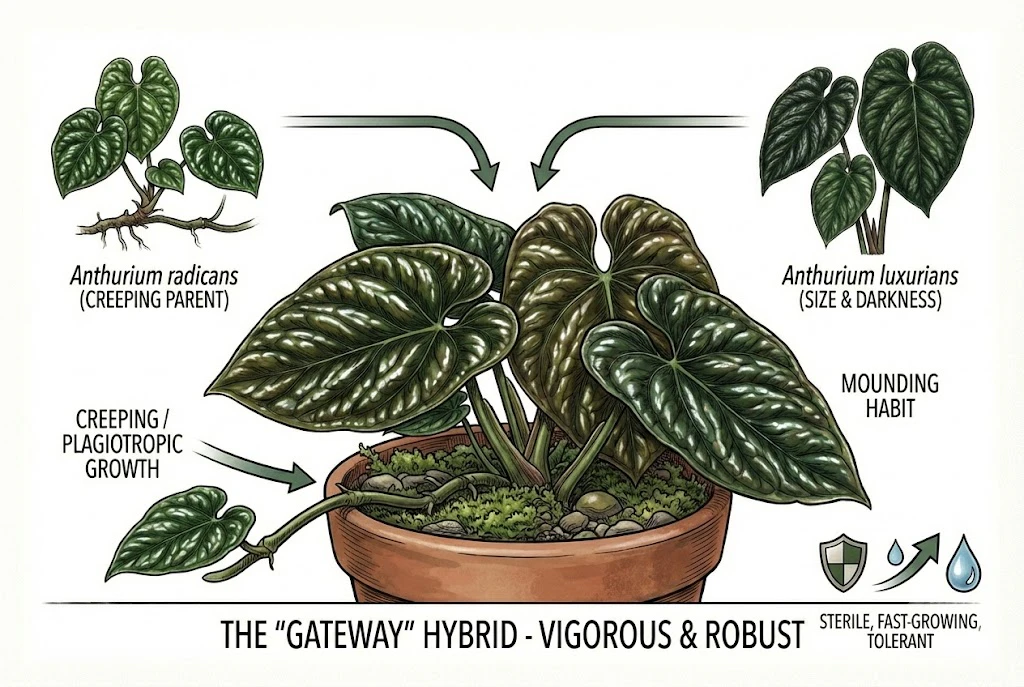
A Common Starting Hybrid
This is one of the more widely grown textured crosses.
It is often among the first textured anthuriums a collector acquires, though there is no survey data to quantify that.
Parentage
A cross between A. radicans (a creeping species with small, deeply bullate leaves) and A. luxurians (a larger, darker species).
Visual Characteristics
The leaves have a distinctly reptilian, quilted look.
In many cultivated examples the leaves are glossy, deeply quilted, and thick.
Rather than a velvet surface, they tend to have a shiny, waxy finish that emphasizes the texture.
Growth Habit
Creeping (Plagiotropic)
This is a useful thing to know before choosing a pot.
Reflecting the crawling rhizome of A. radicans, this cross tends to spread horizontally rather than climb.
It generally scrambles across the substrate surface instead of going up a pole.
In a pot, it will often mound and spill over the sides over time.
Why It Matters
The International Aroid Society and growers have observed that these crosses appear to be sterile, though that is a horticultural observation rather than a cytological test.
It is often described as robust and forgiving. Claims that it shows extreme vigor, tolerates lower humidity, or grows faster than either parent are plausible but rest on grower impressions rather than side-by-side comparisons under matched conditions.
It is a reasonable choice for a first textured anthurium.
Anthurium crystallinum x luxurians
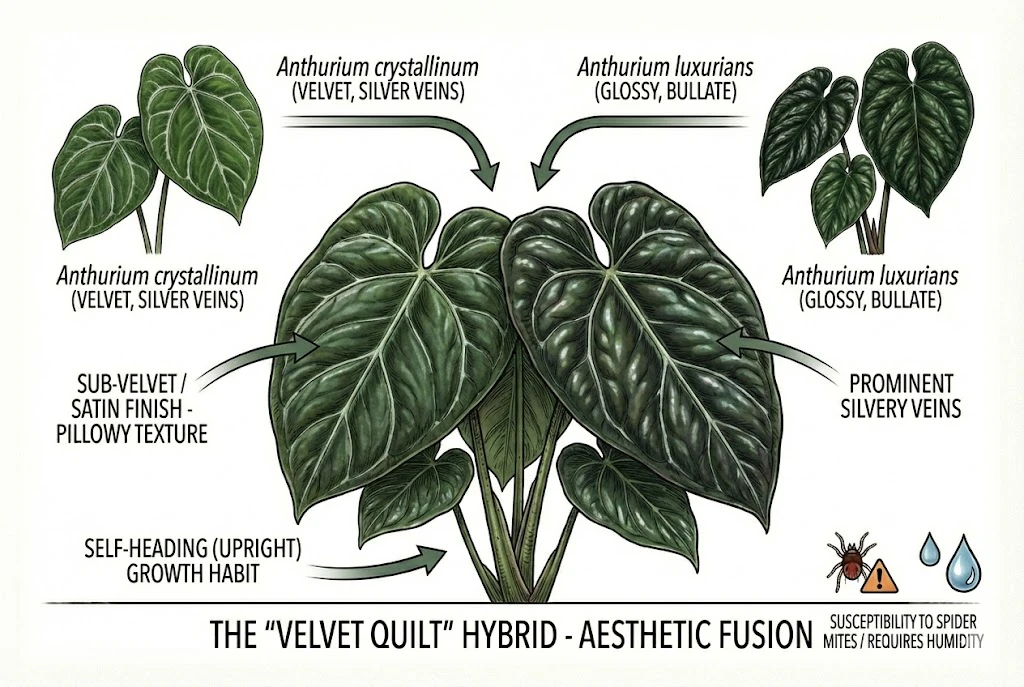
Velvet Meets Texture
This cross combines two looks. The velvety leaf of crystallinum and the heavy texture of luxurians.
Parentage
A. crystallinum (velvet, silvery veins) x A. luxurians (glossy, bullate).
Visual Characteristics
The result is a fascinating intermediate.
The leaves often possess a sub-velvet or satin finish, not fully glossy like luxurians, but not deeply matte like crystallinum.
The venation is typically prominent and silvery (inherited from crystallinum), creating a stark contrast against the dark, textured leaf blade.
Growth Habit
Self-Heading (Upright)
Most reports describe this cross as self-heading. It tends to grow in a rosette form, which can suit display shelves or grow cabinets.
Care Notes
Growers sometimes report that these plants, like crystallinum, can be prone to spider mites and appreciate higher humidity for a clean leaf surface.
Pest susceptibility depends on environment, exposure, and management as much as parentage, and there is no parent-to-offspring trial showing it is inherited, so treat this as a caution rather than a fixed trait.
The texture is often described as puffy or pillowy rather than the sharp ridges of the radicans cross.
Anthurium magnificum x luxurians
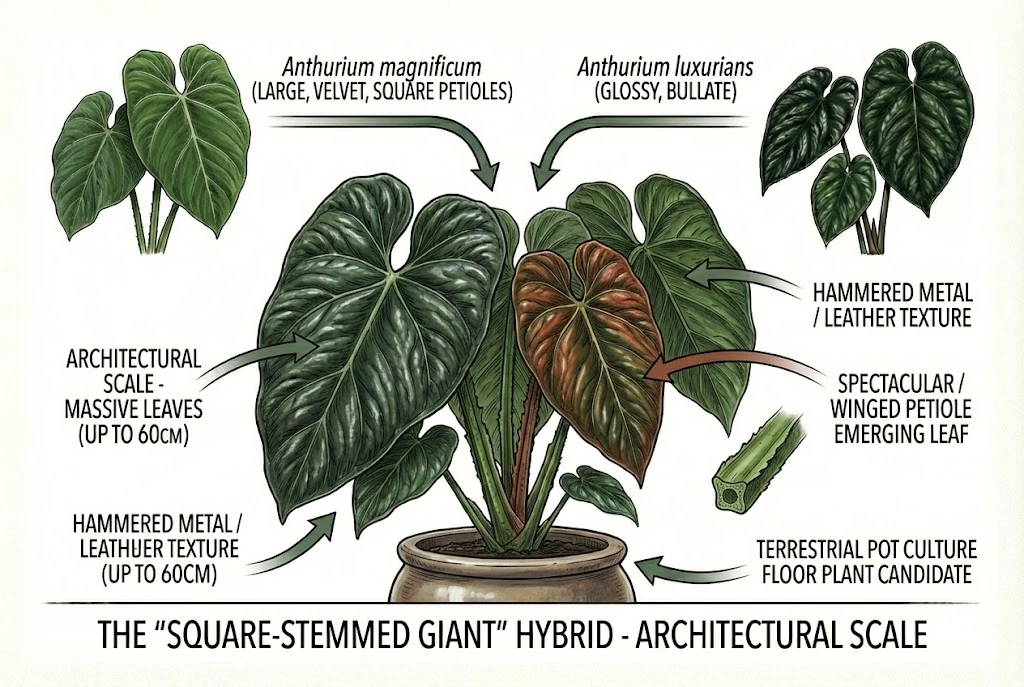
A Larger, Square-Stemmed Cross
For collectors who want a larger plant, this cross is a common choice.
Anthurium magnificum is a large terrestrial species, and crosses with it can reach a substantial size.
Parentage
A. magnificum (large, velvet, square petioles) x A. luxurians.
Visual Characteristics
The square, winged petiole comes from the magnificum parent. Luxurians contributes texture and dark color rather than a square stalk. Many of these hybrids show a pronounced, winged petiole.
The leaves are broadly cordate (heart-shaped) and can become large. Figures around 60 cm are sometimes cited, but mature size depends on the individual clone, its maturity, and growing conditions.
Texture & Color
The texture is often a blend (deeply veined but smoother than the radicans cross, sometimes compared to hammered metal or heavy leather).
Emerging leaves are often bronze or rust-red, darkening to deep green as they mature.
Growing Notes
With a large, terrestrial parent, this cross is generally well suited to pot culture.
It does not strictly require a moss pole, though staking can help with stability as it gains weight.
It can work as a floor plant in a humid room, given enough space.
Anthurium forgetii x luxurians
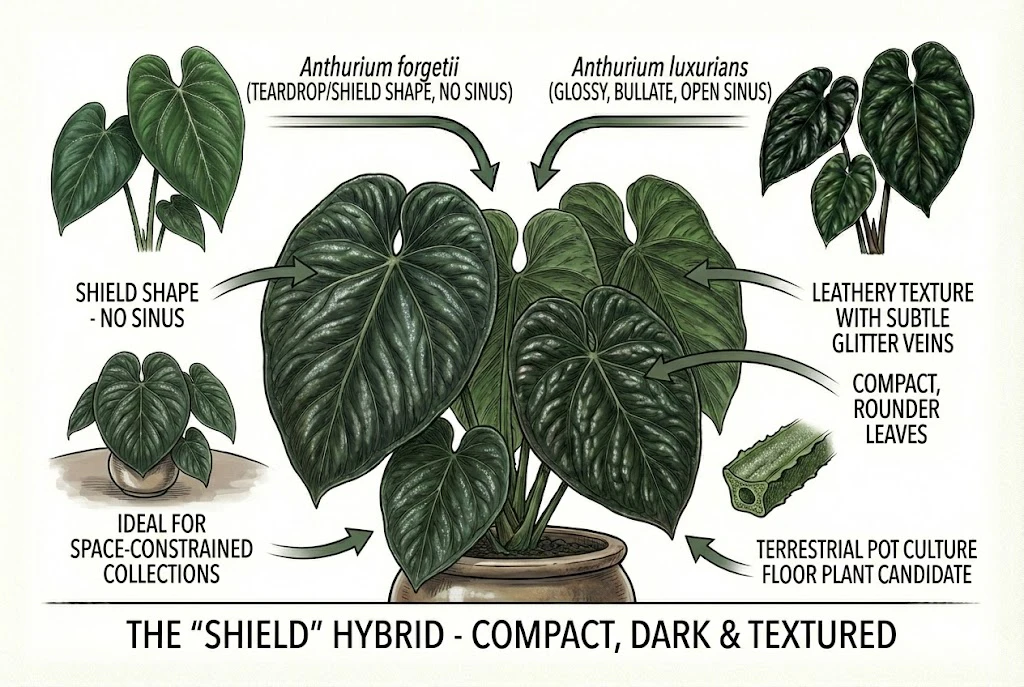
The Shield-Leaved Cross
Anthurium forgetii is notable among commonly grown anthuriums for lacking a sinus (the top notch), which gives its leaf a teardrop or shield shape.
Parentage
A. forgetii x A. luxurians.
Visual Characteristics
The aim of this cross is a dark, textured, shield-shaped leaf.
Growers often report that the open sinus of luxurians tends to close or overlap under the forgetii influence, though outcomes vary between seedlings.
The leaves are frequently rounder and more compact than the more elongated luxurians.
Appearance
It often shows the subtle glitter of forgetii venation together with the heavy, leathery substance of luxurians.
These are frequently smaller, more manageable plants, which can suit growers with limited space.
Anthurium papillilaminum x luxurians
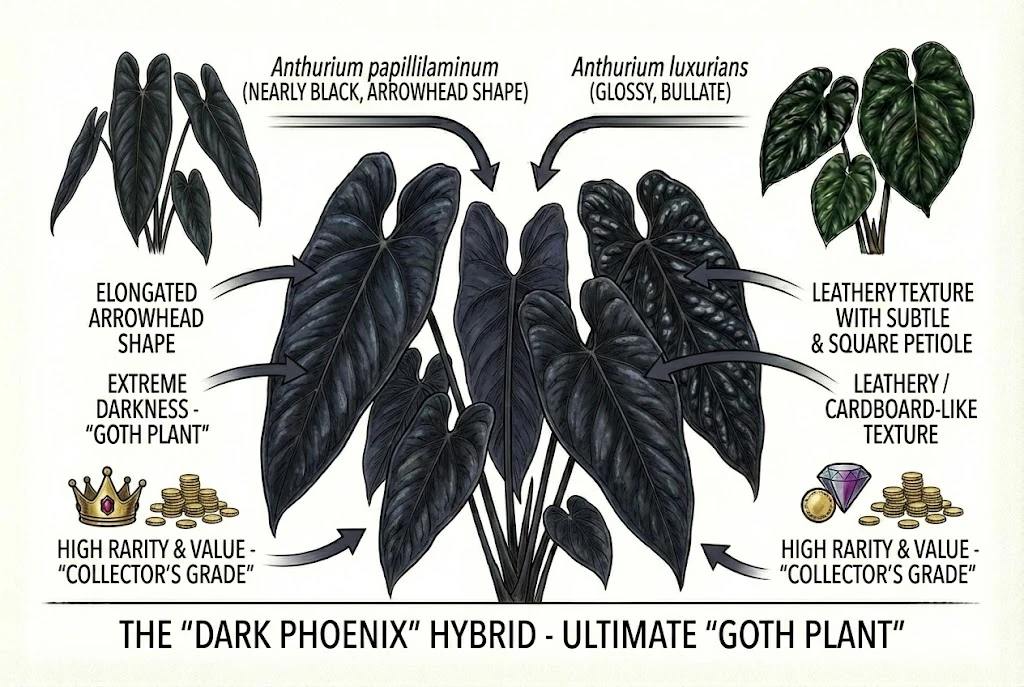
A Very Dark Cross
Anthurium papillilaminum is popular among collectors of dark-leaved plants for producing very dark, sometimes nearly black foliage.
Crossing it with luxurians is aimed at combining that darkness with luxurians texture.
Visual Characteristics
These hybrids often have an elongated, arrowhead shape (from papillilaminum) and can be very dark, though the degree varies between individuals.
The texture is often more subtle, appearing leathery or cardboard-like rather than deeply blistered.
Availability & Price
These are often less common and can sell at a premium.
They are valued for dark coloration, but how stably any given plant holds that color across light conditions varies and has not been systematically measured, so treat stable pigmentation as a hope rather than a guarantee.
Complex Cultivars and Named Clones
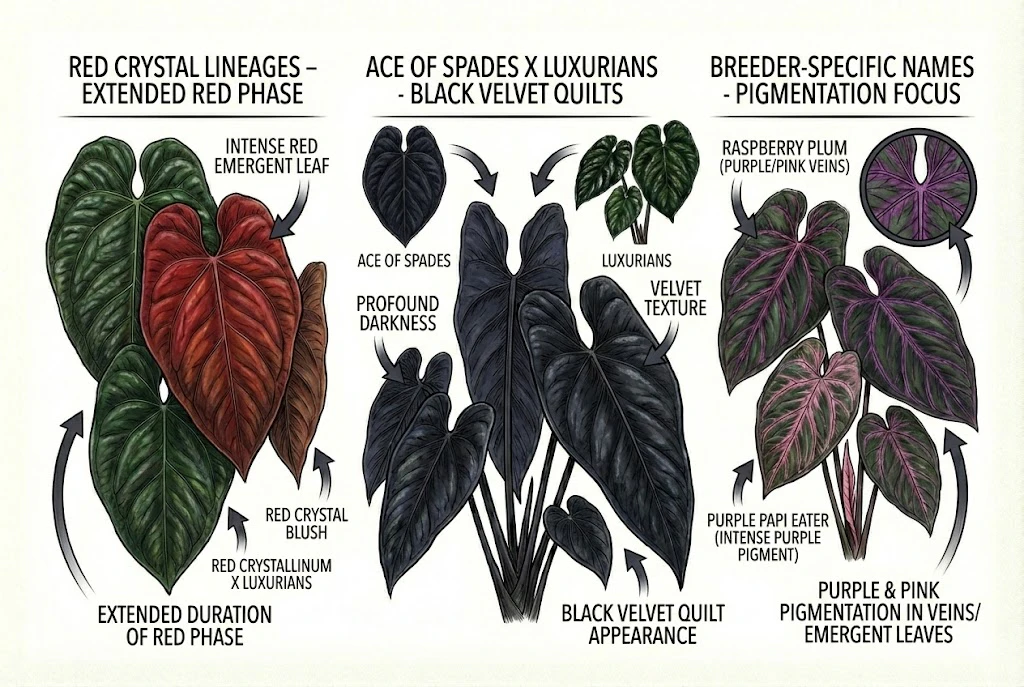
Breeding has moved beyond simple F1 (first-generation) crosses toward specific clones and multi-generation lines.
Verify Lineage Before Assuming a Cross
Sales names do not always reveal parentage, and it is easy to assume luxurians is involved when it is not.
Check the breeder’s own records rather than inferring lineage from a name.
Luxurians Lines vs. Similarly Named Clones
Some lines genuinely involve luxurians. Breeders such as All the Plant Babies list, for example, Red Crystallinum × luxurians and Ace of Lux as separate luxurians crosses.
By contrast, several popular breeder names are not luxurians crosses, despite sometimes being grouped with them.
According to the breeder’s recorded parentage, Red Crystal Blush, made from Red Crystallinum × Silver Blush, Raspberry Plum, Purple Papi Eater, and Little Pink Dress do not have luxurians in their lineage.
These are selection lines focused on purple and pink pigmentation, and they should not be described as luxurians hybrids.
Ace of Spades × Luxurians
Crosses that pair a dark, velvet parent such as Ace of Spades with luxurians aim for very dark, textured foliage.
The origin and parentage of Ace of Spades itself is not firmly documented, so treat its own lineage cautiously.
Practical Cultivation (From Rainforest to Living Room)
Because the exact wild habitat of Anthurium luxurians is not documented, the care below is based on general aroid horticulture and grower experience rather than derived directly from its native environment.
The aim indoors is simply to provide airy roots, appropriate light, humidity, and modest feeding, and to adjust based on what your own plant does.
Substrate Physics (The Oxygen Imperative)
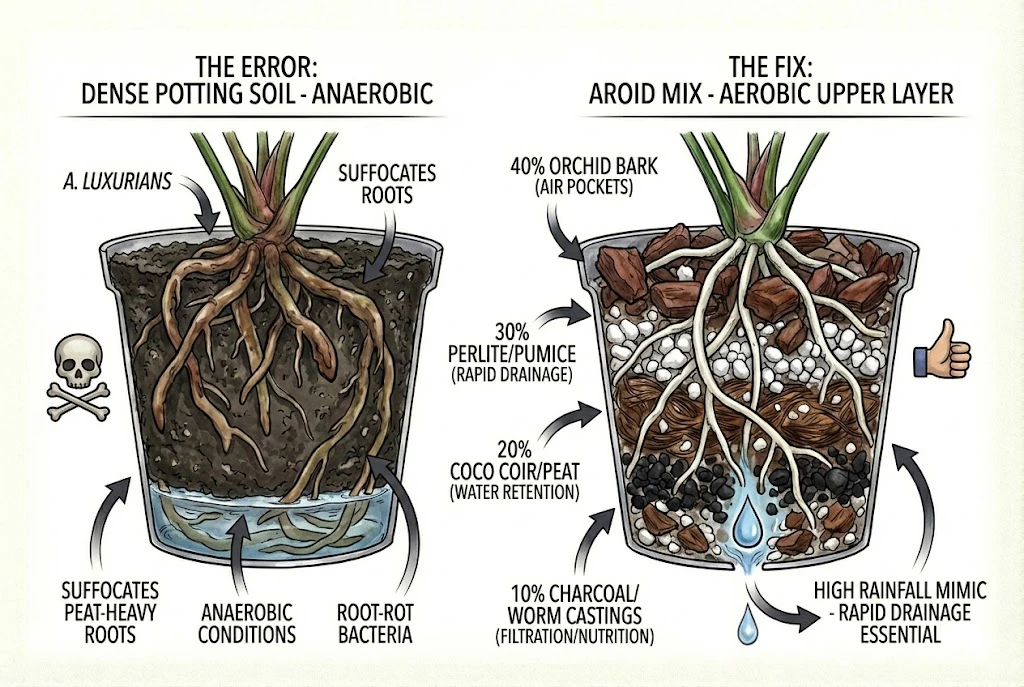
A. luxurians is terrestrial and grows in loose, organic material with plenty of air around the roots.
Its roots are thick and fleshy.
The main mistake to avoid is a dense, water-retentive potting mix that stays saturated, since low air porosity at the roots creates conditions that favor root rot.
Root rot in anthuriums is commonly caused by oomycetes such as Pythium and Phytophthora and by fungi such as Rhizoctonia, not simply bacteria. It depends on pathogen presence, temperature, and plant condition, not just wet soil.
The practical fix is a chunky, free-draining aroid mix. A bagged blend can be a reasonable starting point, though its exact proportions and physical properties may not be published, so it is not identical to the DIY formula below.
You can also mix your own.
Perfect Plants Aroid Mix
Perfect Plants aroid mix is a convenient starting point when you want a ready-made mix rather than sourcing each component. It is not a guarantee of the right moisture level in every pot, so use it only if it drains freely in your conditions and adjust with coarser material if it stays wet too long.
Orchid Bark
Use roughly 40% large orchid-bark chunks to create structural porosity and air pockets.
Perlite or Pumice
Use roughly 30% perlite or pumice to improve drainage and resist compaction.
Coco Coir or Peat
Use roughly 20% coco coir or peat to hold some moisture without making the mix uniformly dense.
Charcoal and Worm Castings
Use roughly 10% charcoal and worm castings for additional structure and a small amount of organic content.
Treat these percentages as a rough guide, not a precise formula. The actual air-filled porosity, water retention, pH, and EC depend on your particle sizes, ingredient sources, and pot geometry, so check how the finished mix drains and adjust it.
The general aim is a mix that lets water pass through the root zone freely rather than leaving the roots sitting in saturated media.
Light Placement
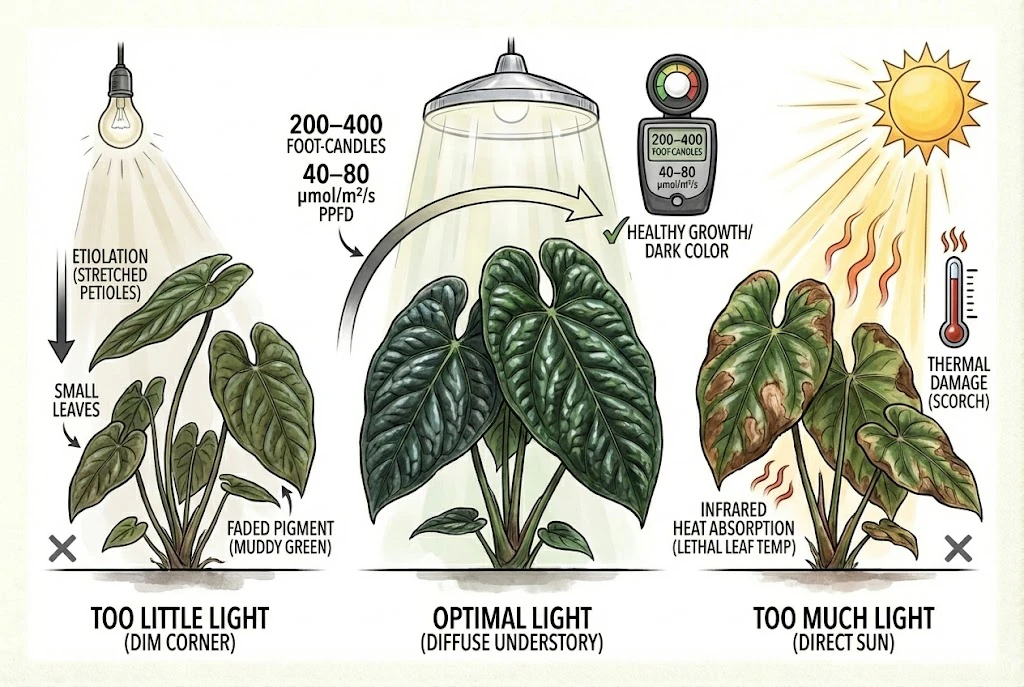
These are grown as shade-tolerant plants, but shade in a bright greenhouse is still far more light than a dim corner of a room.
A Light Target
A modest, evenly spread light level is usually safer than placing this shade-tolerant plant close to a strong bulb. A light meter can help, but do not convert foot-candles to PPFD as though they were the same measurement.
A modest full-spectrum bulb can work for a shade plant, but at close range a grow bulb may be far brighter than the target band.
SANSI 36W Grow Light
SANSI 36W Grow Light can work for one plant when it is in an open fixture and covers the leaves evenly. It is not a good fit for a wide shelf or a closed fixture that traps heat. Start farther from the plant, raise the intensity gradually, and use leaf response or a leaf-level meter to set the final distance.
Too Little Light
In too little light, a plant typically survives but produces smaller new leaves, stretched petioles (etiolation), and can lose some of its dark color, drifting toward a muddier green.
Too Much Light
Foliage that has not been acclimated to bright light can scorch in direct sun. This is a real risk and worth guarding against by acclimating gradually.
Scorch on an unacclimated plant comes from light stress and sunscald, not a special rule for dark foliage. Increase light gradually and move the plant back if the surface bleaches or burns.
The SANSI bulb below is a workable option, but its listing shows the bulb, not its light footprint.
It does not tell you the PPFD or coverage at a given distance, so plan to measure at leaf level and set the height to suit your plant, and make sure the fixture allows the bulb to shed heat safely.
Humidity and Watering
Humidity
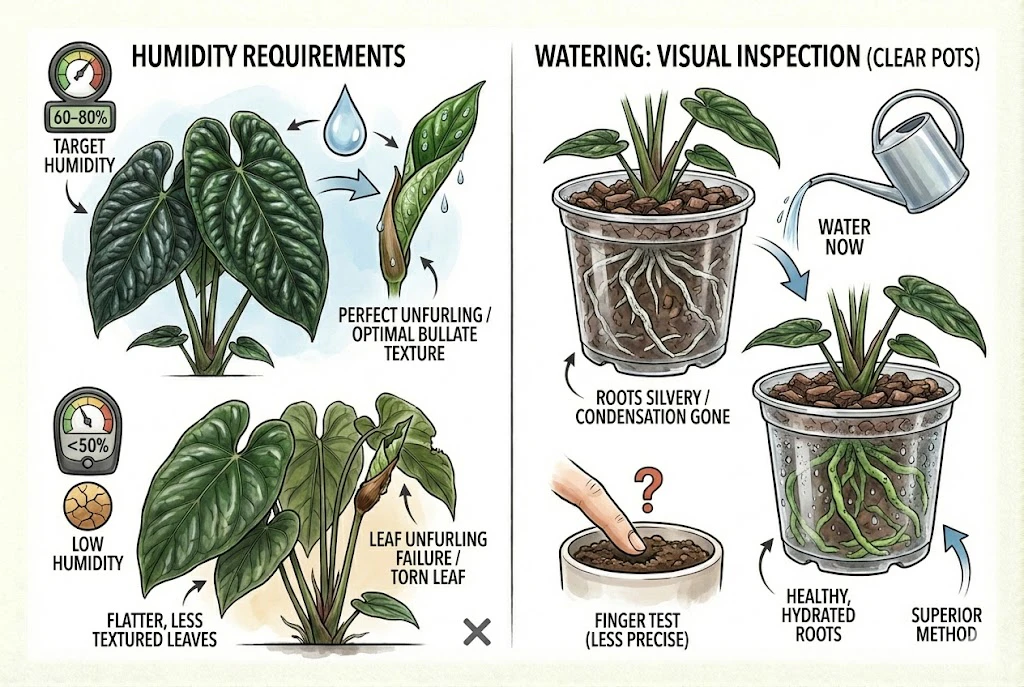
Higher humidity can help a new leaf unfurl, but no fixed percentage guarantees it. In a lived-in room, avoid raising humidity high enough to create condensation. In a cabinet, use gentle airflow and make sure leaves do not stay wet.
Watering
The finger test is the standard check. A clear pot can add a useful visual cue by letting you see the roots and moisture.
Some growers water when condensation on the inside of the pot has cleared and the roots look silvery rather than green.
This is a helpful cue but not a foolproof rule. Pot-wall condensation depends on temperature, ambient humidity, and airflow as well as substrate moisture, so confirm with the substrate itself before watering.
Nutritional Requirements
A. luxurians and its hybrids are generally slow growers and do not need heavy feeding.
Feeding
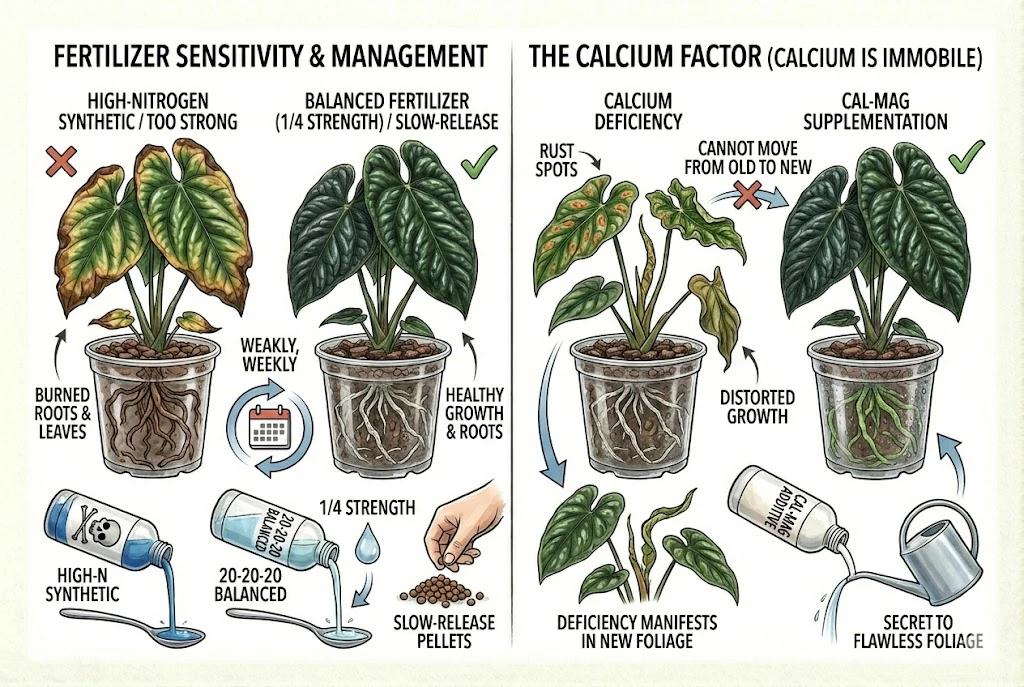
Because these are light feeders, a well-diluted balanced fertilizer is a safe default, or a slow-release pellet such as Osmocote used sparingly. Over-fertilizing can cause salt buildup and root injury.
Feeding at a fraction of the label rate on a regular schedule is a reasonable approach, but the exact concentration you deliver depends on the product, your water, and how much you leach. Follow the product’s label and dilute conservatively rather than relying on a fixed quarter-strength figure.
Calcium and Cal-Mag
Calcium has low mobility within the plant, so a steady supply matters for healthy new growth. It is not readily relocated from old leaves to new ones.
Be careful with diagnosis, though. Rust or brown spots and distorted new growth are non-specific symptoms that can come from pathogens, edema, salt injury, mechanical damage, or various nutrient imbalances, not calcium deficiency alone.
Whether calcium actually reaches new tissue also depends on transpiration, root health, pH, and the balance of other ions, not just how much calcium is in the mix.
A Cal-Mag supplement can be genuinely useful if you water with RO or distilled water, or grow in coir, where calcium and magnesium may be low.
Botanicare Cal-Mag Plus
Botanicare Cal-Mag Plus is not a universal response to rust spots or distorted leaves. It is a targeted option for RO or distilled water, coir-heavy media, or a confirmed gap in the base fertilizer. Skip it when your water and complete fertilizer already cover calcium and magnesium, because unnecessary additions can raise EC and create an imbalance.
Whether a Cal-Mag supplement helps comes down to your specific water, mix, and base fertilizer.
Its listing confirms the product and size but does not tell you whether your plants actually need it, so treat it as a targeted tool for RO/coir setups rather than a routine addition.
Growth Habits (A Guide for Placement)
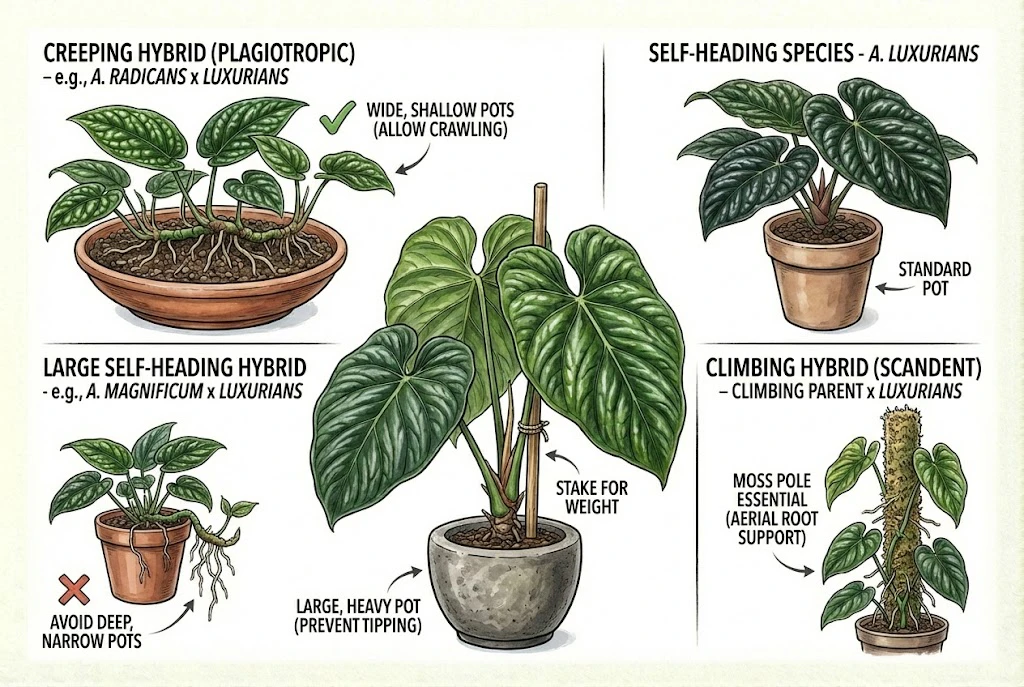
| Hybrid Type | Typical Habit | Support Needs | Potting Strategy |
|---|---|---|---|
| A. radicans x luxurians | Often creeping | Usually none. | Wide, shallow pots (e.g., azalea pots) often suit a crawling rhizome. |
| A. luxurians (species) | Usually self-heading | Minimal. Short stem. | Standard pot. |
| A. magnificum x luxurians | Usually self-heading (large) | Stake as it gains weight. | Large, stable pot to prevent tipping. |
| A. crystallinum x luxurians | Usually self-heading | Usually none. | Standard pot or cabinet display. |
| Climbing x luxurians | Scandent (climbing) | A moss pole helps. | Vertical support for aerial roots. |
A common frustration is buying a plant that grows differently than expected, so it helps to know a cross’s likely habit before choosing a pot.
These are tendencies, not guarantees. Individual seedlings vary, so watch how your particular plant grows before committing to a pot or support.
Crosses with a creeping radicans parent often do poorly in deep, narrow pots, where the rhizome grows over the rim and roots dangle in dry air.
Giving a creeping plant a wide, shallow bowl lets the stem root continuously into the substrate as it spreads.
Market Dynamics and the Future of Collecting
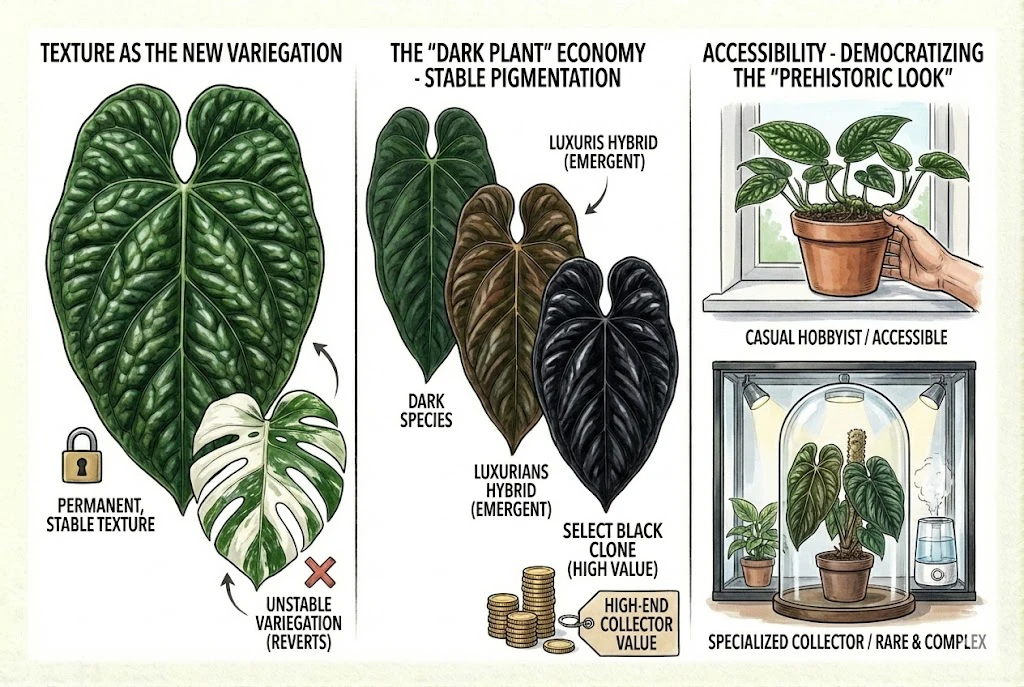
Interest in Anthurium luxurians hybrids reflects a broader shift toward appreciating leaf morphology and texture.
How to Read These Market Observations
The observations below are general market impressions rather than price data or sales samples.
They describe collecting context, not investment value.
Texture vs. Variegation
White variegation (as in Monstera Albo) has been a major driver of value in the houseplant market.
Variegation can be unstable and revert.
Texture such as the bullate ridges of luxurians tends to be more stable within a plant. Even so, phenotype stability does not guarantee stable resale value, and there is no genetic data showing texture remains stable across all hybrids, so this is not a basis for treating a plant as a financial investment.
Demand for Dark Plants
Dark-leaved plants have been consistently popular.
A. luxurians is one of the species breeders use to bring dark coloration into hybrid lines.
Calling it the primary source requires evidence across current market data, and no single price level applies across sellers and time.
Breeders continue to select for darker, more textured clones, and some complex hybrids do sell at high prices, but reported figures vary widely by seller and time.
Accessibility
Wider propagation of crosses like radicans × luxurians has made this prehistoric-looking foliage more available to hobbyists, without the specialized conditions that high-elevation species can require.
As always, judge a specific plant on its health and the seller’s provenance rather than on its name or a general market narrative.
Affiliate Disclosure
This article contains Amazon affiliate links. As an Amazon Associate I earn from qualifying purchases. If you use these links, the site may earn a commission at no extra cost to you. Product availability, price, and specifications can change. Check the current listing before buying.