
Anthurium King of Spades Care: Light, Soil & Humidity
Grow Anthurium King of Spades with measured light, airy bark mix, controlled VPD, careful watering, complete nutrition, and early pest and disease checks.
Jordan Cole · Published 2026-01-20 · 25 min read
Key Takeaways
- The King of Spades is a complex hybrid associated with Haji Ulih, but its exact parentage is not publicly documented. Treat care claims as observations of this plant rather than as proven hybrid traits.
- Protect the velvet surface from direct sun. Bright, diffused light is a practical starting point, and the lower end of a commercial Anthurium light range may help retain darker color.
- Root failure usually reflects poor oxygen supply as well as excess water. Use a chunky, fast-draining mix that re-aerates between waterings and judge it by drainage and dry-down.
- Brown leaf edges have several possible causes, including dry air, salt buildup, root damage, and inconsistent watering. Check humidity and gentle airflow as part of the picture rather than chasing a number alone.
- Feed lightly and consistently with a complete fertilizer. Consider Cal-Mag only when RO or distilled water and a measured nutrient gap justify it, and control the dose with label strength and total EC.
Introduction
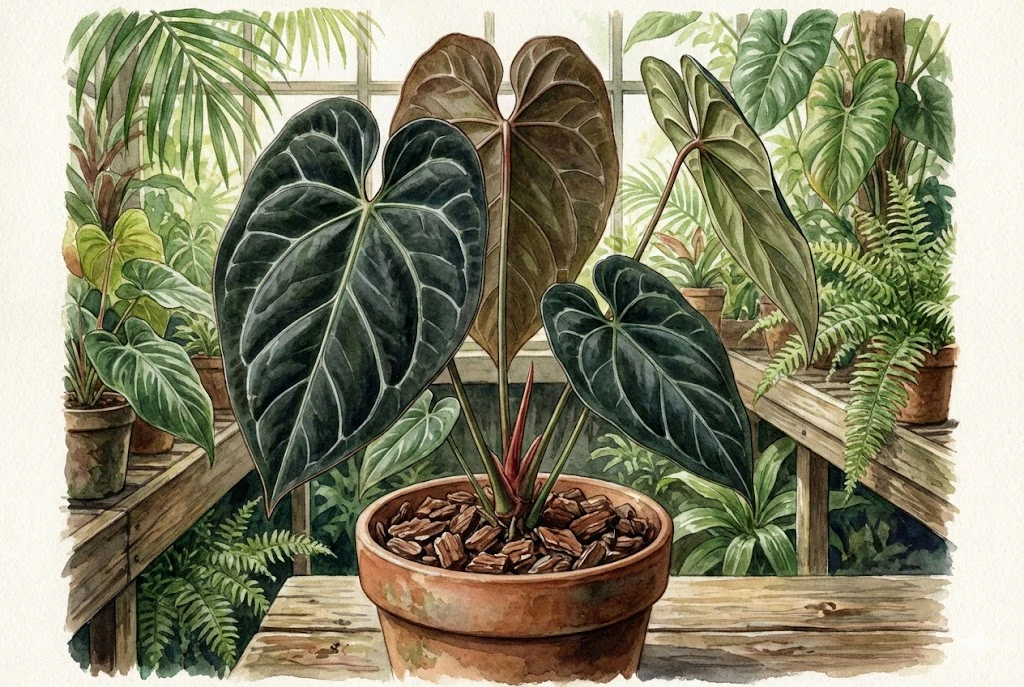
The Anthurium King of Spades is a foliage anthurium popular among Aroid collectors in the family Araceae. Unlike the common Flamingo Flower (Anthurium andraeanum) found in grocery stores, it is grown for its leaves rather than its flowers. Those leaves are heart-shaped, very large, and have a dark, matte, light-absorbing texture.
I trace the projected mature leaf width with paper around the plant before choosing its shelf. Velvet leaves can look compact while young, then rub glass, fans, or neighboring petioles as they expand.
One clear route stays open for the next leaf to harden without touching wet surfaces. When damage follows the exact contact arc, I fix clearance before treating the mark as humidity or disease trouble.
Care Starts With Observed Response
Common online advice suggests the King of Spades requires greenhouse conditions, extremely pure water, and very high humidity. Some of that is overstated. Base care on general Anthurium physiology and observable environmental responses because cultivar-specific trials remain limited. The plant is not necessarily fragile, but it reacts noticeably to its environment. Like many tropical understory aroids, it appears adapted to filtered light and an airy root zone.
Origin (What Is Documented and What Is Not)
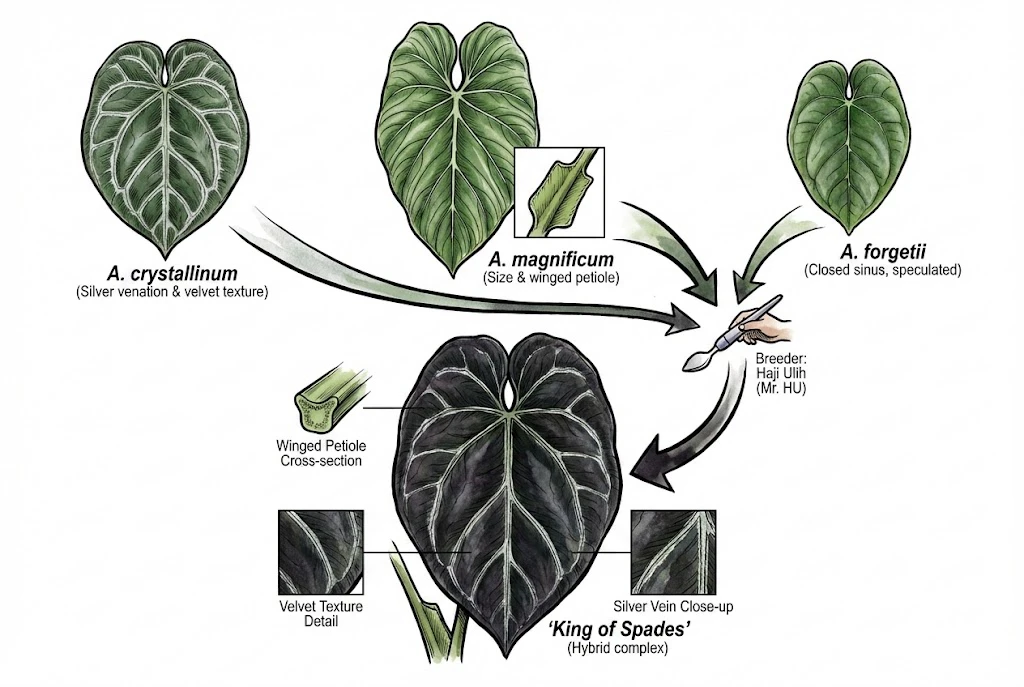
Unlike a species found directly in nature (like Anthurium warocqueanum or Anthurium veitchii), the King of Spades is a cultivated hybrid.
The Origin and Mr. HU
In the collector community, the King of Spades is commonly associated with Haji Ulih (Haji Uli), often referred to as Mr. HU, a breeder based in Indonesia.
Beyond that association, the exact parentage is not publicly documented. Independent sellers and collectors describe it as a complex Anthurium hybrid of unknown parentage, and different accounts propose different crosses.
Commonly Proposed Parents
Anthurium crystallinum
Anthurium crystallinum is suggested as a source of silver veins and velvet texture. That is a phenotype-based guess, not a confirmed parent.
Anthurium magnificum
Anthurium magnificum is sometimes proposed for the large size and square-shaped winged petioles, which are the leaf stems.
Anthurium forgetii
Anthurium forgetii is occasionally suggested because the top gap of the heart shape, called the sinus, is closed in some plants. A closed sinus is not proof of parentage.
Because no documented pedigree exists, treat these as hypotheses. Practical care rests on the plant’s observed behavior and general Anthurium horticulture, not on a confirmed cross.
Hybrid Vigor (A Reasonable Expectation, Not a Guarantee)
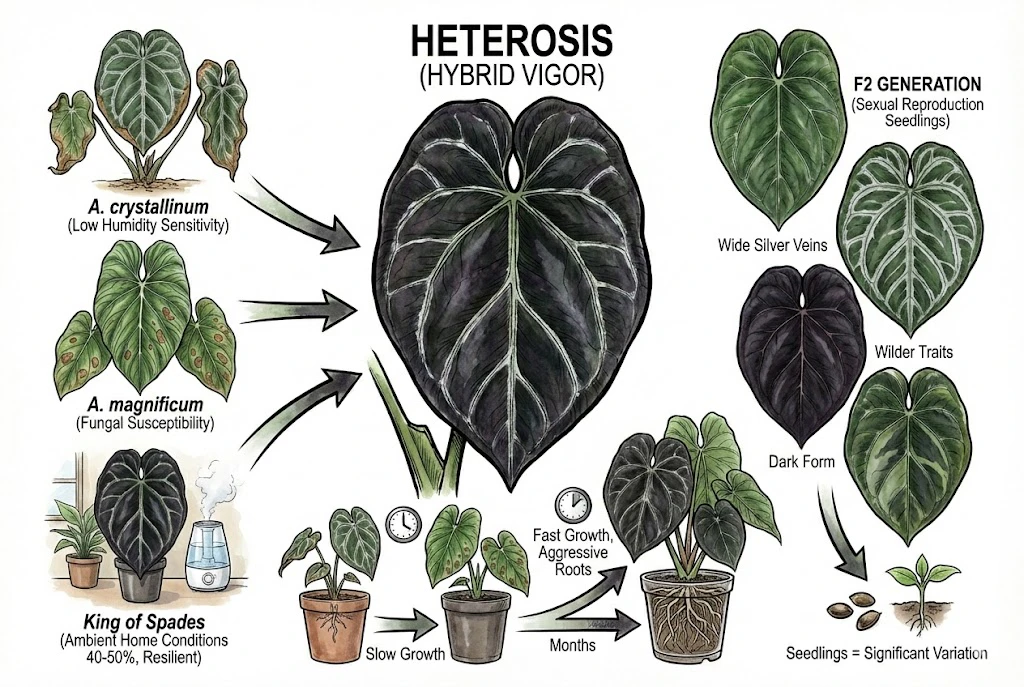
In biology, heterosis (hybrid vigor) refers to crossbred plants sometimes showing traits stronger than their parents.
It does not appear in every trait, and demonstrating it requires comparing the hybrid to each parent under the same conditions.
Resilience
Growers often report that the King of Spades tolerates ordinary home humidity (roughly 40-50%) reasonably well.
There is no published, controlled comparison of KOS against named parent species, so treat this as anecdotal experience rather than a measured advantage.
Growth Rate
Some growers describe vigorous growth and robust rooting, but this varies by individual plant and conditions and has not been quantified against pure species.
Variability
Seed-grown plants vary noticeably from one another. One might have wide silver veins, another may look nearly black.
Note that F2 is a specific genetic term for the offspring of an F1 selfed or crossed to another F1.
It should not be used as a blanket label for every seed-grown KOS unless that generation is actually documented.
Check the seller’s description for whether a plant is a named clone, a seedling, or a stated generation.
The Physiology of Velvet (How the Leaf Works)
The most distinct feature of the King of Spades is its texture. It has a matte, velvety appearance (technically called a velutinous surface), a functional adaptation that directly affects light and water requirements.
The Convex-Lens Hypothesis
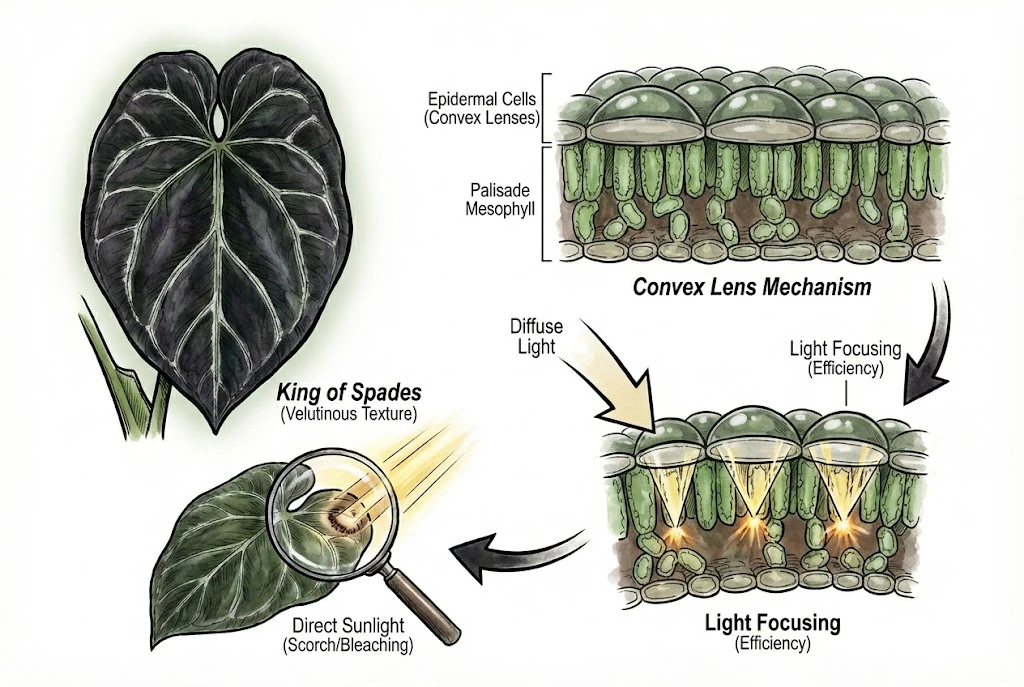
In some tropical shade plants, the upper epidermal cells are dome-shaped.
What this means for light placement
No study shows that the King of Spades uses lens-shaped leaf cells to capture light. The microscopic explanation is uncertain and does not change the care decision.
The practical takeaway
Keep the King of Spades in bright, diffused light and move it out of intense direct sun if leaves bleach or burn.
Transpiration and the Cuticle
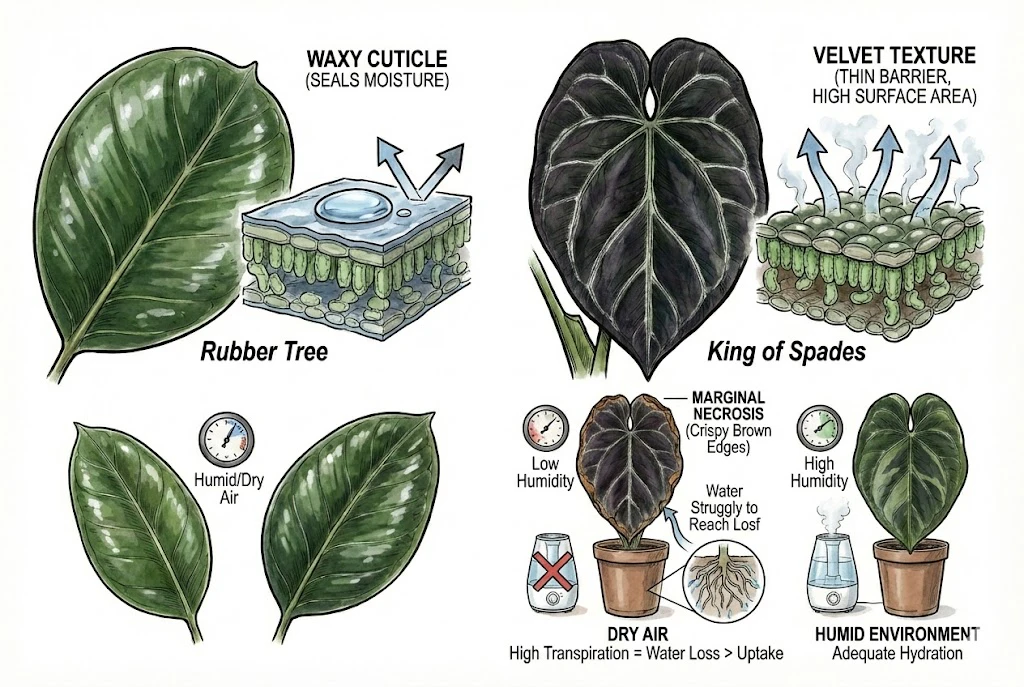
The King of Spades’ exact leaf-water-loss traits have not been measured. Treat dry air as one possible source of stress, not a diagnosis based on leaf texture alone.
The practical takeaway
In dry air, a King of Spades can lose water from its leaves faster than the roots supply it, which can contribute to browning leaf margins (marginal necrosis).
Dry air is only one cause, though. Browning edges can also come from accumulated salts, root damage, inconsistent watering, or disease, so consider those before assuming humidity is the problem.
The Dark Color
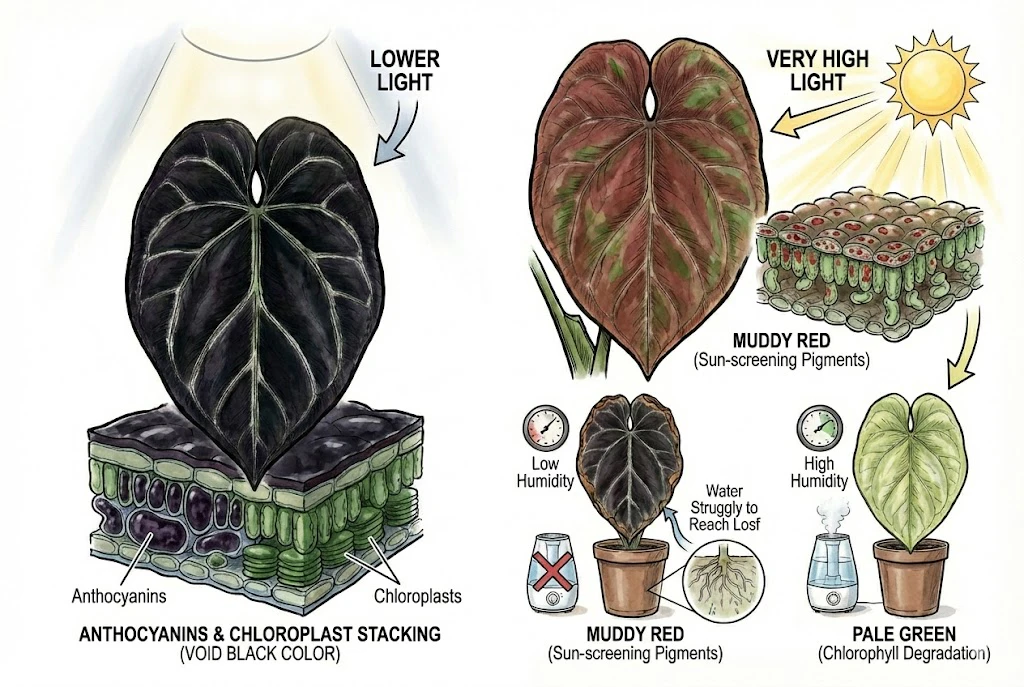
The dark leaf color of anthuriums is generally attributed to anthocyanins and chloroplast arrangement.
The specific pigment concentration and cell-level arrangement in the King of Spades have not been published, so this is the usual explanation rather than a measured finding for this plant.
Many growers report that leaves look darkest under moderate-to-lower light, and that very bright light can make foliage look reddish or paler.
This may reflect protective pigments or reduced chlorophyll, but it also depends on the individual plant, leaf age, nutrition, and acclimation, none of which were controlled here.
For darker foliage, keep the plant toward the lower end of its safe light range and observe the next leaves over several weeks before reducing light again.
Substrate (The Physics of the Root Zone)
Many Anthurium problems involve root rot, which is linked to poor oxygen supply in a wet, dense mix rather than water alone.
Getting the substrate right is one of the most useful things you can do.
An Airy Root Zone
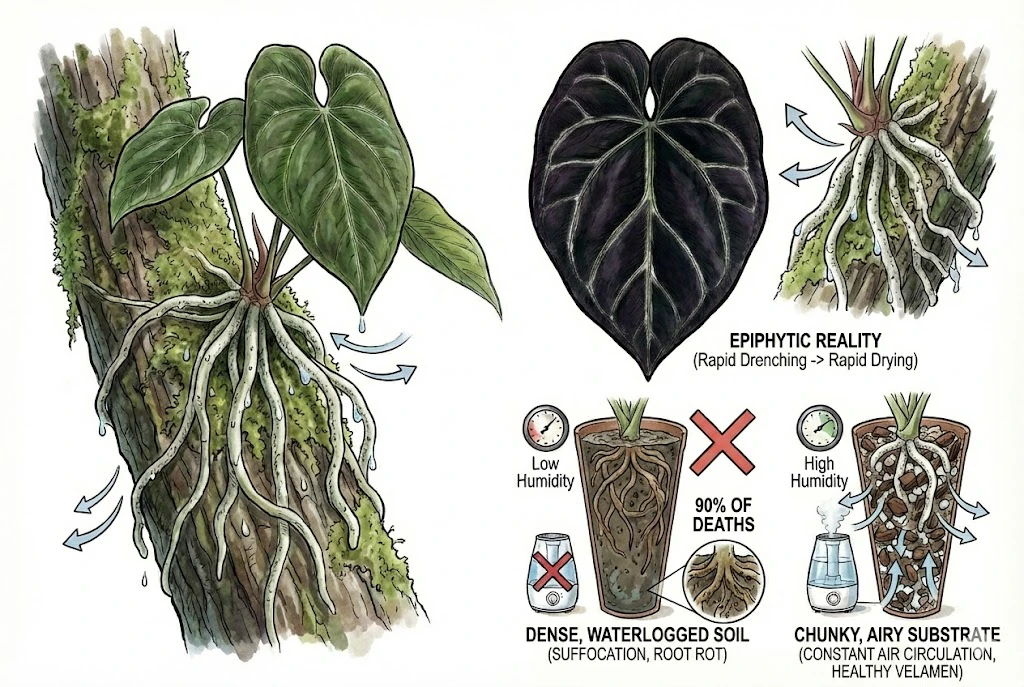
Anthuriums in the crystallinum/magnificum group are commonly grown as, and species like them often occur as, epiphytes (on trees) or in loose leaf litter rather than deep soil.
Because the exact parentage is undocumented, this is a general inference about related plants rather than a proven fact about KOS ancestry.
Root Environment
Their roots are used to constant airflow and a cycle of getting wet followed by drying out quickly.
Velamen
The roots are covered in a spongy tissue called velamen, which absorbs moisture rapidly from humid air or rain.
Air-Filled Porosity (AFP)
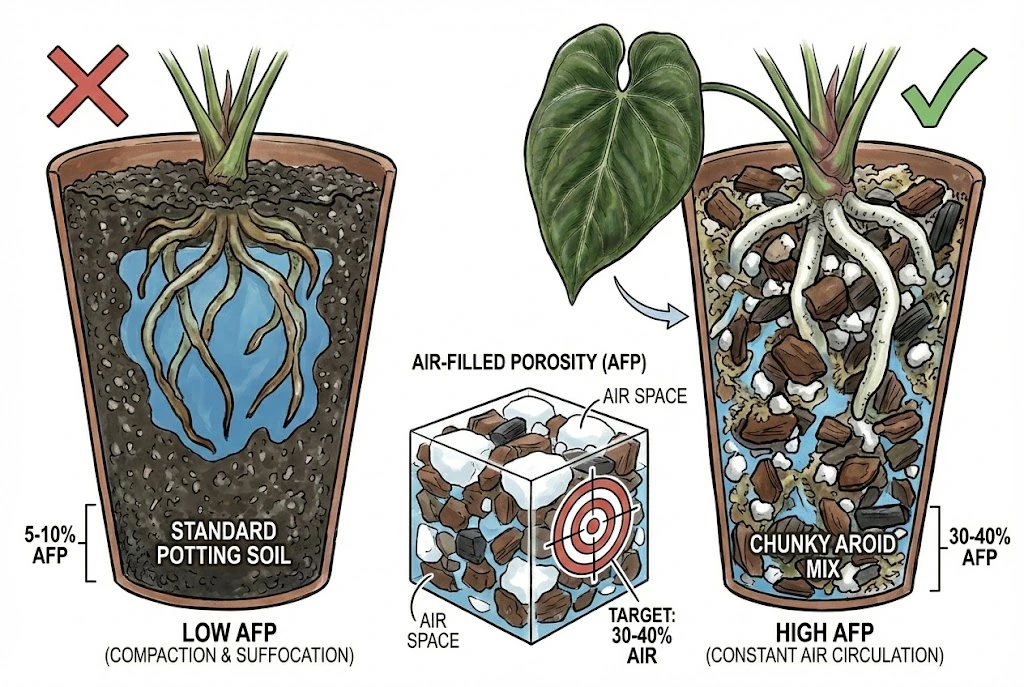
Fine, dense potting mixes can hold too much water and leave few air pockets, which stresses roots that expect a well-drained, airy zone.
The metric
Air-Filled Porosity (AFP) is the percentage of a pot’s volume filled with air after watering and draining.
A sensible target range
General container recommendations often fall in the 10-30% air-space range, and higher porosity can reduce root-rot risk in some nursery trials (at the cost of more frequent watering).
There is no published AFP optimum measured for the King of Spades, and AFP also depends on particle size, pot height, packing, and how much the mix has broken down.
Rather than chasing an exact number, aim for a chunky mix that drains freely and lets the root zone re-aerate, and judge it by drainage and dry-down in your own pots.
How to get there
The substrate should resist compaction, which is achieved with chunky materials.
Ingredient Breakdown
| Ingredient | Role | Function |
|---|---|---|
| Orchid Bark (Pine/Fir) | Structure | Creates large air gaps. Quality bark resists breaking down, keeping the mix airy. |
| Coco Chips (Husk) | Absorption | Large chunks that hold water inside but keep air gaps outside. They release moisture slowly. |
| Pumice | Drainage | Volcanic rock. It is heavy and does not float, helping keep air pathways open (depending on particle size and packing). |
| Tree Fern Fiber | Root Surface | Fibrous strands similar to a tree trunk. Epiphytic roots often attach well to this texture. |
| Charcoal | Structure | Lightweight chunky component. Sometimes credited with adsorbing salts or odors, but the benefit is unproven and varies by product. |
| Sphagnum Moss | Moisture | Holds significant water. Use in moderation to create damp areas without blocking air. |
To make a suitable mix, it is helpful to know the function of each component.
Orchid Bark
Orchid bark is the structural backbone. It holds shape, resists compaction, and creates the large air channels velamen roots depend on.
Pumice or Perlite
Coarse pumice or perlite helps keep the mix loose and draining. Its effect on air pathways depends on particle size and how much fine material and packing you end up with.
Coco Chips
Coco chips retain a little moisture in their fibers, buffering the mix between waterings without going soggy.
Horticultural Charcoal
Horticultural charcoal is often added as a lightweight structural component. It is sometimes credited with adsorbing salts or reducing odors, but that varies with the raw material, activation, and pH, and can also bind some nutrients, so treat any filtration or antibacterial benefit as unproven rather than guaranteed.
Worm Castings
Worm castings add a gentle, slow-release nutrient charge in the moisture-retentive recipes.
Better-Gro Orchid Bark
Better-Gro Orchid Bark suits a mix that needs a chunky structural base when pumice, charcoal, and a moisture buffer are already available separately. It is not a finished aroid mix, so skip it when one ready-to-use bag is the goal. Rinse away fines, adjust the mix for your room and watering habits, and check drainage and dry-down after potting.
Situation-Specific Soil Recipes
For a one-bag option or a particle-size comparison, match the pot and watering style in the aroid potting-mix chooser before ordering substrate.
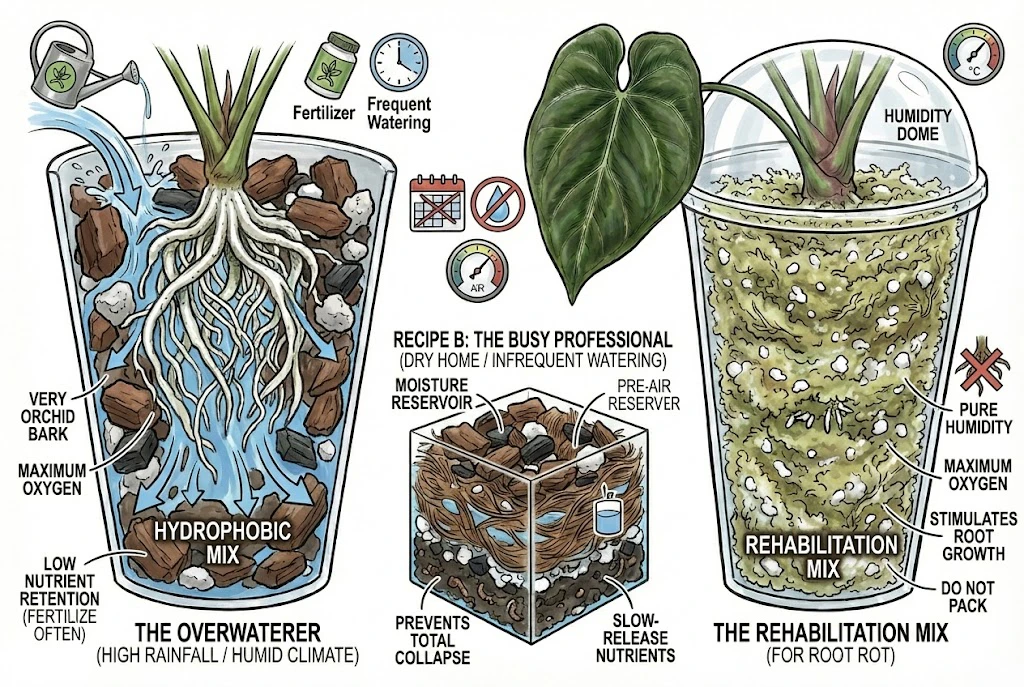
Use these as starting examples and adjust to your conditions. The parts are by volume. The actual water-holding and porosity also depend on particle size, pot height, root volume, ambient humidity, and how much you water, none of which a fixed ratio can capture.
Recipe A. For Frequent Waterers (High Humidity)
For people who water often or grow in enclosed, humid spaces.
This mix drains quickly, so the root zone re-aerates soon after watering. That makes it more forgiving of frequent watering, though any mix can stay waterlogged if it sits in a cache pot or is kept constantly saturated.
Ingredients
- 4 Parts Large Orchid Bark
- 3 Parts Coarse Pumice (or Perlite)
- 2 Parts Coco Chips
- 1 Part Horticultural Charcoal
- 0 Parts Soil/Peat
Note
Because this mix holds few nutrients, plan to fertilize regularly. Feeding with most waterings is one workable approach, but the safe rate depends on fertilizer concentration, source-water EC, leaching, temperature, and growth rate. Dose to the label and a target EC rather than treating fertilizer at every watering as mandatory, and flush with plain water periodically.
Recipe B. For Infrequent Waterers (Dry Home)
People who water less often or live in drier environments.
This mix holds moisture in the fibers while using bark to maintain structure.
Ingredients
- 3 Parts Medium Orchid Bark
- 2 Parts Coco Coir or Tree Fern Fiber
- 2 Parts Perlite
- 1 Part Worm Castings (slow-release nutrients)
- 1 Part Charcoal
Recipe C. A Recovery Mix (For Root Loss)
For a plant that has lost most of its roots and needs to regrow them.
Before potting, address the cause. Trim rotten tissue with a sterile blade, check for a viable node and any pathogen, and keep it warm.
A loose moss-and-perlite mix holds humidity around the stem while staying open enough to breathe.
Ingredients
- 70% Damp Sphagnum Moss
- 30% Perlite
Mix loosely and do not pack it down. Sphagnum packed tightly can become low in oxygen, so keeping it airy matters. Place the stem in the mix.
The moss holds humidity to encourage new roots, while perlite keeps it from staying soggy.
Light (The Energy Source)
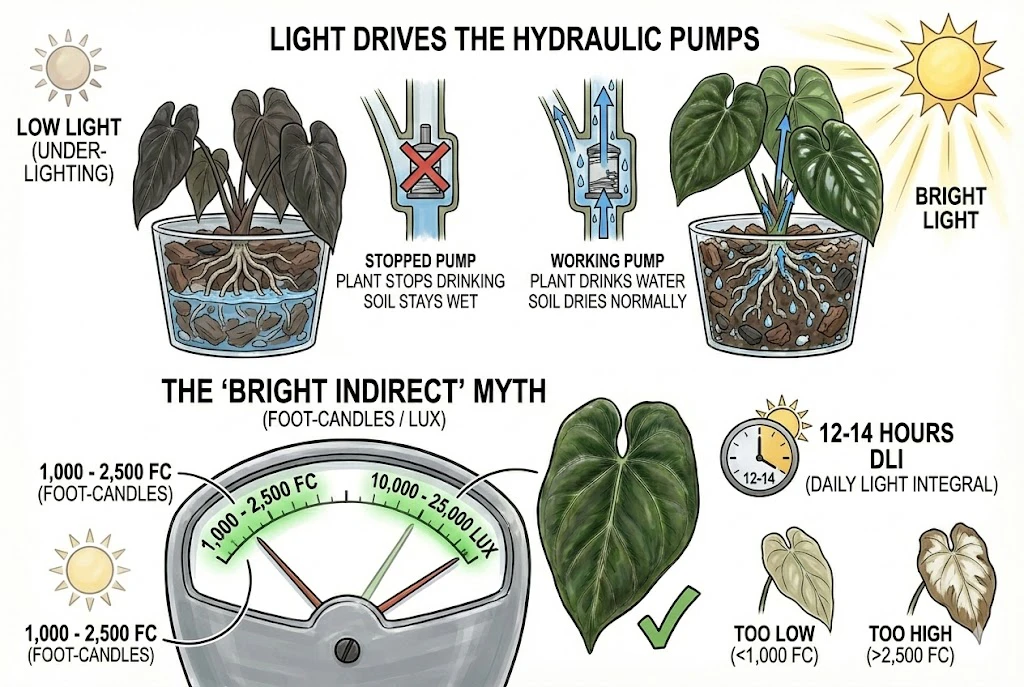
Light drives photosynthesis and, with it, transpiration and water use. In very low light a plant uses less water, which is one reason overwatering problems often go hand in hand with too little light.
Measure Bright Indirect Light
The term bright indirect light can be vague, so a measured target helps.
The metric
Foot-candles (fc) or lux for illuminance. PPFD (µmol·m⁻²·s⁻¹) if you have a PAR meter.
A general starting range
UF/IFAS commercial guidance for interiorscape Anthurium suggests roughly 1,000 to 2,500 foot-candles (about 10,000–25,000 lux), with pale foliage and sunburn possible above that.
This is a generic Anthurium range, not a KOS-specific optimum, but it is a reasonable starting point.
DLI (Daily Light Integral)
DLI is the total PAR light received in a day. Foot-candles and hours alone don’t give it. You need canopy PPFD (from a PAR meter) and your photoperiod to calculate mol·m⁻²·d⁻¹. As a practical schedule, 12-14 hours of the intensity above is a common starting point to adjust from.
The Shadow Test
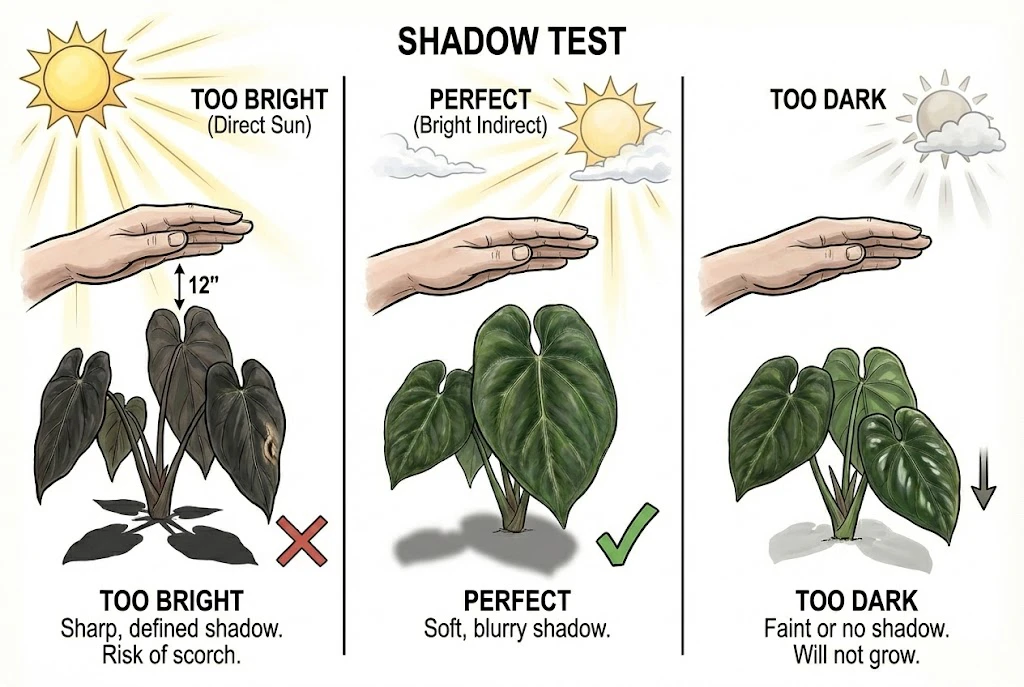
Meter-free light cue Shadow sharpness gives only a rough impression of brightness because it also depends on the size, number, and angle of the light sources and on ambient fill light. Use a lux or PAR reading at leaf level when you can.
- Hold your hand about 12 inches above the leaf during the brightest part of the day.
- Observe the shadow it casts.
Sharp Shadow
A sharp, hard-edged shadow usually means direct or very bright light, with some risk of scorching.
Soft Shadow
A soft-edged shadow is roughly consistent with the bright-indirect range.
Faint Shadow
A very faint shadow or no shadow usually means dim light. The plant will often survive but grow slowly.
Spectrum Effects (Blue vs. Red)
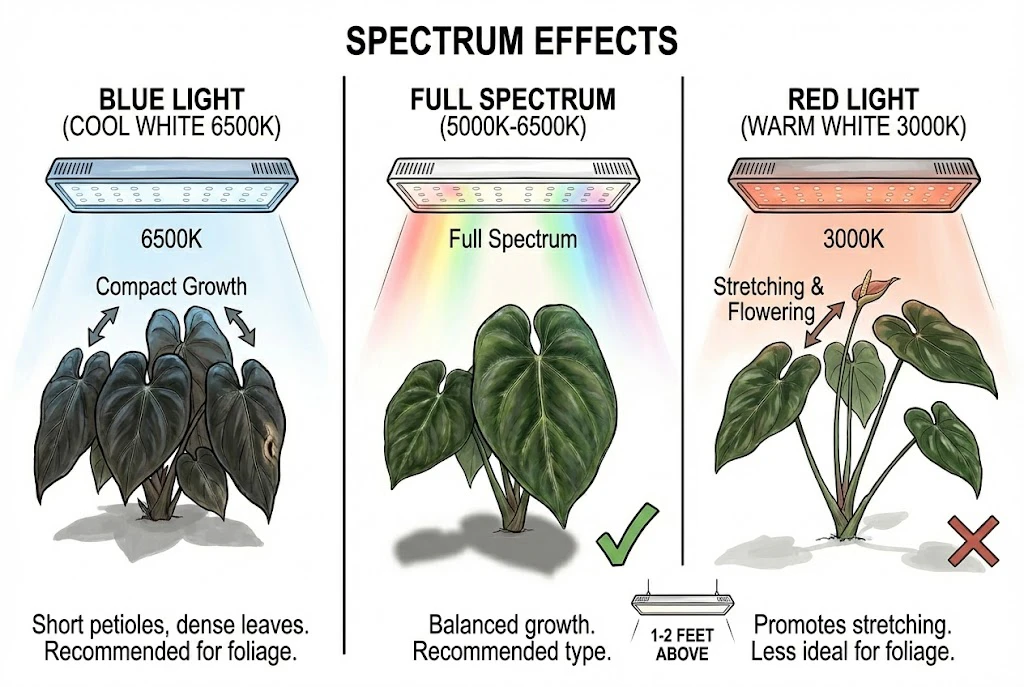
Light spectrum can influence a plant’s shape, but the effect is more complex than a simple blue-versus-red comparison.
Blue Light
A higher fraction of blue light is often associated with more compact, leafy growth, though total intensity and photoperiod matter too.
Red and Far-Red
Stem stretching is usually driven more by a low red-to-far-red ratio (a shade signal) than by red light alone. Red can even support compact growth in some conditions.
Flowering responses for this ornamental foliage plant have not been specifically tested.
Practical Advice
For the King of Spades, compact foliage is usually preferred, and a balanced white full-spectrum LED (which looks white rather than purple) is a practical choice. Keep in mind that color temperature (Kelvin) describes how the light looks to your eye, not its PAR output or the PPFD reaching the canopy.
SANSI 36W Grow Light
SANSI 36W Grow Light fits one plant when an open, properly rated E26 fixture can cover the full canopy. It is not a good fit for a wide shelf, several mature plants, or an enclosed fixture that traps heat. Start farther from the leaves, increase gradually, and judge the final height and run time by leaf response or a canopy-level light measurement.
Atmosphere (Humidity and VPD)
For wider shelves or fixtures that need documented coverage, compare PPFD maps, dimming, and heat management in the aroid grow-light chooser.
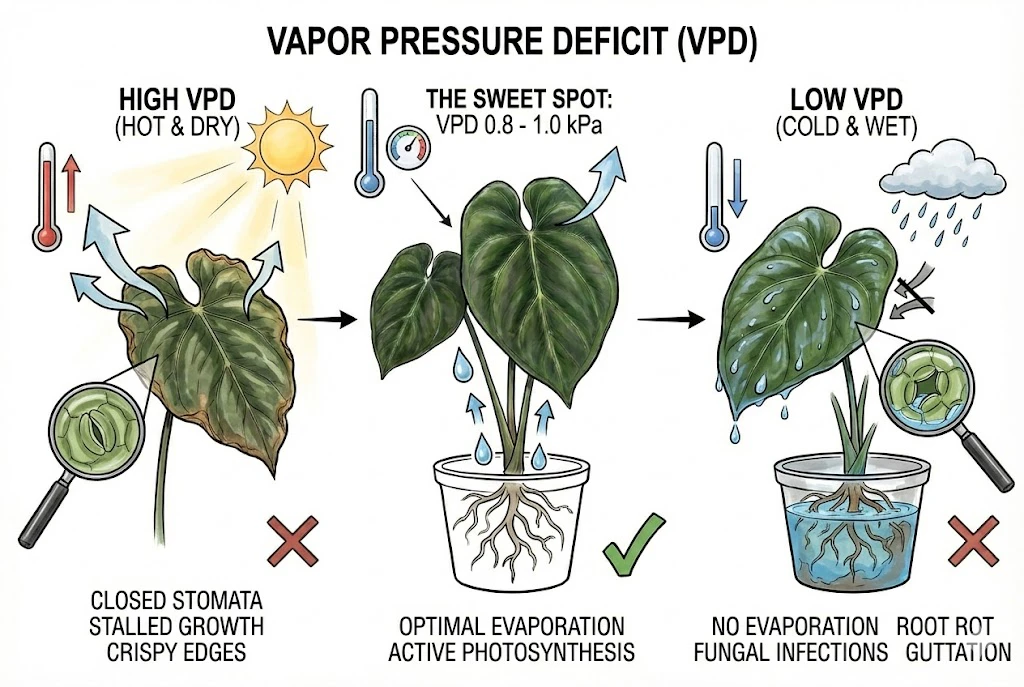
The King of Spades is often considered difficult because of its humidity needs. It does want humidity, but stagnant, constantly wet air can encourage disease.
Understanding VPD (Vapor Pressure Deficit)
Relative humidity (like 70%) is only part of the picture. The plant responds to VPD.
What is it?
Strictly, VPD is the difference between the saturation vapor pressure at the leaf’s temperature and the actual vapor pressure of the surrounding air. It measures the air’s drying potential on the leaf.
Without measuring leaf temperature, a VPD figured from air temperature is an approximation, and grow lights or transpiration can make the leaf warmer or cooler than the air.
High VPD (Hot & Dry)
The air pulls water from the leaf quickly. The plant tends to close its pores (stomata) to conserve water, which reduces photosynthesis and can stall growth and dry the leaf edges.
Low VPD (Cool & Saturated)
The air is nearly saturated, so little water evaporates from the leaf. With little transpirational pull, water uptake slows, and persistent surface wetness can favor root rot and disease. In a reservoir pot, check oxygen supply and wick behavior against the self-watering root-rot safeguards.
Use plant response, not a fixed VPD target
There is no King of Spades-specific VPD target. Use room temperature and humidity as context, then watch for dry edges, slow unfurling, condensation, and leaf wetness. Raise humidity only enough to ease dry-air stress, and add gentle airflow before the leaves or surrounding surfaces stay wet.
The Stuck Leaf Phenomenon
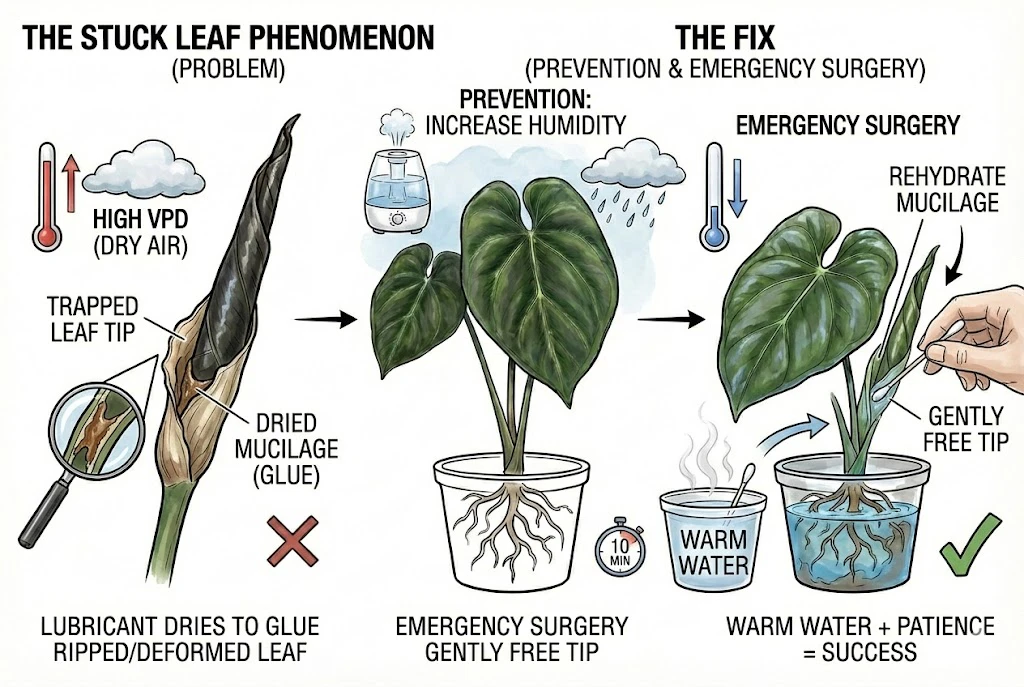
Sometimes a new leaf gets trapped in its sheath and tears as it tries to expand.
A possible mechanism
Anthuriums secrete mucilage around developing tissue, and it may act as a lubricant. The idea that dry air lets this mucilage dry into a glue that traps the leaf is a reasonable hypothesis, but it has not been tested for this cultivar.
What to do
Prevention
Keep humidity steady when a new leaf is emerging so tissue stays supple. This is the reliable approach.
If a Leaf Sticks
Do not force or peel it. Young leaves and cataphylls tear easily, and a wound can invite infection. Keeping the environment humid and stable while letting the leaf finish on its own is usually safer than manual intervention.
First Report of Colleters in Araceae. Anthurium andraeanum Reveals Diverse Mucilage Glands
Airflow (Preventing Rot)
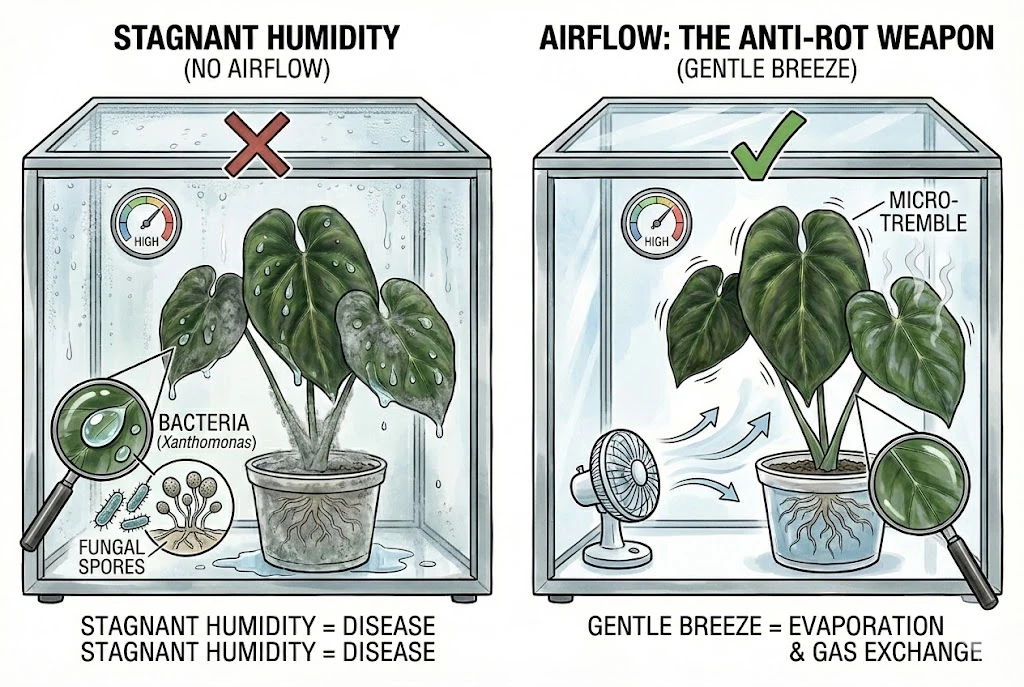
If you raise humidity (for example, in a cabinet), add gentle air circulation. Still, saturated air tends to encourage bacteria and fungus by keeping leaf surfaces wet.
Balancing airflow
Gentle circulation helps break up the saturated layer near the leaf and reduces condensation and humidity pockets.
Avoid a strong, direct blast, though. Too much continuous airflow raises local VPD and can dry out tender leaves.
Watch for leaf wetness, condensation, and how the plant responds, and adjust the fan speed rather than treating any fixed setting as a rule.
Water Chemistry and Hydraulics
Water transports nutrients. If water uptake is compromised, nutrients cannot reach the plant.
Determining When to Water
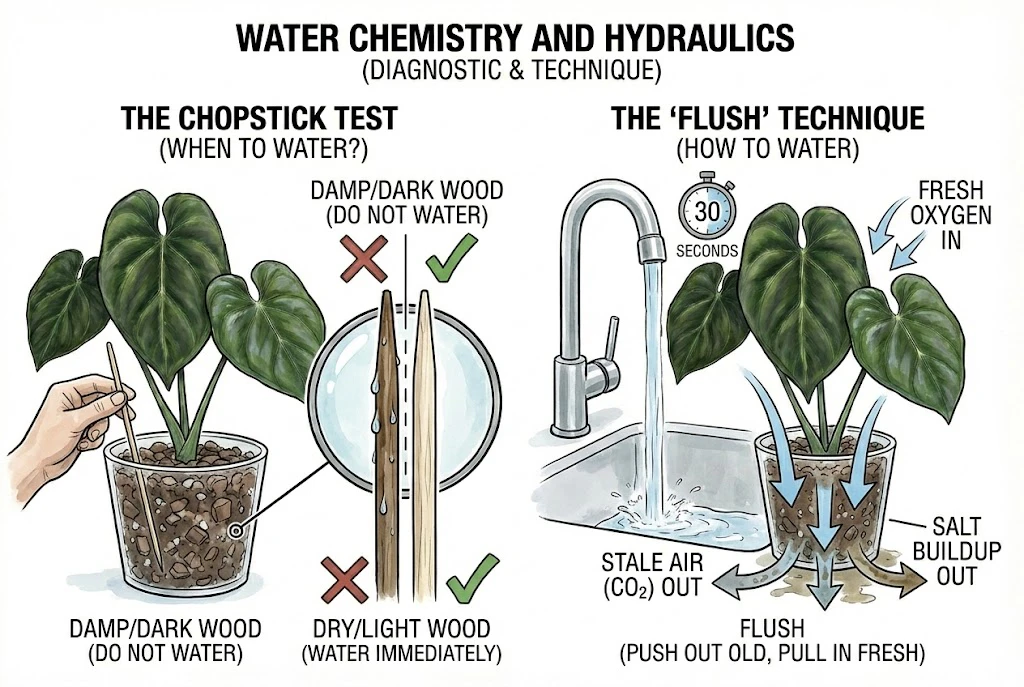
Water by checking moisture rather than following a strict calendar.
1. The Chopstick Test
Insert a wooden skewer to the bottom of the pot, leave it a few minutes, then pull it out.
Damp, darkened wood suggests moisture remains. Dry, light wood suggests it’s drying out.
Treat this as one signal, not a rule. Skewer color is affected by bark or coir staining, where you insert it, and contact, and the pot center can be damp while parts of the root zone are dry.
Combine it with pot weight, how the mix has dried down, and a look at the roots before deciding to water.
2. The Flush Technique
When you do water, run water through the pot thoroughly.
Why flushing helps
Flushing washes away accumulated salts. It also helps re-aerate the mix. Water fills the pore spaces, and as it drains, fresh air is drawn back in behind it.
(The oxygen comes from that drain-and-refill cycle, not from the pour itself.)
Water Quality (A Common Issue)
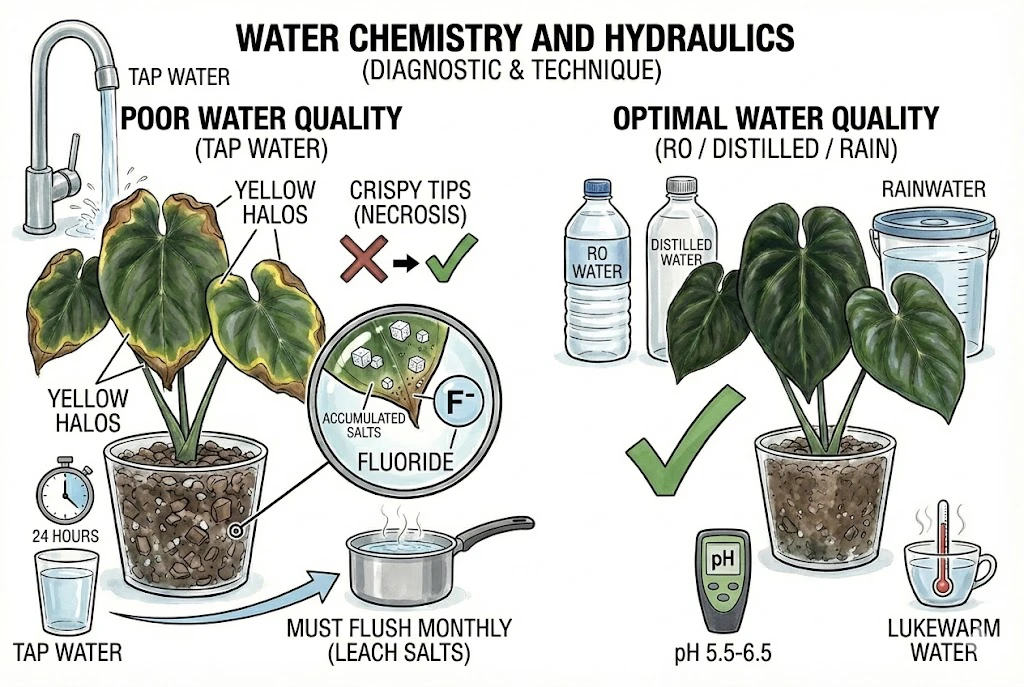
Accumulated salts can contribute to tip injury in anthuriums, and some growers point to fluoride as well.
Note that brown tips with a yellow halo are a nonspecific symptom, so this is not a single, definitive diagnosis for the King of Spades.
Symptoms
Brown tips that slowly expand, sometimes with a yellow halo.
Managing water quality
Whether your tap water is a problem depends on its actual alkalinity, hardness, sodium, EC, and disinfectant. Check the local water report rather than assuming all tap water is bad or all low-mineral sources are ideal.
RO or Distilled Water
Reverse Osmosis (RO) or distilled water is low in minerals. If you use it, supply a complete fertilizer (including calcium and magnesium), since these waters carry no nutrients.
Rainwater
Rainwater can work, but roof debris, pathogens, metals, and storage sanitation matter more than pests alone.
Tap Water
Tap water is often fine. Letting it stand 24 hours off-gasses chlorine but does not remove chloramine or fluoride. If mineral buildup is a concern, flush the pot heavily every so often to leach salts.
When RO water is the long-term source, choose calcium and magnesium additions from the water report, base fertilizer, and target EC with the RO remineralization chooser instead of adding a supplement by habit.
Nutrition (Feeding Requirements)
Anthuriums are light but consistent feeders. They prefer steady, low doses of nutrients.
The Need for Calcium & Magnesium
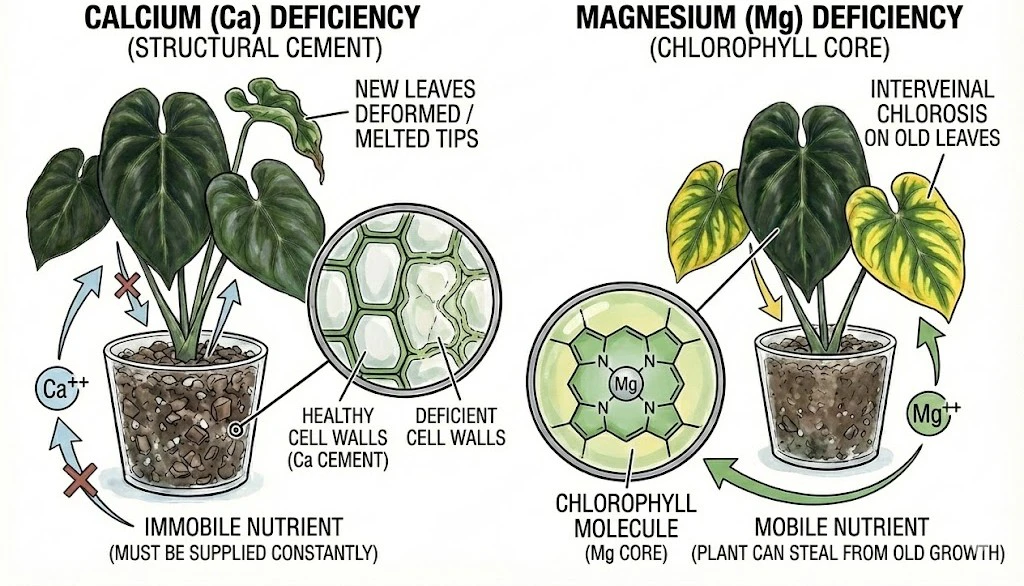
Anthuriums generally have a relatively high calcium requirement.
Calcium (Ca)
Calcium is a structural component of cell walls and is relatively immobile in the plant, so it cannot be moved from old leaves to new ones. New growth depends on a steady supply from the roots.
Deficiency Sign
New leaves may emerge deformed, hooked, or damaged at the tips. This look is not specific to calcium, though. Low transpiration/high humidity, a leaf sticking mechanically, thrips or mites, root damage, or a boron/calcium imbalance can all produce deformed new growth, so diagnose before dosing.
Magnesium (Mg)
This is essential for chlorophyll. It is mobile, so the plant can move it from old leaves to new ones.
Deficiency Sign
Yellowing between the veins on the oldest leaves.
A Feeding Approach
Use the fertilizer label, your water source, and the plant’s response rather than a fixed community recipe.
Dyna-Gro/SUPERthrive Foliage-Pro
Choose Dyna-Gro/SUPERthrive Foliage-Pro when you need one complete fertilizer for this plant and the rest of your collection. Its complete formulation can avoid automatically adding a second Cal-Mag product. Skip it if your current fertilizer already supplies the necessary macro- and micronutrients without driving EC too high.
Dosage
A common approach is 1/4 to 1/2 of the label strength, adjusted to a target EC/pH for your water.
Frequency
Feeding at a dilute rate with most waterings works for many growers, but confirm it against your source-water EC and leach with plain water periodically rather than feeding blindly every time.
Botanicare Cal-Mag Plus
Botanicare Cal-Mag Plus is an optional supplement for RO water, coco-heavy media, or a confirmed mineral gap that the base fertilizer does not cover. Skip it with mineral-bearing tap water or a complete fertilizer unless your combined analysis and EC show a real need. Unneeded calcium and magnesium can raise EC and create an imbalance.
Silicon
Silicon may help strengthen cell walls. If you use it, add it to the water first to reduce reactions with other nutrients.
Pest Management
The King of Spades is prone to spider mites and thrips. For treatment, favor labeled products used to their directions over homemade sprays, which can damage these thin velvet leaves.
Stippling, webbing, and live mites should be confirmed before treatment. The spider-mite inspection checklist sets the scouting interval and escalation order.
Spider mites (Tetranychidae)
Susceptibility
They thrive in hot, dry conditions, which also stress the plant.
Signs
Stippling
Tiny yellow or white dots appear across the leaf.
Leaf Appearance
The leaf may look dull or dusty.
Webbing
Fine strands may gather near the leaf stem.
Life Cycle
The two-spotted spider mite’s development time depends heavily on temperature (roughly 5 to 20 days, with the fastest turnover (about a week) only in hot conditions near 30°C). Warmer, drier air speeds them up.
Control Strategy
Start with the least aggressive, best-documented options and identify the pest first.
Rinse
Spraying or rinsing the foliage with water knocks off many mites and is safe to repeat.
Labeled Products
For treatment, use a product labeled for spider mites on indoor or ornamental plants, such as a registered insecticidal soap or horticultural oil, and follow its directions, including any spot-test and re-application interval. Avoid homemade alcohol-and-dish-soap sprays. Dish detergent is not insecticidal soap and can damage the cuticle, alcohol can be phytotoxic, and both are especially risky on thin, sensitive velvet leaves. Extension sources warn against homemade alcohol and detergent mixtures on plant tissue.
Biological Control
The predatory mite Phytoseiulus persimilis specializes on two-spotted spider mites but needs prey to stay. It disperses or starves without them and works best in moderate warmth, roughly 62-80°F, with moderate humidity. Contact sprays like soaps and oils will also kill predators, so do not combine the two at once. Release predators only after any contact treatment has cleared.
Thrips (Thripidae)
Why they are hard to control
Thrips lay eggs inside the leaf tissue, where surface sprays cannot reach them.
Signs
Silvering
Silvery patches appear on the leaf surface.
Frass
Tiny black dots may smear when touched.
Deformity
Thrips feed on new growth and can cause leaves to emerge twisted.
Control Strategy
Inspect and Isolate
Confirm thrips before treating and separate the affected plant. Blue sticky cards help monitor adult activity and partially suppress it, but they do not remove eggs or larvae in the tissue.
Spinosad
A spinosad product can be effective against thrips, including some larvae in new growth. Choose one labeled for thrips on indoor ornamentals and follow its rate, re-entry, application limits, and resistance-rotation guidance. The safest choice depends on whether you mean risk to people, pets, beneficials, or the plant, so rely on the label rather than a blanket claim.
Selective Pruning
Cutting off tissue you have confirmed is infested can reduce eggs, but check before removing a valuable leaf because cutting also wounds the plant.
Systemics as a Last Resort
Imidacloprid soil granules work, but neonicotinoids are highly toxic to bees and other pollinators and translocate into pollen and guttation droplets. Reserve them for a stubborn infestation that other measures cannot clear, keep the treated plant away from any flowering or outdoor plants, and follow the label exactly.
Treatment Frequency
Continue treatment and scouting on a schedule set by the product label and the pest’s life cycle at your temperatures. Several weeks of repeated treatment is typical. Rotate modes of action to limit resistance.
Disease (Bacterial vs. Fungal Clues)
Bacterial blight (Xanthomonas) is far more serious than most leaf-spot fungi, but lesion shape, halo, texture, and spread are only clues, not a diagnosis.
Symptoms overlap, early or systemic infections can look mild or show nothing, and only a lab or extension diagnostic can confirm the pathogen.
When in doubt, treat a suspect plant as if it could be bacterial.
| Feature | Suggestive of bacterial blight (Xanthomonas) | Suggestive of a fungal leaf spot |
|---|---|---|
| Appearance | Often V-shaped lesions at leaf edges. | Often circular or irregular spots. |
| Halo | Frequently a yellow halo. | Concentric rings or a less distinct halo. |
| Texture | Can look water-soaked or greasy. | Often dry or powdery. |
| Spread | Can move rapidly and systemically. | Often slower and more localized. |
What to Do With a Suspected Bacterial Infection
UF/IFAS guidance for Anthurium is to treat a confirmed or strongly suspected Xanthomonas-infected plant as unsalvageable. Discard the whole plant (not just individual leaves), and sanitize tools, water, and surfaces because the bacterium spreads readily to nearby aroids. Removing a few leaves is usually not enough. Isolate the plant immediately and, if possible, get a diagnosis before deciding.
Fungal Leaf Spots
Fungal leaf spots cover several different pathogens with different treatments, so telling someone to use a fungicide is too vague. Identify the organism where you can, improve airflow and reduce leaf wetness, and choose a product labeled for that disease on Anthurium, following its resistance-group and phytotoxicity guidance rather than reaching for a generic spray.
The Guttation Risk
Bacterial blight often enters through pores at the leaf tip (hydathodes) during guttation, when the plant exudes water droplets. If you see droplets on leaf tips, reduce humidity and increase airflow so they dry quickly.
Acclimation and Propagation
Acclimating New Plants
Easing a plant into your conditions is sensible, but start by inspecting it rather than following a fixed timeline.
On arrival
Inspect and Quarantine First
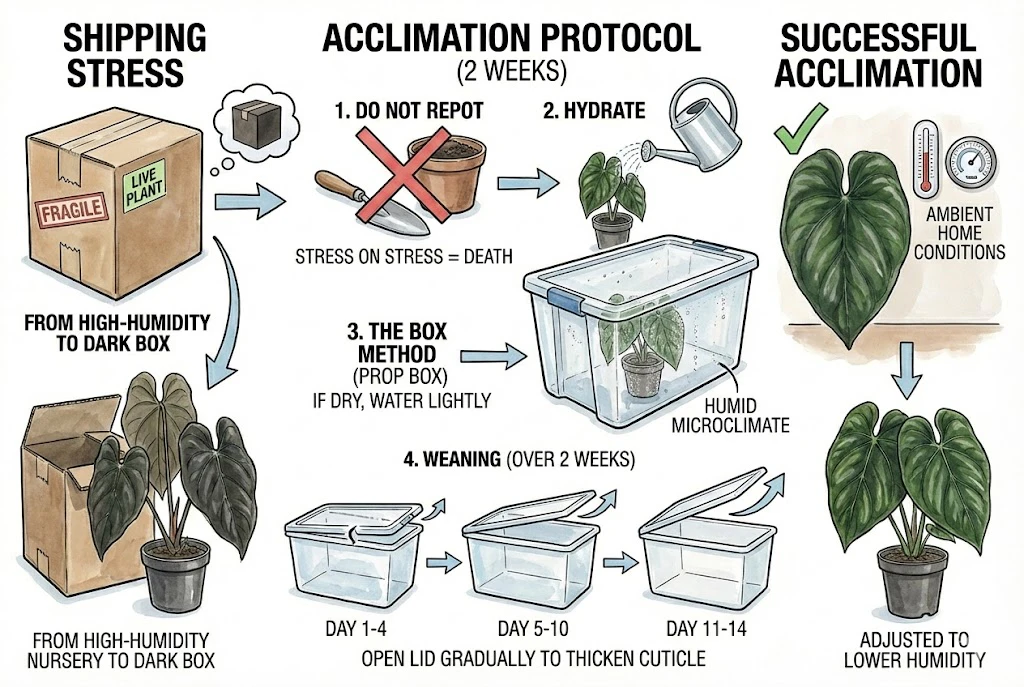
Check the roots and media and keep the new plant separate from your collection for a few weeks, scouting repeatedly for pests. Waterlogged or rotting media, no drainage, root pests, or a severely root-bound plant may need attention right away rather than being left undisturbed.
If the roots and media look healthy, avoid unnecessary root disturbance and water lightly if the mix is dry.
A clear bin with the lid cracked can help a plant that arrived from a humid nursery into dry air.
But if the plant or media is already wet or possibly infected, a closed bin can worsen condensation and spread disease, so ventilate it and judge by the plant’s condition and the humidity gap, not by a rule.
If you use a bin, open it gradually over a couple of weeks so the plant adjusts to lower humidity.
Propagation
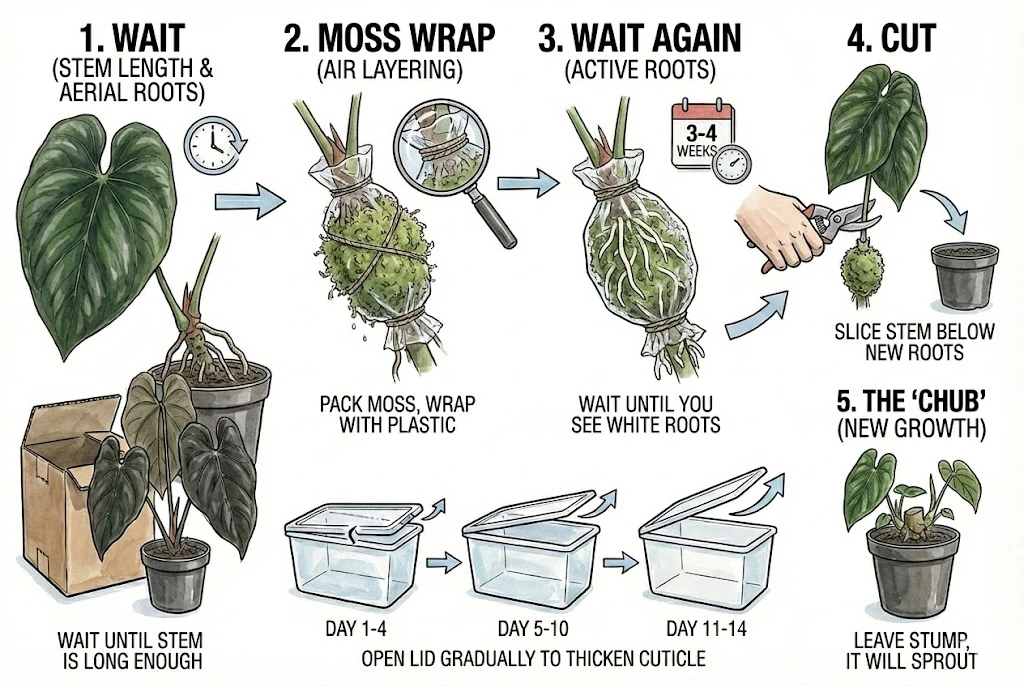
Stem cuttings and air-layering are workable ways to propagate the King of Spades, though commercially it is also produced by tissue culture and grown from seed.
Air-layering encourages roots to form on the stem before you separate it.
Propagation Steps
1. Wait for a Node
Wait until the stem shows aerial roots or a node you can wrap.
2. Wrap the Moss
Wrap damp sphagnum moss around the roots or node and cover it with plastic to hold humidity.
3. Let Roots Form
Rooting time varies with stem maturity, node, temperature, moisture, and season, so watch the moss rather than counting weeks.
4. Cut When Ready
Once an adequate, healthy root mass has formed, cut just below it with a sterile blade and pot the top.
5. Watch for Regrowth
Left in the pot, the bottom stump may resprout from a viable node, but this is not guaranteed. Keep cut surfaces clean and watch for rot.
Affiliate Disclosure
This article contains Amazon affiliate links. As an Amazon Associate I earn from qualifying purchases. If you use these links, the site may earn a commission at no extra cost to you. Product availability, price, and specifications can change. Check the current listing before buying.