
2025 Paludarium Design Trends: The Riparian Renaissance
The 2025 paludarium trends decoded: atmospheric mossscapes, vertical cliff ecotones, kinetic pumped streams, hardscape engineering, functional planting, and how to scale it all up.
Priya Patel · Published 2025-12-12 · 12 min read
Key Takeaways
- The 2025 paludarium trend is a riparian renaissance built around realistic land-water transition zones, with atmospheric moss landscapes, vertical cliff ecotones, and pumped-stream systems replacing the simple terrarium water bowl.
- The land section can contribute to the system when water passes over oxygenated, biofilm-covered moss and rock, but it supplements rather than replaces the main filter and routine water testing.
- Engineering matters because overhangs and shaped landforms need planned support, and cotton must never be packed into cyanoacrylate joints because the reaction can cause burns or ignition.
- Planting should follow micro-climates, with amphibious plants and waxy Anubias in the splash zone, moss near the waterline, and a raised drained pocket for carnivorous plants such as Nepenthes.
- Large builds need structure, humidity, lighting, filtration, and failure safeguards sized to the measured needs of the species rather than to tank dimensions alone.
The Riparian Renaissance in 2025
A good paludarium treats the land-water edge as one connected habitat. Plan how water moves, where roots stay wet, and where foliage gets humidity without standing water.
I tape the proposed low and high water lines onto the empty glass and build the main hardscape dry. Then I reach every pump, drain, and planting pocket with the lid and doors in their real positions.
If my hand or siphon cannot reach a hidden area without dismantling the focal piece, I change the trend-inspired layout before it gets wet. Maintenance clearance is part of the design even though finished photographs never show it.
The Three Winning Approaches
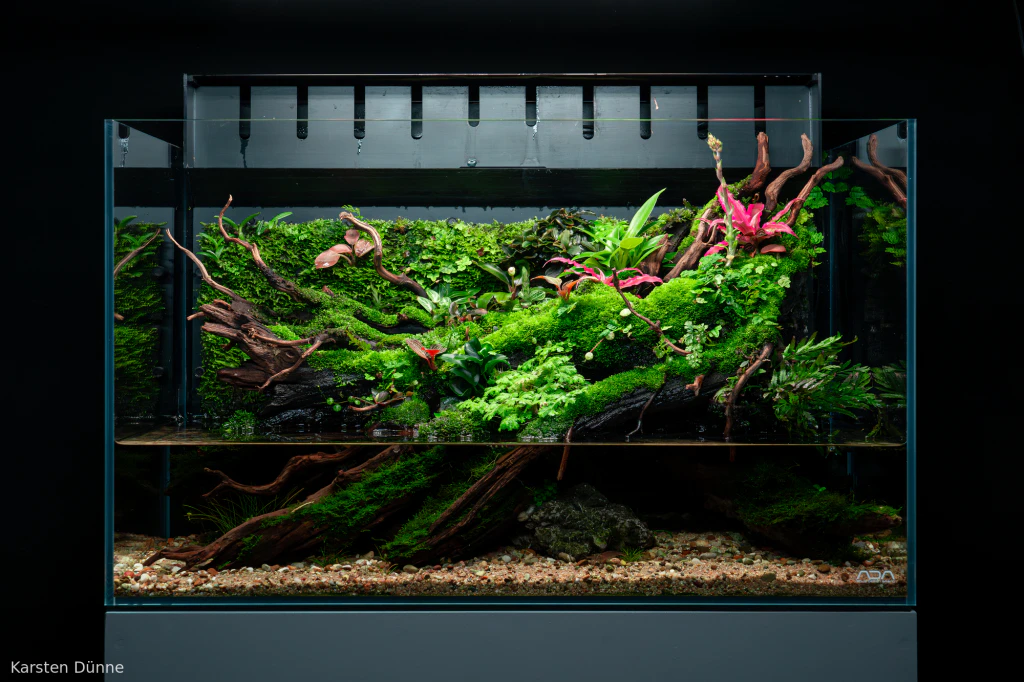
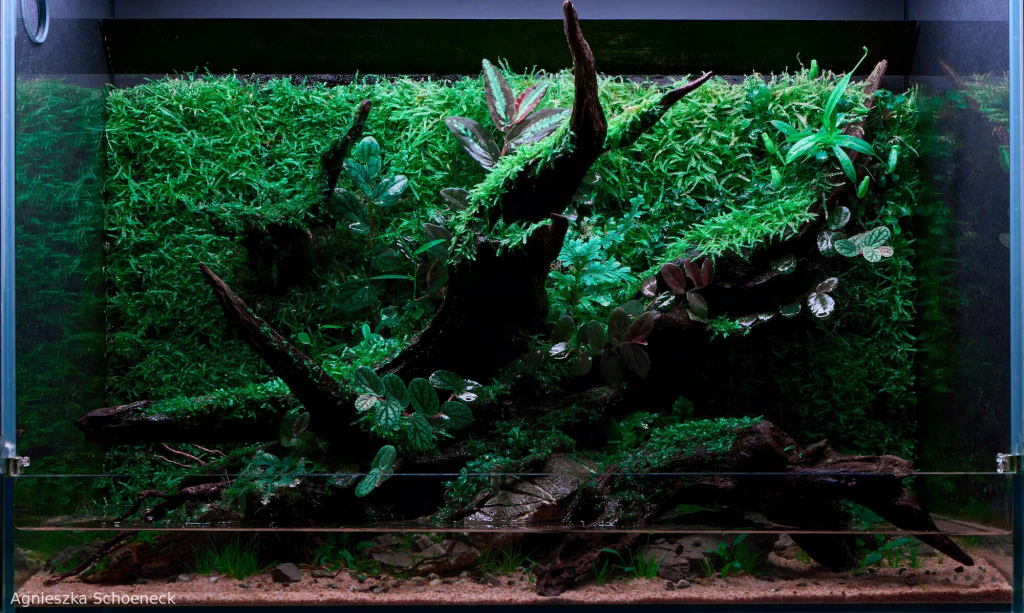
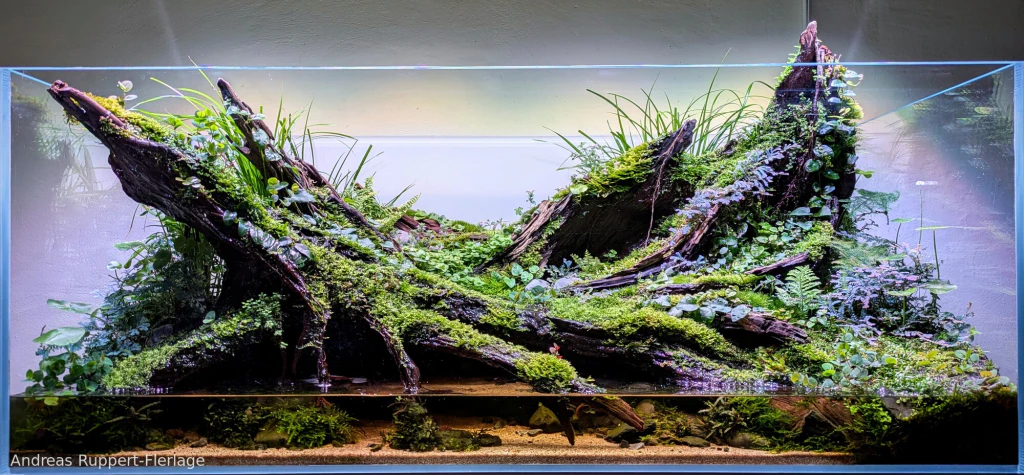
The winners, Koke No Yume by Karsten Dünne, Emerald Wilds by Agnieszka Schoeneck, and Fountain of Life by Andreas Ruppert-Flerlage, each show a strong command of erosion-like form, planting, and water movement.
Water Is a Design Agent
They don’t just display plants. They emphasize water shaping land, with eroded-looking banks, exposed roots, and active waterfalls.
2. Deconstructing the 2025 Archetypes
2.1 Rank 1. Koke No Yume (The Dream of Moss) – The Atmospheric Softscape
Texture Comes From the Softscape
Dünne’s first-place entry is an atmospheric softscape, a texture-driven composition rather than a heavy, aggressive hardscape.
Use moss, wood, and small plants to soften the visible stone skeleton. A dark background can make the planted surface feel continuous instead of exposing every structural joint.
2.2 Rank 2. Emerald Wilds – The Vertical Cliff Ecotone
Build Verticality With a Cliff
Schoeneck’s Emerald Wilds introduces verticality and carnivorous flora. It uses horn wood and Akaishi stone to build a steep, cliff-like interface, a sharp transition that mimics a cutbank rather than a rolling bank, with driftwood the judges highlighted for its visual impact. The inclusion of Nepenthes, or pitcher plants, points toward a drained, nutrient-poor upper zone kept apart from the nutrient-rich water below, although the entry’s exact internal construction is not documented.
Use Air Space for Scale
Its classic triangular composition, whose apex breaks the water’s surface, draws the eye upward and effectively doubles the perceived volume by using the air space.
2.3 Rank 3. Fountain of Life – The Kinetic Riparian System
Use Flow as a Structural Feature
Moving water can irrigate the terrestrial section and create a focal point. Set the flow so it keeps the intended plants moist without flooding their roots or eroding the substrate.
Match Wood to Wet-Dry Zones
Rot-resistant mangrove wood suits the wet-dry zones the streams create, and the agitated surface adds a shimmering texture that static water lacks. The judges also praised the quality of the flow.
2.4 Choose Plants for the Available Scale
A double-bank valley, with terrestrial sections rising on either side of a central channel, is one reliable way to create depth. In a small build, use genuinely small plants such as Anubias ‘Petite’ or Bucephalandra ‘Mini’ rather than repeatedly pruning an oversized plant into place.
3. The Visual Narrative (Photography Trends)
Balance Air and Water in the Frame
The interface between air and water can be difficult to photograph. Clean the glass, remove droplets, and decide whether the picture should show the water surface or look through it before setting the lights.
Control Reflections and Droplets
Expose the Two Zones Separately
The most common issue is dynamic range. Because water absorbs light, the aquatic section usually reads darker than the land, though how much depends on lighting, depth, turbidity, background and exposure choices.
A practical answer is zoned lighting (tighter light aimed into the water column, more diffused light over the terrestrial zone) and some photographers mix color temperatures to visually separate the cool water from the warmer land.
Use Reflections Deliberately
The air-water interface can also be used deliberately. The surface reflection mirrors the hardscape, creating a double horizon that Fountain of Life breaks into impressionistic texture. A circular polarizer, rotated to the right angle, can cut glare off glass and submerged leaves, though it works by angle and won’t selectively erase only unwanted reflections.
Freeze Droplets Only When Needed
When you want to show mist, use a fast flash burst to freeze droplets. Test it with your own camera before changing the enclosure conditions just for a photograph.
4. The Architectonics of Nature (Hardscape Engineering)
Build the Supporting Skeleton
Build hardscape as a stable skeleton that supports plants, water flow, and the load it will carry.
Choose Durable Texture
Material choice favors texture that survives macro-photography scrutiny. Dense, rot-resistant woods such as horn wood and mangrove provide gnarled movement, while directional stones such as layered Akaishi slate and wrinkled Frodo stone point their strata toward the focal point.
Support Overhangs Deliberately
Several layouts feature an overhang (terrestrial sections jutting over the water to create shadowed caves).
The entrants’ exact build methods aren’t documented, but as a general approach this look is achieved with an internal armature, epoxy putty at load-bearing joints, and expanding pond foam sealing the base so water flows over the hardscape rather than under it.
Match the materials and any weight-bearing joints to your loads, cure times and livestock-safety requirements.
Bond Small Joints Safely
Cyanoacrylate (superglue) gel is the usual bonding agent for small stone-and-wood joints. Do not pack it with cotton, wool, cotton swabs, or cotton gloves. Cyanoacrylate reacts with cellulose fibers extremely fast, and the reaction can get hot enough to cause burns and even ignite the material.
Use only gap fillers the glue’s manufacturer supports, and treat any joint that actually carries weight as a structural connection to design and verify separately, per the adhesive maker’s guidance.
General-purpose cyanoacrylate gel
A general-purpose cyanoacrylate gel grabs quickly for small dry stone-and-wood joints, but it is brittle under shear, so it is not for load-bearing flex joints.
Hardware-store formulas are usually not labelled aquarium-, paludarium-, or amphibian-safe, so treat aquatic or animal use as unverified. Confirm suitability with the maker, follow the full cure time before any submersion, and rinse thoroughly before adding livestock. When the joint matters or you want documented livestock safety, compare aquarium-safe glue, silicone and foam options.
Shape the Land-Water Profile
Geometrically, layouts split between the convex cliff (a high rear corner sloping sharply to the opposite front, maximizing terrestrial planting while leaving open swimming space) and the double-bank valley (a V or U shape creating a canyon down a central river channel, excellent for depth in shallow tanks).
5. The Botanical Gradient (Functional Planting)
Plant the Splash Zone
Choose Plants by Microclimate
Choose plants for the microclimate where they will actually grow, not only for color.
Treat Waterline Plants as Transitional
The hardest zone is the waterline, solved with amphibious transition specialists. Hygrophila serpyllum and Hydrocotyle verticillata can be planted in shallow water and allowed to creep onto wet land, transitioning leaf forms to hide the water’s edge. Anubias barteri var. nana ‘Petite’ also tends to hold up better than delicate stems in the constantly-wet splash zone because its leaves are tough and waxy, though no plant is immune to rot there.
Keep Moss Near the Waterline
Use Moss for Low Surfaces
Moss also earns its place. Species like Vesicularia hold moisture and, through capillary action, can help keep low surfaces near the waterline damp, which may reduce how much you have to mist those immediate areas.
Water Tall Plantings Separately
It won’t reliably lift water to tall upper plantings. That depends on species, substrate, height, density and evaporation, so treat watering for higher plants as a separate, independently verified job.
Add Fine Underwater Texture
Feathery Fissidens adds fine texture on submerged wood.
Give Carnivorous Plants a Drained Pocket
Keep Carnivores Above the Nutrient Zone
Carnivorous plants generally prefer low-nutrient, acidic, well-drained media and high humidity. Give them a raised, drained pocket that stays clear of nutrient-rich aquarium water.
6. The Living System (Ecology)
Treat Land as Supplemental Filtration
Let Land Supplement Filtration
These builds work best when treated as modeled ecosystems rather than static dioramas. Pumping aquarium water over terrestrial moss and rock exposes it to air and biofilm, so the land zone can act as a supplementary biological filter.
Retain Main Filtration and Testing
That doesn’t replace your main filtration. Effective nitrification needs enough surface area, oxygen, appropriate flow and a mature biofilm, plus water testing for ammonia, nitrite, nitrate and dissolved oxygen.
Export Nutrients From the System
Leaf-litter botanicals grow biofilms that feed shrimp, but their breakdown also adds to the oxygen and nitrogen load, so the nutrient cycle is not self-closing. You still need water changes and nutrient export.
Separate Air Movement From Air Exchange
Maintain Turgor Without Stagnation
Success with high-humidity emersed plants such as Bucephalandra and Bolbitis depends on maintaining turgor without fungal rot.
Separate Movement From Exchange
That means distinguishing internal air movement from fresh-air exchange. A waterfall stirs the internal air but also adds water vapor, so on its own it doesn’t prevent condensation or mold.
Tune Ventilation to Observations
Use genuine ventilation, drainage, and sensible planting density to manage condensation. Tune conditions to the species and respond when leaves, glass, or substrate stay wet for too long.
Match Fauna to Its Actual Role
Recognize Cleanup Crew Limits
Fauna have roles but limits. Small fish like Boraras and Rasbora eat small animal foods and won’t reliably clear detritus, and an Amano-shrimp/Nerite-snail crew grazes some algae but won’t remove all of it.
Plan Stocking Before Relying on Fauna
Match each species’ diet, minimum group size, water parameters such as temperature and GH/KH, stocking level, space, escape-proofing and predator relationships before relying on them.
7. Scaling the Trends to Large Designs
Scale the Structure Before the Hardware
A larger installation needs more deliberate engineering and automation, not merely a scaled-up version of a small tank.
Design the Load Path
Structurally, small tanks can lean on glued stone, but a large 200 cm build generally uses an internal PVC or egg-crate skeleton clad in stone or foam-carved rock.
An internal skeleton does not remove the load from the glass on its own. The load still travels to the floor, frame, and stand, so size the whole system to the tank and stand maker’s load ratings and have a large installation reviewed by a structural professional.
Reserve Access for Maintenance
Account for point loads, buoyancy, long-term creep, underwater aging of adhesives and foam, and maintenance access before closing the structure behind hardscape.
Automate Humidity With Failure Handling
Match Misting to Measured Needs
Hand-misting is impractical at large scale, so big builds often plumb in high-pressure misting with hidden nozzles and a controller that triggers bursts when humidity drops.
Whether that keeps orchids or Nepenthes stable in an open-top display depends on the specific species, temperature, VPD, ventilation, drainage, water quality and sensor placement, not on a single humidity number.
Add Failure Handling to Automation
Design to your plants’ measured needs and include a fail-safe for when a nozzle clogs or the controller fails.
Use Sensors to Close the Loop
That automation is only as good as your sensing, so a hygrometer/thermometer in the canopy turns a visual impression of humidity into a number you can act on.
Digital thermo-hygrometer
A low-cost indoor digital thermo-hygrometer is a manual display sensor, not a controller. Accuracy, refresh rate, logging, alarms, and control outputs vary by model, so check the exact specification sheet rather than carrying one product’s figures over to the category.
A display-only unit is useful for following trends and checking whether misting is holding target. Automatic control needs a separate controller and sensor with alarms and a failure response.
Keep the sensor in the canopy away from direct nozzle spray, and confirm that its operating and water-resistance ratings cover the humidity and condensation it will encounter. Many inexpensive indoor units are not rated for sustained high humidity or condensation.
Measure Before Choosing Lighting
Match Beam to Water Depth
Lighting a deep column usually means hybrid fixtures (broad LED bars for the terrestrial canopy plus narrower-beam pendants for the water).
Whether a beam reaches the bottom of 30+ inches of water depends on the target PAR, beam angle, water clarity and fixture output, so choose fixtures against those numbers rather than assuming a pendant will reach the bottom.
Size Filtration to the Surface
Use a Sump for Capacity
Filtration can scale via drilled overflows to a cabinet sump with large biomedia capacity and a stable water level.
Size Rain Walls to the Surface
A rain wall can split the return to trickle down the back wall for extra biological filtration, but size flow, drainage, waterproofing, and splash or erosion to the actual surface. A high flow rate is not a target in itself.
Treat Protein Skimming as Conditional
Protein skimming, or foam fractionation, is well established in marine systems. In freshwater it can reduce organic and particulate load in purpose-built recirculating setups, but its usefulness depends on the device and operating conditions, so it isn’t a default sump component here.
Select Plants for the Final Canopy
Select for Final Size and Shade
Plant selection also shifts from nano toward larger species, for example Anubias gigantea and Lagenandra in place of Anubias nana, larger Microsorum and Bolbitis for bulk, and big aroids like Monstera, Philodendron or Alocasia in the canopy.
Check Species-Specific Constraints
These plants vary widely by species in final size, light and airflow needs, toxicity and how aggressively their roots spread, so check the specific species’ mature size and requirements. A dense canopy also shades the aquatics below, which isn’t automatically beneficial.
The Future of the Living Art
The Shared Design Principle
Three Forms, One Interface
Whether you use moss-driven softscape, a vertical cliff, or a moving stream, treat land and water as one connected build.
Integration Is the Common Thread
Design the waterline as a managed transition, with a clear wet zone, a drained planting zone, stable hardscape, and airflow that prevents stagnant condensation.