
How to Use Cytokinin Paste to Force Plant Branching
A cautious guide to the species- and product-dependent use of cytokinin (BAP) paste on ornamental plants: the apical-dominance science, careful application and handling, and the many reasons results vary.
Elena Vargas · Published 2026-04-02 · 18 min read

Key Takeaways
- Cytokinin can release a dormant bud, but it shifts a network rather than flipping an on-or-off switch. Auxin, strigolactones, sugars, light, species, and product strength all affect the result.
- Use only a tiny amount and treat paste weight as different from BAP dose. Commercial pastes differ in strength, and excess cytokinin can produce stunted, malformed clusters instead of one branch.
- Handle BAP as a synthetic plant growth regulator. Wear gloves, avoid skin and eye contact, keep it away from children and pets, and follow the product’s SDS and label on ornamental plants only.
- Support the plant with normal light, watering, and feeding. A new branch draws on stored carbohydrates and current photosynthesis, so extra fertilizer or humidity cannot replace adequate light.
- Expect a wait and test on a replaceable plant first. Visible swelling can take weeks, so leave an untreated node for comparison and do not re-apply early.
Have you ever looked at a bare, leggy houseplant stem and wished you could encourage a new branch to grow lower down?
Applying cytokinin paste to a dormant axillary bud is one horticultural approach to that problem.
It works with the plant’s own hormone signalling rather than against it, but it is not a guaranteed result.
Cytokinin can help release a dormant bud, so a small local dose sometimes prompts a lower bud to break dormancy over a few weeks.
Whether it works, and how cleanly, depends heavily on the species, the specific product, the node you choose, and the plant’s health and growing conditions.
Apical dominance, careful application, and steady aftercare explain most cytokinin-paste outcomes.
Use temperature, timing, and dose figures only as rough starting points because houseplant trials have not established precise rules.
How Does Cytokinin Paste Force Axillary Bud Activation?
Treat Success Rates as Unverified
Do not rely on online success-rate tables for cytokinin paste on Monstera, pothos, or Ficus. Controlled houseplant trials do not establish a reliable percentage, dose, or day count.
Treat a visible response as possible, not promised, and do not reapply early because a node has not moved yet.
Cytokinin Nudges a Larger Control System
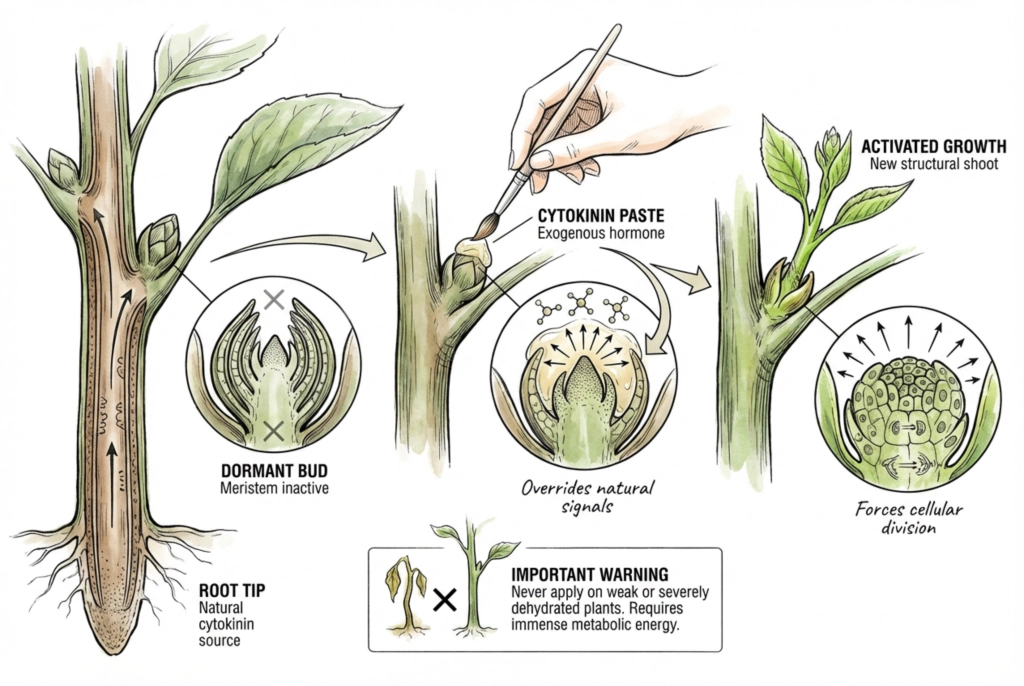
A local application of cytokinin paste can shift the hormone balance at a dormant node in favour of bud outgrowth.
It does not simply override the plant on command. It nudges one part of a larger control system.
Where Cytokinin Comes From
Cytokinins are plant hormones involved in cell division. They are made and metabolised in both roots and shoots, and root-derived cytokinin can move up in the xylem, but there is also local synthesis in shoot tissue. The source depends on the species and the stage of growth.
What Changes at the Node
When you apply cytokinin directly onto a dormant axillary bud, you change the local hormone balance there.
That can encourage the meristematic tissue to break dormancy and begin producing a new shoot.
Plant Condition Sets the Ceiling
Crucially, this is not independent of the plant’s condition. Bud outgrowth also depends on light, sugar (source–sink) status, and the plant’s overall health, so a stressed plant may not respond even with a good application.
The dose that matters is the amount of active BAP delivered, which you usually cannot read off the paste weight because the concentration is rarely published.
Start With a Healthy Plant
Avoid applying cytokinin paste to a weak or severely dehydrated plant.
Building a new branch draws on the plant’s energy reserves, and a struggling plant is less likely to respond well.
Transcriptome response of Jatropha curcas axillary buds to BA and GA3
What Are The Biological Mechanisms of Apical Dominance?
Apical Dominance Is a Growth Strategy
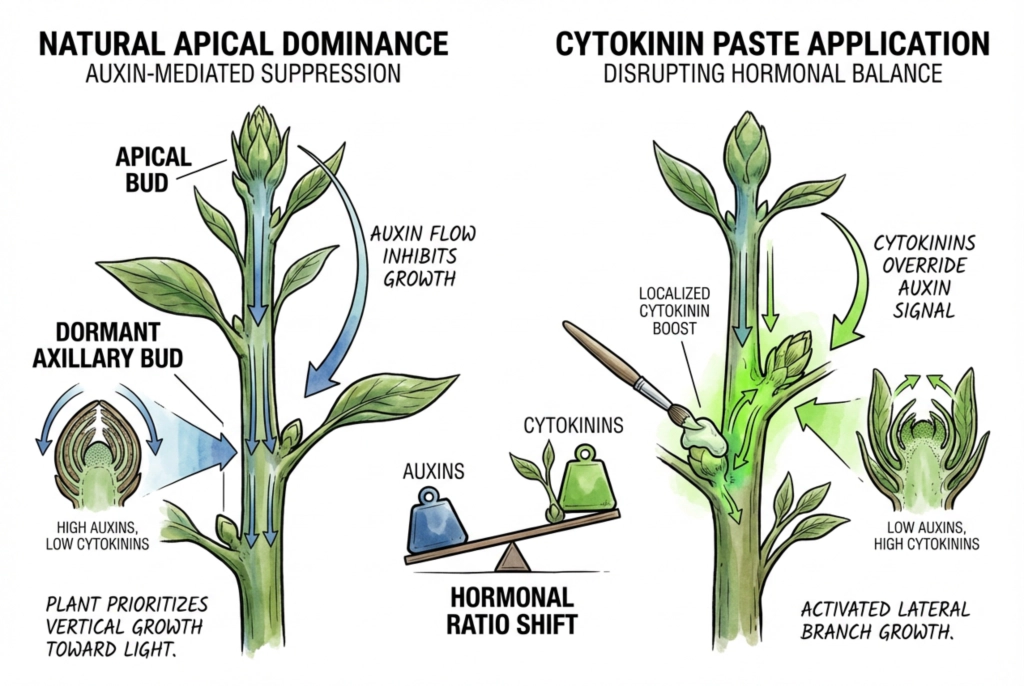
Apical dominance is the tendency of a plant’s growing tip to hold back the outgrowth of lower, lateral buds.
Auxin Acts Through a Network
Auxin produced near the shoot tip moves down the stem and is part of what keeps those lower buds dormant.
Its effect is largely indirect. Rather than simply flooding each bud, auxin works through downstream signals including cytokinin and strigolactones, along with sugar availability and light, to set whether a given bud grows.
Why Tips Suppress Side Shoots
One reason plants behave this way is that concentrating growth at the tip helps them compete for light before investing in side branches, though architecture and resources also play a role.
A Local Dose Can Shift the Node
A local cytokinin paste can shift this balance at the node it touches. Broadly, a high-auxin, low-cytokinin environment tends to keep a bud dormant, while a lower-auxin, higher-cytokinin environment can favour outgrowth, but in an intact plant this is not a simple on/off ratio, and sugars, light, and the bud’s own readiness all matter.
Light Regulation of Axillary Bud Outgrowth
Are There Specific Products You Should Actually Use?
Lanolin Is the Carrier
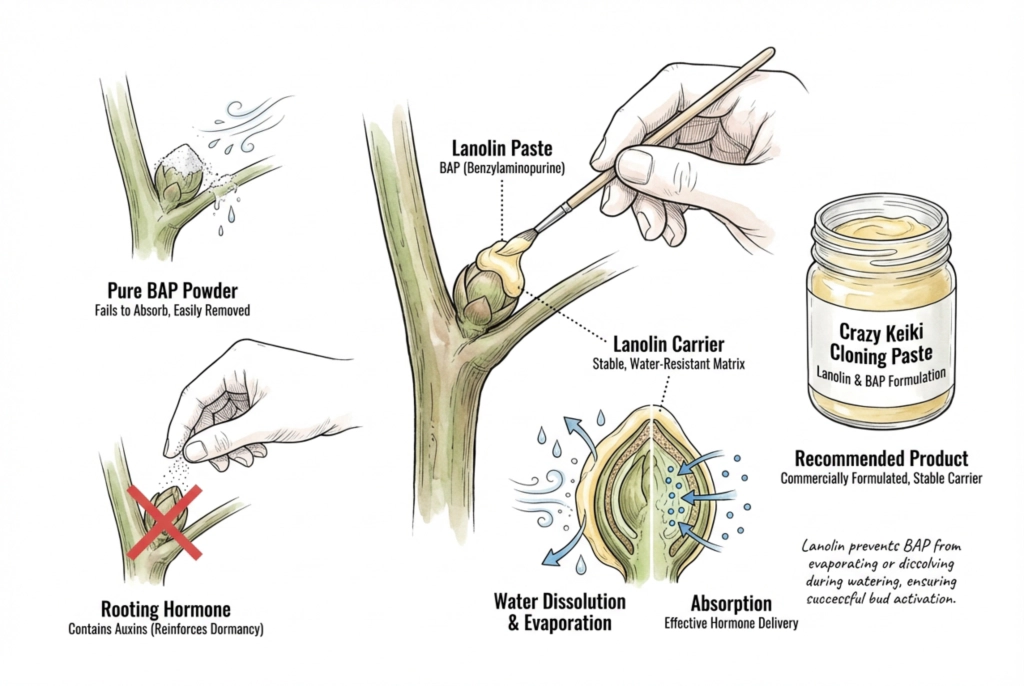
The products commonly used for this are lanolin-based pastes containing a cytokinin such as benzylaminopurine (BAP).
Lanolin is a semi-solid, water-resistant carrier that helps a small dab stay put on the tissue rather than washing off at the next watering, which is one reason pastes are preferred over trying to apply a raw powder.
Commercial Strengths Vary
Keiki paste is not a single, standardised chemistry. Confirmed commercial examples vary. Some contain BAP together with other ingredients, often at proprietary amounts, and manufacturers note that effectiveness is species-dependent.
So the exact active concentration, the number that actually determines your dose, is frequently not published.
Rooting Hormone Has a Different Job
Rooting hormone is a different category. These products contain auxins and are formulated to promote roots, not to release dormant buds.
Keiki Cloning Paste
Keiki paste is sold for orchid nodes, not as a validated aroid treatment. Do not assume it suits an aroid unless the manufacturer clearly identifies the active ingredient, use directions, and safety information.
If those details are unavailable, choose a product with a clear label and SDS instead.
Treat the Product as a Regulated Input
BAP is a synthetic plant growth regulator, and different products carry different hazards depending on their ingredients and concentration.
Read the specific product’s label and safety data sheet, and follow its guidance for personal protection, first aid, storage, spills, and disposal. Do not pour leftover paste or rinse water down the drain into waterways.
Wear gloves, avoid skin and eye contact, keep it away from children and pets, and treat this as advanced at-your-own-risk use on ornamentals only. Because most hobby pastes are not labelled for food crops, do not use them on plants you intend to eat.
How Do You Best Prepare and Apply The Paste?
Prepare the Node
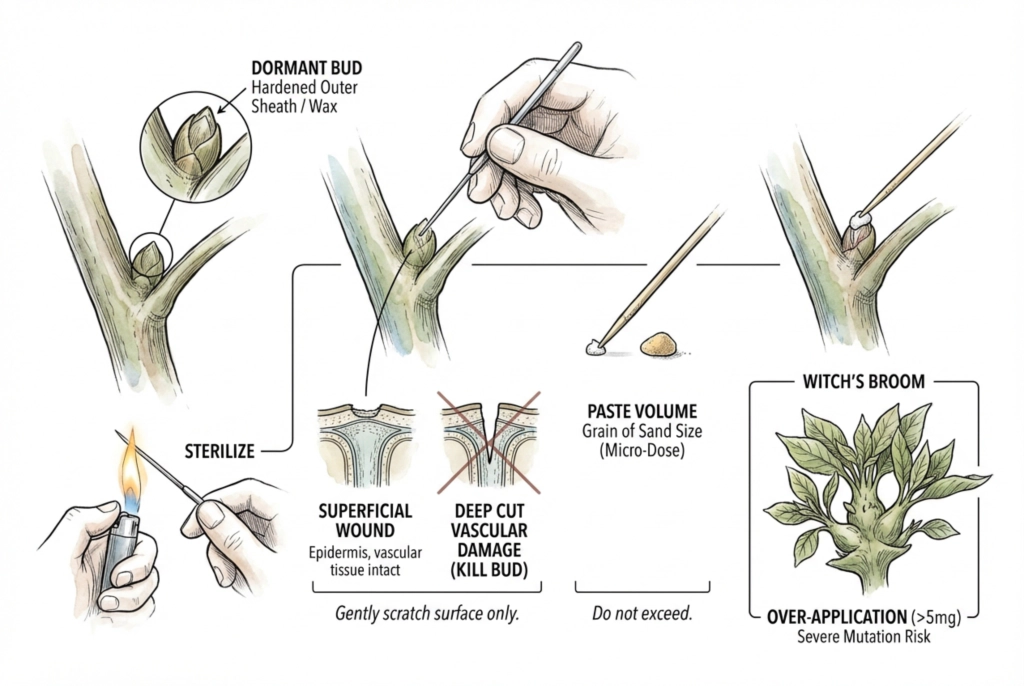
Start by following your product’s own instructions, since they differ. Many orchid keiki protocols only ask you to gently expose the eye by removing the papery bract over it. Some growers also lightly score the surface over a stem node so the paste can contact live tissue.
Scoring is not always necessary, and it is worth remembering that any wound is itself a route for infection, drying, and injury, so if the label does not call for it, do not add it.
Respect Different Stem Anatomy
If you do expose a node, use a clean tool, such as a needle or blade wiped with 70% isopropyl alcohol and allowed to dry.
This disinfects the tool but does not make it truly sterile, so work cleanly. Keep any scratch shallow and minimal. Cutting deeply into the stem can damage the vascular tissue and kill the bud.
Aroids such as Monstera and pothos are monocots with scattered vascular bundles, not the neat cambium ring of a woody dicot like Ficus, so there is no single correct cut depth across plants.
Place a Minimal Dab
Then pick up only a very small dab of paste on a toothpick or micro-swab (roughly a grain of sand is the usual guidance, though that is a rough visual cue, not a measured dose) and place it over the node.
Keep the Dose Small
More is not better. Applying too much cytokinin risks a cluster of stunted, malformed shoots from one point rather than a single clean branch.
Because the BAP concentration of a given paste is usually unknown, there is no reliable milligram threshold across products, so err small and treat one node at a time.
A General Application Sequence
The steps below are a conservative outline. Always defer to the specific product’s label, and to species-specific guidance from an experienced grower.
- Wipe your tool with 70% isopropyl alcohol and let it dry. Keep alcohol away from flames.
- Choose a healthy, plump-looking dormant node (green or slightly swollen is a good sign, though not a guarantee it will respond).
- If the product calls for it, gently expose the eye, peeling back a papery bract, or scoring lightly, without damaging live tissue.
- Apply only a tiny dab of paste over the exposed node.
- Keep the treated area from being soaked or heavily handled for the next few days.
I begin with one labeled node on a healthy, replaceable plant and leave another visible node untreated. Both nodes are photographed on application day with a small ruler in frame. Light, watering, and feeding remain unchanged while I watch for swelling or malformed growth.
The untreated node is not a formal scientific control because nodes differ in age and position, but it is a useful brake on wishful thinking. I do not redose merely because nothing has happened quickly, since a second application would erase the cleanest comparison I have.
How Should Post-Application Care and Watering Be Adjusted?
Baseline Care Supports the New Branch
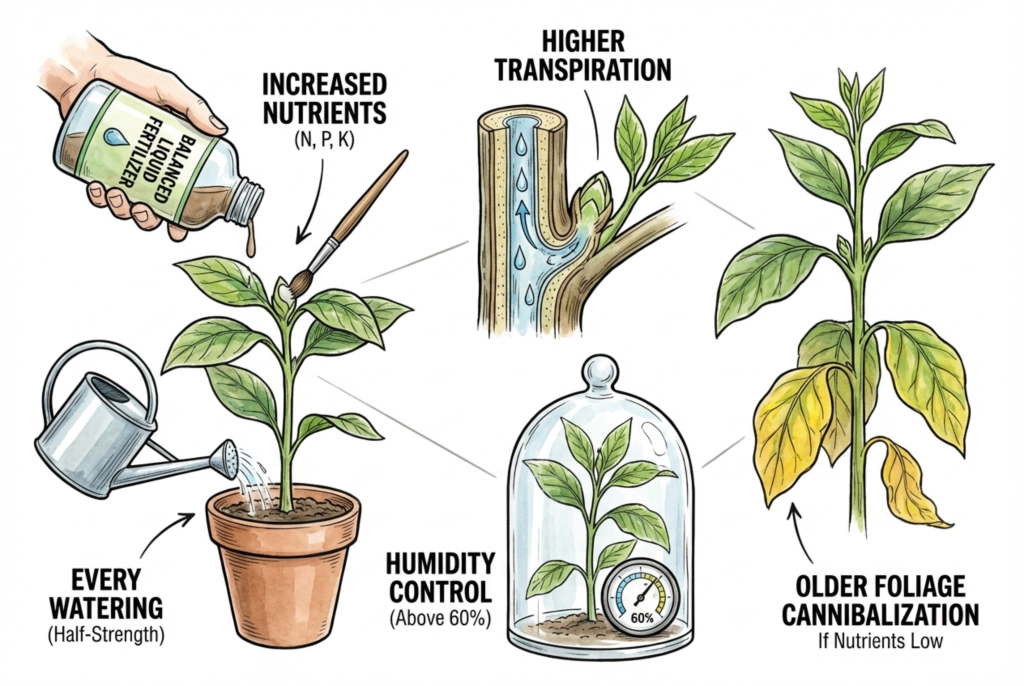
The most important aftercare is simply good, steady care for the species, not a special high-nutrient regime.
A new branch is built largely from the plant’s stored carbohydrates and ongoing photosynthesis. Fertilizer supplies mineral nutrients (like nitrogen and phosphorus), not carbohydrates, so no amount of feeding replaces adequate light.
Yellowing Needs a Diagnosis
If lower leaves yellow after an application, don’t assume it means the plant is starving for fertilizer.
Yellowing can also come from over-watering, root problems, low light, acclimation, or ordinary ageing of old leaves, so diagnose before you react.
Use Fertilizer at the Label Rate
A complete, balanced liquid fertilizer is a reasonable general foliage feed when used at the label rate.
SUPERthrive Foliage-Pro 9-3-6
SUPERthrive Foliage-Pro 9-3-6 is a complete option. There is no evidence that a paste application requires a special half-strength-every-watering schedule. Feed at the manufacturer’s recommended rate, adjusting for your substrate and existing routine rather than adding extra just because you applied paste.
Water and Humidity Still Follow the Plant
Water based on the substrate’s moisture, as you normally would. One small bud beginning to grow does not by itself mean you should water more often.
If the new growth is a tropical species sensitive to very dry air, moderately higher humidity can help, but there is no magic threshold. Pushing humidity too high indoors invites condensation and mould, so prioritise airflow.
What Are The Most Common Mistakes and Solutions?
Excess Paste Can Create Clusters
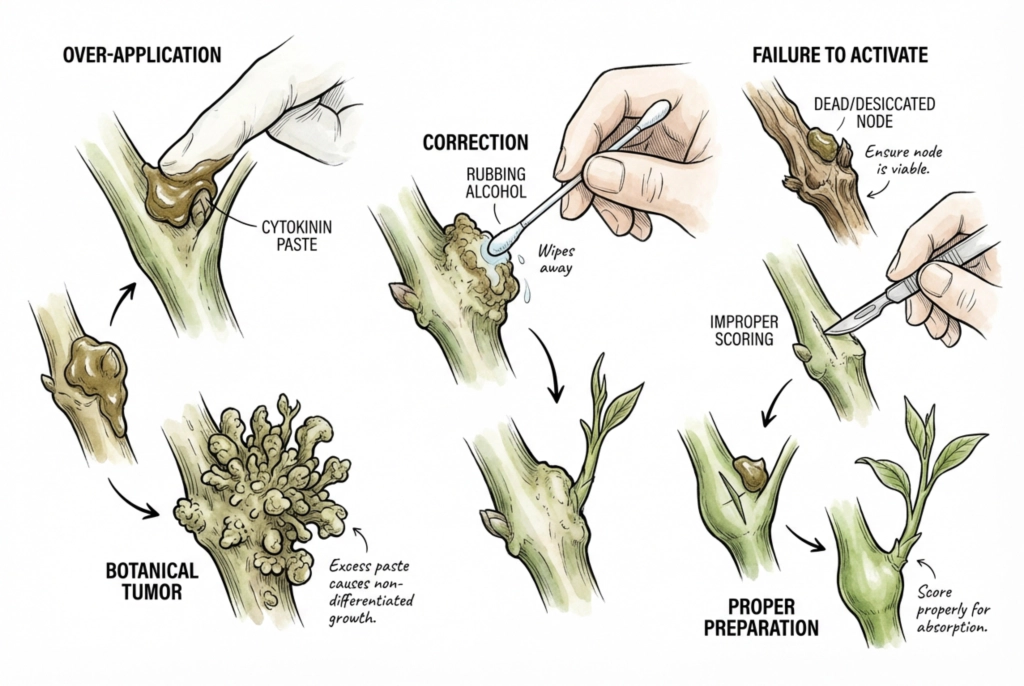
A common mistake is applying too much paste, on the mistaken assumption that more means faster growth.
It doesn’t. Excess cytokinin can push the tissue into producing multiple stunted, malformed shoots or callus-like growth from one point instead of a single clean branch.
That is a growth-regulation response, not a tumour or a permanent genetic mutation, even though it can look alarming.
Inspect Deformed Growth Before Removing It
If you see several deformed bumps forming instead of one shoot, you may have over-applied, though infection, callus, or several adventitious buds can look similar, so observe before acting.
If fresh excess paste is still sitting on the surface, you can gently wipe it off mechanically.
Avoid scrubbing rubbing alcohol into open, wounded tissue, which can itself injure the plant, if you clean, do so lightly and follow any manufacturer guidance.
No Response Has Several Possible Causes
The other common outcome is simply no response. It is tempting to blame poor scoring or a dead node, and those are possible causes, but they are not the only ones. An inactive or wrong-strength product, the wrong node or season, low light or sugar reserves, poor plant health, temperature, and plain species non-response all matter too.
A green or slightly swollen node is a helpful clue to viability, but not a firm gate. Some species hide their eyes well.
What to Do When Nothing Happens
If nothing happens after several weeks, resist the urge to keep cutting deeper and re-dosing.
Stop, photograph and date the node, inspect the node and overall plant health, re-read the product’s expected wait time, and if in doubt consult the manufacturer or an experienced grower before trying again on that stem.
Does Temperature Impact The Success Rate?
Warmth Supports Active Growth
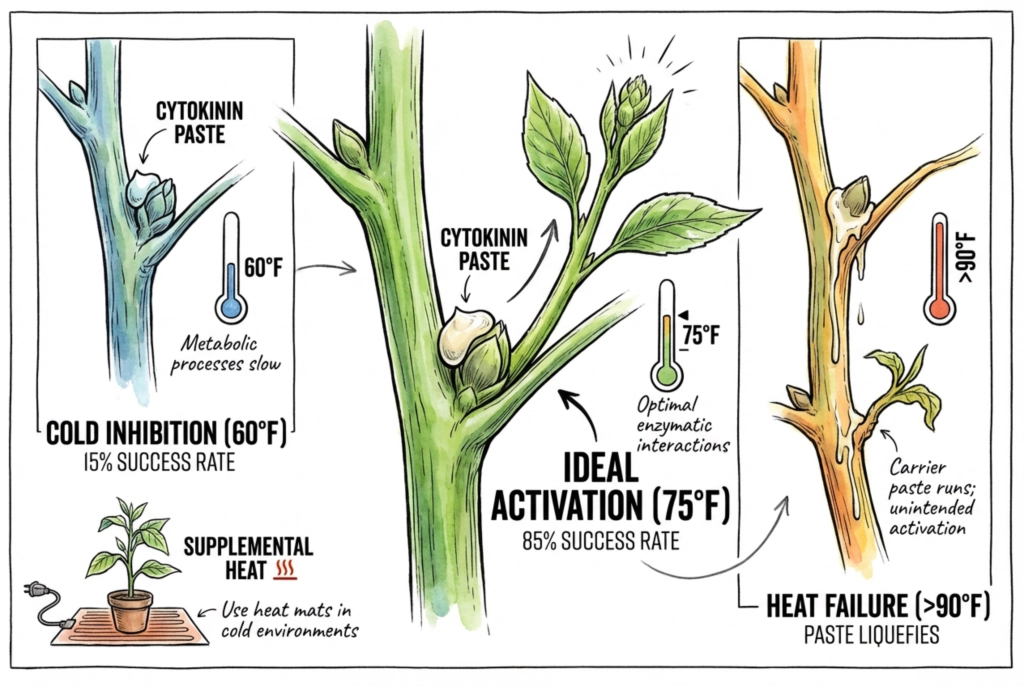
Temperature affects a plant’s metabolism and growth rate, so warm, active growing conditions generally support new growth better than cold ones.
Typical warm-room temperatures, roughly the low-to-mid 70s Fahrenheit, are a reasonable target for most tropical houseplants, but there is no single strict optimum that applies to every species.
Cool Conditions Slow the Response
Hormone signalling doesn’t switch off in the cold, but growth slows in cool conditions, so a response may be slower or weaker if you apply cytokinin to a plant sitting in a chilly, draughty spot.
If you want to keep a tropical plant warmer in winter, a gentle heat source is reasonable, but choose and set it carefully.
VIVOSUN Seedling Heat Mat
VIVOSUN Seedling Heat Mat is for seed starting and root-zone warming, not for setting room temperature. Its fixed output can overheat or dry roots under a finished pot.
Use it only with a suitable probe or thermostat, keep it on a dry drained surface, and stop if the root zone becomes too warm or dries too quickly.
Protect the Paste From Excess Heat
Very high temperatures can soften a paste and make it more likely to run. Formulated pastes vary, so keep the plant out of extreme heat, wipe away paste that visibly migrates, and follow the product’s storage guidance.
Is Hormone Application Safe For Rare Aroids?
Test on a Replaceable Plant
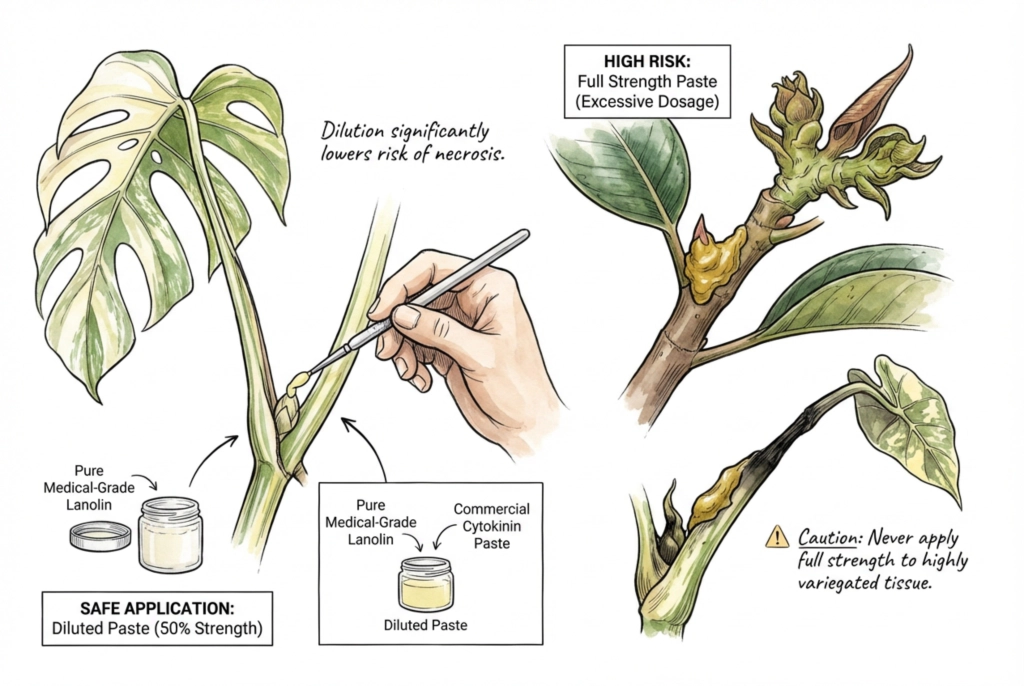
Do not make your first cytokinin application on a rare or irreplaceable aroid. Learn how the product behaves on a replaceable plant first and leave one comparable node untreated.
Species Sensitivity Is Not Universal
Be sceptical of claims that all rare aroids share unusually sensitive tissue, or that plant biology is identical across every genus.
Hormone pathways are broadly shared, but anatomy, receptors, dormancy behaviour, and dose sensitivity genuinely differ between species, so you cannot assume a result seen on one plant transfers to another.
Dilution Lowers Dose Without Making It Known
Some growers dilute a paste with plain lanolin to reduce its strength. That can lower the effective dose if it is mixed thoroughly, but because the original concentration is usually unknown, a 50 percent dilution does not give you a known, reproducible dose, and poor mixing can leave hot spots.
It is a way to be more conservative, not a guarantee of safety.
Variegated Tissue Needs Green Support
On highly variegated tissue, use extra caution. White sectors cannot photosynthesise, so heavily variegated growth has less reserve, although nearby green tissue can still support a new bud.
If you choose to apply paste, use the smallest amount on a node with adjacent green tissue.
What Is The Difference Between Auxins, Gibberellins, and Cytokinins?
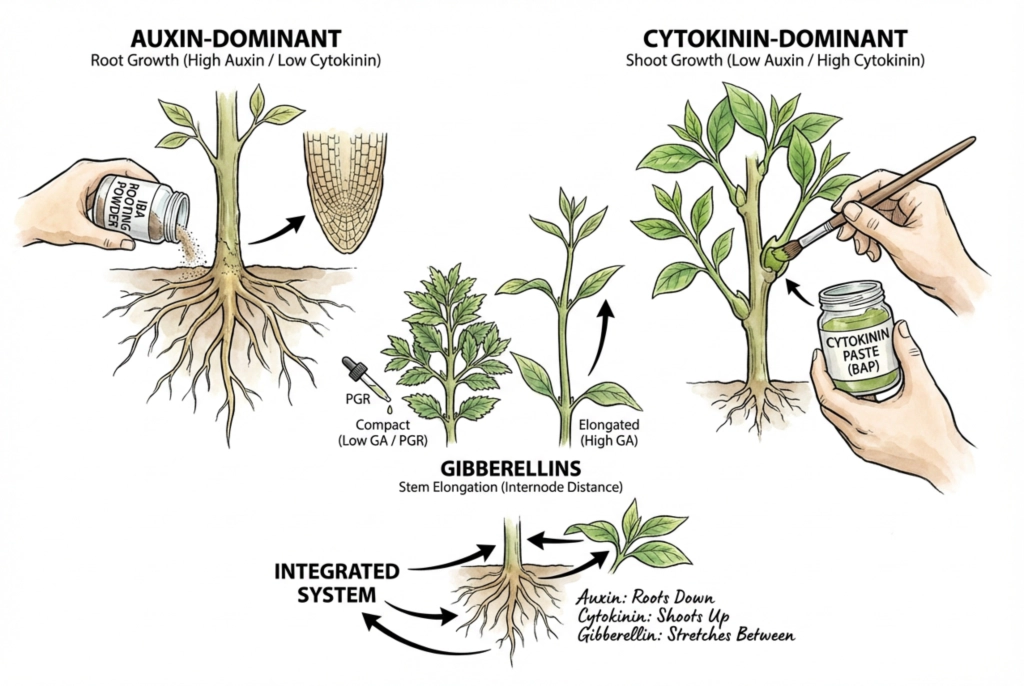
| Hormone class | Commonly associated with | Typical horticultural use | General tendency (not guaranteed) |
|---|---|---|---|
| Cytokinin (e.g. BAP) | Cell division | Encouraging bud outgrowth / branching | Can help release a dormant bud into a shoot. |
| Auxin (e.g. IBA) | Cell elongation, apical dominance, rooting | Rooting cuttings | Often promotes adventitious root formation. |
| Gibberellin (e.g. GA3) | Internode elongation (and more, e.g. Germination) | Various | Can contribute to longer internodes. |
Use Hormone Roles as Broad Tendencies
A useful mental model is that auxin is broadly associated with roots and apical dominance, cytokinin with cell division and bud outgrowth, and gibberellin with stem elongation.
Each hormone actually has many roles (pleiotropy), so treat these as tendencies, not one-to-one controls.
Hormones Interact
These hormones never act in isolation. They work through interacting gradients and ratios, together with sugars, light, and the plant’s condition.
Ratios Shift Odds Rather Than Guarantee Outcomes
In tissue-culture systems, a higher auxin-to-cytokinin ratio tends to favour root formation and a lower ratio tends to favour shoot formation.
That historical heuristic is where the idea comes from, but in an intact plant a ratio does not mathematically guarantee an outcome. It shifts the odds.
Rooting powders use auxins such as indole-3-butyric acid (IBA). A cytokinin such as benzylaminopurine (BAP) is used to encourage bud outgrowth.
Gibberellin Changes Internode Spacing
Gibberellins influence how far apart nodes sit, among other things. If a treated bud grows, active gibberellins can contribute to that branch stretching, though genotype and environment matter too.
Growth retardants are a group of plant growth regulators, not a single anti-gibberellin hormone and not synonymous with the general term PGR. They are used in specific labelled crops to produce more compact growth and should only be used according to their labels, not applied off-label to houseplants.
| Hormone | Primary role | General tendency at the bud (not a guarantee) |
|---|---|---|
| Auxin (e.g. IBA) | Roots, apical dominance | High auxin, low cytokinin tends to keep the bud dormant |
| Cytokinin (BAP) | Cell division, bud outgrowth | Lower auxin, higher cytokinin can favour the bud growing into a shoot |
| Gibberellin (GA) | Internode elongation (among other roles) | Can influence how far apart the new nodes sit |
Does The Type Of Lanolin Carrier Matter?
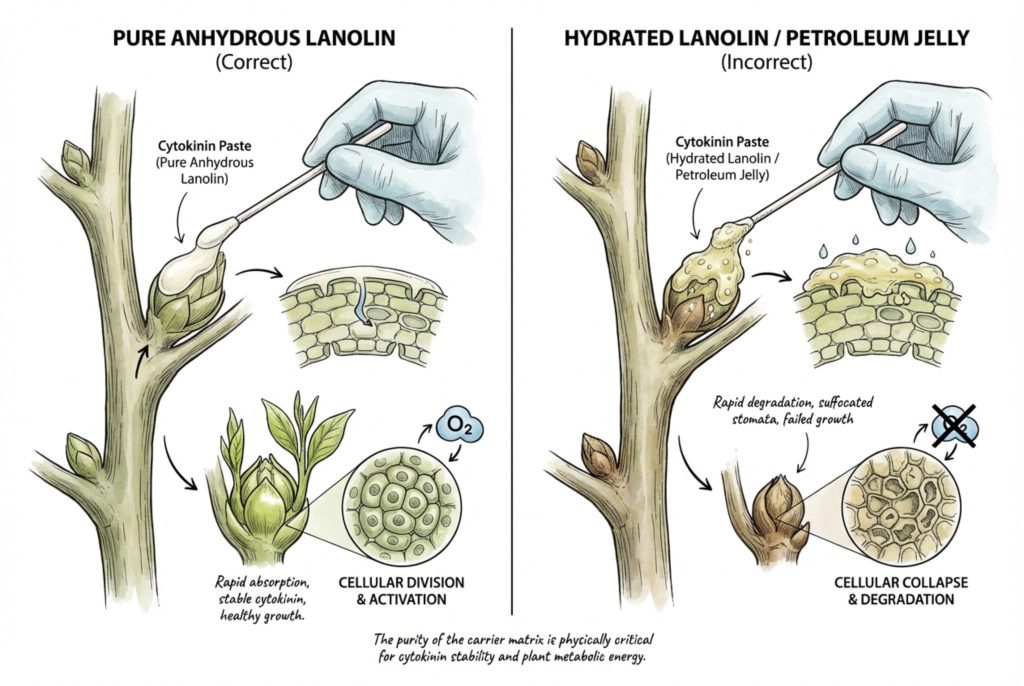
Choose a Transparent Formula
The carrier can affect how a paste handles and stores, so it is reasonable to prefer a product that is transparent about its ingredients.
Beyond that, be cautious about strong claims, because the specifics are often not well supported.
Moisture Claims Depend on the Product
Anhydrous lanolin means low-moisture by specification, not literally zero water, and lanolin can absorb and emulsify a fair amount of water.
Whether moisture meaningfully degrades the cytokinin in a given product depends on that product’s formulation and shelf life, which the maker should state. There is no general rule that any exposure to moisture rapidly destroys it.
Treat Oxygen-Blocking Claims as Unproven
Some formulations use other bases, and petroleum-type carriers are sometimes said to suffocate tissue or block oxygen exchange.
No evidence establishes that mechanism at the small amounts used on a node, so treat the claim as speculation rather than fact.
Carrier Blends Vary
Commercial keiki pastes are not always a single pure carrier. Confirmed products can contain lanolin alongside several other ingredients.
Rather than insisting on one universal carrier, choose a product with a clear ingredient list and follow its guidance.
How to Identify and Salvage a Failed Application?
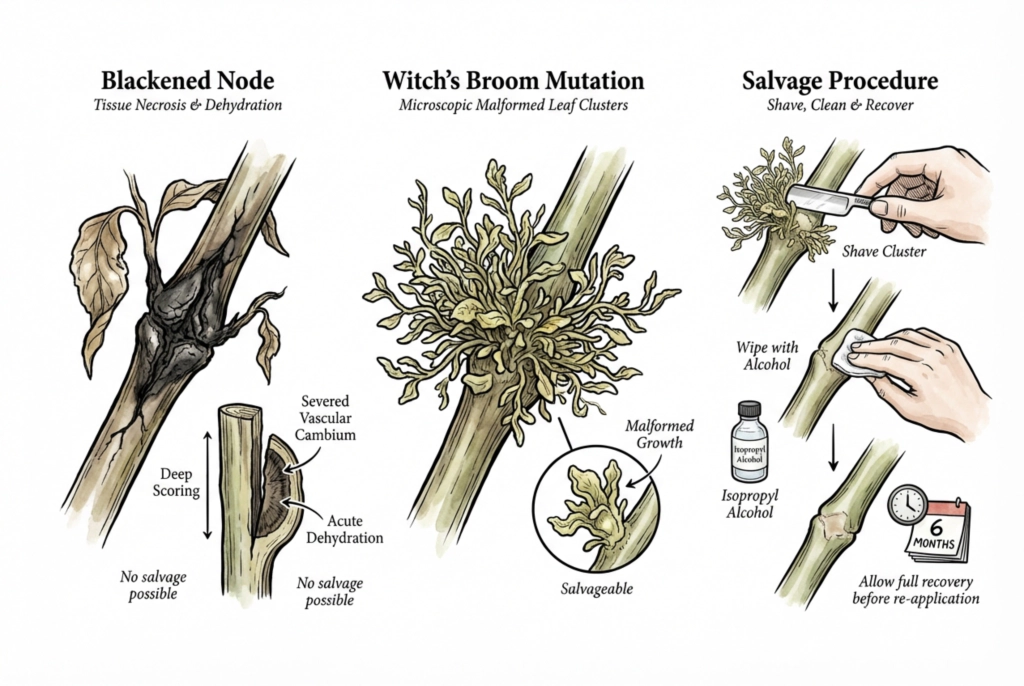
Different Signs Need Different Triage
Two problems you might see are a darkening node and a cluster of small, malformed shoots. Neither has a single cause. Darkening can come from a chemical burn, a wound drying out, infection or rot, or a bud that was already dead, while clustered growth can come from over-application, callus, or several adventitious buds.
So observe first rather than assuming what happened.
Protect a Darkening Node
If a node darkens or a lesion appears and spreads, treat it as possible tissue injury. Remove any remaining paste mechanically (without scrubbing solvent into the wound), keep the area clean and not soaking wet, isolate the plant if you suspect disease, and watch for signs of rot.
Fully dead, blackened tissue at one node will not recover, but that does not mean the rest of the stem or plant is lost. Assess the healthy tissue nearby, and seek help from a qualified grower or diagnostic service if a whole stem is declining.
Handle Malformed Clusters Conservatively
If a cluster of malformed shoots forms, describe it plainly as multiple shoots or callus-like tissue, not a mutation. Any cutting is a wound with its own infection risk, so shave conservatively with a clean blade, and consider getting species-specific advice before removing much tissue.
Then give that stem segment a long rest before trying again. How long recovery takes varies, so let the plant’s condition, not a fixed number, guide you.
Let the Node Rest Before Re-dosing
Finally, be patient. A visible response can take a few weeks, and sometimes longer or not at all, depending on species, product, and season.
Do not add more paste just because nothing has happened in the first week (re-dosing early mainly raises the risk of injury).
Affiliate Disclosure
This article contains Amazon affiliate links. As an Amazon Associate I earn from qualifying purchases. If you use these links, the site may earn a commission at no extra cost to you. Product availability, price, and specifications can change. Check the current listing before buying.