
Master VPD in Plant Cabinets: Growth & Disease Guide
Use VPD to balance temperature and humidity in a plant cabinet. Measure leaf conditions, choose species targets, manage airflow and automate control safely.
Priya Patel · Published 2026-04-12 · 20 min read

Key Takeaways
- VPD adds temperature to humidity, so it describes drying pressure more usefully than RH alone. A working range around 0.8 to 1.2 kPa suits many tropical aroids, but treat it as a starting point and adjust from plant response.
- Temperature can move VPD even when the humidity percentage does not change. Log the light cycle and check the canopy rather than setting one RH target and forgetting it.
- Airflow reduces leaf wetness and boundary-layer humidity, but it does not replace fresh-air exchange or disease diagnosis.
- Seal obvious cabinet leaks before adding a humidifier. Then watch for condensation, stale air, and electrical moisture risk as the enclosure becomes tighter.
- Match the target to the plant’s roots and acclimation stage. A cutting and a mature plant do not have the same capacity to replace water lost through transpiration.
What Is VPD and Why Does It Matter More Than Humidity?
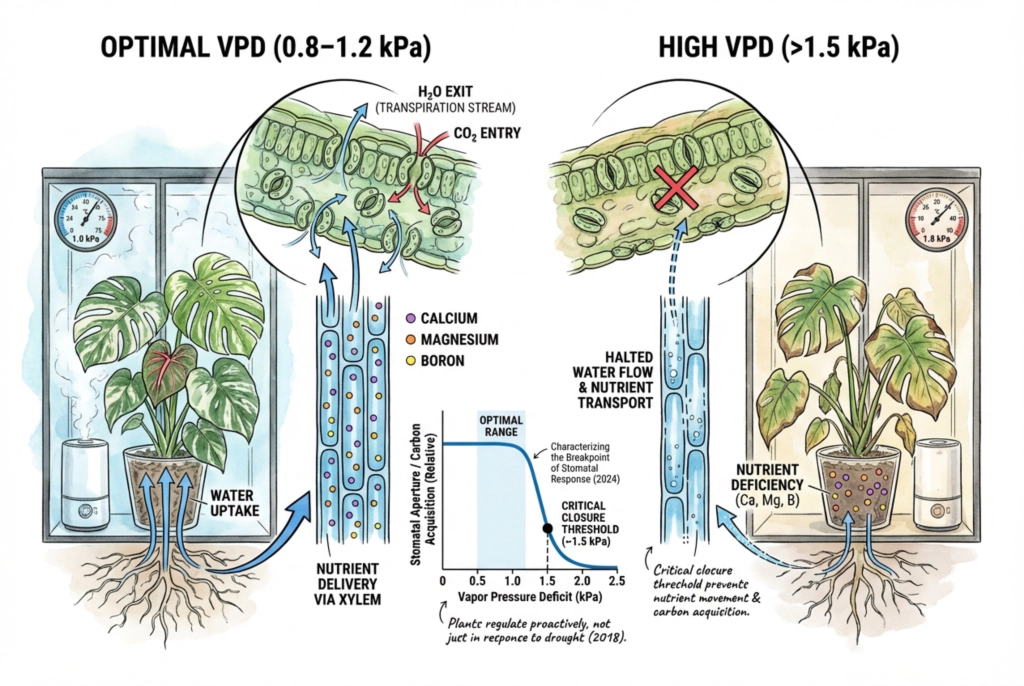
Vapor pressure deficit, or VPD, is the moisture gap between a leaf and the surrounding air. It is often more informative than relative humidity because RH changes meaning as temperature changes.
At 20°C and 75% RH, air VPD is about 0.58 kPa. At 30°C with the same RH, it is about 1.06 kPa. The humidity percentage has not changed, but the drying pressure has risen sharply.
VPD is a useful proxy rather than a complete plant model. The actual water-loss rate also depends on leaf temperature, stomatal opening, root moisture, light, and airflow.
Why Does the Plant Care About VPD?
Stomata respond to VPD alongside light, soil moisture, temperature, and plant hormones. In a workable range, they can exchange carbon dioxide without losing water too quickly.
Transpiration also carries water and some nutrients through the xylem. Low transpiration reduces that flow rather than stopping every nutrient movement, and the response differs by species.
Research in individual crops shows that stomatal responses can change as VPD rises or remains low for long periods. Those studies demonstrate that breakpoints exist, but they do not establish one universal kPa cutoff for tropical cabinet plants.
Characterizing the Breakpoint of Stomatal Response to Vapor Pressure Deficit
How Do You Measure VPD in a Plant Cabinet?
Air VPD requires air temperature and RH. Leaf-to-air VPD also requires leaf temperature, so an air sensor alone is an estimate.
Sensor tolerance, calibration drift, condensation recovery, and placement all matter. A five-point RH error around 80°F can shift the calculated VPD enough to change how you interpret a plant’s conditions.
What Equipment Do You Need?
| Measurement | What it tells you | Main limitation |
|---|---|---|
| Air temperature | Thermal input for saturation pressure | Does not show leaf temperature |
| Relative humidity | Moisture input for air VPD | Placement and condensation affect the reading |
| Leaf or canopy temperature | Closer estimate of leaf-to-air VPD | Infrared readings depend on emissivity and field of view |
Place sensors at more than one height in a tall cabinet. A single air reading cannot represent a top-to-bottom gradient, a shaded corner, or the boundary layer next to a large leaf.
Use a logging thermometer and hygrometer for trends, then verify unusual readings with a second measurement before changing the whole cabinet.
How Should VPD Targets Vary by Plant?
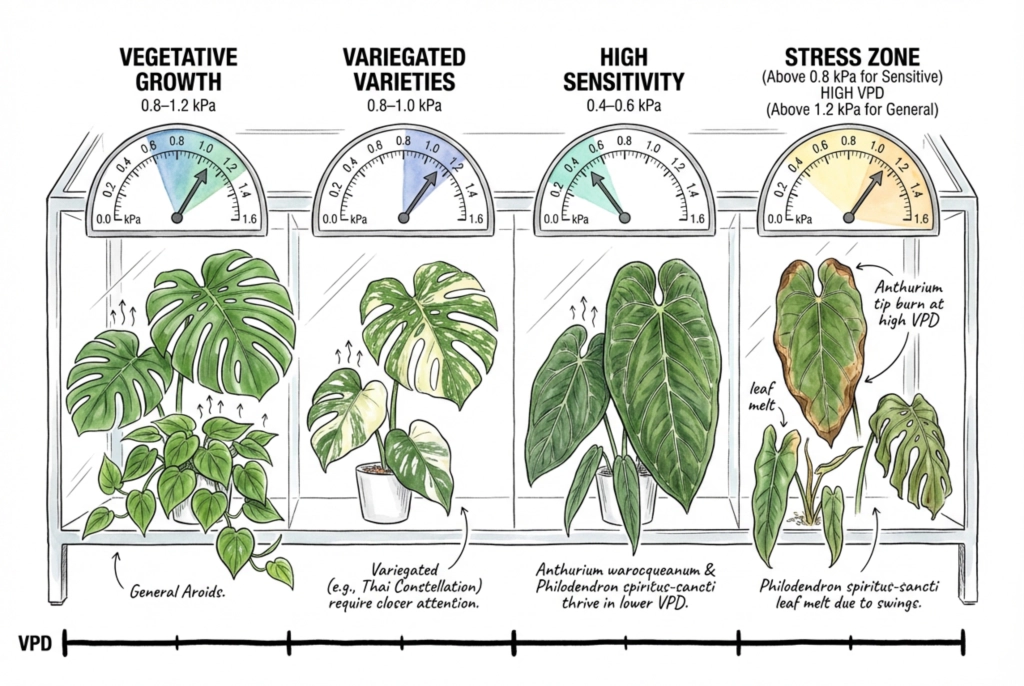
Native habitat can help you choose a starting point, but it cannot produce a precise formula. Many lowland tropical aroids are often managed around 0.8 to 1.2 kPa during active growth, while some cloud-forest plants are kept lower.
Direct comparative trials for rare ornamentals are scarce, so watch new growth, leaf edges, root condition, and the moisture trend rather than treating a table value as a guarantee.
What Do Aroids Need?
Monstera and many Philodendron can often start near 0.8 to 1.2 kPa when roots are established. Variegated plants may need closer observation because less green tissue can reduce the margin for water loss.
Anthurium warocqueanum and other humidity-sensitive plants are often kept lower, but tip burn can also come from roots, salts, light, or watering. Diagnose those causes before assigning the symptom to VPD.
What About Orchids and Cloud-Forest Plants?
Phalaenopsis are generally forgiving across a wider range than many cloud-forest begonias or ferns. A lower target can reduce drying pressure for sensitive plants, but very low VPD can also keep leaves wet and slow transpiration.
Use the plant’s response and measured leaf conditions to refine the starting range.
How Does Temperature Drive VPD?
Temperature is a major driver of VPD in a small cabinet. A 5°C rise raises the air’s saturation pressure by roughly a third across typical cabinet temperatures, so lights can increase drying pressure even when the RH display looks stable.
The size and speed of the change depend on enclosure sealing, driver heat, room temperature, fans, and plant transpiration. Log the light cycle instead of assuming a fixed rise.
How Much Heat Do Grow Lights Add?
Low-heat LED bars often put less radiant load on leaves than high-output fluorescent fixtures, but both convert most electrical energy to heat. The actual cabinet response depends on wattage, driver placement, airflow, and leakage.
Measure leaf temperature and PPFD at the shelf rather than using a per-watt rule.
How Do You Reduce Temperature-Driven Spikes?
Use low-profile lighting, increase circulation, and schedule humidification around the measured light-cycle trend. Keep electrical connections dry and use GFCI or RCD protection in a humid cabinet.
Running lights during a cooler part of the day can help with overheating, but the useful schedule depends on the room and the plants.
How Do You Control Humidity to Hit a VPD Target?
Humidity control combines sealing, passive moisture, active humidification, and fresh-air exchange. Sealing obvious gaps is usually the first step because a leaky cabinet can make any humidifier run continuously.
After sealing, monitor condensation and stale air. A cabinet that holds moisture too well can create a different problem.
What Is the Best Way to Seal a Plant Cabinet?
Match weatherstripping to the actual door gap and make sure the doors close without force. Avoid routing cables through the seal because the cable creates a permanent leak.
If a cable must pass through the cabinet body, use strain relief, a suitable grommet, and a protected circuit.
What Humidifier Should You Use?
An external or controlled humidifier is safer than an uncontrolled ultrasonic unit inside a sealed cabinet. Use low-mineral water when the manufacturer allows it, clean the reservoir on schedule, and stop adding moisture when leaf surfaces or electrical components begin to condense.
Passive Evaporation with LECA
A shallow tray of wet Legigo expanded-clay pebbles can provide a small amount of passive evaporation when kept wet. It is a supplement, not a dependable way to hold a chosen humidity.
Use a LECA Tray Only When It Serves Another Purpose
Use a removable LECA tray when you also need expanded-clay growing media or want to test a small passive evaporation source that you can clean easily.
Skip the LECA Tray When Humidity Control Is the Goal
You expect humidifier-level output, cannot clean standing-water trays regularly, or only need a humidity fix. Exposed water area, airflow, and temperature matter more than pebble depth.
Densely planted, semi-sealed cabinets may partly humidify themselves through transpiration, but the effect depends on leaf area, ventilation, temperature, and watering rather than a fixed percentage.
How Does VPD Change Across Plant Growth Stages?
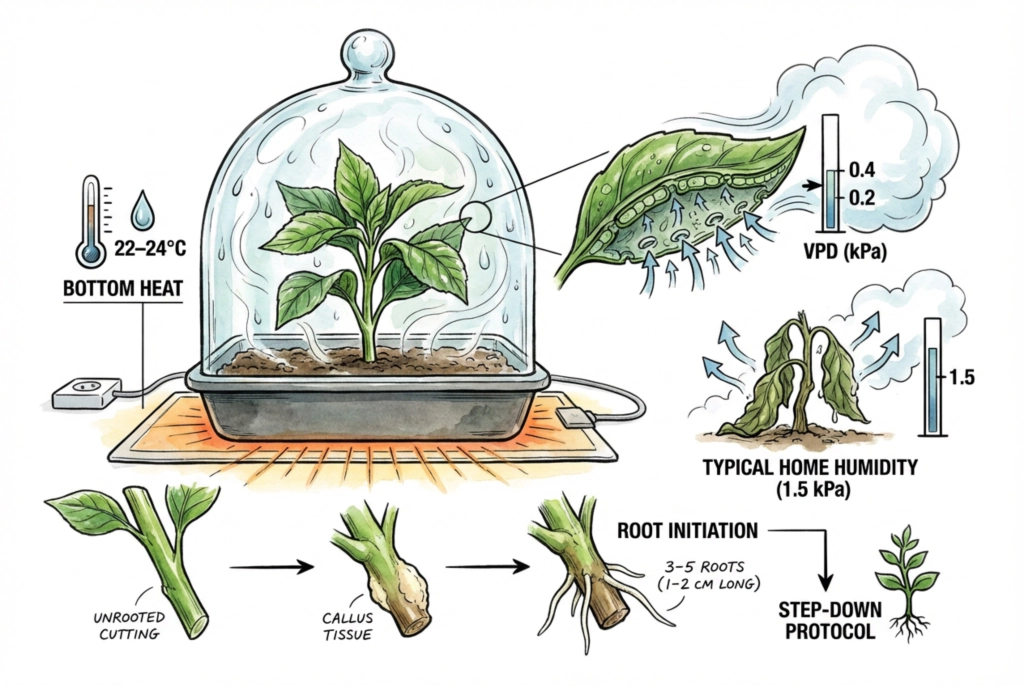
VPD needs shift as a plant matures. An unrooted cutting with no roots to replace lost water can wilt quickly at 1.0 kPa, while a mature plant held very low near 0.3 kPa may grow slowly.
A good working target tracks the plant’s current root capacity (its ability to replace water lost through transpiration).
What VPD Do Unrooted Cuttings Need?
Cuttings are usually kept near saturation, roughly 0.2–0.4 kPa, so the pressure gradient pulling water from the leaf is small.
Exact needs vary with the species, leaf area, and whether you mist.
With little water uptake available, keeping the drying pressure low helps a cutting conserve moisture while it forms callus and roots.
The pressure gradient at 1.5 kPa is about five times that at 0.3 kPa, so an unrooted cutting faces much stronger drying pressure and can struggle before it forms roots.
Actual water loss also depends on cuticle, leaf temperature, and boundary layer, so the ratio is a guide, not a measured 5× loss.
A propagation dome or clear bag helps hold this near-saturated range. Gentle bottom heat (around 22–24°C) can encourage rooting. Tune temperature and timing to the species and system.
Once several roots a centimeter or two long have formed, begin stepping down.
How Do You Transition a Plant from Propagation to Cabinet?
| Life Stage | Target VPD (kPa) | Approx. RH (%) near 25°C | Physiological Goal |
|---|---|---|---|
| Unrooted Cutting | 0.2 – 0.4 | 85% – 95% | Minimize water loss while callus forms |
| Root Initiation | 0.4 – 0.6 | 80% – 85% | Support early water uptake |
| Rooted Seedling | 0.6 – 0.8 | 75% – 80% | Encourage root expansion |
| Juvenile Growth | 0.8 – 1.0 | 65% – 75% | Support leaf expansion |
| Mature Active Growth | 1.0 – 1.2 | 55% – 65% | Balance gas exchange and water loss |
| Hardening Off | 1.2 – 1.5 | 45% – 55% | Acclimate stomatal response to room air |
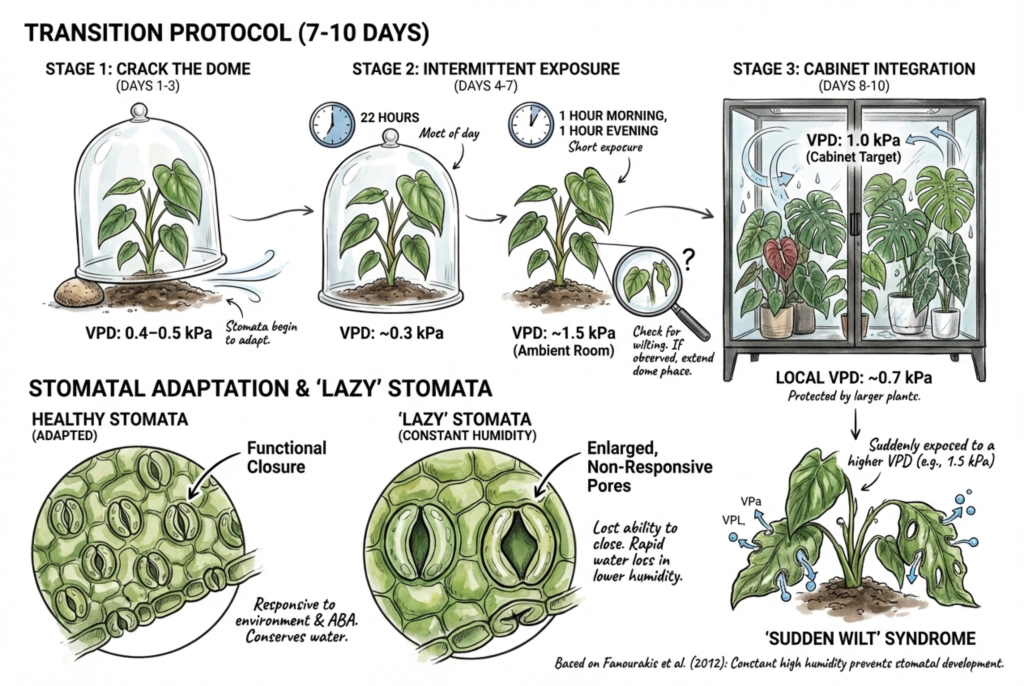
Moving a plant from a dome to a cabinet is best done gradually, over roughly a week to ten days for many plants, because stomatal adjustment happens over days, not instantly.
The exact schedule depends on the species, root development, and your cabinet.
- During the first few days, crack the dome slightly by propping one edge open so VPD rises a little.
How much it rises depends on the dome and room, so check with a sensor. - During the middle days, remove the dome for short periods once or twice a day while watching for wilting. If the plant wilts, extend the dome phase before continuing.
- During the final days, transfer the plant to the cabinet. Placing it among larger, transpiring plants can create a slightly more humid local microclimate, though the exact local VPD varies.
Research (Aliniaeifard et al., 2014) shows that plants grown for a prolonged period at very low VPD can develop stomata that respond poorly to closing signals such as abscisic acid (ABA).
The effect depends on the species and how long the plant was held humid.
This helps explain the sudden wilt some growers see when a nursery plant grown in high humidity is moved into much drier air. Its stomata may close incompletely, so it dehydrates faster than watering alone can offset.
It is a tendency in affected plants, not an inevitable outcome for every nursery plant on day one.
Stomatal Malfunctioning Under Low VPD Conditions
Rooting for Success. Best Practices in Unrooted Cutting Propagation | e-GRO
How Does VPD Protect Against Disease and Root Rot?
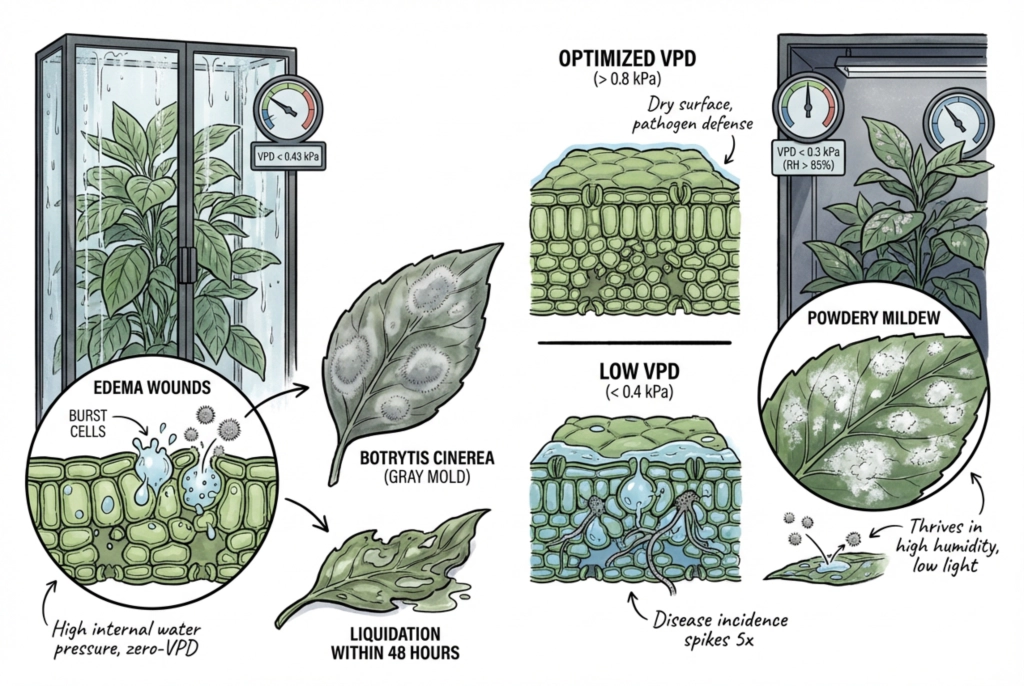
VPD is one useful lever for managing disease risk in a plant cabinet, but it is not the only one. Substrate moisture, root-zone oxygen, sanitation, and the specific pathogens present all matter, and root rot in particular is driven mainly by waterlogged, low-oxygen media rather than air VPD.
When VPD stays very low for extended periods, several risk factors can coincide. The risks include surface water or condensation for spore germination, reduced calcium delivery to new tissue, and a stagnant boundary layer around leaves.
These conditions raise risk. They do not guarantee infection, which also needs a susceptible host and pathogen present.
What Causes Botrytis and Mold in Plant Cabinets?
Botrytis cinerea (gray mold) is favored by cool, humid, still conditions. Older ornamental literature notes it survives well below roughly 0.43 kPa at around 25°C, with worse damage as conditions approach saturation.
That is a disease-favorable guideline, not a threshold at which every cabinet plant becomes infected.
Higher humidity and leaf wetness generally raise Botrytis risk, and it often enters through wounded or weakened tissue.
No reliable evidence supports a universal fivefold incidence jump or leaf loss within 48 hours, so do not use those figures as cabinet thresholds.
Many powdery mildews do not need free surface water to germinate, but their preferred humidity varies by pathogen and host, so there is no single RH rule that fits all of them.
Better airflow and a drier leaf surface can reduce risk for several of these diseases, but keeping VPD above 0.8 kPa is a rough guideline rather than a cure.
Why Is Airflow Critical for Disease Prevention?
| VPD Level | Cabinet Tendency | Safer First Check |
|---|---|---|
| < 0.4 kPa | Condensation and leaf-wetness risk may rise | Verify leaf temperature and sensor placement. Add gentle circulation or controlled air exchange |
| 0.4 – 0.7 kPa | Humid range that suits some sensitive species | Watch leaf surfaces and stagnant pockets. Compare with the species target |
| 0.8 – 1.2 kPa | Common working range for many tropical plants | Maintain only if plants, roots, and leaf surfaces remain healthy |
| > 1.5 kPa | Drying stress can rise | Check root-zone moisture, then lower heat or increase humidity gradually |
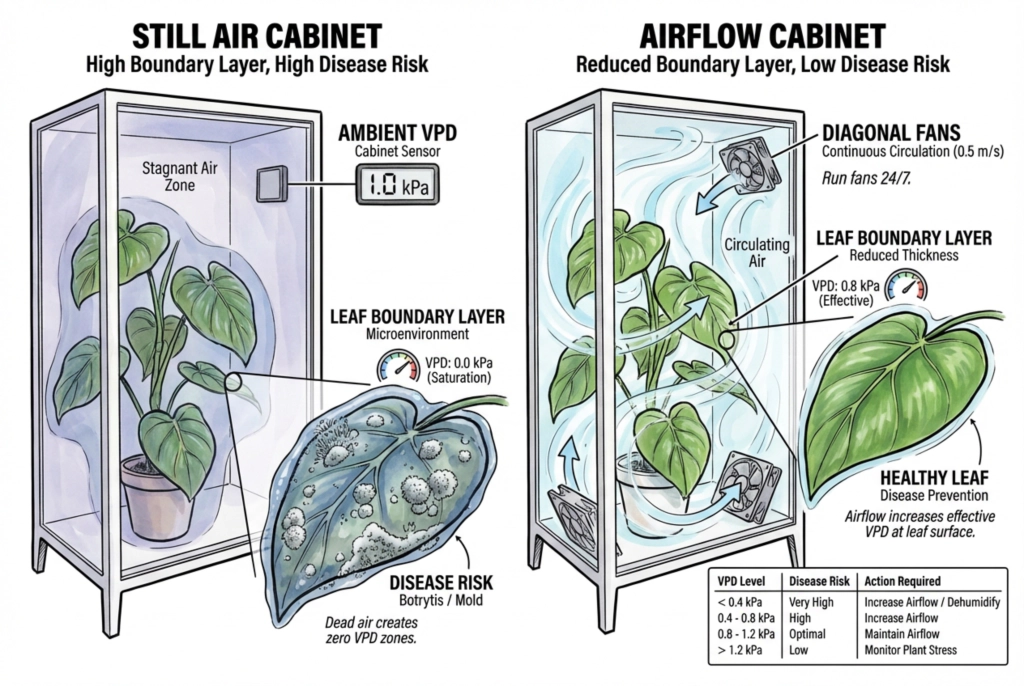
Even a cabinet reading a comfortable 1.0 kPa can hide higher-risk pockets around individual leaves.
The leaf boundary layer, a thin film of relatively still, humid air right at the leaf surface, resists vapor exchange, so conditions there can be much more humid than the ambient cabinet reading.
It is a resistance and a gradient, not literally a zero-VPD zone.
Moving air reduces that boundary-layer resistance and brings the leaf-surface humidity closer to the bulk air.
How much a given air speed helps depends on leaf size, shape, and orientation, so there is no universal resistance-halving constant at 0.5 m/s.
This is why adding gentle circulation to a cabinet with otherwise correct readings often helps with condensation-driven disease.
It reduces leaf wetness rather than curing an established infection, which still needs isolating affected tissue, sanitation, and water management.
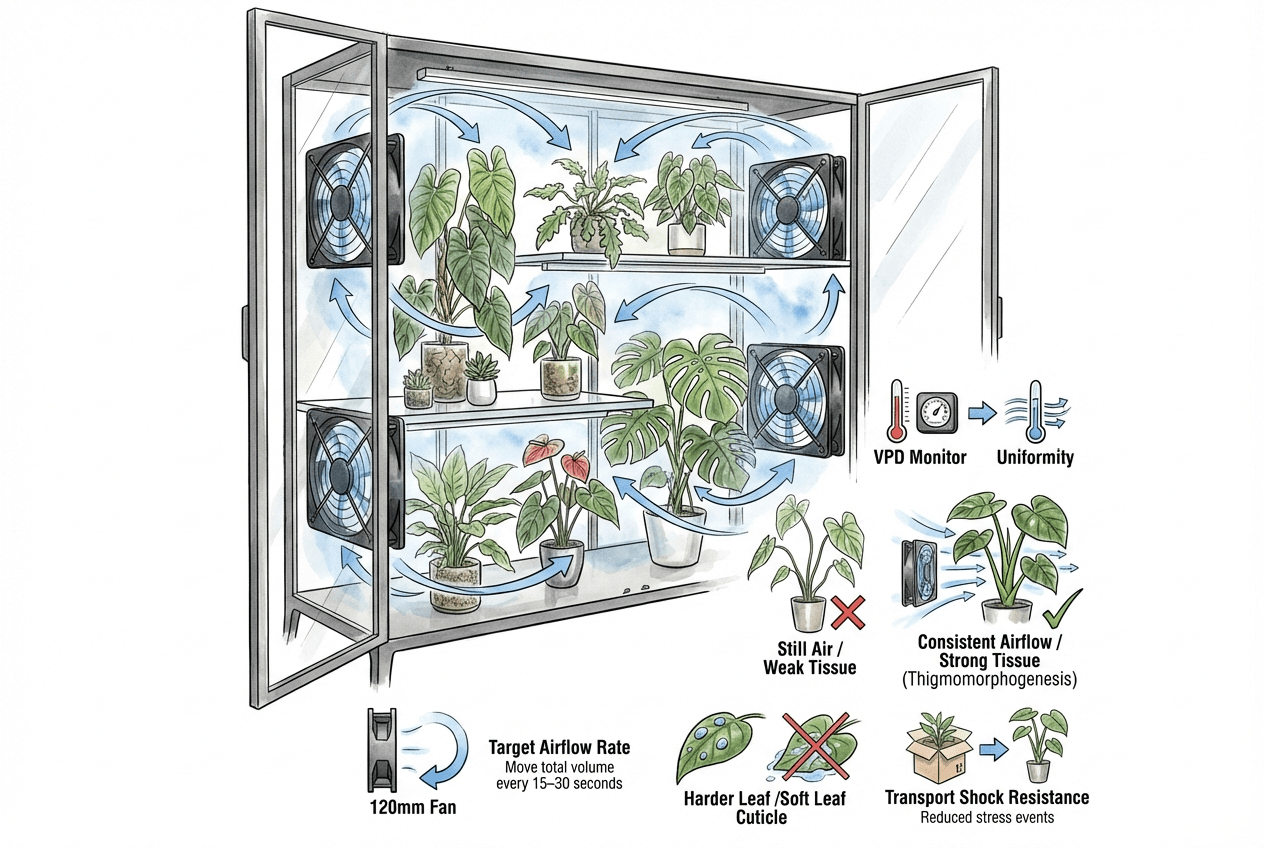
Place fans to keep air gently moving throughout the cabinet, for example one higher up and one lower down, angled to circulate rather than blast the plants.
A diagonal pattern is a reasonable starting point. Decide on continuous versus intermittent running based on your fans, noise, and whether the cabinet is drying out or condensing.
The Ultimate Vapor Pressure Deficit (VPD) Guide
How Do You Build and Structure a Cabinet for Optimal VPD?
Cabinet structure sets the baseline around which all VPD control operates. Sealing, shelf material, fan placement, and glazing all affect thermal stability and humidity distribution.
What Shelf Type Maximizes VPD Uniformity?
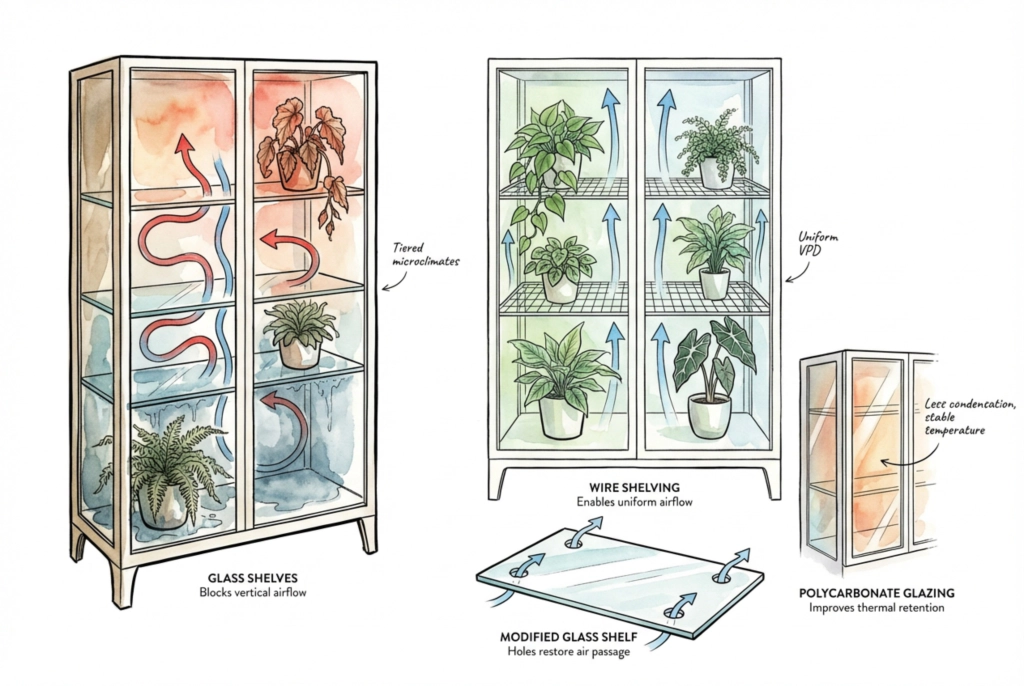
Solid glass shelves block vertical airflow and can create tiered microclimates within one cabinet (warmer and drier up top, more stagnant and humid near the floor).
Open wire shelving is generally the best choice for vertical airflow. Do not drill the cabinet’s original shelves. IKEA Milsbo (and similar) shelves are tempered glass, which is manufactured to size and then heat-treated. Cutting or drilling a finished tempered pane can shatter the whole shelf.
If you need more airflow, swap the glass shelf for a purpose-made wire or slotted panel rather than modifying the tempered glass.
Replacing a solid glass shelf with open wire or slotted material can noticeably reduce the top-to-bottom temperature difference and even out VPD across shelves.
The exact improvement depends on your cabinet, fans, and sensor placement, so verify it with your own readings rather than expecting a fixed figure.
Choosing a more insulating front panel material can reduce condensation and heat loss, but the effect depends on the material, thickness, any air gap, and how well the frame is sealed, so treat X% better claims cautiously and compare the specific products you are considering.
Also weigh shelf choice for load rating, corrosion, pot stability, and cleaning.
What Is the Optimal Fan Setup for a Milsbo Cabinet?
A tall cabinet benefits from several small fans distributed to circulate air rather than one unit.
AC Infinity MULTIFAN S5
AC Infinity MULTIFAN S5 is a compact USB fan pair with a shared speed controller. It suits a cabinet only when every fan and connection can stay outside mist and condensation.
Choose the S5 When You Can Keep It Dry
You can keep both fans away from mist and condensation.
Skip the S5 When Its Connection Cannot Stay Dry
The cabinet has no path for air exchange, needs a waterproof fan, or cannot keep the USB connection dry. The manufacturer designed it for electronics cooling, not wet enclosures or outdoor use.
Set Airflow by What Leaves Actually Experience
Use the lowest fan setting that prevents stagnant, wet pockets without constantly bending leaves or drying the cabinet too fast. Output ratings are measured without shelves and foliage, so confirm movement at leaf level instead of sizing the cabinet from a number on the box.
Gentle, continuous air movement can also produce a thigmomorphogenic response in some plants (sturdier growth from mild mechanical stimulation).
It is not guaranteed for every tropical plant, and there is a trade-off with over-drying, so aim for gentle movement rather than constant strong wind.
How Do You Automate VPD Control for a Low-Maintenance Cabinet?
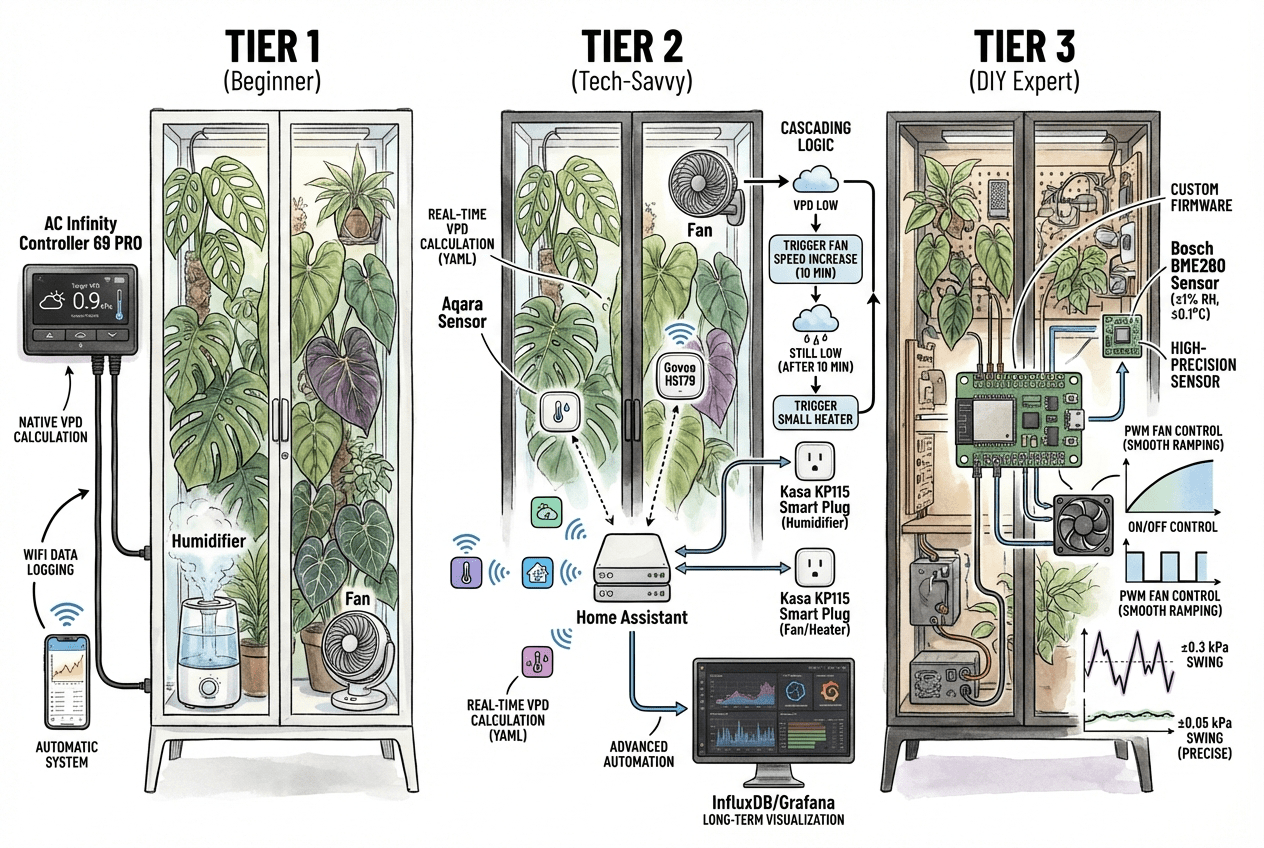
Automation can take VPD management from constant vigilance to a weekly check-in. Targeting VPD rather than a static RH can cut some over-humidification during warm periods.
Any specific savings or growth figure depends on your setup, so treat percentages as illustrative.
Which Controller Is Best for Cabinet VPD Automation?
Choose an Automation Tier
Three tiers of automation suit different collector needs.
Tier 1 (Beginner)
The AC Infinity Controller 69 PRO provides native VPD calculation and WiFi/Bluetooth data logging, and can drive up to four UIS-compatible devices.
To run a standard 120V humidifier or fan from it you need a UIS Control Plug adapter. You cannot plug a wall-plug appliance straight into a UIS port.
Check that the appliance restarts on its own after power is restored, since the controller works by switching power. Also be cautious about rapid on/off cycling and using it with heaters.
Tier 2 (Tech-Savvy)
Home Assistant with compatible sensors and smart plugs (for example Aqara Zigbee sensors, or WiFi/Bluetooth units such as the Govee H5179, plus a smart plug like the Kasa KP115) can calculate VPD in real time via templates.
It supports cascading logic automation and integrates with InfluxDB/Grafana for long-term trend visualization.
When designing that logic, remember an internal circulation fan mainly changes the leaf boundary layer. It does not directly raise the cabinet’s air-VPD sensor reading.
To move bulk VPD you need exhaust, dehumidification, or heat, so keep sensor-target actions and leaf-airflow actions separate.
Tier 3 (DIY Expert)
| Feature | AC Infinity 69 PRO | Home Assistant | Inkbird IHC-200 |
|---|---|---|---|
| Native VPD Control | Yes | Yes (via Template) | No |
| Max Devices | 4 (UIS Ecosystem) | Unlimited | 2 (Humidity Only) |
| Ease of Setup | High | Medium | Medium |
| Long-term Data | App (90 days) | InfluxDB (Unlimited) | None |
| Price Point | $$ | $ + Time | $ |
DIY Sensor and Control
An ESP32 microcontroller with a Bosch BME280 sensor running ESPHome firmware is a capable DIY route.
The BME280’s official humidity tolerance is about ±3% RH, with temperature accuracy near ±0.5°C at 25°C. Those figures are useful, but they do not support the ±1% RH and ±0.1°C accuracy sometimes claimed.
PWM (pulse-width modulation) fan control allows smooth ramping instead of harsh on/off switching, which reduces the peak-to-trough VPD swing.
Real-world stability is limited by actuator lag, mixing, and sampling as much as by sensor error, so a headline like ±0.05 kPa overstates what sensor accuracy alone can deliver.
Automation Stability
A common automation pitfall is VPD hunting (the humidifier turns on, VPD swings, an actuator responds, and the system oscillates). The exact timing depends on your system’s time constants.
Hysteresis reduces this by giving the humidifier a buffer instead of switching on and off at the same value.
A ~0.2 kPa band, such as on near 1.1 kPa and off near 0.9 kPa, is one example. Choose the band and minimum on/off times to suit your plant target and equipment.
Not every controller exposes this setting, so check before relying on it.
How Do You Diagnose and Fix VPD Problems?
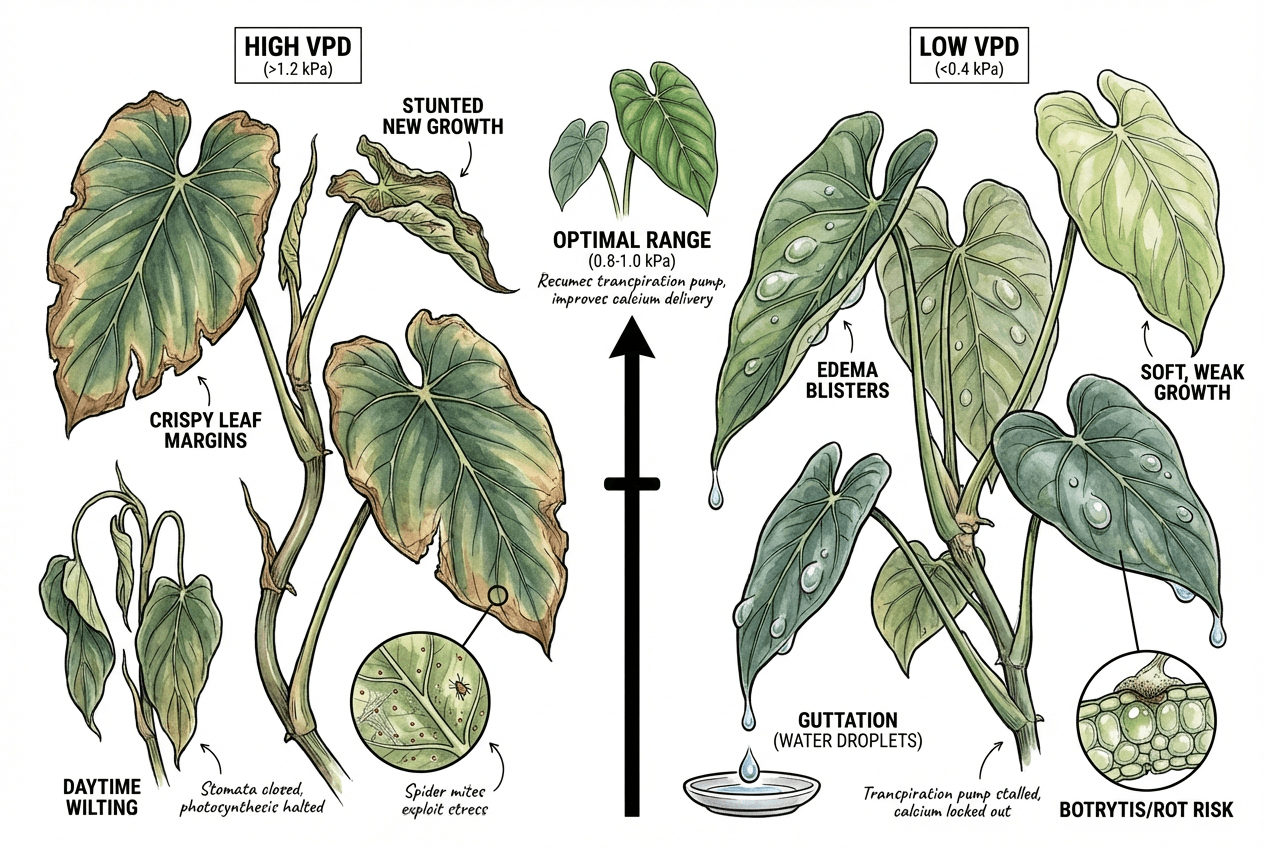
Leaf symptoms can hint at whether VPD is too high or too low, but they are not exclusive to VPD.
Crispy leaves are not always dehydration, and mushy tips are not always overwatering.
Both extremes of VPD can produce tip damage by different routes, but so can root problems, salt buildup, watering, heat or light stress, pests, disease, and nutrition, so rule those out before blaming VPD.
What Do Crispy Leaves vs. Mushy Tips Tell You About VPD?
| Symptom | High VPD (Dry) | Low VPD (Humid) |
|---|---|---|
| Leaf Tips | Brown, crispy, brittle | Yellow or soft, so investigate calcium transport and roots |
| New Growth | Stunted or deformed, with growth that can remain stuck | Soft or weak growth |
| Water Appearance | Wilting despite moist soil | Edema blisters or heavy guttation |
| Pests / Pathogens | Dry-stressed plants may favor spider mites | Leaf wetness may favor Botrytis, while root rot still requires wet, low-oxygen media |
High VPD (Over 1.2 kPa)
Crispy, brown, brittle leaf margins. New growth emerges stunted or fails to unfurl.
Under severe water deficit a plant may wilt during the day despite adequate watering, and gas exchange declines as stomata close.
Spider mites often do better on stressed plants, though their presence has other causes too.
Low VPD (Very Humid)
Edema blisters on leaf undersides and heavy guttation (water droplets at leaf tips in the morning) can appear when water uptake outpaces transpiration.
Soft, oversized new growth and stagnant, saturated conditions that favor Botrytis and root problems can also occur, but soft tissue, calcium disorders, Botrytis, and root rot are distinct issues with different checks, so do not fold them all into low VPD.
If tip burn is actually driven by stalled transpiration rather than a true shortage of calcium in the medium, adding more calcium fertilizer may not help. The calcium is present but not being carried to the leaf edge.
In that case the bottleneck is delivery, not supply. With very low transpiration, the water flow that moves calcium toward the leaf tip is reduced.
If there is a genuine supply shortfall, added calcium can still help, so check EC/pH, root health, and watering before deciding.
If low VPD is the bottleneck, improving airflow and nudging VPD toward roughly 0.8–1.0 kPa can improve transpiration and calcium delivery.
Already-damaged tissue will not recover, so judge success by healthy new growth rather than expecting existing marks to heal.
How Does Opening the Cabinet Door Disrupt VPD?
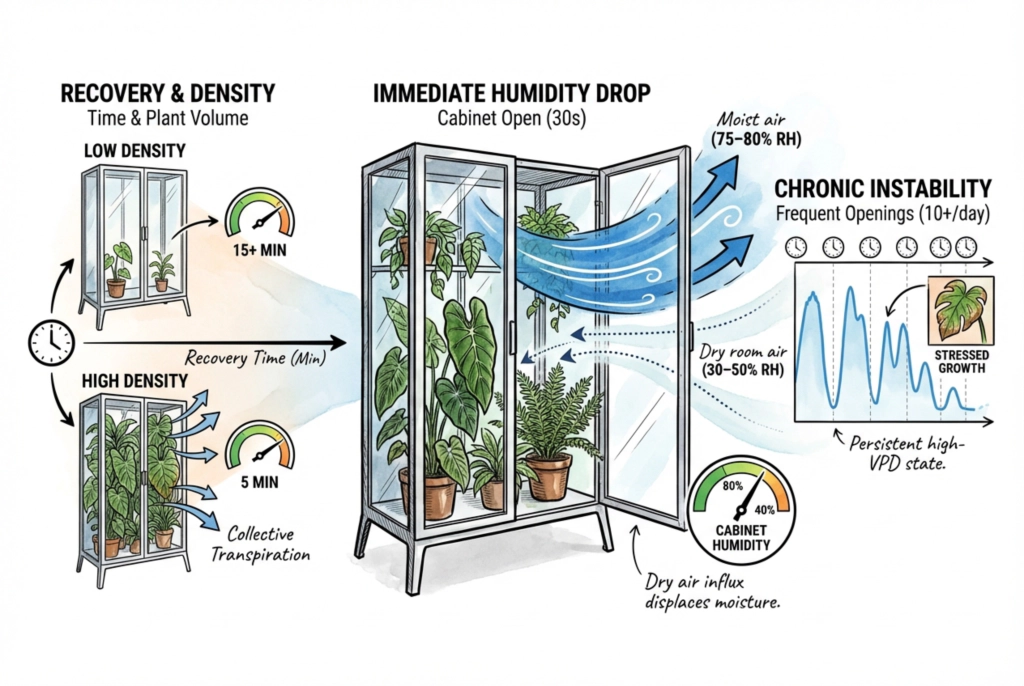
Opening a cabinet door lets humid inside air mix quickly with drier room air, so humidity drops and then recovers once the door is closed.
How large the drop is and how long recovery takes depend on the opening, room airflow, sealing, and humidifier, so measure your own rather than relying on fixed figures.
Frequent openings can keep a cabinet from settling at a stable target. Whether that amounts to chronic stress depends on how long the door stays open and how fast the cabinet recovers.
Densely planted cabinets tend to recover faster, because collective transpiration adds moisture back.
The exact recovery time varies with the cabinet, room, and equipment.
Before opening, I record a two-minute temperature and humidity average, then leave the cabinet open for five minutes at the same point in each light cycle. After closing it, I log both sensors once a minute until five readings stay within 0.5 °C and three relative-humidity percentage points of that baseline. Five minutes matches my routine inspection and small watering task, while those tolerances ignore ordinary sensor flicker but still expose slow recovery.
After changing one fan angle or shelf gap, I repeat the test with a similar plant load. This exposes a trapped pocket that a single center sensor can miss and gives me a recovery baseline before seasonal room conditions change.
How Do Seasonal Temperature Changes Affect Cabinet VPD?
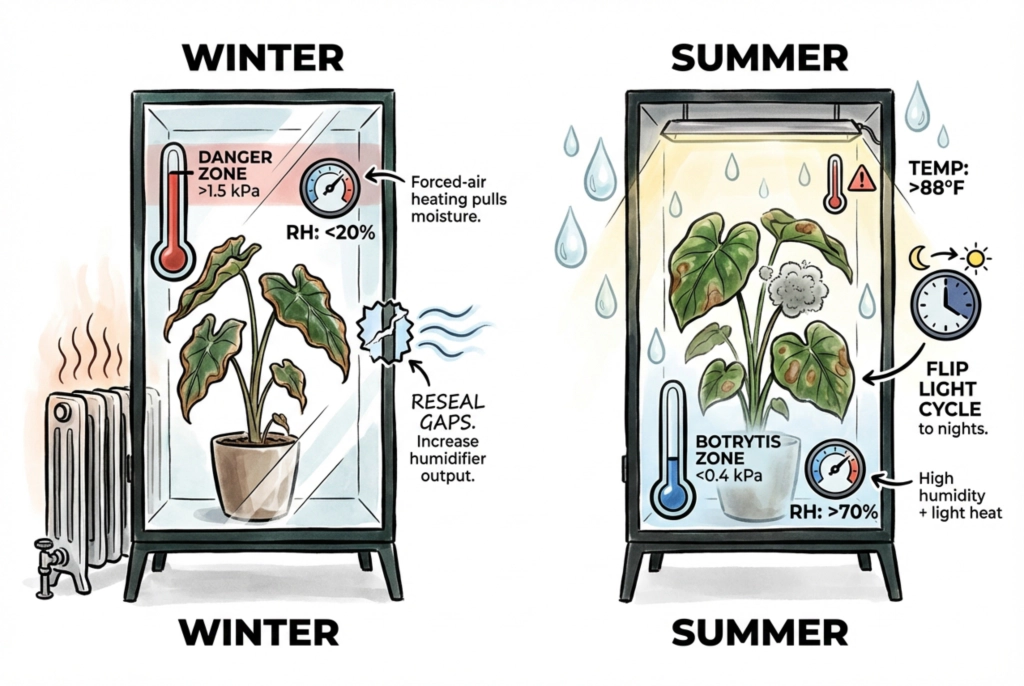
Winter
Indoor heating lowers room RH at the same moisture content, which increases the gradient pulling moisture out of the cabinet through any unsealed gap.
In a heated room, RH can fall well below 20%.
As a result VPD tends to rise, often gradually, so plants may slow before visible leaf damage appears. The pace depends on your climate, heating, and controls.
Inspect and reseal weatherstripping before heating season, and expect to raise humidifier output (tune the amount to your sensor readings rather than a fixed percentage).
Summer
In summer, high room heat raises the air’s saturation pressure and tends to push VPD up, not down. VPD only falls low when RH climbs even faster than temperature.
Hot and humid conditions can mean either high or low VPD depending on the actual numbers, for example, 88°F at 70% RH is roughly 1.36 kPa (a fairly high VPD), and it would take about 91% RH at 88°F to drop below 0.4 kPa.
Read your own sensor rather than assuming.
If the cabinet overheats, running lights at night can help. Watch the maximum internal temperature and each plant’s response. There is no single temperature that is critical for all tropical aroids.
Affiliate Disclosure
This article contains Amazon affiliate links. As an Amazon Associate I earn from qualifying purchases. If you use these links, the site may earn a commission at no extra cost to you. Product availability, price, and specifications can change. Check the current listing before buying.