
IKEA Greenhouse Cabinet: Milsbo & Rudsta Build Guide
Build an IKEA Milsbo or Rudsta greenhouse cabinet with safe cable routing, measured VPD, full-spectrum lighting, airflow, sealing, and monitoring.
Marcus Hale · Published 2025-12-18 · 21 min read
Key Takeaways
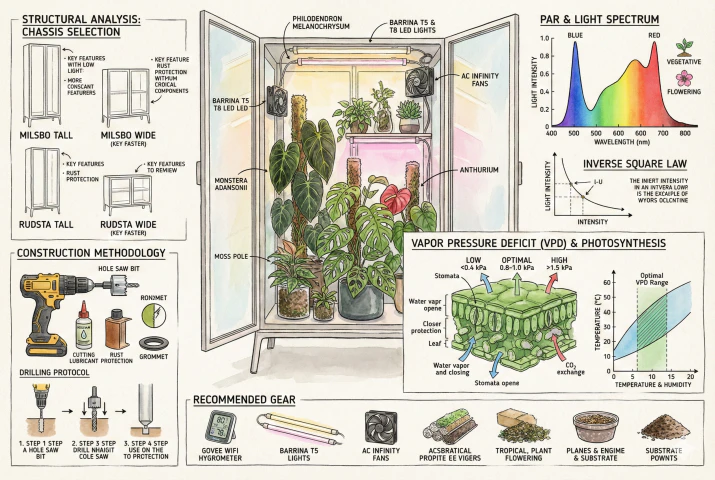
- Read RH together with temperature and think in terms of VPD, the moisture gap between a leaf and the surrounding air. Light heat makes the air thirstier, so measure and adjust rather than assume. The right band is species- and cultivar-specific, and leaf temperature matters as well as air temperature.
- Pick the chassis for your goal. Milsbo Tall suits tall climbing aroids, while Rudsta offers a magnetic steel back for repositioning lights, fans, and trellises. Buy from current IKEA product pages because older DIY guides circulated incorrect Rudsta dimensions.
- Route power cables through the cabinet’s existing cable outlet or prepared cable management before considering any drilling. Drilling the steel requires removing the glass, clamping the panel, and following power-tool and wet-location electrical safety.
- Use low-heat full-spectrum LEDs, then verify PPFD and heat with a meter at your actual mounting distance. A fixture’s T5/T8 label or warm/daylight CCT does not tell you its real output or spectrum.
- Run fans continuously to even out temperature and humidity and thin the leaf boundary layer, but remember that recirculation is not fresh-air ventilation. Airflow alone does not prevent disease. Keep any humidifier controlled and outside a sealed box.
Many rainforest-understory plants (a Philodendron melanochrysum is a common example) struggle in the low humidity of a typical heated living room, because human comfort and their native climate pull in different directions.
One practical fix is a modern Wardian case. Converting a steel-and-glass IKEA cabinet into a semi-sealed grow space lets you manage light, air, and moisture together.
Build and test it in stages because a cabinet is not a certified greenhouse and its conditions can change quickly with lights, watering, and room weather.
IKEA Greenhouse Cabinet Build (Quick Plan)
- Choose the cabinet. Use Milsbo Tall for vertical growing room, Milsbo Wide for trays, or Rudsta when a magnetic steel back and easy repositioning matter most.
- Define the climate before buying equipment. Log room temperature and RH, then set a species-specific working range. Use the plant-cabinet VPD guide to interpret the readings.
- Plan power safely. Use the factory cable outlet or cable-management route first. Keep mains strips and adapters outside and above water, with GFCI/RCD protection and drip loops.
- Install low-profile lighting. Mount bars with a secondary safety catch, then map PPFD and calculate DLI at leaf height instead of trusting a T5/T8 label.
- Create circulation and fresh-air exchange. Use gentle fans to mix cabinet air, but provide a separate passive or timed path for fresh air.
- Seal gradually. Add weatherstripping only after the equipment is running, checking peak temperature, condensation, and door pressure after each change.
- Commission the cabinet. Run it empty for at least one full light cycle, log the top and bottom zones, then add plants and tune the system. If you need hardware options, compare the fan, humidifier, sensor, and controller tradeoffs.
1. Set the Cabinet Climate
Success depends less on the hardware than on managing several interacting variables together, including light intensity and spectrum, air movement and fresh-air exchange, moisture in the air and substrate, and temperature, including leaf temperature, which can differ from the air.
1.1 Read Temperature and Humidity Together
Relative humidity only makes sense alongside temperature. VPD is a useful estimate of how strongly the air is pulling water from a leaf, but a sensor calculates it from air conditions and cannot know the exact leaf temperature.
Lights can warm the cabinet quickly. The same humidity reading then represents drier conditions for the plant, which can increase water loss. Near-saturated, still air has the opposite problem because it slows transpiration and keeps leaves wet.
Use VPD as a trend tool, not as a universal target. Watch leaf condition, new growth, temperature, condensation, and substrate moisture together.
VPD Monitoring
Govee H5179 suits a cabinet where remote alerts and trend history will help you catch a light-driven heat spike while you are away. Use the two sensors at different heights, not as a promise of exact leaf conditions.
A hygrometer measures cabinet air, not leaf temperature or leaf wetness, so use it to spot trends and confirm them against the plants.
Minimizing VPD Fluctuations Maintains Higher Stomatal Conductance and Photosynthesis, Resulting in Improvement of Plant Growth in Lettuce
1.2 Choose Light by Output, Not Label
Plants use light across the visible range. A full-spectrum white fixture can work well in a cabinet, but “full spectrum,” colour temperature, and a T5 or T8 label do not show how much useful light reaches your plants.
Choose a fixture that fits the cabinet, then measure PPFD at the leaves and check that the light does not overheat the enclosure.
Measure PPFD and DLI
Intensity is measured as PPFD (µmol·m⁻²·s⁻¹), and it falls off with distance. The simple inverse-square law is a point-source approximation. It only holds once you’re several times the fixture’s largest dimension away, which you rarely are with a 2-ft bar sitting 6–12 inches above a shelf.
So don’t rely on a 200 at 6 in to 50 at 12 in calculation. Instead map PPFD at your actual mounting distance with a quantum sensor at several points, and use that plus your photoperiod to estimate daily light integral (DLI).
As very rough starting points (verify by measurement), understory ferns/Calathea/Begonia sit lower, general aroids/Philodendron/Alocasia in the middle, and high-light Monstera/Hoya/orchids higher.
These genera each span a wide range of light adaptation, so treat any published band as a first guess and confirm with a meter, watching leaf response and DLI rather than a single PPFD figure.
Green light is similarly effective in promoting plant biomass as red/blue light. A meta-analysis
1.3 Fluid Dynamics and Airflow
In high humidity, stagnant air raises disease risk. The still boundary layer clinging to a leaf saturates, condensation and leaf wetness linger, and those are conditions that favor bacterial rot (Erwinia) and fungal pathogens (Botrytis).
Airflow alone doesn’t create or prevent disease, though. You also need the pathogen present, a susceptible plant, and lapses in sanitation and moisture control.
Fans can even spread inoculum that’s already there, so pair circulation with clean tooling and prompt removal of wet, damaged tissue.
Circulation and Fresh-Air Exchange
The goal is gentle circulation that thins those boundary layers without wind burn, usually via small axial fans.
This mixing evens out temperature and humidity inside the box, but it is not fresh-air ventilation. It recirculates the same air.
A tightly sealed cabinet can draw down CO₂ during the light period, so plan for some fresh-air exchange (timed or passive) separately from internal mixing.
2. Choose the Cabinet
The Milsbo and Rudsta series are the two main choices, with different materials and modularity.
2.1 The Milsbo Series (The Vertical Giant)
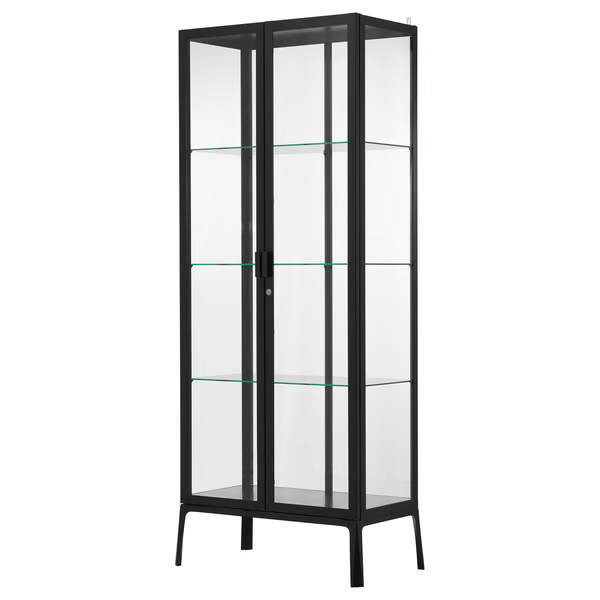
The Milsbo Tall (≈73 W × 175 H × 42 D cm per IKEA) has a powder-coated steel frame with tempered glass on all four sides. IKEA rates each shelf to about 5 kg (11 lb).
Its big vertical clearance suits mature climbing aroids on moss poles. IKEA’s own guidance requires anchoring the cabinet to the wall to prevent tipping, and damage to a glass edge can cause the tempered pane to break. Both points matter once you start drilling or loading shelves.
For cable routing, the Milsbo Tall already has a cable outlet at the top, so drilling the frame is not a default requirement.
The Milsbo Wide (≈101 W × 100 H × 38 D cm, shelf max ≈44 lb) gives a landscape orientation good for propagation trays. Stay within that rated glass-shelf load and treat the limit as load, impact, and break risk rather than assuming the tempered glass simply sags.
2.2 The Rudsta Series (Magnetic Utility)
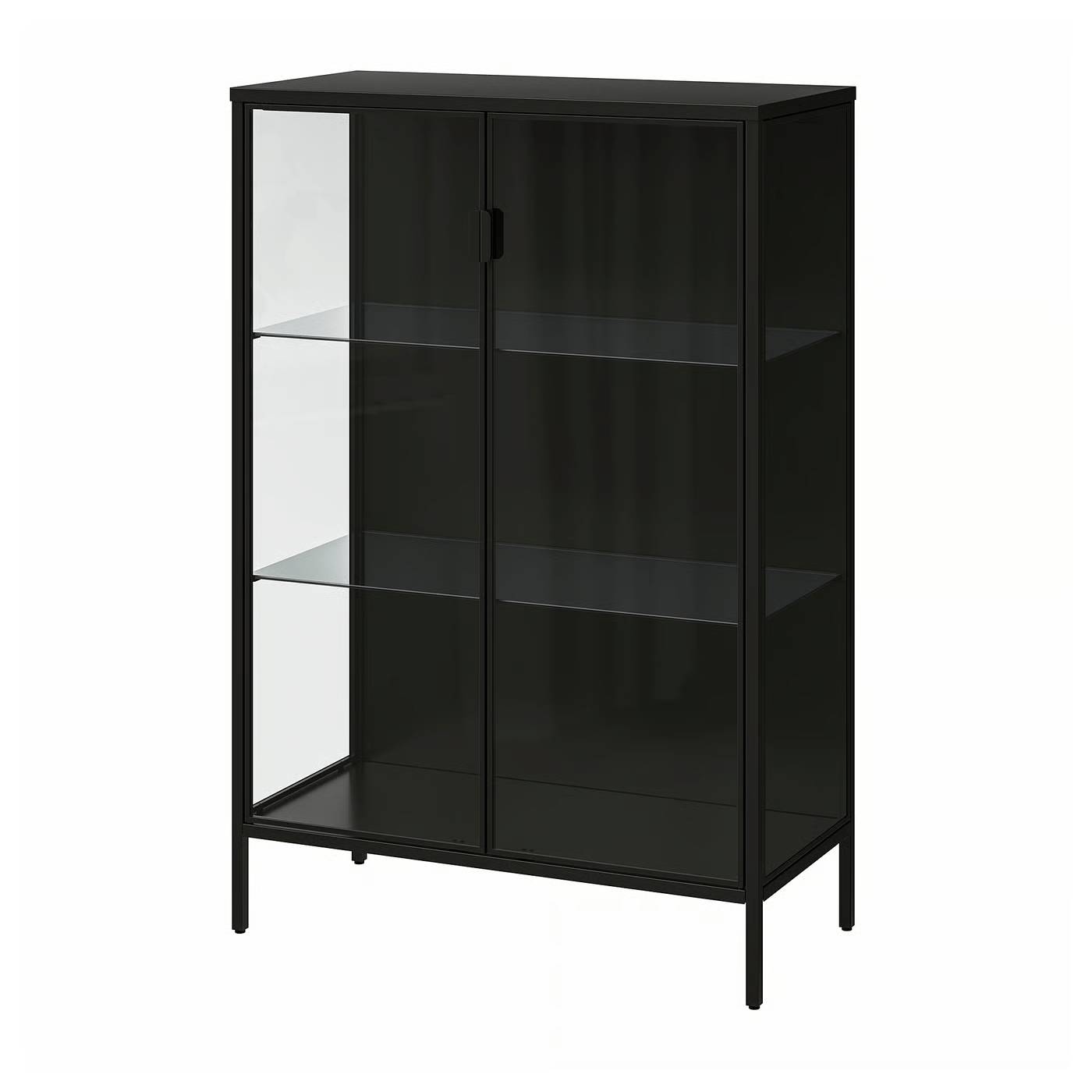
The Rudsta adds one useful advantage with its solid steel back panel, which lets you mount lights, fans, and trellises with magnetic hooks and reposition them without adhesives or drilling.
Per IKEA, the Rudsta Wide is ≈80 W × 120 H × 37 D cm and the Rudsta Tall is ≈42 W × 155 H × 37 D cm. Verify on the current product page, since earlier DIY guides circulated sizes that were off by tens of centimetres.
Like the Milsbo, Rudsta must be anchored to the wall.
The Rudsta also ships with prepared cable management, so the no-drilling benefit isn’t only about magnetic mounting. You can route power without cutting the steel.
The tradeoff is volume. Rudsta units are generally smaller than the Milsbo Tall, which caps plant size.
Rather than crowning a single winner, compare the models on what actually constrains your build, including price, usable interior height and footprint, shelf load, door opening, the cable outlet or cable management provided, and the wall-anchoring footprint.
The Milsbo Tall favors mature climbers with its height. The Rudsta favors quick, drill-free rearranging via its magnetic back. Which fits depends on your species, budget, and space.
| Cabinet | Best fit | Useful feature | Main constraint |
|---|---|---|---|
| Milsbo Tall | Climbing aroids and moss poles | About 175 cm tall. Top cable outlet | Glass on all sides. Each shelf is rated around 5 kg |
| Milsbo Wide | Propagation trays and broad displays | About 101 cm wide. Higher stated shelf capacity | Less vertical clearance than Milsbo Tall |
| Rudsta Tall or Wide | Flexible layouts and magnetic accessories | Magnetic steel back. Prepared cable management | Less overall growing volume than Milsbo Tall |
Dimensions and load ratings can change by market or product revision. Confirm the exact SKU on IKEA’s current product page before buying shelves or cutting any part.
3. Route Cables Safely
Converting a cabinet means getting power cords in safely. First use what the cabinet already provides. The Milsbo Tall’s top cable outlet and the Rudsta’s prepared cable management route a cord without cutting metal.
Avoid running cords through the door gap, which can compromise the seal and pinch insulation.
Drilling the steel should be a last resort, for example if no provided route reaches where you need it, and it changes how the cabinet is used, so first check the manufacturer guidance and warranty and any local electrical code, and consider having a qualified metalworker or electrician do it.
3.1 Tools
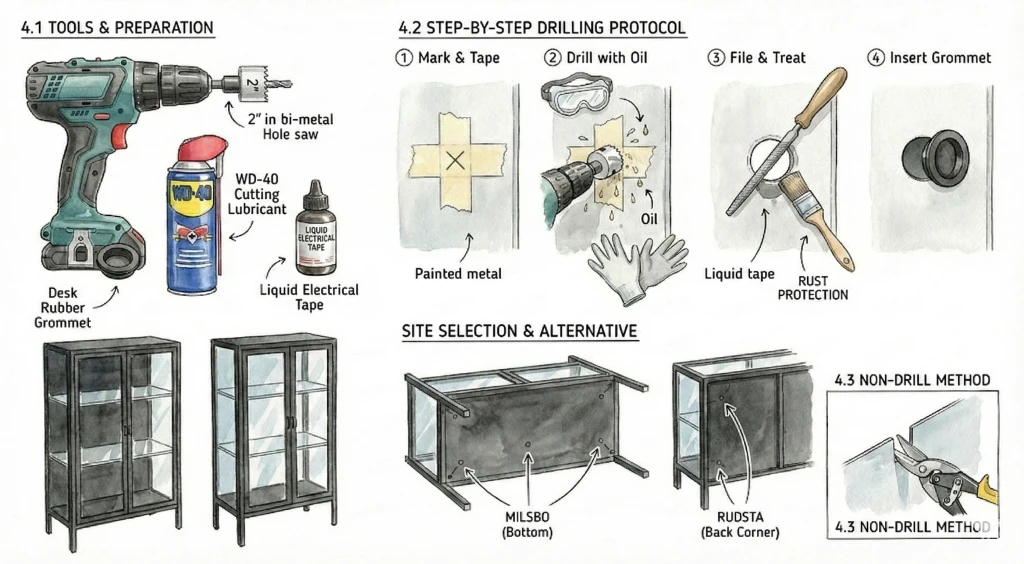
Use a variable-speed drill, a bi-metal hole saw sized to the cord and grommet, a lubricant intended for drilling metal, a rubber grommet matched to the panel thickness, clamps, and a corrosion coating applied according to its product instructions. A three-prong plug typically needs a hole of about 2 inches or 51 mm. WD-40 is a penetrant and displacer rather than a true cutting oil, so prefer a proper cutting fluid where possible.
3.2 Drilling as a Last Resort
Before you drill
Unplug and remove all electronics, take out the tempered glass panels entirely (don’t drill an assembled cabinet. That’s where vibration cracks glass), and disassemble the metal part you’re cutting.
Clamp that panel firmly to a stable bench with a hold-down fixture so it can’t grab and spin.
- Choose the site with enough edge distance for the grommet groove. On the Milsbo, the bottom metal plate is two layers, so account for both and keep the cut away from where any glass or electronics will later sit.
- Mark the center, cover the spot with masking tape to stop the bit walking and scratching the finish, apply cutting fluid, and start slowly to seat the pilot before working up to a moderate, steady feed suited to the saw and metal. Do not force it because excess pressure creates heat that warps metal, dulls teeth, and invites kickback. Wear eye, face, and hearing protection. Hot chips eject. Do not wear gloves while the tool is spinning because a rotating bit can catch a glove and drag your hand in. Put on cut-resistant gloves only after the tool has stopped, for handling sharp edges and cleaning up chips.
- Deburr the edges with a round file, then coat the bare steel against corrosion using a product rated for the job and following its label for surface preparation and full cure. Do not treat clear enamel and liquid electrical tape as interchangeable waterproofing. Fit the grommet, then route the cord with a drip loop and strain relief so the steel cannot abrade the insulation.
If a provided cable route won’t work and you’d rather not drill, note that notching a panel with tin snips leaves a sharp, coating-damaged edge that can abrade a cord, and raising the back panel changes the fit and anchoring. Neither is a clean substitute for the built-in cable outlet or cable management, which should be your first choice.
4. Install Lighting
4.1 T5 vs. T8
Barrina T5 Grow Lights
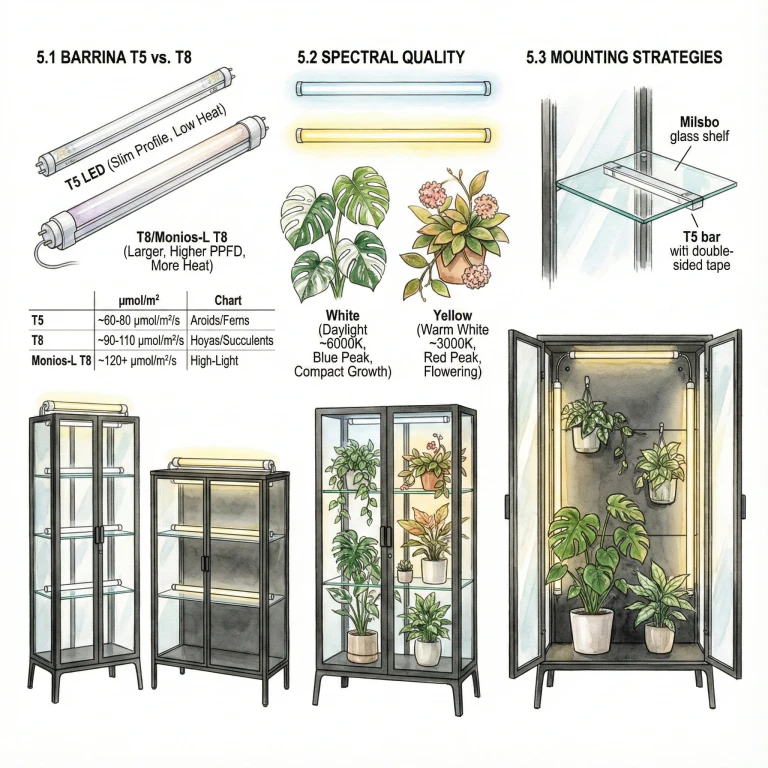
Barrina T5 Grow Lights are a popular, low-cost choice in the plant-cabinet hobby because the slim bars are linkable, but lighting remains one of the most consequential decisions in the build.
T5 and T8 describe tube diameter, not a fixed output or heat class (in LED bars they’re marketing families whose real PPFD, power draw, and surface temperature vary by model).
So don’t treat T5 as cool and low-power or T8 as hot and high-power. Compare the specific fixtures on measured PPFD/PPF, input watts, and how hot the housing runs, then check heat at your shelf spacing.
A slim, linkable bar can be a sensible default for a tight cabinet because it’s low-profile and reduces cable clutter, but confirm it delivers enough light and doesn’t push the cabinet too warm for your plants. There is no single safe temperature that applies to all tropical foliage.
Whichever you pick, verify it with a meter. Photobleaching, heat injury, and low-light stretching cannot be diagnosed from a fixture label alone. Check leaf temperature, PPFD, and DLI.
If you are still weighing specific bars, the aroid grow-light chooser compares fixtures by the PPFD and DLI they deliver at the canopy rather than by wattage or T5/T8 labelling.
The linked Barrina bars are useful when their slim, linkable form fits a shelf. Add only enough bars for the measured light target, because adding every bar can raise both the electrical load and cabinet heat.
Keep these indoor fixtures out of spray and condensation because the listing does not state a wet-location rating.
4.2 Spectrum (Yellow vs). White
Warm-white (~3000 K, yellowish) and daylight (~6000 K, whiter) bars can both be marketed as full-spectrum, but CCT alone doesn’t tell you the spectral power distribution, photon output, efficacy, far-red content, or CRI, so it’s not purely aesthetic.
Beyond appearance, higher-CCT light looks whiter and renders variegation crisply while warmer light blends with home decor, and the two can differ in useful photons and heat.
Mixing CCTs is a reasonable aesthetic preference (some growers run whiter light on lower shelves for visibility and warmer up top) but I’m not aware of evidence that a particular arrangement changes plant response, so choose it for looks and verify light with a meter.
4.3 Mounting
Prefer the manufacturer’s clips or brackets, plus a secondary tie or catch, so a bar can’t fall onto wet plants or a water tray if a fixing lets go.
Magnetic clips on a steel back or the metal roof are convenient and repositionable. If you must use adhesive mounting tape (e.g. A 3M VHB product) under a glass shelf, follow its rating for surface prep, load, and temperature/humidity, and still add a secondary retention. Energized bars falling into water are the failure mode to design against.
On the Rudsta, the magnetic back also allows vertical side lighting in the rear corners, which can help reach the lower leaves of bushy plants. Whether that reduces leaf drop specifically isn’t something I can back with comparative evidence, so treat it as a plausible layout option.
5. Atmospheric Regulation (Airflow and Ventilation)
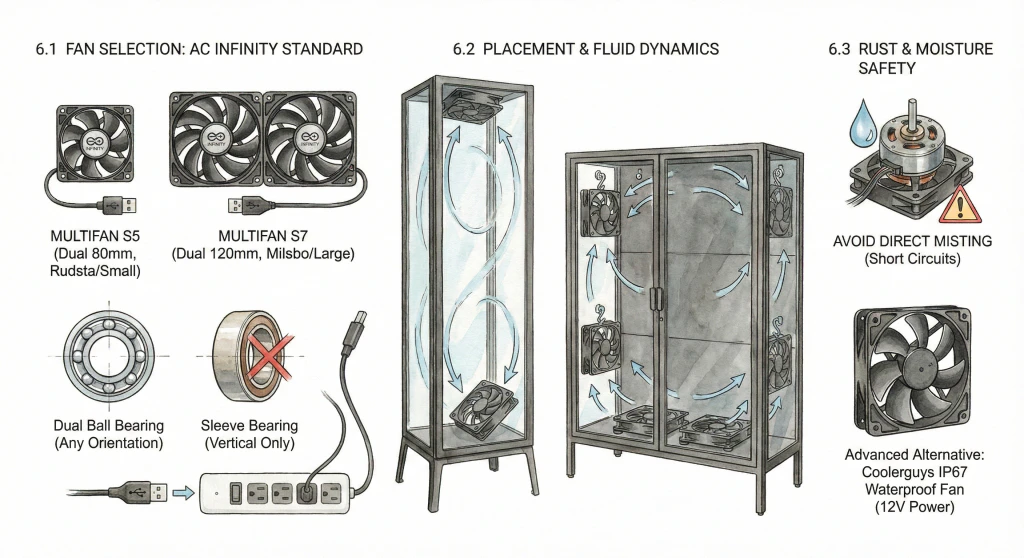
In a humid, still cabinet, running lights without any air movement raises mold and rot risk (it doesn’t guarantee it, see the disease conditions above).
Steady mixing helps even out temperature and humidity.
5.1 Fan Selection
AC Infinity Multifan S5
AC Infinity Multifan S5 is a quiet USB fan that can suit a small cabinet when it has a dry mounting position and enough free space. Size the fan around obstructions and plant density, then measure conditions at the canopy and adjust rather than choosing by cabinet volume alone.
The S5 has no stated wet-location rating, so keep it out of mist and condensation, clean it regularly, and keep its adapter and mains connections outside the cabinet and above water.
5.2 Placement
Create a loop by angling one fan at the top down and a second at the bottom up. This circulation scrubs the front glass to help with condensation and moves boundary-layer air off the leaves.
It carries CO₂-depleted air away from the leaf surface but only recirculates it, so it does not add fresh CO₂. Pair it with the fresh-air exchange noted earlier.
Mount with magnetic hooks on the Rudsta’s back, or zip-tie to wire shelves / suction-cup to glass in the Milsbo, and check the load rating, add a secondary tie, and watch that suction cups can release as humidity rises.
5.3 Electrical and Moisture Safety
A high-humidity metal cabinet full of water and mains-powered gear needs real electrical protection, not a single rule of thumb. At minimum, use the following safeguards.
- Power everything through a GFCI/RCD-protected outlet.
- Keep power supplies, adapters, and any power strip outside the cabinet and above the water level. Run cords with a drip loop so water can’t track down into a connector.
- Use fixtures and connectors suited to a damp location. Keep connectors out of the splash and condensation path, and consider a leak tray under the cabinet.
- Watch the total load and fuse/breaker rating, and inspect cords and connections periodically.
AC Infinity fans carry no IP/wet-location rating, so never mist them directly and keep them out of condensation.
Note that USB, 12 V, and IP67 describe supply topology or an ingress rating, not overall electrical safety. Swapping in an IP67 fan doesn’t make the system misting-tolerant unless its connectors, cable entry, supply, and any mains adapter are also suitable and kept out of the water.
Keeping components dry helps, but it isn’t a substitute for the protections above.
6. Interior Architecture (Shelving and Layout)
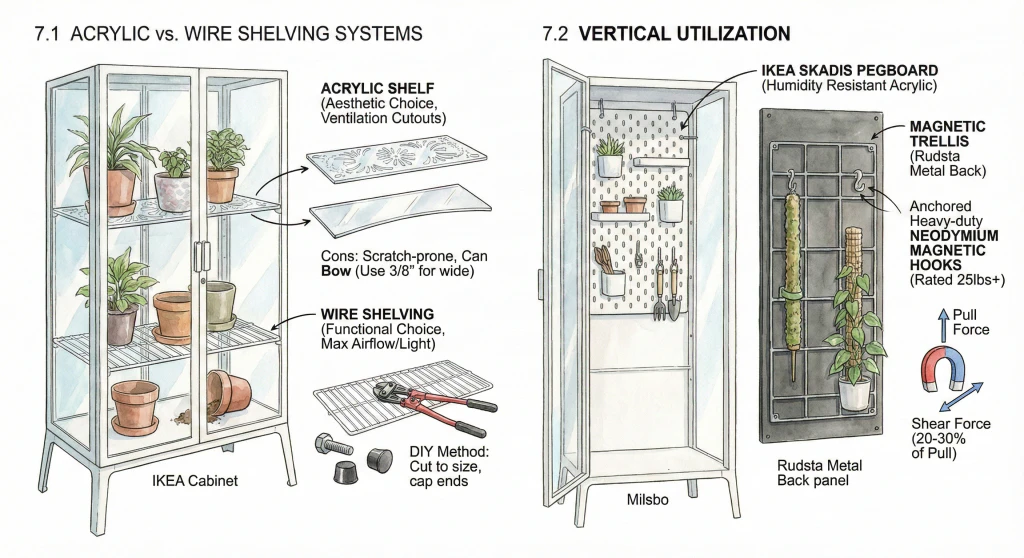
IKEA’s stock glass shelves are solid, so they can obstruct vertical circulation and reduce light reaching lower tiers (IKEA notes glass shelves also spread light around), so many builders swap them, but you can also keep them within their rated load as a low-cost option.
Acrylic shelves
Custom laser-cut acrylic shelves with ventilation cutouts look clean and wipe down easily, but they’re pricey, scratch-prone, and can bow under heavy wet pots.
There’s no universal minimum thickness. The right choice depends on the unsupported span, how much you cut out for ventilation, the support points, and the load, so size it for deflection rather than assuming 3/8-inch is always enough.
Wire shelving
Closet shelving cut to size with bolt cutters allows a lot of airflow and light through, is cheap and durable, but looks industrial and lets small pots tip between the wires. The wires and pots themselves still block some light, so it isn’t 100 percent open. Bolt-cut ends expose bare metal, and a plastic cap may not fully stop corrosion, so seal or otherwise protect them.
For vertical space, IKEA’s SKÅDIS pegboard holds small pots, tools, and sensors, but note it’s painted fiberboard, not acrylic, so in a continuously humid cabinet check the edges/sealing, swelling, and load, and IKEA’s use conditions.
On the Rudsta’s metal back, neodymium magnetic hooks can anchor moss poles and trellises, but a magnet’s holding force against sliding isn’t a fixed fraction of its rated pull (it depends on the steel thickness and coating, any air gap, hook geometry, and vibration).
Test each magnet on your actual cabinet, apply a safety factor, and for anything overhead add a secondary tether or a tray to catch a falling pot.
7. Environmental Control (Sealing and Monitoring)
7.1 Weatherstripping
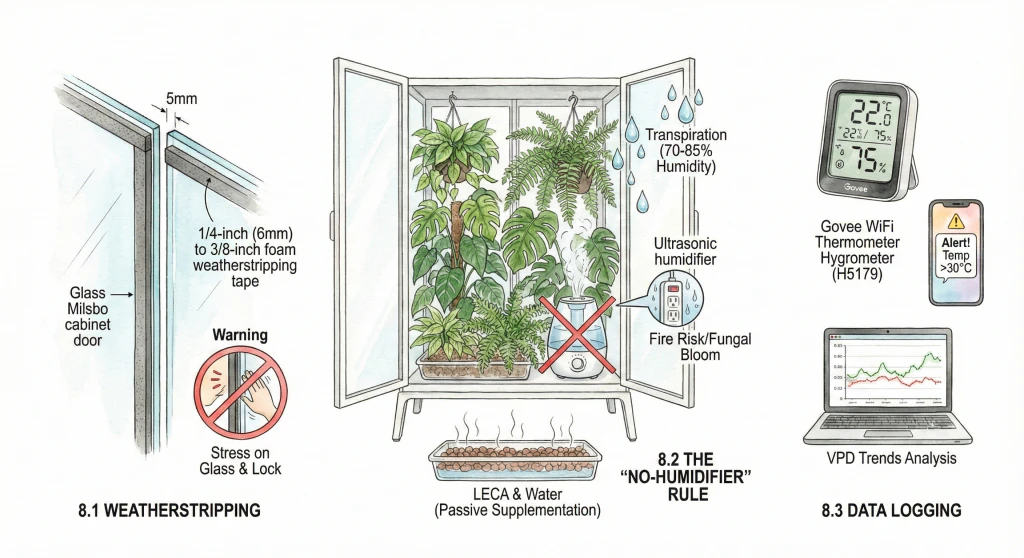
To help hold humidity, semi-seal the cabinet (then watch the tradeoffs, because tighter sealing also affects CO₂, peak temperature, and condensation).
Measure your own door gap and pick weatherstripping to match. Foam or a silicone D-profile in the 1/4-inch (6 mm) range is a common starting point, but the exact size depends on your gap and closing force.
Too-thick tape can force the doors and load the glass and lock, so if the doors won’t close cleanly, step down a size.
After sealing, check CO₂ (or at least fresh-air exchange), peak temperature, and how long condensation takes to clear, so you don’t over-seal.
7.2 Humidifiers
An uncontrolled ultrasonic humidifier inside a sealed cabinet is a real hazard. It can over-humidify quickly, condense water on electrical components, and encourage fungal growth, and its mineral aerosol coats surfaces.
How fast and how far depends on the unit’s output, any controller, and the cabinet volume, so this isn’t automatically 99 percent in minutes, but the safe approach is to avoid an uncontrolled unit inside the box. Use a controlled/external source, or rely on transpiration.
How high a fully planted cabinet self-regulates depends on your room’s dew point and temperature, the seal, leaf area, watering, and air exchange. Often it lands somewhere around the mid-to-high range, but measure rather than assume a fixed 70–85%.
If it’s low during early setup, a bottom tray of LECA and water can add gentle evaporative humidity. Keep it from spilling, watch for algae and fungus gnats, and keep it clear of electrical connections.
7.3 Data Logging
A WiFi hygrometer/thermometer with alerts and data export helps you catch a temperature spike from light heat while you’re away and track trends over time.
Set the alarm to a threshold that suits your species rather than a universal cut-off, and remember a single air sensor can’t represent the top-to-bottom gradient or leaf temperature, so place sensors at more than one height and treat any VPD you calculate as an estimate.
Before changing fan speed, weatherstripping, or shelf layout, I let the cabinet run through two normal light cycles. I place one sensor below the upper canopy and another above the lowest shelf.
I compare the readings near the warmest part of the light period and again just before the lights come on. A useful airflow change often appears as a smaller top-to-bottom gap and faster clearing on the glass, even when the cabinet average barely changes.
Both sensors stay away from the back glass, direct fan discharge, wet moss poles, and open water trays. Those spots measure a local surface or moisture source rather than the air most leaves experience. If I have only one sensor, I move it between marked positions on consecutive days instead of trusting one convenient location.
8. Substrate and Plant Selection
Substrate Choice
Because humidity is high and airflow is lower than outdoors, substrate dries far more slowly, so you will usually want a more aerated mix or a change in watering habit. Ordinary potting mix is not guaranteed to rot roots by itself because the outcome also depends on watering, drainage, particle structure, pot size, root oxygen, pathogens, and species, but slow-drying dense mix makes rot more likely.
A chunky aroid mix with orchid bark, perlite, and charcoal or a semi-hydro setup with LECA or Pon can both work well. The best choice depends on the species and your watering routine rather than one being universally right.
To compare the actual materials, the aroid potting-mix chooser explains how bark, perlite, and pumice shape air-filled porosity. If you prefer semi-hydro, the semi-hydro conversion-kit chooser compares near-inert LECA with buffered, pre-fertilized Pon.
Plant Placement
Arrange plants by measured conditions, not a fixed genus map. Put higher-light, warmer-tolerant plants where the actual PPFD and leaf temperature are highest and cooler, dimmer-loving plants toward the bottom.
Genera like Hoya, orchids, and Philodendron each vary widely, so use your meter readings and each plant’s mature size and response to decide, adjusting as you observe.
9. Conclusion
Converting an IKEA cabinet into a greenhouse combines a bit of structural work with plant physiology, turning a piece of furniture into a controllable grow space.
By managing the inputs, light spectrum and intensity, airflow and fresh-air exchange, temperature, and VPD, and verifying them with measurements rather than fixed numbers, you can build a stable microclimate for demanding tropicals.
Start from a Milsbo or Rudsta chassis bought to its current specs, add lighting and circulation you’ve checked with a meter, sound electrical protection, and honest rust-proofing, and treat the result as a careful DIY build you monitor, not a certified, hands-off system.
Affiliate Disclosure
This article contains Amazon affiliate links. As an Amazon Associate I earn from qualifying purchases. If you use these links, the site may earn a commission at no extra cost to you. Product availability, price, and specifications can change. Check the current listing before buying.