
Vivarium Mold Control: Springtails, Airflow & Drainage
Vivarium mold control in a bioactive enclosure: how to read early white surface growth, when to involve an exotics vet, and how a springtail cleanup crew, cross-ventilation, and a drainage layer help manage moisture.
Marcus Hale · Published 2026-02-21 · 9 min read

Key Takeaways
- Early white fuzz on new damp organics is often saprophytic growth, but appearance alone cannot confirm that it is harmless, so log location, odor, and animal behavior.
- Color, density, smell, and a two-to-four-week timeline are observations rather than a fungal identification or toxicity test.
- Springtails and isopods can manage minor surface growth, but environmental correction is still necessary and the cleanup crew is not a cure-all.
- Animal lethargy, appetite loss, abnormal shedding, skin lesions, cotton-like growth, or labored breathing require isolation and an exotics veterinarian.
- Ventilation and a designed drainage layer help control moisture, but equipment must stay within the animal’s safe humidity and temperature range.
- Do not spray fungicides, bleach, or garden antifungals into an occupied enclosure. Veterinary treatment belongs in a separate quarantined setup.
If you notice white fuzz on a bioactive vivarium substrate, observe before reacting. Note its location and amount, any odor, and how the animals behave before changing the enclosure.
What causes mold in a vivarium?
What Drives Vivarium Mold
Visible fungal growth is usually associated with moisture, organic substrate or food, and limited air exchange. It is not a single trigger. Species, inoculum, temperature, and enclosure cleanliness all play a part.
Airborne fungal spores are widespread, and many germinate on wet organic material in a warm humid enclosure. Species differ in the water activity, temperature, and substrate they need, so growth is not uniform.
Where evaporation and air movement are low, substrate surfaces stay wet longer and give fungi more opportunity to spread. Airflow is an environmental control you can adjust rather than the fungal mechanism itself.
A dart-frog terrarium may be kept above 80% RH, but a glass box does not reproduce a rainforest’s airflow, light, temperature swings, rainfall, or microbial diversity.
A newly enclosed setup also takes time for its microbial community and cleanup crew to establish, so early surface fungi may be more visible before balance develops. The timing depends on the setup and has not been measured here.
At each numbered wet, middle, and drier point, I place three two-centimeter squares cut from the same known-safe leaf-litter batch. I photograph mold, grazing marks, and breakdown every 24 hours for seven days. Matched size, three replicates, and fixed timing separate a neglected zone from one odd leaf fragment.
One hidden patch does not automatically call for more springtails. If the tagged litter is untouched only in that zone, I check flooding, airflow, and access before changing the population.
Is white mold in my vivarium dangerous?
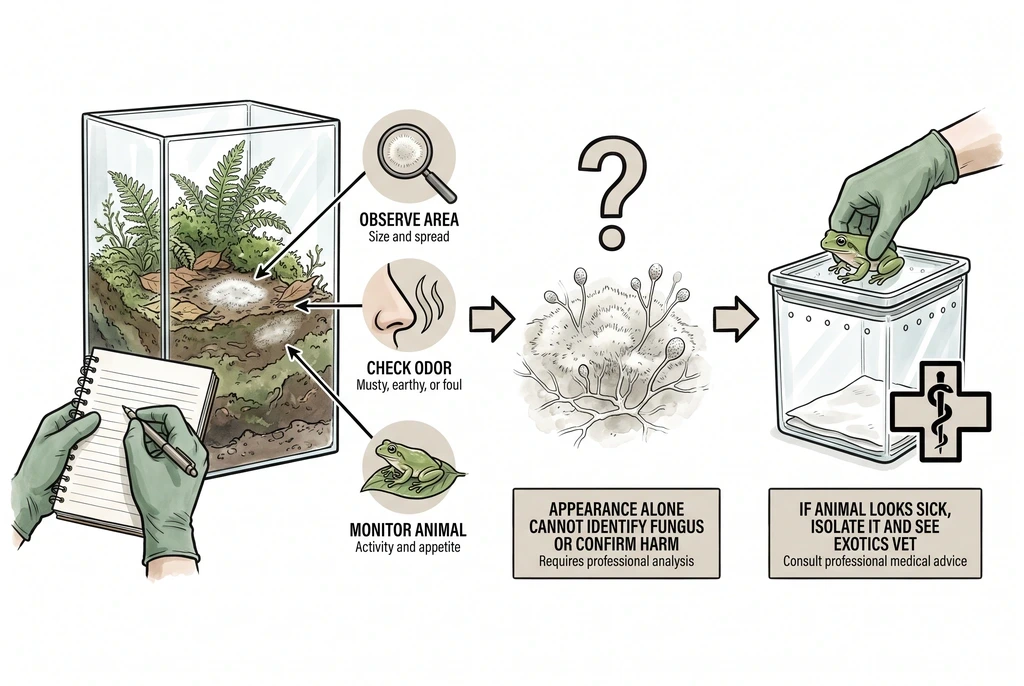
| What to observe | Often seen with early surface growth | Worth a closer look |
|---|---|---|
| Appearance | Light, sparse white fuzz | Thick, dense web-like mats or coloured patches |
| Duration | Often settles as the setup matures | Persists or keeps spreading |
| Smell | Mild earthy scent | Sharp, sour, or rotting odor |
| What to do | Keep logging area, odor, and animal behaviour | Review moisture and food sources. Watch the animals closely |
Appearance Is Not a Diagnosis
Light saprophytic fungi are common on new damp organic substrate, and many cause no obvious problem. There is no single white terrarium fungus, and appearance alone cannot confirm safety for plants, reptiles, or amphibians.
Fungi break down organic matter and cycle nutrients, so early growth on raw materials is not surprising. That does not guarantee it is beneficial, and new tank syndrome is not a standard diagnosis here.
If growth becomes widespread or substrate stays saturated, investigate the setup. Root-zone oxygen problems come mainly from water-filled pores, compaction, and limited gas diffusion. A surface fungal layer does not seal the substrate.
Amphibians and reptiles can develop skin or respiratory fungal disease, so visible growth alongside a sick animal should not be dismissed. These infections cannot be diagnosed from substrate mold. Isolate the animal and seek veterinary testing rather than assuming a link.
Early surface growth is not automatically failure and often becomes less prominent as microbial communities establish. Keep watching rather than assuming any patch is harmless.
How to treat mold without harming reptiles?
Do springtails eat mildew?
Use Cleanup Crews Within Their Limits
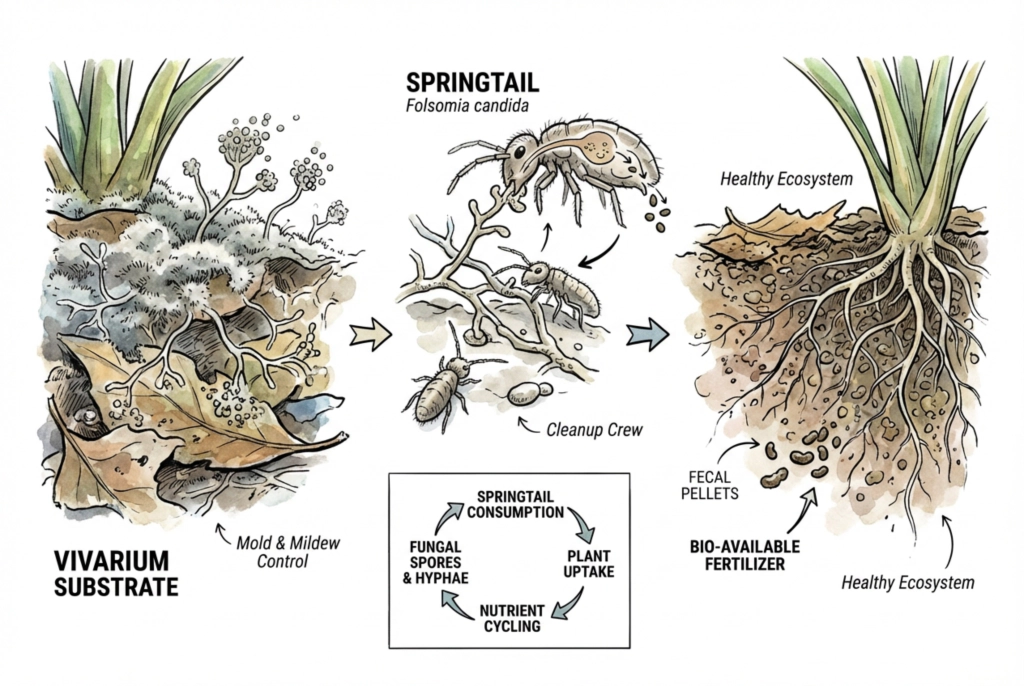
A springtail and isopod cleanup crew can help keep minor surface growth in check, and starting with the environment rather than chemicals is sensible in an occupied vivarium. It is not a cure for every mold problem, so pair it with moisture control and observation.
These small arthropods are part of a bioactive setup. Many springtail (collembolan) species feed on fungal hyphae and mycelium. Isopods are mainly detritivores that process decaying matter, so their diets and roles are not identical.
By grazing, springtails can reduce fungal biomass and take part in nutrient cycling. How much becomes plant-available depends on mineralization, leaching, and plant uptake, so it is not a direct conversion of mold into fertilizer.
Josh’s Frogs Springtails
To start a cleanup crew, add a live culture such as Josh’s Frogs springtails to the substrate. Inspect the culture on arrival and consider a short quarantine before combining it with other cleanup organisms. Choose a springtail supplier you can verify rather than relying on an unconfirmed listing.
Live cultures are sold by volume rather than a fixed head count, so there is no reliable number for a given enclosure. Follow supplier seeding instructions and judge establishment by visible persistence and spread scaled to enclosure size, substrate depth, and bioload.
Soil Allies. Exploring the Combined Potential of Folsomia candida and Trichoderma spp. Against Fusarium oxysporum
How do I improve high humidity mold prevention?
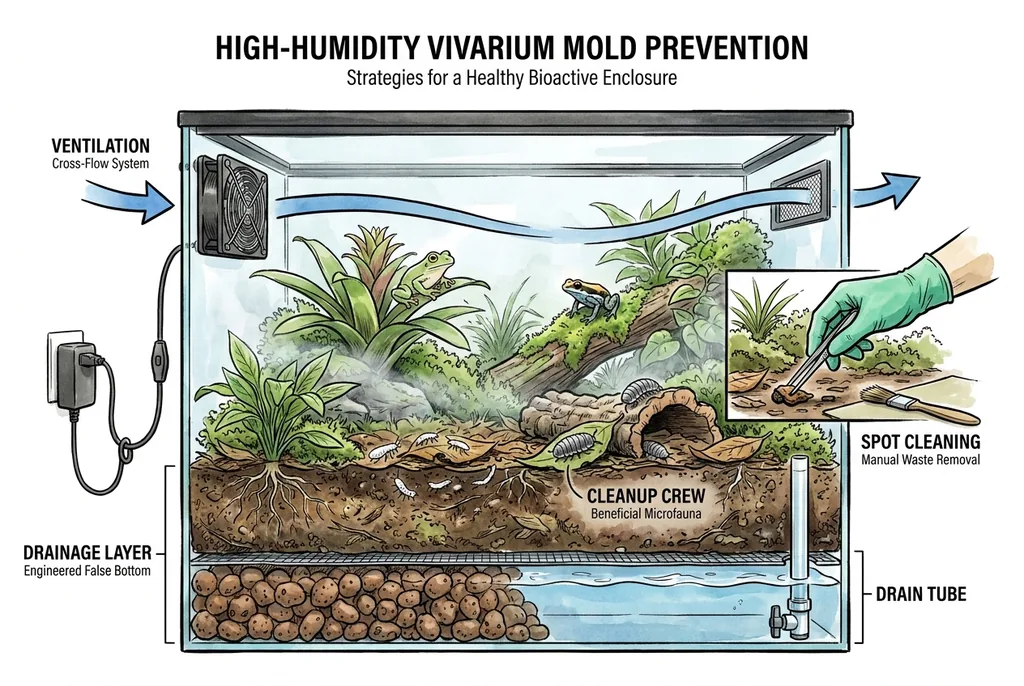
| Strategy | What it aims to do | Effort and cautions |
|---|---|---|
| Adding a cleanup crew | Helps manage minor surface growth over time | Low effort, not a cure-all, quarantine cultures |
| Improving ventilation | Lowers surface wetness and condensation | Equipment needed. Keep within the animal’s safe humidity |
| Spot cleaning | Removes food and decayed material at a spot | Ongoing attention. Treats the spot, not the cause |
| Drainage layer | Keeps standing water below the substrate | Design work. Needs a barrier, waterline, and drain |
Design Cross-Ventilation Around the Animal
Improving ventilation can lower surface wetness and condensation, which often reduces the conditions surface fungi need. It is one factor among species humidity requirements, moisture input, food sources, and enclosure shape, so it is not a single guaranteed fix.
A stagnant, moist microclimate tends to favour fungal growth. Whether moisture, substrate, temperature, or the fungal species is the limiting factor in your enclosure is something to measure rather than assume.
Cross-ventilation works best with an intake and exhaust path that moves air across the enclosure while keeping humidity and temperature within the animal’s safe range and leaving a humid refuge. If you add a fan, mount it outside on the dry side behind a guard, protect it from splash and condensation, use a dry adapter with a drip loop and GFCI, confirm local electrical requirements, and start at the lowest speed while watching a hygrometer, temperature, and the animals.
AC Infinity Multifan S5
AC Infinity Multifan S5 can provide external dry-side circulation across a vent. It is not wet-rated for an animal enclosure and cannot solve mold without correcting moisture and decay.
Make the Drainage Layer Hydraulic
A drainage layer is useful, but hydraulics matter more than simply buying clay balls. A functional false bottom needs raised aggregate or a platform, separator mesh, a waterline below the substrate, an accessible drain or siphon, and an overflow path. You still have to manage capillary bridging and root intrusion.
LECA Clay Pebbles
Leca Clay Pebbles can form raised aggregate below the substrate, but the material alone does not make a working false bottom. Include a barrier and a way to monitor or remove pooled water, and rinse off dust before use.
Water-filled pores lower oxygen diffusion and can stress roots and aerobic processes. How quickly conditions become anaerobic depends on substrate and organisms, so it is not a simple chain from low oxygen to beneficial-microbe loss and rot.
Mechanisms of Waterlogging Tolerance in Plants
Common Troubleshooting & Problem-Solving
The Mold Keeps Returning
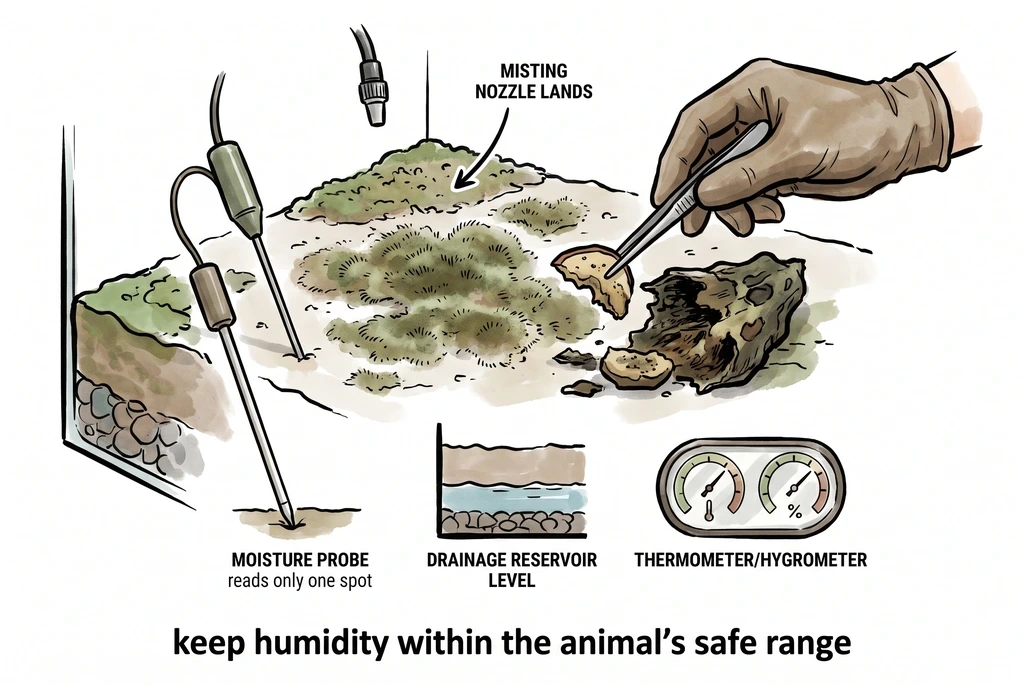
What to Look For
Mould keeps coming back to the same spot after cleaning, for example, returning within a day or two. That timing is just an example to notice, not a fixed threshold.
How to Check
Record the location, whether the affected area is growing, the local substrate moisture, where your misting lands, the drainage reservoir level, temperature and RH, any odor, and how the plants and animals look.
Why This Can Help
Remove uneaten food, feces, and severely decayed material, including affected removable hardscape. Reducing a concentrated food and moisture source can slow regrowth. A bioactive substrate is full of organics, so you cannot fully starve the fungus, and reducing misting must not push humidity below the animal’s safe range.
Springtails Are Not Doing Their Job
What to Look For
You added a cleanup crew, but the mould is still spreading.
How to Approach It
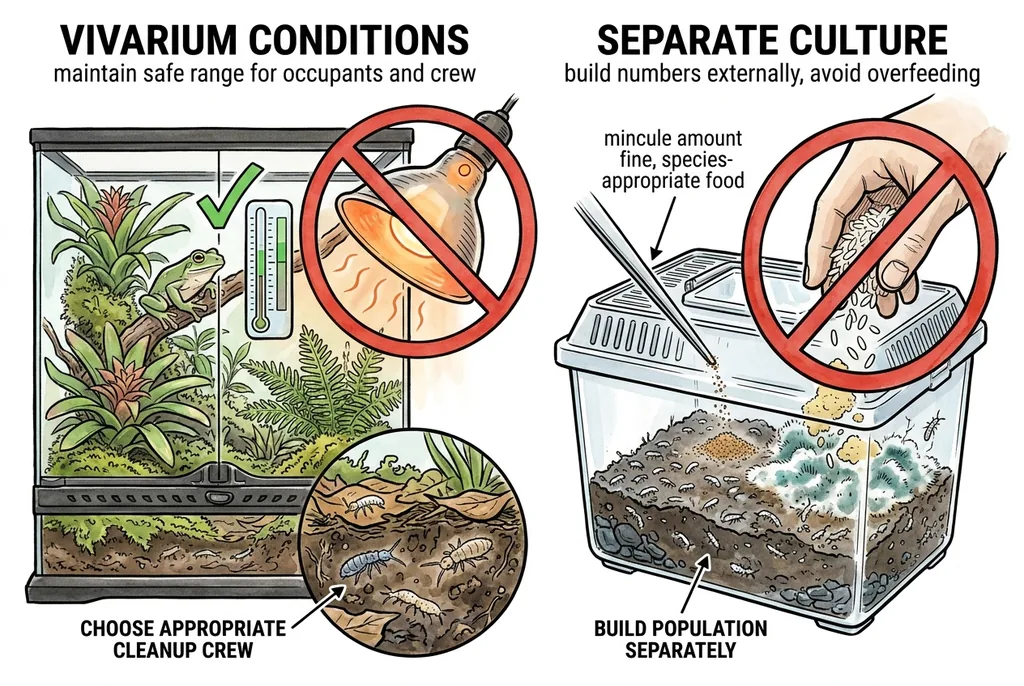
Keep the enclosure within the safe temperature and humidity range for animals and plants first. Do not heat an occupied enclosure to speed up springtail breeding. Choose a cleanup-crew species suited to that range. Springtails develop more slowly at low temperatures, but there is no simple switch at 68 F.
If you want to build numbers, do it in a separate culture with a small amount of species-appropriate food rather than in the display enclosure. Raw rice or yeast in an active mold outbreak can feed more fungus and attract mites and odor. If the crew is not establishing, check moisture input, food sources, temperature, and whether the culture was healthy.
Affiliate Disclosure
This article contains Amazon affiliate links. As an Amazon Associate I earn from qualifying purchases. If you use these links, the site may earn a commission at no extra cost to you. Product availability, price, and specifications can change. Check the current listing before buying.