
Why Your Dwarf White Isopods Crashed (and How to Fix It)
Dwarf white isopod population crash? The 8 real causes, from calcium and moisture to systemic pesticides, plus a diagnostic tree and rescue steps.
Priya Patel · Published 2026-08-06 · 16 min read
Key Takeaways
- A crash traces to 8 fixable causes. Moisture, air, heat, calcium, food, competitors, predators, or pesticides.
- Too dry desiccates them, and too wet drowns them. Their gill-derived lungs need humid air, not wet soggy soil.
- Calcium is non-negotiable. Without a cuttlebone, molts fail and the colony bleeds out with few new juveniles.
- A whole-crew wipeout within 2 weeks of a new plant points to a systemic pesticide. Springtails die ~10x sooner.
- Rebuild by quarantining plants 4-8 weeks and replacing poisoned substrate. Then re-seed with litter and calcium.
A dwarf white colony can boom and then disappear when moisture, food, calcium, air, temperature, predators, or contamination shift.
Check the moisture gradient, food and calcium, airflow, heat, predators, and any new treated plant before you replace the colony.
What kind of animal is a dwarf white isopod, and why does that predict how it dies?
Read the biology before the symptoms
Dwarf whites need available calcium to molt and moist, oxygenated substrate to breathe. Their colonies can be affected broadly when one condition fails.
Trichorhina tomentosa reproduces by parthenogenesis. Only females are known, and they give birth without mating. A single female produces multiple broods a year, so a colony grows fast, but that same clonal biology gives it almost no genetic buffer against a shared threat.
I place one 5 mm square of the same fish flake under numbered bark pieces in wet, middle, and drier zones. Thirty minutes after room lights go out, I count adults and juveniles at each station for ten minutes, then remove leftovers the next morning. Equal bait and a fixed nocturnal window reduce feeding and daylight bias without leaving excess protein to mold.
Adults, juveniles, uneaten food, and mold go into separate counts before I add more animals. Juveniles at one station show reproduction even when the colony looks absent from the surface.
At a marked point 30 mm from each bait station, I press a clear 10 mm inside-diameter tube down to the drainage layer, cap the top, and lift one core. I photograph the profile, note any odor without bringing the core to my face, and replace it immediately, stopping if the tube meets wood, a burrow, or an isopod. Cutting the tube 10 mm longer than the measured substrate depth makes every sample reach the same boundary, while the 30 mm offset keeps bait moisture out of the core.
Did the substrate dry out or go waterlogged?
Hold a moisture gradient
Moisture is the number-one abiotic killer, and it kills at both extremes. A dried-out substrate desiccates the colony, and a waterlogged one suffocates it. Dwarf whites need a moisture gradient, not uniform wetness.
Keep one side and the lower layer consistently moist, with a less-wet retreat elsewhere. Use enough substrate for burrowing and mist one side rather than soaking the whole enclosure.
Why does a dry substrate kill them so fast?
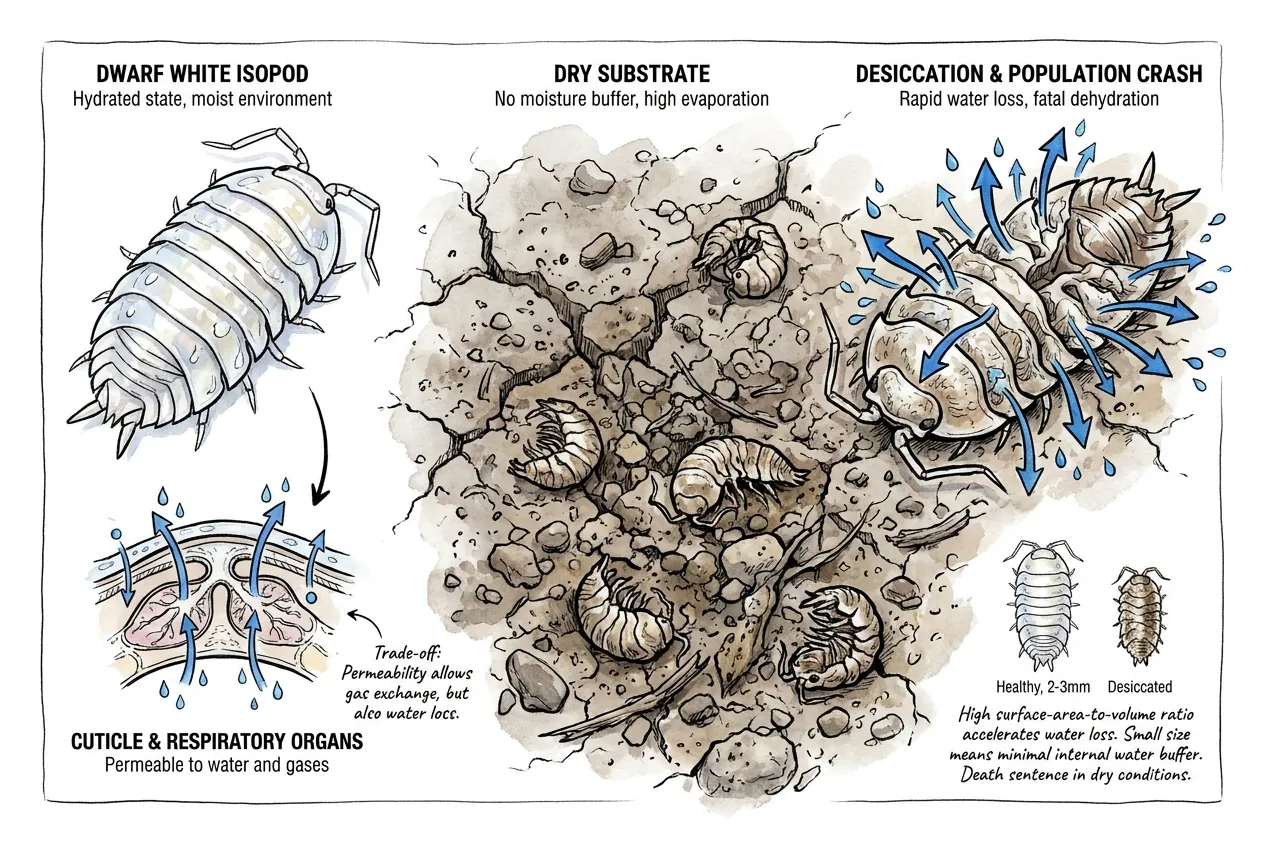
Dwarf whites lose water quickly in a dry enclosure. If the substrate is dusty and crumbly, restore a moist refuge before the colony crashes.
Why does a soggy substrate also kill them?
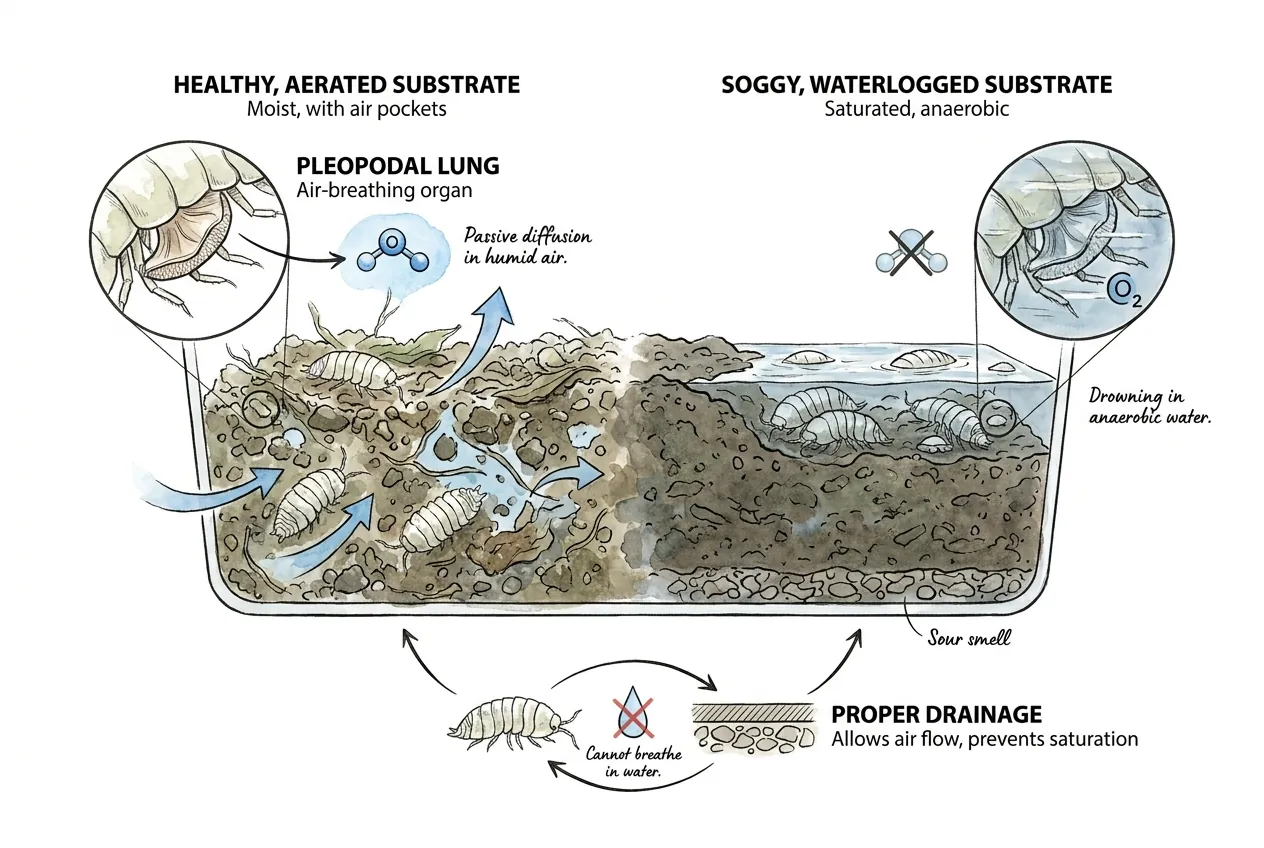
A waterlogged substrate drowns the colony because their pleopodal lungs cannot pull oxygen out of water-filled air spaces. Too wet is as lethal as too dry.
Terrestrial isopods breathe with pleopodal lungs, air-breathing organs inside the rear appendages that evolved from ancestral aquatic gills. Gas exchange happens by passive diffusion across a thin cuticle into the blood, where oxygen binds hemocyanin. This only works in humid, oxygenated air.
When substrate stays saturated with no drainage, the air pockets fill with water and the microbes go anaerobic. Isopods burrowing there cannot breathe, and a sour smell with standing water at the bottom is the tell. The fix is a proper drainage layer and letting the top dry between mistings.
What moisture and temperature numbers should I actually hit?
Aim for a moist-to-dry gradient across the floor, humidity of at least 50%, and temperatures in the low-to-mid 70s Fahrenheit for a stable colony. Use the following targets as working ranges.
| Parameter | Target | Failure sign |
|---|---|---|
| Moist zone | ~2/3 of floor consistently damp | Whole floor dusty and crumbly |
| Dry retreat | ~1/3 of floor drier | No dry zone. Uniform soak |
| Humidity | 50% minimum, ~80% ideal | No condensation on glass |
| Substrate depth | 2-3 inches for burrowing | Shallow, animals exposed |
| Husbandry temp | ~70-86°F | Warm to the touch near heat |
| Best breeding temp | ~68-75°F (20-24°C) | Sustained cold stalls broods |
Did stale air or a heat spike push them over the edge?
Keep oxygen and heat in the same check
A sealed, unventilated enclosure builds a low-oxygen pocket at the substrate surface, and that stale air both weakens the colony and slashes its heat tolerance. Oxygen and temperature failures compound each other.
Stale air makes isopods less tolerant of heat. Keep gentle ventilation so the surface does not become a hot, stagnant pocket.
What hypoxia means in practice
A stale, oxygen-starved enclosure makes isopods slower, more heat-sensitive, and less able to survive a warm afternoon.
Note that these are laboratory extremes used to expose the mechanism, not a target you should engineer at home.
Airflow takeaway
Give the enclosure low-to-moderate airflow so a dead-air pocket never forms.
How hot is too hot for a dwarf white colony?
Prolonged high heat can crash a colony, especially in stale air. Keep the enclosure away from sunny windows and direct heat sources.
Did the colony run out of calcium to molt?
Build a calcium reserve
A calcium-poor substrate causes failed molts, and a failed molt is usually fatal, so a slow bleed of deaths with few new juveniles points straight at calcium. Isopods are crustaceans that must rebuild a calcium carbonate shell at every molt.
Isopods recycle calcium while molting, but a growing colony still needs an ongoing supply.
In captivity that net cost is the trap. A growing colony draws down whatever calcium the substrate held, and once it runs low, molts start to fail.
Failed-molt warning
A stuck molt means the animal cannot escape its old shell, cannot feed, and dies, which reads across the colony as a slow, causeless decline.
What calcium source actually fixes this?
Keep a permanent, pure calcium carbonate source in the enclosure so animals can graze it as they premolt. Cuttlebone is the default because it is essentially the same mineral the isopod deposits in its cuticle. Choose an untreated source intended for animal use, since particle size, cleanliness, and additives still matter.
Cuttlebone, crushed eggshell, oyster shell, and limestone can all supply calcium carbonate. Purity and usable calcium vary, so choose a clean source suitable for animal use. Monitor consumption and molts, and replace the source before it is exhausted rather than assuming one piece will last a fixed number of months.
A calcium-enriched isopod substrate distributes the mineral through the whole medium, which reaches juveniles that ignore a solid block. The tradeoff is that these premixes vary in base ingredients, added-calcium form and amount, and whether they carry fertilizer or pesticide, so a calcium-enriched label alone does not guarantee hardwood, leaves, coco fiber, or enough calcium. Confirm the mix on the packaging rather than trusting the category.
For a rebuild culture, use a calcium-enriched substrate that also provides the required moisture gradient and aeration, then still drop one cuttlebone on the surface so premolt animals have a concentrated source too.
Did they simply run out of food?
A bioactive terrarium does not feed a detritivore forever, and a colony that ate through its initial leaf-litter charge starves once nothing replaces it. Dwarf whites are detritivores that need a continuous supply of decaying plant matter plus periodic protein.
Their base diet is partly decomposed leaf litter, with oak and magnolia favored, plus rotting hardwood and other decaying organic matter. On top of that base, protein roughly one to two times a week drives growth and, critically, reproduction. Deep leaf litter, rotting wood, a weekly protein and calcium input, and temperatures around 20-24°C together make failed molts rare.
The bioactive-terrarium trap is assuming the display self-feeds. A heavily planted enclosure with little leaf-litter turnover and no supplemental protein or calcium is a calorie-poor, mineral-poor desert for a detritivore. The colony that boomed on the initial litter charge crashes once that charge is gone.
| Input | Frequency | Why it matters |
|---|---|---|
| Leaf litter (oak, magnolia) | Continuous | Base detritivore diet and cover |
| Rotting hardwood | Continuous | Slow-release food and moisture buffer |
| Calcium (cuttlebone) | Always available | Prevents failed molts |
| Protein (fish flake, shrimp) | 1-2x per week | Drives growth and reproduction |
| Fresh veg or fruit | 2-3x per week | Moisture and micronutrients |
Did springtails or mites actually cause the crash?
Separate competition from predation
Usually not directly. Springtails and dwarf whites mostly split the food niche rather than fight, and grain mites are a nuisance and food competitor rather than a predator. When these tankmates suppress an isopod colony, it is almost always because the enclosure was already food-limited.
Do springtails outcompete dwarf white isopods?
Springtails only outcompete isopods when food is scarce, and even then the fix is more food, not fewer springtails. In a well-fed enclosure the two are complementary, not rivals.
Springtails handle mold and fine particles while isopods process coarse debris like frass, shed skins, and whole leaves, which is why the standard advice is to run both. The two jobs need two organisms. Competition only bites in a small, food-poor bin, where a fast springtail bloom can strip the fine-food layer that slow-reproducing dwarf white juveniles depend on before they can use it.
So springtails crashing your isopods is a symptom of resource limitation, not a cause you solve by removing springtails. Add leaf litter, protein, and calcium, and the competition eases.
Are grain mites killing my isopods?
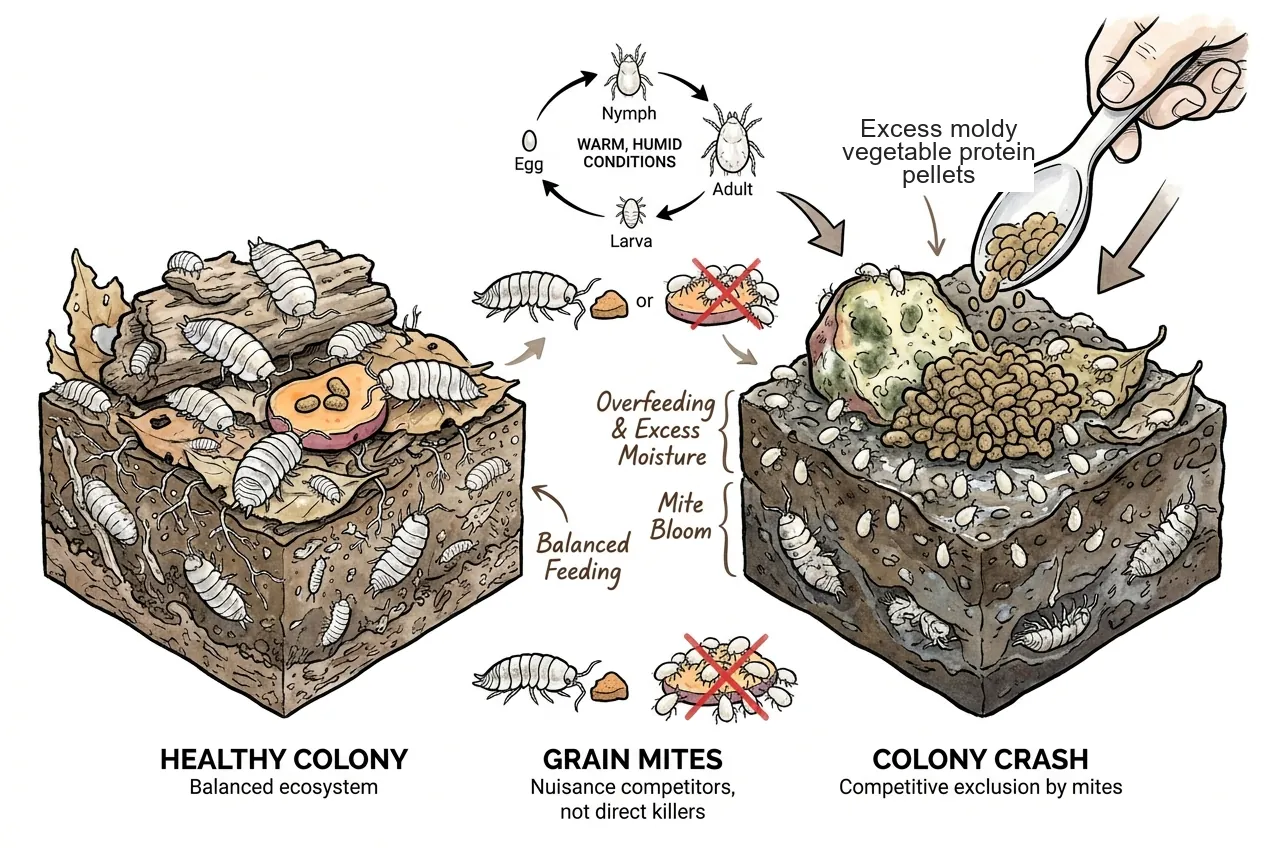
Grain and mold mites almost never kill isopods directly. They are a nuisance and a competitor for supplemental food, and their bloom is really a signal that you are overfeeding on too-wet food.
Grain mites (such as Tyrophagus putrescentiae) are white or translucent, explode on excess or moldy food, and can complete a generation in 8-21 days in warm, humid conditions, with a single female laying hundreds of eggs. Adults are essentially harmless to isopods, and isopods are unaffected by the associated mold. Juvenile mites can latch onto arthropods, which is unsightly but rarely lethal.
The real harm is competition. A mite bloom devours the protein you put in before the isopods reach it, and it flags overfeeding that fouls the enclosure. The fix is to feed only what is eaten in a day, remove moldy food, and improve airflow, not to panic about the mites themselves.
Was it predation, or too few founders to begin with?
Real predators and an undersized starter colony are the two biotic causes that genuinely crash dwarf whites. Both come down to deaths outrunning births before the colony reaches self-sustaining density.
Actual predators enter with plants, soil, or feeder insects, and include predatory mites, centipedes, rove beetles, and ants. In a vivarium built for a dart frog or gecko, the host itself grazes the colony, since dwarf whites are used deliberately as feeders. Without a predator-free refuge of deep leaf litter and cork bark, that grazing can outrun reproduction.
The founder-size problem compounds it. A parthenogenetic colony is near-clonal, so it has little buffer against a stressor that hits every individual the same way, and a starter cup of only 10-25 animals has almost no demographic margin. Seed too few into too large or too hostile an enclosure and a few weeks of net deaths ends the colony before it ever establishes.
Did a systemic pesticide wipe the whole cleanup crew?
Treat timing as a contamination clue
If a thriving colony died all at once shortly after a new plant went in, suspect a systemic insecticide first. Neonicotinoids like imidacloprid are designed to make plant tissue lethal to invertebrates, and they persist in soil for weeks to months.
Neonicotinoids bind the insect nervous system’s nicotinic acetylcholine receptor, overstimulate it, and cause paralysis and death. They are systemic, so the entire plant, its roots, and the runoff into your substrate all become toxic. Big-box nursery plants are frequently pre-treated with imidacloprid drenches, and dropping one into a bioactive terrarium leaches poison straight into the layer your isopods live in.
Why did my springtails die before the isopods?
Springtails may disappear before isopods when systemic pesticide residue is present. Treat that pattern as a reason to investigate contamination, not as proof on its own.
So if your springtails vanished just before your isopods, a systemic pesticide is a strong suspect. If instead the colony bled out slowly over weeks with no new plant, look back at calcium, food, and moisture instead.
| Organism | Lethal conc. (LC50, mg/kg soil) | Reproduction effect (EC50, mg/kg soil) |
|---|---|---|
| Springtails (Folsomia candida) | 0.20-0.62 | 0.097-0.30 |
| Earthworms (Eisenia andrei) | 0.77 | 0.39 |
| Isopods (Porcellio scaber) | 7.6 | 6.7 |
How do I diagnose which cause hit my enclosure?
Use timing and pattern first
Work the timing and pattern first, because they separate the fast chemical wipeout from the slow husbandry bleed. Then confirm with the substrate, air, food, and predator checks below.
Walk this tree in order and stop at the first match.
| Step | Question | If yes, suspect |
|---|---|---|
| 1 | Crash within ~1-2 weeks of a new plant, substrate, or litter? | Systemic pesticide contamination |
| 2 | Springtails died before isopods, or everything at once? | Chemical contamination (springtail-first fingerprint) |
| 3 | Substrate dusty and dry, or soggy and sour? | Desiccation (dry) or anaerobic drowning (soggy) |
| 4 | Sealed lid with no airflow, or a heat source nearby? | Stale-air hypoxia and/or heat |
| 5 | Leaf litter gone to bare substrate, no cuttlebone present? | Nutritional. Food or calcium exhaustion |
| 6 | Active insectivore host or hitchhiker predators, no refuge? | Predation outpacing reproduction |
| 7 | Seeded fewer than ~25 into a large or hostile enclosure? | Founder population too small |
How do I rescue the enclosure and rebuild the colony?
Rebuild from clean inputs
Fix the confirmed cause first, then re-seed a robust founder count into a right-sized, well-provisioned bin and let density build before you expose it to predators or harvest it. If contamination is confirmed, the substrate itself is the problem and must go.
What is the step-by-step rebuild protocol?
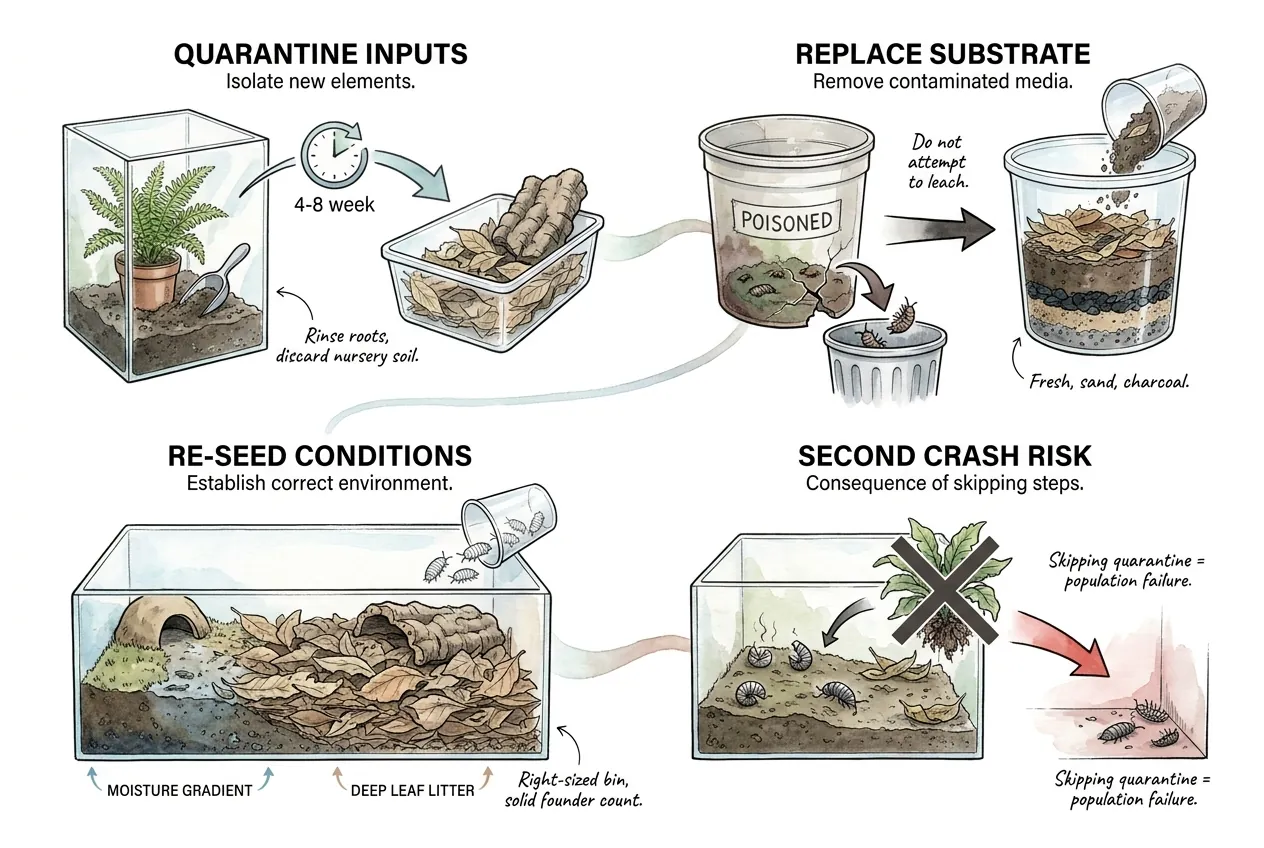
Quarantine new inputs, replace poisoned substrate, and re-seed into correct conditions. Skipping the quarantine step is what causes the second crash.
Quarantine every new plant before it touches a bioactive enclosure. Unpot it, rinse the roots thoroughly, discard the nursery soil, and grow it out in clean media for at least four to eight weeks so systemic residue can decline. Prefer plants sold as pesticide-free or bioactive-safe.
Source Clean Materials
Source leaf litter and wood only from clean areas with no lawn treatment and no roadside or agricultural runoff. A light freeze or bake reduces hitchhiking pests, but it does not remove pesticide, so clean sourcing is the only reliable defense against contamination.
If contamination is confirmed, strip and replace the substrate. Leaching a persistent systemic out of soil is slow and unreliable, so replacement is faster and surer. Then re-seed with a solid founder count into a right-sized bin with a moisture gradient, deep leaf litter, cork bark, a permanent calcium source, and weekly protein, and let the colony build density before harvesting.
The goal is a substrate that both retains water and drains into a base layer, so the top can dry while the base stays moist and the air pockets isopods and springtails need stay open. That matters because dwarf whites want roughly two-thirds of the floor kept damp. A premixed bioactive substrate can deliver this ready-made, but it does not build the gradient on its own. Check its ingredients, water-retention and drainage behavior, and any fertilizer or pesticide disclosure, and finish the gradient with enclosure ventilation and where you water.
In practice, fill 2-3 inches of substrate, moisten about two-thirds of it, add a drainage layer beneath, and top with clean oak or magnolia leaf litter before re-seeding. Keep a damp retreat under cork bark or litter, with another part of the enclosure less wet but not desiccated.
Key Takeaways
- A dwarf white crash traces to one of eight fixable causes. Moisture, stale air, heat, calcium, food, competition, predation, or pesticides.
- Too dry desiccates them and too wet drowns them. Their gill-derived lungs need humid, oxygenated air, not a soggy substrate.
- Calcium is non-negotiable. Without a cuttlebone, molts fail and the colony bleeds out slowly with few juveniles.
- A whole-crew wipeout within two weeks of a new plant points to a systemic pesticide. Springtails die about 10x sooner than isopods.
- Rebuild by quarantining plants 4-8 weeks and replacing poisoned substrate. Then re-seed a strong founder count with litter, protein, and calcium.