
Paludarium Hardscape Shape: Engineer a Distant View
How to build depth into a paludarium hardscape: working with water’s refraction, forced-perspective depth cues, golden-ratio layout as a design guide, a safe build approach, and small-leaved plants that suggest distance.
Jordan Cole · Published 2025-12-18 · 15 min read
Key Takeaways
- Refraction makes submerged objects look shallower, so steepen the slope beyond what seems natural and confirm the composition with the tank filled from the real viewing position.
- Use converging lines, texture gradients and controlled haze to create pictorial depth because the glass itself cannot be stretched to make the tank deeper.
- Golden-ratio and Fibonacci placement are composition heuristics rather than natural laws, so use an off-center focal point only when it improves the view.
- Build support and drainage deliberately, keep fine soil from staying waterlogged, and let heavy stone rest on mechanical support rather than adhesive.
- Small-leaved plants suggest miniature trees and shrubs, while a fogger raises humidity but does not replace root-zone watering.
You can spend a lot on low-iron glass, high-end lights, and rare plants and still end up with something that looks flat.
What often makes the difference is scale (the sense of looking into a deep landscape rather than a shallow box).
Budget matters less here than geometry, layout, and plant choice.
Combine Optics, Composition and Scale
To build a tank that reads as a deep vista, think about how water refraction changes what you see, how the brain reads pictorial depth cues and how plant morphology can suggest distance.
This is the Distant View (diorama) style, and it’s all about forced perspective.
2. Make a Shallow Tank Read as Deep
Start With the Optical Limits
Creating depth in a glass box involves refraction at the water surface and the near-absence of any real atmosphere between front and back.
I place the camera at the eye height and distance where the paludarium will normally be viewed, then add temporary cardboard layers for foreground, middle ground, and background. A forced perspective that works close to the glass can collapse from across the room.
That camera position is marked and reused for every dry-layout revision. Once the main depth reads from the normal viewpoint, I check the side angles to make sure the illusion does not expose unstable supports.
Refraction and Apparent Depth
Light bends as it passes between air (refractive index ≈ 1.0) and water (≈ 1.33), following Snell’s law, so what you see through water is not exactly where the object sits.
For the specific case of looking nearly straight-on at an object under a flat water surface, a standard small-angle approximation gives an apparent depth of about three-quarters of the real depth, so something roughly 10 inches back can look about 7.5 inches away.
This is a limited near-normal approximation, not a single rule that governs every viewing angle in the tank. Looking down at the water surface compresses depth differently, and the exact result depends on your eye position, the glass, and the surface.
Practically, this means a slope that looks right while the tank is dry can read differently once it’s flooded.
Rather than trusting your dry eyes or a fixed target angle, steepen the slope somewhat, then fill the tank and check the composition from where you’ll actually be viewing it, adjusting from there.
Monocular Cues (Tricking the Brain)
Use Pictorial Depth Cues
You cannot stretch the glass, so you lean on the brain’s pictorial depth cues.
- Linear perspective. Lines that converge read as distance. A riverbed or sand path that is noticeably wider at the front than at the back reads as receding, not just as a change in shape. The exact widths depend on your layout and viewpoint. A path tapering from, say, 15 cm to 1 cm is one example, not a required ratio.
- Texture gradient Use larger, highly detailed plants in the foreground and smaller, lower-detail plants in the back. A nearby leaf reveals its veins, while a distant tree reads as a green mass.
- Aerial (atmospheric) perspective. Outdoors, distant objects look lighter, bluer, and lower-contrast because of light scattering over long distances. A tank only tens of centimeters deep has almost no air path to produce that effect, so any haze you add with light mist and lighting gradients is a deliberate stage effect rather than a scaled-down copy of real atmospheric scattering.
The Golden Ratio as a Composition Guide
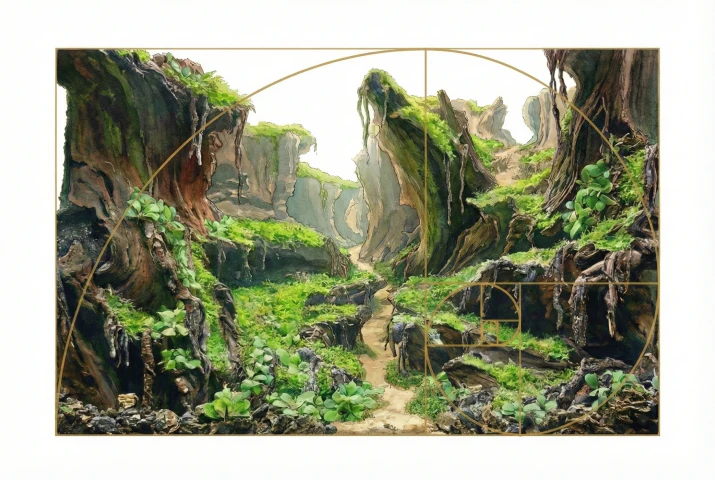
The GOLDEN SPIRAL in Photography by Reg Does Stuff. It covers golden-spiral composition in photography as background on the visual idea only, not paludarium biology, optics or structural methods.
Use the Golden Ratio as a Guide
The golden ratio, φ ≈ 1.618, is a widely used composition guide and appears in some biological patterns. In many plants, successive leaves emerge close to the golden angle of about 137.5° through phyllotaxis, which produces Fibonacci-like spiral counts. That is a specific developmental pattern, not evidence that φ is built into all biology, human aesthetics or hardscape layout, and the common claim that a nautilus shell is a golden spiral does not hold up to measurement.
As a practical heuristic, try not centering the main mountain. Place it off-center, near a 1/1.618 division if that helps you visualize it.
Off-center placement tends to lead the eye across the open space toward the focal point, and that sense of travel can read as depth.
Use it where it looks good rather than as a rule you must follow.
Biophysical optimality of the golden angle in phyllotaxis
3. Build the Illusion Safely
Treat the build carefully. The structure has to hold up under the weight of wet substrate and stone, water, and any digging inhabitants.
Plan the support and loads before you commit, and when heavy stone is involved, rely on mechanical support rather than trusting glue or foam to carry the weight.
Phase 1. Foundation & Substrate Banking
A flat substrate reads as flat, so slope it up from front to back. How high you can go depends on your tank’s footprint and how much water volume you’re willing to trade away. A tall rear bank adds a lot of wet weight and lateral pressure, so keep it within what your tank and its base can safely carry.
A cushioning mat (neoprene or cut yoga mat) under heavy stones can help spread point loads, but it is not a guarantee against cracked glass. Follow your tank manufacturer’s guidance on base support and keep grit and sharp edges off the bottom pane.
A terraced framework from plastic egg crate (light-diffuser panel) can help hold a slope in place so piled soil doesn’t slump forward over time.
Note that this is a hobby framework, not an engineered retaining wall. If you silicone it to the bottom glass, its hold depends on the silicone-to-plastic bond and the wet lateral load, so don’t rely on it alone under heavy stone.
Backfill behind the framework with a coarse drainage layer of LECA or crushed lava rock, then cap with active aqua-soil or a fine mix.
A coarse layer under fine soil can help drainage, but a fine-over-coarse boundary can also perch water above it, so plan for how the deep bed will drain and stay oxygenated rather than assuming the coarse layer fixes it.
A black pond-and-stone foam can lock smaller rocks together and fill gaps. Being black, it reads as shadow where you miss a spot (unlike cream Gaps & Cracks foam).
Treat it as a gap-filler and cosmetic bond, not as a structural, load-bearing monolith. It is a closed-cell, water-resistant foam rated by the manufacturer as safe for ornamental fish and plants once cured. The maker does not rate it as UV-resistant when exposed (it recommends covering or painting exposed foam outdoors), nor as load-bearing.
Because it’s a pressurized polyurethane product, follow the label and SDS. It can be flammable, releases isocyanate aerosol, and can irritate or sensitize skin, eyes, and airways.
Work in good ventilation, wear gloves and eye protection, keep it away from ignition sources, and let it cure fully with no animals present before returning them (cure time depends on bead size, temperature, and humidity, not a single fixed number).
Great Stuff Pond & Stone foam costs more than standard expanding foam. Its main advantage here is the black color, which makes a missed spot read as shadow instead of a glaring beige scar, plus a closed-cell, water-resistant cured surface intended for water features. Use it for nonstructural gap-filling only. It is not rated as UV-resistant when exposed, so cover or paint any exposed foam, and do not rely on it to hold weight.
Phase 2. The Hardscape
Materials with jagged, self-similar texture, detail that still reads at different sizes, tend to work best. Seiryu-type stone has deep jagged fissures and grey-blue tones that suggest distant mountains. Rounded river stones are usually harder to make read as scaled-down peaks, though they can suit other styles. Spider wood can read as an entire dead tree or root system rather than a single log.
Grade Hardscape by Size
Place the biggest, most textured rocks and thick branches in the foreground, medium rocks in the midground and small rubble with the tiniest twigs in the background so they read as massive distant mountains. If you break stone to make rubble, wear eye protection and a dust mask and control flying shards because hammered stone can splinter sharply.
Phase 3. Bonding the Hardscape
Bonding Safety Note
A method that circulates online packs paper towel or a cigarette filter between rocks and soaks it in cyanoacrylate to force a fast bond. Do not do this. Cyanoacrylate reacts violently with cotton, paper and other cellulose materials. The reaction can flash to high heat, smoke and even ignite, and there are medical case reports of serious burns. That heat is a hazard rather than a strength indicator, and a cigarette filter is typically plasticized cellulose acetate with unknown additives, not aquarium-safe pure cellulose.
For heavy stone, don’t rely on glue at all. The main support should be mechanical, a stable base, keyed or interlocking placement, or a physical cradle, so a joint failure can’t drop rock.
Use adhesive only as a light secondary aid on small pieces.
When you do glue, apply a gel cyanoacrylate sparingly directly to clean, dry rock (or to plant roots, not rhizomes) and press the pieces together, following the product’s directions.
Gel is easier to control on vertical surfaces than a runny liquid because it stays put. It is not rated for gap filling or a guaranteed underwater structural bond, and its holding strength on wet, submerged, load-bearing joints is unverified, so keep it to accents and let mechanical support do the real work.
Gorilla Super Glue Gel stays put and gives a cleaner result on vertical surfaces than a runny liquid. The manufacturer specifies clean, dry surfaces in small amounts and does not rate it for gap filling or outdoor or structural use, so treat it as a secondary aid for attaching plants or light pieces rather than a load-bearing bond.
Phase 4. The Atmospheric Engine (Mist)
To suggest the haze of distance, an ultrasonic mist maker in a chamber behind the hardscape can roll fog over the rocks and settle it in the valley, physically obscuring the back glass and lowering background contrast.
This is a stage effect that resembles fog rather than a scaled copy of real atmospheric scattering.
Plan for access to the chamber for cleaning, keep the electrics safe around water, and make sure the setup is safe for any animals. Fog and standing condensate change the local environment.
4. Use Plant Scale to Finish the Scene
Choose Plants by Leaf Scale
The biggest failure point is leaf scale. A large leaf reads as oversized in a miniature landscape and breaks the illusion. Use small-leaved plants as trees and shrubs. In botany, microphylly is a specific leaf-type term rather than a synonym for tiny leaves, so small-leaved is the accurate description here.
Tree Mimics
Asparagus setaceus (asparagus fern) has fine foliage that can read as a distant conifer forest, and it prefers well-drained conditions rather than wet feet.
Be aware it is fast-growing and tends to climb and spread, reportedly reaching a few feet as a houseplant, so it needs regular, fairly aggressive pruning and room for its roots to stay small enough for the scene.
Ficus microcarpa, or ginseng ficus, is often sold with a thickened trunk-like base that can work as a foreground feature, though the swollen roots are not a true caudex and it needs pruning to stay miniature. Biophytum sensitivum can read as a small palm for the midground. Check its light, humidity, substrate and mature size before committing.
Ivy Mimic
Ficus pumila ‘Quercifolia’ has small oak-shaped leaves (on the order of a few millimeters) that grow flat against rock like ivy on a cliff, and it tends to stay smaller and slower than standard creeping fig, which grows fast with larger leaves.
Confirm the cultivar and give it appropriate humidity, light, and periodic pruning.
Bush Mimics (Aquarium Plants Grown Emersed)
Some aquarium plants work well here. Anubias ‘Pangolino’ has very small leaves that can read as a dense shrub, and Bucephalandra (Bornean rheophytes) can do well in the splash zone with round, iridescent leaves that add texture and scale.
Attach them by placing a little gel glue on the roots or the rock, never coat the rhizome, and keep the roots consistently moist. They don’t thrive automatically, so match their light, moisture, and water chemistry.
Lighting for Depth
Natural light isn’t uniform. The foreground is usually brighter and the distance hazier. Frosted window film on the back glass with a small LED behind it pointing up can create a glowing horizon line that silhouettes the darker front hardscape and adds a sense of depth.
Plan for access to that fixture, and consider glare and any animals’ day/night cycle.
A cooler back light (roughly 8000–10000 K) and warmer front light (around 6500 K) can reinforce the depth cue as deliberate color grading.
Note that color temperature (CCT) is not the same as spectrum or intensity. A given CCT doesn’t guarantee a particular blue output, and this is a scenic effect rather than a physical recreation of atmospheric scattering.
Prioritize the light your plants need (and, if present, fish color and behavior and any algae response) over the look.
5. Avoid Common Setup Failures
Super Glue Safety in a Tank
Cyanoacrylate is widely used in aquascaping and generally cures into a stable solid. Moisture, including water, speeds the cure via anionic polymerization, and cured glue is far more stable than the liquid. However, inert and completely aquarium-safe is an overstatement. Household glues can carry additives and may not cure fully, while medical tissue adhesives use different longer-chain formulations than household ethyl cyanoacrylate. Shared chemistry is not proof that a specific hobby glue is fish-safe.
Work Without Animals Present
Keep wet glue off fish and their gills, use small amounts on clean surfaces, rinse the hardscape and let it cure fully before returning animals.
Fog Does Not Replace Root Watering
Not reliably on their own. Ultrasonic foggers produce fine droplets (droplet size varies by device and conditions, not a fixed value) that mainly raise humidity and can wet leaves.
Fog can deliver some water to leaf surfaces, but for most ordinary paludarium setups it doesn’t supply enough root-zone moisture to replace watering, so don’t count on it as your only source.
Keep watering the substrate or run a drip wall, and put the fogger on a timer. The piezo disc can heat up and foggers can run dry, so avoid running it continuously. Check on your own setup and species rather than following a fixed schedule, since the right on/off cycle depends on the device, chamber water, ambient humidity, and the plants.
Brown Moss Is Not Always Dead
Not necessarily. Aquatic-grown mosses (Java, Christmas) can lose old tissue when moved from submerged to a humid emersed setup and then regrow leaves suited to air.
But brown tissue isn’t always harmless acclimation melt. It can also mean a genuine problem.
Green growing tips are a good sign of life, though on their own they don’t confirm the whole clump will survive.
Give it airflow, clean water, and patience, and rule out light, temperature, water quality, and drying.
White slime is not automatically mold (it can be fungi, bacteria, yeast, or decaying biofilm) so improve ventilation, remove the affected material, and check conditions rather than assuming a single cause.
Sandbeds Need Maintenance
Often they don’t. Soil from a steep back slope tends to migrate down and dirty a front sand path over time, though how much depends on your barriers, compaction, water flow, and inhabitants. It isn’t truly inevitable.
Build a physical border (rubble stones or a low fence of secured twigs) along the soil-sand line, and baste loose soil off the sand during maintenance.
Think of it as a planted setup that needs occasional upkeep rather than a set-and-forget system.
Oral Applications of Cyanoacrylate Adhesives. A Literature Review
6. Conclusion
Bring the Design Principles Together
A distant-view paludarium brings together water refraction, pictorial depth cues, and a living planted system that suggests a landscape.
It takes patience, and some trial and error is normal, but plan the build so the failures are cosmetic, not hazardous.
Work safely with glue and foam, support heavy stone mechanically, and keep an eye on plant health.
When the mist rolls over a Seiryu-style ridge and small Bucephalandra catch the light, the tank can start to read as a window into a scene that looks far deeper than the glass.
7. Keep the Design Safe and Maintainable
Never use cyanoacrylate with cotton, paper, or other cellulose filler, and never let adhesive carry heavy stone. The fast reaction can create dangerous heat. Use mechanical support first, then use a compatible adhesive only for small, dry-fit accents.
Attach Bucephalandra or Anubias gently to rock with the rhizome exposed. Keep the roots moist, provide species-appropriate light and airflow, and avoid a permanently saturated deep soil bank by including drainage and an accessible overflow.
Use cool backlighting or a curved hardscape line only as visual staging. The tank remains shallow, so animal welfare, plant light, and reliable airflow take priority over the distant-view effect.
A grey, craggy Seiryu-style hardscape stone can make a small layout read as a larger cliff. Check the actual stone and water after a soak, because similarly named listings can differ and carbonate-bearing batches may raise hardness and pH. Choose an inert alternative when soft-water livestock cannot tolerate that change.
Affiliate Disclosure
This article contains Amazon affiliate links. As an Amazon Associate I earn from qualifying purchases. If you use these links, the site may earn a commission at no extra cost to you. Product availability, price, and specifications can change. Check the current listing before buying.