
Blue Foliage Plants: The Science of Iridescent Leaves
Why blue foliage plants like Begonia pavonina shimmer: it’s structural color from photonic-crystal chloroplasts that trap scarce green light in deep shade, not pigment, and why the blue tends to fade under bright light or dry air. Note: much of the landmark research used a Begonia grandis × pavonina hybrid, so treat care numbers as starting points to test, not fixed rules.
Elena Vargas · Published 2026-01-11 · 16 min read
Key Takeaways
- The blue is mainly structural color, so crushing an iridescent Begonia leaf removes the layered structure and leaves ordinary green pigment behind.
- In the landmark low-light study, iridoplasts showed a 5–10% higher maximum PSII quantum efficiency than ordinary chloroplasts, which is an organelle result rather than a whole-plant survival guarantee.
- Brighter light is associated with greener leaves, but hobby lux ranges are not fixed rules, so use any number as a starting point and judge the plant’s response.
- Hydration helps preserve the fine spacing that produces the color, while stagnant near-saturated air can increase condensation and disease risk.
- The shimmer depends on viewing angle and light direction, while soil acidity cannot create this structural blue.
Why Blue Leaves Shimmer
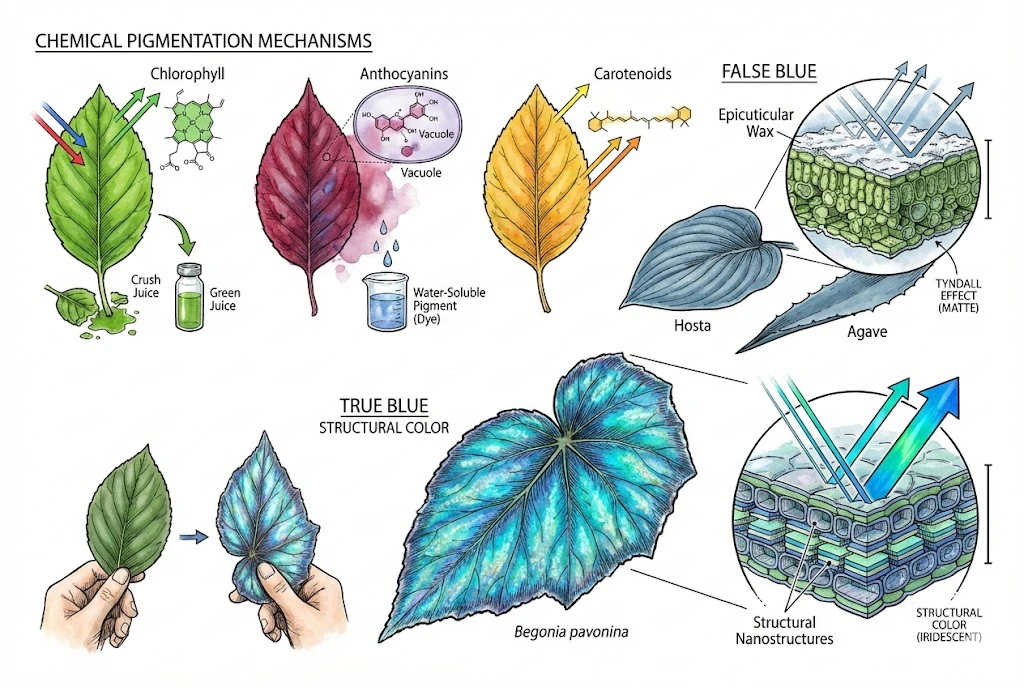
Leaves can look blue for two very different reasons. Some have pigments or a powdery wax that shifts their colour. Peacock Begonia and a few other shade plants get their metallic blue mainly from tiny, orderly layers in the leaf.
Changing soil acidity or adding a colour booster cannot create this kind of blue because the colour comes from leaf structure, not from a blue pigment.
Most foliage colour comes from pigments. Chlorophyll makes leaves green, anthocyanins can make them red or purple, and carotenoids make yellows and oranges.
- Hydrangea blue is a pigment effect that changes with soil chemistry.
- Blue hostas and agaves usually look blue because a whitish leaf wax scatters light.
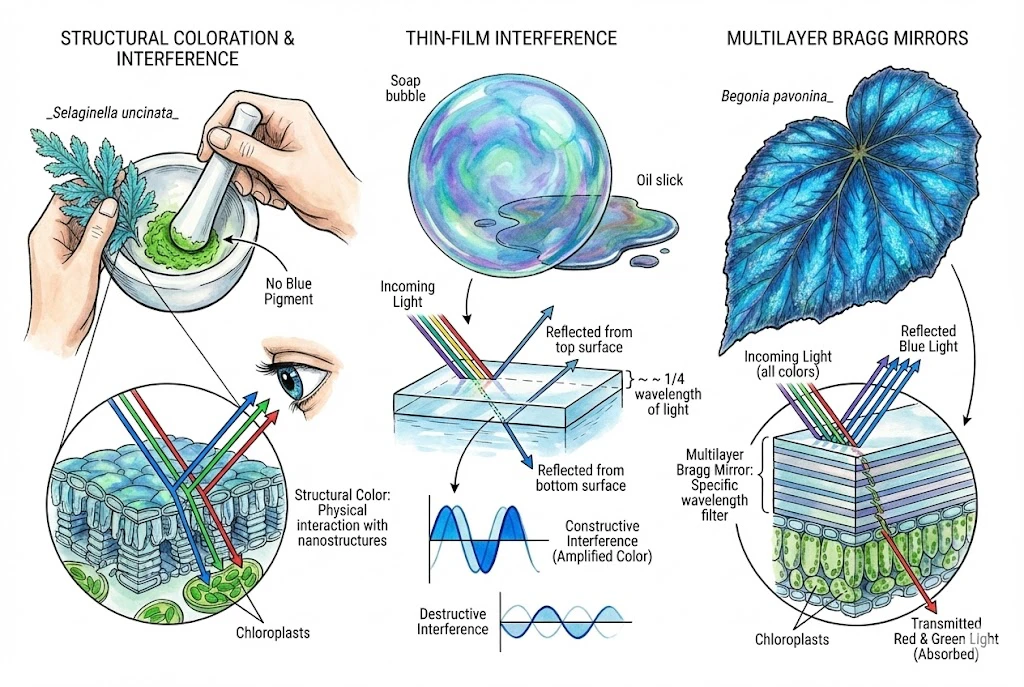
Structural blue works more like the shifting colour of a soap bubble than like paint. Light reflects differently from the leaf’s fine layers as you move around it, which is why the shine changes with the viewing angle and disappears when the structure is damaged.
What Happens Inside a Peacock Begonia
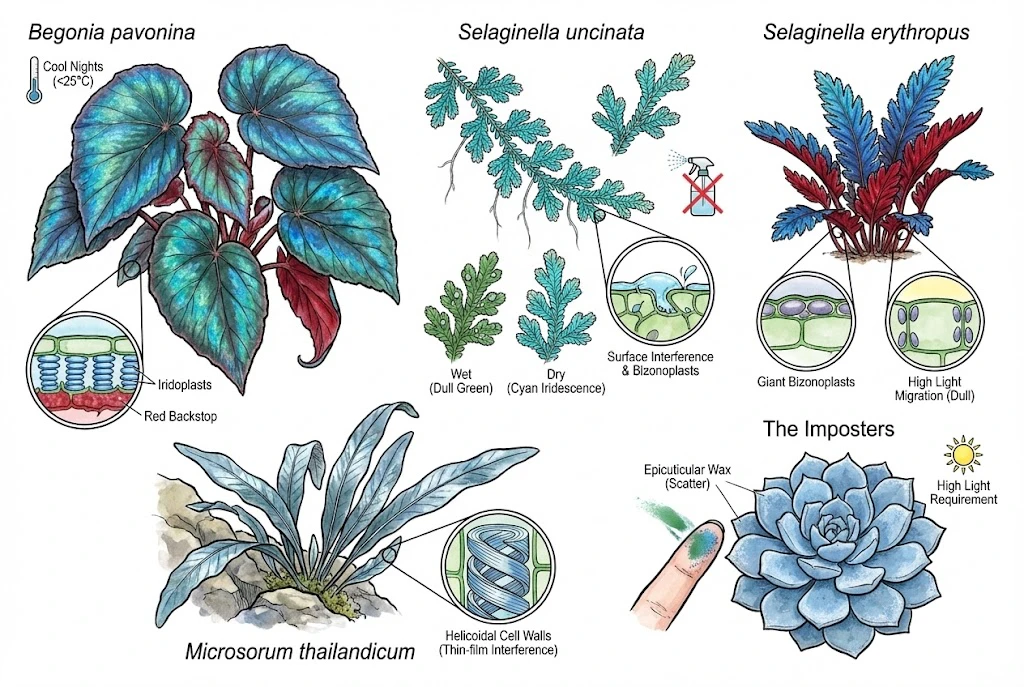
Not every blue plant uses the same mechanism. In Begonia, the blue comes from modified chloroplasts inside the upper leaf cells. In rainbow moss and blue oil fern, it comes from patterned cell walls nearer the surface.
The Layered Chloroplast
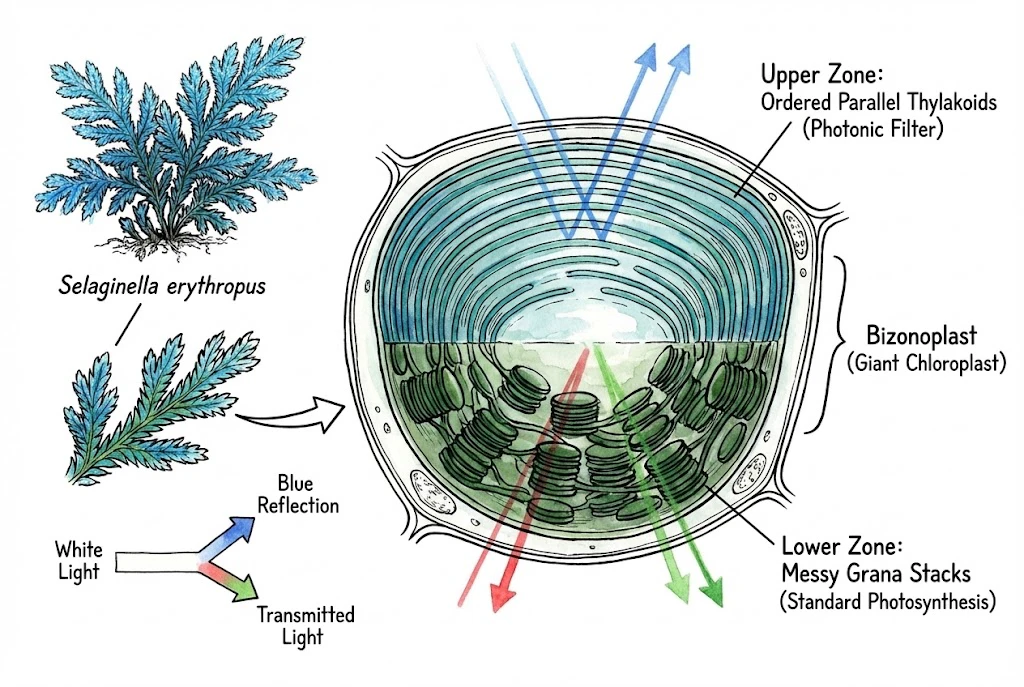
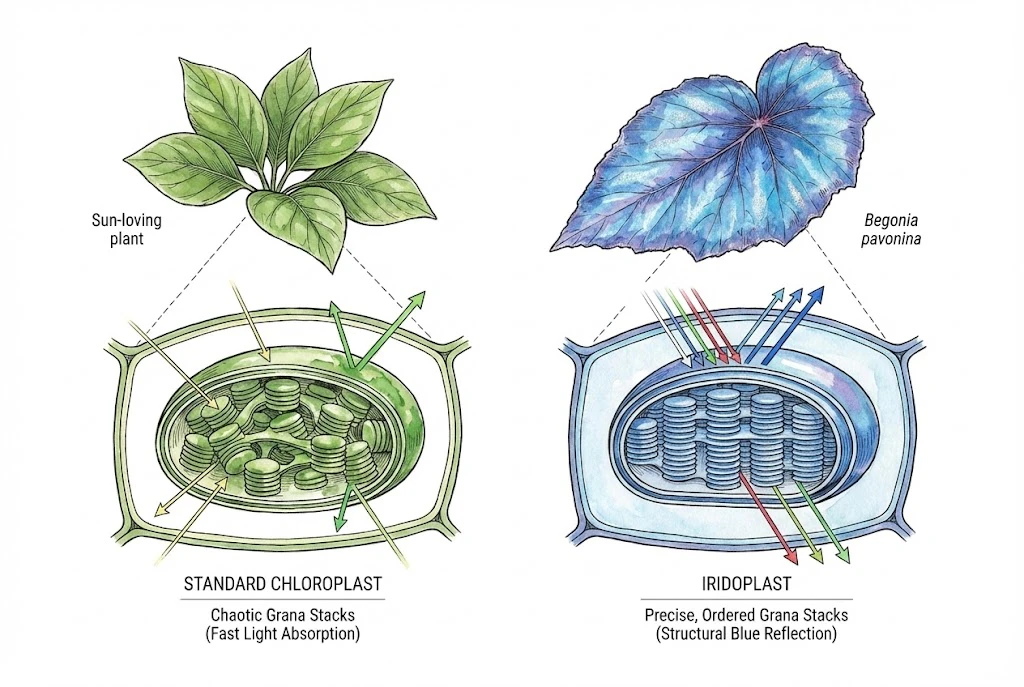
Begonia has specialised chloroplasts called iridoplasts. Their internal membranes form orderly stacks that reflect blue light and can help the leaf use scarce light.
The best-known study used a vigorous Begonia grandis × pavonina hybrid rather than pure B. pavonina. Its result supports the mechanism, but it does not establish a universal care target or guarantee better whole-plant growth.
Photonic multilayer structure of Begonia chloroplasts enhances photosynthetic efficiency
A Different Case in Spikemoss
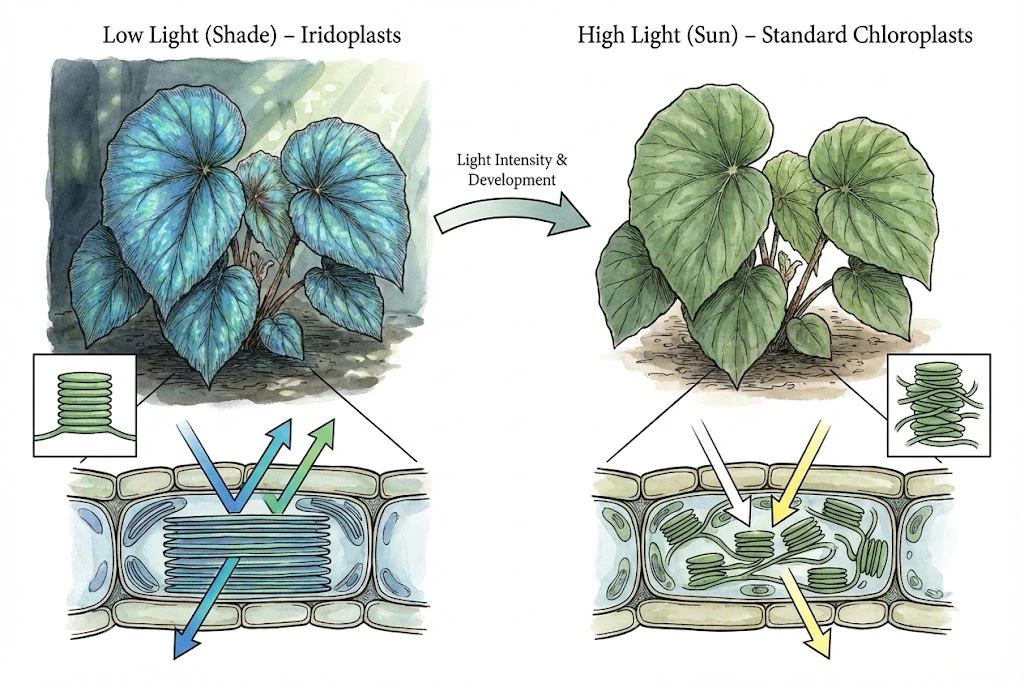
Selaginella erythropus has a different specialised chloroplast called a bizonoplast. It is not the same as the blue-producing structure in S. uncinata, so care advice should follow the identified species rather than the shared “blue foliage” label.
The two-zone anatomy is documented, but its exact visible colour effect remains an interpretation. It is useful context, not a reason to copy Begonia light targets to every spikemoss.
Bizonoplast, a unique chloroplast in the epidermal cells of Selaginella erythropus
Why the Blue Can Fade
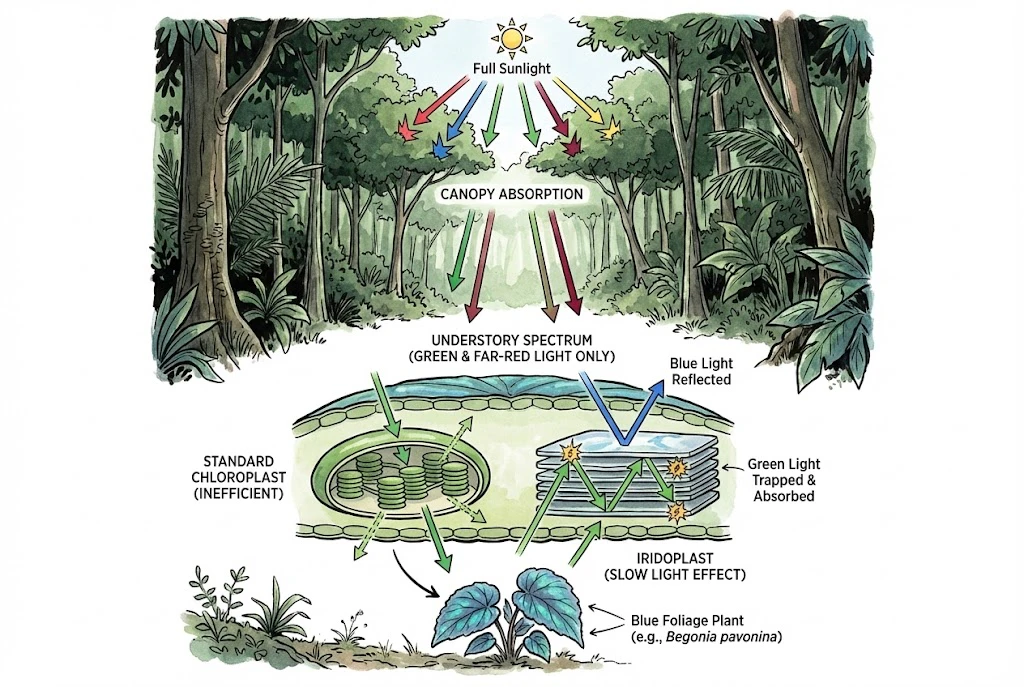
Begonia commonly becomes greener in brighter conditions. Strong light is associated with this change, but the exact changes inside a living leaf and the speed of recovery are not settled.
Use greening as a prompt to reassess light, heat, watering, and new growth rather than as proof that one condition has harmed the plant.
Light-dependent morphological changes tune light absorption in iridescent plant chloroplasts
Why Shade Can Bring Out the Colour
A Low-Light Adaptation
Forest-floor plants receive much less light than plants in an open room or greenhouse. The leading explanation is that the layered chloroplast helps Begonia make better use of weak light while producing the blue reflection we see.
This is a useful explanation for the plant’s preference for gentler light. It does not mean the plant needs darkness or that one low reading suits every clone and setup.
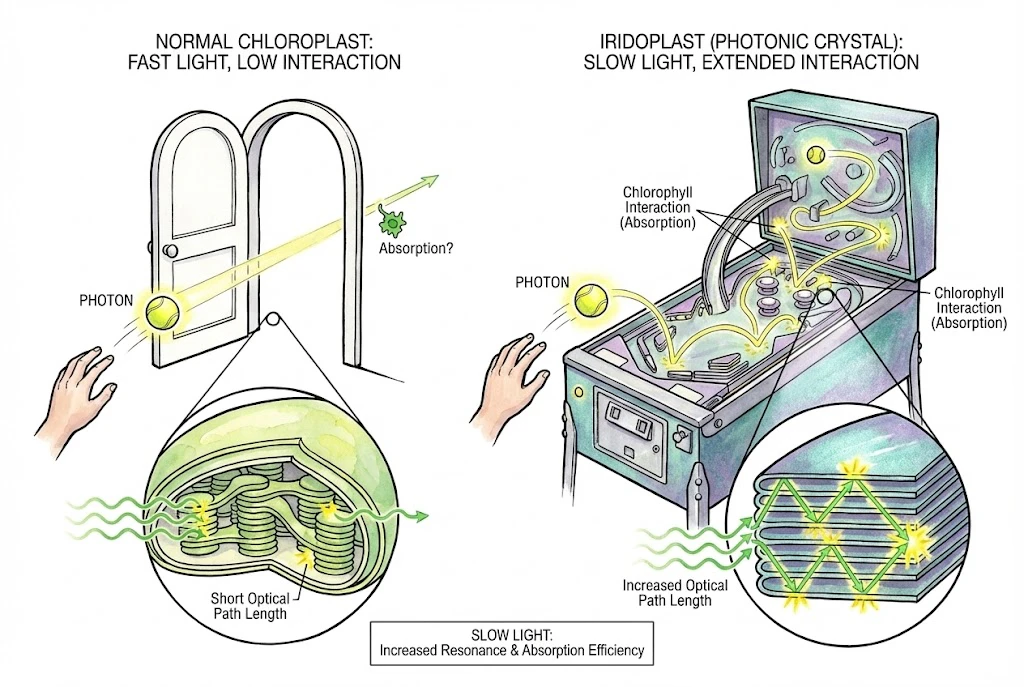
Under a closed canopy, the amount and mix of light change constantly with gaps, weather, and the time of day. These leaves still use several colours of light. Their structure may help them capture a little more of the weak light available.
What the Study Found
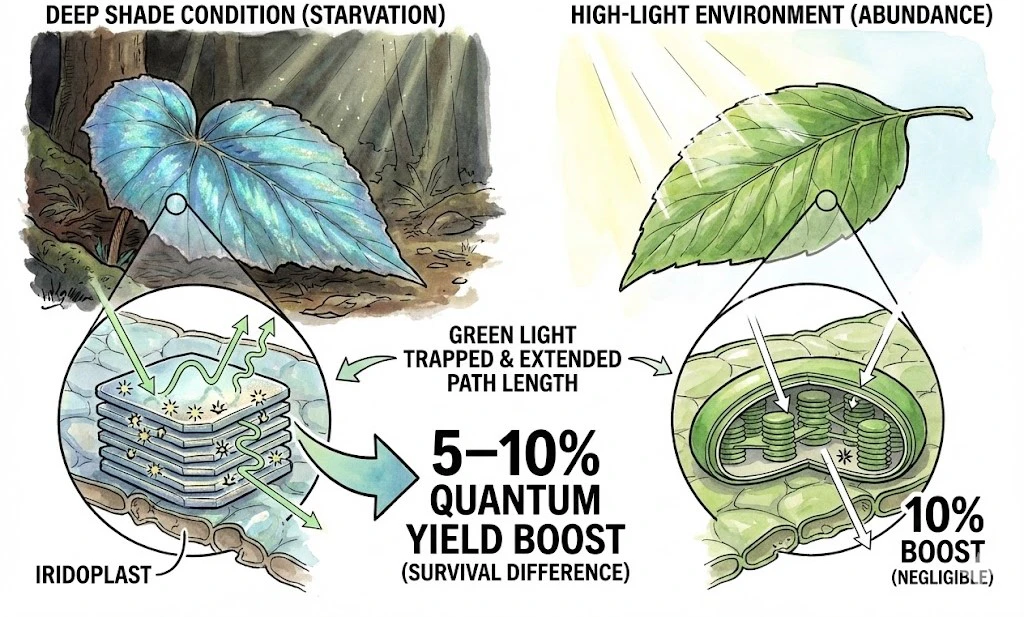
In low light, the original study found a small efficiency advantage in isolated iridoplasts compared with ordinary chloroplasts. That was a laboratory measurement of plant parts, not proof that a houseplant will grow faster or survive better.
Read Colour Changes as Feedback
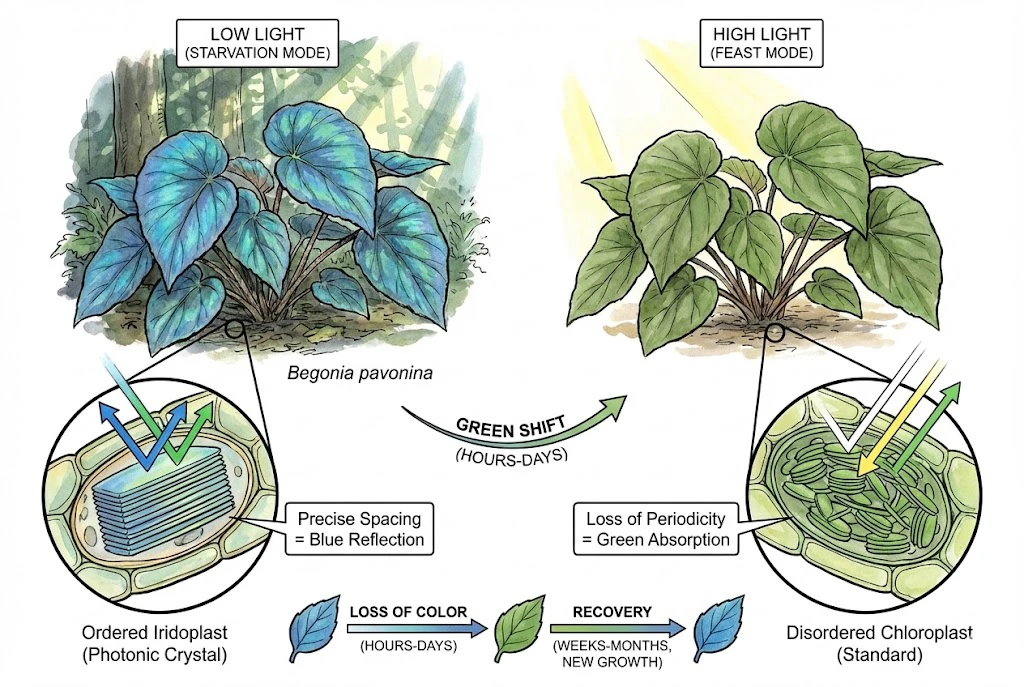
Blue can fade or new leaves can emerge greener under brighter conditions. A greener leaf can be normal acclimation, but it can also appear with real light stress.
Check the whole plant before changing the setup. Healthy new growth, leaf texture, temperature, and watering tell you more than colour alone.
I mark one camera position and one small point-light position outside the enclosure, then photograph the same mature leaf and the newest leaf separately. Iridescence can vanish when the viewing angle changes, so casual photos are a poor record of whether the plant itself changed.
New leaves that developed under the changed conditions are my main evidence of acclimation. An older leaf may keep the structure it formed before the move, while a new leaf records the current light and humidity more directly.
Match Care to the Plant
Compare Species by Mechanism
Not all blue foliage plants need the same conditions. Identify the plant first, then use the colour mechanism only as a clue for how to handle light and leaf wetness.
Begonia pavonina (The Peacock Begonia)
Origin
Montane rainforests of Malaysia, including the Cameron Highlands. Much commercial blue material may be the vigorous B. grandis × pavonina hybrid rather than the pure species.
Its blue comes from layered chloroplasts inside the leaf. The red underside is part of the plant’s look, but it is not a colour-control tool.
Give Begonia pavonina gentle light, avoid persistent heat, and judge the plant by vigorous new growth as well as its blue sheen.
Selaginella uncinata (Rainbow Moss)
Origin
East Asia, including parts of southern China.
Its cyan-to-teal colour comes from layers in the outer leaf wall, not from the specialised chloroplast found in S. erythropus.
Let the foliage dry between mistings. This keeps the shimmer easier to see and reduces the disease risk of constantly wet leaves.
Selaginella erythropus (Ruby Red Spikemoss)
Origin
Neotropical, ranging from Central America, including Costa Rica, through tropical South America.
It has the unusual bizonoplast described above and typically shows a red underside with a blue-tinted top.
It is strongly shade adapted. Higher light can make the colour look duller, so make changes gradually and use leaf health rather than a colour ranking to guide care.
Microsorum thailandicum (Blue Oil Fern)
Origin
Limestone karst areas of Thailand and nearby Southeast Asia.
Its blue comes from layered cellulose in the cell walls and usually looks metallic or silvery from different angles.
Its colour is often steadier than Begonia’s, but the research does not establish a universal low-light target. Use the species’ normal fern care and watch its response.
The Imposters Epicuticular Wax
It helps to tell structural-blue foliage apart from waxy blues because their care can differ. Both are legitimate ways a leaf can look blue. Here, an imposter means a surface wax bloom rather than a photonic structure.
Examples
Echeveria, some Senecio, and Philodendron hastatum.
Mechanism
A powdery epicuticular wax scatters light, giving a chalky blue.
How to Tell Them Apart
You can sometimes rub a small hidden spot and see whether the blue is a removable bloom, but do this sparingly because the wax may not grow back and rubbing damages the leaf. Better first steps are identifying the species, changing the viewing angle, and checking a reliable reference. Structural blues shift with angle, while wax bloom does not shimmer in the same way.
Care Implication
Many waxy blue plants come from brighter habitats than the shade-loving Begonia, so they generally want more light, and the wax helps with water loss and UV as well as appearance.
Don’t assume every waxy-blue plant has identical needs, though. A succulent Echeveria and an aroid like Philodendron hastatum are quite different.
Rot in these plants usually comes from overwatering, poor drainage and pathogens rather than from low light alone.
Practical Husbandry
One useful firsthand account is the grower writeup Begonia pavonina Care & Culture. It is worth reading because it complicates the tidy story. The author notes the commercial blue plant may be a hybrid and reports growing it successfully as a houseplant at only about 35–50% relative humidity under bright filtered light, far drier and brighter than the near-saturated, very dim conditions often prescribed. Keep that contrast in mind as you read the numbers below.
The care for these plants differs from standard houseplant advice. Most of the specific numbers below are starting points to test against your own plant, not fixed laws.
The Shadow Lighting Protocol
A common way to lose color and sometimes stress the plant is too much light, especially when growers use high-output LED vivarium lamps meant for bromeliads or orchids. Calling excess light the most common cause of death would require mortality data that is not available here. Root rot, watering, and temperature matter at least as much.
The Idea
Iridoplasts evolved in a very dim understory, so bright light tends to push the leaf toward green.
Be careful with the specifics. The claim that more than 1,000 lux overloads and greens the plant is not well supported. The grower writeup linked above reports success at roughly 10,000–20,000 lux, and the Microsorum study grew its plants at about 2,000 lux. Bright light may cost you maximum blueness, but it is not a proven death threshold. Aim dim for color, and judge health separately.
The Protocol
How to Make a Begonia Terrarium with Begonia pavonina (Daily Plant, about 8 minutes) is a practical build walkthrough. It is included for terrarium technique, not as evidence for any specific lux or color-temperature figure.
Start With a Low PPFD Range
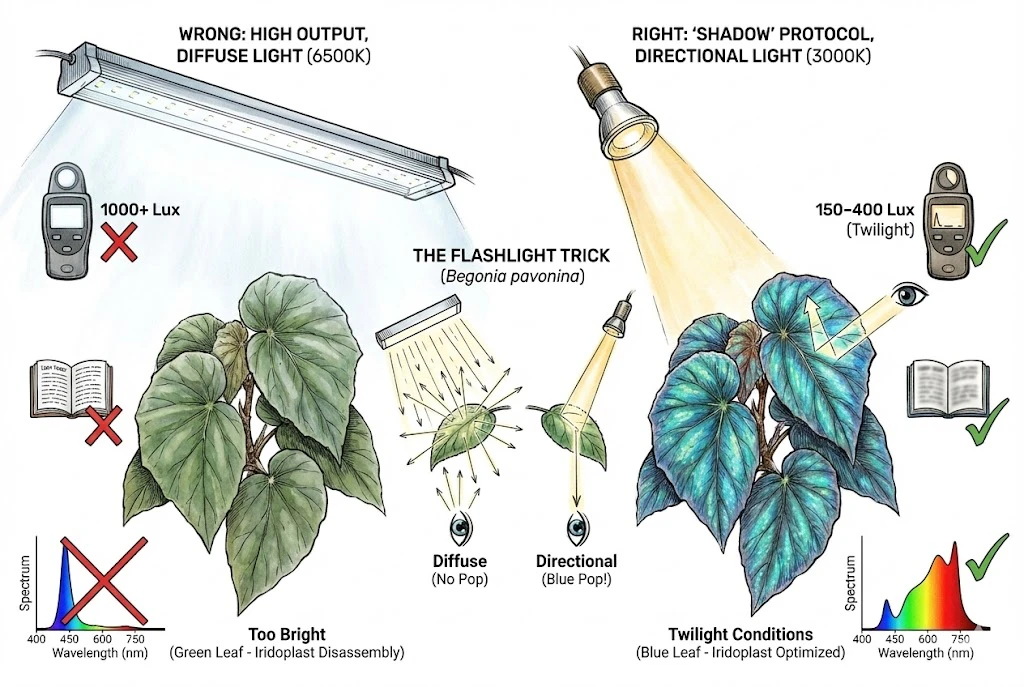
Many growers keep these on the dim side, roughly 5–15 µmol m⁻² s⁻¹ at leaf level if they have a quantum meter. This deliberately prioritizes color over growth. If the plant looks weak, it is likely too dark.
Use Lux Only for Comparison
Lux and PPFD do not convert with one fixed factor because the relationship depends on the lamp’s spectrum. For common sources, 5–15 PPFD may be roughly 300–1,100 lux, but a flat 150–400 lux target does not match every lamp. If you only have a lux meter, use it for relative comparison and apply your lamp’s conversion rather than trusting one number.
Think in Daily Light
The total daily dose, or DLI, and how evenly the light is distributed matter as much as the peak reading.
Choose Spectrum for the Whole Setup
Warm-white light around 3000K is often preferred because it is easier on the eyes and lower in blue, but no controlled study shows that one color temperature is required. The same nominal 6500K can vary in actual spectrum. Pick what keeps the plant healthy and shows the color.
Showing Off the Color with a Point Light
This is about viewing, not growing. Because the iridescence is directional (specular), a point light shows it off far better than broad diffuse light, which washes the effect out visually.
Best for Showing the Color
A single point-source spotlight is directional. A broad, diffuse source such as a large fluorescent panel tends to hide the shimmer, though a strip light can still create a highlight depending on angle and distance. Diffuse describes the light’s spread, not the fixture’s name.
To make the blue pop, remember that reflection is measured from the leaf surface. The angle of incidence equals the angle of reflection about the surface normal. In practice, move the spotlight (or your head) until the reflected beam lines up with your eye.
Keep this separate from the plant’s growing light. A single hot spotlight can create hotspots and uneven growth if it is also the main energy source.
Humidity and Turgor Pressure
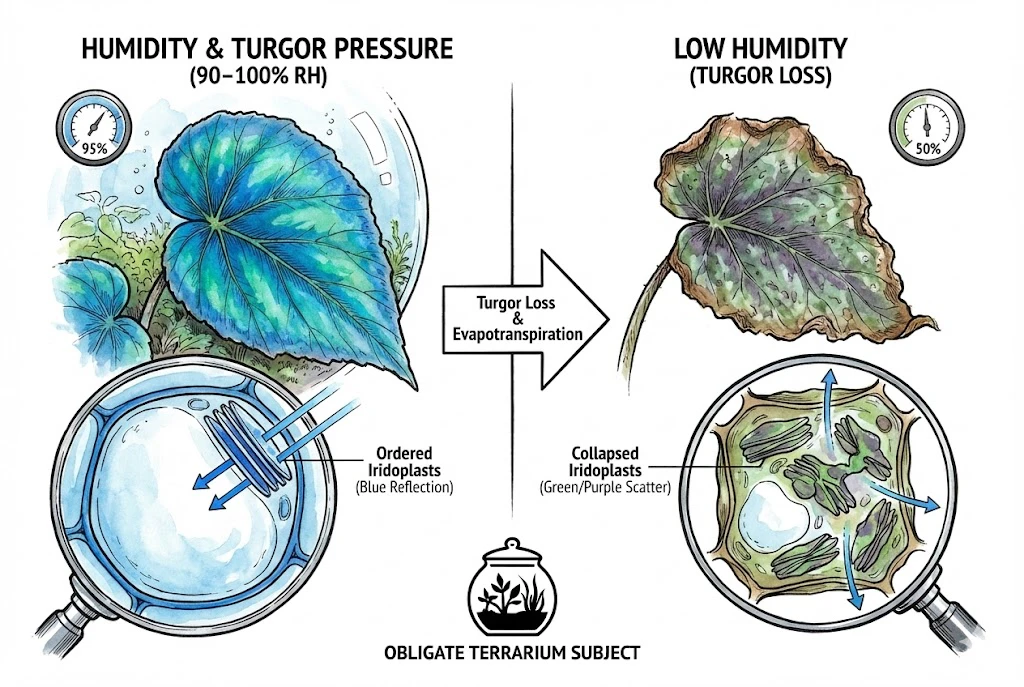
The iridoplasts of Begonia (and the giant chloroplasts of Selaginella erythropus) depend on fine, regular spacing of membranes, and S. uncinata’s color depends on fine cell-wall layers.
Well-hydrated tissue holds that fine structure in place.
The Plausible Chain
Very dry air raises water loss, which can lower tissue water status and, in principle, alter the spacing the color depends on, so the blue may dull or shift toward purple. This is a reasonable mechanism, but hydration depends on root water supply, temperature, and airflow or VPD, not humidity alone. The cited studies did not show a specific ambient-humidity value collapsing the structure, so treat low humidity leading to lattice collapse as a likely trend rather than a measured fact.
The Protocol
High humidity generally helps, and many growers keep pure B. pavonina and the Selaginellas in the 70–100% range in a terrarium. Avoid treating one number as mandatory, and do not seal the enclosure airtight. Near-saturated, still air invites condensation, persistent leaf wetness, and fungal or bacterial disease. Pair high humidity with some ventilation. The American Begonia Society, for example, recommends good airflow even in terrarium culture and notes that many rhizomatous begonias do fine near 50%.
Reports vary by clone and setup. The grower writeup linked earlier kept a possibly hybrid blue Begonia vigorous as a houseplant at only 35–50% humidity, while the pure species is usually described as wanting things damper. Aim humid, watch the specific plant, and increase humidity if leaf edges brown while keeping air moving.
A hygrometer in the enclosure helps you avoid guessing at humidity, though it is one tool among several (you also want to watch leaf wetness, substrate moisture, temperature and airflow).
Digital hygrometer
An inexpensive digital hygrometer reads air humidity, not the leaf surface. Accuracy, refresh rate, calibration, and rated operating range vary by model, and many indoor units become less accurate near saturation. Read the exact specification before placing one in a very humid enclosure. Use it to follow trends, keep it out of condensation unless it is rated for that exposure, and cross-check it against a second sensor when a small difference would change your decision.
Soil Chemistry (The pH Myth)
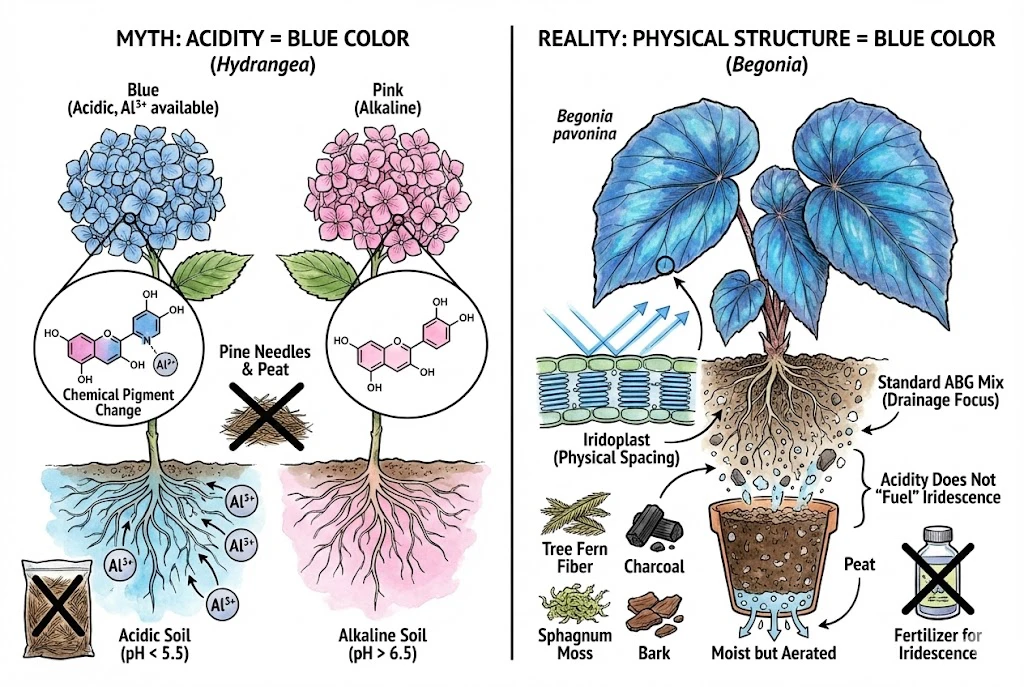
A persistent hobby myth is that adding acidifiers such as pine needles or extra peat to lower pH will make the leaves bluer, by analogy with Hydrangeas.
Peat is still useful as a substrate ingredient for moisture and structure. The misconception is that acidity itself creates the blue.
Why the Comparison Fails
In Hydrangeas, soil pH controls how available aluminium is, and aluminium complexes with the anthocyanin pigment to produce blue (a genuine chemical color change).
Begonia’s blue comes from the physical spacing of membranes, which pH does not set. So you cannot acidify or fertilize a leaf blue.
Many of these plants do like a somewhat acidic, well-drained root zone, but that is not universal. Microsorum thailandicum grows on limestone karst, and even B. Pavonina’s habitat isn’t uniformly acidic.
Match the substrate to good drainage and the species’ needs, not to a hoped-for color effect.
The Protocol
A well-known option is an ABG (Atlanta Botanical Garden) mix (charcoal, milled sphagnum moss, pine bark, tree fern and peat).
The aim is a root zone that stays moist but drains and breathes, which suits humid terrarium plants.
The general principle holds. Roots want to be moist but aerated, and stagnant, waterlogged soil encourages rot. Rot involves pathogens, temperature, and low oxygen as well as drainage, so saying dense soil always rots the rhizome overstates it. Heavy, airless soil is still a poor choice for these plants.
Ready-made ABG-style vivarium mix
A ready-made ABG-style vivarium substrate can be a moist, airy medium for a humid terrarium, but recipes sold under that name vary. Read the ingredient list, particle sizes, salt or fertilizer additions, and sourcing for the mix you are considering. The name does not guarantee a fixed charcoal, sphagnum, bark, tree-fern, and peat formula. Such a mix is not a native-soil replica or the single right medium for every blue species, and pot size and watering habits matter as much as the mix itself. If you are weighing components and layers, use the terrarium substrate guide rather than an aroid potting recipe.
Future Outlook From Rainforest to Solar Panel
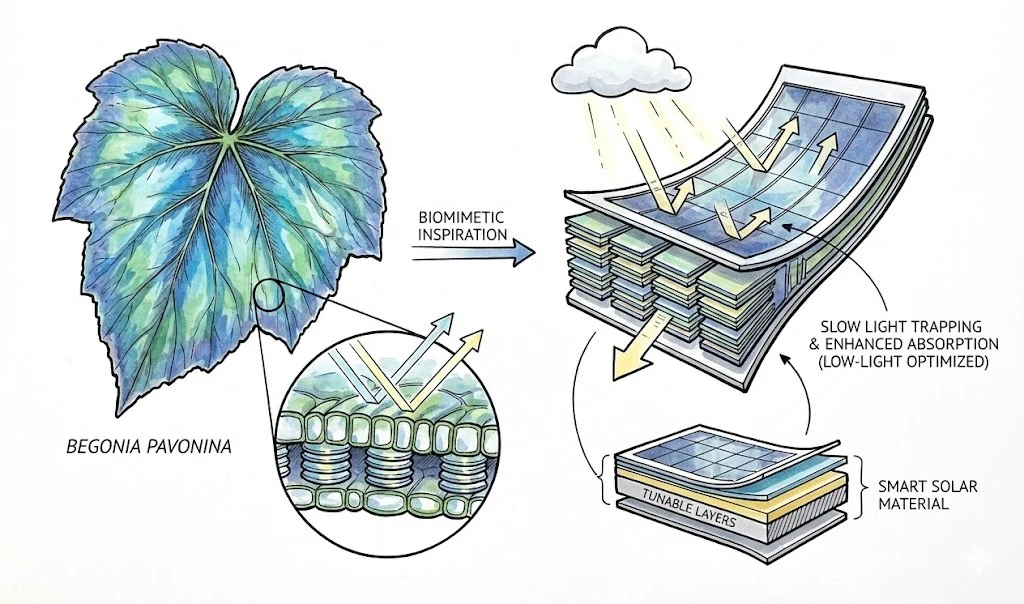
Beyond the terrarium, natural photonic structures like the iridoplast are sometimes raised as inspiration for light-harvesting materials.
The appeal is easy to see. A structure that increases absorption of scarce light could, in principle, inform designs for low-light solar collection.
Keep the Technology Claim Bounded
This is an analogy and an aspiration, not a delivered technology. The 2016 paper mentions the general relevance of biological photonics to solar energy, but there is no specific Begonia-derived device, prototype, or efficiency figure to point to here. Low-light photovoltaic performance depends on many factors, so a plant mechanism does not transfer directly.
Modest Light Brings Out the Blue
The label Blue Foliage Plants is a bit of a misnomer. In most cases these are green plants whose leaves use fine internal or cell-wall structures to reflect blue while making the most of dim light.
When you look at Begonia pavonina, you are seeing an adaptation to a low-light habitat. Its periodic biological structure reflects blue light and helps capture the scarcer green wavelengths.
For the hobbyist, the practical takeaway is measured. These plants generally want less light than typical houseplants for their best color, but they still need enough light, water, warmth and airflow to stay healthy.
The useful correction is that excess light can stress shade specialists. Light itself is not the enemy. Give them a stable, humid, dimly lit spot with gentle air movement.
So keep the growing light modest, keep humidity high but the air moving, and use a small directional light when you want to admire the blue. Then watch how your particular plant responds and adjust.