
Rare Labisia & Sonerila Care: Terrarium Jewel Guide
A practical care guide to rare Labisia and Sonerila trade plants for high-humidity terrariums: why structural color makes some leaves shimmer, an airy never-soggy mix, low-salt water, and quarantining new imports.
Jordan Cole · Published 2026-02-01 · 14 min read
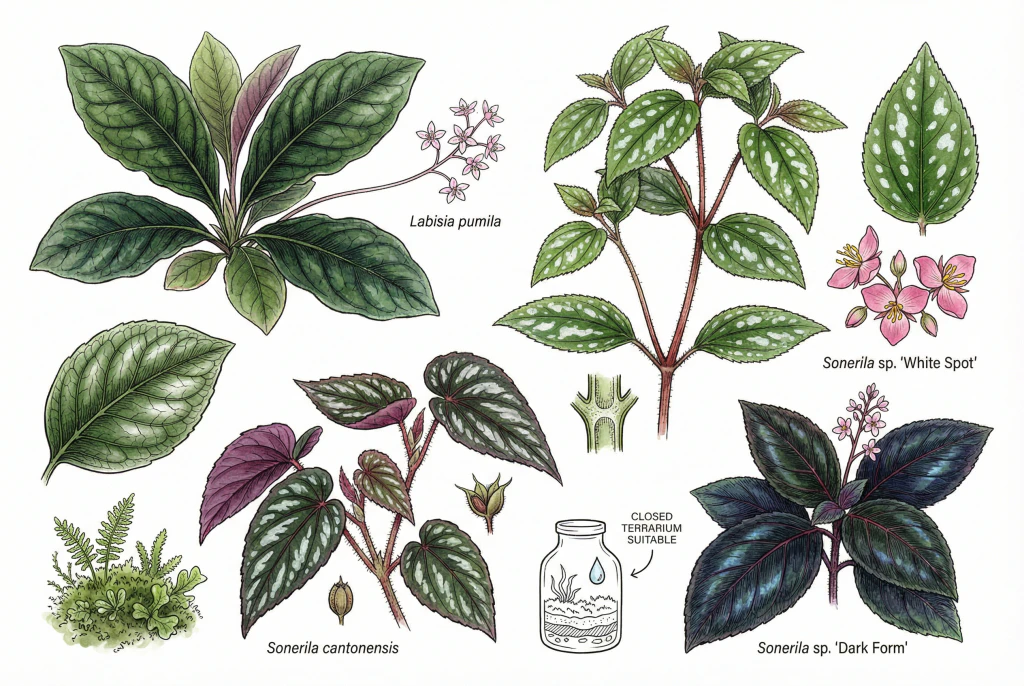
Key Takeaways
- Most of these plants are sold under unresolved trade names, so exact growth and reproduction claims should be treated as hobby observations rather than species data. Buy from a seller who states provenance, and expect Labisia to grow slowly and some Sonerila faster.
- The shimmer in high-contrast foliage may be structural color, but iridoplasts have not been confirmed in these particular trade plants. Read the science below as a plausible mechanism, not a measured fact.
- High humidity and bright indirect light are useful starting conditions, not rigid survival thresholds. Commercial Turtle Back guidance lists roughly 60–70% RH and 60–85°F, and a covered terrarium is one convenient way to hold humidity.
- Plant shallow in an airy, never-soggy mix and avoid burying the stem deeper than it grew. A tree fern, chopped sphagnum, bark, and charcoal blend can hold moisture without inviting crown or stem rot.
- Low-salt water is safest in a no-drain terrarium, but test your tap water before assuming it is harmful. Keep light modest and quarantine new imports in a separate, inspectable container for at least three weeks.
The Turtle Back Labisia
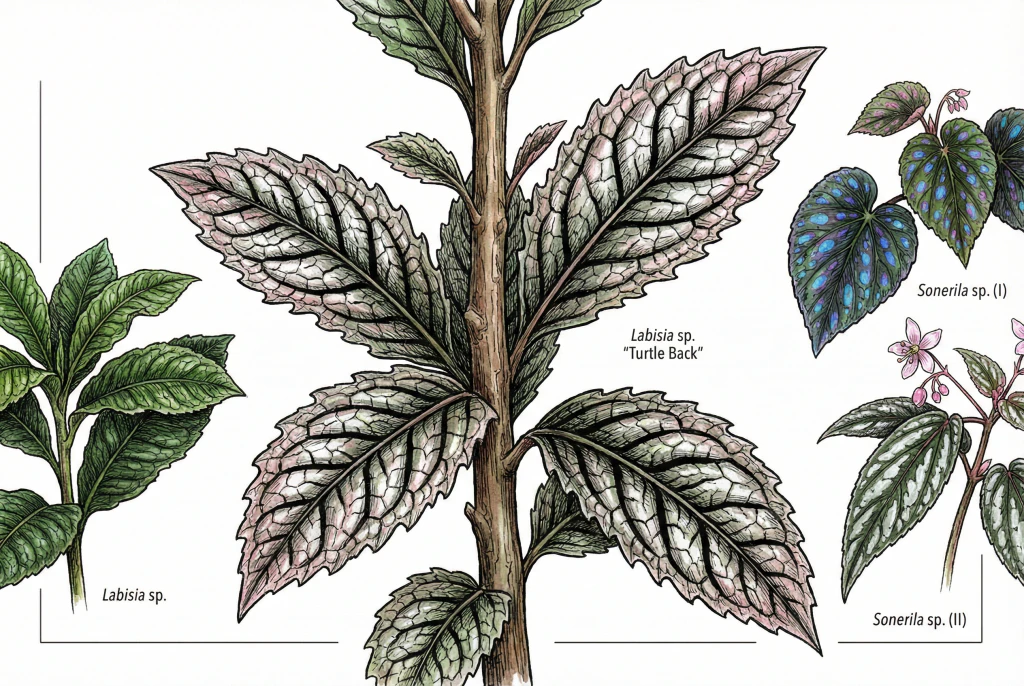
In the hobby, Labisia are the more solid, structural of the two. They sit in the family Primulaceae. Labisia pumila lists Ardisia pumila as a synonym, which is part of why the two names get confused.
Note that the common trade plant is usually sold as Labisia sp. Turtle Back, an unresolved horticultural name rather than a confirmed species.
The plants pictured here grow from a central, sometimes woody stem and produce firm, serrated leaves with a deep surface texture.
As soon as the plant arrives, I photograph it and mark every existing leaf on a simple outline. Leaves that emerge after placement go onto a second layer, so old shipping damage and new environmental damage never share the same count.
I wait until two consecutive new leaves either emerge clean or develop the same mark at the same stage before changing humidity, light, or substrate again. Two leaves separate a recurring response from one damaged leaf. Rare plants make every blemish feel urgent, but repeated corrections can be more stressful than the original transition.
The Look
Compact, with high-contrast venation, darker veins on a silver or pink leaf, that reads as a tessellated, shell-like pattern. Exact leaf color and size vary between trade forms, so treat any one photo as an example rather than a fixed standard.
The Vibe
Miniature and slightly prehistoric-looking. This is an aesthetic impression, not a care fact.
Growth
Generally slow. Hobby growers often report only a handful of new leaves per year on an established plant, but the actual rate depends on species, maturity, light, and season, so use it as a rough expectation rather than a target.
The Flashy Sonerila
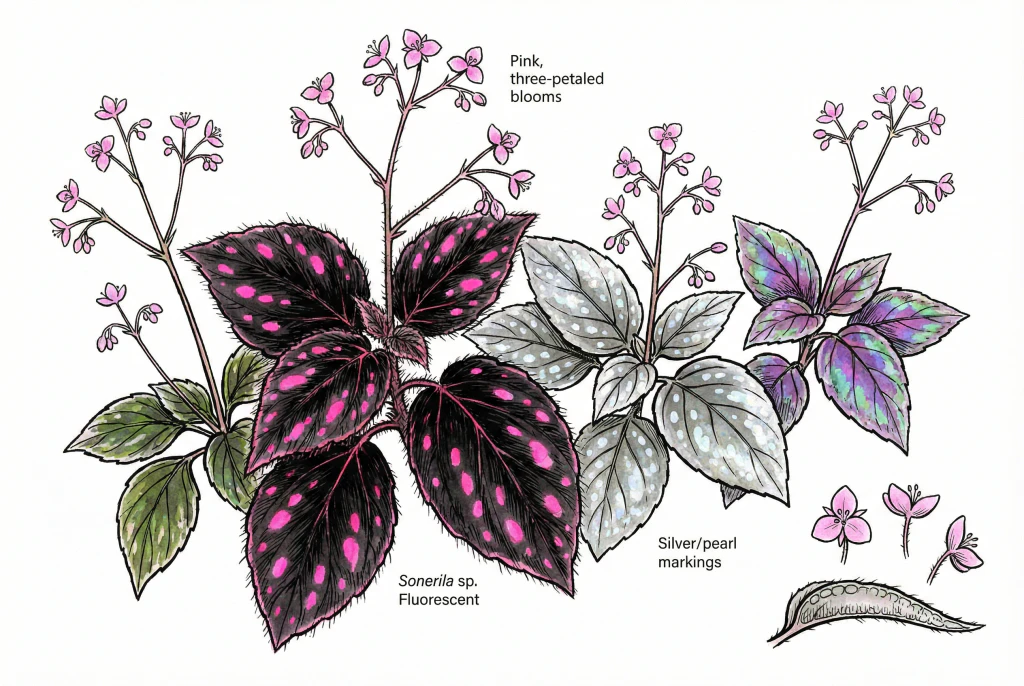
Compared with Labisia, the Sonerila sold in the hobby tend to be softer, faster-growing, and more prone to collapse if stressed, though this is a general impression, and growth and sensitivity vary with species, size, and conditions.
The Look
These members of the family Melastomataceae are softer, hairier, and often very colorful. Trade forms sold as Sonerila sp. Fluorescent or Fluo have bright pink spots on dark foliage. Despite the name, there is no evidence these leaves actually glow or emit light in the dark. The color simply looks vivid under normal lighting, and the pink pattern can come from pigment as well as any structural effect.
Flowers
Many Sonerila readily produce small, three-petaled pink blooms, sometimes over a long period. How often depends on the species and conditions rather than being a guaranteed constant display.
The Science of the Shimmer
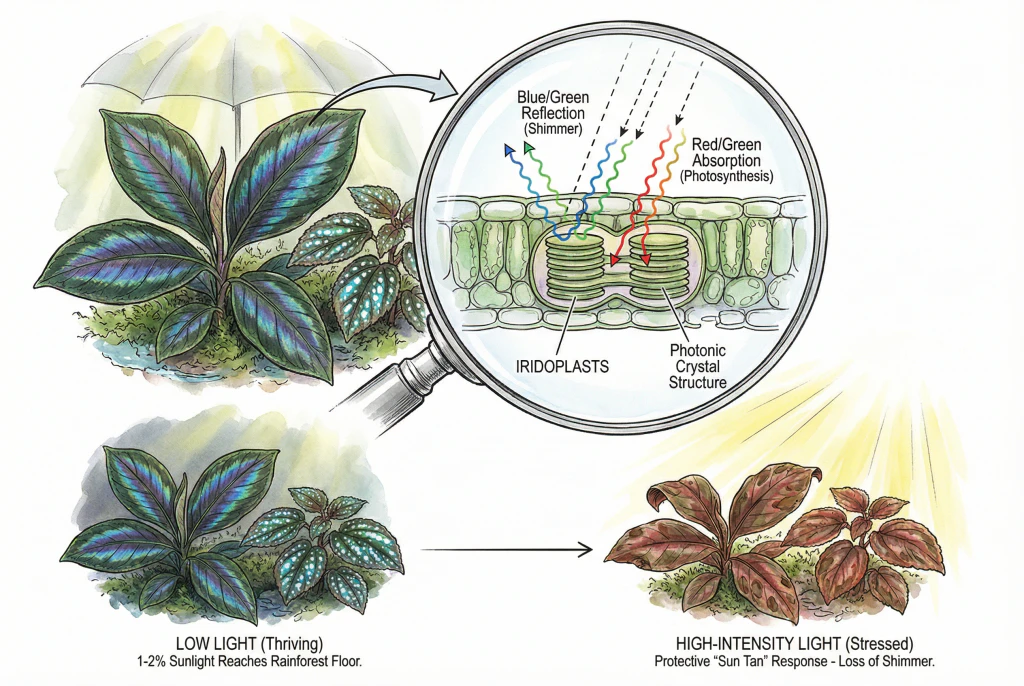
Why do some understory plants shimmer? In many cases the color is not pigment but structural color (light interference from ordered, nanoscale layers inside the leaf).
Deep in the rainforest understory, only a small fraction of sunlight reaches the ground (estimates vary widely by site).
One well-studied adaptation is a specialized chloroplast called an iridoplast, but note the key caveat. Iridoplasts have been characterized in Begonia, not in the Labisia and Sonerila covered here.
Whether these trade plants use the same structure is unconfirmed, so treat the explanation below as a plausible model rather than a measured fact about your plant.
In the studied Begonia, the iridoplast contains thylakoids stacked into a photonic crystal that interferes with light.
That structure reflects part of the blue-green light (producing the visible shimmer) while helping capture dim, largely green understory light more efficiently.
It does not mean the plant can't use blue or green light (chlorophyll uses blue and red strongly, and green matters in shade) so the older shorthand that these plants simply reflect what they can't use is misleading.
What this means for you
True structural iridescence is directional. The color shifts as you move your head. These are shade plants, so favor modest indirect light rather than intense direct light.
Under very strong light many shade plants build up red anthocyanin pigment as a kind of chemical sunscreen, which can mute the shimmer.
Whether a given Labisia or Sonerila does this, and at what intensity, has not been tested, so watch your own plant for bleaching or color change rather than assuming a fixed threshold.
Photonic Multilayer Structure of Begonia Chloroplasts Enhances Photosynthetic Efficiency
Nature’s Swiss Army Knife. The Diverse Protective Roles of Anthocyanins in Leaves
Why High Humidity Helps
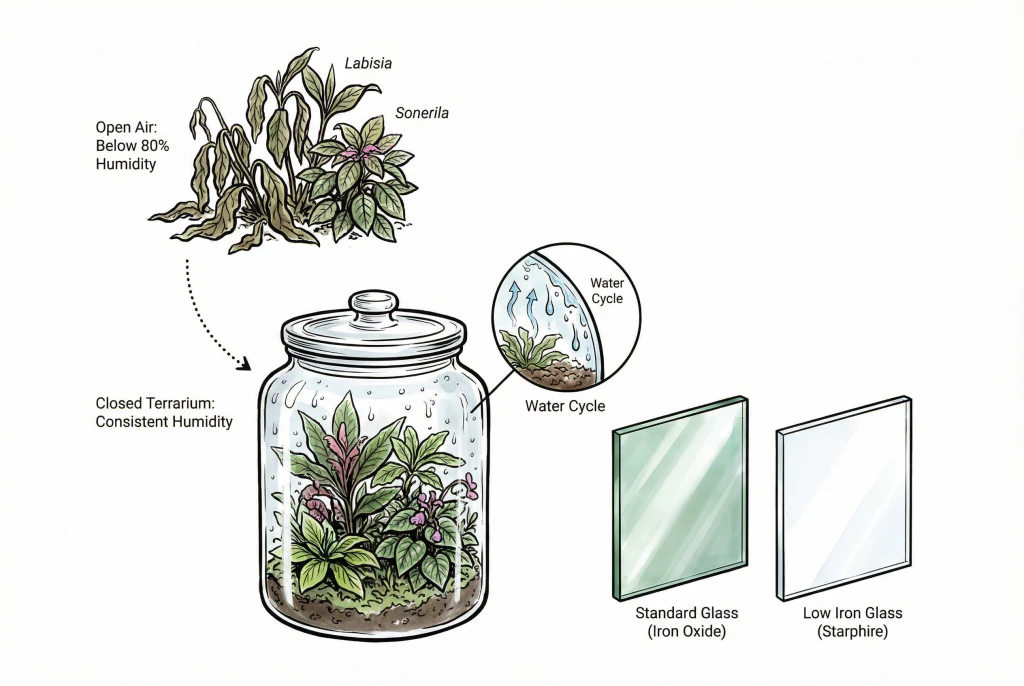
These are thin-leaved tropical plants that generally prefer high humidity. In dry indoor air they can show leaf-edge browning, likely because they lose water faster than the roots replace it.
There is no published measurement of a hard cutoff for these plants (commercial Turtle Back guidance actually cites roughly 60–70% RH) so treat any single humidity number as a rough guide, not a survival line.
A closed or covered terrarium is a convenient way to hold humidity. Water evaporates from the substrate, condenses on the glass, and returns, echoing the humid, sheltered conditions of the forest floor.
It is not a set and forget box, though.
Because a closed vessel has no drainage and traps humidity, it can also accumulate disease.
Extension guides recommend venting excess condensation, letting foliage dry before you re-cover it, and avoiding standing water and leaves pressed against the glass.
If you see persistent heavy fogging, open the lid to let some moisture out rather than assuming the plants are fine.
Choosing Your Glass
Ordinary soda-lime glass contains some iron, which adds a green cast that is most visible at the edges and in thicker panes.
If you want the truest color rendition, low-iron glass (sold under names like Starphire) reduces that green tint.
It is an aesthetic upgrade rather than a plant-health requirement (in a small, thin-walled terrarium ordinary clear glass already transmits a lot of light).
Manufacturer data puts low-iron glass around 91% visible transmittance and ordinary clear glass around 90% at a thin 1/8-inch pane, with both dropping as the glass gets thicker, so the real difference depends on thickness and viewing angle, not a fixed gap.
For the plants themselves, avoiding glare, heat buildup, and direct sun usually matters more than the glass grade.
Building the Foundation
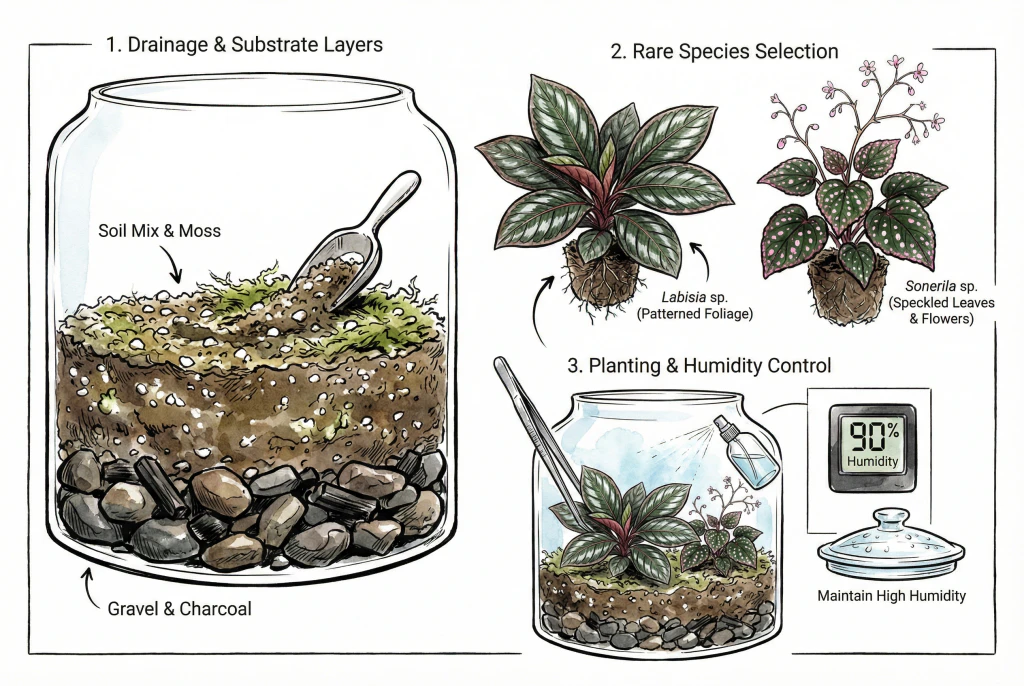
Substrate (Airy but Moisture-Retentive)
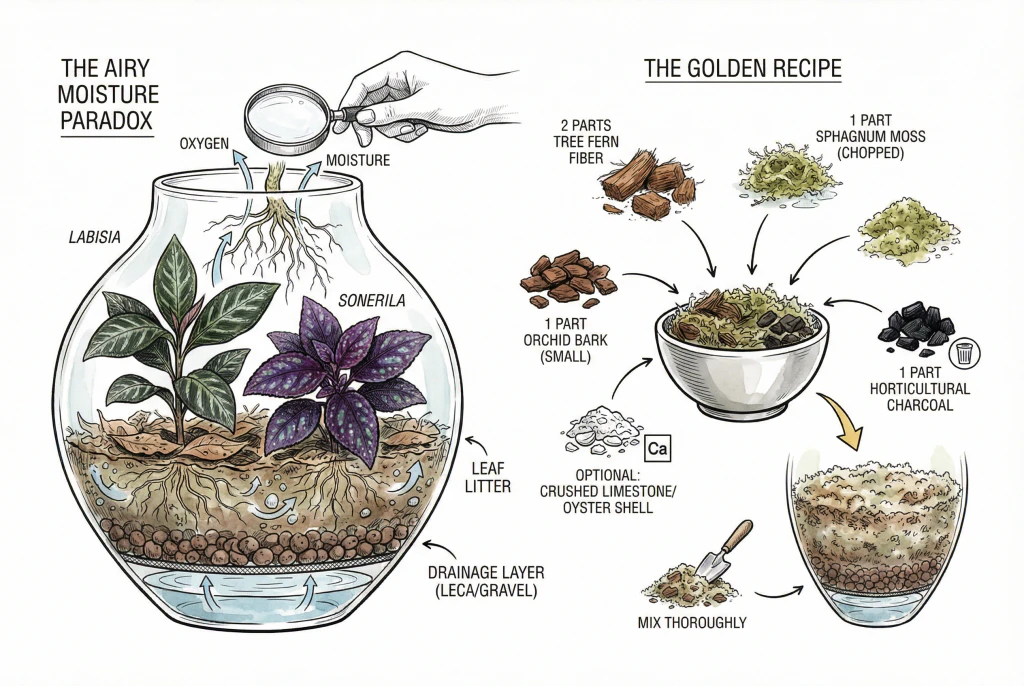
These plants grow in loose leaf litter rather than dense mud, so aim for a root zone that stays moist yet still holds air.
Plain garden or standard potting soil tends to compact and stay wet, which can rot the roots, if you do use a bagged potting mix, open it up with bark and perlite.
A Starting Mix
A commonly used blend is roughly 2 parts tree fern fiber to 1 part each of chopped sphagnum, small bark, and charcoal.
Treat the ratio as a starting point (the right balance depends on particle size, how deep your container is, your water, and the species) and adjust if the mix stays soggy or dries too fast.
Tree Fern Fiber
Adds structure and air spaces and breaks down slowly.
Besgrow Sphagnum Moss
For water retention and mild acidity. This long-fiber grade tends to keep its structure longer than loose bagged moss, though how long it lasts in your setup will vary. Watch that the overall mix does not stay waterlogged.
Orchid Bark
Small pieces improve drainage and coarse porosity.
Mosser Lee Charcoal
Horticultural charcoal is sometimes added to help keep the substrate fresh. Its benefits are often overstated in marketing, and it is optional rather than essential.
Optional Calcium
A small pinch of crushed limestone or oyster shell can raise pH and alkalinity. Some Labisia are associated with limestone habitats, but skip it unless you know your substrate is acidic and both plants tolerate it. Test rather than assume.
Legigo LECA
A drainage layer is one design option, not a rule. In a jar with no outlet, lightweight clay pebbles create a reservoir space below the roots rather than draining water away, and the layer boundary can hold a perched water table.
Use it if you want a buffer for occasional excess water, but it is not always better than plain substrate.
Planting Technique
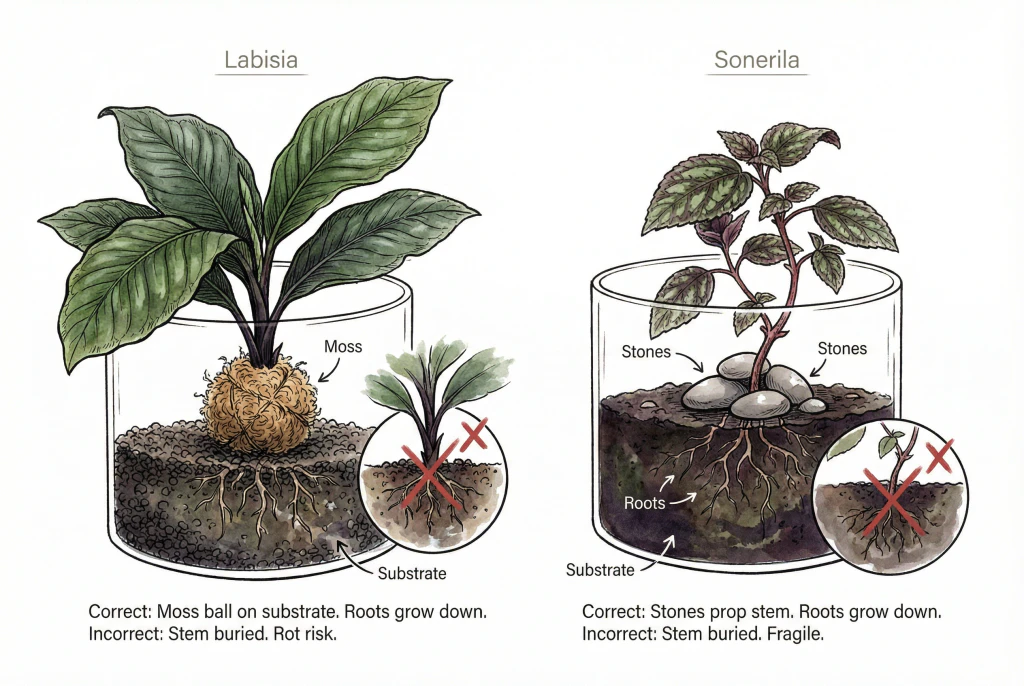
Plant shallow
A common cause of loss with these plants is burying the crown or stem too deep, which can invite crown and stem rot.
Keep the stem at roughly the depth it grew before, and don't pack substrate up around the crown.
One approach some growers use is to wrap the base of the stem in a small ball of damp sphagnum and set it on the surface so it roots down.
This can help, but a wet moss ball against the stem can also trap moisture, so watch for softening at the base.
Sonerila often have fragile stems. Small stones can hold a cutting steady while it roots. Take care that the stone does not press hard enough to bruise the stem or trap water against it.
Environmental Parameters
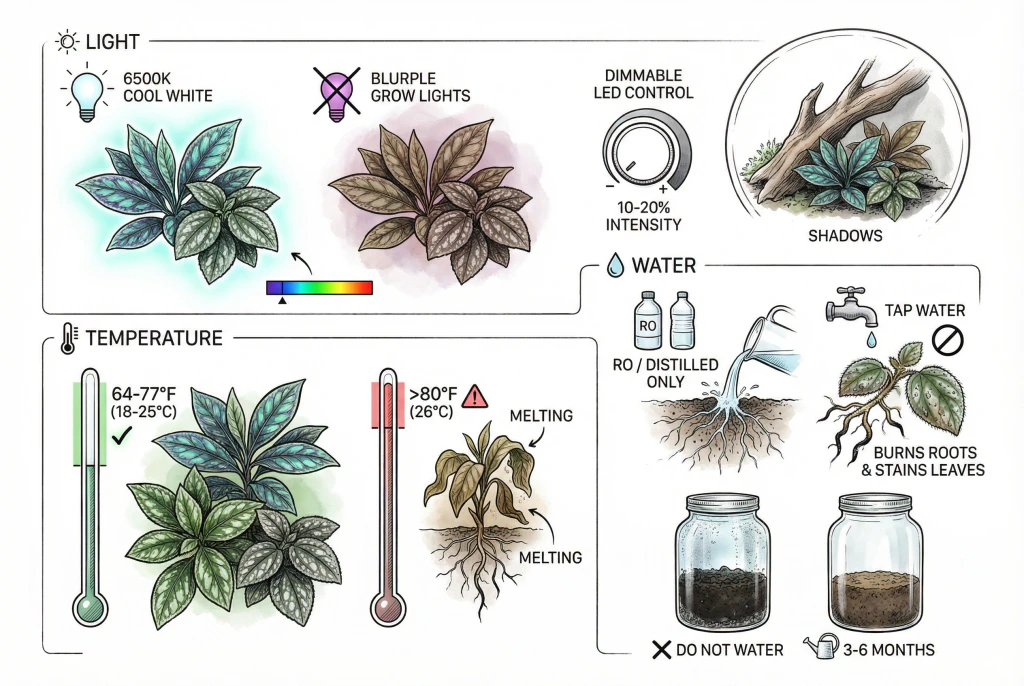
Light
Spectrum
A neutral white around 6500 K makes foliage color easy to view. This is an appearance preference. Blurple red-blue fixtures are not inherently bad for the plants, but they make colors harder to judge.
Intensity
Keep it modest because these are shade plants. A dimmer percentage like 10–20% only means something for one specific fixture at one distance, so measure at the canopy if you can and adjust based on how the plant looks rather than trusting a fixed percentage.
Temperature
Range
Ordinary room temperatures suit them. Roughly 64–77°F (18–25°C) is a comfortable target, and commercial Turtle Back guidance allows a wider ~60–85°F (15–29°C).
Heat and Disease
Sustained warmth combined with wet foliage and stagnant air can raise the risk of bacterial disease. There is no proven temperature at which the plant automatically melts, so focus on airflow and keeping leaves dry rather than a single threshold.
Water
Type
In a no-drain terrarium, dissolved salts have nowhere to go, so low-salt water such as rainwater, distilled, or RO is the safest default, especially in hard-water areas. That does not mean tap water universally burns roots. Most tap water is fine for most houseplants. Check your water or a local water report and lean toward low-salt water if it is hard. Hard water sprayed on hairy leaves can leave mineral spotting, which is another reason to keep water off the foliage.
Frequency
A sealed jar can go a long time between waterings. Extension sources cite roughly 3–6 months for closed terrariums, but this varies with substrate volume, seal, light, and temperature. Rather than following a calendar, check root-zone moisture and leaf turgor. If condensation is constant and heavy, vent excess moisture instead of simply withholding water.
Quarantine and Acclimatization
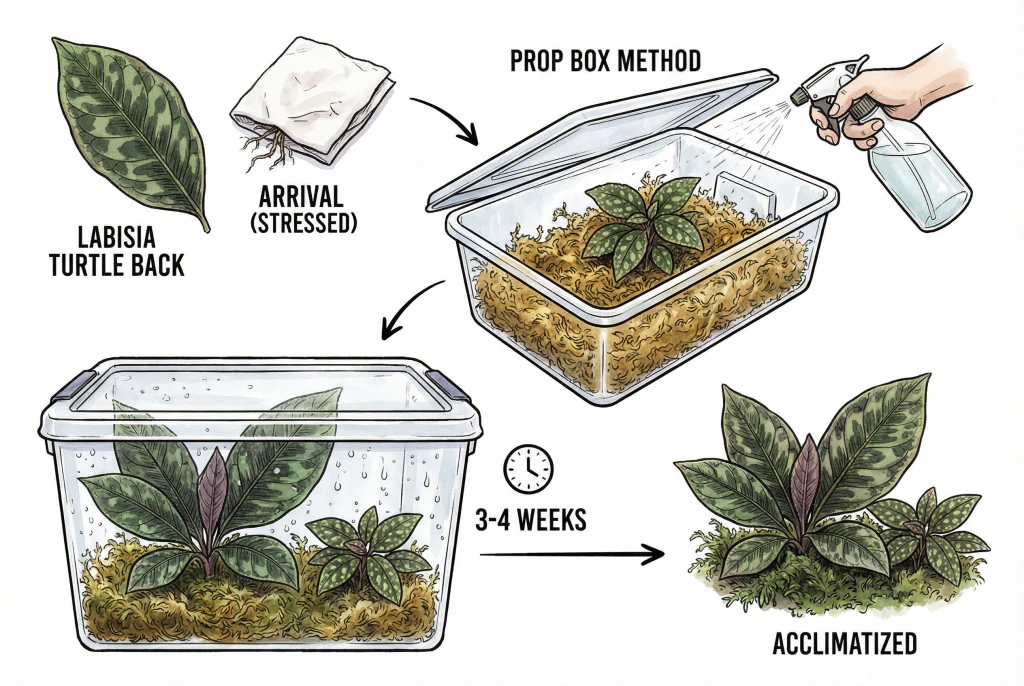
When a new import arrives, often wrapped in damp paper towel, Do not put it straight into your display tank. Two separate goals apply here. Quarantine (keeping pests and disease away from your other plants) and acclimatization (easing a stressed plant into stable conditions).
A Simple Prop-Box Setup
- Use a clear, lidded container such as a Sterilite storage box. Check that it is tall enough for the plant and leaves some air space.
- Line it with damp sphagnum moss, and keep the plant in its own pot rather than pressing it onto loose, unsterile moss.
- Place the new plant inside, physically separated from your display so you can watch it in isolation.
- Mist only if it is drying out, and cover the lid to hold humidity.
- Keep it isolated for at least 3–4 weeks, inspecting every few days for pests, disease, and rot, and removing any affected tissue.
High humidity can reduce moisture loss while a shipped plant recovers, and the claim that it regrows root hairs on a fixed timeline is not established.
When it looks stable, vent the lid gradually to step it down toward your terrarium's humidity rather than moving it all at once.
Prices for these plants vary widely by seller, size, and species, so treat any single figure as a rough guide.
Care & Troubleshooting
Feeding
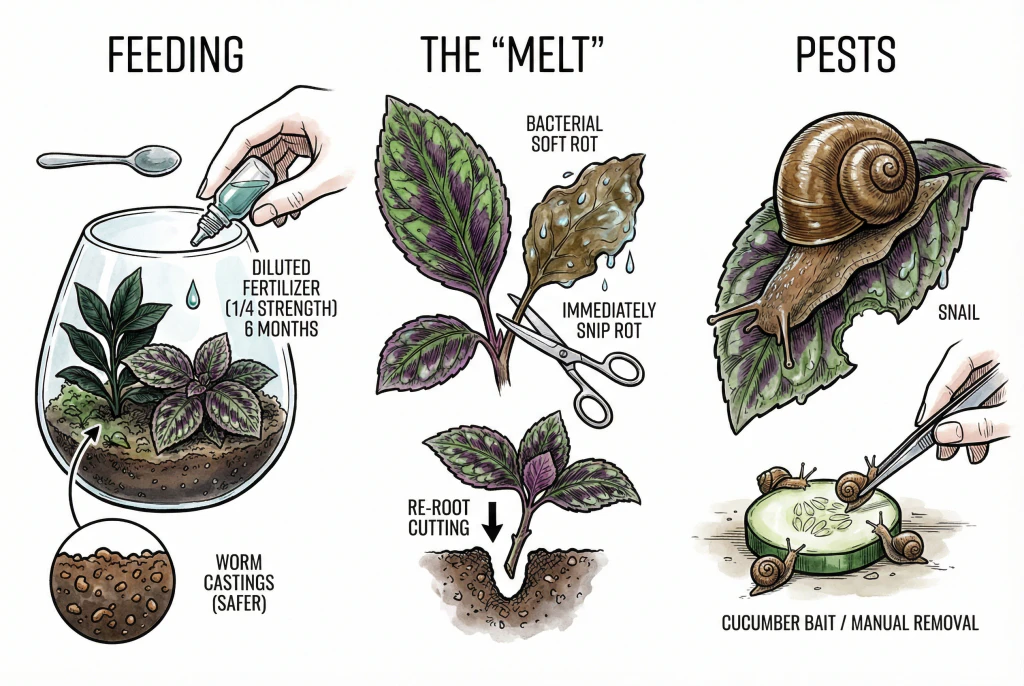
In a slow-growing, enclosed display, keep feeding light. Overfeeding is a bigger risk than underfeeding.
A very dilute balanced fertilizer applied sparingly during active growth is a reasonable approach. The exact dose depends on the product and your substrate's fertility, so start weak and watch the response rather than following a fixed 1/4 strength every 6 months rule.
Commercial Turtle Back guidance even allows monthly half-strength feeding when the plant is actively growing.
The melt
A leaf can go from fine to mush quickly. Warm, wet, stagnant conditions do favor bacterial soft rot, but that is not the only cause (root or crown rot, fungal or oomycete disease, cold damage, and physical injury look similar).
Confirm the pattern before assuming which one it is.
Action
Isolate the plant, then cut away affected tissue back to healthy growth with a clean, sterilized blade, disinfecting between cuts and sealing up the discarded material. If the base is rotting, you can try re-rooting a symptom-free top as a cutting, but with systemic rot even a healthy-looking top may already be infected, so a save is not guaranteed. Improve airflow to help leaf surfaces dry.
Pests
Snails and slugs can quickly damage soft foliage in a humid terrarium. A cucumber slice or similar bait can help you find and handpick them, but bait alone rarely clears an infestation.
Combine repeated inspection, handpicking, removing hiding places and eggs, and disposing of what you collect.
Propagation (Patience Required)
Sonerila
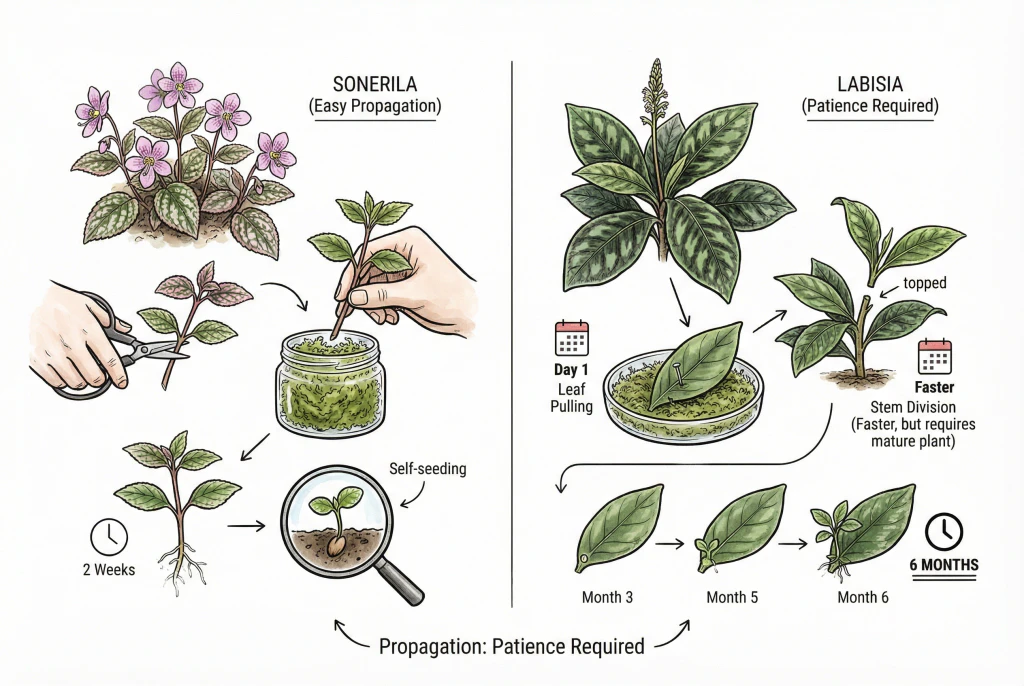
Often relatively easy. A stem cutting set in damp moss can root within a few weeks, and some species self-seed readily.
Actual rooting time and success depend on the species, node count, temperature, and light, so a specific 2 weeks is a rough expectation rather than a rule for every trade form.
Labisia
Slower and less predictable. Studies on Labisia pumila show that leaf or stem cuttings can root under controlled conditions, with root development reported over roughly weeks 4–12 in one study, and stem cuttings sometimes outperforming leaf pieces.
That does not guarantee a pinned leaf on an unidentified Turtle Back will produce a plantlet on a fixed 6-month schedule, so expect months and variable results.
Patient Attention Rewards These Jewel Plants
Rare Labisia and Sonerila reward a patient, attentive grower rather than a set-it-and-forget-it one.
The most important step happens before care. Know what you actually bought, since most are sold under unresolved trade names, and buy from a seller who states provenance.
Give them modest indirect light, steady high humidity, low-salt water, an airy mix, and good hygiene, and check on them regularly rather than assuming a sealed jar takes care of itself.
Watch the plant, adjust to what it shows you, and these jewel-box plants can do well for a long time.
Affiliate Disclosure
This article contains Amazon affiliate links. As an Amazon Associate I earn from qualifying purchases. If you use these links, the site may earn a commission at no extra cost to you. Product availability, price, and specifications can change. Check the current listing before buying.