
A PPFM Biological in Kevin Kalb’s 425-Bu Corn: What the Record Actually Shows
Kevin Kalb’s 2025 NCGA win and a separately reported one-field biological treatment result are not the same evidence. Learn how to judge a PPFM product, follow its label, and test it fairly.
Elena Vargas · Published 2026-02-01 · 5 min read
Key Takeaways
- Two separate facts must not be conflated. Kevin Kalb won the 2025 NCGA B (Conventional, Non-Irrigated) Corn Belt class at 425.7728 bu/A with hybrid DKC68-35RIB, which verifies yield but not its cause. Separately, in one field he reported a +6 bu/A gain from a treatment relative to his usual fungicide program.
- The treatment was a combination, not one product. Per field reporting, Kalb tried a TS601 biofungicide plus Terrasym 450, a PPFM biostimulant, in-furrow under southern-rust pressure. It was not Terrasym alone or the driver of the whole 425 figure.
- PPFMs are a group of plant-associated bacteria. What one strain does in a formulation does not prove that another product will produce the same response.
- The proposed root and stress benefits were not measured in Kalb’s field. Do not treat a plausible mechanism as proof of a yield response.
- Calculate break-even with your current total product and application cost, your expected crop price, and a measured local yield response.
Kevin Kalb is a repeat national corn-yield winner who has reported mixed experiences with biological products. In 2025 he won the NCGA B non-irrigated Corn Belt class at 425.7728 bu/A and separately reported a modest gain from a biological treatment in one field.
The contest confirms the recorded yield. It does not prove that the biological treatment caused it, and one field result does not establish the product’s response on other farms.
Why Are Farmers Skeptical of Biologicals?
Two reasons come up repeatedly. Inconsistent results and effects that are hard to see or measure in a single field.
University multi-location trials of biological products show a mix of positive, null, and negative responses.
That variability, more than any single cause, is why many growers stay cautious.
Viability Is One Failure Mode
Live microbial products do face viability limits. Shelf life, tank-mix compatibility, and exposure to UV and desiccation can all reduce how many cells survive to reach the plant.
That is a real constraint for formulated bacteria, but it is one of several reasons a product might not respond in the field. Soil chemistry, the native microbiome, crop and weather, and application all matter too.
There is no published denominator to say most beneficial bacteria simply die before they help.
The Effect Can Be Hard to See
Unlike a herbicide with a visible three-day weed kill, a biostimulant might produce a small yield change that is easily masked by normal field variability.
A visual difference is also not the same as a yield difference.
Kevin Kalb’s Experience
By his own account, Kalb had grown skeptical after years of trying biological products without a payoff he found convincing.
That is a recollection of his experience with specific products, not a measured verdict on the whole category.
What Kalb Actually Tried in 2025
According to field reporting, Kalb applied a TS601 biofungicide plus Terrasym 450, a PPFM biostimulant, in-furrow. It was a combination treatment on high-yield ground under southern-rust pressure.
The result came from one treated strip in one field and one year, without the randomization and replication needed to assign a yield difference to the product. Because two products were used together, it also cannot show what Terrasym alone did.
What He Reported Seeing
Kalb reported visibly larger stalks and about 6 bu/A above his usual fungicide program. Those observations are worth testing, but they are not root, nutrient-uptake, or replicated yield data.
The Contest Result
His winning entry came in at 425.7728 bu/A in a non-irrigated field. NCGA verifies that yield, not a cause-and-effect response from any individual input.
Reading It Honestly
A contest result cannot validate a product because hybrid, soil, weather, fertility, and the rest of the program were not controlled. The useful conclusion is only that a combination treatment produced a reported gain worth independent testing.
What a PPFM Product Is
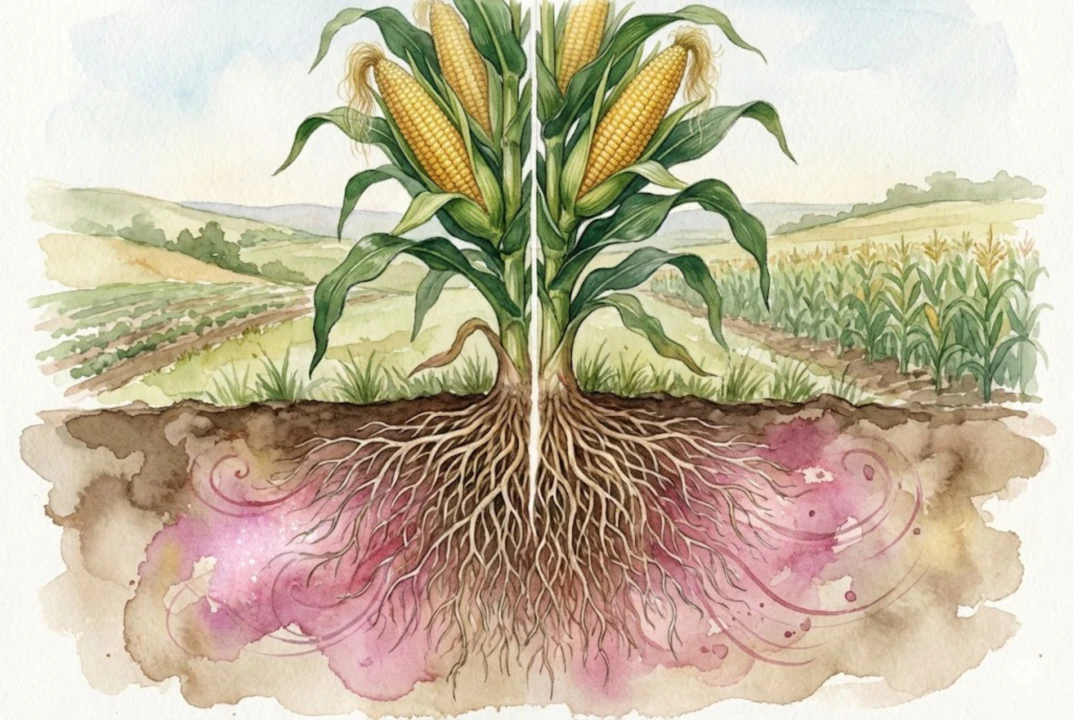
PPFMs are plant-associated bacteria that can use compounds released by plants. Some strains can produce substances that may affect rooting or stress response, but those effects vary by strain, dose, formulation, crop, and conditions.
A general biological mechanism does not prove that a specific product increased roots, nutrient uptake, drought tolerance, or yield in Kalb’s field. High-yield corn can still be limited by weather, disease, hybrid, stand, water, and several nutrients at once.
Application & Integration
Terrasym-family products are sold in more than one formulation, so application depends on the exact product and its label. The notes below are general only and do not replace the label.
Planter-Box Application
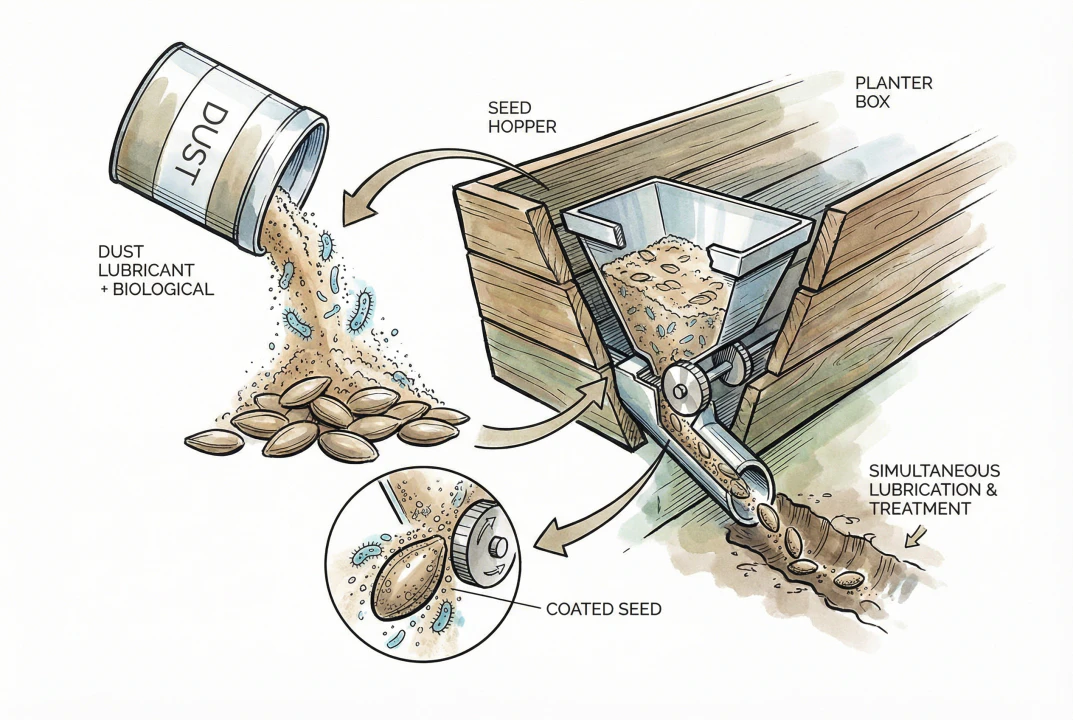
- Use a planter-box carrier only where the specific product label and planter manufacturer allow it.
- Follow the label for mixing, calibration, seed coating, storage, shelf life, and eye and skin protection.
- Do not transfer a planter-box rate to an in-furrow product or treat it as the program Kalb used.
In-Furrow Application
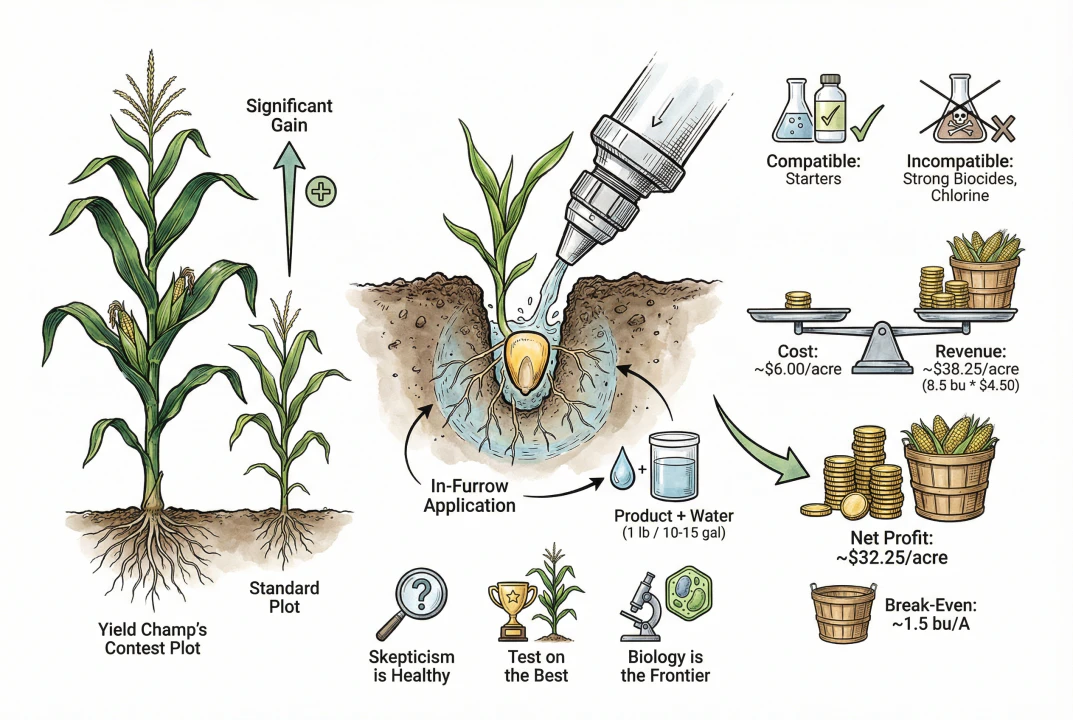
- Get the rate and label identifier for the exact formulation. A mixing concentration without an acre or seed-unit basis is not a usable application rate.
- Jar-test a new tank mix and follow the most restrictive partner label. Do not assume compatibility or crop safety.
Calculate Return From Your Own Trial
A biological product pays only if it produces a real, measured gain that exceeds the full product and application cost. Company response figures and Kalb’s one-field observation are not a break-even estimate for another farm.
Use current costs and crop price, then compare replicated treated and untreated strips at harvest before expanding use.
I alternate labeled treated and untreated strips across the field instead of putting every treated pass on one side. The hybrid, planting population, planter settings, fertility, and harvest width remain matched. A rule written before harvest excludes headlands and obvious drainage failures from both groups.
Raw scale tickets stay with the record, and I calculate each strip separately before looking at the average. A single heavy strip beside better soil can otherwise make a product look convincing even when the alternating pattern does not repeat.
What Can a Home or Market Gardener Take From This?
A field-corn biological does not transfer directly to a garden. Choose each product by its own crop label and evidence.
Mycorrhizal inoculants are fungi, not PPFM bacteria. They can help where suitable roots are not already well colonized, but they are often unnecessary in established soil and do not benefit non-host crops such as brassicas and beets.
For seaweed extracts or any other biostimulant, check the current label for edible-crop use and the guaranteed analysis. Test a small area at the stated rate beside an untreated area before using it across the garden.