
Pivot Bio PROVEN 40 Usage Tips and Application Guide
A practical field guide to Pivot Bio PROVEN 40: how the two gene-edited strains work, formulation-specific storage and mixing, PPE, and an honest look at the up-to-40 lb N claim against independent trial results.
Marcus Hale · Published 2026-01-28 · 14 min read

Summary
Read the claim within its limit
- Pivot Bio PROVEN 40 is a commercial soil inoculant of two gene-edited, root-associated bacteria. It can supply part of a corn crop’s nitrogen, while the manufacturer positions it to offset up to 40 lb N/acre rather than guarantee a one-for-one replacement.
- Manufacturer guidance calls for pre-straining, agitation, and adding the product last in the tank mix. Use non-chlorinated or compatible water.
- Independent university trials are mixed. Several found no significant yield or nitrogen benefit, while one peer-reviewed study found a small yield gain and a harvest fertilizer-N equivalent near 10 lb/acre. Run replicated, untreated-check strips before cutting nitrogen.
Key Points
Confirm the formulation before use
- Storage depends on the formulation. The Liquid In-Furrow (LIF) label calls for 32–70°F, out of direct sun, and no freezing. The current On-Seed (OS) dry-microbe pouch is different because its label calls for freezer storage at about 0°F until mixed. Follow the label for the exact product you have.
- Application rate depends on row spacing. The current LIF rate is 12.8 fl oz/acre for 30-inch rows. Narrower rows use more, so check your label.
- Adding PROVEN 40 last is the manufacturer’s preferred mixing order. Use compatible, non-chlorinated water.
- Pre-strain through a 60-mesh screen before the tank. Match the filter size to your equipment maker’s guidance.
- Odor is only a rough abnormal-lot screen. A normal LIF product smells mild and fermented, but odor does not measure microbe count or activity.
- The manufacturer claims an offset of up to about 40 lb synthetic nitrogen per acre. Independent results vary widely, so verify on-farm before relying on it.
- Use an LIF tank mix within 24 hours and a mixed OS batch within 4 hours.
Some bacteria can convert nitrogen gas from the air into a form corn can use. This is well established for legumes, and free-living or root-associated diazotrophs are also known in non-legume crops such as corn, though without the root-nodule symbiosis legumes form.
Pivot Bio PROVEN 40 puts selected, gene-edited strains of these bacteria near the corn root to supply part of the crop’s nitrogen.
How much it supplies depends on the season, soil, existing N level, and how well it is handled.
For decades, farmers have relied on the Haber-Bosch process, synthesizing ammonia from natural gas under high heat and pressure, to feed the world.
It has real limits, including nitrogen losses to volatilization and leaching under some conditions, and the cost and logistics of moving fertilizer.
Biological products aim to offset part of that load, not replace it wholesale.
What is Pivot Bio PROVEN 40?
Pivot Bio PROVEN 40 is a commercial microbial soil inoculant for corn.
Unlike a synthetic salt fertilizer, it contains live bacteria (the LIF formulation is a liquid. The current OS formulation is a dry-microbe pouch mixed before use).
The current label lists two strains, Klebsiella variicola 137-2253 and Kosakonia sacchari 6-5687. These began as naturally isolated bacteria, but the product strains are gene-edited to change how their nitrogen fixation is regulated.
Applied at planting, they colonize the root zone and associate with the roots through the season.
In the research literature this is described as free-living, associative, or root-associated (asymbiotic), not the root-nodule symbiosis that legumes form.
Mechanism of Action (The Nitrogen Factory)
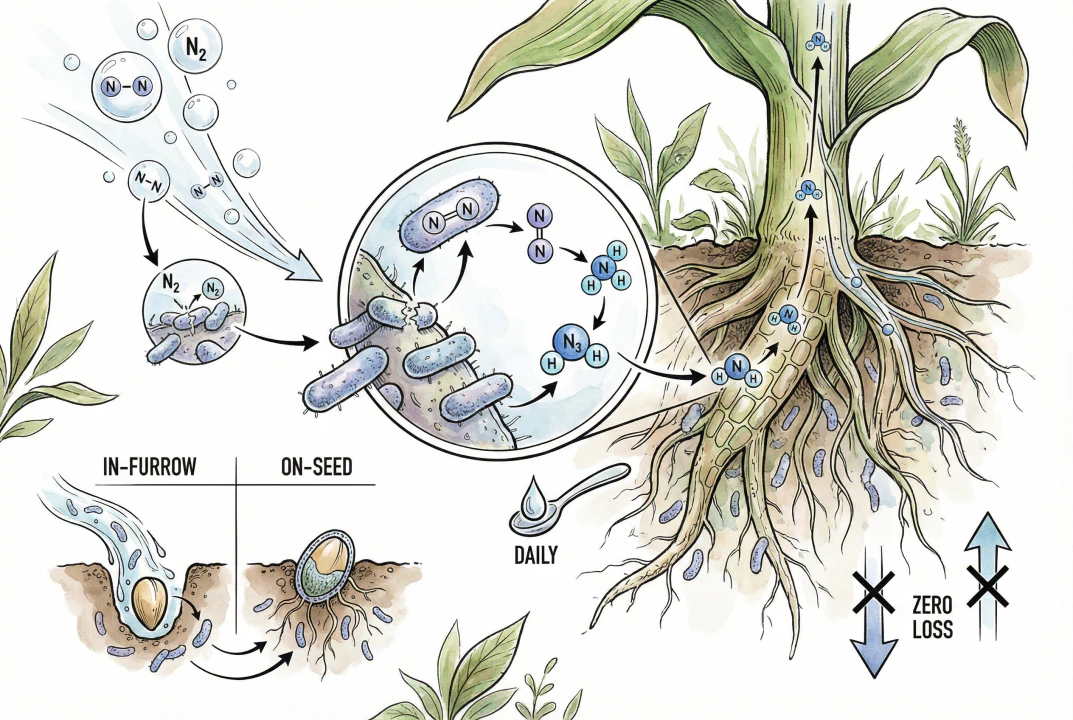
The mechanism is biological nitrogen fixation. This is best known in legumes such as soybeans and alfalfa, but free-living and associative nitrogen-fixing bacteria also occur with non-legume crops like corn.
The bacteria in PROVEN 40 use the nitrogenase enzyme complex to take inert nitrogen gas (N₂), which makes up about 78% of the atmosphere, and break its strong triple bond.
They convert it to ammonium/ammonia. At typical soil pH the plant-available form is mainly ammonium (NH₄⁺), which the crop can take up and use to build protein and chlorophyll.
How does this differ from synthetic nitrogen? A single synthetic application supplies a large amount at once. Growers manage the timing gap with split applications, stabilizers, and 4R practices.
Any N the crop does not take up enters the soil N cycle, where a portion can be lost under wet or warm conditions, but not all unused N is lost immediately.
Because the bacteria colonize the root zone, the nitrogen they fix is released close to the roots. This proximity may improve how efficiently that N is used.
It does not mean zero loss. Nitrogen released near the root still enters the normal soil N cycle through uptake, immobilization, mineralization, nitrification, leaching, and denitrification.
Company-affiliated research describes reduced environmental loss as a potential that needs more study, not a proven, quantified result.
Treat delivery close to demand as a goal, not a measured outcome.
Application Methods (In-Furrow vs. On-Seed)
You have two main ways to get these microbes into your field. Choosing the right one depends on your equipment, your labor availability at planting, and your specific logistical setup.
Both methods deliver the same two strains, but concentration, carrier, storage, handling equipment, and application rate differ, so they are not interchangeable. Follow each formulation’s own label.
Liquid In-Furrow (LIF)
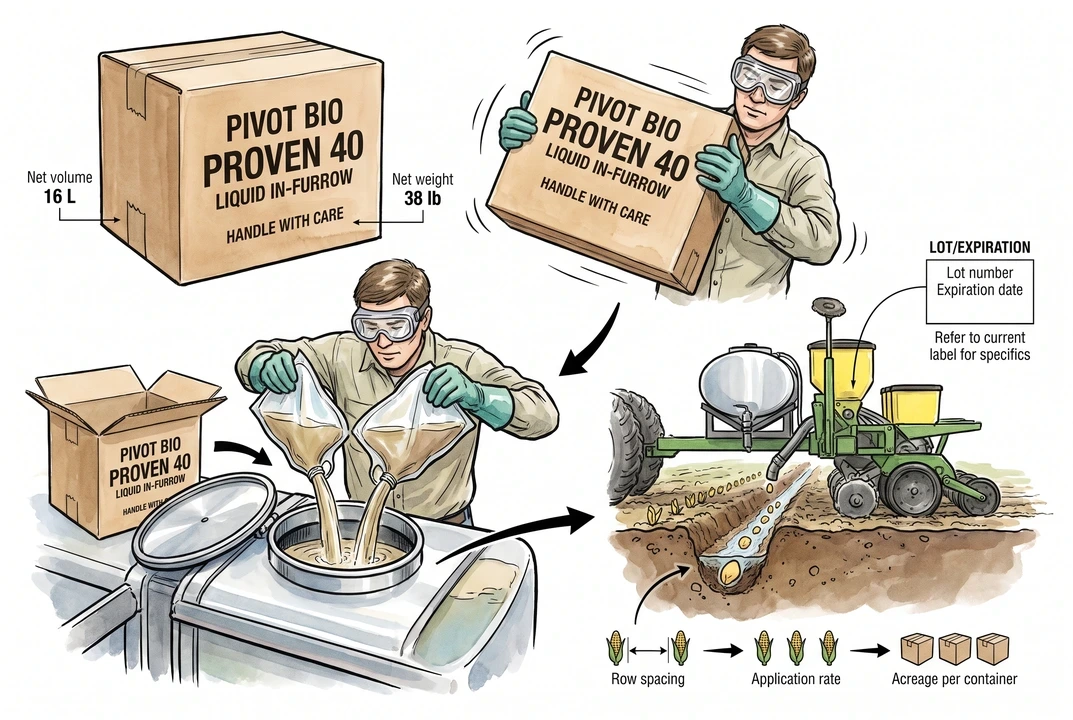
The Liquid In-Furrow (LIF) option can be convenient for growers who already run liquid starter or insecticides, if it is compatible with those products.
The current LIF label lists a net weight of 38 lb (about 16 L / 4.23 gal). At the 30-inch-row rate of 12.8 fl oz/acre it covers roughly 40 acres. Narrower rows use more per acre, so the acres covered are lower.
Confirm coverage and the expiration date on your box.
- Mixing. It is a liquid concentrate with visible sediment and biological material, not a clear fertilizer. Mix it with a compatible starter fertilizer or non-chlorinated water carrier in your fertilizer tanks. Check the current compatibility list first, and use chlorine remediation if your water is chlorinated.
- Timing. Apply directly in the furrow at planting, placing the microbes where the seed will germinate near the emerging radicle. Colonization depends on conditions and is not guaranteed to be immediate.
- Shelf Life. The manufacturer states an unopened in-package life of about 120 days when stored properly. The expiration date printed on the box is the final authority. Take delivery close to planting.
On-Seed (OS)
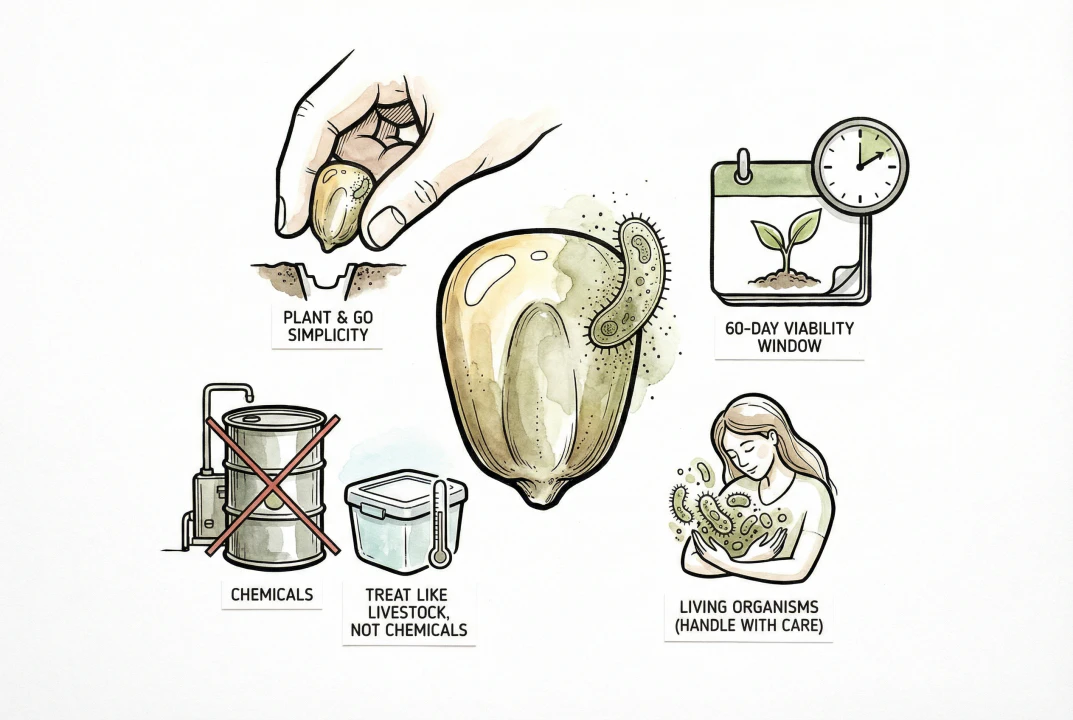
On-Seed (OS) can reduce planting-day tank work, but it does not remove the work entirely (it shifts it to dealer scheduling, seed treating, and cold storage).
For growers who prefer not to run extra tanks and plumbing on the planter, OS is one option. Compare performance and cost before choosing it.
The seed is treated upstream by your seed dealer or on the farm. Per the current OS label, the unopened dry-microbe pouch is stored frozen (about 0°F / -18°C) until use, then mixed with a separate Extender using dedicated treating equipment (roughly 2.4 fl oz per seed unit) and used within 4 hours of mixing.
Wear the label-specified PPE.
- Convenience. At planting it is close to ‘plant and go’. You fill the hopper as normal with treated seed. Observe the seed’s storage, compatibility, and expiration limits.
- Window. Pivot Bio lists on-seed stability of up to 60 days once treated, given proper temperature and compatible seed treatments. This is separate from the frozen storage of the unopened pouch. Plan planting within that window.
Handling and Storage (Keeping Them Alive)
The key point is that these are living organisms, so storage matters more than for a chemical salt like UAN or urea.
That said, this is still a commercial agricultural input. Read the label and use the required PPE.
Storage requirements differ by formulation, so do not treat the two products the same. The LIF liquid must not freeze, while the current OS dry pouch is stored frozen.
Follow the label for the product you have.
Temperature is Key
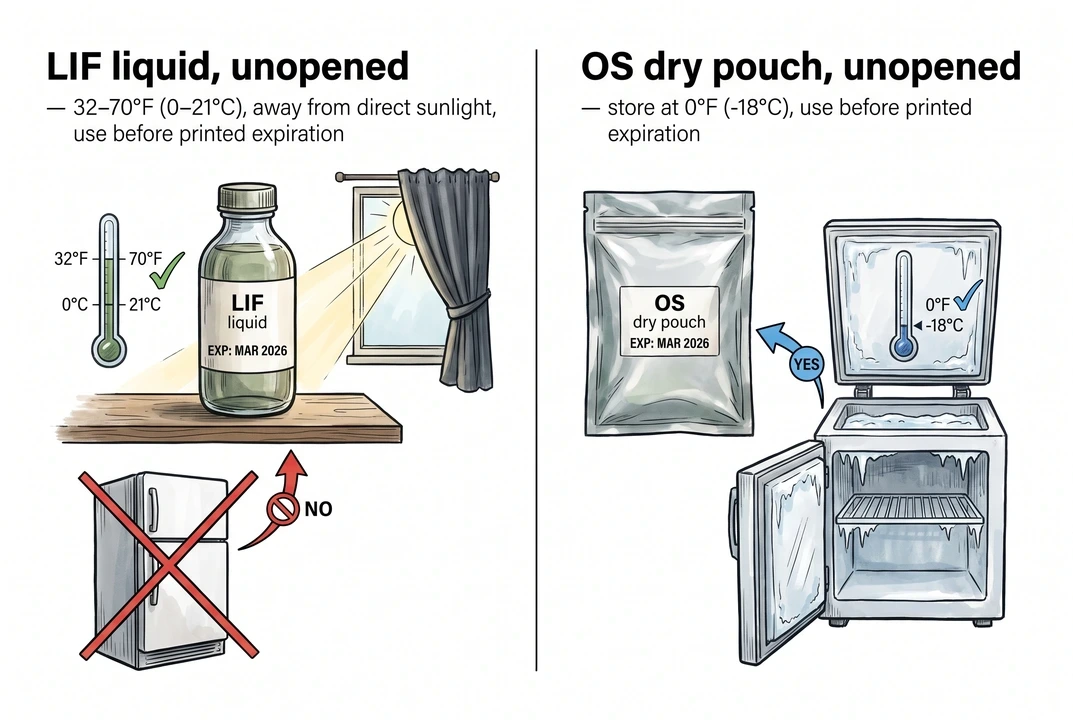
Store the LIF liquid between 32°F and 70°F (0°C – 21°C), out of direct sunlight. This range is for the liquid. The current OS dry pouch is stored frozen at about 0°F until mixed, so the two are not the same.
- No Freezing (LIF). Freezing can reduce the viability of the LIF liquid, so keep it above 32°F. (This is specific to the liquid. The current OS pouch is deliberately frozen.) If liquid product has frozen, do not assume it is fine. Follow the guidance in the troubleshooting section.
- Limit Heat. The manufacturer indicates that temperatures above about 75°F can reduce product stability, so keep it below 70°F. Avoid prolonged heat during storage and transport.
- Avoid Direct Sunlight. Keep boxes closed and out of direct sun until just before mixing, as the label directs.
The sniff test
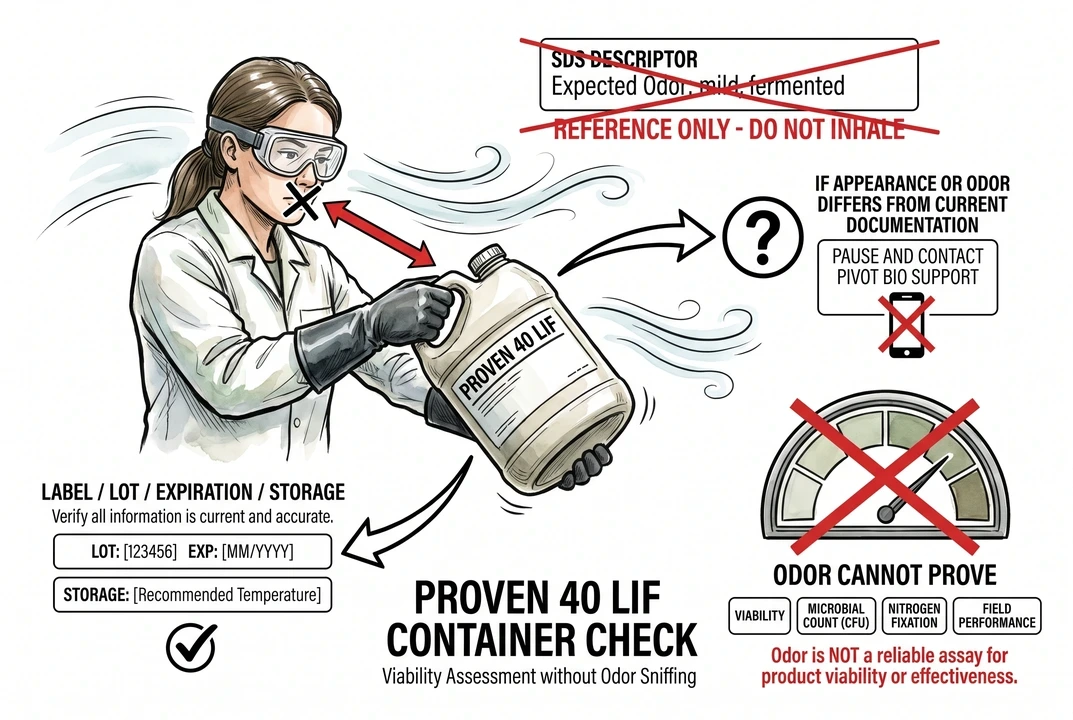
Before you mix, do a quick odor check. This is a rough screen for an obviously off lot, not a test of viability. It cannot measure microbe count (CFU) or nitrogen-fixation activity.
The current LIF safety data sheet describes a normal odor as mild and fermented. Earthy or yeasty descriptions and a brewery comparison are informal, not an official pass/fail standard.
A strong rotten-egg (hydrogen sulfide) or strong ammonia smell may indicate a problem, though odor alone cannot confirm the product is dead or contaminated.
If the odor is clearly abnormal, do not put it in your tank. Contact Pivot Bio support and provide the lot number, expiration date, and storage history.
This does not by itself guarantee a replacement.
Monitor storage temperature
I record the product lot, seal condition, delivery time, storage-temperature range, planter fill time, and first and last row for each container. A harvest difference is difficult to interpret if I cannot identify which rows received each bottle. I also record whether a bottle froze, overheated, or sat in a mixed tank for a different length of time.
A preloading photograph captures the label and temperature display together. If the storage record falls outside the current label, I stop and contact the manufacturer rather than using smell or appearance to declare living product viable.
Min/max thermometer
Why it helps. A min/max thermometer helps you spot whether the storage area dipped below freezing overnight.
It records the low and high since you last reset it, which a plain thermometer does not. It is a low-cost check, not a compliance logger. It does not timestamp readings, log hourly data, or send alerts.
How to use it. Mount it in your chemical storage area and check the minimum and maximum readings daily in the weeks before planting.
For proof of continuous storage conditions, use a logging device with timestamps or alerts instead.
How to Apply (Step-by-Step)
Applying biologicals calls for gentle, deliberate handling. As with any agricultural input, follow the label. This is for commercial agricultural use, wear safety glasses and chemical-resistant gloves, work in a ventilated area, keep it away from children and animals, and follow the first-aid and disposal instructions on the label.
1. The Prep Work
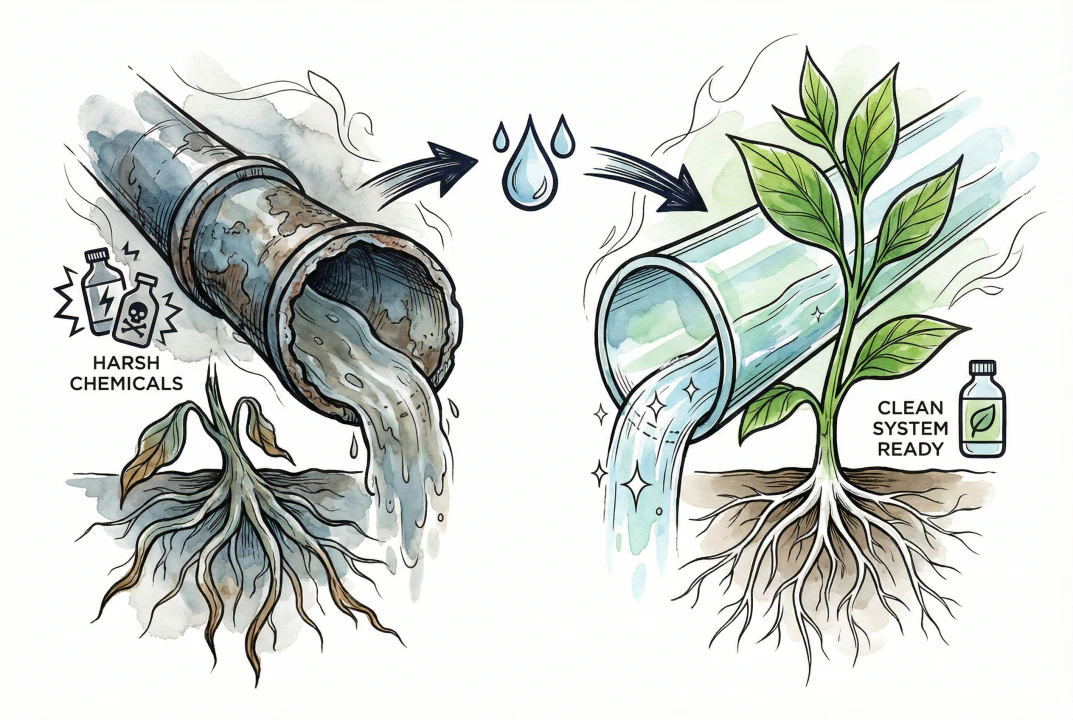
Start with clean lines. If you previously ran bactericides, copper products, or strong oxidizers, clean the system per those products’ label instructions and flush with clean water before loading the inoculant, since residues can reduce microbe viability.
Handle and dispose of rinsate according to the relevant label.
2. The Mix (LIF)
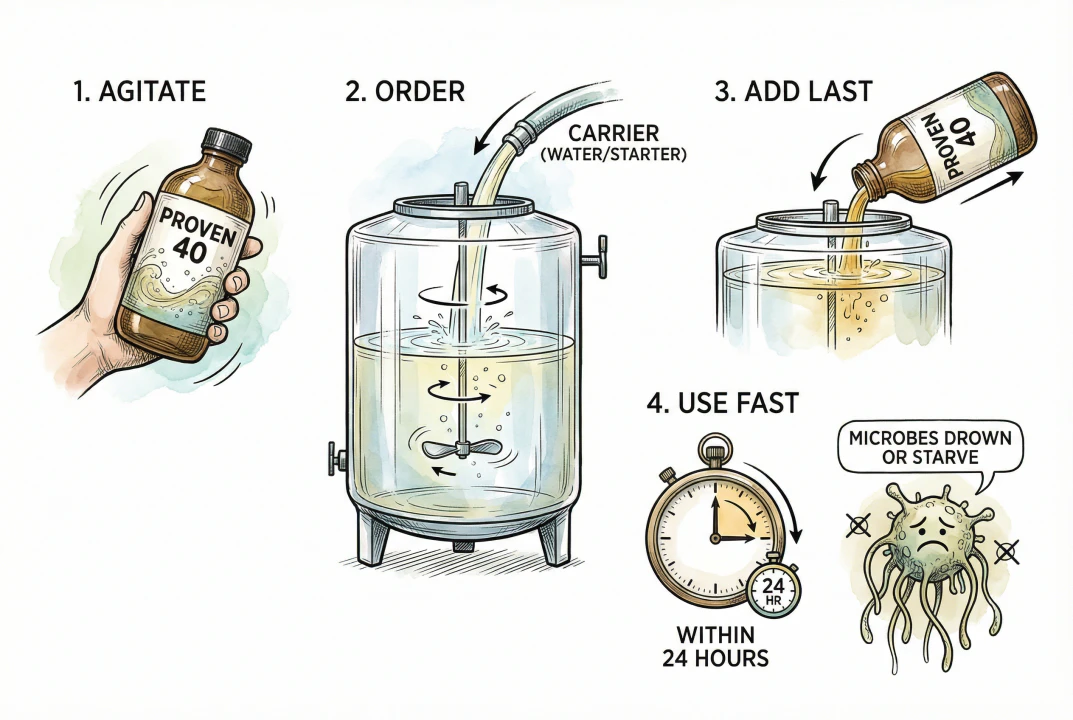
When mixing for In-Furrow application, use the manufacturer’s preferred order of operations.
- Agitate. The product can settle, so move the container gently 3–4 times to resuspend it, per the manufacturer’s stewardship sheet. If the box has two bladders, use both. A gentle tumble, not violent shaking.
- Order. Fill your tank with a compatible carrier (non-chlorinated water, or 10-34-0 if compatibility is confirmed). Start your agitation/recirculation pump.
- Add Last. Adding PROVEN 40 last is the preferred order, which limits the time the product spends mixed with concentrated fertilizer.
- Use Fast. Use an LIF tank mix within 24 hours (a mixed OS batch within 4 hours). Prolonged time in the mix, and fertilizer pH, can reduce viability, so mix close to application.
3. Equipment Setup
Filters matter
Filtration and flow are a common source of trouble when first running a biological.
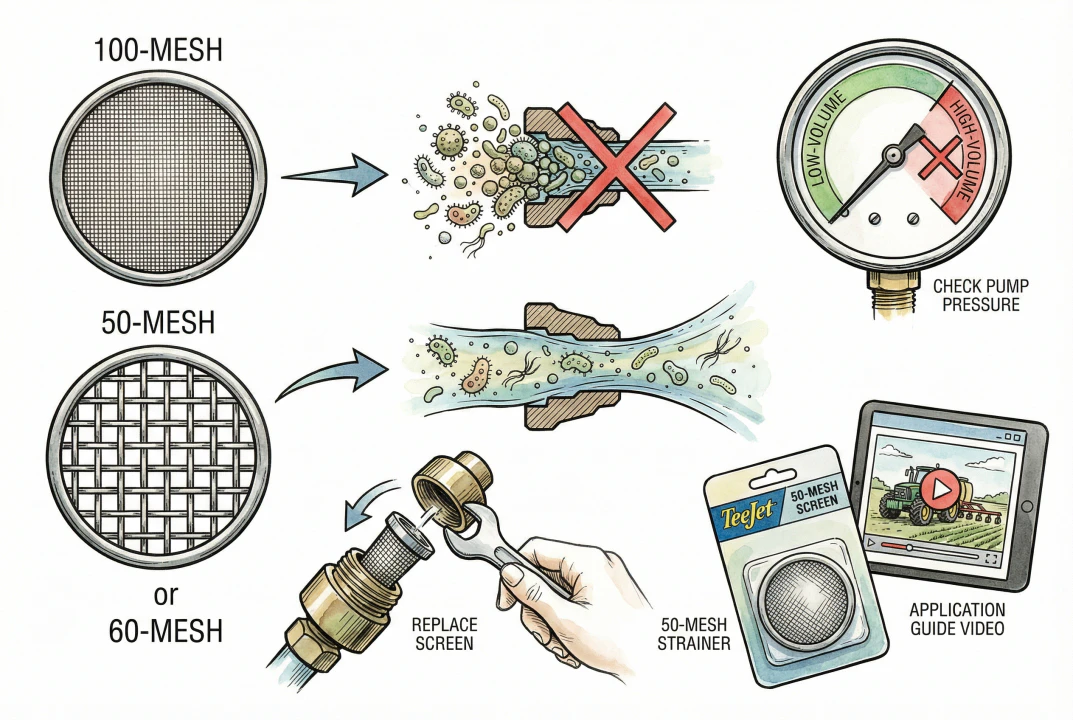
Fine factory screens (often around 100-mesh) can be a problem with biologicals, because the product’s carrier and any biofilm can restrict flow.
Check what screens your specific sprayer or planter in-furrow system uses.
The manufacturer’s guidance is to pre-strain the product through a 60-mesh screen before the tank and to manage biofilm and flow, not that individual bacteria are physically too large to pass.
If flow is restricted, tips can clog and delivery to the field becomes uneven.
- Use the recommended pre-strain screen. Pre-strain through a 60-mesh screen before the tank, and match filter sizes to your equipment maker’s guidance so debris is stopped without restricting product flow.
- Check Pump Pressure. Ensure your pump is calibrated for low-volume addition (if using direct injection). The 30-inch-row rate is small (12.8 fl oz/acre), so precision matters. Also follow your injection equipment manual.
ROI (Does it Pay Off?)
The manufacturer’s primary claim is that PROVEN 40 can offset up to 40 lb of synthetic nitrogen per acre. This is a ceiling, not a typical result, and the company itself notes it is not a one-size-fits-all figure.
Whether it pays off depends on your fields, and independent results are mixed.
The Math
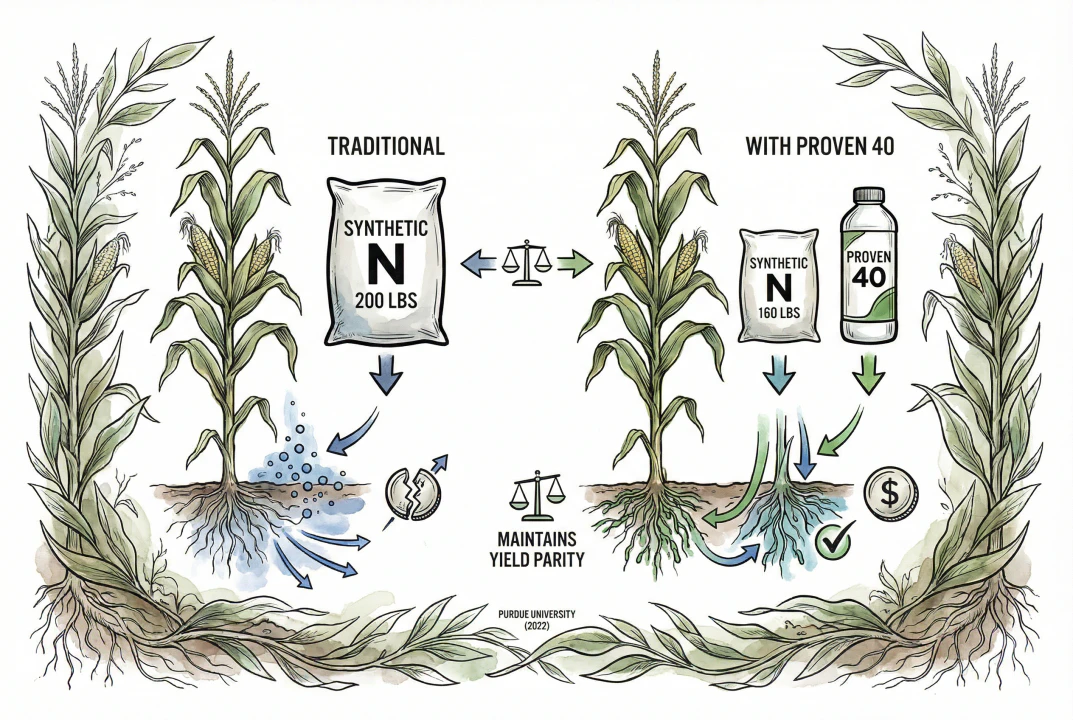
As an illustration, suppose your standard N rate is 200 lb/acre. Your actual rate should come from a soil test, yield goal, previous crop, soil organic matter, and an MRTN or similar rate tool, not a fixed 200 lb assumption.
- Traditional Approach. You buy and apply 200 lb of synthetic N (anhydrous, urea, UAN), managed with appropriate source and split timing.
- With PROVEN 40 (example). You apply 160 lb of synthetic N + 1 unit of PROVEN 40 per acre. Cutting a full 40 lb this way follows the manufacturer’s ceiling, not a farm-verified result, and carries yield risk if the offset does not materialize on your fields.
The independent evidence does not consistently support yield parity at a 40 lb reduction. Several university trials, including University of Wisconsin (2023, five sites), NDSU’s North Central summary, and University of Nebraska (2024), found no significant yield or economic N benefit from the product.
Purdue results varied by year (a larger optimum-N reduction in 2021 than in the drier 2022, with confidence intervals that included zero).
One independent peer-reviewed Illinois study (Agronomy Journal) did find a small but significant average yield gain of about 1%, with a harvest fertilizer-N equivalent near 10 lb/acre (smaller than the 40 lb headline and, at the study’s prices, not enough to justify the product cost on its own).
So treat the offset as uncertain and field-dependent. If you cut synthetic N, do it only on strips you can compare, and keep records.
Nitrogen prices are volatile (roughly $400 to $1,500 per ton in recent years), so build any savings estimate from your actual per-acre product cost, N price, corn price, and application cost, not a single scenario.
There is also a risk-management argument, but it is easy to overstate. A wet spring can cause N loss from soluble synthetic sources, though how much depends on the N form, timing, soil, and drainage. There is no fixed loss rate to assume.
Nitrogen fixed biologically is not immune from loss either. Once released, it enters the same soil N cycle and can be lost under the wrong conditions.
Reduced loss is a possible benefit, not a guarantee, and this is not a validated insurance policy with a defined payout.
To judge the value, run a randomized, replicated comparison of full-N, reduced-N, and reduced-N-plus-product, and include real costs and the statistical uncertainty.
Troubleshooting Common Issues
Even with good planning, issues come up. Before troubleshooting, have your lot number, expiration date, and storage history on hand, and keep the label support contact available.
Here is how to handle common hiccups.
Issue 1. Clogged Filters
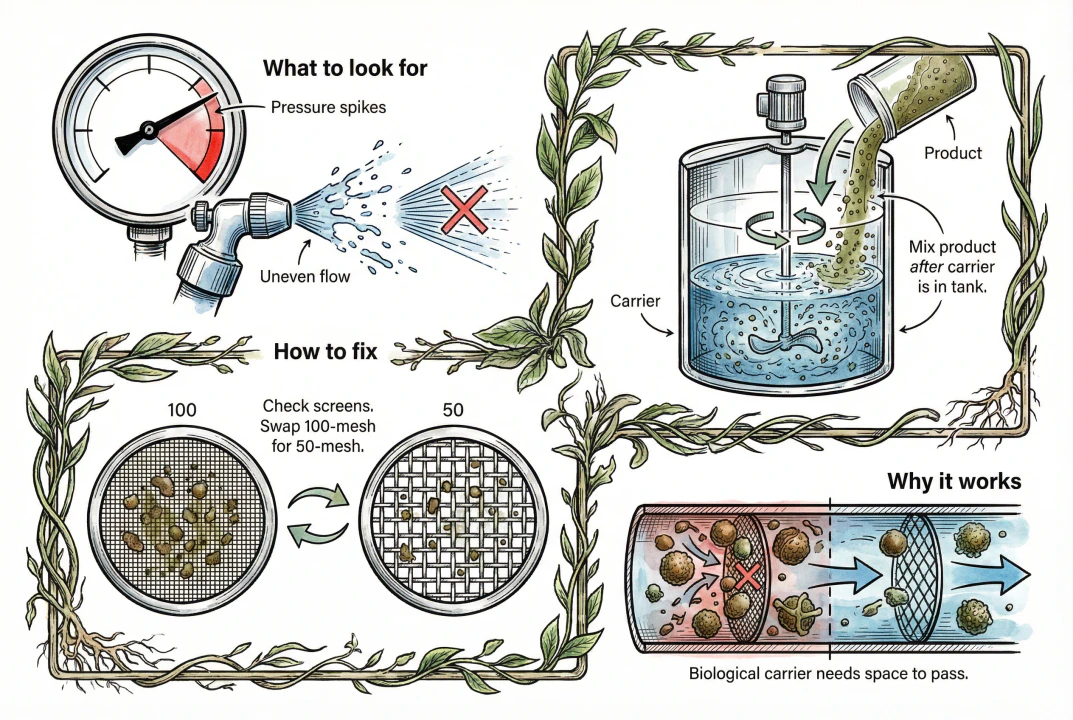
What to look for
Pressure spikes on your monitor or uneven flow from row units can signal a problem. Field striping can appear later if rows were blocked, though striping has other causes too.
How to fix
Stop and check your screens against your equipment maker’s recommended sizes and confirm the product was pre-strained. Verify you added the product after the carrier.
Also check calibration, product compatibility, and biofilm buildup. Screen size is not the only cause.
Why
The product is a suspension with carrier material, not a dissolved salt, so pre-straining and correct filter sizing help it flow.
This is about flow management, not individual bacteria being too large for the mesh.
Issue 2. Frozen Product
What to look for
The LIF liquid is solid, has ice chunks, or looks slushy when you open the box. (This does not apply to the OS dry pouch, which is stored frozen on purpose.)
How to fix
Do not use it. Freeze-thaw can reduce viability, so treat frozen liquid product as compromised.
Contact your dealer or Pivot Bio support with the lot number, expiration date, and storage history, and ask about a replacement.
Why
If the microbes did not survive, the product will not fix nitrogen, so applying it wastes the input.
Odor and appearance are rough screens, though, and cannot confirm on their own that every cell is dead.