
Plant Grow Lights: What a 2024 Meta-Analysis Says About Green Light
Green light is not wasted: a 2024 meta-analysis found it about as effective as red/blue for biomass under equal PPFD, and it can raise intrinsic water-use efficiency (a case for broad-spectrum white over blurple panels, with the caveats the study actually reports).
Priya Patel · Published 2025-12-23 · 28 min read
Key Takeaways
- Green light is not wasted because a 2024 meta-analysis found that replacing some red or blue with green at equal total intensity kept biomass roughly equal, not superior.
- The clearest pooled effects were a small fresh-weight gain and about 15% higher intrinsic water-use efficiency driven by lower stomatal conductance, while dry weight did not change.
- Results are species-specific and modest, so lettuce, basil and tomato outcomes should not be generalized into a magic spectrum rule.
- For an indoor display, broad-spectrum white is often more useful than red or blue alone because it improves inspection, but judge the fixture by measured PPFD, target DLI, photon efficacy and coverage.
- Silicon and mycorrhizal inoculants can help under some conditions but are not universal fixes, and ordinary houseplants do not meaningfully purify indoor air.
Rethinking Blurple
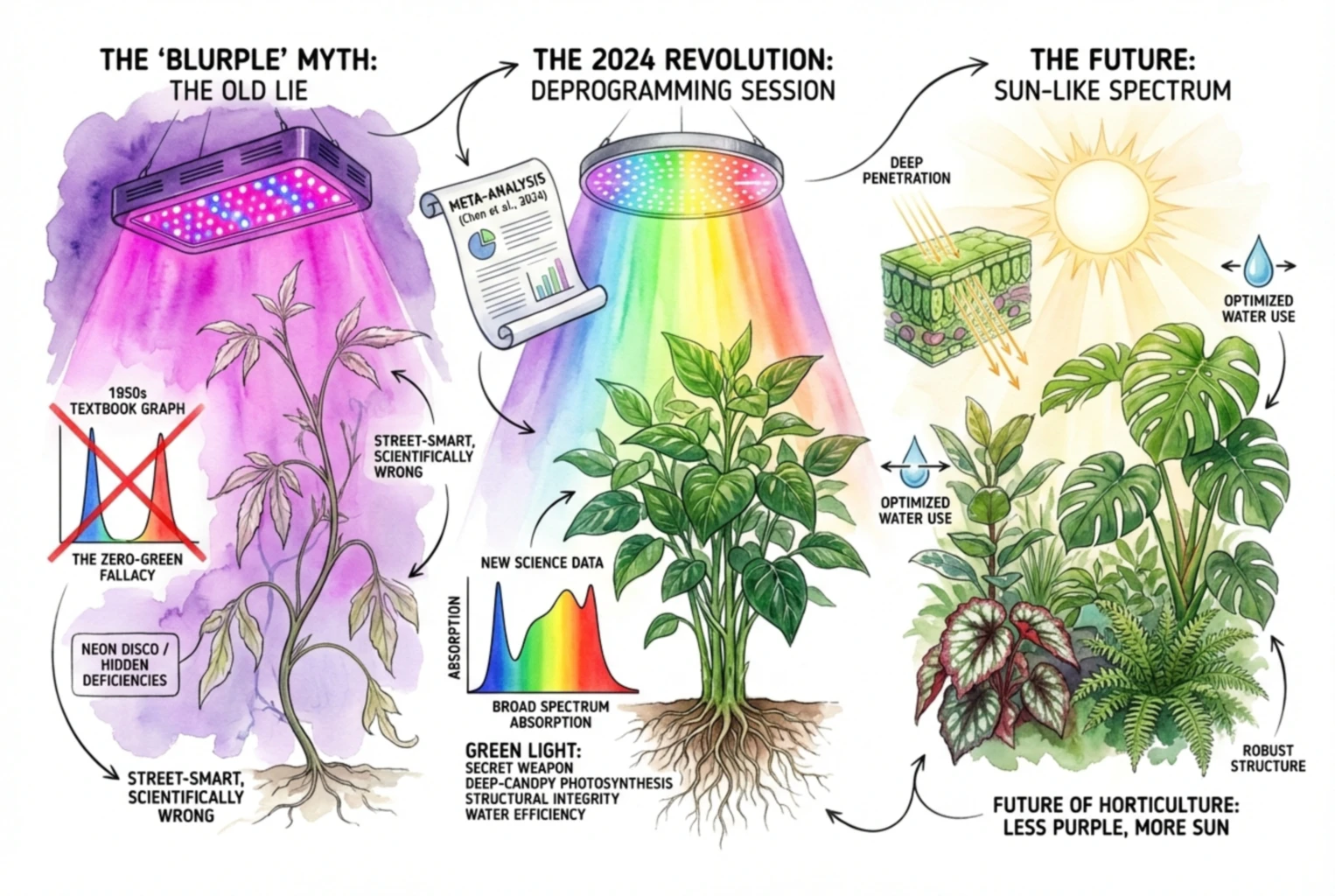
For years, red and blue blurple panels dominated indoor growing, partly on the reasoning that plants reflect green light and therefore make little use of it.
Narrow red/blue emitters were chosen for real reasons. Red diodes are electrically efficient and, early on, cheaper, and the fixtures were easy to market.
But the underlying claim that green is essentially useless turns out to be an oversimplification.
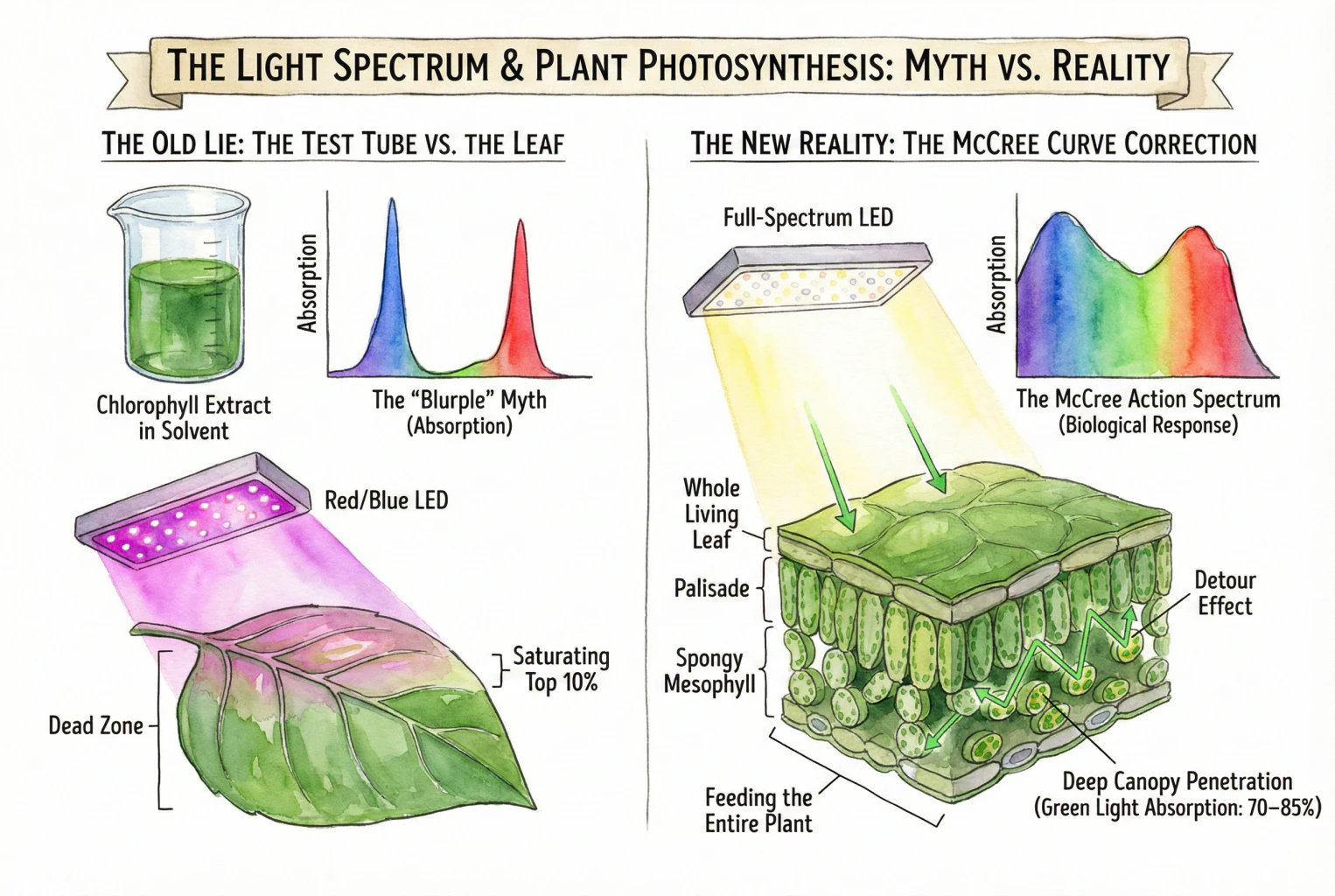
Chlorophyll extracted into solvent does absorb little green light. A whole living leaf is a different optical system, and green photons can contribute meaningfully to photosynthesis deeper in the leaf.
Separate Measured Effects From Claims
A 2024 meta-analysis by Chen et al. is a useful anchor for what the evidence does and does not show. It did not test tissue strength and left several questions unresolved. Measured effects and claims that go beyond the data need to be kept separate.
2. Where the Green-Is-Useless Idea Comes From
The idea starts from a real observation but stretches it too far.
2.1 Extracted pigment vs. A whole leaf
Open a general biology textbook and you will see the absorption spectrum of chlorophyll a and b, with strong peaks in the blue and red.
Exact peak positions depend on the solvent and pigment, but the pattern is a dip in the green (roughly 500–600 nm) (a region of lower, not zero, absorption).
Do Not Treat a Solvent Curve as a Leaf
Reading that curve as proof that plants ignore green is where the reasoning goes wrong. It describes pigment in solution, not a leaf. Red and blue fixtures were built partly on this reading, alongside the electrical-efficiency and cost advantages of those diodes.
The key point is that A leaf is not a test tube.
When that curve is measured, chlorophyll is extracted from the cells and dissolved in a solvent such as acetone.
In solution, stripped of its cellular context, chlorophyll absorbs green weakly.
In a leaf, chlorophyll sits inside chloroplasts, packed inside cells, stacked in layers (palisade and spongy mesophyll) and covered by a cuticle.
Those structures scatter light and change how far it travels before it is absorbed.
2.2 Absorption, action spectrum, and where light goes
Separate Absorption and Action Spectrum
Three different things get conflated in these debates, and it helps to keep them separate.
| Measurement | Chlorophyll in solvent | Whole leaf |
|---|---|---|
| What it shows | Absorption of extracted pigment. | Absorptance of intact tissue, plus the action spectrum for photosynthesis. |
| Green absorption | Low. | Higher. Whole leaves typically absorb on the order of 80% of green light. |
| Takeaway | Green looks negligible. | Green is absorbed and used, though its quantum yield per absorbed photon is not identical to red. |
This is not a new correction. In the 1970s, K.J. McCree measured the photosynthetic response of whole leaves under relatively low light and produced what is now called the McCree action spectrum.
Compare What Each Curve Measures
A leaf’s absorptance, which describes how much light it absorbs, is not the same curve as its action spectrum, which describes how much photosynthesis results per photon. Neither is the solvent-extract absorption curve.
The rough figure worth remembering is that whole leaves absorb most incident green light, not near-zero.
The reason is optical. Green is absorbed less strongly per pass than red or blue, so it tends to scatter within the tissue and travel a longer effective path before it is absorbed (the detour effect).
This lengthened path gives green more chances to reach a chloroplast deeper in the leaf. The exact path-length ratio varies by leaf and is not a fixed number.
Because red and blue are absorbed strongly near the surface, the upper cell layers can approach light saturation while deeper layers receive less. How pronounced this is depends on intensity, leaf anatomy and canopy geometry. It is a tendency rather than a fixed split between the top 10% and bottom 90%.
3. What the 2024 Meta-Analysis Actually Measured
The paper was published online in the Journal of Experimental Botany in 2024, with issue publication in September 2024. It is a useful reference point for anyone weighing spectrum choices.
The Chen et al. meta-analysis aggregated 136 datasets from 48 publications across 17 crop species. Most comparisons used red, green and blue versus red and blue at equal PPFD, with a mean green fraction near 20%, ranging roughly from 3% to 45%. Monochromatic green was excluded, and broad-white comparisons were a small share of the data, so the findings apply most directly to crop species under partial green substitution rather than every houseplant or vivarium.
The Question the Meta-Analysis Tested
If you take a red/blue spectrum and swap some of that energy for green while holding total intensity constant, what changes?
Several pooled effects were statistically significant. Others (dry weight, net photosynthesis, height, chlorophyll) were not.
The results are best read outcome by outcome, not as a blanket verdict.
Green light is similarly effective in promoting plant biomass as red/blue light. A meta-analysis
3.1 Green did not reduce growth
Read Fresh Weight Separately
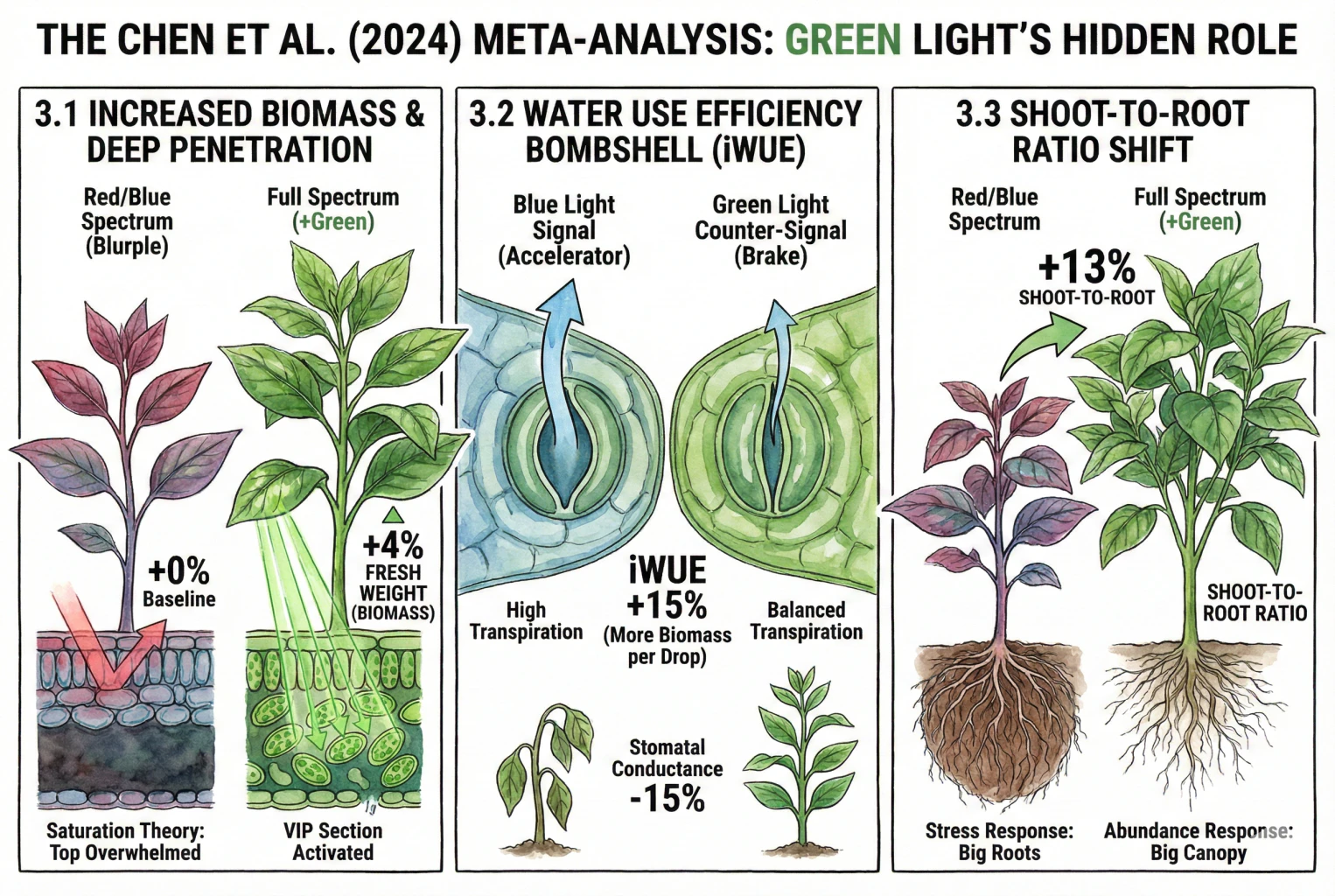
Adding green to the spectrum produced a 4% increase in fresh weight, with P = 0.02. Fresh weight includes water. Dry weight did not change, and dry-matter content fell about 2%, so the gain is a small increase in water-rich mass rather than clearly more built tissue.
Four percent is small, but the more informative point is the direction. If green were pure waste, replacing red with green at equal intensity should have lowered growth, but it did not.
The authors keep the claim modest. Green was roughly equal to red and blue for biomass, not superior, and the effect was species-specific. Green is not a magic bullet. It is simply not the wasted spectrum that the blurple framing assumed.
There is a plausible mechanism for deeper layers. When upper chloroplasts approach light saturation, additional strongly absorbed red or blue near the surface contributes less and some energy is dissipated through non-photochemical quenching. Green, absorbed less strongly per pass, can reach less-saturated chloroplasts deeper in the leaf. Work such as Terashima et al. (2009) supports this under strong white light, but the Chen meta-analysis did not test a general saturation theory, and its relevance depends on species, intensity and canopy. A vivarium is not automatically a high-light case.
3.2 Water-use efficiency
Interpret iWUE Correctly
The most-cited pooled result concerns water. Adding green raised intrinsic water-use efficiency, or iWUE, by about 15%.
What iWUE means matters here. It is the ratio of net photosynthesis to stomatal conductance (roughly, carbon fixed per unit of stomatal opening).
It is not a direct measurement of whole-plant water consumption or drought survival. A higher iWUE means better gas-exchange economy per stomatal opening, not necessarily that a plant will tolerate a missed watering.
Why Stomatal Conductance Changed
The proposed mechanism is a shift in stomatal behavior.
Blue Light Signal
Blue light contributes to a signal that opens stomata, the pores that admit CO₂ and release water vapor.
Open Stomata
Open stomata allow both CO₂ uptake and transpiration, a normal and regulated exchange.
Green Light Response
Green light, in some species, appears to partly reverse the blue-light opening response, which is consistent with the lower pooled stomatal conductance. The authors describe this as a putative, species-dependent mechanism rather than a settled universal counter-signal.
Do Not Overread iWUE
In the pooled data, stomatal conductance fell about 15% while net photosynthesis showed no significant change, which is what raises iWUE. Whether that improves real-world resilience was not tested.
The study measured neither whole-plant water use over time, nor terrarium condensation, nor HVAC drying, and it did not compare identical setups where red/blue controls were shown to be water-stressed.
Green light is not a substitute for a proper watering schedule.
3.3 Shoot-to-root ratio
Treat Shoot-to-Root as a Ratio
The pooled data also showed the shoot-to-root ratio rose about 13%, with P = 0.008, measured on a dry-weight basis.
Read plainly, that means relatively more biomass in shoots than roots when green was added. It does not tell you which side changed because a higher ratio can come from more shoot mass, less root mass or both, and this varied across datasets. It is a ratio rather than a measurement of where the plant put its energy, and it does not establish reduced root mass in absolute terms.
For a vivarium, this is easy to over-read. The meta-analysis did not measure root-ball volume, drainage behavior, or long-lived tropical display plants, so it is not evidence that green light prevents root problems in an enclosure.
If you want to manage root volume, pot size, substrate, and pruning are more direct levers than spectrum.
4. The Physics of Leaf Penetration
Green tends to reach deeper into a leaf than red or blue because it is absorbed less strongly per pass and scatters through the tissue. Root-zone additions have different evidence and should be evaluated separately from leaf optics.
4.1 The sieve effect (a conceptual analogy)
Use the Sieve Effect as an Analogy
Picture a colander. Pour water over it and some hits the metal and stops while some passes through the holes. Treat this as an intuition pump rather than a literal model because real leaves involve absorption, scattering and cell geometry that the analogy simplifies.
In a leaf, chloroplasts do not form a solid wall. They are distributed within mesophyll cells.
Blue and Red Light
Absorbed strongly, so most is taken up near the surface. Some transmittance still occurs and varies by leaf.
Green Light
Absorbed more weakly, so a green photon is more likely to scatter past a chloroplast or through gaps and travel deeper. This weak-absorption-plus-scattering behavior is the sieve effect.
As a result, green tends to reach the abaxial, or lower, tissue and lower leaves more than red or blue. In a dense Monstera or thick clump of Anubias, lower leaves sit in shade. How much extra green reaches them has not been measured for these specific plants, and reflected light plus some red and blue penetration also reach lower leaves, so they are not automatically dead weight. Submerged Anubias adds water attenuation, a separate factor covered below.
4.2 The adaxial vs. Abaxial divide
Terashima et al. (2009) showed, in sunflower leaves under a strong white background, that adding monochromatic green drove photosynthesis in deeper mesophyll more effectively than adding red.
Their setup was specific, one species, strong white base light, supplemental monochromatic light, so treat the direction as well supported and the exact numbers as condition-dependent rather than universal.
Blue Light
Tends to be absorbed strongly in the upper layers of the leaf.
Green Light
Penetrates further, so its absorption is spread more through the leaf's depth as a gradient rather than perfectly evenly.
This connects to photoinhibition. When the surface layer is driven hard by strongly absorbed light, upper chloroplasts can be over-excited while deeper ones are underused. The adaxial surface is normally specialized for high light and acclimates to it, so concentrating absorption there is not inherently dangerous. Heat, UV and desiccation are outdoor stresses that depend on the fixture, not spectrum alone.
Think in Terms of Load-Sharing
Spreading absorption through the leaf depth can make use of more of the tissue than piling it into the top layer.
This is a qualitative point about distribution, not a measured efficiency ratio.
5. Morphology and the Shade-Avoidance Question
One reason growers were wary of green is a concern about stem elongation, or stretch.
5.1 Green as a shade signal (conditional)
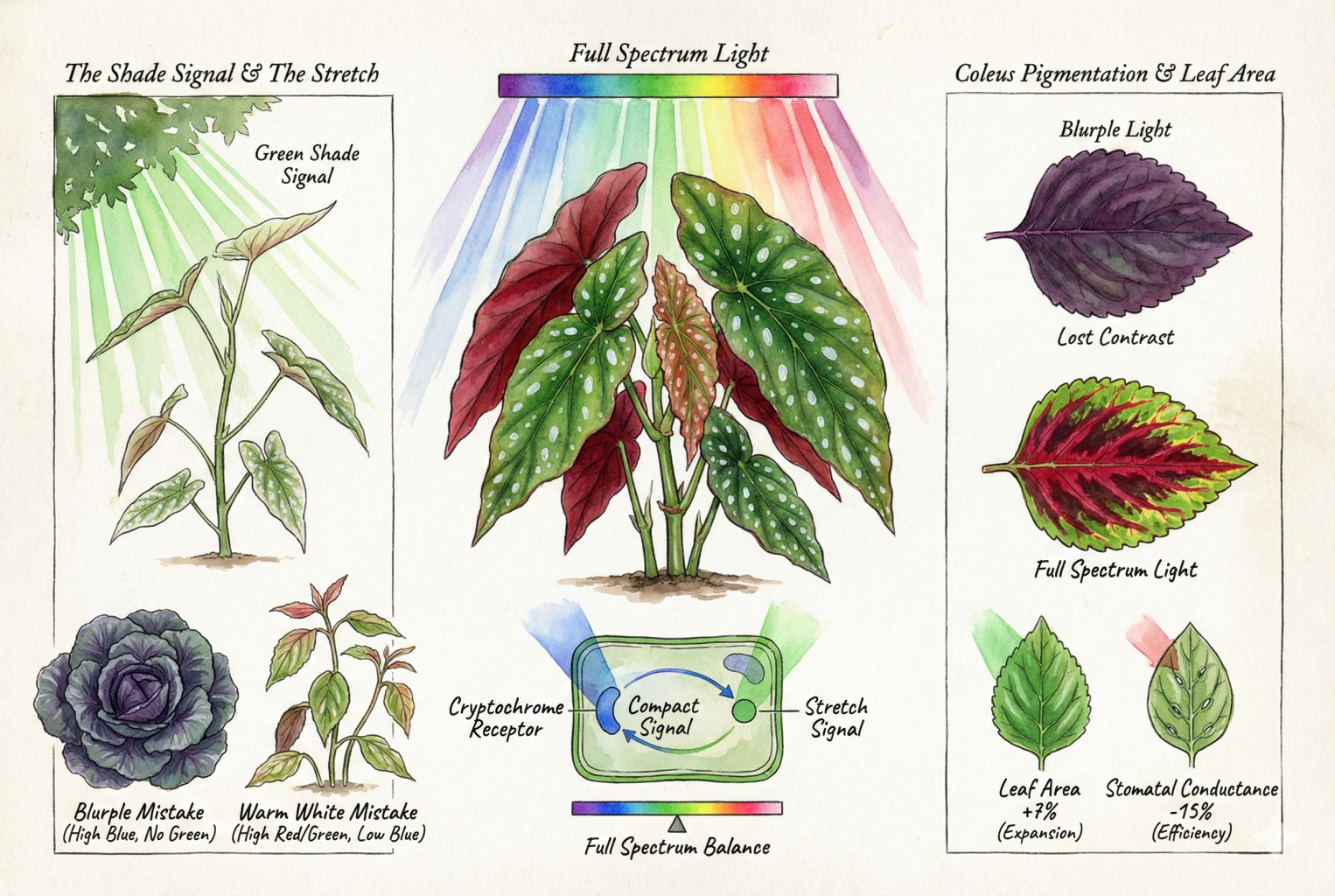
Under a canopy, more blue is absorbed by upper leaves while relatively more green passes through, so a high green-to-blue ratio can act as one shade cue.
Plants can respond with shade-avoidance behavior, stem elongation, petiole extension, upward leaf angling, but this depends on the full context, including red-to-far-red ratio, intensity, and species. Green is one input, not the whole signal.
Some studies report that adding green to a red and blue background can promote elongation in certain conditions. The Chen meta-analysis found no significant overall effect on stem height and flagged possible confounding from red and far-red differences. Green making plants stretch is conditional rather than a general result.
5.2 The cryptochrome interaction
Blue light activates cryptochrome photoreceptors, which are associated with more compact growth (shorter internodes).
In some species and conditions, green light can partly reverse blue-mediated responses, which is one proposed route to elongation (the effect depends on species, wavelength, and dose).
Avoid a Fixed Spectrum Recipe
Because monochromatic green was excluded from the meta-analysis, it says nothing about pure-green setups, and it found no overall height effect for partial green substitution. There is no single published optimum ratio here. Keep a meaningful blue fraction and evaluate the fixture on the actual plants rather than assuming a fixed recipe. Claims that high blue always yields cabbage-like plants or warm white always yields weak seedlings ignore intensity, DLI and the actual spectral power distribution.
Read Leaf Area With Leaf Thickness
The pooled data showed leaf area increased about 7% (P = 0.005) with green. Larger leaf area can improve light interception, but it is not automatically desirable. Specific leaf area also rose about 4%, meaning leaves were somewhat thinner, and the study did not establish that this was beneficial or a sign of tougher tissue.
5.3 A note on color plants
Separate Pigment From Color Rendering
For plants grown for color, terrarium begonias, Coleus, and bromeliads, spectrum interacts with pigmentation. One question is how much pigment a plant produces. Another is how its color is rendered to your eye by a given light.
On the physiology side, blue light is generally associated with anthocyanin (red/purple) accumulation, which can act as a sunscreen.
Claims about a specific effect of green on Coleus variegation are harder to pin down. The often-mentioned 2024 Coleus study is not identified here with authors, cultivars, spectrum, or effect sizes, so it should not be treated as evidence.
The more reliable point is rendering. A narrow red/blue spectrum makes it hard to judge true leaf color, while a broad-spectrum white light with high CRI makes reds, greens, and variegation easier to see.
That is a good reason to view a prized plant under white light (a viewing benefit for you, not a claim that white light changes the plant's pigment output).
6. Side Note (The Air-Purifier Claim)
A common marketing claim is that houseplants clean indoor air of VOCs such as formaldehyde and benzene, often traced to a 1989 NASA study.
A 2020 review and analysis by Cummings & Waring examined this directly. Rather than re-analyzing a single study, they converted reported VOC-removal results from 12 studies (196 experimental results) into a clean air delivery rate (CADR).
What the Air-Quality Review Found
The median single-plant CADR was about 0.023 m³/h, far too small to matter against the normal air exchange of a real building.
The gap comes from setting. The original chamber experiments sealed plants with gas in small enclosures. Ordinary rooms have far higher air exchange through ventilation and infiltration, which dwarfs what a few plants remove.
Estimated Scale
To match typical building air exchange, the authors calculate you would need roughly 10 to 1,000 plants per square meter of floor space.
The practical conclusion is simply that a normal number of houseplants does not meaningfully reduce indoor VOCs.
If air quality is the goal, source control, filtration, and adequate (safe) ventilation do the work.
This connects to lighting only loosely. Plants placed in a dark corner for supposed health benefits grow poorly regardless.
Light requirements are species-specific, so match the plant to the location.
Grow plants because you enjoy them and they look good. Just do not expect a single peace lily to scrub the VOCs from new carpet, for that, ventilate and address the source.
Potted plants do not improve indoor air quality. A review and analysis of reported VOC removal efficiencies
7. Root-Zone Additions (Silicon and Mycorrhizae)
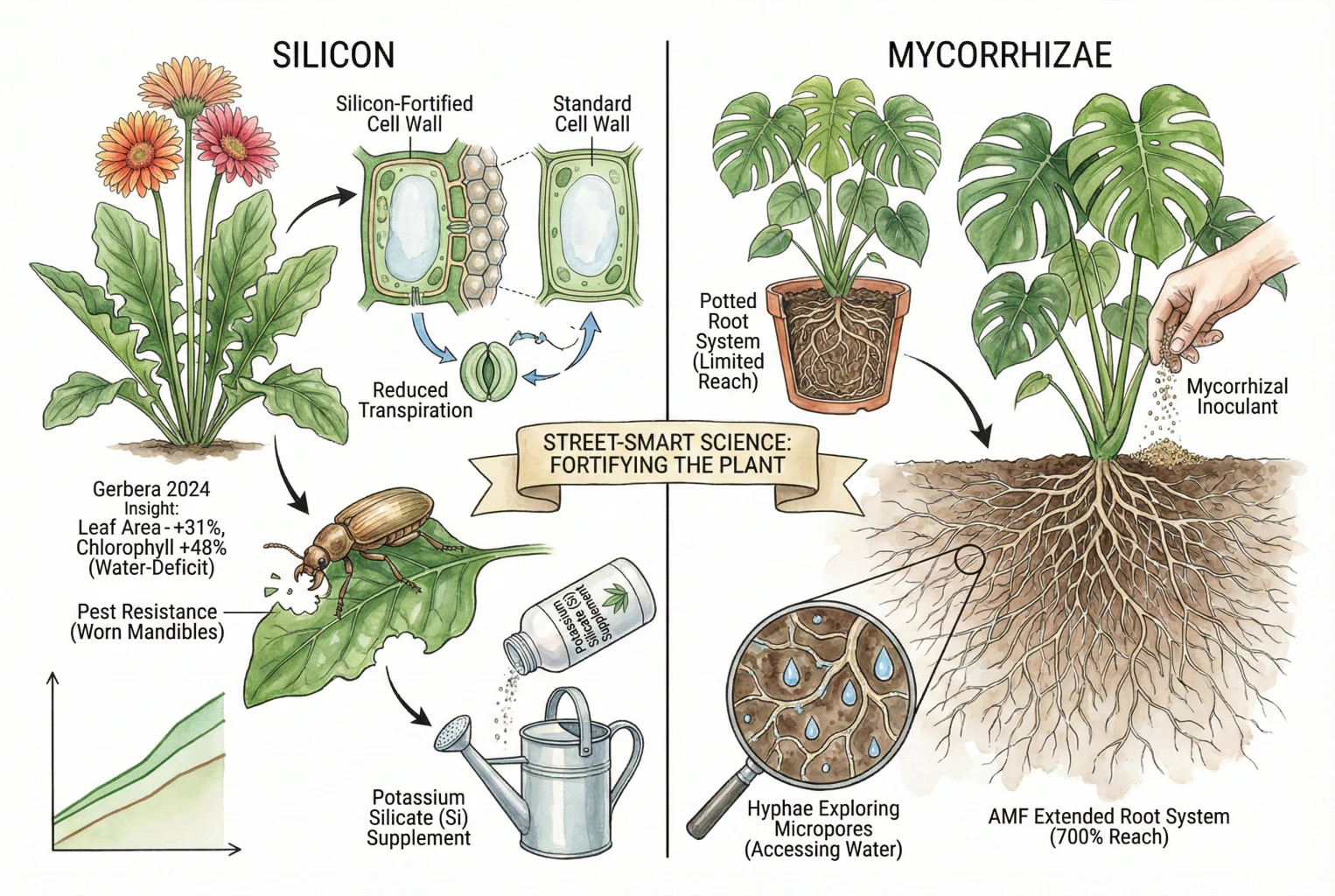
Evaluate Root-Zone Inputs Separately
Beyond light, two root-zone inputs come up often, silicon and mycorrhizal fungi. Both can help in some conditions, but their benefit is conditional, not guaranteed.
7.1 Silicon
Silicon (Si) is not a classically essential element, and many standard NPK fertilizers do not include it.
Whether that matters depends on the plant. Some species accumulate silicon and respond to it, others do not, so it is not a universal deficiency to correct.
There is a real literature suggesting silicon can help with several stresses, but it is best described as conditionally useful rather than a universal stress reliever. The effect depends on species, the form of silicon, dose, and the specific stress.
Drought
Silicon deposited in tissues is associated with better water relations in some species and conditions. The mechanism is debated. Reviews note effects on water uptake and root hydraulics may matter as much as any simple reduction in transpiration, and results are not consistent across studies.
Structure and Pests
Silicon can stiffen tissue and contribute to mechanical and biochemical resistance to some insects. This is species- and pest-dependent. It does not guarantee non-drooping leaves, and different mechanisms apply to chewing versus sucking pests.
What One Study Found
A 2023 study on Gerbera under water-deficit conditions (foliar potassium silicate, 40 mg/L weekly) reported roughly +31% leaf area and +48% chlorophyll. In that same study transpiration rose about 12% and stomatal conductance about 55%, so gas exchange went up, not down. This result does not support the idea that silicon automatically reduces water loss, and it used foliar application rather than a monthly soil drench.
If you want to try silicon, a bottled potassium-silicate product is a soluble source, but dose, label directions, pH, and compatibility all matter, and many plants do fine without it.
Growth Technology GT Silica
This potassium-silicate liquid is an optional source for a silicon-responsive plant, not a requirement for most houseplants. Add it to water first and follow the current label because silicate can raise pH and mix poorly with some feeds. Do not infer its effect from unrelated silicon studies.
Silicon application improves tomato yield and nutritional quality
7.2 Mycorrhizal fungi
Potting mix is not necessarily sterile, and commercial substrate may be intentionally pasteurized or controlled. Either way, whether it is sterile does not by itself determine whether an inoculant helps.
Arbuscular mycorrhizal fungi (AMF) can help many plants acquire water and nutrients, but treating them as critical for container survival overstates the evidence. Countless potted plants grow normally without added inoculant, and the benefit is context-dependent.
The Idea
In a pot, roots reach the wall and stop exploring. AMF hyphae can extend into pores that roots do not enter, potentially improving water and nutrient uptake.
Where It Helps
Mainly with a compatible host, in lower-phosphorus conditions, when live, viable propagules make direct root contact. Not all plants form these associations.
Product Reality
A meta-analysis of commercial AM inoculants (Koziol et al., 2025) found that only about 12% delivered both sufficient colonization and a growth benefit, so product quality and viability vary widely, and no specific batch is guaranteed to work.
How to Use It
If you try it, apply granular inoculant in direct contact with roots at repotting. It will not rescue an already-rotted root system.
On a compatible, healthy host, successful colonization can widen the root system's effective reach, but treat it as a low-cost experiment, not a guaranteed result.
Xtreme Gardening Mykos
This granular inoculant uses one mycorrhizal species and must contact healthy roots at repotting. It can suit a compatible plant in lower-phosphorus media, but it will not rescue root rot or guarantee growth. Storage, viability, host compatibility, and technique all matter.
8. Efficiency Is Not the Same as Efficacy
Separate Fixture Efficiency From Plant Response
Red/blue panels remain common because fixture efficiency and biological usefulness are measured differently. Track wall-plug power, photon output and efficacy, PPFD and DLI distribution, and crop response as separate measurements.
8.1 The efficiency framing
Separate Photon Efficacy From Plant Response
Red LEDs around 660 nm can achieve high photon efficacy for electrical-optical reasons, and blue is often close behind. The exact ranking shifts with device generation, drive current, and temperature.
Direct green-emitting LEDs suffer from the green gap, but most white grow LEDs generate green by blue-pump phosphor conversion, so direct-green inefficiency does not apply to white fixtures.
Manufacturers advertise photon efficacy (PPE, in µmol/J).
What PPE Measures
PAR photons emitted per joule of electricity. It is a legitimate and important fixture metric.
What PPE Does Not Measure
A direct measure of biomass produced per joule. A red-heavy fixture can post a high PPE, but PPE alone does not tell you how the plant responds.
Modern white LEDs are close, too. In Samsung's own figures, an LM301H white can run near 3.10 µmol/J and a deep-red near 3.16 µmol/J, so the idea that red always wins on efficacy overstates a small, shifting gap.
A pure-red fixture at about 3.0 µmol/J is efficient and its photons are photosynthetically effective, but pure red makes color inspection and morphology assessment hard.
PPE is useful, but you also need spectrum, a PPFD map at distance, DLI, and coverage to judge a fixture.
8.2 The value of seeing your plants
A PAR meter and your eyes measure different things, and you want both. A PAR meter quantifies PPFD. Your eyes cannot (spectral sensitivity and adaptation make eyeballing intensity unreliable), so do not skip measurement.
But white light does make visual inspection far easier.
Pests
Spider mites are pale, thrips yellow or brown, and mealybugs white. Under a purple light these are hard to distinguish. Exact appearance also depends on life stage and magnification, but color rendering clearly helps.
Deficiencies
Nitrogen deficiency commonly yellows older leaves, while iron deficiency affects newer ones. Those patterns are much harder to read under narrow purple light. Diagnosis still needs other checks such as pH, roots, and disease, not color alone.
Viewing
A high-CRI white light (CRI > 90) renders leaf color more faithfully, which helps you see a Neoregelia's reds or a Selaginella's iridescence. For critical color work, R9 and TM-30 metrics say more than CRI alone.
9. Practical Application (Choosing a Fixture)
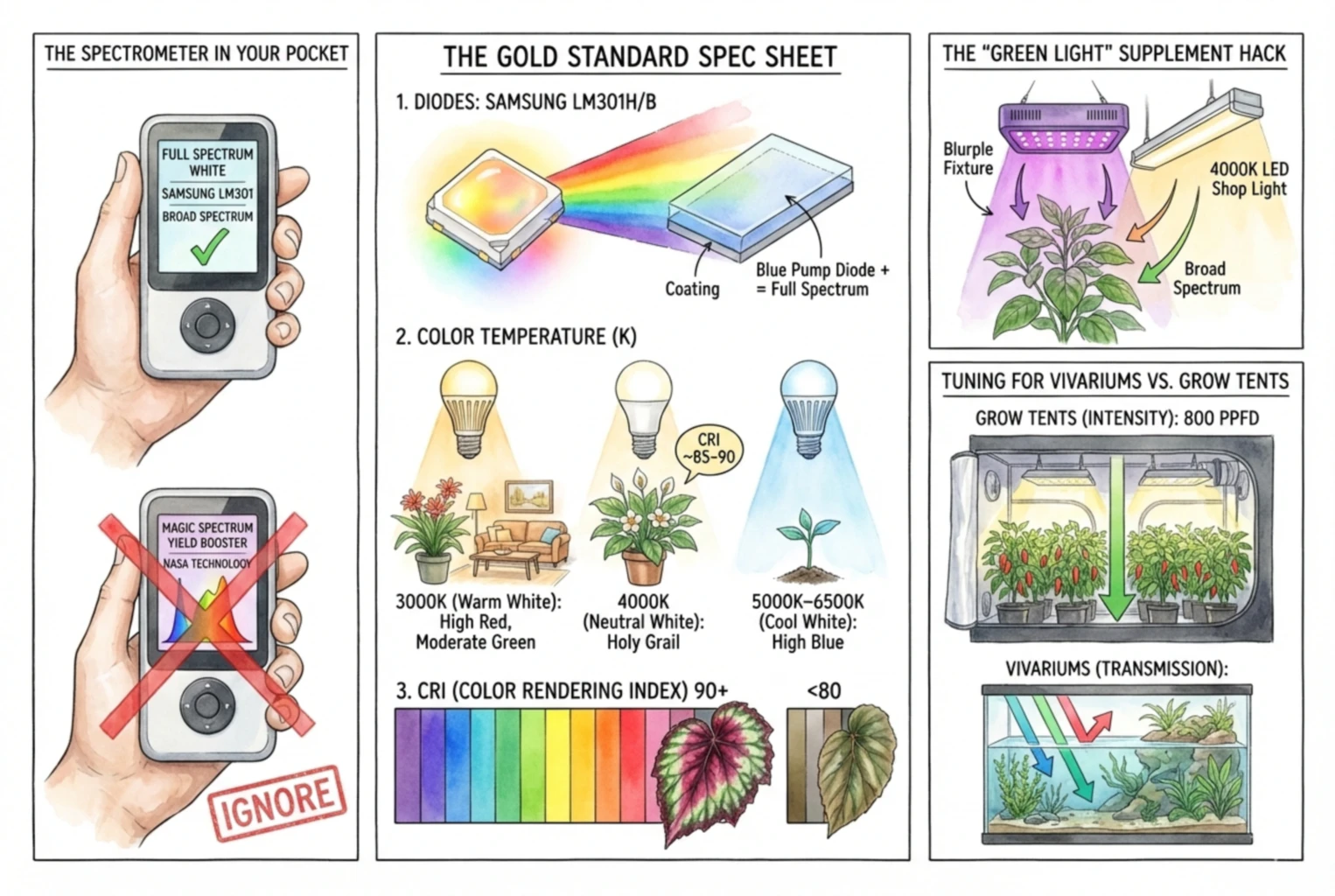
Use the specification sheet to create a shortlist, but treat box wording as a starting point because it cannot verify spectrum, PPFD, or efficacy. Independent or certified data is needed for those measurements.
9.1 Reading the box
You don't need a lab to start, but read claims critically.
Claims That Need Evidence
Vague terms such as Magic Spectrum, Yield Booster, or NASA Technology need substantiation. Do not dismiss or trust the wording alone.
Reasonable Starting Points
Broad-spectrum white and reputable diodes are candidates. Labels such as Full Spectrum or Sunlike, and a diode model such as Samsung LM301, do not by themselves confirm the fixture's spectrum, cooling, drive current, authenticity, or safety.
9.2 What to look for on the spec sheet
The meta-analysis did not compare specific color temperatures or CRI values, so treat the following as a reasonable display-oriented preference, not something the study endorses.
1. Diodes
Samsung LM301H or LM301B are widely used high-efficacy white packages (a blue pump diode plus phosphor giving a broad spectrum). The exact spectrum still depends on the specific CCT/CRI bin, drive current, and board thermal design, and the diode name alone does not guarantee a good fixture or genuine sourcing.
2. Color Temperature (CCT)
A human-vision descriptor, not a plant-growth setting. CCT alone does not fix the blue or green photon fractions.
3000K Warm White
Warmer appearance with relatively more red. Flowering suitability actually depends on species, photoperiod, far-red, and DLI, not on CCT.
4000K Neutral White
A common, balanced display choice. It is not a universal optimum, and 4000K does not automatically imply any particular CRI.
5000 to 6500K Cool White
Cooler, bluer appearance. Seedling suitability depends on actual spectrum, PPFD, and DLI.
3. CRI and Color Fidelity
Useful for inspection and viewing, with 90+ as a practical target. CRI measures color fidelity relative to a same-CCT reference. It is not a plant-need metric or a proxy for how much green or yellow the light emits, and very high CRI can involve an efficacy tradeoff.
For a home display, a broad-spectrum white bar around 4000K is a sensible default for viewing.
But that choice does not tell you the delivered PPFD, DLI, coverage, mounting distance, or safety. Measure or check those before relying on any single fixture.
Barrina T5 Grow Lights
This is an inexpensive full-spectrum bar set (the indexed listing is a 2 ft, eight-bar, 8×10 W = 80 W yellow full-spectrum T5 kit, 120 VAC). Be aware it does not obviously meet the 4000K, CRI 90+, or Samsung LM301 criteria described just above. The listing does not publish exact CCT, CRI, diode type, PPE, or a PPFD map, so verify those specs against your needs before assuming it matches. Near a vivarium, also check splash and condensation exposure, use a drip loop and GFCI, and mount the driver in a dry location.
9.3 Supplementing an existing panel
If you already own red/blue panels, you don't have to replace them outright.
The Approach
Add a broad-spectrum white LED shop light or strip alongside the existing fixture to broaden the spectrum and make inspection possible.
Measure the Combined Setup
A 4000K label alone does not tell you the useful PPFD, mounting distance, added heat, or electrical load. Combining fixtures also risks uneven PPFD/DLI across the canopy. Check the combined PPFD, coverage, and heat, and adjust to a target range rather than assuming more light is automatically better.
9.4 Grow tents vs. Vivariums
Grow Tents
Intensity measured as PPFD and DLI matter most. The Chen meta-analysis did not show green helping most at high intensity. It found no PPFD correlation for the green effect in lettuce, and basil and tomato had too little data to say. A high-PPFD green requirement is not supported by that study.
Vivariums and Paludariums
For a submerged section, water attenuates longer wavelengths more, but the effect over aquarium depths is smaller than often stated. In pure water, roughly 88% of 660 nm red still transmits through about 12 inches according to Pope and Fry data. Real tanks add glass, surface losses, turbidity, dissolved organics, and algae, so measure attenuation in your actual setup rather than assuming a color is blocked.
A Case for Broad Spectrum
Red/blue panels were a reasonable early step, favoring electrical efficiency, and they still have valid uses.
But the evidence that green light contributes to photosynthesis and can shift plant responses is solid enough to reconsider treating it as waste.
Work by Chen, Terashima, Smith, and others supports a role for green photons deeper in the leaf while leaving open questions and reporting species-specific and null results that a simple green-wins narrative would gloss over.
The measured effects are worth stating plainly and separately. Adding green was associated with lower stomatal conductance and higher intrinsic water-use efficiency, small morphological shifts, and no change in dry weight. Separately, white light renders color better for your own inspection.
No single cited experiment demonstrated better hydration, stronger tissue, and improved appearance together.
Lighting, substrate, and root symbionts are best considered as a system, but none of them is a guaranteed fix, and the affiliate products here are options to evaluate, not proven upgrades.
Make the Practical Choice From Measured Light
If you are choosing between a red/blue panel and a broad-spectrum white one for an indoor display, white is often the better pick, mainly for visibility, but decide based on measured PPFD, coverage, DLI, and safety, not on the color of the light.
And a normal number of houseplants will not clean your air. For that, ventilate and control the source.
With the fixture on, I photograph the canopy from above, then measure PPFD at the bright leaves, the deepest visible shadow, and the outer edge at their actual heights. A fixture can have an excellent center specification while hard leaves and supports block much of its useful light.
One plant is moved or tilted before I raise power and repeat the shadow point. If redistribution fixes the dark zone, I avoid increasing heat and light for every other leaf just to correct a placement problem.
Table A (Spectrum Bands at a Glance)
Approximate roles by waveband. These are tendencies. Actual effects depend on intensity, ratio, species, and canopy.
| Band | Wavelength | Where it is mostly absorbed | Associated effects |
|---|---|---|---|
| Blue | 400–500 nm | Upper leaf layers | Contributes to stomatal opening. Via cryptochromes associated with more compact growth. |
| Green | 500–600 nm | Penetrates deeper (detour effect) | Absorbed and used. Reaches deeper tissue. In the pooled data lowered stomatal conductance and raised iWUE. It is not essential on its own. |
| Red | 600–700 nm | Upper leaf layers | Strongly absorbed and photosynthetically effective. Upper layers can saturate at high intensity. Useful in its own right, not useless without green. |
| Far-Red | 700–750 nm | Penetrates. Low direct photosynthesis | Involved in photomorphogenesis and shade/flowering signaling. Can interact with red (Emerson enhancement) and, in excess, promote elongation. Context-dependent. |
Table B. Chen et al. (2024) Pooled Effects
Effect of substituting some green for red/blue at equal PPFD, pooled across 136 datasets / 17 crop species.
Read effects individually. Non-significant results are not evidence of change.
| Outcome | Pooled effect | Significance | Note |
|---|---|---|---|
| Fresh weight | +4% | P = 0.02 | Includes water. Dry-matter content fell ~2%. |
| Dry weight | ~no change | Not significant | No clear increase in built tissue. |
| Leaf area | +7% | P = 0.005 | Specific leaf area +4% (thinner leaves). |
| Stem height | ~no change | Not significant | No overall elongation effect. |
| Shoot-to-root ratio | +13% | P = 0.008 | Dry-weight basis. Direction of change varies. |
| Net photosynthesis / chlorophyll | ~no change | Not significant | No significant pooled effect |
| Stomatal conductance | -15% | Significant | Lower conductance drives the iWUE gain. |
| Intrinsic WUE | +15% | Significant | Pn/gs ratio, not whole-plant water use. |
Species Notes
Lettuce fresh weight rose (~+8%, dry weight unchanged). Basil dry weight fell about 8%. Tomato biomass was slightly negative but not significant.
Species-Level Summary
Green was roughly equal to, not better than, red/blue for biomass, and results were species-specific.
Humidity tolerance, drought resilience, and vivarium root benefits were not measured.
Table C (Symptoms and What to Check)
Light spectrum is only one possible cause. Rule out the common ones first, total light (PPFD/DLI), distance, heat/VPD, watering and roots, nutrition and pH, pests and disease, and genetics, before blaming the spectrum.
| Symptom | Things to check (not a single diagnosis) |
|---|---|
| Leggy / stretched stems | Low total light or DLI. Light too far away. Low red. Far-red. Low blue fraction. Naturally lanky genetics. Measure PPFD before changing spectrum. |
| Dense, cabbage-like, self-shading | Often high intensity/DLI or cultivar habit. Spectrum (blue fraction) is one factor among several. It does not necessarily indicate a green deficiency. |
| Wilting under lights | Heat/VPD, underwatering, or root problems such as rot are the first suspects. Check substrate moisture and temperature before attributing it to spectrum. |
| Pale lower leaves | Could be nitrogen or another deficiency, pH/root issues, low light reaching lower canopy, or disease. Diagnose by pattern and test rather than assuming a lack of green. |
| Cannot spot pests or true color | Narrow red/blue light renders color poorly. A high-CRI white light for viewing makes inspection easier. It is not a pest treatment. |
Glossary
PPFD
Photosynthetic Photon Flux Density. The number of 400–700 nm photons landing on a surface per area per time, in µmol/m²/s. This is distinct from PPF, the total photons a fixture emits.
DLI
Daily Light Integral. Total photons received over a day, in mol/m²/day (roughly PPFD multiplied by seconds of light divided by 1,000,000).
CRI
Color Rendering Index. How faithfully a light renders colors compared with a reference illuminant of the same color temperature. CRI 100 means no color difference from that reference. It does not equal sunlight, and it is a human-vision metric rather than a plant requirement. Aim for 90+ for inspection.
iWUE
Intrinsic Water-Use Efficiency. Net photosynthesis divided by stomatal conductance (Pn/gs). This is a ratio of gas-exchange economy, not total water used.
Detour Effect
Weakly absorbed light such as green scatters inside a leaf and travels a longer effective path, giving it more chances to be absorbed deeper. This is one of several reasons green is useful, not the sole reason.
Blurple
The common colloquial name for red and blue LED fixtures, whose combined output looks purple.
Scope and Disclaimer
The discussion draws on published research from roughly 2017–2024 and general horticultural practice.
Use it as general information, not advice tailored to your specific plants.
Species and cultivar, PPFD/DLI, temperature, VPD, CO₂, watering, and substrate all matter, and measuring your own conditions beats assuming. Treat the studies as a starting point.
Affiliate Disclosure
This article contains Amazon affiliate links. As an Amazon Associate I earn from qualifying purchases. If you use these links, the site may earn a commission at no extra cost to you. Product availability, price, and specifications can change. Check the current listing before buying.