
Full Spectrum LED Lighting Schedule for Moss Growth
Set a moss terrarium LED schedule using measured surface light, a 10-12 hour starting photoperiod and gradual adjustments for browning, growth and algae.
Jordan Cole · Published 2026-02-13 · 37 min read
Key Takeaways
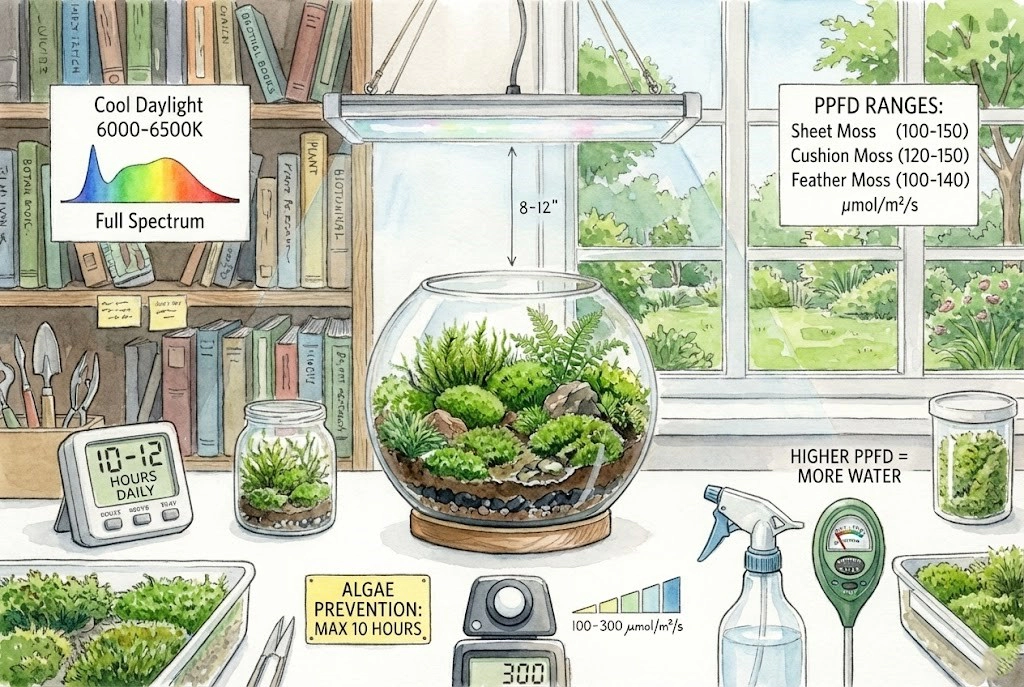
- A broad white LED is a sensible default for a moss terrarium. White light renders moss colour well and includes the green 500-600nm band that contributes to photosynthesis. Red-blue spectra can work too, but their output between roughly 500-600nm varies by model, so check spectral data when it is available.
- Start with moderate light on a steady daily cycle. Rather than chasing one universal number, begin around 100-150 μmol/m²/s at the surface for 10-12 hours and adjust to how your specific moss responds.
- Use lamp position as the main intensity control. Moving the lamp farther reduces intensity, but the exact fall-off depends on the fixture’s optics, so measure at the moss surface instead of relying on a formula.
- Treat browning and paling as clues, not verdicts. Colour change can come from light, heat, drying, water chemistry, transplant shock, or age, so change one variable at a time and watch the result.
- Simple gear can be enough. A consumer daylight bulb, clamp lamp, and timer make an inexpensive setup. When managing algae, watch photoperiod, moisture, and nutrients together because hours alone are not the whole story.
Moss lighting does not have to be expensive or complicated. An ordinary white LED, a timer, and a way to check intensity at the moss surface will cover most terrarium mosses.
The price tag matters less than getting the intensity, duration, and moisture right for the moss you actually have.
Choose the lamp by delivered light, set a repeatable photoperiod, and troubleshoot from measured changes rather than the label on the box.
Any number is a starting point to test against your setup, not a fixed rule (moss species, hydration, temperature, and enclosure all shift the result). For moisture, substrate, and ventilation, use the moss propagation-box guide.
A practical starting point for many terrarium mosses is roughly 10-12 hours daily in the low-to-moderate intensity range, using a broad white LED positioned above the substrate. Adjust from there based on how the moss responds over several weeks.
A consumer daylight bulb, clamp lamp, and timer make an inexpensive starter setup, and a small lamp uses little electricity.
Specialty terrarium systems add convenience rather than being strictly required.
White light is a reasonable default because it renders colour well and includes green wavelengths (500-600nm) that contribute to photosynthesis.
That said, the best choice for a given moss depends on the actual light output, not colour temperature alone.
What Light Spectrum Do Mosses Actually Use for Photosynthesis?
Like other plants, mosses rely on chlorophyll, which absorbs strongly in the blue (around 450nm) and red (around 660-670nm) regions.
In living tissue the effective absorption is broader than those two peaks, because accessory pigments and the leaf structure spread light use across the spectrum.
Green wavelengths (500-600nm) are not wasted. Green photons that are absorbed drive photosynthesis with efficiency comparable to red, and because green penetrates deeper into tissue and canopies, it can reach cells that blue and red do not.
This is true for vascular plants as well as mosses, so the idea that leafy plants simply ignore green is outdated.
Some bryophytes are shade-adapted and can maintain a positive carbon balance at low irradiance.
The details vary widely by species, hydration, and measurement method, so treat any single figure as species-specific rather than a rule for all moss.
For a terrarium, a broad white spectrum is a safe, convenient choice. It covers blue, green, and red, and renders moss colour naturally. A red-blue blurple grow light can still grow moss, but its output in the 500-600nm band depends on the model, and it makes colour harder to judge by eye.
Colour temperature alone (for example 6000-6500K) does not tell you a lamp’s full spectral output, photon efficacy, beam pattern, or delivered PPFD.
Where those matter, look for the manufacturer’s spectral data or measure at the moss surface.
I map light only after the moss surface has reached the same visible moisture state each time. Wet moss reflects and photographs differently from drying moss, which can make color and apparent density look like a lighting response.
At the marked center, edge, and shaded hardscape points, I track new tip growth in the same locations. I adjust duration or intensity one at a time rather than changing both to chase a greener photograph.
Do Red-Blue Grow Lights Work for Moss?
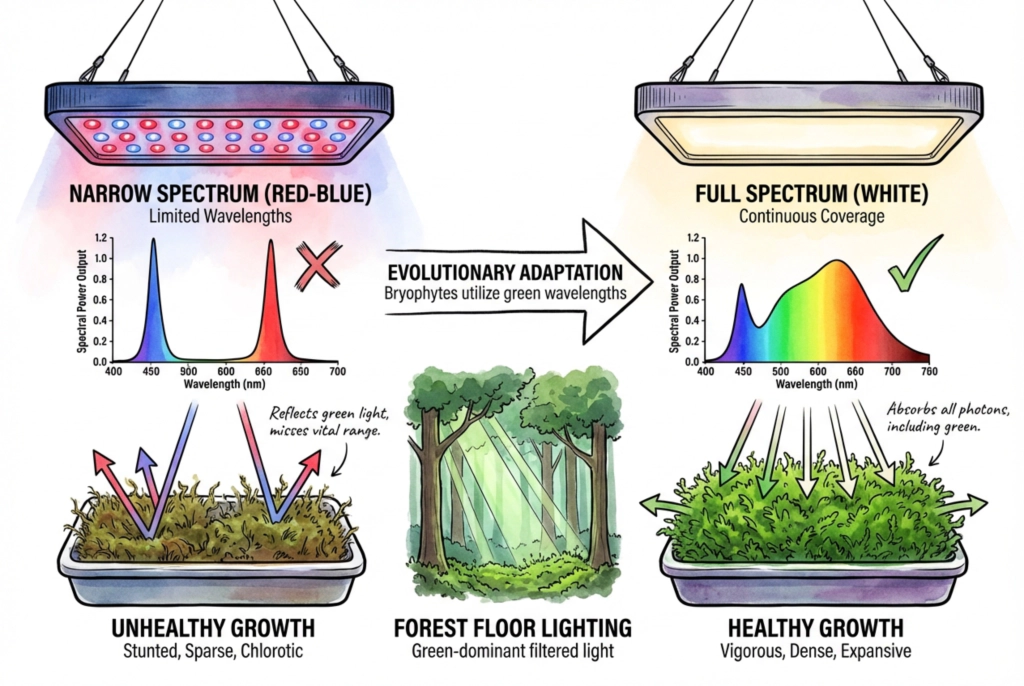
Red-blue blurple grow lights are designed to concentrate output near the chlorophyll absorption peaks.
That works for many crops, but it is a design choice, not proof that green light is useless because absorbed green photons still drive photosynthesis.
Leaves appear green because they reflect and transmit a portion of green light, but the green they do absorb is used for photosynthesis. Green is not wasteful for lettuce, tomatoes, or moss.
Many bryophytes grow in dim, filtered light, and shade-adapted species make efficient use of the light available to them.
How much of the spectrum any given lamp misses depends on the specific model, so compare published spectral power distributions rather than assuming all red-blue lights behave the same.
A broad white LED gives continuous coverage across the visible range and makes moss colour easy to read by eye, which is why it is a convenient default.
Claiming faster growth than a red-blue fixture would require a controlled comparison at matched intensity and spectrum. Without that test, choose by measured output and viewing quality.
Can Moss Photosynthesize in Low Light Conditions?
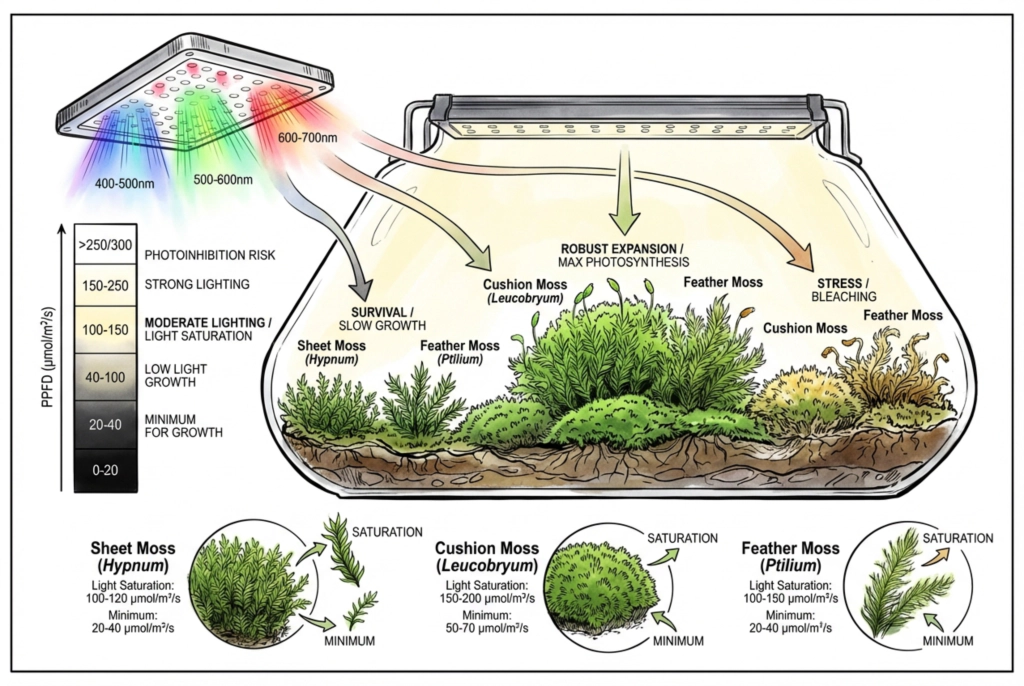
Yes. Many mosses are shade-tolerant and can photosynthesize at low intensities. In a survey of 39 mosses and 16 liverworts, Marschall and Proctor (2004) found the light response varied a great deal between species. Some saturated at low irradiance while others did not saturate until several hundred μmol/m²/s or more. There is no single saturation figure that applies to all moss.
Three physiological endpoints help describe how moss responds to light, and they should not be treated as interchangeable numbers.
| Term | What it means |
|---|---|
| Light compensation point | The intensity at which photosynthetic carbon gain just balances respiratory loss. Below it, the moss draws down reserves rather than accumulating growth. |
| Light saturation point | The intensity above which photosynthesis no longer increases with more light. This varies widely between species and with temperature, hydration, and CO₂. |
| Damage / photoinhibition | Sustained light well above what a shade-acclimated moss can use may bleach or brown tissue. The threshold is species- and condition-dependent, not a fixed number. |
Published values span a broad range and depend on species and conditions, so they do not support exact per-species terrarium thresholds.
A workable approach is to start in the low-to-moderate range (roughly 100-150 μmol/m²/s at the surface), then let the moss’s colour and growth tell you whether to move brighter or dimmer.
How Do I Measure Light at the Moss Surface?
Measure delivered light at the moss surface, where it actually matters, rather than at the lamp. A quantum PAR meter reads PPFD directly. The PPFD and DLI guide shows how intensity and photoperiod combine into a daily dose.
A lux meter or a smartphone light-meter app reads illuminance (lux), which is a different quantity weighted for human vision.
There is no single, universal lux-to-PPFD conversion. The conversion factor depends on the light source’s spectrum. Published values are roughly 0.0185 for sunlight and about 0.0135 for cool-white fluorescent, and an LED’s factor depends on its specific spectral output.
Applying a sunlight factor to a white LED will give a wrong PPFD, so do not treat any fixed multiplier as exact for your lamp.
What a lux meter is genuinely good for is relative measurement with one lamp, such as mapping bright versus dim zones and tracking whether intensity changed after you moved the fixture.
For an accurate absolute PPFD you need a calibrated quantum sensor, or a supported and correctly configured smartphone app.
Many consumer LEDs do not publish PPFD, so you often only see full-spectrum or bright-white marketing without photon-flux data. Reputable grow bulbs sometimes do publish PPF or PPFD figures. When they do, use them, and confirm with a surface measurement.
Dr.meter LX1330B
Dr.meter LX1330B fits relative mapping under one fixed lamp, with the sensor kept dry in room air. Use it with an open enclosure or take repeatable lid-off readings. Skip it if you need absolute PPFD, need to compare different spectra, or cannot keep the sensor dry. A calibrated quantum meter is the right tool for those jobs.
What’s the Difference Between Lux and PPFD?
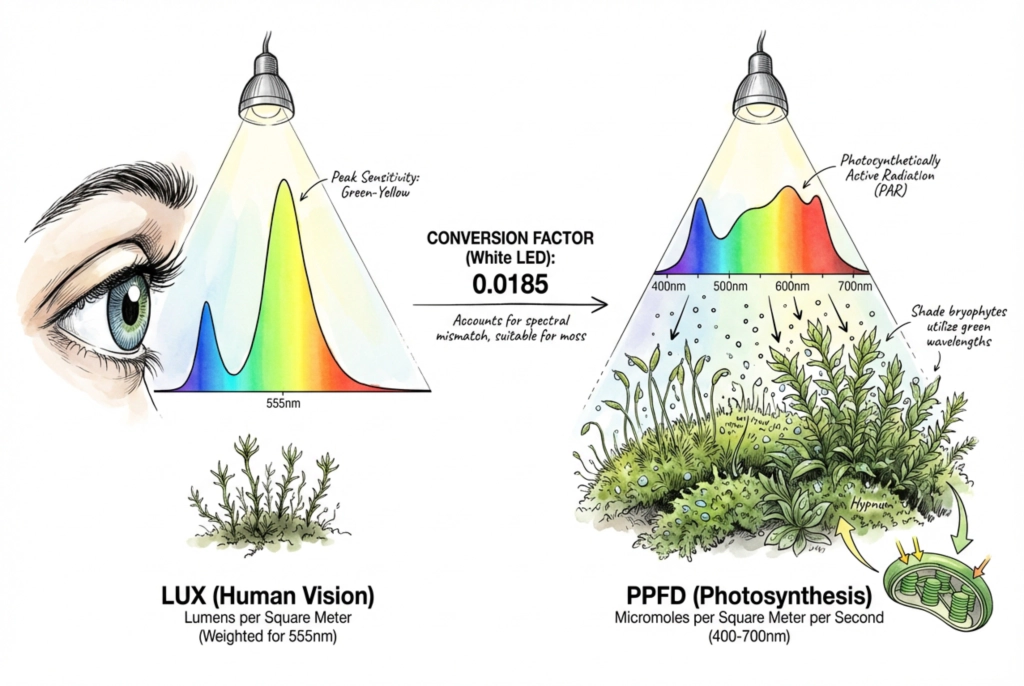
Lux measures illuminance. Lumens per square metre weighted for human vision, which peaks around green-yellow (555nm).
PPFD counts photosynthetically active photons (400-700nm) per square metre per second, counting each photon in that band equally regardless of wavelength.
Because lux is weighted toward green and PPFD is not, the two do not track each other unless you know the light’s spectrum.
That is why the conversion factor changes with the source, and why a single number like 0.0185 (a sunlight approximation) cannot be relied on for a white LED.
Converting exactly requires integrating the lamp’s actual spectral power distribution.
Counting photons regardless of wavelength refers only to how PPFD is tallied. It does not mean the plant responds to every wavelength identically. Blue, green, and red all contribute to photosynthesis, with wavelength-dependent effects on morphology as well.
For terrarium use, the practical point is to measure at the surface and compare positions with the same lamp.
If you need a true PPFD number, use a calibrated quantum meter rather than a lux-based estimate.
Do I Need an Expensive PAR Meter?
It depends on what you need. For comparing positions under the same lamp (deciding whether one spot is brighter than another, or whether intensity dropped after a move) an inexpensive lux meter or a light-meter app is usually enough.
Smartphone apps like Photone can help, but they are not zero-effort tools. Accuracy depends on the phone model and its sensor, and the app generally needs the correct light-source setting and, on some devices, a diffuser or calibration. Some features may be paid. Follow the app’s own instructions rather than assuming any reading is exact.
A dedicated quantum (PAR) meter is not merely a marginal upgrade. It integrates 400-700nm photons directly with a defined spectral and cosine response, which is exactly what you want when comparing lamps of different spectra or when you need an accurate absolute PPFD. That said, hobby cultivation rarely needs sub-unit precision.
The practical workflow is the same either way. Measure at the surface, adjust the lamp, and read the moss’s response over a few weeks.
A consistent method reduces guesswork, but remember that a lux-based estimate can carry a systematic offset if you do not know the lamp’s spectrum.
What Photoperiod Do Moss Terrariums Need?
A Steady Daily Cycle
A steady daily cycle in the range of about 10-12 hours is a good default for many terrarium mosses.
Consistency helps mainly because it removes a variable when you are troubleshooting.
Seasonal and Reproductive Cues
Mosses do not flower, so they lack the flowering-plant photoperiod responses that gardeners often think of. That does not mean day length is biologically irrelevant to them. In Physcomitrium (Physcomitrella) patens, short days and cooler temperatures strongly promote sporophyte formation, so reproductive development can respond to day length.
If your goal is only vegetative carpet growth, a fixed photoperiod is fine. If you are trying to encourage reproduction, day length and temperature are worth considering.
Photoperiod and Algae
Very long photoperiods can favour algae in some systems, but there is no universal hour at which this begins. The result depends on nutrients, moisture, the algae present, and total daily light, as discussed in the algae section. Extending the day is one lever, not a guaranteed cause.
Abrupt Switching and Light Ramps
The bryophyte circadian clock has a comparatively simple architecture, but that is not evidence that abrupt on/off cycles are biologically identical to gradual ramps, nor that time of day is irrelevant. Light-dark transitions still influence clock entrainment and gene expression.
A basic timer with abrupt switching is perfectly adequate for most hobby setups. No comparative growth trial establishes a sunrise/sunset dimmer as a necessary upgrade.
BN-LINK Programmable Timer
BN-LINK programmable timer fits a moss setup that needs a repeatable light cycle without relying on memory. It is more useful for multiple enclosures or separate schedules than for one simple on-and-off routine.
Choose BN-LINK for Independent Schedules
Choose it when you need independent schedules for two terrariums or want a spare, and the lamp load stays within its 125V, 15A/1875W resistive rating.
Skip BN-LINK for One Simple Cycle
Skip it if you need only one basic daily cycle, live outside its voltage system, or plan to put the timer where condensation or splashes can reach it. The timer belongs at a dry indoor outlet, not inside the enclosure.
Should I Adjust Light Duration Seasonally?
For a purely vegetative indoor moss carpet, a fixed photoperiod year-round is usually fine, since your enclosure is not tracking outdoor seasons.
This is a practical convenience rather than a strict biological requirement, and it can differ if you are chasing reproduction (short days and cooler temperatures promote sporophytes in some species) or if the terrarium also gets ambient window light.
Outdoor plants in temperate regions do respond to changing day length, but that is a comparison, not a rule for your tank. Mosses reproduce by spores rather than flowers. The fact that they do not flower does not mean sporophyte development is independent of day length.
For a new closed terrarium, starting on the shorter side (around 8-9 hours) is a reasonable, cautious default because sealed systems hold moisture and can favour algae.
Extend gradually toward 10-12 hours if the moss looks pale or grows slowly after a few weeks, while also checking nutrients, moisture, and ventilation, since photoperiod is only one factor.
If algae does take hold, clearing it can take patience and repeated cleaning. Prevention is easier than cure, so it is worth starting conservative.
Do Moss Terrariums Need Sunrise/Sunset Simulation?
Probably not, for most setups. Mosses grow well under abrupt on/off cycles, so a plain timer is a fine choice and a dimming controller is optional.
A sunrise/sunset ramp is a convenience and aesthetic feature, not an established growth advantage worth paying a premium for.
If your budget is limited, spending it on a reliable timer and a way to measure intensity is a practical priority over a dimmer.
Mosses do not run the complex developmental programs (bud break, flowering) that make gradual photoperiod transitions matter for woody plants and annuals.
Their circadian systems do help time metabolic processes such as starch handling and respiration, which is a reason not to assume that time of day and light-dark transitions are entirely without effect.
For growth, total daily light, the daily light integral, roughly intensity multiplied by hours, is the dominant variable.
The exact ramp speed at dawn and dusk is a smaller factor, but evidence is not strong enough to call its effect zero.
How Bright Should a Moss Terrarium LED Be?
Measure at the Moss Surface
Wattage alone does not tell you the PPFD at the moss surface. Two 15W lamps can deliver very different intensities depending on efficacy, optics, beam angle, the number of diodes, and losses through glass.
So rather than reading a target off the wattage, place the lamp at a plausible starting height (a bench of a foot or so above the substrate is a common starting point), then measure at the surface and adjust.
Use Distance as the Control
Intensity does fall off as you move the lamp farther away. The textbook inverse-square rule (double the distance, one-quarter the intensity) holds for an ideal point source, but a real LED panel, bulb, reflector, or nearby terrarium wall produces a near-field pattern where that relationship does not hold exactly.
Use it only as a rough intuition, and let the meter tell you the real change.
Adjust in small steps, roughly a couple of inches at a time, and judge the result over two to three weeks of moss response rather than expecting a precise percentage change. Moving closer raises intensity and moving farther lowers it. The exact magnitude depends on your specific fixture, which is why measuring beats calculating here.
How Do I Know If My LED Is Too Bright?
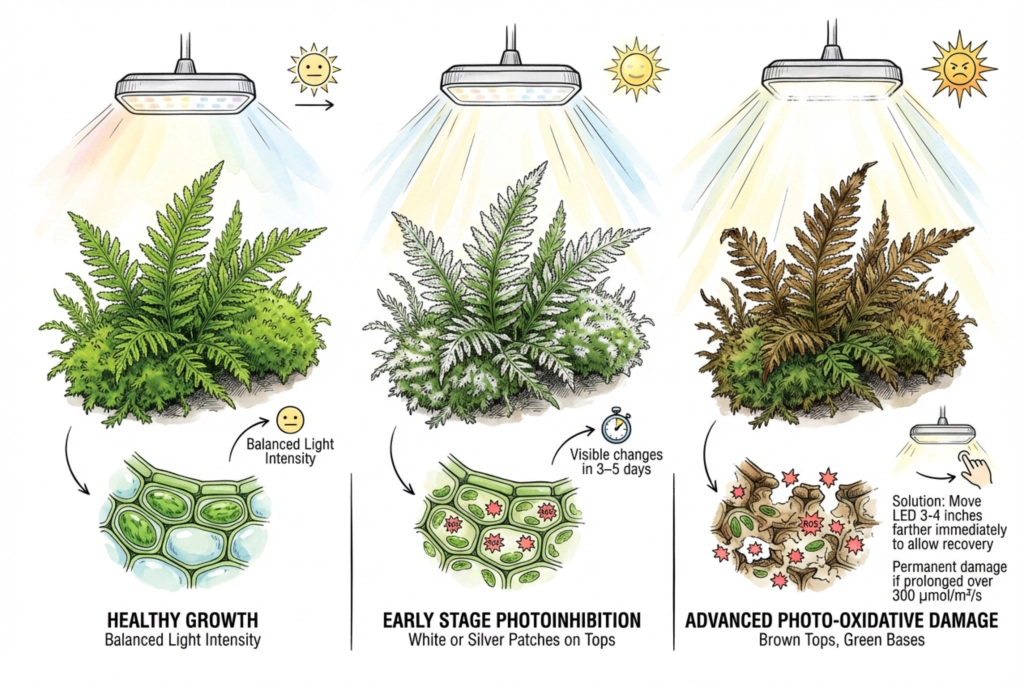
Pale, white, or silvery patches on the exposed tops of a moss can be a sign of light stress, and browning that starts at the tops while the bases stay green points more toward light than toward drying. These are useful clues, not proof. Bleaching and top browning can also come from desiccation, mineral or salt residue, heat, or fungal growth, so confirm with a measurement before assuming intensity is the cause.
The general mechanism is real. When a leaf absorbs more light energy than it can use, excess energy can generate reactive oxygen species that damage photosystem II and chlorophyll.
Whether that is what is happening in your specimen is hard to confirm without controlled conditions or fluorescence measurement.
If you suspect too much light, the safe response is to reduce intensity (move the lamp farther or dim it) and watch.
Severely browned tissue may not recover, but healthy tissue often does once conditions improve.
There is no single PPFD above which every shade moss is permanently damaged. Species tolerances vary widely, and some bryophytes tolerate several hundred μmol/m²/s.
Rather than a fixed damage number, treat a measured reduction plus observation as the reliable approach.
What If My Moss Looks Pale Yellow-Green?
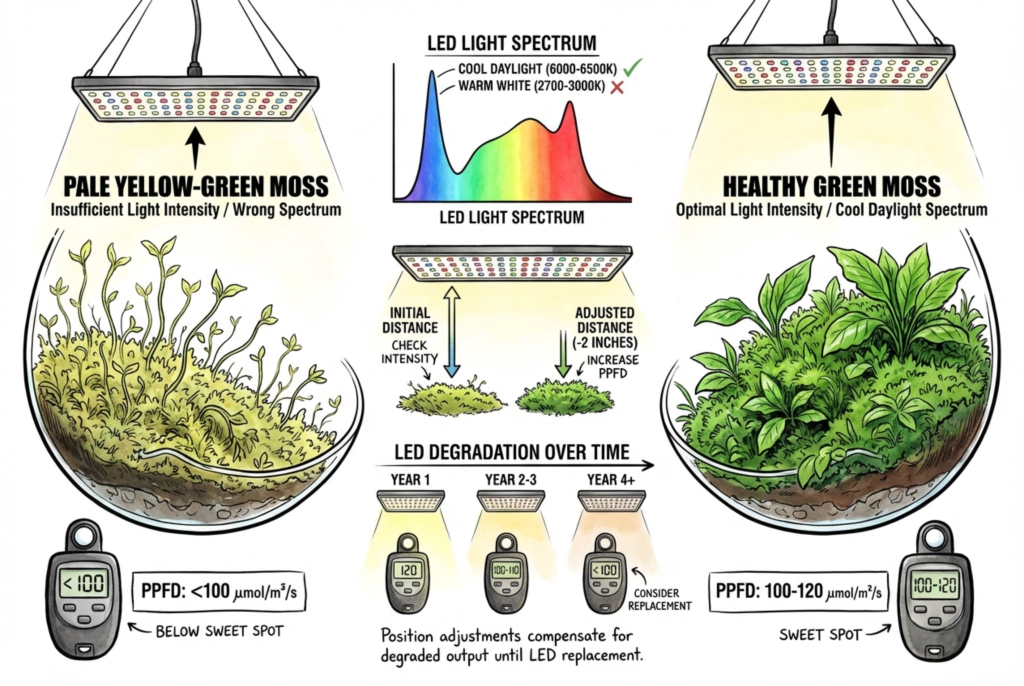
Pale yellow-green colour across the whole colony (rather than just the exposed tops) can indicate too little light.
It is one possibility, not a diagnosis. Nutrient shortage, water chemistry, pH, poor acclimation, and natural ageing can also pale a moss, so rule those out too.
If low light seems likely, move the lamp modestly closer or increase the photoperiod, then watch over a few weeks.
Contrary to a common claim, warm-white (2700-3000K) light is not inherently unusable for moss. Green and red are both used in photosynthesis.
Colour temperature affects appearance and morphology signalling, but it is not the reason a moss is pale.
Before assuming the light itself weakened, measure the delivered intensity at the surface.
LED output does decline over a lamp’s life, but there is no universal annual loss rate. Useful life is normally rated as the hours to reach about 70% of initial output (L70), and the actual decline depends on the driver, operating temperature, and the LED package.
Compare a current surface reading against your earlier baseline rather than assuming a fixed annual loss.
Moving the lamp can compensate for some output decline, but it also changes the beam footprint and heat at the surface, so re-check both when you adjust.
How Close Is Too Close for LED Positioning?
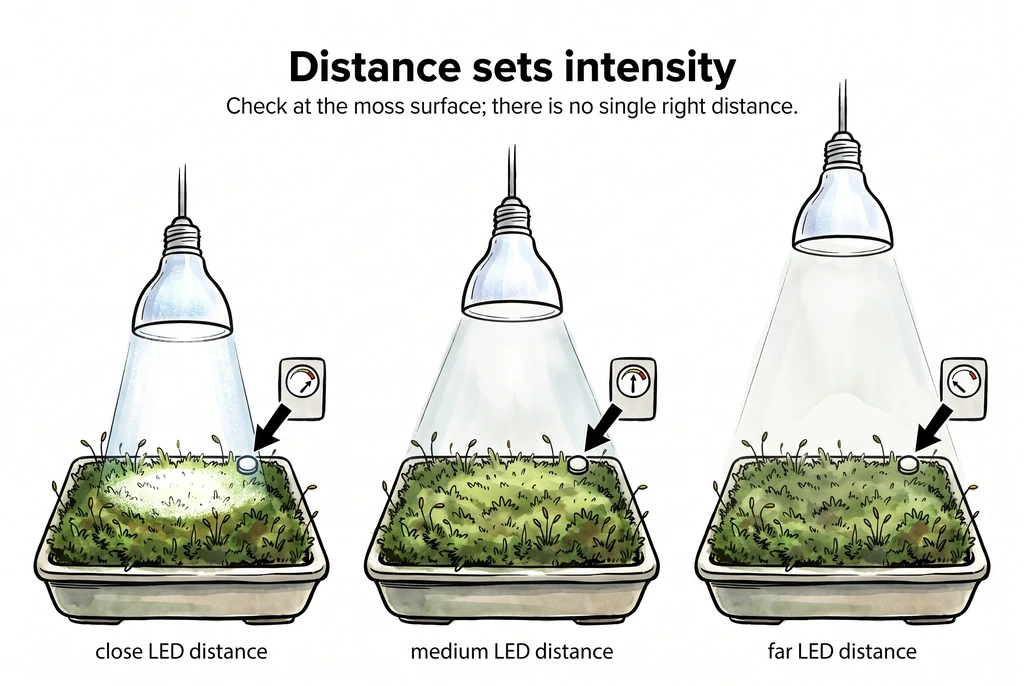
There is no single safe distance, because it depends on the fixture’s output and optics. A low-wattage bulb close to the moss may be fine, while a high-output panel at the same distance could be far too intense.
Rather than trusting a distance number, measure at the moss surface and back the lamp off if the moss shows signs of light stress.
High-output grow lights sold for vegetables or cannabis are built to run at high intensity for light-hungry crops.
Their manufacturer heights are set for those crops, so a shade moss will usually want the lamp much farther away, but decide that by measuring, not by a fixed multiplier.
Sustained intensity well above what a shade-acclimated moss can use can bleach or brown it. The level that is too high varies by species and acclimation. Some bryophytes tolerate several hundred μmol/m²/s, so avoid treating any one figure as a universal ceiling.
The safe habit is to start dim and increase only if the moss looks under-lit.
Which LED Type Works Best for a Moss Terrarium?
Compare Delivered Light, Not Labels
A consumer daylight LED bulb in a standard E26 fixture, clamp lamp, or desk lamp is a good, inexpensive starting point.
Cool-white or daylight bulbs give broad coverage across the visible range and render moss colour naturally.
A consumer bulb is often cheaper than a terrarium-branded one of similar wattage. But matching wattage and colour temperature does not mean identical performance. Spectral output, photon efficacy, beam pattern, thermal management, sealing, flicker, and lifetime can all differ.
Compare the actual output where you can, rather than assuming two bulbs with the same label perform the same.
Modern white LEDs work by using a blue chip plus one or more phosphors to produce broad visible light.
This gives a reasonably continuous spectrum, but the exact shape varies by package and phosphor mix, and narrow-spectrum grow lights can still support photosynthesis, so a smooth curve is a convenience, not a strict requirement.
When choosing a bulb, a reputable daylight-white LED is a safe default. Check its spectral data, PPF/PPFD if published, beam, and any enclosed/damp-location rating rather than relying on colour temperature alone.
SANSI 36W Grow Bulb
SANSI 36W grow bulb is a high-output 4000K E26 bulb for situations where a small daylight lamp cannot cover a deeper or wider planting. Its manufacturer-rated PPF is 65.6 μmol/s and its PPFD is about 265.58 μmol/m²/s at one foot, so it needs careful distance and surface measurement for shade moss.
Choose SANSI for Deep or Wide Terrariums
Choose it only when a weaker daylight bulb cannot cover a deeper or wider planting and you have room to mount it farther away, measure at the moss surface, and use an open, adequately rated socket outside the enclosure.
Skip SANSI for Small Shallow Terrariums
Skip it for a small shallow terrarium already within the target range. One foot is substantially brighter than the conservative 100-150 μmol/m²/s starting band, the bulb weighs about a pound, and SANSI does not recommend it in a tightly closed fixture.
Confirm socket wattage, physical support, ventilation, and clearance before ordering.
Do Color Temperature and Kelvin Rating Matter?
Somewhat, but it is a coarse descriptor. Colour temperature (in Kelvin) describes how warm or cool a lamp looks and is a rough proxy for the balance of its spectrum.
Higher values (6000-6500K) tend to be relatively blue-rich and lower values (2700-3000K) relatively red/yellow-rich, but two lamps at the same CCT can still have different blue fractions and different spectra.
Blue light does influence photomorphogenesis in plants, and this can affect compactness and pigmentation.
The direction and degree depend on species, intensity, and the plant’s photoreceptor response. A simple rule that cool white makes moss compact while warm white makes it loose and yellow is not reliable and lacks direct moss trial support here.
Be cautious with the shorthand that red means shade. Classic shade-avoidance responses are driven mainly by a low red-to-far-red ratio, which is not the same as the red content of a warm-white bulb.
In practice, a daylight-white bulb is a fine default largely because it makes moss colour easy to judge.
If you prefer the look of 6500K, that is a reasonable aesthetic choice. Just do not assume it beats warm white for moss health at equal intensity.
Are Expensive Terrarium LED Systems Worth It?
For many moss setups, a simple consumer bulb does the job, and a specialty fixture is not required.
The main cost tiers differ in integration and output. Prices vary by vendor and over time, so check current listings.
| Setup type | Approx. Total cost | Notes |
|---|---|---|
| Consumer DIY (bulb + clamp lamp + timer) | roughly $25-45 | Cheapest. You assemble it and measure at the surface. |
| Specialty terrarium fixture | roughly $60-120 | Integrated housing, timer, arm, and sometimes an ingress rating. |
| Vegetable grow light | varies | High output. Needs careful positioning and measurement for shade moss. |
A cheaper consumer bulb and a pricier terrarium fixture are not automatically equivalent. Even at matched wattage and colour temperature, actual output, optics, coverage, thermal design, and sealing can differ, so identical PPFD at equal distance is not something to assume. Verify by measuring if it matters to you. Without side-by-side long-term data, do not assume the price difference produces either zero difference or better growth.
Premium pricing for terrarium-branded lights may buy aesthetic housing, an integrated timer, an adjustable arm, and sometimes a moisture or ingress rating.
Features such as safe placement and thermal design can affect reliability and results, so the added cost is not always purely cosmetic.
The choice is a tradeoff, not a single winner. A specialty fixture suits buyers who value integrated design and convenience, while a consumer bulb suits those who want lower cost and are willing to measure and adjust.
Do Moss Species Need Different Light Schedules?
Match Light to Species and Provenance
Yes. Different mosses have different light preferences, and it helps to match placement to the species you have.
Published per-species PPFD figures for common terrarium mosses are not well established, so the evidence supports tendencies rather than exact numbers.
As a rough guide, sheet moss (Hypnum) and feather moss (Ptilium) are typically found in shaded, low-to-moderate light, while cushion moss (Leucobryum) often tolerates somewhat brighter, filtered light. These are genus-level generalisations. Individual populations vary with their origin and microclimate.
A single overhead lamp naturally produces a brighter centre and dimmer edges, which lets you place species with different preferences in different zones.
The size of that gradient depends on your fixture and container, so map it with a meter rather than assuming a fixed percentage.
Where you can, identify the moss and note where it was collected or how it was grown. Matching your terrarium’s light zones to that background gives the best chance of healthy, attractive growth.
Provenance and a little observation matter more here than any single target number.
Can I Mix Different Moss Species Under One Light?
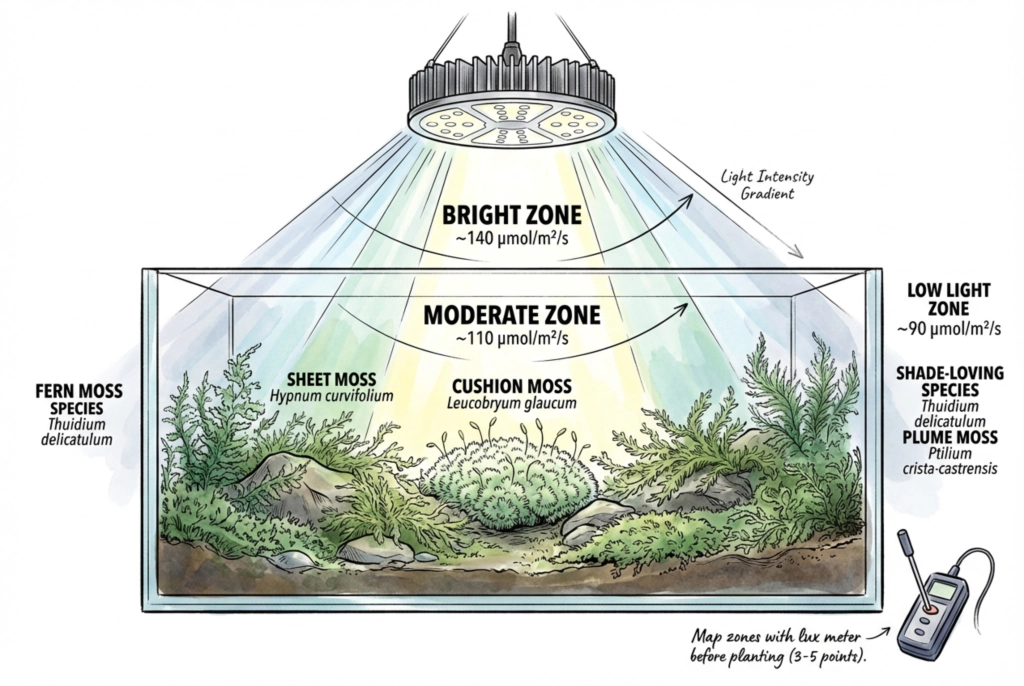
Often yes, by using the natural light gradient. A single overhead lamp is usually brightest in the centre and dimmer toward the edges, so species that prefer more light can go near the middle and shade-lovers toward the edge.
The exact shape of that gradient is not something to calculate from beam angle alone. Reflectors, multiple diodes, and the container walls can make the real pattern uneven or non-monotonic, so measure at several points rather than assuming a fixed centre-to-edge percentage.
A workable plan is to place brighter-tolerant moss, such as cushion moss, toward the centre and more shade-loving mosses toward the edges.
Assign positions from your measured map, not from generic target numbers.
The most useful preparatory step is to map 3-5 positions with a lux meter before planting and write the readings down.
Treat these as same-lamp relative readings for comparing zones, not as absolute PPFD values, and re-check occasionally as the planting fills in.
What Happens If I Use Wrong Intensity for a Species?
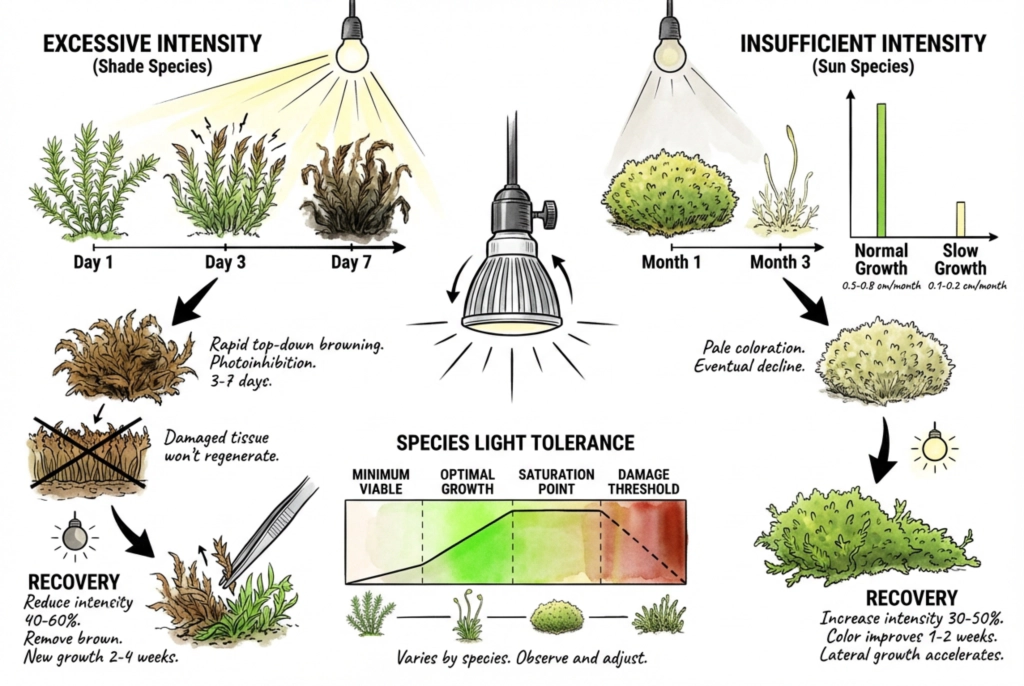
Getting the intensity badly wrong for a species causes stress in two directions. Too much light can bleach and brown a shade-adapted moss. Too little tends to leave it pale and slow. Precise timelines and growth rates depend on species, hydration, and temperature, so do not promise exact days-to-symptom or centimetres per month without controlled measurements.
Note also that Java moss (Taxiphyllum barbieri) is commonly grown underwater in aquariums, so it belongs to a different use case than a terrestrial terrarium carpet. Do not fold aquatic and terrestrial mosses into one intensity schedule.
If a moss is over-lit, the safe response is to reduce intensity and remove tissue that is clearly dead. Badly browned tissue may not recover, but healthy portions and surviving growing points often regrow once conditions improve. Recovery time varies with the species and how much damage occurred.
If a moss is under-lit, increase intensity or photoperiod gradually and watch colour and growth improve over the following weeks.
In both directions, change one variable at a time so you can read the result.
Should I Change the Light During Establishment?
Establish New Moss Gently
It can help to ease newly placed moss in gently. During establishment, a shorter photoperiod and modest intensity are a sensible, cautious default while the moss settles. Once it is clearly attached and putting out new growth, you can raise intensity or extend the day if it wants more light.
As the planting matures, a stable schedule is usually easiest to manage.
Treat any specific hours or intensities here as starting points, not fixed prescriptions (the right values depend on the species, the enclosure, and how the moss responds).
Moss Water Use Follows Surface Drying
A physiology note is important here. Mosses are not vascular plants. The visible gametophyte has no true roots and no stomata. Rhizoids mainly anchor it, and it takes up water directly over its surface because it is poikilohydric, meaning its water content tracks the surrounding environment.
That is why language about damaged roots failing to service transpirational demand does not fit moss.
What is true is simpler. Stronger light raises evaporation and surface drying, so if you increase intensity you may need to keep the surface moister.
Watch the moss and the surface moisture rather than following a fixed watering multiplier, and change one thing at a time.
How Do I Know When to Increase Lighting?
Gently touch the moss. If it resists lifting from the substrate and shows several points of fresh, bright-green growth, it is establishing and can usually take a little more light.
Use these signs alongside the species, the moisture level, and your baseline intensity rather than treating them as a strict green light on their own.
When you do increase light, do it gradually and change one variable at a time. You can lengthen the photoperiod in small steps over a week or so. Note that going from 8 to 12 hours at the same intensity raises the daily light integral by about 50%, not double it.
Adding time slowly is about avoiding a sudden dose jump, not preventing thermal shock because a longer photoperiod does not itself heat the moss.
If you also want to move the lamp closer, do that as a separate step so you can tell which change produced the effect. Watch growth and colour over the following weeks. Exact centimetre-per-month rates depend on the species and conditions and are not something to promise in advance.
What If My Moss Grows Too Fast?
If a moss is spreading faster than you want, trimming the photoperiod is one reasonable lever. Fewer hours lowers the daily light integral and slows expansion while leaving the instantaneous intensity unchanged.
This is worth trying before cutting intensity, since very dim light can leave moss pale, but whether shorter days preserve colour better than lower intensity is a tendency, not a guarantee.
The underlying relationship is that the daily light integral (intensity multiplied by hours) is a major driver of growth, though how strongly it correlates and where growth saturates depend on species and hydration.
Colour is influenced more by the instantaneous intensity and spectrum than by total dose.
So running fewer hours at the same intensity gives less total light and generally slows spreading.
It will not necessarily keep chlorophyll perfectly unchanged, but it avoids the paling that can come from dropping intensity too far. Watch the moss and adjust from there.
Are Bryophytes Shade Plants? Photosynthetic Light Responses and Pigment Proportions
Acclimation of Bryophytes to Sun vs Shade Conditions
How Do Light and Water Interact?
Light Increases Drying Demand
Brighter light tends to increase how quickly a moss and its surface dry out, so raising intensity usually means paying more attention to moisture.
The reason is mostly straightforward evaporation and surface warming from absorbed light, not stomatal transpiration, since the visible moss gametophyte has no stomata and exchanges water directly across its surface.
There is no fixed rule that says to double misting when you double intensity. How fast the surface dries depends on airflow, humidity, substrate, enclosure type, and the moss itself.
A moss doing fine on occasional watering at moderate light may need more frequent moisture at higher intensity, so watch the surface rather than following a multiplier.
Open and Closed Terrariums Differ
Watering frequency also differs sharply between open and closed systems. An open terrarium may need misting several times a week, while a well-sealed closed one can hold moisture for much longer.
Container size, ventilation, and species all shift this, so use these as starting points and adjust to what you observe.
Be careful with very frequent watering at high intensity. Keeping a substrate constantly saturated risks overwatering, anaerobic conditions, and fungal or algal growth, so aim to keep the surface appropriately moist rather than watering on a rigid twice-daily schedule.
When Should I Water Relative to Light Schedule?
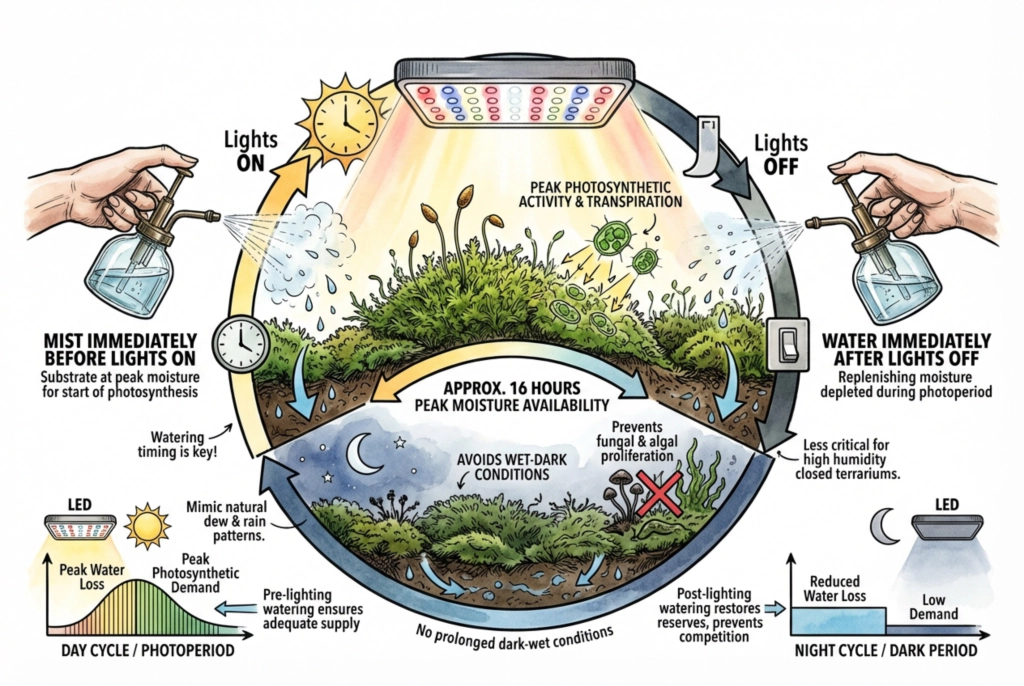
A reasonable habit is to check moisture and mist shortly before the lights come on, so the surface is damp during the moss’s active period.
Evaporation is highest while the light is on, so having moisture available then makes sense.
Be cautious about watering right after lights-off. A moss that sits soaking wet through a long dark period can favour some fungi and algae, so it is generally better to let the surface not be freshly drenched going into the dark cycle (the reverse of watering immediately at lights-off).
Judge this by how wet the surface actually is rather than by a fixed clock rule.
In a closed terrarium holding high humidity, watering timing matters less because moisture rarely runs short. There the more useful question is whether persistent surface wetness plus warmth is encouraging algae.
Note that the visible moss takes up water over its surface rather than through roots, so think in terms of surface moisture and air humidity, not stomatal transpiration.
What If I See Browning Despite Adequate Water?
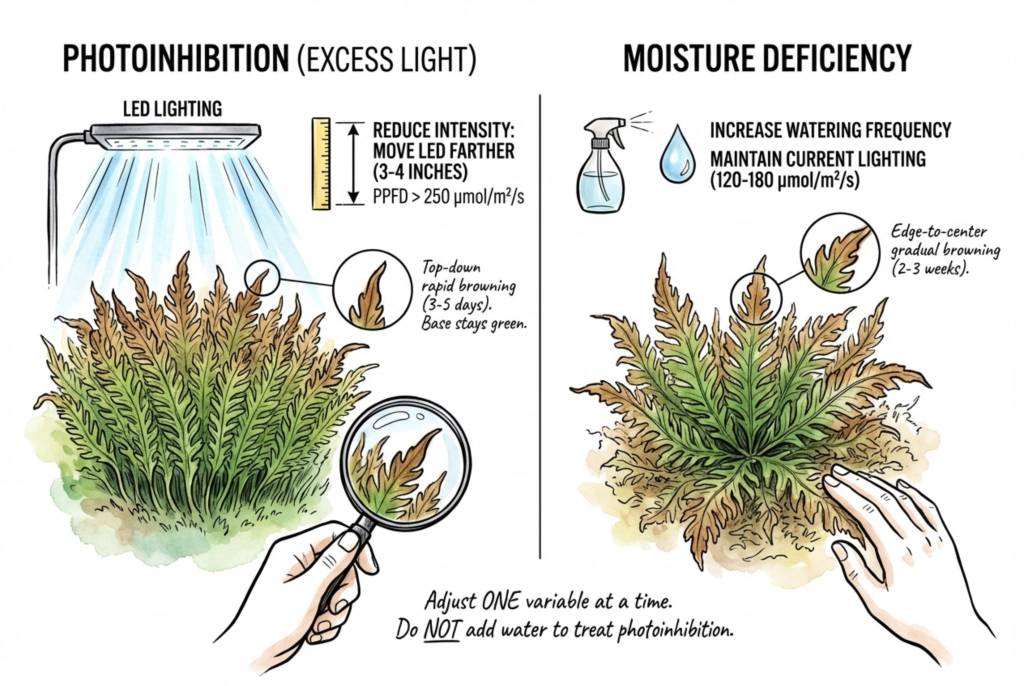
The pattern of browning can hint at a cause. Rapid browning that starts at the tops while the bases stay green leans toward too much light. Slow browning that creeps from the edges inward leans toward drying. Treat these as clues, not verdicts because heat, salt or fertiliser residue, water chemistry, contamination, transplant shock, and natural ageing can produce overlapping symptoms. The brown-moss troubleshooting guide provides a broader moisture-versus-decay diagnostic.
As a general troubleshooting principle, change one variable at a time so you can see what helped. The exception is a clear safety problem or coupled conditions that genuinely need fixing together.
If a surface measurement shows the light is clearly on the high side and the moss looks light-stressed, reduce intensity first (move the lamp farther or dim it) even if the substrate feels moist.
Remember that a lux reading is relative unless you know the lamp’s spectrum, so use it to compare against your own baseline.
If intensity looks moderate but the surface dries out quickly between waterings, address moisture or ventilation while leaving the light alone.
Adding water will not fix genuine light stress, but excess light and drying can occur together, so do not assume watering accomplishes nothing without checking both.
What Causes Algae in My Terrarium and How Do I Fix It?
Balance Light, Nutrients, and Moisture
A green film on the glass is a sign that light, nutrients, and moisture are out of balance in a way that favours algae.
Long photoperiods are one contributing factor, but they are not the whole story (nutrients, the algae already present, surface wetness, and total daily light all matter).
In this context, saturation refers to the light intensity at which photosynthesis stops increasing, not to a number of hours.
Running the lights for many hours does not saturate the moss in that sense. It simply adds to the daily light integral, which can give algae more to work with.
First Response to Algae
Start by shortening the photoperiod toward the lower end of your range and physically remove existing growth.
If you scrape glass, use a plastic card or a scraper suited to your enclosure material to avoid scratches.
Then watch for a few weeks to see whether spread slows before changing anything else.
If algae persists, look beyond hours. Reduce intensity, review nutrients and water chemistry, improve ventilation, and cut down standing surface water.
Closed, very humid enclosures can be more prone to glass algae under bright, sustained light, but the trigger is system-specific rather than a single universal hour.
Why Algae Can Grow While Moss Struggles
Algae and moss compete for light, nutrients, and space but respond differently to them. Beyond a certain point, extra daily light does little for the moss while giving fast-colonising algae more to grow on, especially on wet glass where moss cannot attach.
That said, this is a tendency shaped by the whole system, not a fixed clock threshold.
Aquascapers running low-tech planted tanks often use shorter photoperiods to keep algae down, which is where the general caution about long days comes from. That is useful background, but aquarium conditions differ from a terrestrial terrarium, so borrow the principle (shorter can help) rather than a specific hour count.
The daily light integral, roughly intensity multiplied by hours in mol/m²/day, is a more meaningful figure than hours alone. For example, 150 μmol/m²/s for 8 hours works out to about 4.3 mol/m²/day, but whether that is enough for moss while staying below an algae threshold depends entirely on the system. Treat the arithmetic as an illustration, not a safe cut-off.
Can I Prevent Algae Before It Starts?
Prevention is easier than cleanup, and the most reliable tactic is to start conservatively and observe.
Beginning a new closed terrarium on the shorter, dimmer side and extending only if the moss looks pale or slow after a few weeks keeps early conditions from favouring algae.
Open terrariums with more airflow and lower humidity generally tolerate a somewhat longer day from the start.
Other measures can help but come with caveats. Dense, healthy moss occupying the surfaces first leaves less room for algae. Activated carbon in the substrate can adsorb some nutrients, but it is not a selective algae filter because it affects overall substrate chemistry, so treat it as one tool rather than a guarantee.
Managing moisture and ventilation also helps. Briefly venting a closed lid can lower humidity and discourage algae, but a fixed instruction to open it for a set number of hours or to reach a fixed humidity is not safe for every enclosure. Too much venting risks drying the moss or letting in contaminants. Adjust venting to your specific setup and watch both the moss and the algae.
What Are the Signs My LED Needs Replacement?
Judge Output from a Baseline
LED output does fade over a lamp’s life, and the colour can shift as it ages, but there is no universal annual loss rate and no rule that red phosphors always fail first.
The rate depends on the LED package, the driver, and how hot the lamp runs. Manufacturers typically rate useful life as the hours to reach about 70% of initial output (L70), alongside outright failures.
The reliable signal is a measurement, not an assumption. If the moss gradually pales despite unchanged positioning, re-measure the intensity at the same spot and compare against your earlier baseline.
A clear drop from that baseline, not a calculated annual percentage, is what indicates the lamp is worth replacing.
Before blaming the lamp, rule out spectrum, nutrients, moss age, and heat.
Rated Life Is Not a Deadline
Rated lifespans in the range of roughly 15,000-25,000 hours are plausible for many bulbs. At 12 hours a day that is several years of use. Keep in mind that a rated life is not a hard replacement deadline. It is a point defined by lumen maintenance or failure.
Replacing a bulb before it fails outright can keep light steady, and having a spare on hand avoids a sudden gap.
The threshold at which you replace is a judgement based on your measured output and the product’s rating, not a fixed universal number.
Do LEDs Degrade Faster in High-Humidity Terrariums?
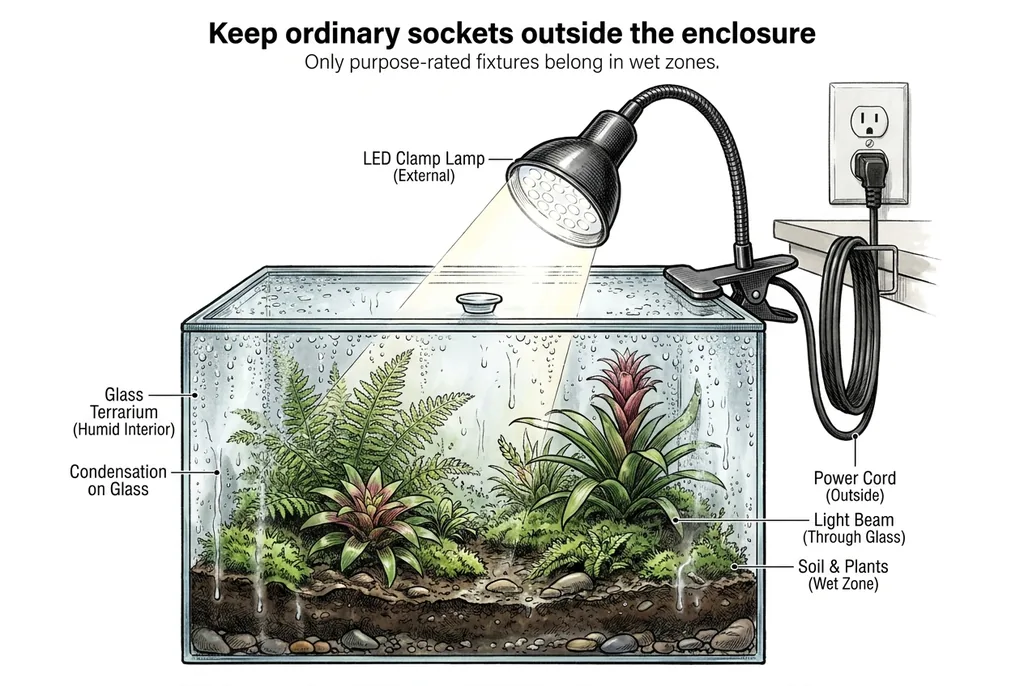
The LED itself is fairly robust, but the socket and wiring are the weak point in a humid enclosure.
Moisture can corrode contacts and degrade connections, which often shows up first as flickering or intermittent operation.
Do not assume any given bulb is safe in damp or enclosed conditions. Check its actual label rating (enclosed-fixture, damp-, or wet-location) and the fixture’s wattage, since these vary by product.
The core safety advice is simple. Keep an ordinary socket and its driver outside the terrarium. A clamp lamp or desk lamp mounted above the enclosure keeps the electrical parts in normal room humidity rather than the much wetter interior, which is easier on the connections. Leave clearance from condensation and splashing.
If you genuinely need a light inside a paludarium or near water, use a fixture that is purpose-rated for that location and follow the manufacturer’s instructions. Do not improvise with an ordinary bulb in a jury-rigged socket. IP ratings are specific. IP65 means dust-tight and protected against water jets, not immersion. Temporary immersion is IP67 and continuous immersion is IP68, as defined by the manufacturer, so an IP65 strip is not rated to sit below a waterline.
Confirm the mounting zone, the connectors, and the driver rating, not just the strip.
How Much Does a Moss Light Cost to Run?
A single small lamp costs very little to run. A 15W LED for 12 hours a day uses about 0.18 kWh per day, or roughly 5.4 kWh a month. Multiply by your own electricity rate to get the cost. At $0.12/kWh that is about $0.65/month, while at the US residential average of about 18.4¢/kWh (EIA, May 2026) it is closer to $1.00/month. Rates vary widely by country, state, and plan, so use your own bill.
Monthly Energy-Cost Formula
Use this formula for the variable energy cost. Watts divided by 1000, multiplied by hours per day, days per month, and your price per kilowatt-hour gives the monthly cost.
This captures the variable energy cost. Fixed charges or tiered rates on your bill are separate, and a timer or driver may draw a small amount on standby.
Running several small lamps still adds only a few dollars a month at typical rates, so for most single-terrarium hobbyists electricity is a minor cost compared with the initial equipment.
If you run many systems, or pay a high rate, the running cost and added heat are worth tallying rather than dismissing.
A digital timer costs a little more than a mechanical one and gives more precise, reliable scheduling.
Whether it saves enough on algae cleanup to justify the price depends on your setup, so treat that as a plausible convenience benefit rather than a guaranteed return.
Are LEDs More Efficient Than Fluorescent Tubes?
Often yes. Modern LEDs tend to be more efficient and longer-lived than fluorescent tubes, which is why they have largely replaced them.
But the specific numbers depend on the fixtures being compared, so avoid treating any percentage or watt-for-watt equivalence as universal.
Photon efficacy varies by product, and a fair comparison uses each fixture’s measured PPF or PPFD, not its wattage.
Spectrum is not automatically better on one technology. White LEDs have their own phosphor peaks and gaps, and a good fluorescent tube can produce perfectly usable plant light, so a line spectrum is not inherently inferior. Compare actual spectral data where it matters.
The practical advantages that usually hold are lower heat input and longer rated life. An efficient LED can put less heat into a closed enclosure, which helps with temperature and condensation, and good LEDs are often rated for more hours than typical fluorescent tubes.
Even the best fluorescent tubes can be rated well into the tens of thousands of hours, so any claim that an LED lasts a fixed multiple longer is product-dependent rather than a universal ratio.
If you already have a fluorescent fixture that gives suitable light, there is no need to replace it on principle.
When you do choose new gear, weigh measured efficacy, spectrum, heat, cost, and lifespan rather than assuming LED wins on every count.
Does It Matter What Time of Day My Terrarium Gets Light?
For practical purposes, the clock time you pick matters far less than the total hours and intensity. The daily light integral is the main driver of photosynthesis. This does not mean time of day is biologically irrelevant (circadian phase and any ambient room light can still have some effect) but for a fixed schedule the difference is usually small.
Do keep the hours equal when comparing. A 6 AM-6 PM or 6 PM-6 AM schedule is 12 hours, whereas an 11 AM-9 PM schedule is 10 hours, so those are not the same daily dose. Choose the window, then keep its length consistent.
Beyond that, align the schedule with your own convenience. Running the lights while you are home lets you enjoy and observe the terrarium, while a workspace tank might follow office hours.
Whether shifting hours saves money depends on whether you have time-of-use electricity pricing.
Affiliate Disclosure
This article contains Amazon affiliate links. As an Amazon Associate I earn from qualifying purchases. If you use these links, the site may earn a commission at no extra cost to you. Product availability, price, and specifications can change. Check the current listing before buying.