
Salinity-Tolerant Vegetable Crops: Western Garden Guide
Salinity-tolerant vegetable crops for Western gardeners: how salt affects water uptake, what the EC numbers (ECe vs water/extract EC) mean, leaching and drip tradeoffs, relatively tolerant crops (chard, beet, New Zealand spinach, grafted tomato) and sensitive ones to watch.
Marcus Hale · Published 2026-02-12 · 11 min read
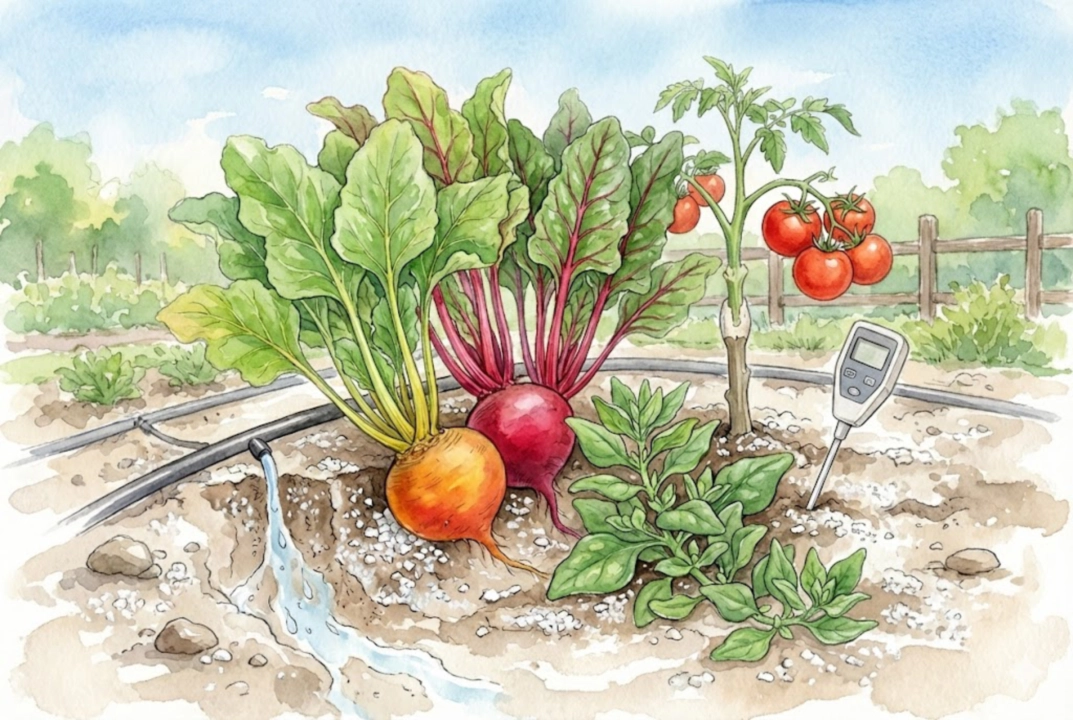
Key Takeaways
- Salt makes water harder for roots to absorb, so a soil can be moist while plants still wilt, and sodium or chloride can add toxicity and nutrient imbalance beyond simple water stress.
- Measure the right number because crop-tolerance thresholds use saturated-paste extract EC, or ECe, while a pocket meter usually reads irrigation water or a home soil extract.
- Leaching and drip irrigation can help only when the water quality, crop demand, rainfall, and drainage are understood, so there is no universal extra-water percentage.
- Swiss chard, table beet, and New Zealand spinach are relatively tolerant vegetables, but tolerance means they lose less yield rather than remaining unaffected.
- Common beans, fava beans, and garden peas are sensitive, while cowpea is a more tolerant legume alternative and should still be managed for salt.
Start With a Salinity Test
You can often still grow vegetables with somewhat saline soil or water, if you choose relatively salt-tolerant crops and manage watering carefully.
Salts Accumulate in Dry Regions
In many arid and semi-arid parts of the Western US, salts can build up in the root zone because irrigation water carries dissolved salts and rainfall is too limited to flush them out.
This does not affect every garden, so the first step is to test your irrigation water and soil rather than assume salinity is the problem.
Crop Choice and Irrigation Involve Tradeoffs
Choosing salt-tolerant varieties such as chard and beet, and improving how you irrigate, can reduce the impact of salinity, though it involves real tradeoffs in yield, water use and drainage.
What Is Soil Salinity and Why Does It Harm Plants?
What Salt Does to Water Uptake
Osmotic Stress Reduces Water Uptake
Soil salinity is the accumulation of dissolved salts in the root zone. The ions involved include sodium and chloride, but also calcium and magnesium, which are also essential nutrients, so it is the total concentration, and the balance between ions, that matters, not the presence of any one ion.
High salt concentration makes it harder for plants to take up water even when the soil is wet, and it can reduce growth rather than block water uptake completely.
Toxicity and Imbalance Add Separate Stress
One part of this is osmotic stress. Dissolved salts lower the osmotic potential of the soil solution, so roots have to work against a lower external water potential.
Salinity also acts through specific sodium or chloride toxicity, nutrient imbalance, and greater sensitivity at the seedling stage, so the symptoms cannot all be explained by reduced water uptake alone.
Know Your Numbers. Electrical Conductivity (EC)
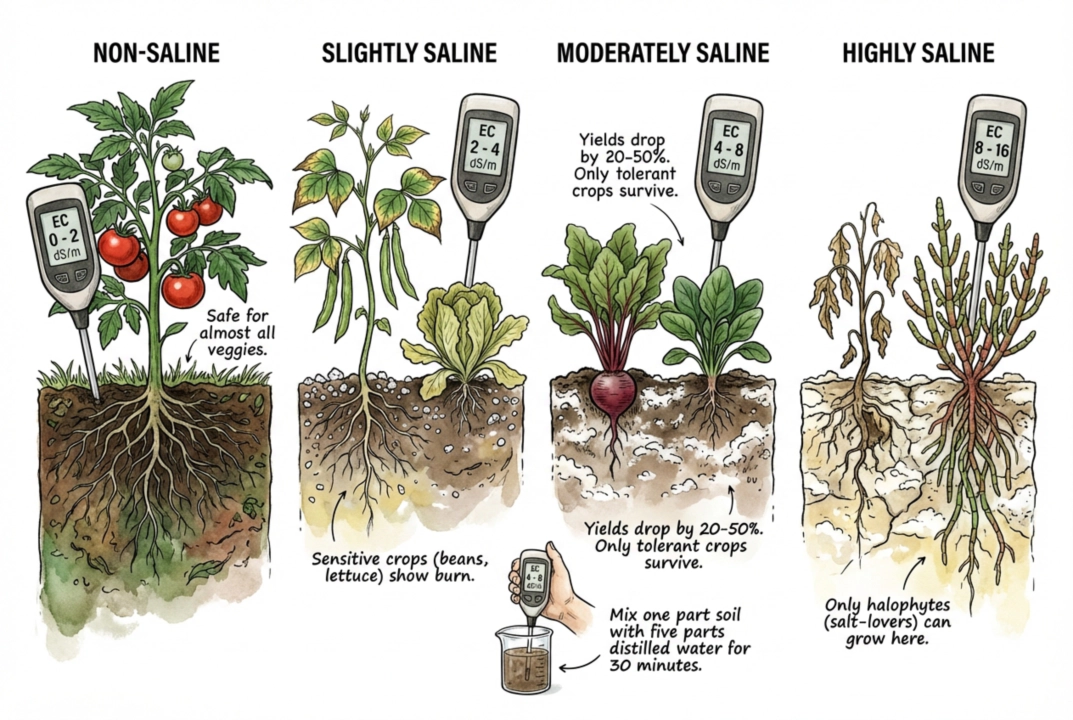
| Salinity Class | ECe (dS/m) | General effect |
|---|---|---|
| Non-saline | 0 – 2 | Suitable for most vegetables. |
| Slightly saline | 2 – 4 | Salt-sensitive crops (e.g. Beans, lettuce) begin to lose yield. |
| Moderately saline | 4 – 8 | Many crops lose yield. More tolerant crops still perform, depending on species. |
| Highly saline | 8 – 16 | Only the most salt-tolerant crops and halophytes grow well. |
Separate ECe From Home EC
Salinity is reported as electrical conductivity (EC), usually in deciSiemens per meter (dS/m).
The key detail is which EC you have. Crop-tolerance tables are based on saturated-paste extract EC (ECe), while a pocket meter reads the EC of irrigation water (ECw) or of a soil-and-water extract you mix yourself. These are related but not interchangeable.
As a rough guide, salt-sensitive vegetables tend to start losing yield above about 2 dS/m ECe, but the exact threshold and rate of loss differ by crop.
Pocket EC Meter
A handheld pocket EC meter is a reasonable way to check the EC of your irrigation water or a standardized soil extract.
It is a general water-solution meter, not a probe you push into dry soil, and its reading is only meaningful if you follow a consistent method (calibration, temperature, a defined soil-mass-to-water-volume ratio, mixing and settling time, and sampling depth).
For decisions about which crops to grow or how much to leach, confirm the numbers with a lab saturated-paste ECe test rather than relying on the meter alone.
Crop Salt Tolerance | UC Davis
With drip irrigation, I take one labeled sample beneath the emitter and another at the outer edge of the wetted zone at the same depth. I never blend them. The edge can collect salts while the soil directly under the emitter looks acceptable, and a single composite result can hide that pattern.
I use the same extraction ratio and settling time for every home comparison and measure the irrigation water separately. When the paired readings move in opposite directions, I send depth-specific samples for laboratory ECe testing before changing the leaching plan.
How Can I Manage Salt in My Garden?
Confirm Drainage Before Leaching
The main way to lower salt in the root zone is leaching, which applies enough good-quality water to move soluble salts below the roots. This only works where the soil drains freely.
Where rainfall is limited, as in much of the arid West, you may need to add water deliberately. First confirm that your soil actually drains, check your irrigation-water quality, and rule out a sodium or sodic problem. On poorly drained, high-water-table, or sodic soils, simply adding more water can cause waterlogging and make conditions worse.
The Leaching Technique
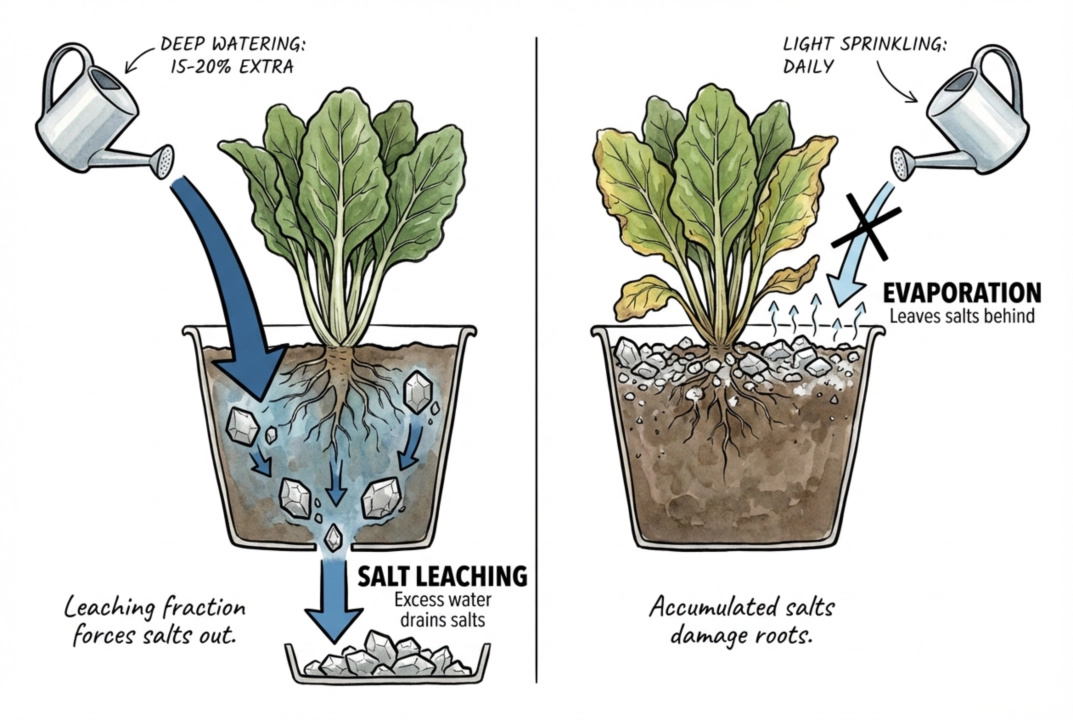
Calculate the Leaching Fraction
Leaching works by applying somewhat more water than the crop uses so the excess drains out the bottom and carries salts with it.
There is no single universal percentage. The fraction needed is calculated from your irrigation-water EC, the target crop’s tolerance, evapotranspiration, effective rainfall, and how uniformly you irrigate.
It is also worth distinguishing routine operational leaching from a one-time reclamation leaching of an already-salty soil, and to re-test ECe by depth before and after so you know whether it is working.
Confirm Drainage Before Adding Water
On soils with poor drainage, a restrictive layer or a high water table, adding extra water will not remove salt and can cause harm. Have the drainage assessed by a qualified specialist first.
Set Irrigation Frequency by Conditions
How often to water depends on crop rooting depth, soil texture, emitter output, evapotranspiration, and salinity, not a fixed rule.
The common deep-and-infrequent advice is a general dry-climate habit, not a law of salinity management. Under saline conditions, more frequent irrigation can actually help by keeping salts from concentrating between waterings.
Very light daily surface sprinkling can leave salt behind through evaporation in some situations, but that is about method and purpose, not a blanket rule.
Drip vs. Spray
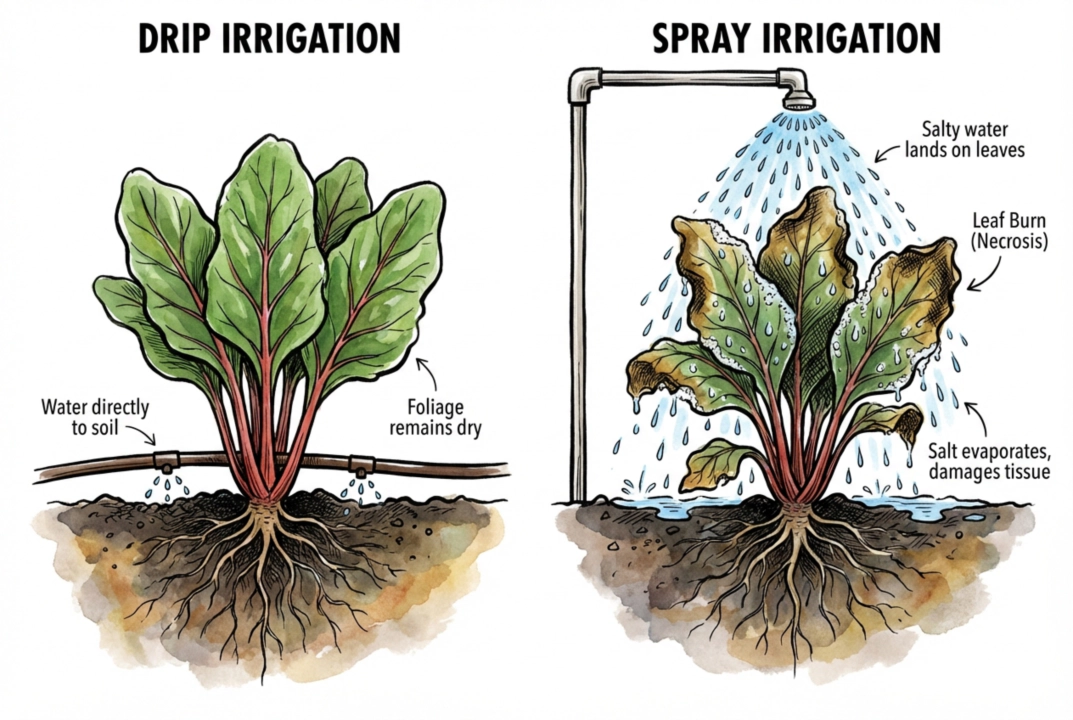
Use Overhead Spray Deliberately
Overhead sprinkling with saline water can scorch foliage because salt deposited on wet leaves can concentrate as the water evaporates.
But this is not automatic or instant. The risk depends on the water’s sodium and chloride levels, the crop’s sensitivity, how long leaves stay wet, and the weather and time of day.
Sprinklers are still used deliberately in some situations, such as leaching the seedling zone, and there are trials where moderately saline sprinkler water did not reduce lettuce yield.
Use overhead application cautiously rather than treating it as universally forbidden.
Drip Irrigation
A drip irrigation system delivers water to the soil and reduces leaf wetting when you want to keep salty water off the leaves.
It does not keep foliage completely dry because rain and splash still wet leaves. Drip also has salinity tradeoffs, including salt building up at the edge of the wetted zone and emitter clogging with saline water, so plan for periodic leaching, filtering, and line flushing.
Which Leafy Greens Survive Salty Soil?
Start With Chard and Beet
Tolerance Is Relative
Swiss chard and table beet are among the more salt-tolerant garden vegetables. Both are forms of Beta vulgaris and share ancestry with wild sea beet (Beta vulgaris subsp. maritima).
That ancestry is background, though. What matters in your garden is the specific cultivar and the actual ECe in the root zone.
Compare Leafy Green Sensitivity
Lettuce is sensitive and starts losing yield at fairly low ECe, whereas chard tolerates considerably more.
Figures around 6–8 dS/m come largely from sand-culture and drainage-water studies rather than a universal soil ECe, so treat them as an indication that chard is relatively tolerant, not as a guaranteed threshold for your soil.
Swiss Chard Is Relatively Tolerant
Swiss chard is a relatively salt-tolerant leafy green. Widely grown cultivars such as Fordhook Giant are commonly used, though there is no cultivar-comparison trial here to single one out as the toughest.
Beet Tolerance Does Not Guarantee Sweetness
Both beet roots and greens are relatively tolerant. Salt stress can change the sugar concentration in beet roots in some trials, but this comes alongside lower yield and depends on cultivar and ion balance, so it is not a reliable way to make beets sweeter.
Spinach Is More Sensitive
In most tolerance tables spinach is on the moderately sensitive side rather than tolerant, and its tendency to bolt depends on cultivar, day length and temperature as well as heat.
Tolerance of Vegetable Crops to Salinity | USDA-ARS (Shannon & Grieve)
The New Zealand Alternative
Establish New Zealand Spinach Before Salt Stress
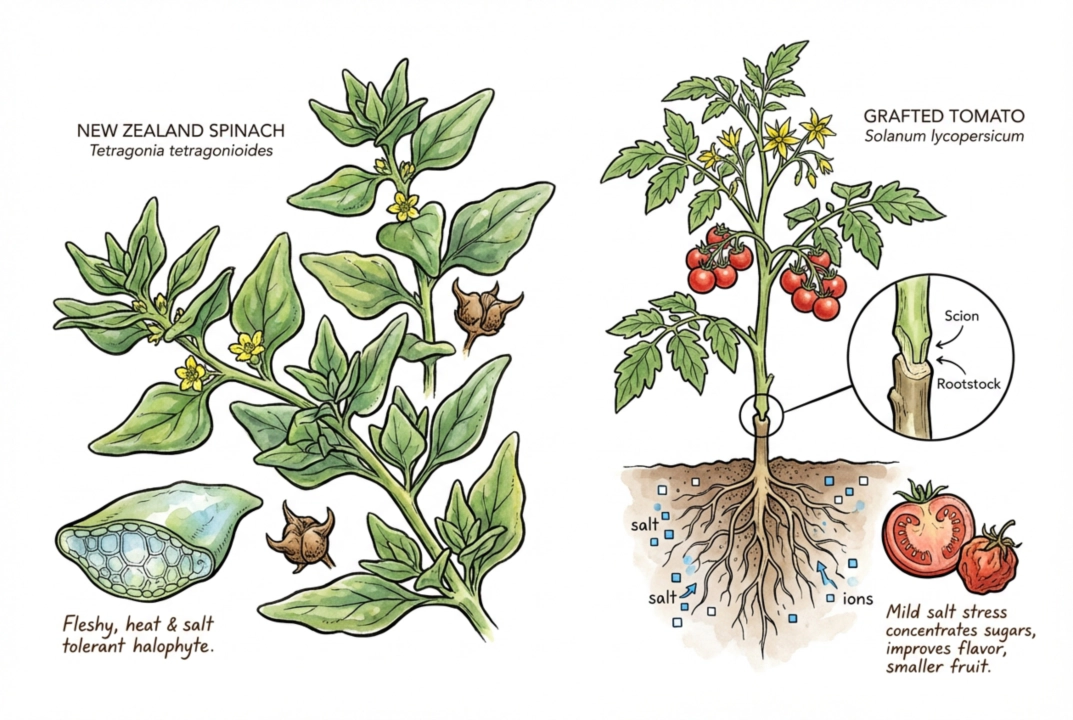
If your soil is too salty for regular spinach, New Zealand spinach (Tetragonia tetragonioides) is worth considering.
It is a fleshy, heat-adapted succulent, and USDA-ARS sand-culture work confirms it is genuinely salt-tolerant.
That tolerance is not unconditional, though. In those trials the salt level a plant could take varied a lot with the growth stage at which salinity began (young seedlings were far more vulnerable) so establish it in less-saline conditions, make sure the soil drains, and check whether it is considered invasive or a food-use concern in your area before growing or eating it.
Can I Grow Tomatoes in Saline Soil?
Rootstock Traits Are Not Salinity Ratings
| Rootstock variety | Vigor level | Breeder positioning |
|---|---|---|
| Maxifort | High | Vigorous rootstock often used for disease resistance and general vigor. |
| Estamino | Balanced | Marketed for balanced growth and steady production. |
| Arnold | High | Strong root system with balanced vegetative/generative growth. |
Use Grafting as a Conditional Option
Tomato is usually classed as moderately sensitive to salinity, not tolerant. Grafting the variety you want onto a vigorous rootstock can improve vigor and help exclude sodium, and studies show it can raise yield under salt stress, but how much depends on the specific scion×rootstock pairing, the salt level and the growing conditions, so it is a conditional option rather than a guaranteed fix.
Grafting also adds transplant cost and requires compatibility, and it is worth checking local trial results for your situation.
Salt Can Concentrate Flavor and Reduce Yield
Research indicates that moderate salt stress can raise the concentration of soluble solids and acids in tomato fruit while reducing fruit size and total yield.
Higher concentration is not the same as better taste to a person, so this is a tradeoff to be aware of, not a reason to add salt deliberately.
Which Crops Should I Avoid?
Sensitive Legumes Need Crop-Specific Testing
Common bean, fava (broad) bean, and garden pea are on the salt-sensitive end and are often the first vegetables to show trouble.
That does not mean all legumes are equally sensitive. Cowpea, lima bean, soybean, chickpea, and tepary bean respond differently, so there is no single threshold at which every legume should be avoided.
If you suspect salinity, confirm it with a lab saturated-paste ECe test and check the specific crop’s tolerance rather than assuming.
Read Symptoms in Context
Brown Margins Have Several Causes
Leaf margins turning brown and crispy can accompany salt or specific-ion injury, but the same symptom also comes from fertilizer burn, drought, root damage, and disease. Use the water or soil EC and the pattern across the garden to tell them apart rather than reading the leaf alone.
Cowpea Is a More Tolerant Legume
Cowpea, or black-eyed pea, is more salt-tolerant than common green bean, though it is moderately tolerant rather than immune and still needs sound salinity management.
Common Beans Struggle First
Common green bean, fava bean, and garden pea are the vegetables in this group most likely to struggle first in salty soil.