
Drought Tolerant Seeds: What Dry Farming Actually Requires
What drought tolerant really means for vegetables: how climate, winter rainfall, soil depth, and water-holding capacity, not just the seed, decide whether varieties like Early Girl, tepary beans, or dent corn can crop with little or no irrigation.
Jordan Cole · Published 2026-01-09 · 27 min read
Key Takeaways
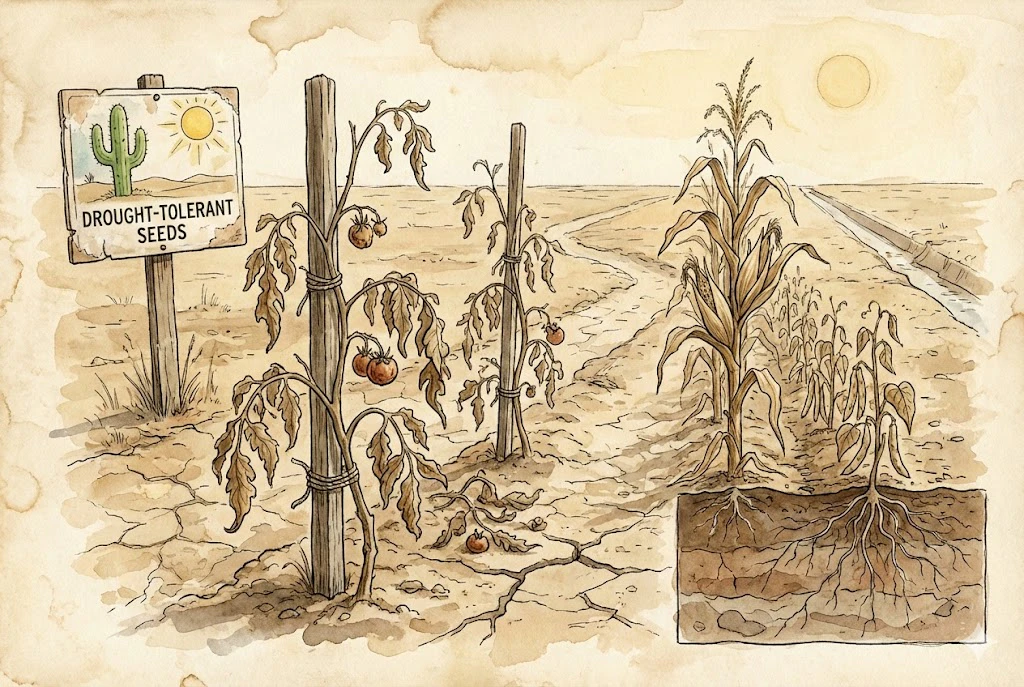
- Researchers describe three overlapping drought strategies (escape by finishing before the drought, avoidance through deep roots or closed stomata, and true cellular tolerance). A single variety often uses more than one, and survival is not the same as setting a marketable crop.
- The site usually matters more than the seed. Deep soil that banks winter rain gives a plant more to draw on. Water-holding capacity ranges from roughly 1.8–2.5 in. Per foot in clay loams down to well under 1 in. Per foot in sands. Shallow or sandy ground makes low-water cropping much harder, though short-season crops and rainfall can still change the math.
- Wider spacing gives each plant more soil to draw from. Reported dry-farm spacings (tomatoes 4–6 ft, melons 6–8 ft, corn in ~4 ft hills) are starting points from specific trials, not universal rules. Optimal density varies by crop, cultivar, and site and is still not well settled.
- Varieties with a track record in specific regions include ‘Early Girl’ and grafted heirlooms for tomatoes (strong on the California coast. Poorer in western Oregon), tepary beans and the bush dry bean ‘Whipple’ for legumes, and dent/flour corns like ‘Painted Mountain.’ Dry-farmed squash and melons tend to be smaller. Storage and flavor results vary by cultivar and trial.
- Management matters as much as genetics. Plant early into moist soil so roots establish deep, control weeds aggressively, and expect smaller, tougher, often more concentrated fruit. Containers have no subsoil bank, so they can’t dry-farm in the field sense. Sub-irrigation is the closest workaround.
What Drought-Tolerant Means for a Grower
Drought tolerant means something different to a botanist than it does to a grower, and that gap is where most disappointment comes from.
A drought-tolerant plant still has to produce a useful crop. Survival alone is not enough if the plant is stunted and will not set fruit.
Vegetables generally cope in three overlapping ways. Some finish before the soil dries, some avoid stress with roots or reduced water loss, and some keep functioning under dehydration.
Use those ideas to understand the trade-off, not to assume a seed will overcome an unsuitable site.
Three Drought Strategies
Drought Escape
These plants outrun drought rather than endure it, finishing their life cycle before soil moisture runs out. An early-maturing corn or a 60-day bean can set seed and senesce before the intense heat of late summer. For the grower this means planting early and harvesting early. Where the season and frost dates allow it, that’s often a reliable approach because the plant dodges the worst of the dry period.
Drought Avoidance
These plants invest in extensive root systems that reach subsoil water other plants can’t, or they close their stomata to slow water loss. The trade-off is that when stomata close, carbon-dioxide intake and growth slow sharply, so the plant largely pauses development to ride out the dry spell.
True Drought Tolerance
These plants keep functioning even as their cells dehydrate, often using osmotic adjustment by accumulating solutes such as sugars, proline, and ions so water is held against dry soil. This is a real mechanism, though it isn’t a guarantee of smaller or more flavorful fruit. In some studies osmotic adjustment actually helps maintain yield.
In practice these strategies blur together. Many vegetables marketed as drought-tolerant still slow down once irrigation stops. The better dry-farm candidates combine deep rooting with enough resilience to set a crop while water is short, but the site often decides the outcome.
The Soil Reservoir (Why the Site Often Matters More Than the Seed)
Deep soil comes before variety choice. Even a drought-resilient seed has little stored water to draw on in shallow sand or above a compacted layer. Rainfall, crop duration, and management matter as much as the seed.
The premise of low-input water farming, dry farming, is that the soil is a bank. In the maritime climates of the Pacific Northwest and parts of California, the bank is filled by winter rains.
Systems that rely on pre-irrigation or snowmelt to charge the profile aren’t strictly zero-irrigation, so it’s worth separating true dry farming from deficit or pre-irrigated approaches.
The dry farmer’s goal is to withdraw that moisture slowly over the season without overdrawing the account.
Tomato dry farming as an agroecological model for California’s drought resilient future
The Myth of Any Soil Will Do
Marketing sometimes implies drought-tolerant seeds are a fix for poor soils. For low-water field cropping it’s often the reverse. Deeper soil with more stored water gives the plant more to work with. Short-season escape crops are a partial exception because they can sometimes finish on a shallower profile.
Across dry-farm studies, effective soil depth and water-holding capacity are among the strongest predictors of success (frequently mattering more than which tomato variety you choose).
Deep silty clay loams and clay soils hold the most available water and act like a dense sponge, though drainage, temperature, disease, and root restriction all still factor in.
Water-holding capacity depends on texture. NRCS figures put clay loams around 1.8–2.5 inches of available water per foot, and many sands well under 1 inch per foot.
But the water a crop can actually use also depends on the effective root depth, whether the profile is filled to field capacity, any restrictive layer, salinity, and rock fragments, so you can’t simply multiply a per-foot figure by five feet and assume a season’s supply is banked.
A sandy soil holding a fraction of that per foot drains faster than a deep-rooted crop can draw on it, which is why sandy ground is a poor bet for zero-irrigation cropping unless rainfall or a short-season crop closes the gap.
If you have sandy or shallow soil, plan to irrigate, or at least test the profile before committing.
Building raised beds or fracturing a compacted layer with a broadfork can help rooting, but neither creates a deep winter-water bank where the underlying soil is shallow over hardpan or bedrock.
Genetics can’t substitute for storage capacity the soil doesn’t have.
The Dust Mulch (Ugly but Effective)
There’s a surface-management technique that fell out of favor with the no-till and soil-health movements, which prioritize keeping soil covered at all times.
Those practices are valuable for long-term soil biology, and the case for cultivating a bare surface instead is specific to a strictly non-irrigated crop in a dry summer. It isn’t a general recommendation.
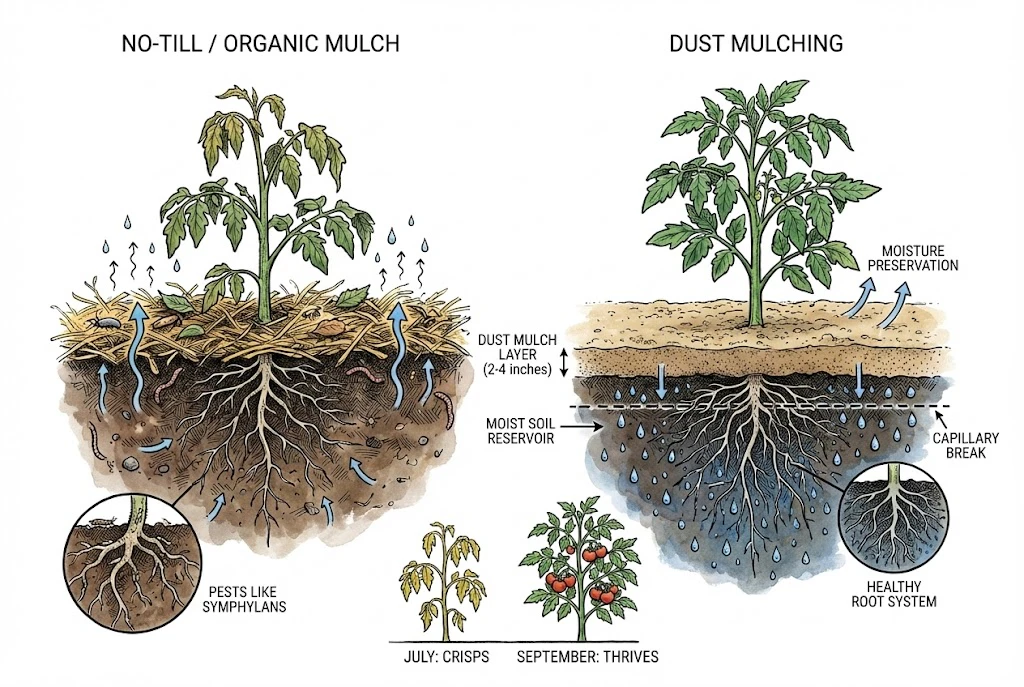
The technique is dust mulching. Cultivating the top 2–4 inches of soil into a dry, loose, powdery layer.
The idea is that breaking the capillary continuity of the pores slows moisture in the wetter layers below from wicking up and evaporating.
Some California dry farmers favor this practice and credit it with holding a crop through the season.
It’s worth noting the trade-offs, though. Replicated OSU dry-farm tomato work did not find a clear yield or soil-drying advantage for a deeper dust mulch over shallow (1–2 in.) clean cultivation, and in that work aggressive weed control mattered more than the mulch depth.
Cultivating the surface also costs soil structure and can raise erosion risk.
Organic mulches (straw, leaves) can also reduce surface evaporation. Applied too thinly they may wick some moisture out, and they can harbor pests such as symphylans that feed on roots, but they cool the surface and suppress weeds, which is why they’re often preferred in hotter regions.
In short, dust mulch, organic mulch, clean cultivation, and no-till are options to weigh against your soil, climate, weed pressure, and erosion risk, not a settled winner.
Vegetable Gardening Using Less Water (OSU Extension Master Gardeners)
Spacing (The Geometry of Scarcity)
One of the most underrated drought-management levers isn’t a product at all (it’s spacing).
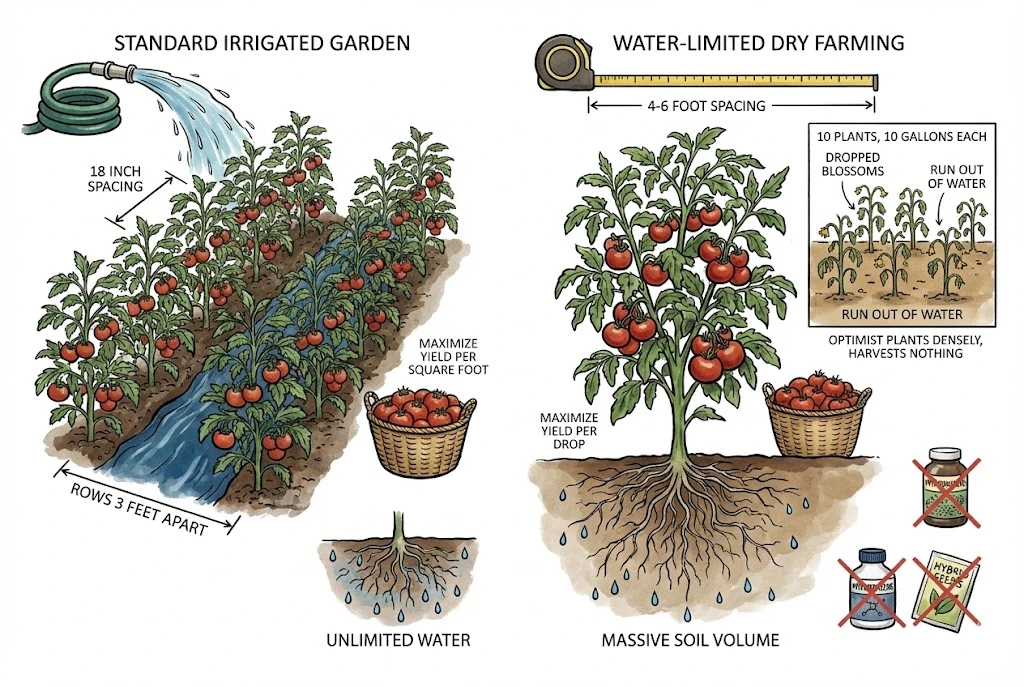
In a standard irrigated market garden you might plant tomatoes 18 inches apart in rows 3 feet apart, maximizing yield per square foot because water can be replaced on demand.
In a water-limited system that same density can leave every plant short, so the goal shifts toward yield per unit of stored water.
Dry-farm trials generally use wider spacing so each plant can draw on a larger soil volume (figures like tomatoes 4 to 6 feet apart, melons 6 to 8 feet apart, and corn in hills on a roughly 4-foot grid come up repeatedly).
Treat these as reported starting points. SARE and OSU note that the optimal density isn’t well settled and varies by crop, cultivar, and site, and some trials have found higher tomato density gives more yield per unit area even under stress.
The underlying logic is simple (a fixed pool of stored water has to be shared among however many plants you grow) but the relationship between density and yield isn’t linear, so the best spacing for your crop and site is something to confirm from local trials rather than a single formula.
The Tomato (The Flagship Dry-Farm Crop)
Few vegetables show the potential, and the risk, of water stress as clearly as the tomato (Solanum lycopersicum).
It’s the crop most associated with dry farming in the West, where dry-farmed tomatoes are often marketed at a premium over irrigated ones, though the size of that premium varies by market and isn’t a fixed multiple.
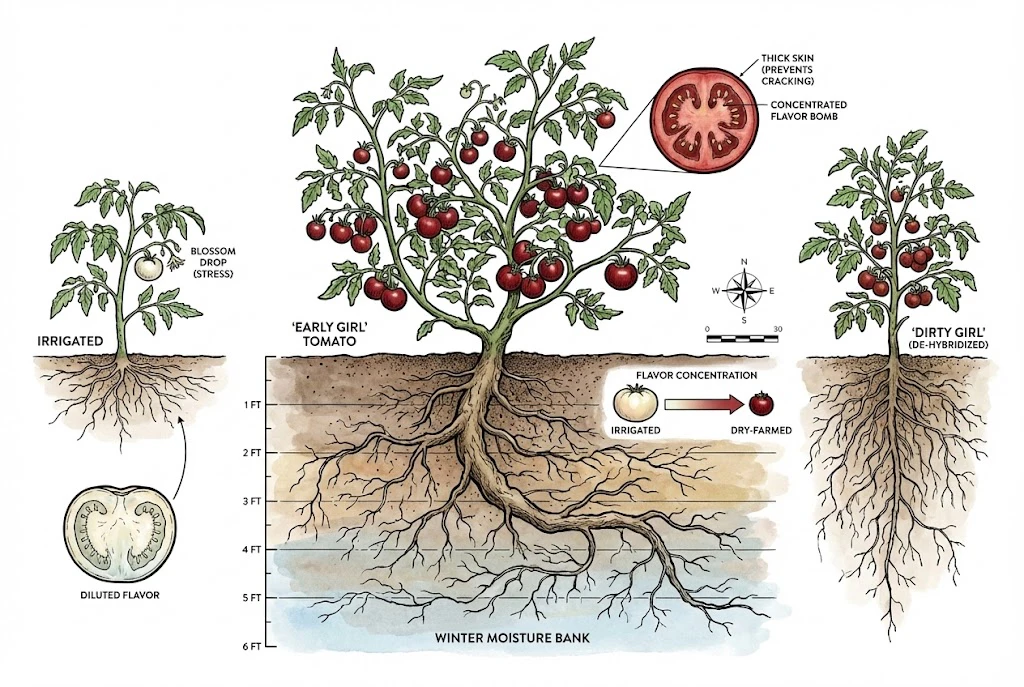
Deficit water can change a tomato. Once the plant slows water flow into the fruit, the fruit tends to stay smaller and, in some cases, more concentrated in sugars and acids.
This isn’t automatic. Trials (below) have found the effect varies by variety, and dry-farmed and irrigated fruit don’t always taste different.
And getting there means managing several physiological failure points.
Comparing dry farming of tomatoes across varieties and soil management history
The Early Girl Phenomenon
The most-cited example is the Early Girl tomato, an F1 hybrid long thought of as a plain supermarket variety.
Under dry farming it has a strong reputation, particularly in coastal California, where it’s a traditional benchmark for non-irrigated production.
That reputation isn’t universal. In western Oregon trials Early Girl has shown high blossom-end rot (reported in the 41–71% range) and comparatively low yields, and current OSU guidance generally doesn’t recommend it there except under cooler, more sheltered conditions.
So it’s a regionally strong choice, not an undisputed champion everywhere.
It has performed well in several university dry-farm trials against a range of other varieties, though the widely repeated claim that it beat hundreds of varieties and almost always wins overstates what those trials tested (one recent comparison, for instance, looked at only a handful of genotypes).
Early Girl is often credited with an aggressive, deep-diving root system that reaches the winter moisture bank, but a variety-specific taproot depth (the frequently quoted 4–6 feet) hasn’t been directly measured, and one trial left root depth as a question for future work.
Its relatively thick skin is sometimes described as an advantage under stress, potentially reducing cracking, though there isn’t a clear measured mechanism showing it conserves fruit moisture better than other cultivars.
As an indeterminate, it sets fruit over a long window, so if a heat spell causes it to drop blossoms early, it may set more fruit later in the season (an advantage that determinate types, which set closer to all at once, don’t share as easily).
Because Early Girl is a proprietary hybrid, some California growers have saved seed over many generations to stabilize an open-pollinated version informally known as Dirty Girl. It’s described in farmer accounts as performing similarly with a bit more variation, though there isn’t robust replicated trial data to treat that as a settled result.
Dry Farming Early Girl Tomatoes (SARE)
The Scourge of Blossom End Rot (BER)
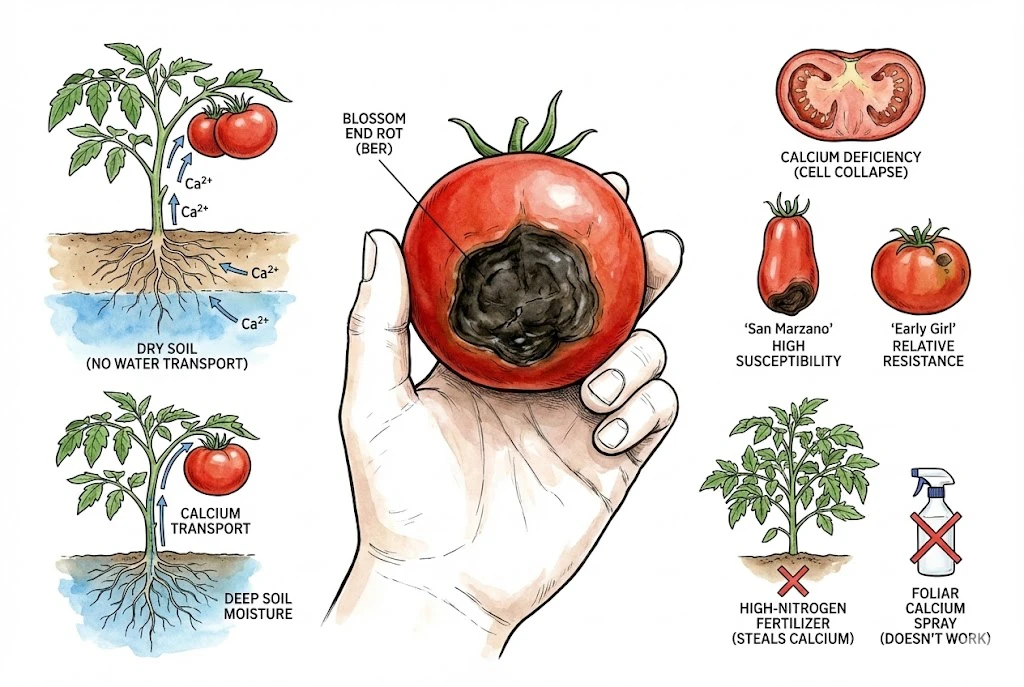
A major challenge for the dry-farm tomato grower is blossom-end rot (BER). You pick a good-looking red tomato, turn it over, and find the bottom is a sunken, dark, leathery patch.
(A photo helps confirm it. By description alone it can be confused with sunscald or fruit rot.)
BER isn’t a disease. It’s a physiological disorder linked to calcium. Many soils already contain adequate calcium, so the problem is often transport rather than supply. Calcium moves in water, so when little water is flowing from roots to fruit, calcium can fall short and the developing fruit’s cell walls fail.
Dry soil is one driver, but cultivar susceptibility, salinity, root damage, rapid growth, and temperature all contribute.
BER rates vary widely by cultivar and season. Susceptible types such as San Marzano and some large beefsteaks can be badly affected, while more resistant types stay low. Recent OSU dry-farm figures, for example, showed roughly 44% in a susceptible type versus about 7% in a resistant one, so headline 90% figures aren’t typical.
Foliar calcium sprays work poorly on existing BER because calcium is largely immobile once in plant tissue.
The more reliable approach is to keep soil moisture consistent (through appropriate spacing and soil prep) so calcium keeps moving, and to avoid pushing heavy nitrogen, which drives fast leafy growth that can compete with the fruit for calcium.
The Grafting Revolution (Renting a Better Root System)
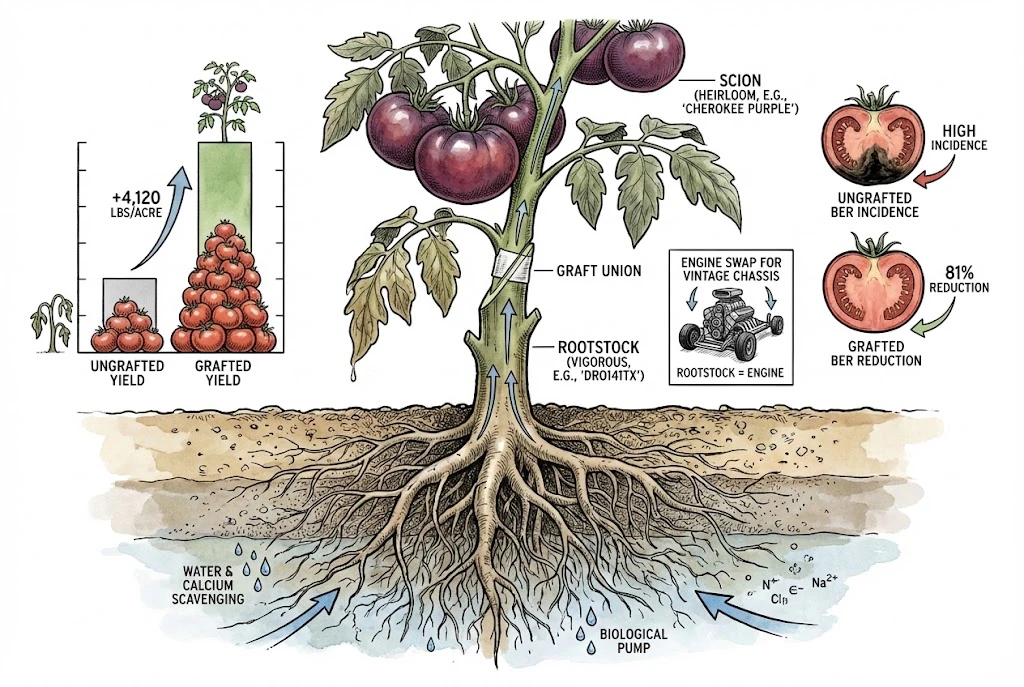
Many heirlooms like Cherokee Purple or Brandywine struggle without irrigation, in part because their root systems aren’t as vigorous under stress.
Grafting is one workaround. Joining the top (scion) of a favored heirloom onto the roots (rootstock) of a more vigorous line.
How well it works still depends on the specific rootstock, scion, graft compatibility, and site.
In an OSU dry-farm station trial, the rootstock DRO141TX raised yield by about 110% and fruit size by roughly 42% and cut blossom-end rot by about 81% versus ungrafted plants (as reported in the SARE OW22-369 follow-up).
Those numbers are tied to that trial’s cultivars, site, and years, so treat them as promising rather than a guaranteed result on your farm.
A vigorous rootstock can improve water and nutrient uptake, which helps supply a demanding scion when soil is dry.
That doesn’t mean any rootstock behaves the same way. Maxifort, Fortamino, and DRO141TX are different rootstocks with different performance, so each is worth checking for your conditions rather than treating them as interchangeable.
If you want to dry-farm heirlooms, buying or learning to make grafted plants is a reasonable path to test.
2016-2018 Dry Farming Collaborative Variety Trials (Oregon State University)
Legumes (The Desert Survivors vs. The Garden Divas)
Where tomatoes are demanding, legumes vary enormously by species in how they handle heat and drought, so the first practical decision is which species you plant, not just which variety.
There’s also wide variation within common beans themselves and by crop use (dry bean versus green bean).
The Tepary Bean (The Desert Specialist)
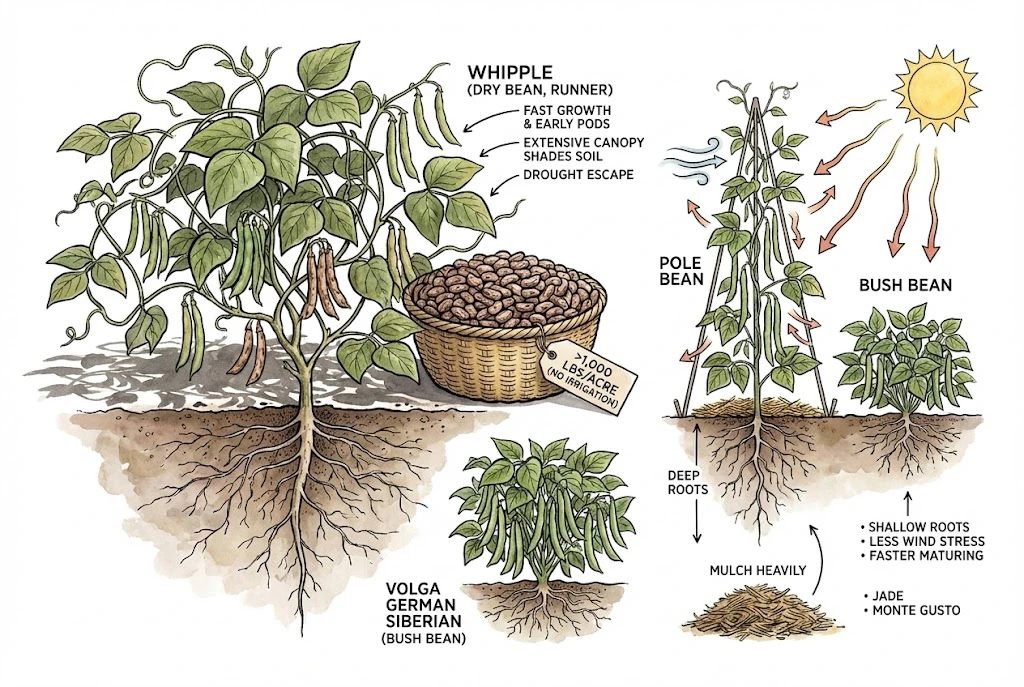
Whipple is officially a bush dry bean, not a runner. Its trial-average yield is closer to ~896 lb/ac, with a wide range across years and sites.
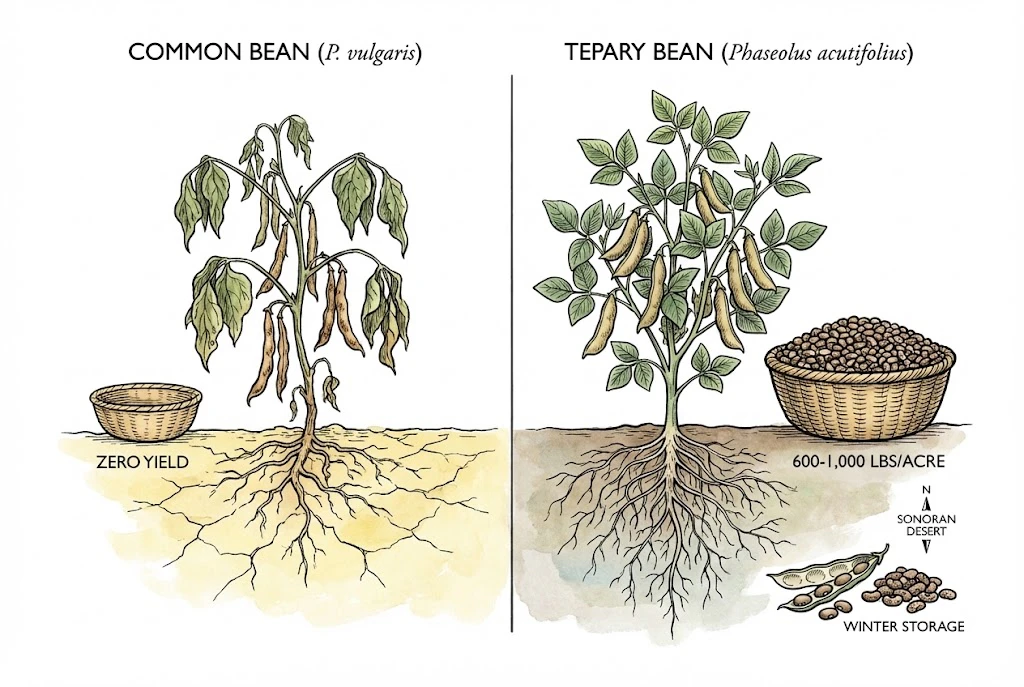
For drought tolerance among beans, the tepary bean (Phaseolus acutifolius) is one of the strongest choices.
Native to the Sonoran Desert and cultivated by Indigenous peoples such as the Tohono O’odham for millennia, it holds up in heat and dryness that common green beans can’t.
In terminal-drought comparisons, common beans (P. vulgaris) lost the large majority of their yield, roughly 92–96% in one multi-environment study, while teparies lost far less at about 34–40%. A zero result for common beans reflects those specific severe-drought conditions, not every environment.
Teparies also use leaf movements called paraheliotropism to reduce sun exposure. That trait is shared with some other legumes, not unique to teparies.
Reported dryland tepary yields fall around 350–700 lbs/acre (USU Extension), rising to roughly 800–1,500 lbs/acre irrigated. Modest next to irrigated soy, but meaningful where a common-bean crop would fail.
The seeds are small, dense, and nutty, and are typically grown as a dry bean for winter storage.
Drought-Tolerant Options for Southwest Agriculture. Edible Produce (Utah State University Extension)
Common Beans (The Whipple Factor)
Among common beans, ‘Whipple’ is a heirloom dry bean that has been one of the higher performers in Oregon dry-farm trials.
Note that it is officially a bush dry bean (about 110 days to maturity), not a sprawling runner (a distinction the popular write-ups often get wrong).
Its 2016–2018 trial average was around 896 lbs/acre, with a wide range, roughly 261–1,350, across years and sites. Other beans such as Volga German averaged similarly at about 891 lbs/acre.
So it’s a solid, tested option, but not a runaway winner that consistently clears 1,000 lbs/acre.
Canopy architecture and maturity do influence transpiration and drought escape, but the neat rule that pole beans always root deeper and bush beans always escape better doesn’t hold across varieties, supports, and soils (it’s better to check performance for the specific type you’re growing).
A workable starting point. For dry beans, tested bush types like Whipple. For green beans, fast-maturing bush types or heat-tolerant pole types, mulched where the climate is hot and dry.
Drought Tolerant Varieties of Common Beans (Phaseolus vulgaris) in Central Afghanistan
Cowpeas (The Southern Strategy)
The cowpea (Vigna unguiculata), or black-eyed pea, is physiologically distinct from the common bean and generally more heat- and drought-tolerant, often maintaining growth at lower water potentials.
Its stomatal behavior isn’t fixed, though. Depending on genotype and how severe the stress gets, cowpeas do close stomata too.
If your summers are trending hotter and drier, cowpeas are worth trying in place of navy beans, keeping in mind that suitability also depends on your daylength, pests, market, and how you use the crop.
Corn (The Spacing Game)
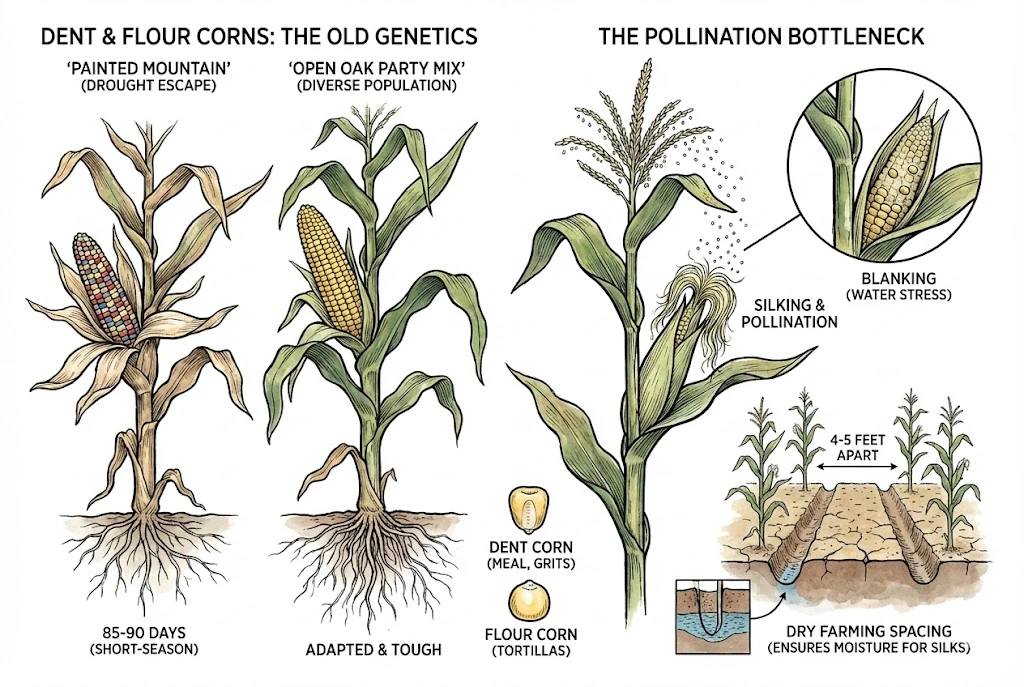
Corn (Zea mays) is a grass with high water demand, so growing it without irrigation can seem counterintuitive, yet it was a staple across the Americas long before mechanized irrigation, supported by Indigenous water-harvesting, soil management, adapted landraces, and careful timing.
Spacing and variety choice both matter.
Dent and Flour Corns (The Old Genetics)
Modern super-sweet corn is bred for sugar and tenderness and often isn’t robust enough for low-water field conditions (though a specific sugar-versus-root-vigor trade-off isn’t well documented).
For drought work, growers usually turn to dent and flour corns grown for meal, grits, and tortillas. ‘Open Oak Party Mix,’ stewarded by Adaptive Seeds and the dry-farming community, is a genetically diverse population. Plants differ from one another, so in a dry year the hardier individuals set seed and gradually adapt the population to local conditions.
Open Oak has been a strong yielder in Oregon dry-farm trials, averaging around 3,670 lb/ac. ‘Painted Mountain,’ bred by Dave Christensen in Montana, is prized as a short-season escape corn. Seed sources list it around 85–90 days to dry corn, though OSU trials recorded a longer average of about 113 days to harvest, so the maturity you get depends on region and how harvest is measured.
It yields less than Open Oak but can be a surer bet in a short, dry window.
The Pollination Bottleneck
The critical moment for corn is silking. If the plant is water-stressed then, pollen can shed before the silks emerge (a widened anthesis–silking interval), and the result is blanking (ears with missing kernels).
Heat, nutrition, and pollination density can cause blanking too, so it isn’t always a moisture-timing problem alone.
To keep enough moisture available at silking, dry farmers often plant corn in widely spaced hills, figures around 4 to 5 feet come up, so each plant has more soil to draw on. This is a reasonable starting point rather than a guarantee. Too sparse a stand can also hurt wind pollination, so local trials matter.
Integrating multi-trait and multi-index approaches for identifying drought tolerant tropical maize genotypes
Cucurbits (Mining the Deep)
Squash and melons can root deeply. A vigorous squash plant may send roots well down into the profile, often deeper than shallow-rooted crops like lettuce or onion, reaching moisture those crops can’t, though exact depth depends on the species, soil, and any restrictive layer.
Winter Squash (The Storage Surprise)
One useful finding in recent research concerns the relationship between irrigation and storage life.
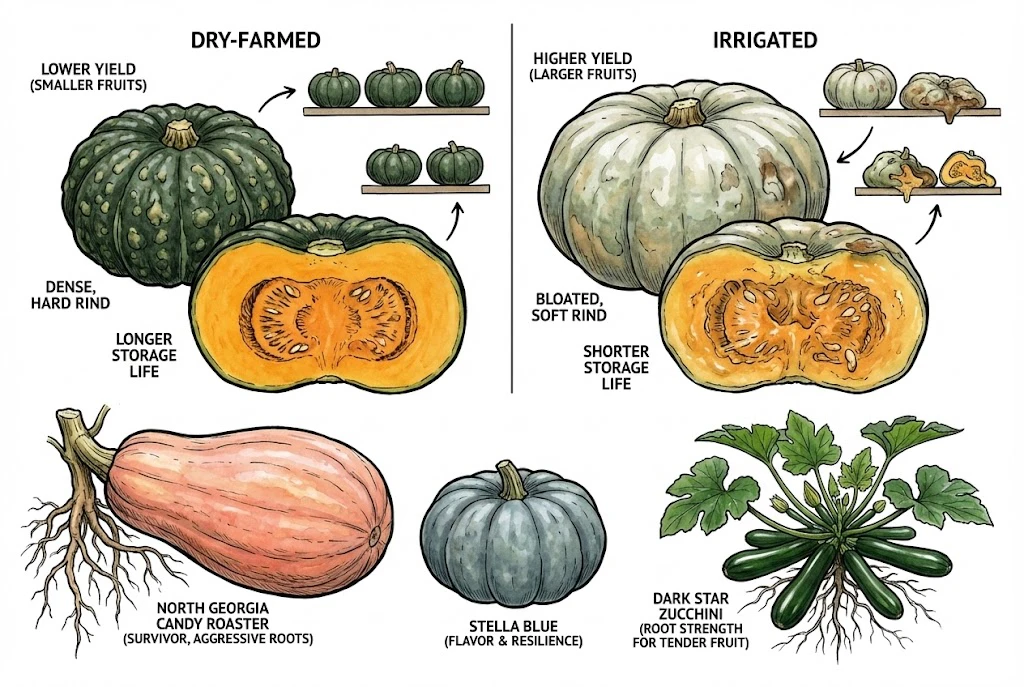
In a SARE winter-squash study (OW16-008), zero irrigation lowered initial yield but reduced four-month storage rot loss in some of the tested varieties.
The common explanation is that dry-farmed fruit are denser and lower in water content, so they resist rot better in storage. That is plausible, but the study didn’t directly measure excessive water content or rind hardness, so treat it as a likely mechanism rather than a proven one.
The top dryland-storage varieties in that formal comparison included ‘Small Wonder,’ ‘North Georgia Candy Roaster,’ and ‘Silver Bell.’ ‘Stella Blue’ (a kabocha) and ‘Dark Star’ zucchini are grower favorites but weren’t part of that storage comparison.
Winter squash. Extending the season and expanding the uses (SARE)
Melons (The Sweet Spot)
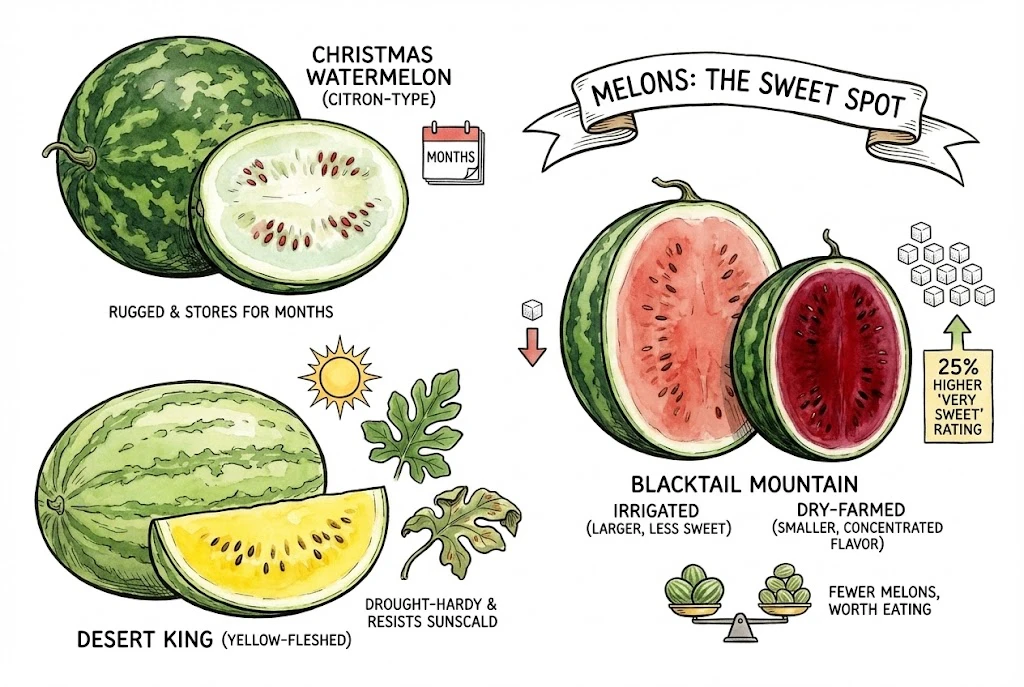
Drought can affect melon soluble solids much as it does tomatoes, though the effect isn’t consistent across varieties. ‘Christmas’ is a long-storing heritage watermelon (Citrullus lanatus, not a citron-type) that has shown storage potential in dry-farm trials, though OSU notes its flavor rated below some other varieties. ‘Desert King’ is a yellow-fleshed watermelon with a reputation for drought hardiness, but it wasn’t part of the cited Oregon trial, so treat those two as separate cases rather than an equally proven set.
In a 2019 demonstration, a larger share of tasters, about 25 percentage points more, rated dry-farmed ‘Blacktail Mountain’ watermelon as very sweet than the irrigated version. That is a difference in preference votes, not a measured 25% jump in sugar, and the report notes that sweetness response varied by variety.
The practical takeaway is usually fewer, smaller melons that many people find more flavorful.
Dry Farm Melon Production in Oregon (SARE)
Peppers (The Heat Problem)
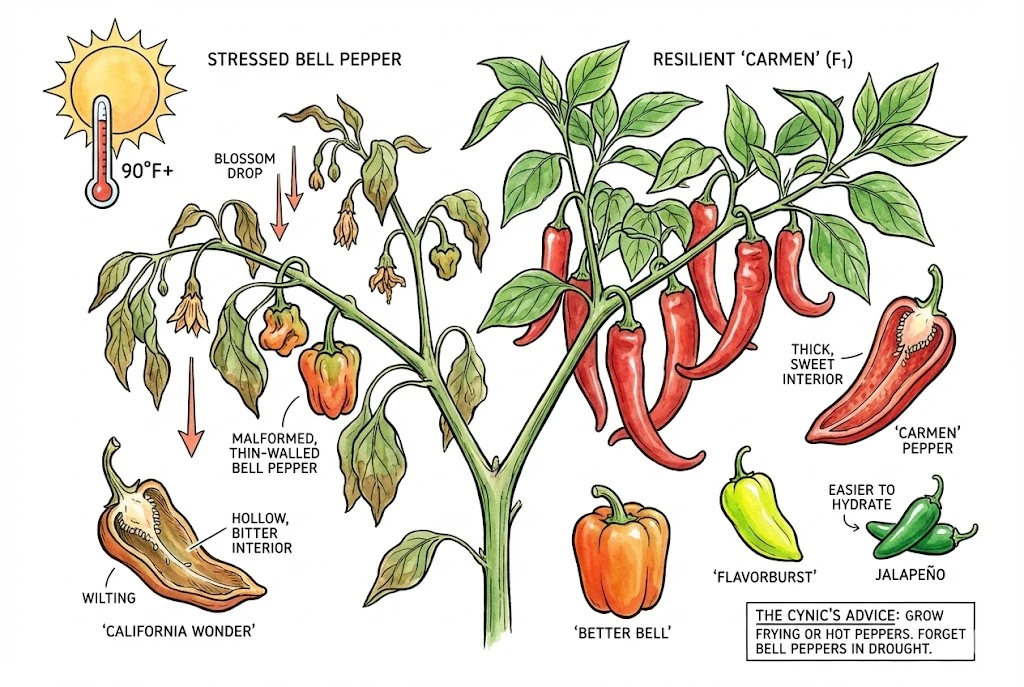
Peppers (Capsicum annuum) tend to root less deeply than tomatoes, and in hot, dry conditions a common failure mode is heat-induced blossom drop rather than outright wilting.
As temperatures climb into the 90s °F (around 32 °C and up), pollen viability can drop and flowers may abort, reducing fruit set.
It isn’t a single hard switch, though. How much you lose depends on night temperature, how long the heat lasts, humidity, water status, and the cultivar, so one hot afternoon rarely means zero fruit.
Varieties That Don’t Quit
‘Carmen’ (F1), a Corno di Toro–type Italian frying pepper, performed well in a Practical Farmers of Iowa sweet-pepper trial (high total yield, large fruit, and good sweetness among the four varieties tested).
That trial wasn’t a zero-irrigation dry-farm test, and it didn’t include ‘Better Bell’ or ‘Flavorburst,’ so it doesn’t support broad claims that those varieties beat bells under drought.
Practical starting point. Smaller-fruited peppers (frying types like Carmen, or hot peppers such as jalapeños) can be easier to carry a fruit load on under stress than large blocky bells.
That’s a reasonable bet to try rather than a proven rule, so it’s worth trialing a few types in your own conditions before writing off bells entirely.
Sweet Pepper Variety Trial (Practical Farmers of Iowa)
The Indoor & Container Illusion
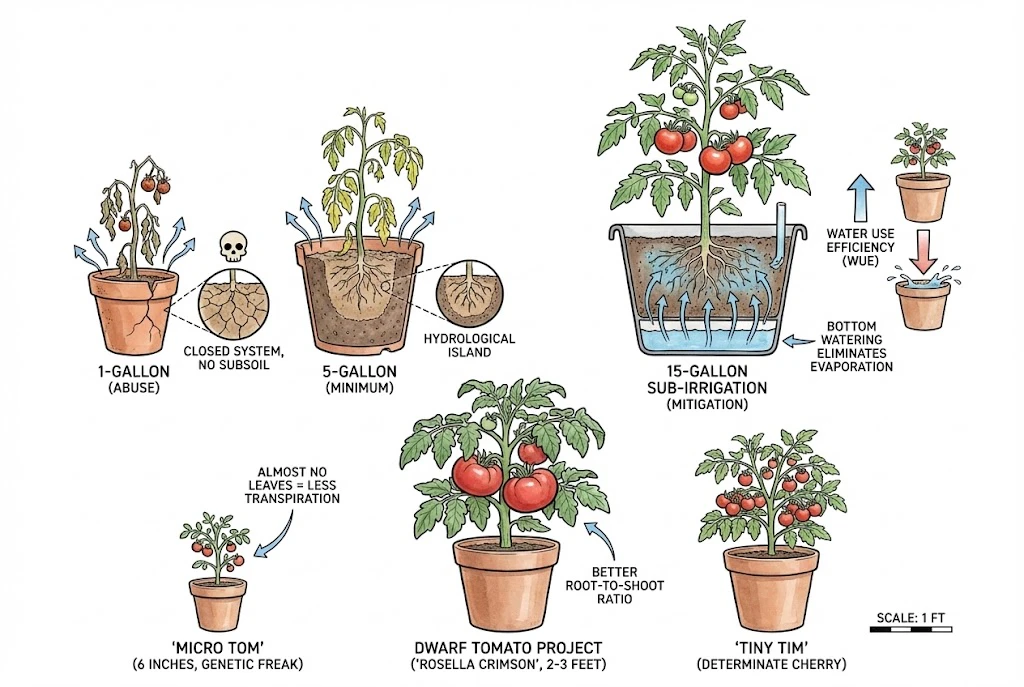
For indoor and patio gardeners, there’s a persistent belief that you can dry farm in a container. In the field sense, living off a bank of stored subsoil moisture, you can’t because a pot has no subsoil to draw on. That’s different from deliberate deficit watering in containers, which is its own subject.
A container is essentially a closed reservoir. Once the water in it is used up, there’s no water table underneath to reach.
A drought-tolerant variety in a pot buys you some extra time, but how much depends on pot size, substrate, plant size, weather, and cultivar. You can, however, stretch the water you have.
Physics of the Pot
In containers, more substrate volume means more water in reserve, so larger pots buffer drought better.
As a general guide, 5 gallons is a workable minimum for a tomato and 15 gallons is better. Very small (1-gallon) pots dry out fast and make water stress hard to manage.
One approach that meaningfully improves water-use efficiency in containers is sub-irrigation (self-watering planters).
Watering from the bottom reduces surface evaporation, and research supports large efficiency gains. In one tomato study, a sub-irrigated treatment used roughly 76 L of nutrient solution per plant versus about 154 L for the comparison, at similar yield.
It doesn’t eliminate evaporation entirely, and it’s one tool among several (mulch, shade, pot material, and drip all help).
A reservoir insert can convert an ordinary bucket into a bottom-watered container, and inserts sized for a standard 5-gallon bucket are the common case. Match the insert to the bucket, and look for the parts that make it work. These include an overflow hole to set the water level, a fill tube, and a level indicator.
Drill the overflow hole where directed, use a substrate that wicks well without staying airless, and saturate the mix at planting to prime the reservoir. This is the opposite of true dry farming because you are still supplying water, but for a balcony with no subsoil it cuts surface evaporation compared with top watering.
The Dwarf Solution
In small spaces, plants with less leaf area transpire less, which is why genetic dwarfs are worth a look. ‘Micro Tom’ is the extreme (about 6 inches tall and widely used as a laboratory model).
Its tiny leaf area means low total water use, but there isn’t comparative data showing it’s especially drought tolerant per unit, and flavor is a matter of taste rather than a documented verdict.
For fuller flavor in a pot, Dwarf Tomato Project varieties such as ‘Rosella Crimson’ and ‘Tasmanian Chocolate’ fit containers while producing larger fruit.
No evidence establishes a superior root-to-shoot ratio over full-size indeterminate vines, so choose them for their compact habit rather than a dry-farming claim.
Management (Use Stored Soil Water Efficiently)
Across dry-farm experience, management often matters as much as genetics. Poor practices can waste a good drought-tolerant variety, and careful ones can carry a mediocre variety to a usable harvest.
In reality yield comes from the interaction of genotype, environment, and management, not one factor alone.
Timing is Everything
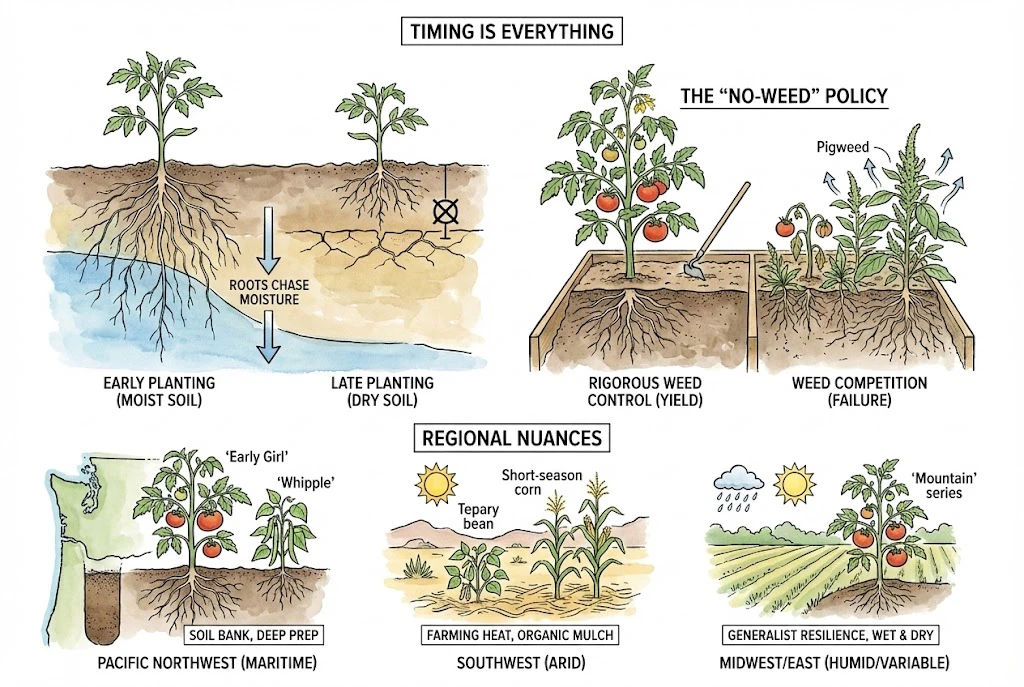
Many successful dry farmers plant early, transplanting tomatoes and beans while the soil is still moist from winter rains.
Exact timing varies with local frost dates, soil temperature, and coastal-versus-inland climate, so treat any single month as a regional example rather than a rule.
The goal is to establish roots into moist soil so they follow the receding wetting front downward as the profile dries (this is stored profile moisture, not a true groundwater table).
Planting late into already-dry soil is a poor bet (the roots meet dry ground and stall) so plant into moisture to encourage deep rooting.
A long-probe soil moisture meter can help you judge moisture below the dry surface instead of guessing from the top.
Compare the probe’s actual length with the depth you need to assess. A single handheld probe samples one point in the upper root zone, not a deep root system or an entire field. Measure repeatable locations, and use multi-depth monitoring when deeper stored water is what matters.
Inexpensive analog meters can respond to both salts and moisture and are usually not calibrated, so read them as a relative trend rather than an exact percentage.
Follow the selected meter’s instructions on hard soil, insertion time, and standing water. Those limits vary and misuse can damage the probe.
For deeper monitoring, multi-depth sensors are a separate, more involved option.
I trial a drought-marketed seed beside a locally reliable cultivar in adjacent short rows with the same planting date, spacing, and irrigation. Every supplemental watering goes in the log, and I weigh the usable harvest separately. Simple survival can hide a crop that produced little worth picking.
When space permits, the row positions swap in the next sowing. A shaded edge or deeper pocket of soil can otherwise make the variety in one row look tougher even when the advantage came from the site.
The No-Weed Policy
In a dry system, weeds compete directly for stored water. Every drop a pigweed transpires is water the crop can’t use.
That’s different from managed living mulch, timed cover crops, or beneficial borders, which can have a place. The concern here is uncontrolled weeds drawing down the water bank at the crop’s expense.
OSU dry-farm results point to early, rigorous weed control as one of the most important management steps. Hoe early and often.
(Where you’re relying on organic mulch rather than a cultivated dust mulch, the surface won’t be fully bare. The two approaches are alternatives, so pick one for a given bed.)
Regional Nuances
- Maritime West (PNW and coastal California). These aren’t identical. Coastal California and western Oregon differ enough that a variety strong in one can disappoint in the other (Early Girl is a case in point). The shared principle is managing the winter-rain soil bank through deep soil prep. Pick varieties from local trials for your specific area rather than a single regional star.
- Arid Southwest. Heat is the main pressure, and the soil bank is usually empty unless you pre-irrigate. Heat- and short-season crops like tepary beans and quick corn fit best. They may need supplemental water or timely monsoon rain rather than finishing reliably on a single storm. Organic mulch to cool the surface is often preferred over dust mulch, though the best surface strategy still depends on your site.
- Humid / Unpredictable East. Drought here tends to be erratic, wet stretches and dry spells in the same season, so broadly adapted, disease-resistant varieties help. The Mountain series tomatoes (NC State) are bred mainly for disease resistance. Treat the phrase handles both wet and dry as a hope to test locally, not an established claim.
Match the Seed to the Site
Low-water vegetable growing depends less on a single miracle seed than on combining a locally adapted variety with good agronomy (soil, water budgeting, spacing, and timing).
Modern breeding and soil science work together here. The seed is one tool among several.
Set up the crop to use stored soil water efficiently rather than trying to rescue it later. Prioritize the following.
- Don’t expect a drought-tolerant mix to carry a poor site on its own. Choose varieties with a local track record and pair them with the right conditions.
- Assess soil depth first. Six inches of soil over hardpan is hard to dry-farm. Raised beds or a broadfork can improve rooting, but neither creates a deep stored-water bank where the underlying soil is shallow. Diagnose the restrictive layer before assuming it can be fixed.
- Control weeds early. They compete for the same stored water your crop needs.
- Expect smaller, tougher fruit. Dry-farmed produce is often smaller and less uniform, and sometimes, not always, more concentrated in flavor.
- Plant into moisture. Establishment while the profile is still moist is usually decisive. The right window depends on your climate and crop, so it isn’t a fixed calendar date.