
Shrink the Weed Seed Bank: Integrated Management
Managing the weed seed bank over time: cut new seed rain first, then combine seed-eating ground beetles, cover crops, tillage choices, and a stale seedbed to your species, crop, and region (testing and monitoring rather than assuming a fixed outcome).
Jordan Cole · Published 2026-02-05 · 16 min read
Key Takeaways
- Manage the seed bank and the weeds together. The soil reserve of dormant seeds is the long-term target, but pulling or hoeing small weeds before they set seed is a legitimate way to stop new seed rain.
- Cut new seed rain first. In one long-running weed-free field trial, blocking seed return cut the measured seedbank by roughly 95% over five years, but two of five sites rebounded close to the original level after a single unmanaged year. Treat it as one documented case, not a guaranteed countdown.
- Choose tillage by species, not by slogan. Deep burial can slow emergence and extend persistence for some seeds, while a no-till surface can expose them to predators and weather. Reduced tillage can also favor shallow-germinating and perennial weeds.
- Recruit seed-eating ground beetles within limits. Carabid beetles remove weed seeds from the soil surface, but the rate varies widely by species, field, and season. A beetle bank is habitat to design to local guidance, not a fixed formula.
- Use cover crops as one suppression tool. A thick cereal rye stand can suppress small-seeded weeds through competition, residue cover, and some allelopathic chemistry, but termination timing, biomass, and moisture and nitrogen tradeoffs matter.
- Consider a stale seedbed. Prepare and firm the bed, wait for a weed flush, then kill it with minimal soil disturbance. If you use a propane flame weeder, read the manufacturer manual and fire-safety precautions first.
If you are on your knees pulling individual weeds, that work is not wasted. Removing small weeds before they flower cuts both the plants competing now and the next round of seed rain.
But hand-pulling alone will not empty the soil reserve of seeds already there. That reserve, the weed seed bank, is what a long-term plan has to address as well.
The weed seed bank is the store of dormant seeds in the soil, some of which can survive for years to decades.
It is a normal population reservoir in any field, not only a record of past mistakes, and it can include crop and non-weed seed too.
Its density depends on your soil, past management, and sampling depth, so it can only be known by sampling, not assumed.
Many weed seeds respond to light, temperature, moisture, and nitrate as germination cues, together with each species’ dormancy cycle.
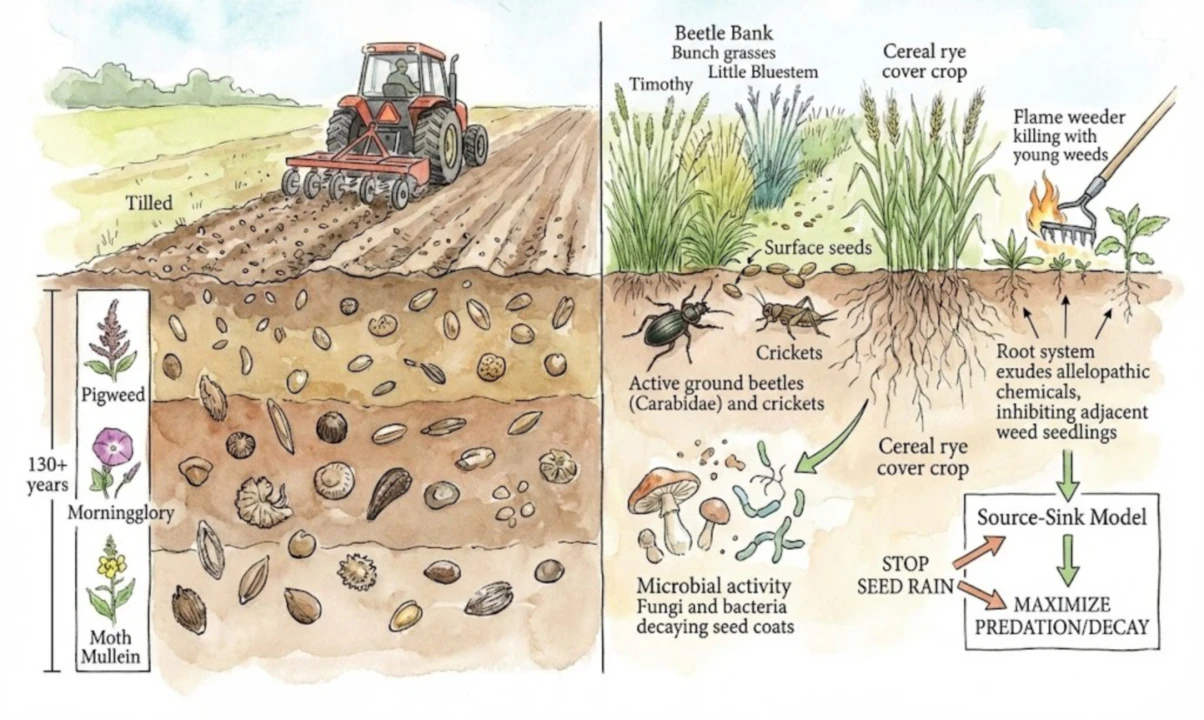
Some hard-coated seeds, such as moth mullein (Verbascum blattaria), can persist for well over a century under the right conditions. Michigan State’s Beal buried-seed experiment is the classic example (see below).
The encouraging part. If you stop adding new seeds, the surface seed bank can decline substantially over several years.
How fast depends on species, climate, depth, and cropping history, so monitor it rather than counting on a fixed timeline.
What exactly is the weed seed bank?
A useful way to picture it is a source–sink balance, as long as you remember it is a simplification.
- Sources. New seeds falling from mature weeds in the field, plus seed carried in on contaminated crop or cover-crop seed, manure and compost, equipment, irrigation, animals, and wind from field edges.
- Sinks. Seeds lost to predation (eaten), decay (rotted), and germination, though some germinated seeds survive to become crop competitors rather than dying, so germination is not a guaranteed loss.
The practical goal is to reduce new seed input as much as you can while encouraging the loss pathways, and to check progress by sampling the seedbank and counting escaped weeds over time, not by assuming the balance has tipped.
How long do these seeds actually survive?
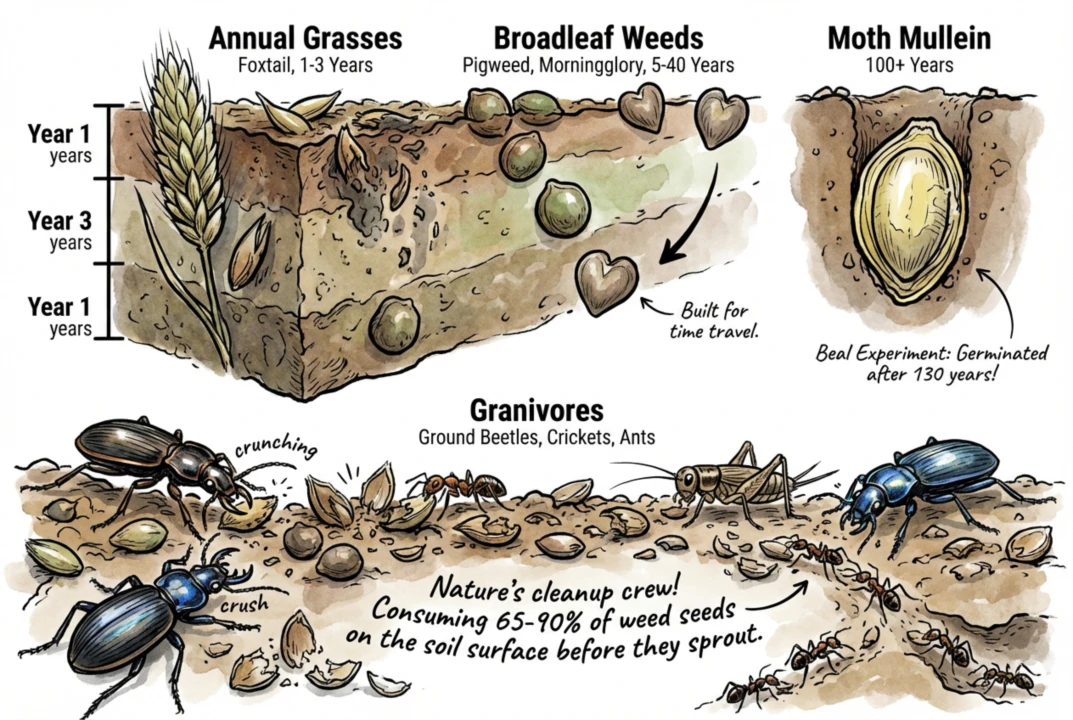
Longevity depends heavily on the species and seed lot, not just on whether a weed is a grass or a broadleaf.
Even within a group the differences are large, so plan by species where you can. The values below are drawn from University of Minnesota Extension data and are given as the years to reach a stated decline, for example 50% or 99% fewer viable seeds, because one typical number can be misleading.
| Species | Time to ~50% decline | Time to ~99% decline |
|---|---|---|
| Giant foxtail | ~1 year | ~5 years |
| Yellow foxtail | ~5 years | ~30 years |
| Redroot pigweed | ~3 years | ~20 years |
| Common lambsquarters | Not reported | ~78 years |
Source. University of Minnesota Extension, seed persistence in soil. Endpoints differ by species. Note that giant and yellow foxtail behave very differently, so a single foxtail figure is not reliable.
Deep burial can extend persistence for some long-lived, hard-coated species, but it is not a universal rule for every seed or tillage system. Burial also prevents emergence for many seeds, which some strategies use deliberately (see the tillage section).
Michigan State’s Beal buried-seed experiment shows how extreme persistence can be. When a bottle buried in 1879 was opened in 2021, after about 141 years, 20 of the 50 original Verbascum seeds germinated. 19 were V. blattaria (moth mullein) and one was a hybrid.
This is a deliberately buried-bottle experiment, so it demonstrates possible longevity under those conditions rather than the typical lifespan of seeds in a working field.
How can insects help me?
Seed-eating animals, granivores, are one route by which surface seeds are lost. Ground beetles (carabids), crickets, ants, and also rodents and birds all eat weed seeds lying on the soil surface.
Reported removal rates vary enormously. Review data show that in some cases certain weed seeds have had 65–90% of an annual crop removed by predators, but that is a best-case range for particular seeds and fields, not a rate you can count on for all surface seeds.
Which insects are the best predators?
Ground beetles (Carabidae) are among the more studied seed predators, but how much they consume depends on the species, the seed, and field conditions.
Practical integrated weed-management guides put field consumption on the order of a few to about a dozen seeds per beetle per day, not hundreds.
Carabids are a diverse family. Some species are mainly seed-eaters, others are omnivores or predators, and both night-active and day-active species exist.
Seed preference is driven largely by seed size, mass, coat, and taxonomy rather than by a single chemical cue.
The resilience of weed seedbank regulation by carabid beetles at continental scales
How do I get more of them?
You can give them overwintering habitat by building a beetle bank. Many carabids move mainly by walking, though the family as a whole is not flightless (wing development and flight vary by species, sex, and season).
Distance, ground cover, disturbance, pesticides, and moisture all affect how well they reach a field interior, so movement alone is not the only limit.
A beetle bank is a raised strip of tussock-forming grasses that gives beetles dry winter shelter.
Traditional UK arable guidance uses roughly a 2 m raised ridge running through a large field, while current England schemes use bands closer to 3–5 m. Grasses such as cocksfoot and timothy are common.
Follow your local agricultural or conservation authority’s specification for width, height, grass mix, establishment, mowing, and pesticide buffers rather than a single universal number.
Choose grasses suited to your region. Timothy, and North American natives like little bluestem, may fit some areas, but check native status, invasiveness, winter survival, and seed availability locally before planting.
Placement also matters and depends on scale. Large fields may use a strip through the interior to shorten walking distance, while smaller plots and gardens usually treat this as field-margin habitat (decide which layout your site and equipment allow, and keep it consistent with your overall plan).
A beetle bank supports a broad range of beneficial insects and farmland wildlife. Treat weed-seed predation as one benefit among several, not a guaranteed biocontrol device.
Can cover crops suppress weeds?
Cover crops can suppress weed germination and growth, which is not the same as killing seeds in the soil bank.
A dense cover crop works through several mechanisms at once. Living plants compete for light, water, and nutrients. Residue creates a physical barrier after termination and changes soil temperature and moisture. Some species also release allelopathic compounds that affect neighboring seed germination or growth.
Iowa State Extension notes that the physical residue barrier is a primary factor in many trials, not chemistry alone.
Which cover crops are used for weed suppression?
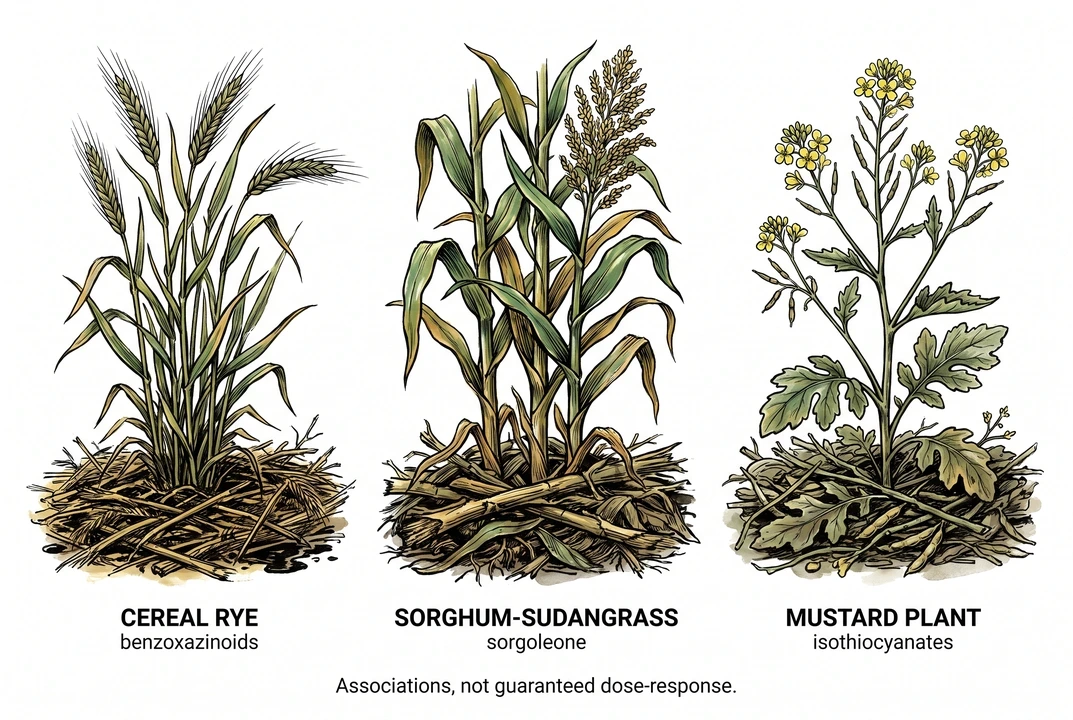
Several cover crops are studied for weed suppression, and each is linked with particular chemistry. Cereal rye with benzoxazinoids, sorghum-sudangrass with sorgoleone, and mustards with isothiocyanates used in biofumigation.
Which weeds or organisms each affects depends on rate, growth stage, termination, and field conditions, so treat any target pairing as a general association rather than a guaranteed result.
Mustard biofumigation in particular can also injure crops and affect non-target soil organisms.
Cereal rye (Secale cereale) is one of the more widely used cover crops for suppressing small-seeded weeds.
Its residue contains benzoxazinoids (compounds such as DIBOA and DIMBOA), and these have been proposed as part of its allelopathic effect.
But reported suppression varies widely with biomass, environment, and weed species. Across reviews, effective rye biomass spans roughly 0.9–20 t/ha with no single optimum, and in one Iowa trial a high-biomass treatment lowered lambsquarters emergence by about 15% while waterhemp density more than doubled, so there is no fixed threshold or guaranteed target.
The benzoxazinoid chemistry itself is more limited than it may sound. In the study below, soil concentrations after termination were about a thousand times lower than in the roots, and many compounds dropped by roughly half within four days and were mostly undetectable after about 20 days.
So the practical suppression from a rye cover crop comes largely from competition and residue, with allelopathy as a contributing, short-lived factor rather than a chemical that burns weed roots.
If you sow rye for this purpose, buy on the seed label rather than the name. Confirm the species is cereal rye (Secale cereale), not annual or perennial ryegrass, and check the cultivar, germination and purity percentages, inert matter, other crop and weed seed, any seed treatment, net weight, and local adaptation.
Choose a seeding date and rate that let the stand build enough biomass and survive winter in your region, and plan the termination method and timing before you plant. A rye stand that is not fully terminated can compete with the cash crop and reduce yield.
For the stale-seedbed flush, a propane flame weeder can kill a surface weed flush without disturbing the soil and pulling up new seeds.
This is only appropriate for small broadleaf seedlings and only under the fire-safety conditions below. Grasses and perennials often regrow, and flaming is generally not recommended for killing the seeds themselves.
Before using any propane torch, read the safety requirements in the next section.
Benzoxazinoids in roots and shoots of cereal rye (Secale cereale) and their fates in soil after cover crop termination
Does tillage help or hurt?
Tillage is a decision, not a villain. It can redistribute buried seed to the surface, but it can also bury fresh seed rain out of reach of predators, so the right choice depends on your weeds, not on a slogan.
When does keeping seeds on the surface help?
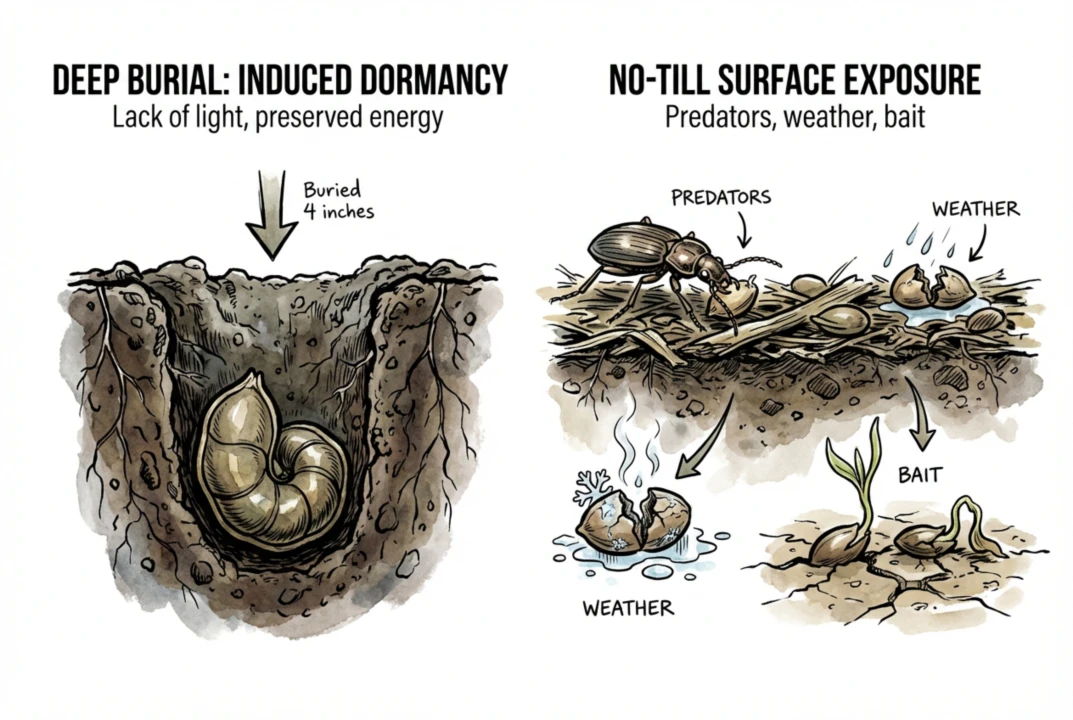
For some species, burial slows emergence and can extend persistence, while seeds left on the surface are more exposed to three loss pathways.
- Predators. Ground beetles and other granivores can reach surface seeds, though how many depends on species, cover, residue, and season.
- Weather. Freeze–thaw cycles can crack some seed coats, but the same scarification can also promote germination rather than death, and effects differ by species.
- Untimely germination. Seeds may sprout after a small rain and die if it dries out, but whether that happens depends on the rain sequence, soil moisture, and canopy, so it is not guaranteed.
The tradeoff runs the other way too. Reduced or no-till systems tend to favor shallow-germinating small-seeded weeds and perennial weeds, and they change how you manage residue, herbicides, and equipment.
There is no single switch-to-no-till answer. Choose reduced-, strip-, inversion-, or no-till based on your target species’ emergence depth and longevity, perennial pressure, crop and equipment, and field history. Some strategies deliberately use one-time inversion tillage to bury a flush of new seed, followed by minimal disturbance afterward.
When should I use the stale seedbed technique?
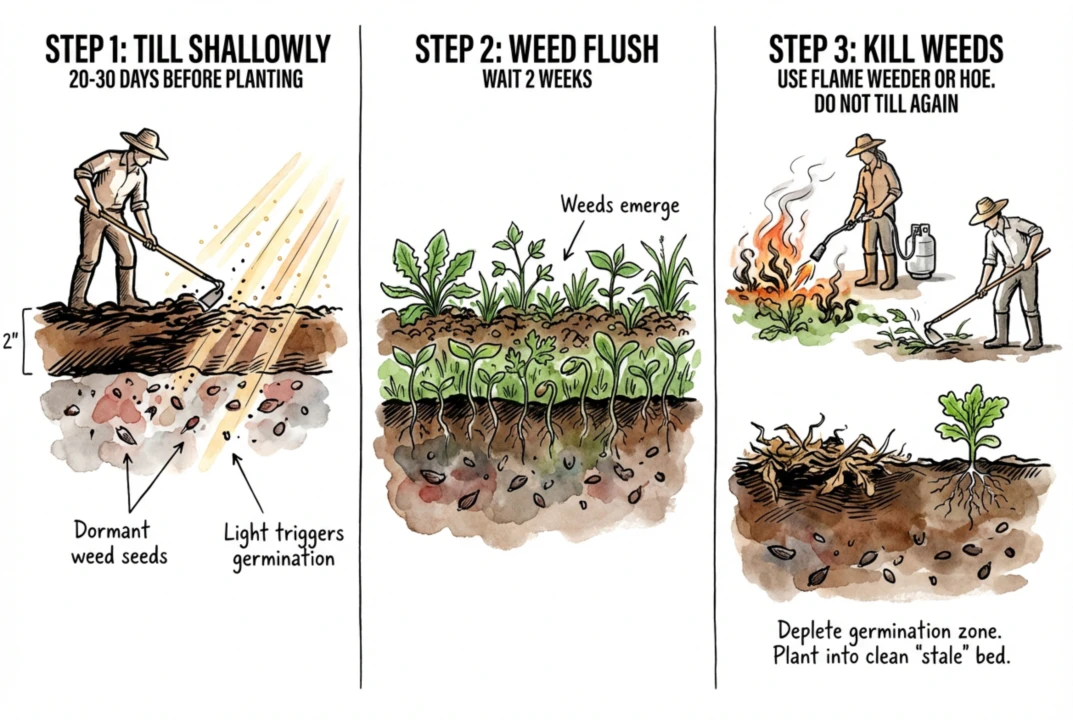
In a true stale seedbed you prepare and firm the crop bed ahead of planting, wait a couple of weeks for a weed flush, kill that flush with as little soil disturbance as possible, then plant with minimal disturbance.
(If you till a bed and then till again to control the flush, that is a false or tilled-fallow approach, which re-exposes fresh seed.)
Timing and depth are site-specific, not universal. Prepare the bed enough ahead of planting to allow a flush, often around two to three weeks, but adjust to your crop calendar, weed spectrum, soil temperature, and moisture.
Any working of the soil should be shallow. Some landscape guidance suggests cultivating less than an inch, because working 2 inches deep can lift fresh seed.
Rain or irrigation usually triggers the flush, and in cool or dry conditions you may not get a green flush on schedule, so be ready to wait, repeat, or shift the planting window.
Kill the flush without stirring the soil. Very shallow hoeing that cuts weeds at the surface, or flaming, are common options.
Flaming works best on small broadleaf seedlings. Grasses and perennials often regrow. Then plant with the least disturbance you can, since the seeding operation itself moves some soil.
The result
Done well, this depletes weeds from the shallow germination zone before you plant, so the crop goes into a relatively clean bed.
How clean the bed becomes and how deep the depleted zone is will vary by species.
If you use a propane flame weeder, read this first
A propane flame weeder is a fire and burn hazard, not a casual tool. The commonly recommended unit for this job is a 100,000-BTU, outdoor-only torch (about 2,000°F) that connects to a refillable propane cylinder.
Before and during use.
- Read and follow the manufacturer’s manual. Keep the cylinder upright and secured, use the correct vapor-withdrawal valve, and leak-check connections with soapy water. If you smell LP gas, shut off immediately.
- Wear gloves, long sleeves and pants, closed boots, and eye protection, and keep an accessible ABC fire extinguisher and water on hand. Never leave a lit torch unattended.
- Do not use it in dry or windy weather, during a local burn ban, or near dry residue or thatch, buildings, decks, fences, mulch, plastic, or irrigation lines.
- Keep at least 10 feet from structures and flammable material (more if local rules require) and keep bystanders and pets clear. In 2026 the Cape May County (NJ) Fire Marshal linked propane weed burners to several structure fires and issued exactly these precautions.
- Target small broadleaf seedlings. You only need to rupture the leaf cells, not char the plant. Because effective exposure depends on the specific torch, travel speed, and plant size and moisture, follow the manual and, ideally, trained local guidance rather than a fixed seconds rule. Check your local fire authority and any permit requirements first.
Can soil microbes rot the seeds?
Sometimes, but this is an uncertain research area, not a reliable tool. Soil fungi and bacteria can contribute to weed-seed mortality, but how much varies greatly with species, seed coat, moisture, temperature, depth, carbon and nitrogen, and the microbial community.
Be careful with the common shortcut that enzymes simply dissolve seed coats. Plant seed coats are made mainly of cellulose, lignin, cutin, and phenolics, generally not chitin, so chitinase, which acts on fungal and insect chitin, does not dissolve them, and no single protease universally breaks down a hard coat.
The often-cited velvetleaf result, about 99% decay in three months, came from a USDA ARS study where the seeds were essentially the only carbon source, and even then it was unclear whether microbes were the initial cause or a contributor.
A separate soil-surface study found microbes did not reduce velvetleaf viability over about a month, with total viability staying above 90%.
So biologically active soil does not reliably rot weed seeds in a few months.
What actually helps (and what to avoid)
You can support soil biology, but treat weed-seed decay as a possible side effect rather than a plan.
- Organic matter can help microbial activity, but not every amendment speeds weed-seed decay (in one eight-species trial only a few species responded to soil carbon and nitrogen treatments). And poorly finished or recontaminated compost can bring in new viable weed seed, so source it carefully.
- Do not blanket-avoid fungicides. Use only diagnosed, crop-labeled treatments within an IPM program, choose the narrowest effective option, follow resistance-management guidance, and protect non-target habitat. Skipping needed disease control can hurt the crop stand and, ironically, open ground for more weeds.
Do not deliberately press mature weed seeds into the soil with a roller. Better soil contact can trigger germination, but it can also hide seeds from surface predators and increase persistence.
If your goal is to shrink the seed bank, remove or contain mature seed rather than working it in.
Putting it together (a multi-year approach)
The steps below are a starting sequence, not a guaranteed schedule. Results depend on your weed species, whether they are annual or perennial, your crop rotation, climate, herbicide-resistant populations, labor, and outside seed sources.
Adapt tactics to your field and, for weed identification, resistance, or fire and pesticide decisions, check with your local Extension office or an agronomist.
First (cut new seed input and set a baseline)
- Prevent seed rain as the top priority. Pull, hoe, or mow small weeds before they set seed, and if weeds escape, mow before seed set or bag and remove clippings that carry viable seed. Handle perennial weeds separately. They also spread by rhizomes, stolons, tubers, and root fragments, so shrinking the seed bank alone will not clear them.
- Decide on a tillage approach for your species and field history rather than switching to no-till by default (see the tillage section).
- Add beetle-bank or grass habitat in a location that suits your scale, a strip through a large field or margin habitat on a smaller plot, and keep the placement consistent with your layout.
- Take a baseline. Sample the seedbank by depth or count emerged seedlings, so later changes are measured rather than assumed.
I mark nine permanent 50 × 50 cm quadrats, with three at the field edge, three in the interior, and three in a known trouble spot. Within each zone, I divide its long axis into thirds and center one square in each third. Three repeats keep one patch from defining a zone, and multiplying each 0.25 m² species count by four gives plants per square meter.
At the same crop stage each year, I photograph each square, count emerged weeds by species, and tally seed-shedding escapes separately. Fixing both the crop stage and the square locations keeps a late flush or a convenient clean patch from looking like seed-bank progress.
A lower emergence count does not mean an empty seed bank. Weather and tillage can suppress one flush. I therefore keep fixed photos, a seed-rain tally, and depth samples as separate ledger entries instead of combining them into one success number.
Then (flush and suppress)
- Where it fits the crop and season, use a stale seedbed before planting, but not every crop, region, or double-crop system allows it.
- Where a winter cover crop fits your rotation, a thick cereal rye stand can add suppression, provided you manage seeding date and rate, termination timing, and moisture and nitrogen tradeoffs.
Over several years (monitor and adapt)
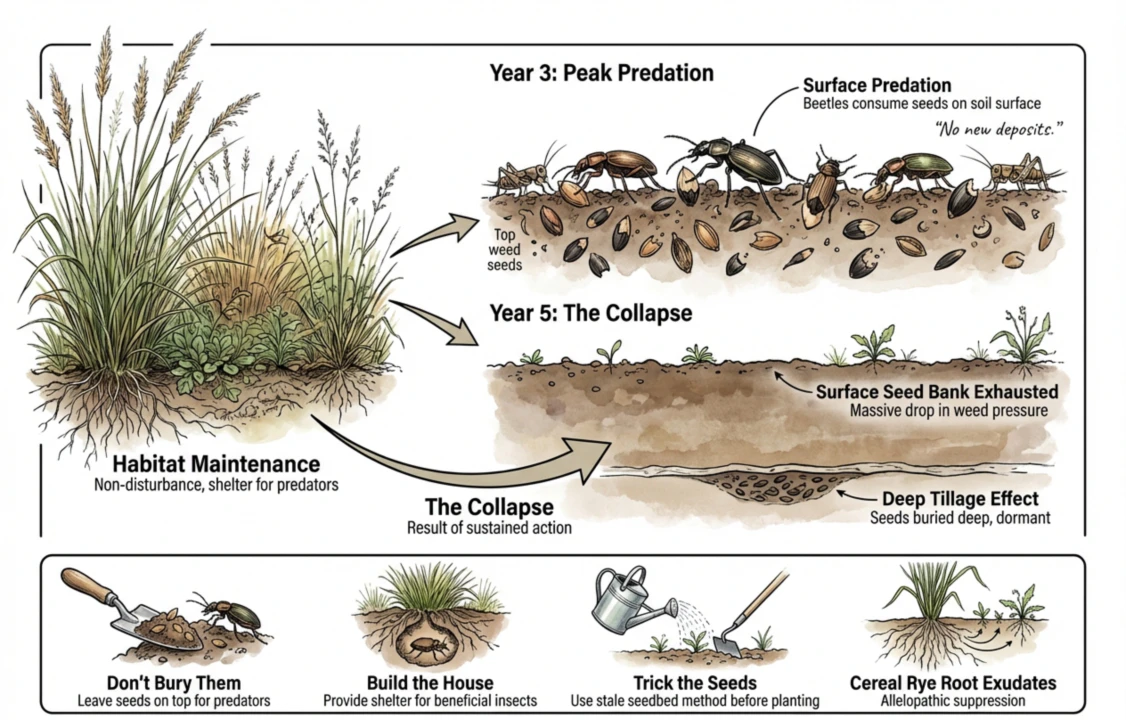
- Maintain the habitat and cultural practices you have chosen, and set a maintenance interval and a success metric so you know whether they are working.
- Keep monitoring. Repeat the seedbank sampling or seedling counts, track escaped weeds each year, and watch crop yield. The surface bank can decline substantially over several years if you keep new input low, but deep dormant seed, perennial propagules, and seed carried in from outside mean the bank may not be exhausted. Aboveground weed counts alone cannot prove that.