
Tillage Radish: A Biological Fix for Compacted Soil
Forage (daikon-type) tillage radish as one part of a compaction plan: how its deep taproot can penetrate some compacted layers, winter-kills into biopores, scavenges residual nitrogen, plus region-specific planting timing, rates, and rotation caveats.
Samuel Reed · Published 2026-02-16 · 15 min read

Key Takeaways
- Tillage radish is one tool in a compaction plan, not a fix on its own. On favorable soil a swollen taproot can reach 12-20 inches, with a finer root potentially extending farther, but severe compaction can stop it or redirect it into existing channels.
- The useful cycle is drill then decay. Fall growth can winter-kill and decompose into biopores, but mild winters or snow cover may let plants survive and require termination.
- Timing, rate, and depth are regional. Many guides start near 4-6 lb/acre drilled and more when broadcast, but local extension figures and seed quality should set the final rate.
- Radish is a catch crop for residual nitrogen, not an automatic fertilizer credit. Deep roots take up nitrate and sulfate, but do not cut fertilizer without a soil or tissue test.
- Mind the rotation and the smell. Keep at least a 3-year gap before other brassicas as routine prevention, use a longer interval where clubroot is confirmed, and expect sulfur odor as roots break down.
Forage or daikon-type radish (Raphanus sativus) is a cover crop often used to help manage soil compaction.
Research and extension work back the core idea. A fast-growing taproot can capture residual nitrate, can penetrate some compacted layers, and, after it winter-kills, can leave biopores that help water infiltrate and give the next crop’s roots a path down.
Use tillage radish as one part of a compaction plan, not as a guaranteed cure for a deep hardpan. Pair it with traffic control, avoiding wet-soil work, drainage and organic-matter management, and targeted mechanical loosening when a real compacted layer needs it.
If you’ve ever tried to dig a hole in late summer and hit a hard layer only a few inches down, you know the frustration of compacted soil.
Before reaching for any single remedy, confirm what you’re dealing with. Shovel resistance alone doesn’t tell you the depth or cause.
Check soil moisture and texture first, since saturation, acidity, or a natural restrictive horizon can turn roots sideways just as compaction does.
Where roots do hit a dense layer and turn sideways, they lose access to deep moisture and nutrients.
One common response is mechanical ripping with deep rippers or subsoilers, which burn diesel and disturb soil structure. That trade-off is real, but targeted ripping done when a compacted layer actually exists and soil moisture is right can restore porosity quickly, so it is not simply the wrong choice.
A deep-rooted cover crop such as tillage radish is a complementary, longer-term biological approach. It is best thought of as one part of a plan that also includes controlling traffic, tire pressure, avoiding work on wet soil, drainage, building organic matter, and, where needed, targeted mechanical alleviation.
What is a Tillage Radish?
A quick note on names. Tillage Radish® is a specific selected daikon-type product/brand (sold by DLF). It is not a synonym for every forage, daikon, or oilseed radish.
All are the same species (Raphanus sativus), but cultivars differ, so tillage radish below means a cover-crop daikon type in general, not the trademark specifically.
Cover-crop daikon varieties have been selected for large storage roots and deep taproots, which is different from saying the species was engineered for one purpose.
Unlike a common garden radish grown for a small edible root, a cover-crop daikon sends a long taproot straight down.
The swollen part you see is an enlarged taproot and hypocotyl (a storage organ, not a true botanical tuber and not a bulb).
On favorable soil, with a good planting date and fertility, the fleshy portion can reach roughly 12-20 inches long and 2-4 inches wide, and a fine root thread can extend several feet. Figures often cited in the 3-6 foot range.
Treat these as best-case maximums for good conditions and a suited cultivar, not a spec that every plant hits. In a severe compacted layer the root is often much shallower.
You may see a claim that radish roots exert 290 psi of pressure and so punch through soil that stops crop roots at 300 psi. That comparison is misleading.
In the field data it traces back to, 270-290 psi was a soil penetrometer reading (soil resistance), not an axial force measured on a radish root, and about 300 psi is a common rule-of-thumb for where root growth is restricted, not a universal threshold roots deflect at.
In an NRCS demonstration on severe compaction, radish struggled to root below the top 3 inches, and reaching 6 inches took another season of cover crop.
Honest Takeaway
Radish can push through some compaction, but it does not reliably break a severe hardpan.
The Mechanism (How Bio-Drilling Works)
Two Stages of Bio-Drilling
The process has two stages. Fall growth drills through reachable soil, then winter-kill and decay leave biopores.
1. The Drill (Fall Growth)
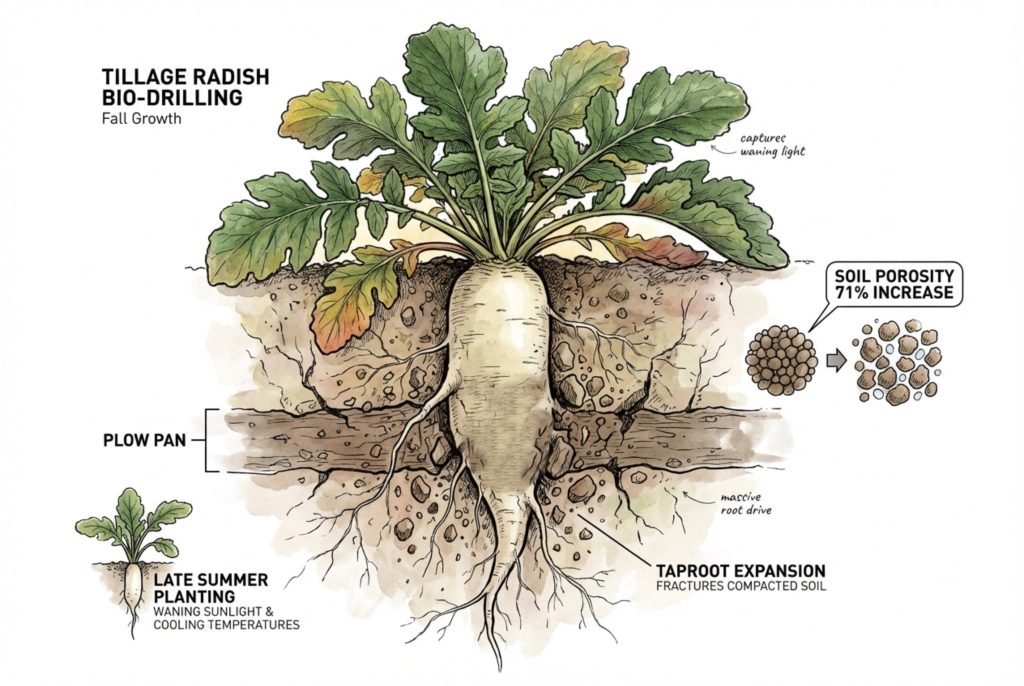
Planted in late summer, the radish uses the shortening days, cooling temperatures, and available water and fertility to put on vegetative and root growth.
As the taproot grows, it can help open a plow pan, which is a dense layer sometimes found around 8 to 10 inches deep in tilled fields. The depth varies. Root penetration can make the upper soil profile more porous, but the size and duration of that improvement depend on the site. Do not expect a fixed percentage gain.
2. The Decay (Winter Kill)
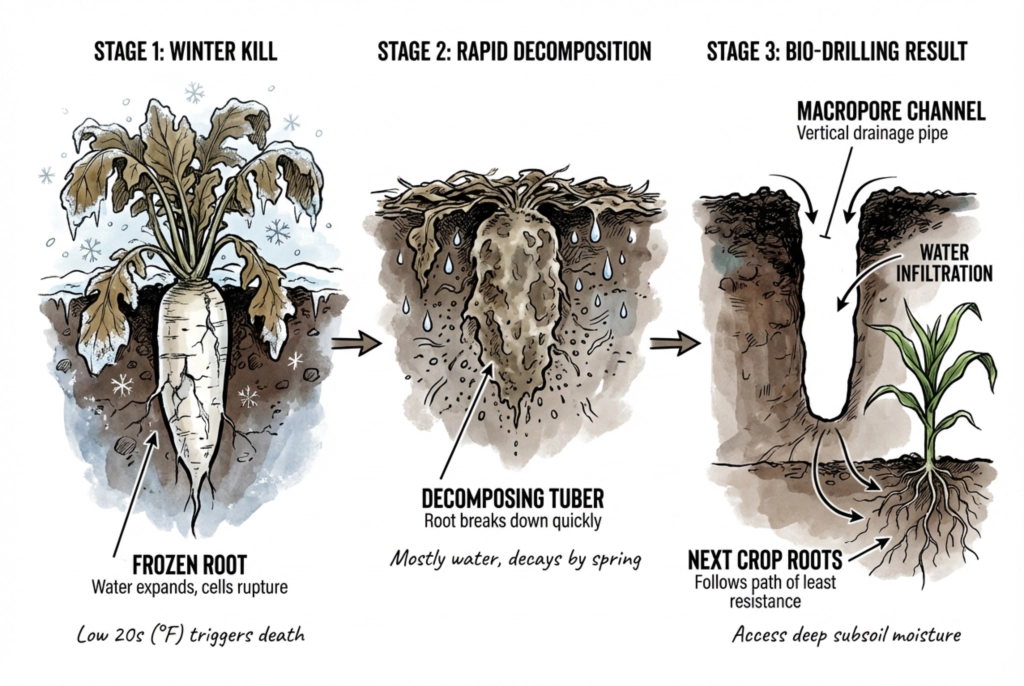
Where winter cold is reliable, radish winter-kills. There is no single death temperature. Maryland guidance points to roughly 17-20°F, or several consecutive nights in the teens, and Michigan State uses about 20°F as a practical guide while warning that snow cover or a mild winter can let plants overwinter.
Being high in water, killed roots break down relatively fast.
Do not count on the root being gone by spring. Decomposing radish carcasses can persist into spring and clog a small seeder, and any plants that survive can bolt and set seed, becoming a weed.
Have a backup termination plan (see the FAQ). The channels left behind vary in size and depth.
- Water infiltration. These biopores can improve infiltration so more spring rain soaks in. They are not literal drainage pipes, though. Saturation, pore connectivity, slope, and surface cover all affect how much runoff is actually reduced.
- Root access. Following-crop roots can preferentially colonize old radish channels. Corn and soybean colonization of radish biopores has been documented. How much this helps is site-dependent, and evidence is stronger for corn and soybean than for every crop.
Radish Cover Crop Fact Sheet | USDA NRCS
Choose a Named Cover-Crop Cultivar
Cultivar matters for a deep-rooted cover crop. Oilseed-type radishes tend to develop less fleshy root and can bolt (set seed) faster, so for a compaction cover crop many growers choose a named daikon-type cover cultivar rather than unlabeled birdseed radish.
That said, choose based on a tested cultivar and your local goals. There isn’t good comparative evidence that every generic lot is shallow-rooted or early-bolting.
Seller claims about root length or leaf size are not a substitute for local results. Choose a cultivar with a clear seed label, then use extension trials where available rather than assuming one named variety will outperform every other option on your soil.
Regardless of cultivar, plan for the fact that radish is low-residue and, as a monocrop on a slope, can leave the surface exposed to erosion.
Extension guidance generally recommends mixing radish with a cereal or grass (see the oats-and-radish mix below) rather than planting it alone.
Radish (Tillage, Groundhog, Nitro, Oilseed or Forage Radish) | University of Wisconsin Extension
Plant for Root Growth, Not a Universal Number
Set planting date, seeding rate, and depth for your region and objective. Local extension guidance and the seed label should overrule a generic rate when they differ.
1. The Planting Window
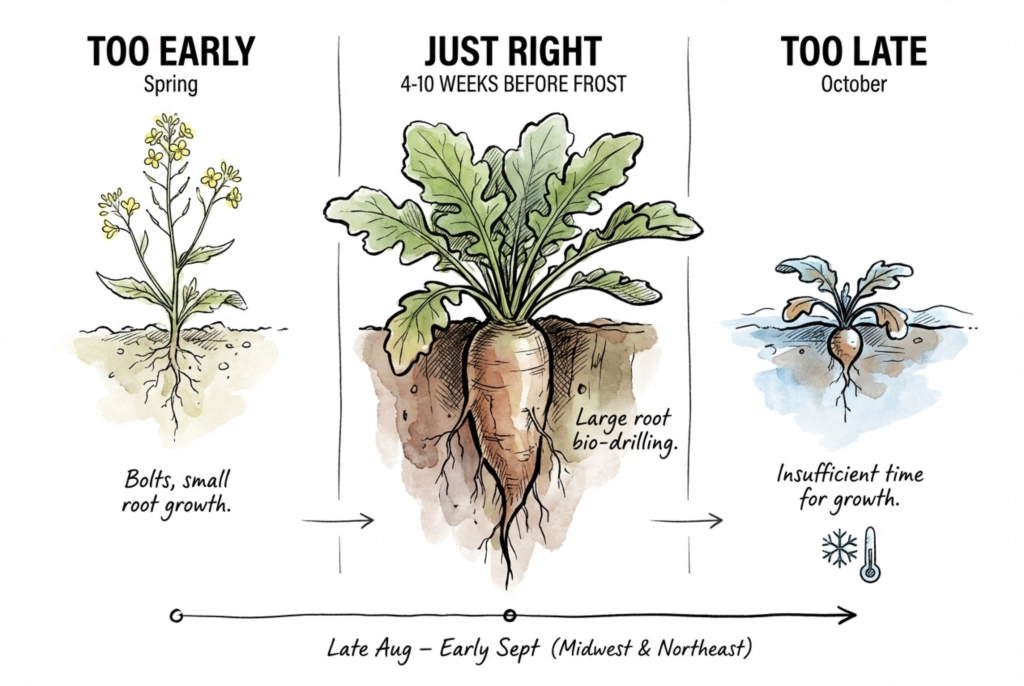
Timing is important, and it is regional. Radish growth responds to day length and temperature, but water, fertility, and planting date all matter too.
- Fall is the usual fit for compaction cover. In much of the Midwest and Northeast, that often means planting several weeks before the first hard frost. Figures like 4-10 weeks are a wide starting range, and local guides vary (Maryland, for example, wants an early-August canopy in its climate, while a July planting risks seed set).
- Spring planting commonly bolts in the North, which is why it isn’t used there for compaction, but bolting depends on cultivar, day length, and temperature, and spring radish is sometimes grown deliberately for biofumigation or other goals.
- October is too late holds for cooler regions but not everywhere. Warmer southern climates can have a later valid window.
2. Seeding Rates
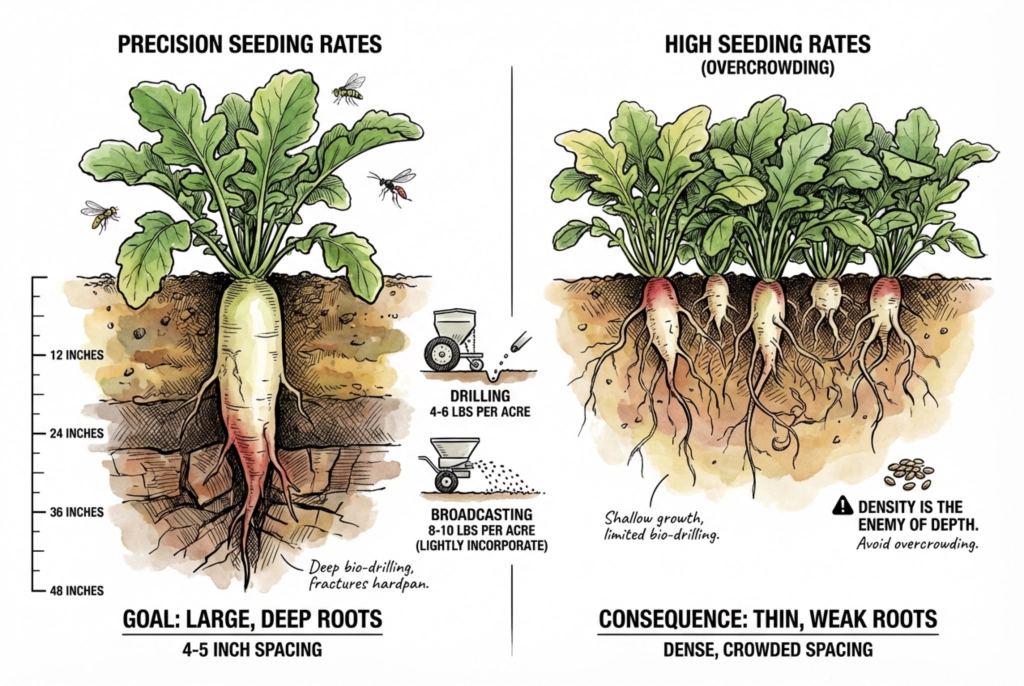
Rates depend on your seeding method, region, and objective. As a rough guide many programs land near these numbers, but they are ranges, not a precise formula (Iowa suggests about 4 lb/acre drilled, Iowa State 4-8, Maryland 6 for the Tillage Radish brand (8-9 in trials), and Wisconsin 5-8 in a mix).
- Drilling. Roughly 4-6 lb/acre (state to your seed dealer whether that is PLS).
- Broadcasting. More than drilled (often about 8-12 lb/acre, lightly incorporated).
- In a mix. A lower radish rate (about 5-8 lb/acre) plus a companion crop is common.
There is a real trade-off in density. Crowding does reduce individual root size, but the goal isn’t simply the biggest possible baseball-bat root. A large root is not required for the soil-cover and weed-suppression benefits.
A stand that is too thin leaves bare soil open to weeds and erosion. If your objective is cover, aim for canopy closure. Maryland monitoring targets on the order of 4-6 plants per square foot, and in-row spacing should be set together with row spacing and any companion crop, not by a single 4-5 inches apart number alone.
For a garden or small plot, a bag of dedicated cover-crop radish seed is a reasonable starting point.
When you buy, check that the label publishes the cultivar, germination/PLS, and seed-treatment status, and work out how much ground one pound will cover for your target rate. If you intend to eat any roots, confirm the seed is untreated and food-appropriate.
3. Depth Control
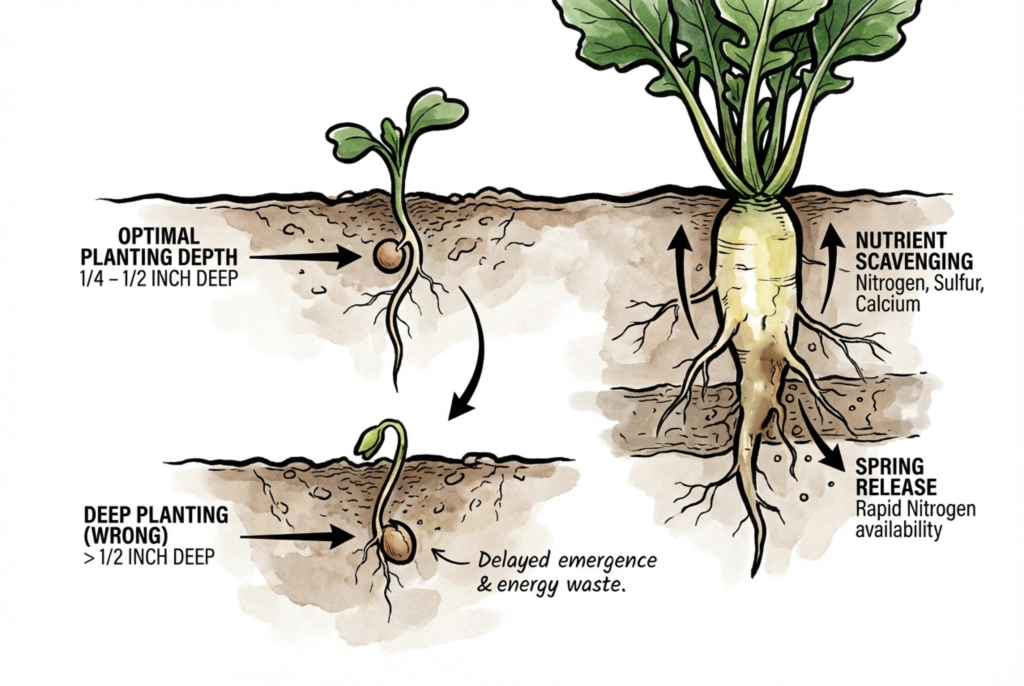
Plant shallow (usually about 1/4 to 1/2 inch deep). Placing seed much deeper generally delays emergence, though into dry soil some guides (Maryland) allow up to about 1 inch to reach moisture.
The Nutrient Bonus (Catch and Release)
Radish is a good catch crop for residual nutrients. Its deep roots take up nitrate and sulfate that could otherwise leach over winter.
Calcium behaves differently in the soil, so do not lump it into the same leaching assumption.
- An early, high-biomass Mid-Atlantic stand can hold a lot of nitrogen in its tissue. Figures on the order of 100-170 lb N/acre are cited for good stands, but a lower-N site or later planting can be well under 50.
- Uptake is not the same as fertilizer credit. Tissue nitrogen is not all released and available exactly when the next crop needs it. Maryland measurements found the spring surface nitrate increase was only about 35 lb/acre, and a multi-site Wisconsin/Agronomy Journal study concluded oilseed radish did not supply nitrogen to the following corn and that spring soil-N response was variable.
Practical Implication
Radish can reduce over-winter nitrate leaching, which is a real benefit, but do not cut your fertilizer rate based on the 100-170 lb figure.
Use a soil test for residual N (and, if available, a tissue/biomass test and spring nitrate reading) and follow your local nutrient recommendation before reducing fertilizer.
And because scavenged nitrogen can be lost if nothing is growing, aim to have a crop established rather than leaving the field fallow into summer.
Managing the Rotation
Radish is often grown ahead of corn, soybeans, oats, and wheat in a rotation.
- Corn & soybeans. Following roots can use the biopores, which may help on compacted ground. On soybean cyst nematode (SCN), the evidence is mixed. One North Dakota microplot study saw daikon radish lower initial SCN density by roughly two-thirds, but repeated greenhouse work did not find a consistent reduction, and the effect is cultivar-, HG-type-, and system-specific and not confirmed to be biofumigation. Treat radish as a possible add-on, not an SCN program. Rely on soil sampling, resistant soybean varieties, and nonhost rotation first.
- Oats & wheat. These can follow radish in a rotation. Note that oats are also a common companion in a mix (below), which is often the more direct benefit.
Avoid following radishes with other Brassicas
Radish is a brassica, so avoid planting cabbage, broccoli, cauliflower, or kale immediately after it. They share hosts for diseases like clubroot and black rot and for some insect pests.
As routine prevention, keep at least a 3-year gap between brassica crops. Where clubroot is confirmed, extension guidance calls for a longer rotation, about 7 years, plus controlling brassica weeds and volunteers, sanitizing soil on equipment, and avoiding brassica cover crops.
Because the right interval depends on your region and the specific pathogen, confirm with a local diagnosis, and check residual-herbicide and flea-beetle considerations too.
Common Pitfalls to Avoid
- Planting too thick. A lawn-thick stand crowds plants into thin roots. But don’t overcorrect (too thin a stand leaves bare soil open to weeds and erosion). Match the rate to your objective (cover versus large individual roots).
- Spring planting in the North. In cooler regions it usually bolts, so it isn’t used there for compaction. In warmer climates, or for other purposes, a spring planting can make sense.
- The smell. Decomposing roots can give off a sulfur (rotten-egg) odor. It’s worth giving neighbors a heads-up. The smell is a by-product of decomposition. It is not a measure of how much soil health or nutrient release you’re getting.
The Verdict
Tillage radish is a useful preventive tool and source of biopores, not a guaranteed one-year fix for compaction. Its total cost includes seed, planting, fertility, establishment risk, termination, and any companion crop. Compare that full cost and the depth of the problem with a targeted ripping pass. The two approaches solve different problems and can be used together.
The same tool doesn’t suit every scale. On a large field, a fall cover crop fits into a broader compaction plan. On a small raised bed you can loosen the top few inches by hand with a broadfork.
Before sowing, I mark ten paired points at equal intervals down the radish strip, with each untreated point one meter across the strip boundary in the same soil type. About 24 hours after at least 25 mm of rain or irrigation, once standing water is gone, I push the same penetrometer vertically at 2.5 cm per second and record the top and bottom of any layer above 300 psi. Ten locations use the upper end of the NRCS eight-to-ten-spot screening range, and the fixed wetting amount, waiting time, and insertion speed reduce moisture and operator effects.
After winter decay, I probe beside the old root channel and again between channels. Easier entry only inside the visible hole tells me the radish made a biopore, while improvement between holes would support a broader change in the layer.
Broadfork
A heavy-duty broadfork loosens soil only to the usable tine depth of the selected tool, which is far shallower than a multi-foot compaction problem. Compare the exact tine length and working width with the layer you need to address. It works best where the soil, stones, bed width, and operator can accept the force involved. A radish stand may extend rooting below the forked layer, but it does not finish deep remediation on its own.
Frequently Asked Questions
Can I eat tillage radishes?
The roots of forage/daikon-type radish can be edible, though older roots often turn woody. Flavor varies with cultivar, age, and temperature, so there isn’t a reliable milder than red, spicier than store daikon ranking.
More importantly, only eat them if the seed was untreated and food-appropriate and any field inputs (pesticides, manure, grazing intervals) are compatible with food use. Check the seed label and your field records first.
Will they come back in the spring?
Usually not where winter cold is reliable. Radish tends to winter-kill somewhere around 17-20°F, but it takes actual repeated cold, and snow cover or a mild winter can let it survive.
A hardiness zone (say, Zone 7+) is a rough proxy, not a guarantee of the cold exposure needed. If plants survive, terminate them before they set seed.
Mowing can work but may allow regrowth depending on growth stage, and any herbicide must match the current local label, your cover crop, and the following-crop interval.
How deep do the roots really go?
On favorable soil, the fleshy portion often reaches roughly 12-18 inches and a fine taproot can extend into the 3-6-foot range.
In a severe compacted layer, expect considerably shallower rooting.
Can I mix them with other cover crops?
Yes, and it’s often recommended. A popular mix is oats and radish. The oats leave surface residue to protect the soil over winter (which matters because radish is low-residue) while the radish contributes the deep rooting.
Note that radish doesn’t always rot away completely. Some carcasses persist into spring, and the deep effect isn’t guaranteed.
Does it smell bad when they rot?
It can. Decomposition can release sulfur compounds with a rotten-egg smell. How strong and how long it lasts depends on temperature, moisture, biomass, and whether the residue is incorporated. There isn’t solid field data for a fixed 1-2 weeks, and the odor doesn’t tell you how much nutrient is being released.