
Blue Hubbard Trap Crop: Beat Beetles, Spray Less
How to use Blue Hubbard squash as a perimeter trap crop to draw cucumber beetles and squash bugs off your cucurbits so you can spray less of the field (an educational overview of the setup, timing, and active management, with the limits of each step).
Elena Vargas · Published 2026-02-15 · 14 min read
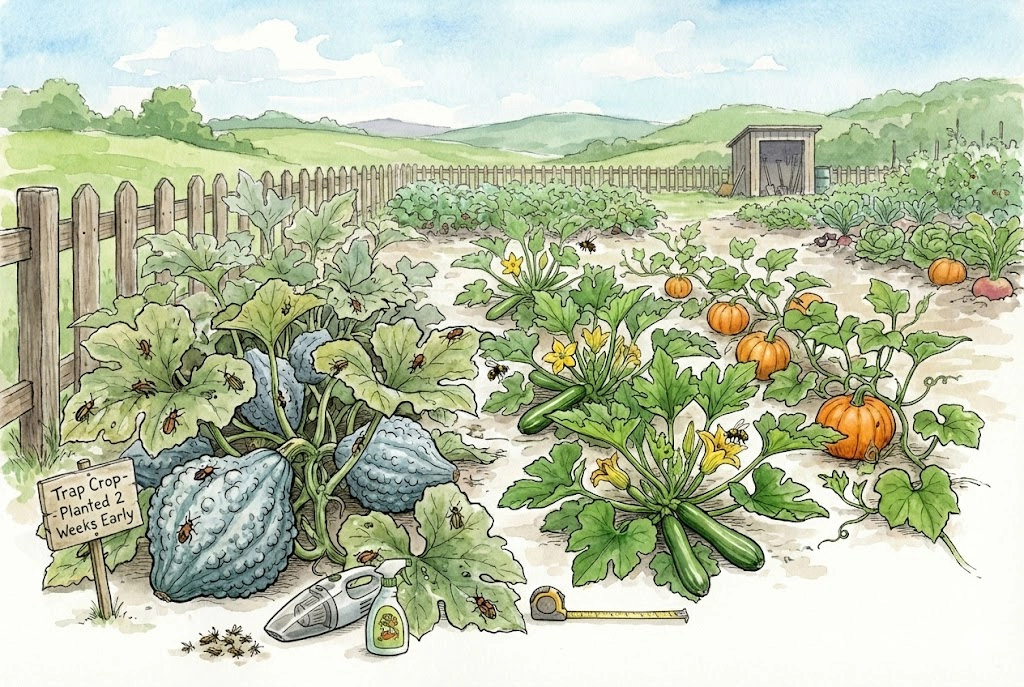
What Is a Trap Crop and Why Does It Work?
A trap crop is a plant grown as a decoy to draw pests away from your main cash crop. It works because insects have preferences.
Two very different pests are involved. The striped cucumber beetle (Acalymma vittatum) is a true beetle, while the squash bug (Anasa tristis) is a piercing-sucking true bug from a different insect order.
The attraction is well documented for cucumber beetles. They respond to bitter compounds called cucurbitacins that stimulate feeding.
Squash bugs also aggregate on Blue Hubbard in the field, but field observation supports that preference rather than the same cucurbitacin mechanism. Treat the two pests as separate cases.
Many modern zucchini and pumpkins have been bred for low bitterness, and Blue Hubbard is a traditional high-cucurbitacin type often used as a trap crop, but the exact cucurbitacin content of any given seed lot depends on cultivar, tissue, and growing conditions and is not something a seed listing guarantees.
In practice, the point is that a vigorous Blue Hubbard planted ahead of the main crop tends to pull the early beetle wave toward itself.
Stabilization of cucurbitacin E-glycoside, a feeding stimulant for diabroticite beetles, extracted from bitter Hawkesbury watermelon
Which Pests Does This Control?
Blue Hubbard is most often used against the striped cucumber beetle and the squash bug, and it can also draw squash vine borer.
It is generally less useful against generalist pests like aphids. How well it works, and which pest it helps with most, varies by region, cultivar, and the specific study, so check local extension guidance for your area rather than assuming a fixed ranking.
The Cucumber Beetle Threat
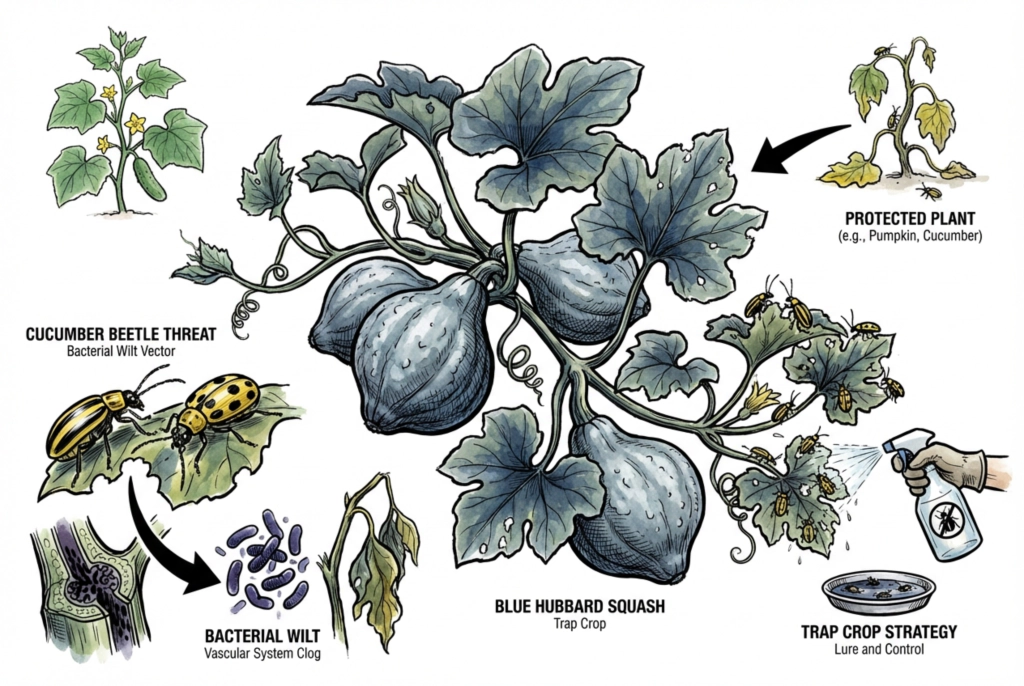
Cucumber beetles are the main vector of bacterial wilt (Erwinia tracheiphila). Not every beetle carries the pathogen. When a carrier feeds, bacteria in its mouthparts or fecal matter can enter the plant through the feeding wound.
Infected plants usually decline gradually rather than instantly, and susceptibility differs a lot among cucurbits. Cucumbers and muskmelons are hit hardest, while squash and pumpkins are less commonly and less severely affected.
There is no cure once a plant is truly infected, but wilting has several causes (daytime water stress, squash vine borer, squash-bug feeding, root disease), so confirm the cause, ideally with a local diagnostic lab or extension guide, before writing a plant off.
You can't spray every beetle before it feeds, but you can draw them to a plant you don't care about and manage them there, reducing the beetle pressure on your main cucurbits.
The Squash Bug Menace
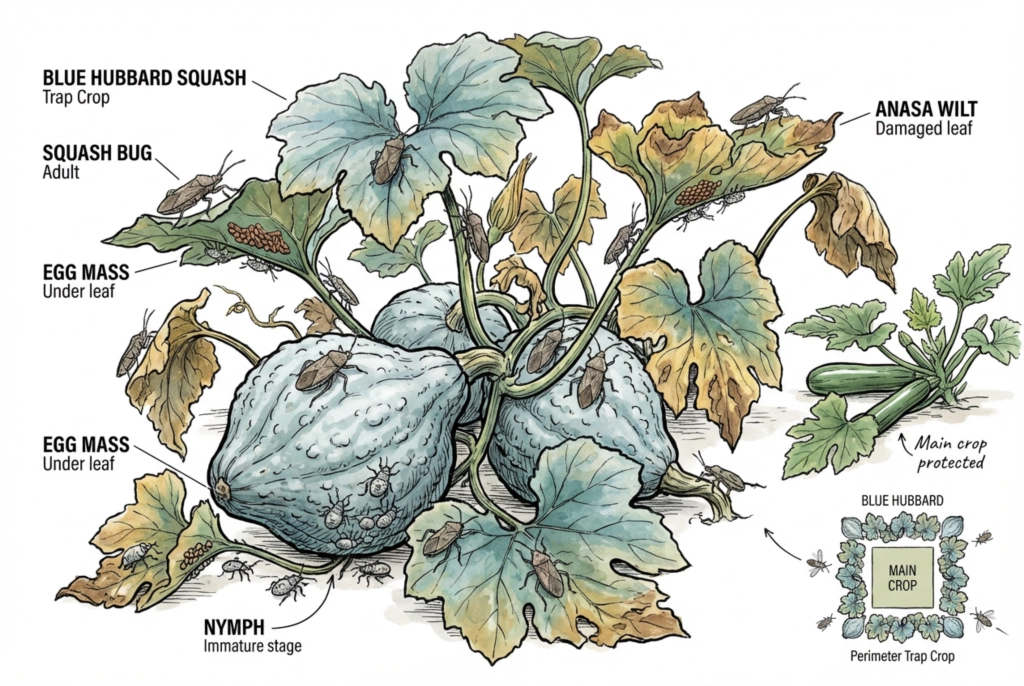
Squash bugs feed by piercing and sucking, which interrupts water and nutrient flow through the plant and, in heavy infestations, can cause leaves and vines to wilt.
This is direct feeding injury. Keep it separate from cucurbit yellow vine decline, a distinct disease that squash bugs can also transmit.
Adults are hard to control with contact sprays, but the reason is timing and coverage as much as their tough bodies. Current extension guidance targets freshly hatched nymphs and stresses thorough coverage of leaf undersides, where the insects shelter.
Squash bugs feed and mate on cucurbits in spring and can aggregate on an early Blue Hubbard trap.
Where they do concentrate, they become easier to reach by hand-vacuuming or spot treatment, but density, stage, and the labor to keep scouting still vary from site to site.
How Do I Set Up a Perimeter Trap Crop?
A full perimeter of Blue Hubbard can intercept beetles arriving from several directions. It isn't always required, though. In a small garden, or where infestation clearly comes from one direction, other layouts, a border on the pressured side, corner blocks, or interior rows, can also work.
Match the shape to where your pest pressure actually comes from.
The Layout
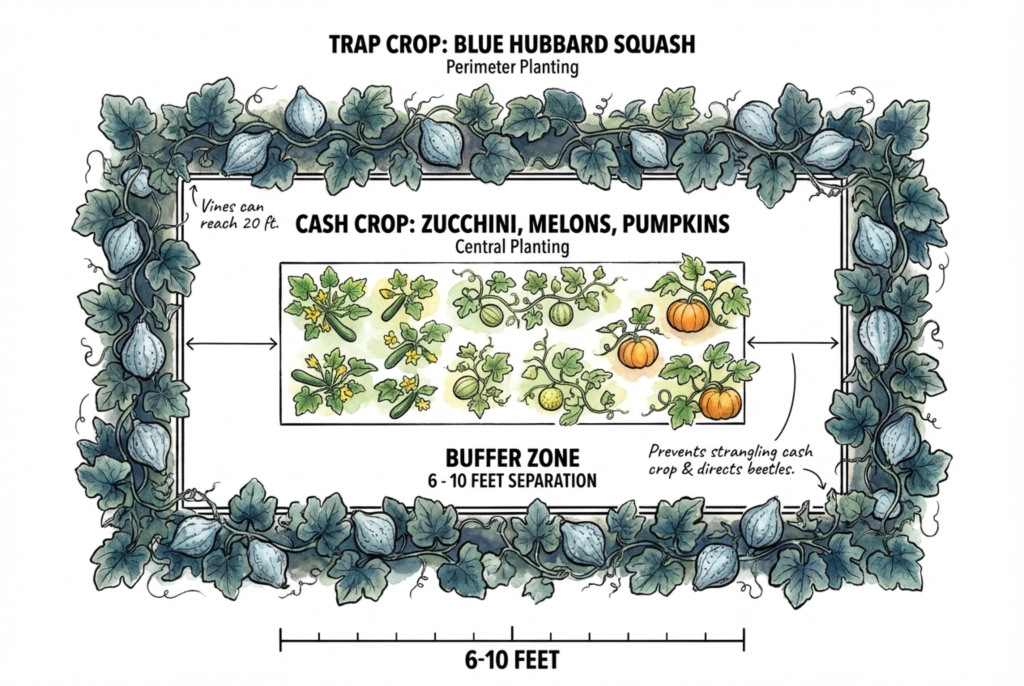
A common starting point is a border of Blue Hubbard around the main crop, with the cash crop (zucchini, melons, pumpkins) in the center and a buffer between the two.
General trap-crop guidance suggests roughly 2–3 rows and about 8–12 feet of separation as a place to begin, but the right width and number of rows depend on your field geometry, how strong the pest pressure is, how mobile the pest is, and which direction it comes from (widen the trap toward a known source and adjust from there).
Blue Hubbard is a vigorous vine that can sprawl a long way (how far depends on the cultivar and site), so give it room. Too close and it can crowd your cash crop. Too far and beetles may settle on the cash crop before reaching the trap.
Watch how your own planting behaves rather than treating any single distance as a hard cutoff.
Whatever cultivar you use, the trap only works if it out-attracts your cash crop, so start with a true Blue Hubbard (or another type known locally as a trap crop).
A seed listing can confirm the cultivar, but it does not certify a specific cucurbitacin level.
I number the perimeter sides and corners, then pair each trap-crop station with a cash-crop station just inside it. At the same time each day, the count covers adults, egg masses, and nymphs. The map also records the windward edge, nearby old cucurbit ground, and hedgerows so one whole-field total does not hide an entry route.
The paired stations show whether pests are stopping at the trap or passing through. I use that pattern to strengthen the pressured side next season and to focus removal there, while still checking quiet sides for a new arrival route.
Blue Hubbard Winter Squash Seeds
Blue Hubbard Winter Squash Seeds fit this trap-crop plan when you have a long season and enough space for a vigorous vine. Seed quality and local performance vary by seller, lot, and season, so check the current listing and grow it as a trap crop rather than assuming the fruit will be suitable to eat after pest treatment.
Timing Is Everything
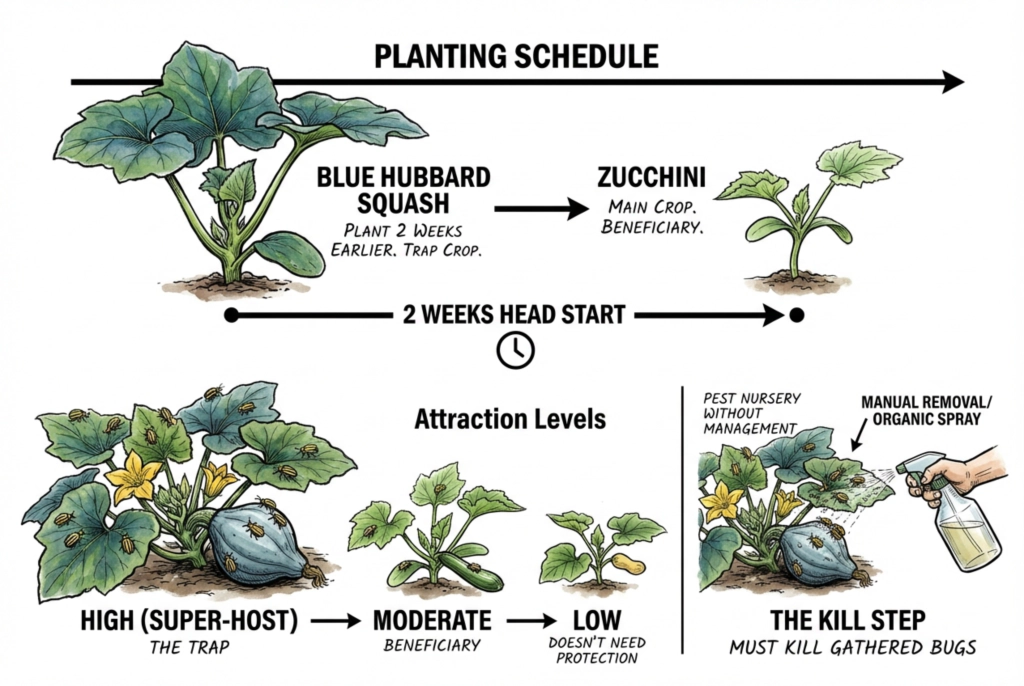
The rough ordering below is a general guide rather than a fixed rule. Actual attractiveness and the right response depend on the pest species, the cultivar, the plant's stage, and local pressure.
| Crop Type | Attractiveness to Beetles | Typical role (varies by site) |
|---|---|---|
| Blue Hubbard | High | Common trap crop |
| Buttercup Squash | High | Also usable as a trap crop, if not, it can compete with the trap |
| Zucchini | Moderate | Cash crop. Watch bacterial-wilt susceptibility |
| Pumpkins | Moderate | Cash crop. Less severe wilt than cucumbers, but still fed on |
| Butternut Squash | Lower | Relatively tolerant to some pests, but not immune (still scout it) |
Plant the Blue Hubbard about two weeks before the main crop so it is established when beetles arrive. Several extension sources recommend this head start.
The idea is that a larger, more established trap plant is more attractive when the beetles arrive.
If the trap and the cash crop reach the same stage at once, the trap loses much of its edge and beetles are more likely to settle on both.
Giving the trap a head start is the single strongest lever in this method.
The Kill Step (You Can’t Just Plant and Walk Away)
An unmanaged trap crop can backfire. If you concentrate pests on the Hubbard and then do nothing, the population can build and spill over onto your main crop.
Scout the trap on a regular schedule and act on what you find rather than relying on a fixed image of thousands of insects.
Whatever you use, you have to remove or kill what gathers on the trap. Which method is best depends on your situation.
Note that organic controls are not automatically safer for pollinators (some organic sprays are also bee-toxic, and flaming and vacuuming have their own risks) so weigh mechanical removal, label directions, real-world efficacy, and labor against each other.
Option A. Conventional / IPM (Systemic on the Perimeter)
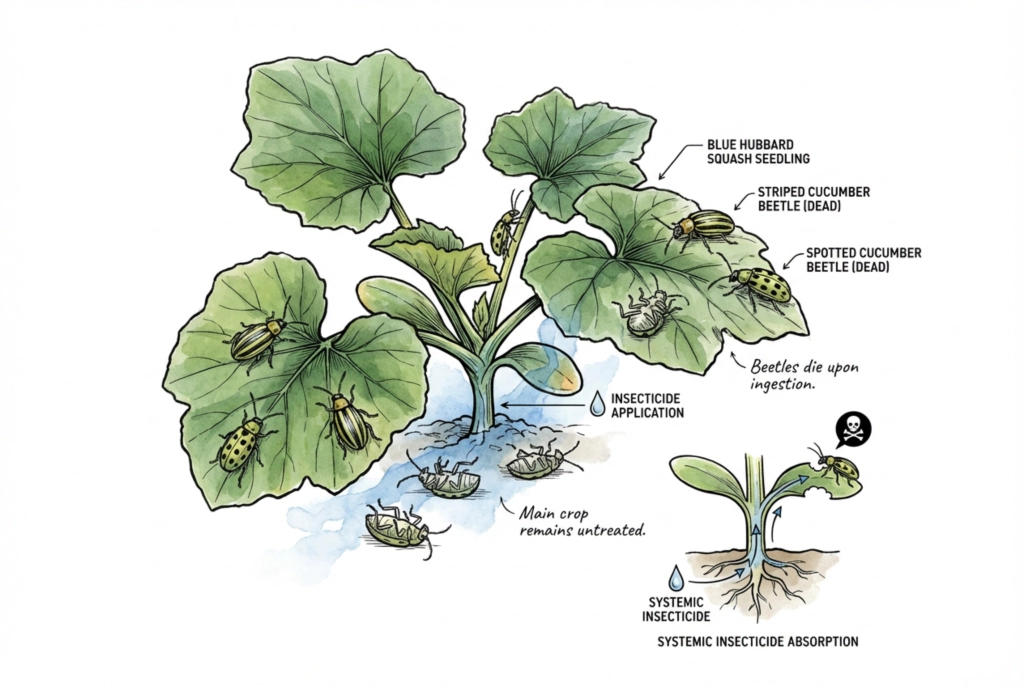
Systemic and Pollinator Safety
One conventional approach confines an insecticide to the Blue Hubbard perimeter, leaving the main crop untreated. The systemics people often mention here (imidacloprid, dinotefuran) are neonicotinoids, which move into the plant's pollen and nectar and are toxic to bees.
Do not treat an active-ingredient name as a recipe. Whether any product is legal for cucumber beetle or squash bug on cucurbits, and at what rate, timing, re-entry and pre-harvest interval, maximum number of applications, and with which pollinator restrictions, is set by the exact product label for your crop and your state.
Read the current label and check local extension guidance before applying anything.
Cucurbit flowers are very attractive to native squash bees, so a systemic neonicotinoid on a flowering trap crop can poison the very pollinators this method is meant to protect. This is not solved by treating early. Soil-applied systemic neonicotinoids have been detected in squash pollen and nectar formed weeks to months later, so a pre-bloom application can still leave residue in flowers that bees visit.
Keeping the center unsprayed also does not make the perimeter a safe zone. Squash bees visit the trap crop's flowers too.
Given all that, keep any conventional systemic to the early seedling / pre-bloom stage at most, never spray open flowers, and seriously consider the non-systemic options below.
Those options are not risk-free either (see the cautions with each), but they avoid the later-flower residue problem of a systemic.
Option B. Non-Systemic and Mechanical Controls
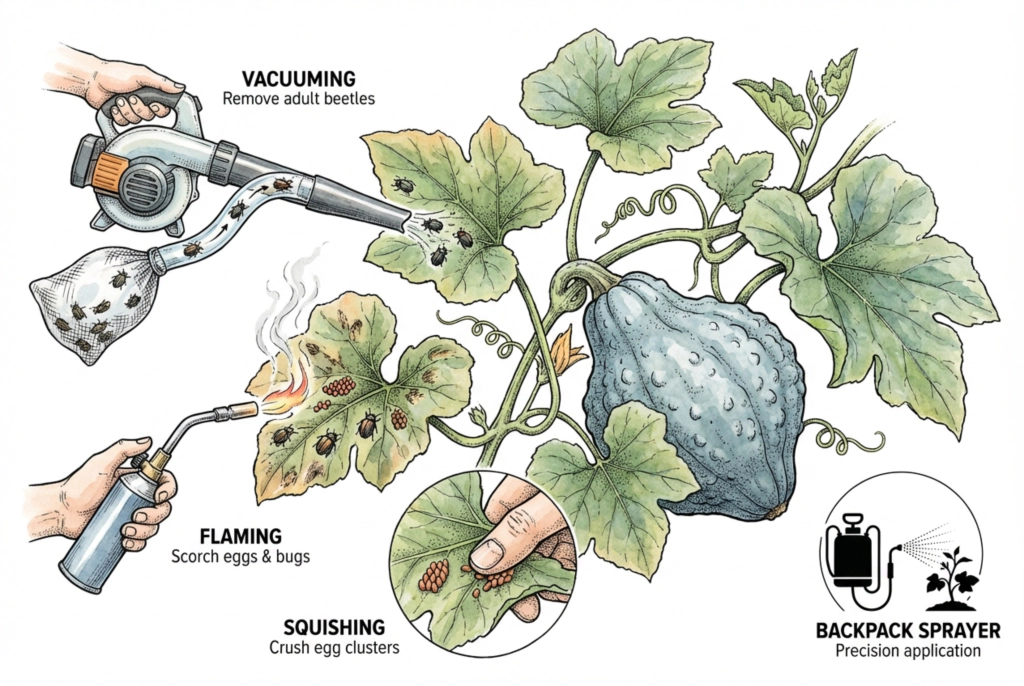
Because the trap concentrates pests in one place, hands-on removal can be practical, especially at small scale. At field scale, labor and pest density decide whether it's realistic.
None of these is automatically safe just because it's non-chemical.
- Vacuuming. Some growers use a reverse-flow leaf blower/vac to collect insects off the trap in the cool morning, when the insects are sluggish. Reports are limited and note some plant damage. If you try it, plan for how you'll collect, kill, and dispose of what you catch. Expect to pick up beneficial insects too. Clean the equipment between uses, and wear eye and respiratory protection against debris.
- Flaming Evidence for this option is thin. One funded farmer project never reached the testing stage, and organic-production sources note that flame damages the trap crop even when it later regrows. Directing a torch at leaves and egg masses can injure the crop, ignite dry mulch, plastic, or drip lines, and create wildfire, burn, and propane hazards. Check local fire restrictions and a qualified farm-safety source before using open flame, and wear appropriate protection.
- Squishing. Check leaf undersides for coppery squash-bug egg clusters and crush them. This is an effective physical control. Scout often (every few days to weekly is typical, more under heavy pressure) rather than assuming a single fixed interval.
- Sprays. If you use a spray, choose the product from what your local extension guide lists for your exact crop and pest, and follow that product's current label. Do not assume any spray, organic or not, is safe for bees. Many are toxic to bees while wet, and label directions on timing and blooming plants exist for that reason.
Captain Jack's Deadbug
Captain Jack's Deadbug does not fit cucumber beetle or squash bug control when its current label does not list those pests on cucurbits. Do not turn an evening application or dry foliage into permission for an off-label use. The label also carries bee and aquatic-invertebrate precautions, so use a product your local extension guidance and its exact label support for the identified pest.
The Benefits (Why Sacrifice the Space)?
Giving over part of your planting area (often on the order of 10%, depending on field shape and border width) to a trap crop can pay off if it protects the bulk of your yield, but whether it's truly profitable depends on your border area, yields, labor, and input costs, so treat it as a trade to weigh rather than a guaranteed win.
Spraying Less of the Field
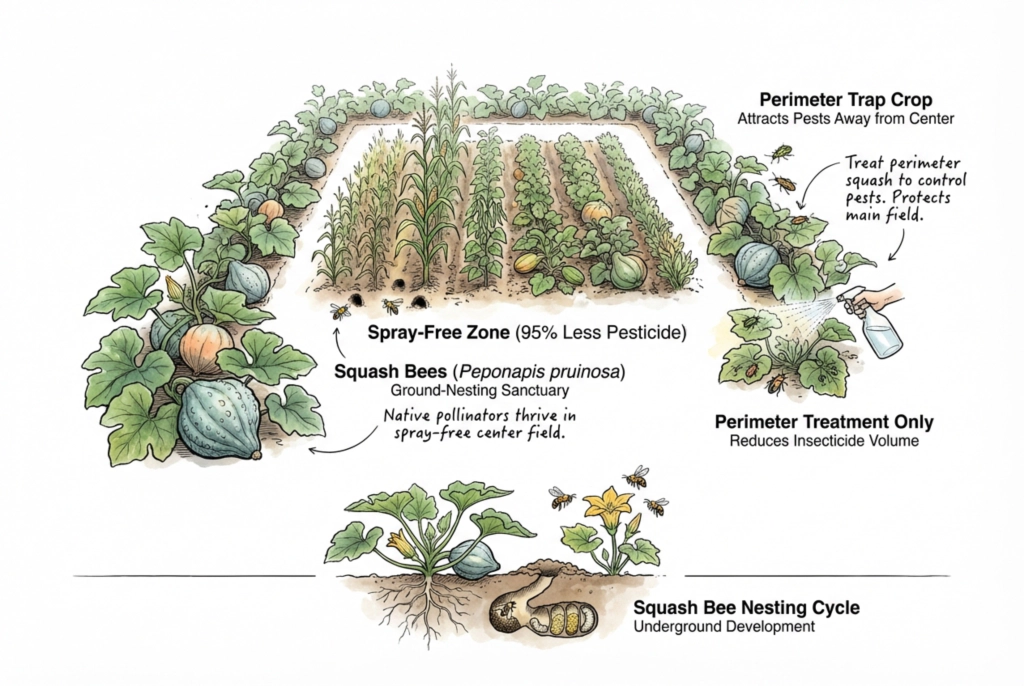
University of Connecticut field work found that over 94% of cucumber beetles ended up on the perimeter trap crop, and that a sprayed perimeter reduced squash vine borer infestation on the unsprayed interior by 88%. Unsprayed centers also saw beetle populations fall by up to about 95%.
Those are three separate measurements. The up to 95% figure is a beetle-population reduction in the center, not a measured cut in pesticide volume.
Confining spray to a border logically uses less product than treating the whole field, and USDA guidance describes an 80–95% pesticide saving as a general range when only the trap crop is sprayed, but the exact saving depends on how much of your field is border, your spray rate, the number of applications, and spillover.
It was not measured for the specific 1–2 row, small-buffer layout described here, so don't read the top of that range as a guaranteed outcome.
Keeping the center field unsprayed can also help ground-nesting native squash bees (Peponapis pruinosa), which is a benefit you lose if you blanket-spray or use a systemic that reaches the flowers.
It isn't a guaranteed sanctuary, though (the bees still forage on the perimeter's flowers, systemic residue can reach those flowers, and soil disturbance affects their nesting habitat) so treat it as reduced exposure, not a protected refuge.
Perimeter Trap Cropping Works! UConn Integrated Pest Management
Economic Sense
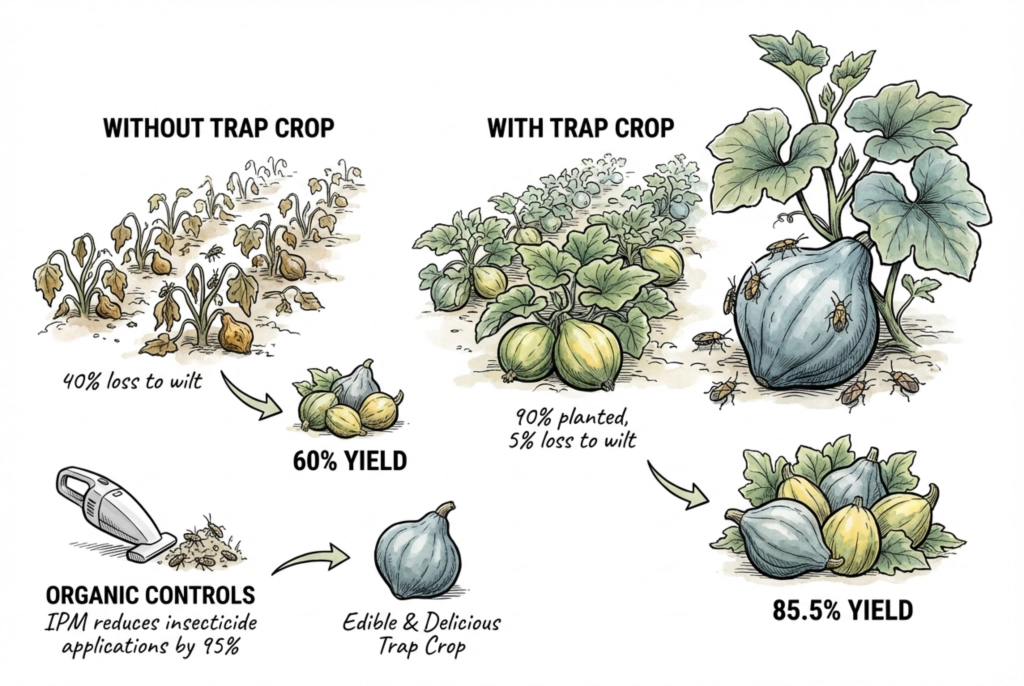
Whether the trap pays off comes down to your own numbers. As a made-up example, if a field lost a large share of its yield to wilt without a trap, but a trap plus active management kept losses small on most of the planting, the trap would come out ahead, but there is no field trial behind those specific figures, so don't treat them as expected results.
To estimate it for yourself, add up seed or transplant cost, labor, scouting time, the control you choose, the area given to the trap, and the trap crop's own marketability, using prices for your region.
Blue Hubbard is an edible, storable winter squash, so the trap plants need not be a total loss, but as noted above, whether a given trap fruit is worth selling or eating depends on what was sprayed on it, its label pre-harvest interval, and any pest damage.
Troubleshooting Common Mistakes
My Trap Crop Failed
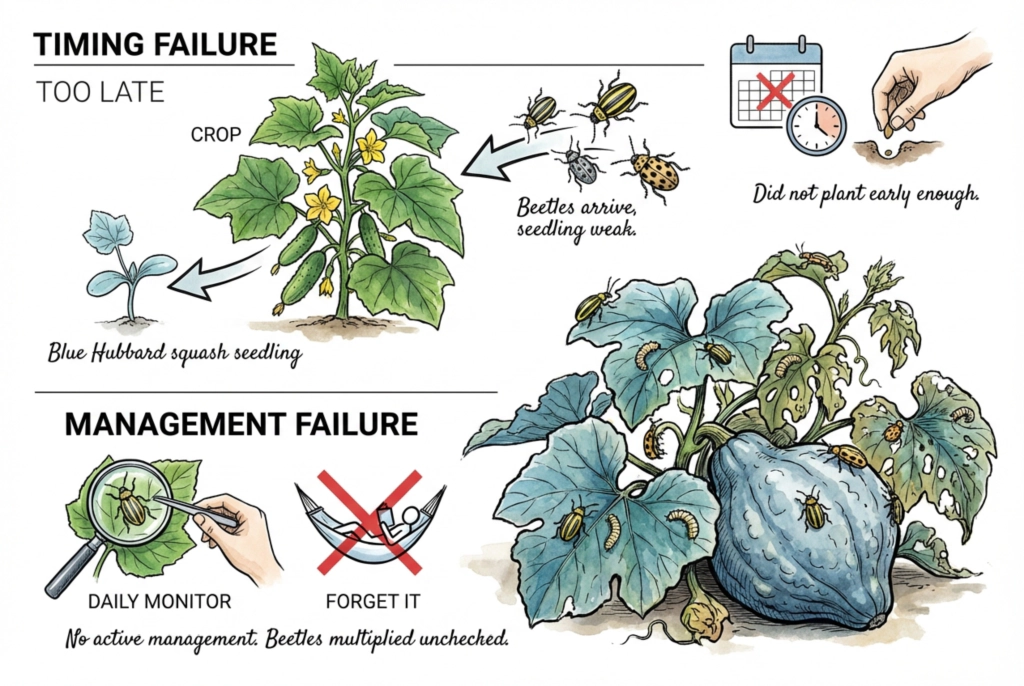
The caterpillar-like larvae drawn on the leaf are not accurate. Cucumber-beetle larvae feed underground on roots, and squash-bug nymphs are not caterpillars.
Check the timing first. Was the Hubbard planted early enough? If it was small and weak when the beetles arrived, it couldn't out-compete the cash crop.
Fertility, the direction and strength of your pest source, cultivar, layout, and weather are worth checking too.
Then check the management. A trap crop isn't set-it-and-forget-it. It needs frequent scouting (extension thresholds range from every few days to weekly or twice weekly, depending on pressure) and prompt action, or it can turn into a source of pests instead of a sink for them.
I Still See Beetles on My Zucchini
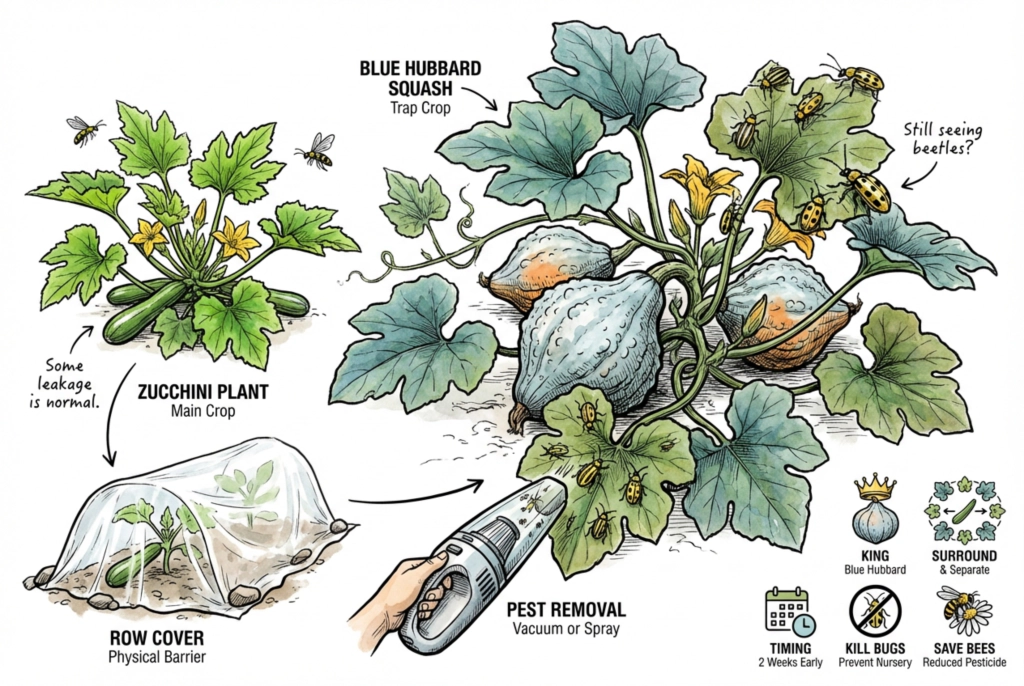
Some leakage is normal. The trap is a decoy, not a barrier. Pair it with floating row covers over the main crop early in the season. The trap draws off the early beetles while the covers physically exclude the rest.
For this to work, install the cover early (before pests arrive), seal the edges, watch for tears, and monitor for heat buildup underneath.
Remove covers at flowering so pollinators can reach the blossoms (non-parthenocarpic cucurbits need insect pollination to set fruit).
Agfabric Floating Row Cover
Agfabric Floating Row Cover suits early-season exclusion when you can seal the edges, vent it in heat, and remove it at bloom. It can reduce beetle access and vector exposure, but it is not absolute prevention and needs regular checks for tears and heat buildup.
Affiliate Disclosure
This article contains Amazon affiliate links. As an Amazon Associate I earn from qualifying purchases. If you use these links, the site may earn a commission at no extra cost to you. Product availability, price, and specifications can change. Check the current listing before buying.