
Drift Reduction Adjuvants: How They Reduce Spray Drift
A drift reduction adjuvant (DRA) guide: the droplet physics behind spray drift, polymer vs oil DRAs, matching them to nozzles, why auxin-herbicide labels are the legal authority, and mixing without clogging your screens. Not legal advice (always follow the exact current product label).
Jordan Cole · Published 2026-02-02 · 14 min read

Key Takeaways
- A drift-reduction adjuvant can reduce particle drift by shifting the droplet spectrum away from the finest droplets. It does not control vapor drift or make an application risk-free.
- Choose a DRA together with the nozzle, pressure, tank mix, and product label. A product that works in one setup can distort the spray pattern in another.
- The current pesticide label controls which adjuvants, nozzles, spray qualities, weather limits, and buffers are legal for that application. There is no universal DRA rule for an entire herbicide class.
- Mix according to the label and add drift-control products at the stage the label specifies. A jar test checks physical compatibility but does not prove crop safety or legal use.
- Coarser droplets can reduce coverage for contact herbicides. Lower drift risk is useful only when the spray still meets the product’s coverage and label requirements.
What Causes Spray Drift?
Start With Droplet Physics
Droplet size is one of the biggest factors an applicator can control. The fine end of the spray, the potentially driftable fines, moves off target most easily.
But it is not the only cause. Extension research (NDSU and others) treats drift as the combined result of wind direction and speed, air stability and temperature inversions, release (boom) height, nozzle and pressure, temperature and humidity, the product’s formulation, and how sensitive the surrounding crops and areas are. Managing droplet size helps, but only alongside those conditions.
As a working rule, extension guides treat droplets smaller than about 150 microns as drift-prone fines.
That does not mean every such droplet always drifts off target in a light breeze. How far a droplet travels depends on its size distribution, release height, evaporation, and air turbulence, and low wind with a temperature inversion can actually carry fines farther.
Think of it as a probability that rises as more of your spray falls into that fine range.
Fine droplets stay airborne longer, so wind has more time to carry them off target. Coarser droplets fall faster and spend less time exposed to the wind.
How do DRAs Reduce This?
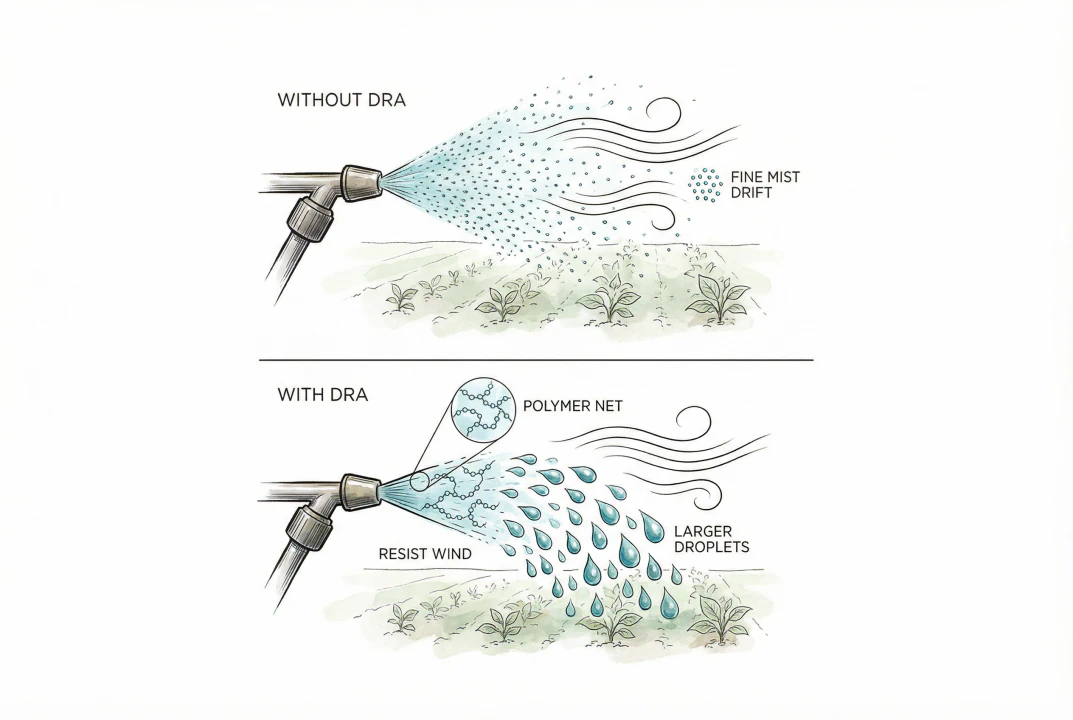
Many DRAs shift the droplet spectrum away from the finest droplets, so a smaller share of the spray is drift-prone.
Not every DRA simply makes the whole spray larger. Some reduce the fraction of fines without greatly enlarging the coarse end.
The only way to know what a given product does is to evaluate the full droplet distribution for your specific nozzle, pressure, tank mix, and rate.
DRAs change how the spray liquid breaks into droplets as it leaves the nozzle. Some make the liquid resist breaking into a fine mist, while oil- and surfactant-based products change how the spray spreads and separates.
Does a DRA Stop All Types of Drift?
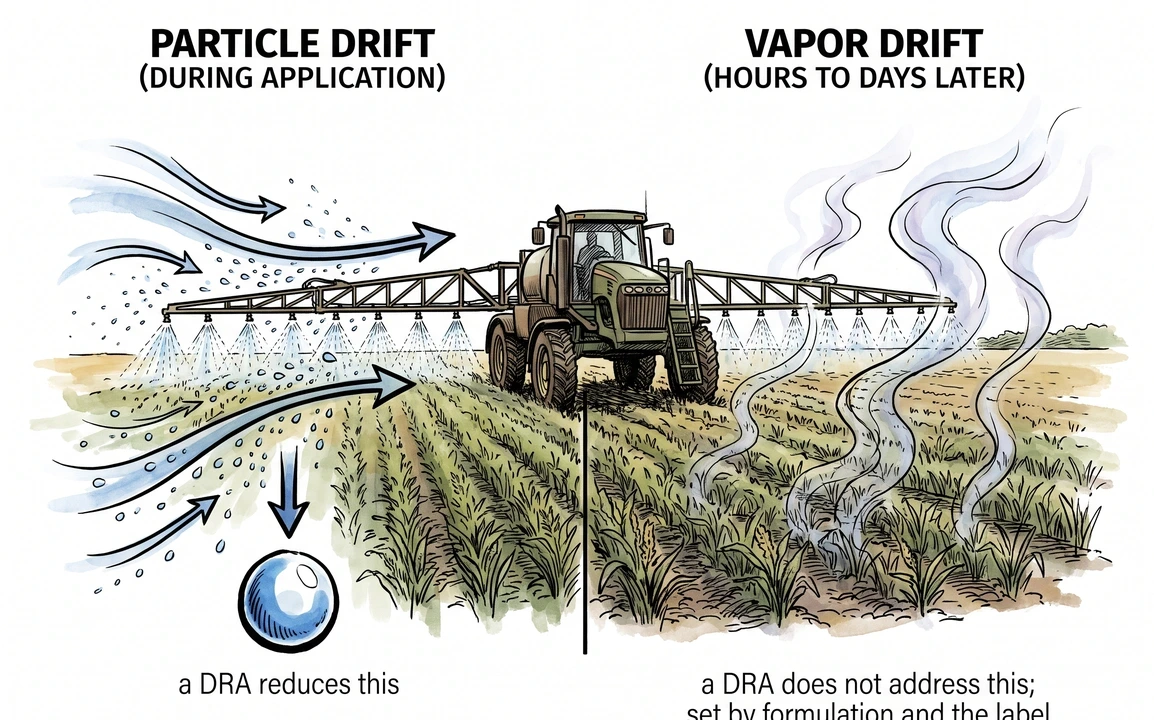
| Feature | Particle Drift | Vapor Drift |
|---|---|---|
| Main factors | Wind, fine droplets, inversions, release height, evaporation | Formulation, temperature, humidity, surface, pH, time, weather |
| Timing | During application | Hours/days after application |
| What helps reduce it | Nozzle and pressure choice, DRA, weather timing, buffers | Formulation choice, label conditions, VRA where the label calls for one |
No. A DRA works on particle drift (the physical movement of airborne droplets), and it reduces that risk rather than eliminating it (wind, inversions, boom height, pressure, droplet spectrum, and sensitive downwind receptors all still matter).
A DRA does not address vapor drift (volatility). Some formulations, such as certain dicamba and 2,4-D ester products, can volatilize and move after application. How much depends on the specific formulation, the label conditions, temperature, humidity, surface, pH, and time.
No polymer or oil DRA changes that. What actually reduces volatility is the right formulation and following the exact product label.
This distinction matters. Reducing particle drift and reducing volatility are separate problems.
Some product labels call for a specific Volatility Reducing Agent (VRA). A VRA is not a universal antidote that makes any volatile pesticide safe to spray in high heat.
Whether one is required, and which one, is set by the specific product’s label, not by preference.
Which Type of DRA Should I Use?
Choose By Chemistry and Equipment
Two common families are polymers (such as PAM or guar) and oil emulsions, but they are not the only ones. Lecithin- and surfactant-based products and multifunction premixes also exist, and Purdue notes that not all oils are effective.
There is no single best type. The right choice depends on the product, the rate, the full tank mix, and the nozzle and pressure.
A poorly matched DRA can hurt both drift control and coverage, so match it to your equipment and label rather than to a general ranking.
Why Choose a Polymer-Based DRA?
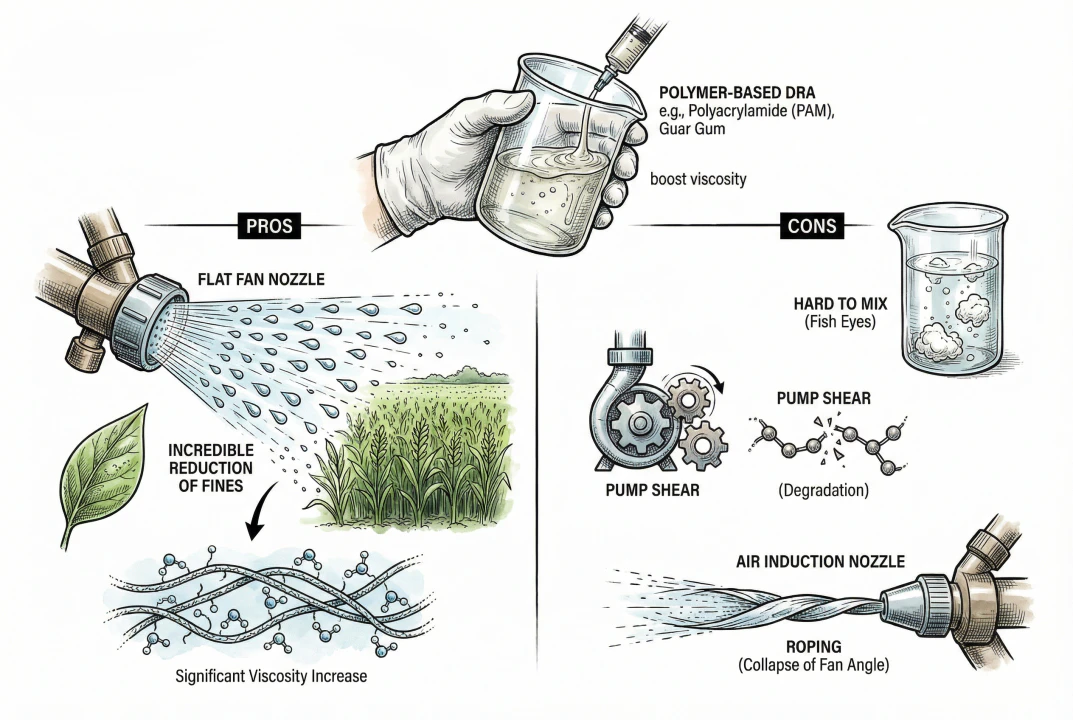
Polymer products often use polyacrylamide (PAM) or guar gum, and they tend to raise viscosity.
Under the right conditions they can strongly reduce fines, but performance varies widely with formulation and rate.
Potential Strengths
Polymer DRAs can substantially reduce fines in some tank mixes and are often paired with flat-fan nozzles. Actual reduction depends on the specific product, nozzle, and pressure.
Potential Drawbacks
Some polymer products are hard to mix and can form fish eyes. Others are susceptible to pump shear, and certain viscosity-modifying polymers can distort the pattern of air-induction nozzles. How likely and how severe these issues are depends on the chemistry, mixing, pump, and nozzle.
Why Choose an Oil-Based DRA?
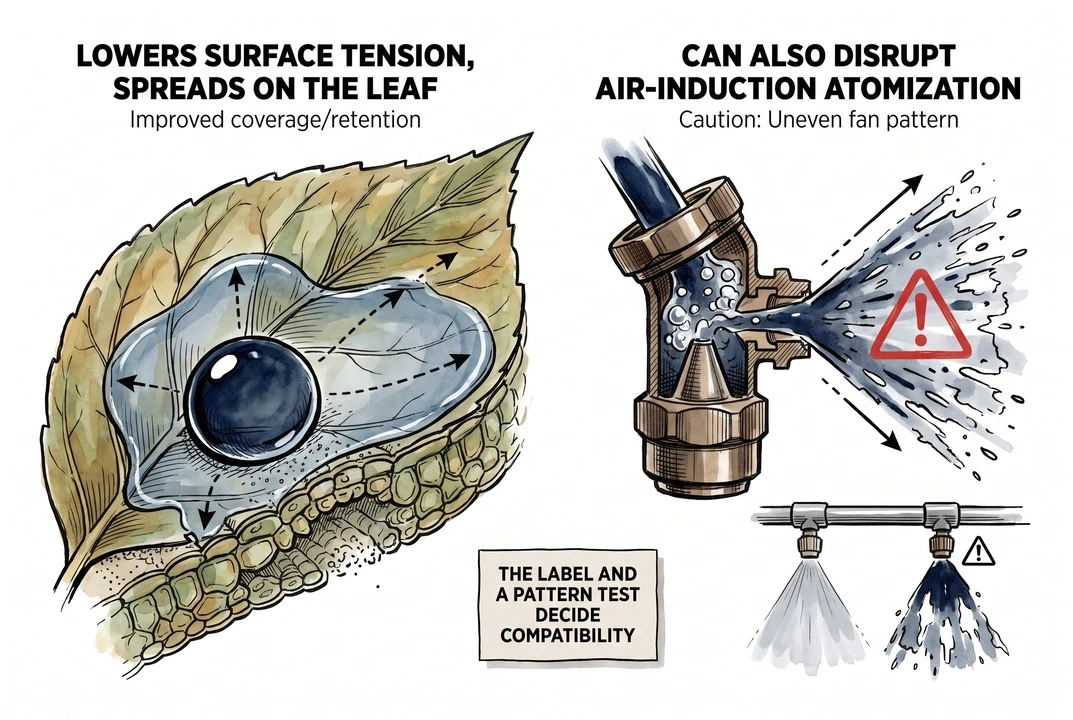
Oil emulsion and surfactant products modify surface tension and the spray-sheet structure rather than simply thickening the water.
Not every oil DRA is easy to handle or good for coverage, and Purdue notes not all oils are effective.
Potential Strengths
Some oil-based products improve spreading and retention on the leaf, and some are less likely than a heavy polymer to distort an air-induction pattern. Oil and surfactant products can also interfere with air-induction (Venturi) atomization, so check the label and run a pattern test.
Potential Drawbacks
Some oil-based products may be less aggressive at cutting the finest droplets than a heavy polymer. There is no fixed ranking across the whole class.
Can I Use Any DRA With Any Nozzle?
No. The DRA has to be compatible with the nozzle. Some viscosity-modifying polymers can be a poor match for air-induction (AI) nozzles.
AI nozzles create coarse droplets by drawing air into the spray stream. Some thick polymer products can prevent the nozzle from forming its intended pattern. Check manufacturer compatibility information and run a pattern test with the complete mix, at the intended pressure.
When it goes wrong, the fan can collapse into a rope or stream, which can cause zebra-striping and poor coverage.
Note, though, that oil and surfactant products can also disrupt AI atomization, so oil for AI is not a universal rule.
Use the following as a starting point only, subject to your labels and manufacturer data.
- With AI nozzles, some growers favor oil-based DRAs or polymers formulated for AI tips, but the exact pesticide and adjuvant labels, the nozzle manufacturer’s qualified pressure range, and a full-mixture pattern test decide what actually works.
- With older flat fans (such as XR), a DRA is not automatically required. If you meet the pesticide label’s minimum spray quality with the nozzle, pressure, and boom setup, that may be enough. A pre-orifice or low-drift nozzle is another option, and in some mixes a polymer could hurt coverage.
Practical Application Guide
How Do I Mix Correctly to Avoid Problems?
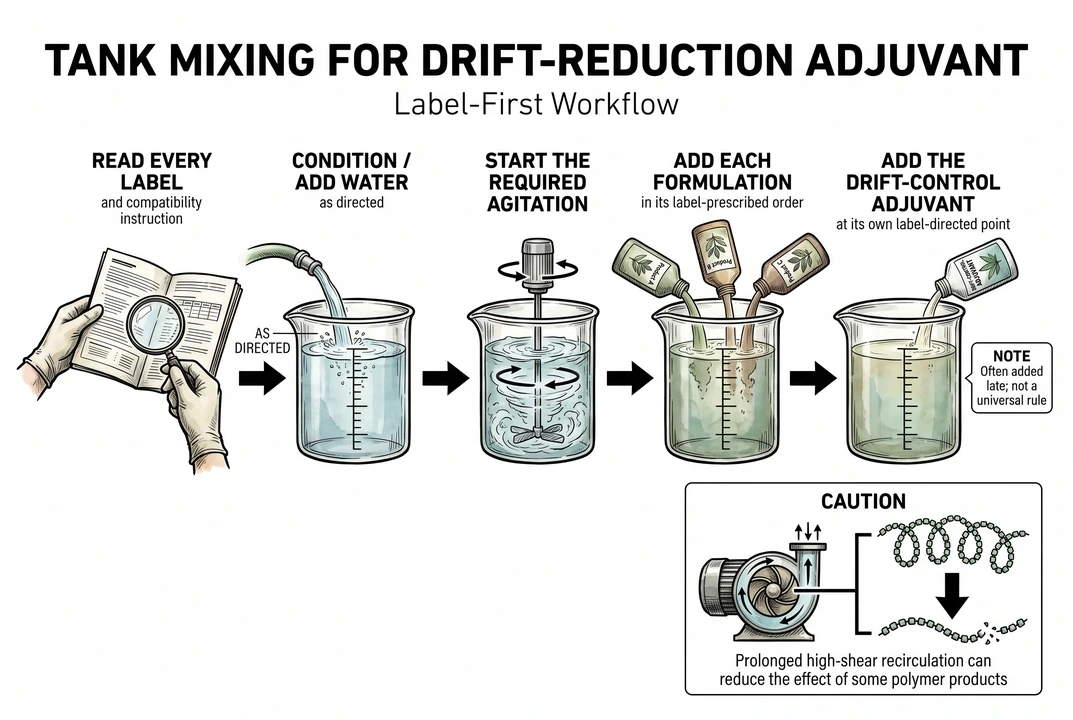
The exact pesticide and adjuvant labels set the mixing order
Follow them first. When a label does not specify one, a common general sequence is WALES/DALES, and you should watch for pump shear.
The general WALES/DALES order is
Wettable and dry formulations first (with agitation running), then Agitation-dependent liquid flowables, then emulsifiable concentrates, and finally surfactants and other adjuvants (drift-control agents typically go in near the end of that sequence, not before the active).
The Enlist specimen label follows the same general idea, placing crop oils, surfactants, and other adjuvants in a later step after the soluble-liquid active.
Pump shear can occur when a centrifugal pump degrades the long polymer chains of some DRAs.
Prolonged recirculation may reduce a polymer product’s effectiveness, but the exact amount depends on the specific product, pump, pressure, plumbing, and rate. There is no reliable universal figure.
Follow the manufacturer’s guidance on maximum recirculation and avoid recirculating longer than needed.
Mixing Steps
- Jar Test. Run a jar test using your actual field water and the label mixing order at the correct field ratios, with proper PPE and ventilation. It checks for physical incompatibility only. It does not prove legal compatibility, crop safety, or efficacy.
- Order. Follow the exact label order. In the absence of label direction, general WALES/DALES puts drift-control and other adjuvants in after the active formulations, not before.
- Agitation. Keep the required agitation running, and avoid recirculating longer than the product label and your system call for.
Will Big Droplets Reduce My Weed Control?
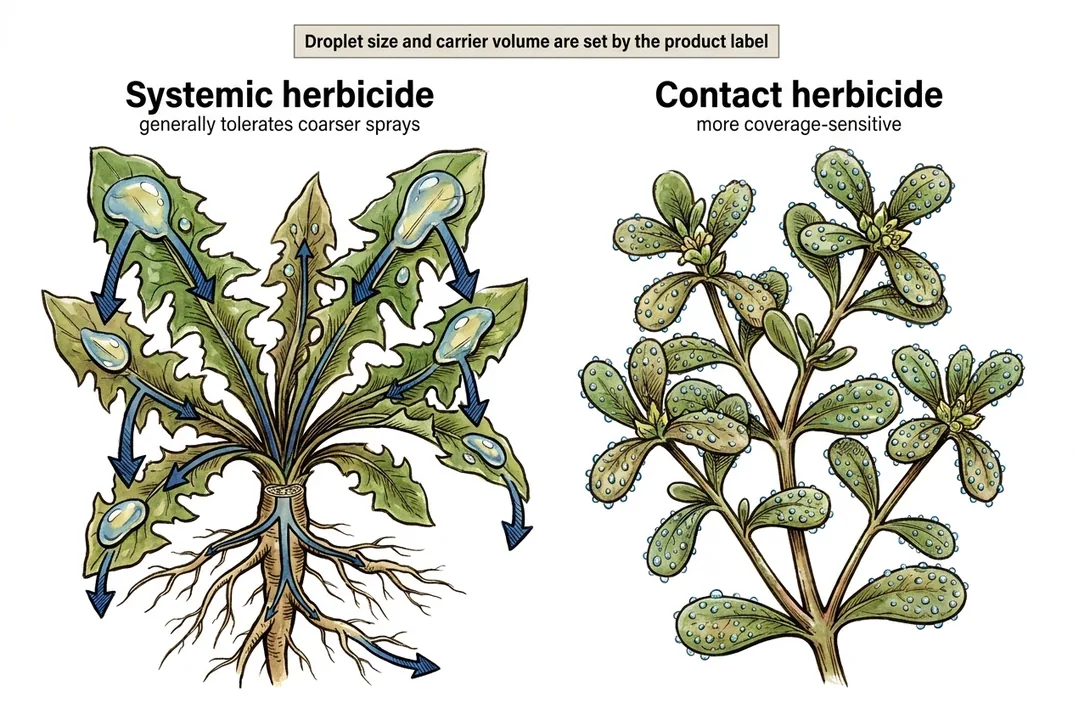
It depends on the herbicide’s mode of action, and the specifics are set by each product label rather than by a simple yes/no.
Systemic Herbicides
Systemic herbicides include glyphosate products such as Roundup and products used in the Enlist and Xtend systems. They translocate through the plant, so NDSU notes they generally tolerate coarse to very coarse sprays. That is a tendency, not a guarantee (the exact droplet size still depends on the label, weed size and leaf, the product, and carrier volume). Roundup is a glyphosate brand, while Enlist and Xtend are trait systems, not single active ingredients.
Contact Herbicides
Contact herbicides include Liberty ULTRA and Gramoxone. These need thorough leaf coverage, so coarser droplets and lower droplet counts can cost control, and higher carrier volumes often help. The requirements differ by product and are set by the current label. Liberty ULTRA calls for at least 20 GPA with a medium-to-coarse spray, while Gramoxone SL 3.0 specifies medium-to-coarse as the default and at least 20 GPA if droplets are larger than coarse. Do not apply a single 15 to 20 GPA rule across every contact product. Read each label. Gramoxone (paraquat) is also a restricted-use product with its own training and closed-system requirements.
Regulations and Compliance
This section is general background, not legal advice, and pesticide registrations change. Always follow the exact current label for the specific product, crop, use, and state on the day you spray, and confirm the current status with your Extension service or state agency.
Is a DRA always mandatory for auxin herbicides?
No. You cannot treat the whole dicamba/2,4-D class as one rule. Requirements are set product-by-product on each label.
Over-the-top (OTT) dicamba is the clearest example of strict, product-specific rules. The relevant OTT dicamba registrations have changed repeatedly through litigation, so treat any general summary as out of date and go to the current EPA registration and the individual product labels.
Where an OTT dicamba product is registered, its label typically imposes a package of conditions (an approved drift-reduction adjuvant plus an approved volatility-reduction agent, a coarse-or-coarser spray, a low boom height, wind-speed limits, downwind buffers, temperature and inversion restrictions, restricted-use status with certified-applicator and annual-training requirements, and recordkeeping).
Those requirements belong to those specific products and uses, not to every dicamba or 2,4-D application.
For the Enlist system (Enlist One and Enlist Duo), the label requires approved nozzles and pressures, an approved tank-mix list, downwind buffers, and other conditions, but it does not force a separate DRA on every application.
The often-cited within 7 days step is specifically about confirming that any product you plan to tank-mix is on the tested, approved tank-mix partner list before you spray.
It is not a universal print the DRA list rule.
The practical takeaway is simple. Where a label restricts which adjuvants or tank-mix partners you may use, those restrictions are enforceable, so follow the label rate, spray-quality, weather, buffer, and applicator-certification requirements exactly.
Do not assume that any off-list adjuvant is automatically illegal in every case, or that a single set of numbers applies across products.
Applicators are responsible for following the label. Broader civil or criminal liability depends on the facts and on state law, so consult your Extension service, state pesticide agency, or a qualified professional for anything specific.
Troubleshooting & Problem-Solving
Why is My Pattern Streaking?
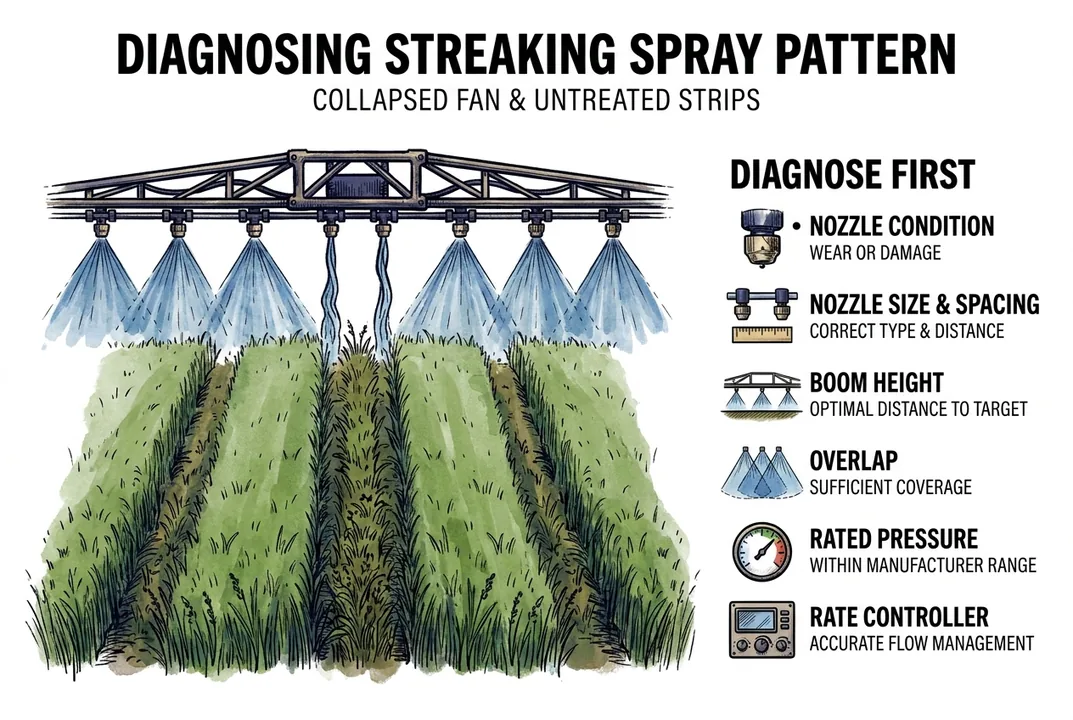
A thick polymer paired with a coarse AI nozzle is one possible cause, but it is not the only one.
Low pressure, the wrong nozzle height or spacing, inadequate overlap, worn or partly plugged tips, boom dynamics, and rate-controller or speed issues can all produce a streaked pattern.
Watch for strips of heavier weed pressure between passes and a nozzle pattern that looks more like a garden hose than a fan. Ideally, catch this before you spray a field.
What to do
Stop and diagnose rather than reflexively changing pressure or products. Run a pattern test with clean water and then the full tank mix. Check nozzle condition, size, spacing, and height. Verify you are within the nozzle’s rated pressure range and the label-qualified nozzle-pressure combination, and check overlap and the rate controller.
Raising pressure only helps if a genuinely low pressure is narrowing the fan and you stay within the rated range. Pushing pressure up otherwise makes droplets smaller, increases drift, and can violate the label’s approved nozzle-pressure combination.
Do not switch to an oil-based DRA without first confirming compatibility, since oil and surfactant products can also disrupt AI atomization.
Why are My Screens Clogged?
Gel, paste, or curd in the filters can signal a physical incompatibility, but a DRA is not necessarily the cause.
Investigate mixing order, water quality (hard or cold water), fertilizers, undissolved dry formulation, contamination, and inadequate agitation before blaming any one product.
What to do
Clean out the system following the exact pesticide label’s cleanout sequence, wearing the required PPE and containing and disposing of rinsate properly. Do not release pesticide residue or wash water to the ground or drains.
Do not pre-slurry every DRA in warm water as a blanket fix. Only certain dry formulations need pre-slurrying, and some products require a specific mixing order set by the manufacturer, so an arbitrary dilution can create gels, dosing errors, or an off-label mixture.
If the label does not give product-specific mixing instructions, check with the manufacturer or your Extension service.
Cold water can slow the dispersion of some materials, but that is not the same as a chemical reaction, and there is no universal dilute first rule that applies to every polymer DRA or fertilizer combination.
Note that most tank adjuvants, including many DRAs, are sold as ordinary inputs. EPA regulates them as tank adjuvants rather than registering them as pesticides, so they are not inherently restricted, dealer-only items.
(A given pesticide may be restricted-use. That is separate from buying an adjuvant.) Managing drift starts with reading the wind.
Measure Wind and Coverage
Handheld wind meter
Pocket wind meters differ in the variables they report, averaging modes, range, accuracy, logging, and environmental limits. A basic unit often measures wind speed only, current, average, and peak, so confirm whether the model you use also reads temperature and humidity, and use only the functions its manual documents.
Hold the meter at boom height rather than eye level, since wind at the release point is what moves the spray. Treat a single short reading, on the order of 30 seconds, as context, not proof of compliance, and measure at the height, position, duration, and frequency the pesticide label requires, following its rules for gusts, direction, forecasts, inversions, and records.
Water-sensitive paper
Water-sensitive paper helps check where your spray is landing when placed at several positions in the canopy. Its yellow surface turns dark blue where aqueous droplets land.
Handle the cards with clean, dry hands. Keep the yellow side facing the spray, and use replicates plus an untreated control.
It is a useful way to compare deposition and coverage between passes, but the blue stains spread and overlap, so at higher volumes they give only a rough visual estimate. A single landing pattern does not prove that a coarse, drift-reduced spray has adequate field coverage or that no off-target drift occurred.
Selecting Spray Nozzles to Reduce Drift | NDSU Extension
Before a new nozzle and adjuvant combination reaches pesticide, I make a labeled clean-water pattern run when the equipment instructions allow it. I place duplicate cards at the boom center and both outer sections in the top, middle, and bottom canopy thirds. The resulting 18 cards expose section and height gaps, and I photograph each beside its position label before the stains spread.
I repeat the layout after changing only one factor such as nozzle height, pressure, or travel speed. This catches an end-section or overlap problem that a single card beneath the center of the boom can completely miss. The pesticide label still decides whether the final setup and any later tank mix are permitted.