
Sphagnum Moss for Staghorns: When to Replace
Check staghorn fern sphagnum for compaction, odor, drainage and salt crust. Learn when to replace moss, preserve roots and shield fronds, and remount safely.
Jordan Cole · Published 2025-12-22 · 19 min read
Key Takeaways
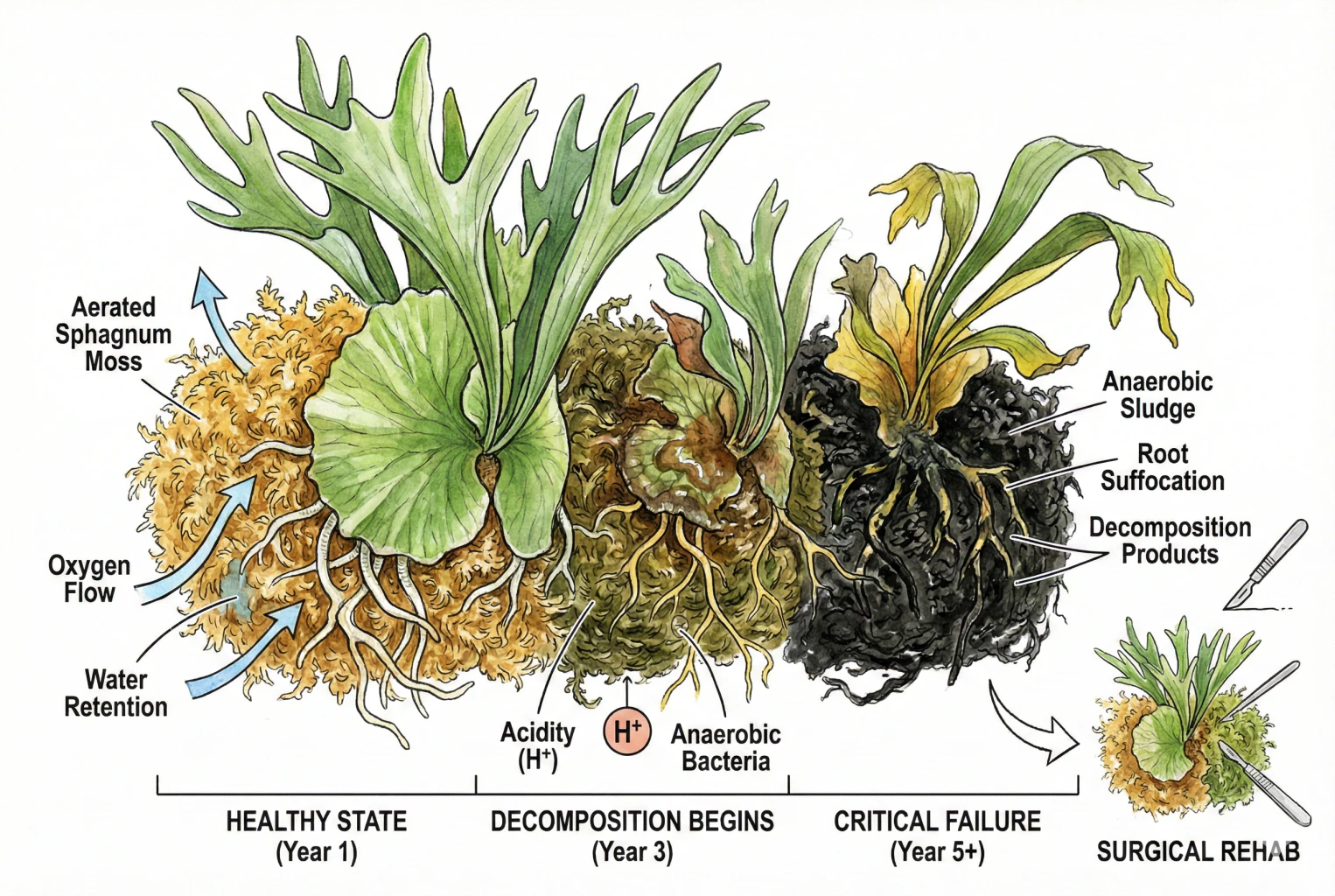
- Sphagnum moss is organic and eventually changes. As it ages it can compact and lose the air pockets epiphytic roots depend on. How fast this happens depends on moss, water, plant, and climate.
- Smell, squeeze, and water behavior are screening clues. Sour or rotten-egg odor, slimy moss that stays compressed, or water that beads off or remains soggy are reasons to investigate, not a diagnosis by themselves.
- Longevity depends on condition rather than a calendar. Long-fiber New Zealand sphagnum often keeps structure longer than short milled moss, and hard water can leave mineral deposits. No reliable published figure gives an exact mount lifespan.
- Remount gently and preserve living tissue. Remove degraded material that comes away easily, keep firm brown shield fronds, avoid the green growth bud, and leave new moss springy rather than packed.
- Dry brown shields are usually structural, but black mushy tissue needs investigation. Let the moss approach dryness between waterings rather than remaining constantly saturated.
When Old Moss Stops Working
It is easy to treat sphagnum moss like an inert sponge and leave it untouched for years after mounting a fern. Sphagnum is organic matter, however, and it changes over time. As it ages it can compact and lose the open, air-filled structure that epiphytic roots rely on. In poorly drained or constantly wet mounts, the loss of airflow can stress the roots.
Older mounts can hide a dark, dense, slimy center even when the surface still looks usable. Treat that observation as a reason to inspect drainage and root condition, not as proof that every dark mount has failed.
If you are starting from a bare board rather than replacing old media, use the staghorn mounting guide first.
At the lower edge farthest from the rhizome, I lift one loose inner bundle about 10 mm long and 5 mm wide with blunt tweezers, stopping when a root catches. I photograph it beside a millimeter ruler and compare it with an equal exposed-edge bundle. The fixed shallow sample reveals compressed material without turning a color check into unnecessary root damage.
After watering until drainage begins, I hang the mount vertically for 30 minutes and start the drying clock. Every 12 hours, I hold a fresh 5 × 30 mm strip of uncoated white paper against each marked point for 60 seconds. The endpoint is two consecutive checks with no translucent damp mark. Matching paper, contact time, and confirmation makes drying comparable instead of relying on finger feel or brown color alone.
Drained and dry-ready weights are tracked over time. A mount that stays heavier for longer despite the same routine can signal compaction or water held in old moss before visible rot appears.
Why Sphagnum Compacts
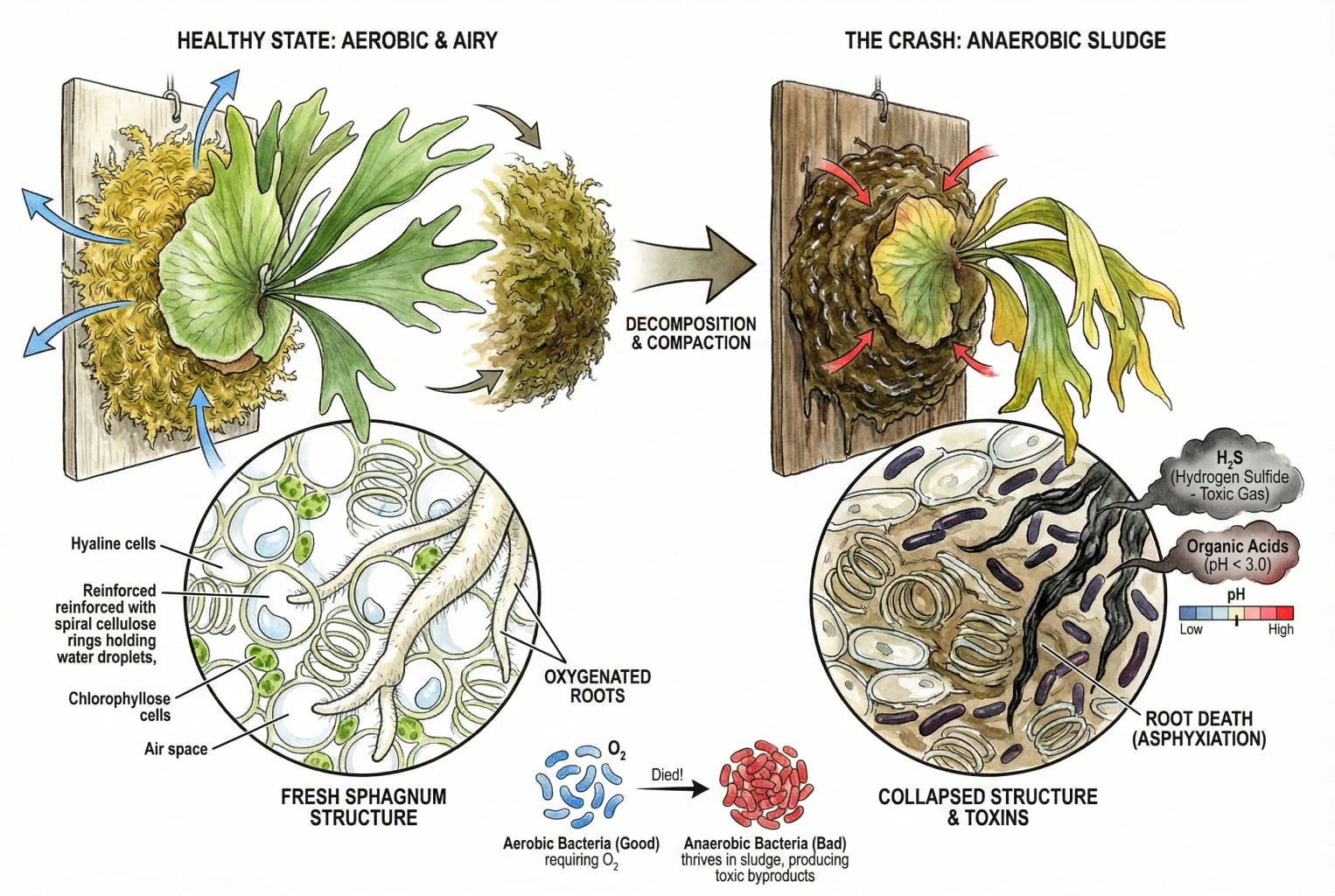
Before pulling a plant off its board, it helps to understand why. Knowing what the substrate is doing makes it easier to judge when to act instead of following a fixed recipe.
Roots Need Air as Well as Water
First, the plant itself. Platycerium (staghorn and elkhorn ferns) are epiphytes.
In nature they do not grow in soil. They attach to tree trunks and branches, anywhere from near the ground to high in the canopy depending on species and habitat.
Their root zone has two practical requirements.
Epiphyte Roots Need Wet-Dry Cycles
Epiphyte roots take up moisture after rain or watering and then dry between soakings rather than sitting in saturated soil. Published anatomical work on P. bifurcatum describes an unusual cortex and sclerenchymatous sheath rather than an orchid-style velamen, so this describes water behavior rather than orchid-like tissue.
Roots Need Oxygen
Like most roots, they need oxygen, and prolonged saturation with no drainage can stress or damage them. This is general plant physiology, and no genus-specific airflow threshold has been established.
A sphagnum mount must balance moisture retention with enough air-filled pore space (macropores) to keep the root zone from staying waterlogged.
Why Sphagnum Holds So Much Water
Long-fiber sphagnum is a popular substrate for this job, and the same structure that makes it hold water is what changes as it ages.
The cellular structure
Under a microscope, a sphagnum leaf is built from two broad types of cells (the exact wall architecture varies by species and whether the moss is live or harvested).
1. Chlorophyllose Cells
Chlorophyllose cells are small living green cells in live moss that carry out photosynthesis.
2. Hyaline Cells
Hyaline cells are large, dead, hollow cells with reinforced walls and pores. Living moss also stores water in capillary spaces between strands, not only inside these cells.
Those hollow hyaline cells are a big part of why sphagnum holds so much water. Major New Zealand suppliers state their moss can hold roughly 20 times its own weight in water. Treat that as a manufacturer figure rather than a fixed scientific constant.
How it changes with age
One plausible mechanism is that microbes gradually break down cellulose, the reinforced cell walls weaken, and the structure loses rigidity. This has not been measured on commercial mounts, and sphagnum can decompose slowly in acidic, low-oxygen bog conditions, so age alone does not dictate the rate.
Fresh Moss Stays Springy
Fresh moss is springy, with plenty of air space between the strands.
Older Moss Can Compact
Older moss can compact into a denser mat with fewer air pockets, especially if kept wet, though not every aging mount ends up this way.
Desiccation tolerance in bryophytes relates to elasticity
What Changes Chemically
Cation exchange and acidity
Sphagnum is generally acidic and has a high cation exchange capacity, meaning it can swap hydrogen ions for cations such as calcium and magnesium from the water. How much this acidifies a mount depends on water ions and alkalinity, the species, and the plant part. In deionized water the effect is small, so there is no single pH that all mounts settle at.
Specific ideal pH ranges are often quoted for staghorns, but credible species-specific evidence for a narrow Platycerium band is lacking. General plant databases list the genus across a fairly wide soil-pH range, so treat any exact optimum with caution and go by plant health.
When drainage fails
If the moss compacts and stays saturated, drainage and air exchange drop and the root zone can become low in oxygen. The microbial community can then shift toward anaerobic activity. This is a real risk of persistent waterlogging, but it is a gradient rather than a clean switch and has not been measured on this kind of mount. Avoid framing it as beneficial bacteria dying and harmful bacteria taking over.
Anaerobic decomposition can produce root-damaging compounds, but you do not need to identify each one before acting. Address a mount that has become compacted, soggy, and foul-smelling. For a species-specific check, compare the Platycerium ridleyi rot guide.
Mechanisms of Waterlogging Tolerance in Plants
Read the Moss Before Replacing It
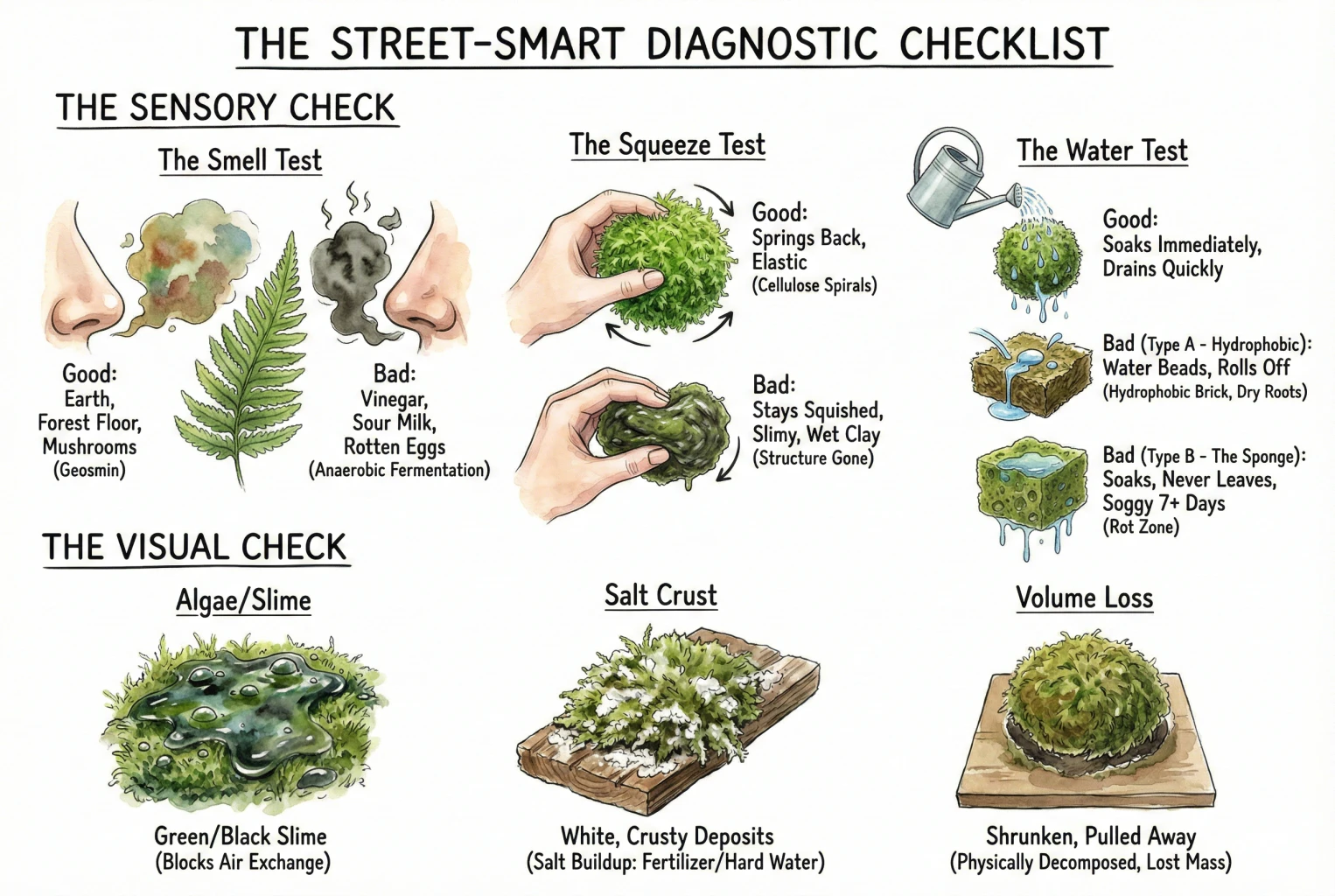
A calendar alone is not enough. How fast moss ages depends on climate, watering, mount exposure, and the moss itself. An outdoor fern in a wet climate may age its moss faster than an indoor fern in a dry climate, but there is no reliable multiplier. Check the actual condition.
Each warning sign can have several causes, so no single sign or simple count confirms that the moss has failed. Use the combination to decide whether to investigate and possibly remount.
Check Smell, Texture, and Water Behavior
A quick hygiene note first. If you’re putting your nose near the substrate, avoid inhaling dust, mold spores, or fertilizer residue. Work in a ventilated spot, and wash your hands afterward.
Smell
- An earthy, forest-floor, or mushroom smell is reassuring. The earthy note is largely geosmin from soil microbes, which indicates microbial activity rather than proving a healthy mount.
- A vinegar, sour-milk, or rotten-egg smell deserves a closer look. It can point to wet, low-oxygen conditions, but odor alone does not confirm a specific process.
Squeeze
- Moss that springs back and feels elastic is reassuring.
- Moss that stays compressed and feels slimy or like wet clay deserves a closer look. Persistent sliminess and compaction are concerns, though they do not prove that the structure is gone.
Water behavior
- Water that soaks in and then drains rather than pooling is reassuring. Compare against a mount of similar size and dryness because volume and starting moisture change how this looks.
- If water beads and rolls off, the moss may be hydrophobic. Even intact, well-made sphagnum can repel water after drying past a threshold, so try slow, thorough rehydration before assuming decay.
- If the mount stays wet for days when the climate would normally dry it, it may be holding too much water. There is no universal day count because temperature, humidity, mount mass, and plant water use all matter.
Check Surface Condition and Volume
Surface Slime Signals Chronic Wetness
A layer of green or black slime on the surface usually signals chronic wetness. It does not automatically mean the core has lost airflow, but it is a prompt to check drainage.
Salt Crust Shows Mineral Accumulation
Crusty white deposits on the moss or board point to accumulated salts or minerals from fertilizer or water. Confirm whether they have reached a harmful level with a water or EC or alkalinity test and by watching the plant. A thorough flush with low-mineral water or replacing the moss is the usual response.
Volume Loss Has Multiple Causes
If the moss ball looks shrunken or has pulled away from the mount, decomposition is one possibility. Drying, settling, and packing can do the same thing, so volume loss alone is not proof.
Prepare Materials for Remounting
A few materials make remounting easier. Long-fiber moss generally holds its structure longer than short, milled moss, though there’s no controlled study giving each an exact lifespan on a mount.
New Zealand long-fiber sphagnum
The Besgrow manufacturer specification cited below describes one premium New Zealand Sphagnum cristatum grade by strand length, with at least half of the material 150 mm or longer. That is a product-grade specification, not an industry-wide definition. Species, length thresholds, compression, and expanded yield belong to the specific supplier and lot, so verify the package. Marketplace labels such as 5A or 7A and fixed multi-year mount lifespans are not standardized guarantees.
When buying, check the stated fiber-length grade, the compressed pack weight and expanded volume, and the delivered price, and confirm you are getting genuine long-fiber moss. Skip anything that turns out to be short or milled moss sold under the same search terms.
Choose Long Fiber for Clean Wraps
Choose long-fiber moss for replacing a compacted mount when you want long strands that wrap cleanly around a root ball and remain springy.
Skip Premium Moss When Watering Is the Problem
Skip premium moss for a healthy mount that only needs more board space, or a setup that stays saturated because of overwatering. Premium moss cannot correct the watering pattern.
Clear monofilament tie line
Clear monofilament fishing line makes a nearly invisible, water-resistant tie. Match diameter, knot behavior, UV resistance, and breaking strength to the mount, and avoid a line thin enough to cut into tissue. Do not treat the stated breaking strength as a safe plant-load rating because fishing line is tested under a straight pull, not the slow, expanding load of a growing fern. Use multiple passes, anchor the board independently, and inspect the line as the fern expands.
Choose Monofilament for Light Indoor Mounts
Choose it for a small or medium indoor mount when you want an unobtrusive, water-resistant tie and can route several passes over firm brown shields.
Skip Monofilament for Heavy or Exposed Mounts
Skip it for a heavy specimen, a sunny outdoor mount where nylon will age faster, or any path that crosses a green shield or growth bud. A wider soft tie distributes pressure better on tender tissue.
Do not buy an outdoor granular fertilizer just for this job
Sphagnum is low in nutrients, so mounted ferns usually need some feeding, but there is more than one way to provide it. Extension guidance commonly suggests a diluted balanced liquid fertilizer or a slow-release product used at its labeled rate. Match the dose to the label. Too much fertilizer near roots in a low-water medium can cause salt buildup and root injury, so no-burn claims are never a guarantee.
Check the exact fertilizer’s application method
Outdoor granular fertilizers with a balanced analysis such as 14-14-14 have directions based on mixing granules into soil. They have no rate for a mounted fern, so do not buy one for this task. Use a balanced liquid or slow-release fertilizer only when its own label covers the plant and application method.
Besgrow Spagmoss grade specification
How to Replace Moss Without Damaging Roots
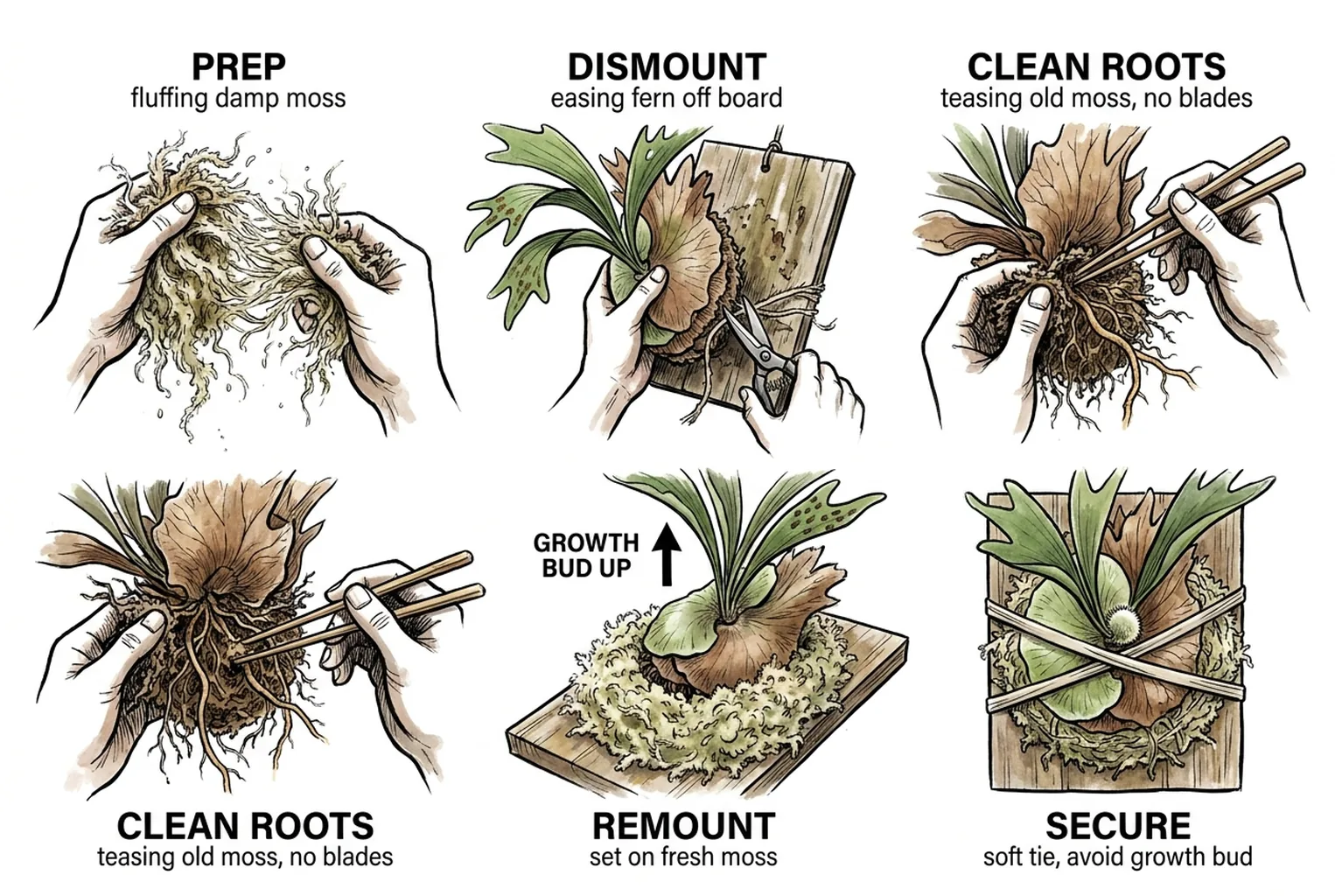
Before dismounting anything, decide whether the moss actually needs replacing. If the plant is healthy and the mount only needs more room, attaching the existing board to a larger one is less disruptive than a full remount. When you do remount, disturb living roots as little as possible.
Step 1. Prep the New Moss
- Soak the new moss in a bucket of water until it is fully wetted.
- Gently press out excess water so the moss is damp rather than dripping. Avoid hard wringing, which can crush long fibers.
- Pull the strands apart rather than leaving dense clumps, so air space remains between them.
Step 2. The Dismount
- Snip the old fishing line or wire, taking care not to cut into plant tissue underneath.
- Gently work the fern off the board. Roots may have gripped the wood, so free the attachment carefully. A clean, disinfected blade can help, but keep cutting minimal and away from your hand and the plant. Consider experienced help for a large or valuable specimen. Some root disturbance is normal, but preserve as much living tissue as possible.
- Dry, brown shield fronds provide structure and should remain. A mushy or rotten shield needs separate evaluation. Disinfect the tool between necessary cuts.
Step 3. Excavation (Cleaning the Roots)
- Turn the fern over to reach the old moss ball. It may look dark and dense, but dark color alone is not proof of decay.
- Use fingers or chopsticks to gently tease out old moss. They are more forgiving than a blade around living roots.
You do not need to remove every speck because trying to do so tears too many roots. Remove degraded material that comes away easily, usually toward the center, while preserving living roots. Stop where the moss is bound up in healthy roots.
Do not rely on color alone because healthy staghorn roots can look dark. Firm, intact roots that remain connected to the plant and any pale new tips are worth keeping. Roots that are truly slimy, hollow, and foul-smelling can be trimmed with a disinfected tool. If you are unsure whether tissue is alive, leave it.
Step 4. The Remount
- Put a handful of fresh moss on the board.
- Place the fern on the moss with the growth point, the fuzzy bud where new fronds emerge, facing up. If mounted upside down, the plant can twist while trying to right itself.
- Pack fresh moss around the root ball and behind shield fronds where there are gaps. Keep it springy rather than rock hard so air pockets remain, but firm enough that the plant does not wobble.
- Hold fertilizer during the remount. Once the plant has settled, use a diluted balanced liquid fertilizer or correctly labeled slow-release product at its labeled rate and keep it away from the growth bud. Do not improvise a pellet dose the product is not labeled for.
Step 5. Secure the Plant
- Wrap the tie around the board and plant.
- Run the tie over brown or dead shield fronds and under soft green shield fronds rather than across them. Extension guidance advises against running line over soft green fronds.
- Never run the tie directly over the fuzzy growth point because it can kill the growing tip.
- Make the tie snug enough that the plant does not shift when the board is shaken, but not so tight that it cuts in. Check it as the plant grows and loosen or retie as shields expand.
Water Quality and Large-Mount Trade-offs
Water Quality
Water chemistry matters, and not all tap water is the same. Check hardness from calcium and magnesium, alkalinity, overall mineral content measured as EC or TDS, and disinfectant such as chlorine or chloramine. High-hardness or high-alkalinity water can leave mineral deposits and make the substrate less acidic, while softer water does less of this. Test your supply and compare options in the houseplant water guide.
Hard Water Leaves Mineral Crust
Hard water can leave minerals on strands and the board as it evaporates. The effect on pore space and moss lifespan has not been measured precisely, so treat crusting as a reason to inspect rather than a fixed penalty.
Resting Water Does Not Remove Chloramine
Letting water sit can allow some free chlorine to dissipate, but it does not reliably remove chloramine or dissolved minerals.
Rain and RO Water Reduce Minerals
Rainwater and reverse-osmosis water are low in minerals. Protect collected rainwater from roof and container contamination. RO water is stripped of nutrients, so feed appropriately, and RO units produce wastewater. These options can reduce deposits, but no specific moss-lifespan gain is established.
Expand a Large Mount Instead of Stripping It
If you have a massive P. superbum that has wrapped its shield fronds around the board, removing the moss may destroy the plant.
- Rather than removing old moss, expand the mount onto more space.
- Mount the entire board onto a larger board and pack fresh moss into the gap. Make sure the new arrangement drains and the board attachment can carry the added weight.
- Roots can grow from old moss into fresh, aerated moss, giving the plant new territory with little disturbance. The old core remains, so continue monitoring it and drainage.
Add Structure if You Overwater
If you tend to overwater, mixing inorganic material into sphagnum adds structure that does not break down. On a mount, make sure added particles do not fall out and that water still distributes evenly.
Chunky Perlite Adds Air Space
Use a coarse grade so it does not wash out.
Orchid Bark Adds Structure
Size it to the mount and remember that it breaks down over time.
Starting Mix Ratio
A practical starting mix is roughly 70% sphagnum, 20% perlite, and 10% bark by volume. This is not a tested formula, so adjust it to the plant, mount, climate, and watering habits.
Handle Pups During Remounting
As a fern grows pups, they can crowd the mount and, over time, create tension and gaps.
- If you divide off a pup to propagate it, tuck fresh moss into the gap it leaves. Wait until the pup has a reasonable size, its own roots, and both frond types. Use a clean, sharp, disinfected tool and give cut surfaces time to callus while keeping the divisions in stable, humid conditions.
Staghorn Sphagnum FAQ
The following questions cover common decisions about staghorn moss.
Should I ever remove a staghorn fern’s brown shield fronds?
Dry, brown shield fronds are structural and should remain. The exception is genuinely rotten tissue. If a shield frond is soft, mushy, and clearly decaying against the rhizome, it may need attention, but do not judge by color or smell alone and take care not to cut living basal tissue. The staghorn disease and fungicide guide separates wet-media correction from treatment decisions. If rot is extensive or you are unsure where healthy tissue ends, seek help from a local expert or extension service.
Does old dead sphagnum still need replacing?
Structure matters as much as whether the moss is living. Sphagnum works largely because of elasticity and porosity. As that structure breaks down and the moss compacts, it holds less air, and poorly aerated, waterlogged substrate becomes a real risk to epiphyte roots. Age therefore matters even though the moss was not alive on the mount.
Should staghorn sphagnum stay wet at all times?
Platycerium are adapted to cycles of wetting and drying, and keeping moss constantly saturated favors low-oxygen conditions and can speed substrate breakdown. Let the moss approach dryness between waterings as a safer default. Exactly how dry and how often depends on climate, species, and mount depth, so use mount weight and inner moisture rather than a single surface-feel rule.
Practical Moss Comparisons
Moss grade, decomposition timelines, and water effects are often presented as exact numbers even though controlled mount trials are lacking. Condition and trade-offs are more useful than unsupported year counts.
Moss type
| Material | What it is | Trade-offs on a mount |
|---|---|---|
| Milled peat / short moss | Fine, short-fibered material | Compacts readily and holds little structure. Generally the shortest-lived choice for mounting. |
| Medium-fiber sphagnum | Includes some South American sources | Usable and often cheaper. Strand length and quality vary by lot, so inspect before buying. |
| Long-fiber New Zealand sphagnum | Long strands, sold in fiber-length grades from premium to blended | Holds structure well and is easy to mount with. Higher cost. Actual lifespan on a mount depends on care and water, not the grade alone. |
How moss changes as it ages (condition, not calendar)
| State | What you tend to see |
|---|---|
| Fresh | Springy and open, drains freely, earthy smell. |
| Settling | Some compaction and darkening. Watering may need adjusting. |
| Degraded | Loss of volume, slower drainage, and it may start to shed water or stay soggy (worth planning a remount). |
| Failing | Dense, slimy, and foul-smelling. Remount when practical. |
The point is to read the mount’s condition rather than count months, because the timing varies widely with the moss, the water, the plant, and the climate.
Water, in general terms
| Water | General effect |
|---|---|
| Rain or RO (low mineral) | Least likely to leave deposits. RO is low in nutrients, so feed accordingly. |
| Soft tap | Fewer minerals than hard tap. Disinfectant residual varies (chlorine vs. Chloramine). |
| Hard tap (high hardness/alkalinity) | More prone to mineral crusting over time and to nudging the substrate less acidic. |
| Well water | Highly variable. Test your own supply rather than assuming. |
Rather than a fixed schedule, use these as reasons to check condition more or less often and to test your water if crusting or plant stress appears.
Make the Replacement Decision by Condition
Growing Platycerium well means paying attention to the substrate, not just the fronds on top.
Judge by condition instead of a fixed schedule. Check the material, drainage, roots, shields, and watering history.
Smell, squeeze, and water behavior are prompts to look closer rather than a definitive diagnosis. Long-fiber New Zealand sphagnum is a solid choice when replacement is justified, and coarse perlite can help preserve structure if the mount otherwise stays too dense. Let the moss approach dryness between waterings.
A healthy staghorn can remain on a wall mount for years, but the interval depends on light, temperature, watering, moss quality, mount depth, and species.