
Best Water for Houseplants: The Silicon Solution
How to think about water for houseplants: when tap-water fluoride, chloramine, and sodium actually matter, how to check your own water first, and where silicon and wollastonite may (or may not) help.
Jordan Cole · Published 2025-12-25 · 32 min read
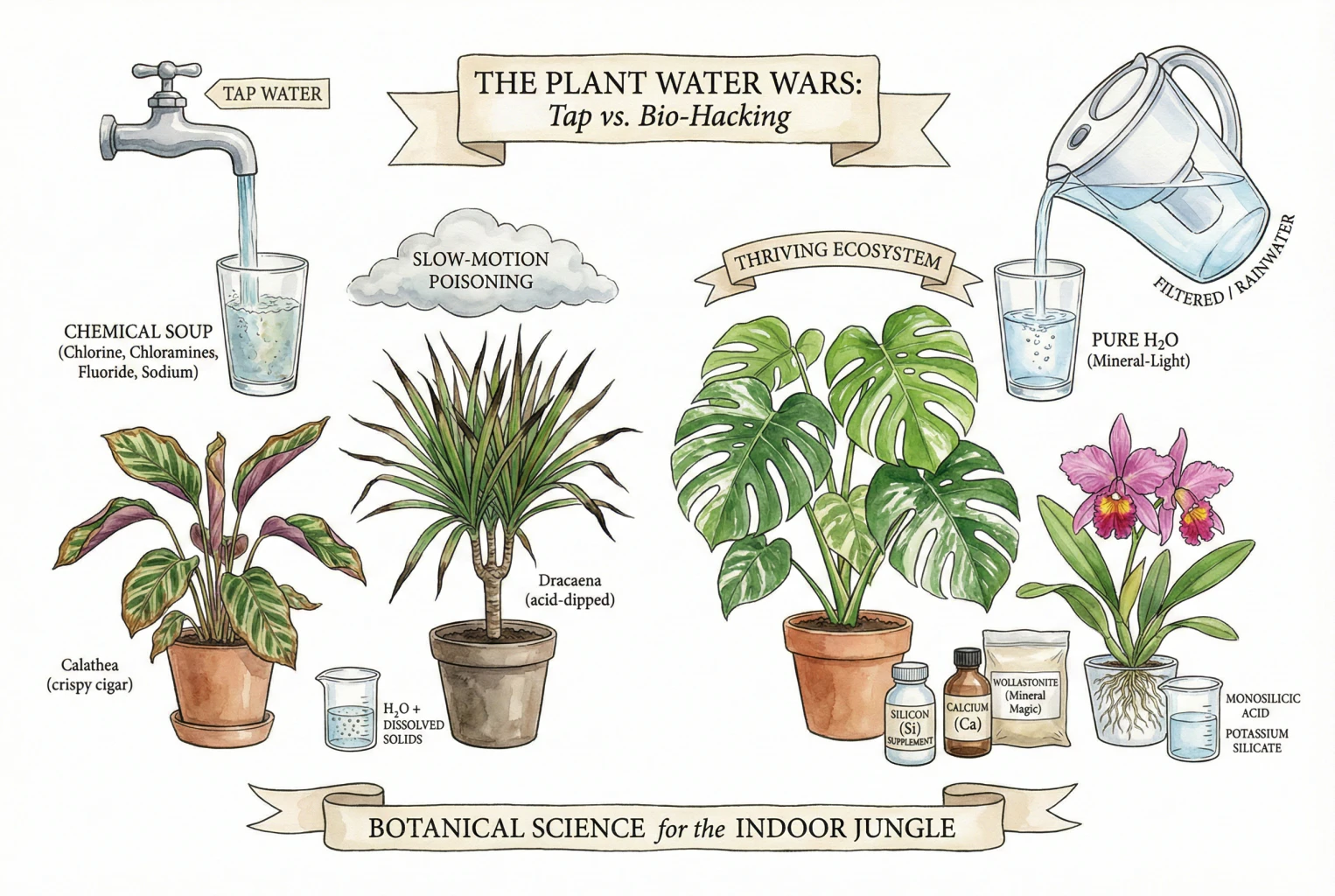
Key Takeaways
- Water quality is one possible cause of brown tips and stalled growth, but it is only one part of the differential. Rule out low humidity, uneven watering, fertilizer-salt buildup, root damage, and disease before blaming your water, then read your utility's Consumer Confidence Report.
- Chloramine is more persistent than free chlorine, so letting water sit for 24 hours is not a reliable removal method. If your utility uses chloramine and you have a sensitive plant, a chemical dechlorinator works faster than standing water.
- Avoid sodium-softened water over the long term. Softeners swap calcium and magnesium for sodium, which can accumulate in the soil and stress plants. Use the bypass tap.
- Silicon is beneficial for some plants but is not an essential element for most. The evidence comes mostly from crop trials rather than houseplants on tap water, so treat it as an option to test rather than a guaranteed antidote.
- Wollastonite is a slow-release calcium-silicate mineral that can raise soil pH. Test your soil before using it, dose conservatively, and handle the dust with care.
Water Is a Variable Worth Checking
If a plant is struggling, water quality is worth ruling in or out, but it is one variable among several, not an automatic verdict.
Tap water contains additives that are regulated safe for people. Whether any of them matter for your plants depends on your local water, the species, and the dose.
A humidity change will not fix a genuine chemistry problem, but many brown tips are not chemistry problems at all.
Chlorine and chloramine, fluoride, sodium, hardness, and alkalinity can all matter in the right combination of water source and plant. Wollastonite and soluble silicon may also have a role, but the first step is always to find out what is actually in your water before changing anything.
I form six pairs matched by species, pot size, and starting leaf condition, then use a coin flip to assign one plant in each pair to the new water source and the other to the source already in use. Fertilizer, light, and delivered volume stay the same, while the source name, pH, conductivity, alkalinity or hardness, and every watering date stay in the record. Six pairs remain manageable for six weeks and prevent one unusual plant from deciding the result.
For six weeks, I photograph the same leaf angle after every watering and inspect the drain holes for crust at the end. Six weeks gives me repeated exposures without letting a whole season of changing light dominate the comparison. Any change in nutrient recipe or total salts also goes in the record instead of being credited to silicon.
Part 1. Check What Is in Your Tap Water
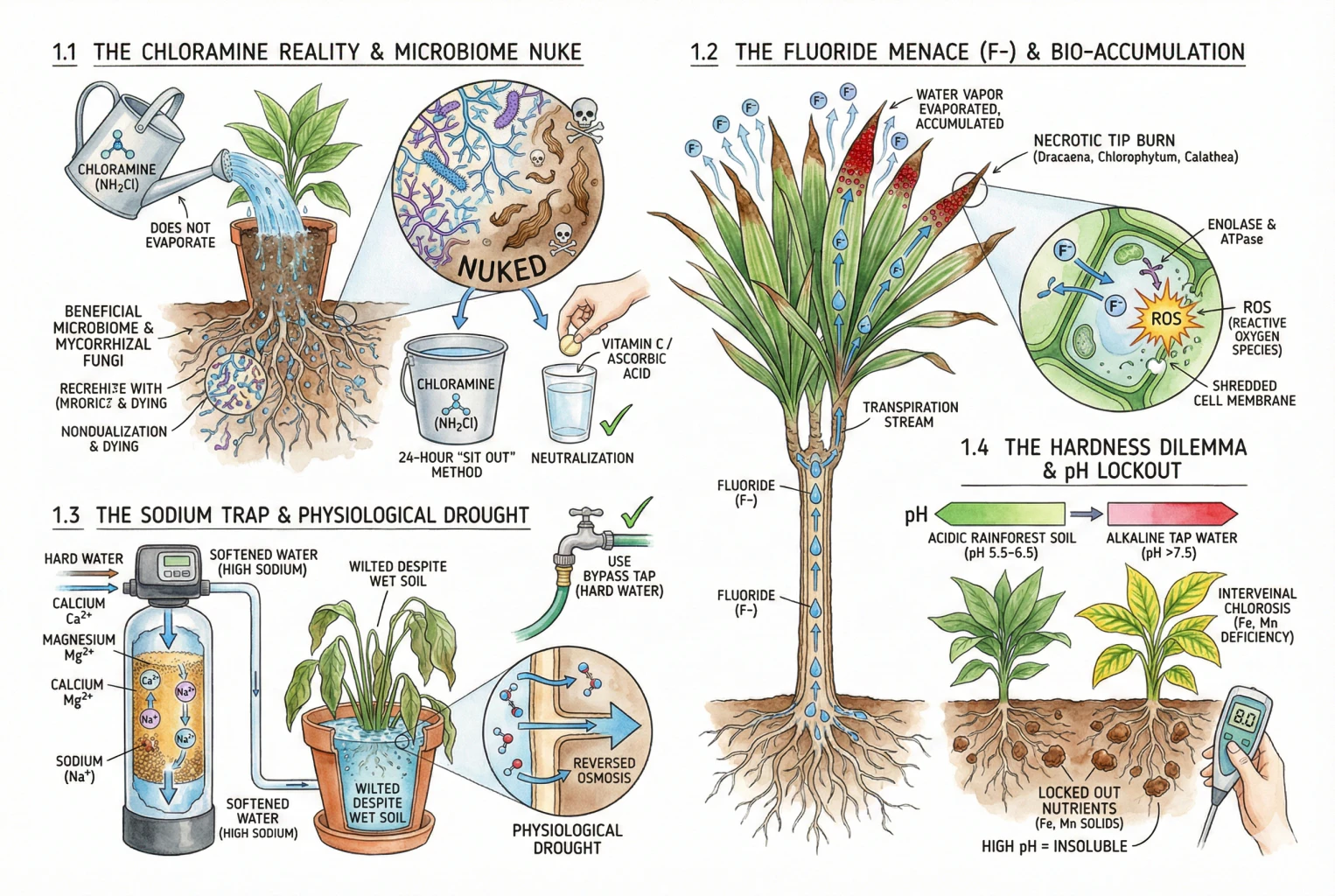
The most useful thing you can do is stop guessing about your water and read its composition.
Your utility publishes an annual Consumer Confidence Report (CCR) that lists the disinfectant used, fluoride level, hardness, and other constituents. A cheap EC (electrical conductivity) meter tells you the total dissolved salts.
Those numbers tell you which of the following sections actually apply to you.
Municipal water treatment is designed to deliver pathogen-free, palatable water to millions of people.
Some of the additives that make water safe to drink can, at some concentrations and for some species, be worth managing for plants, but which ones, and whether they matter for your plants, varies by location.
1.1 The Chlorine Myth and the Chloramine Reality
For generations, the standard advice for indoor gardeners was simple. Fill your watering can and let it sit out for 24 hours. Where a utility disinfects with free chlorine, that logic has some basis. Free chlorine can dissipate from standing, aerated water over time.
How much and how fast depends on the starting concentration, temperature, surface area, and container, so relatively chlorine-free is not guaranteed without measuring.
The bigger issue is that many, not all, U.S. Utilities now use chloramine (formed by combining chlorine with ammonia. Monochloramine is NH₂Cl) as a secondary disinfectant, because it persists longer in the distribution pipes than free chlorine.
Roughly one in five Americans is served chloraminated water. Your CCR will tell you which disinfectant your utility uses.
Chloramine is more persistent than free chlorine, so standing water out overnight is not a reliable way to remove it.
That does not mean it lasts forever. Chloramine does decay through self-decomposition and reactions with organic and inorganic matter, at rates that depend on temperature, pH, and what it contacts.
Why Might This Matter?
Chloramine is a disinfectant, so at high enough concentrations it is toxic to microbes. Whether the residual in tap water meaningfully harms the soil community of a potted plant is a separate question.
Extension research on chlorinated irrigation finds that normal municipal residuals bind to soil organic matter and that microbial populations recover quickly, so the idea that every watering sterilizes the soil is not well supported.
Direct injury to sensitive root hairs is possible at some concentrations, but it has not been demonstrated for routine tap watering of typical houseplants.
If your water is chloraminated and you keep a sensitive plant, the practical options are catalytic carbon filtration or a chemical conditioner (such as ascorbic acid or sodium thiosulfate, the active ingredients in common aquarium dechlorinators).
Standing the water out is the least reliable of these.
1.2 Fluoride (F⁻)
Fluoride is added to many water supplies to reduce dental caries in humans. Plants have no biological requirement for it, and at high enough concentrations it is phytotoxic to sensitive species.
Whether the fluoride in your tap matters depends on its concentration (check your CCR) and on the species you grow.
Uptake is not indiscriminate. Roots take up water and dissolved ions selectively, governed by transporters, membrane barriers, and ion chemistry.
Where fluoride does enter, it travels up the xylem in the transpiration stream. Because it is far less volatile than water, it concentrates where the water evaporates (often at the leaf tips and margins of sensitive plants, though tissue distribution varies by species).
Over time, in a susceptible plant, this can produce marginal or tip necrosis. That pattern is not unique to fluoride, though.
Brown tips also come from low humidity, uneven watering, fertilizer-salt buildup, root injury, and disease, so the tip burn returning after you trim it does not by itself confirm fluoride. The more reliable step is to check the water and the medium.
You may see marginal browning on sensitive genera such as spider plants (Chlorophytum comosum) and corn plants and dragon trees (Dracaena), which have documented fluoride sensitivity, and on prayer plants (Calathea).
At the cellular level, laboratory work on high fluoride exposure describes inhibition of enzymes such as enolase and ATPase and the generation of reactive oxygen species (ROS) like hydrogen peroxide, which can damage membranes through lipid peroxidation.
These are effects seen under defined experimental doses. The concentrations and species matter, and they should not be read as the confirmed fate of every houseplant on fluoridated tap.
Phytotoxic effects of fluoride on Hypericum perforatum
1.3 Sodium and Water Softeners
If you live in an area with hard water and have a conventional water softener, it is worth understanding what it does to the water.
Most softeners work by ion exchange. Resin beads charged with sodium (Na⁺) capture the calcium (Ca²⁺) and magnesium (Mg²⁺) in the incoming water and release sodium in their place.
Some systems regenerate with potassium chloride instead, which avoids the sodium issue.
So conventionally softened water is higher in sodium and lower in calcium and magnesium. Over the long term, watering pots with sodium-rich water can build up sodium in the soil, and high soil sodium can stress plants, but how much and how fast depends on the sodium concentration, your source-water hardness, and how thoroughly you water and drain.
It is a gradual accumulation risk, not an instant one.
At very high soil salinity, the salt concentration outside the roots can rise enough to reduce water uptake. Sometimes called physiological drought, where a plant can wilt in wet soil.
That is a real endpoint of long-term salt buildup, though the same wilting-in-wet-soil symptom can also come from oxygen-starved roots and rot, so it should not be pinned on sodium by symptom alone.
Avoid Sodium-Softened Water
Avoid watering houseplants with conventionally softened water. Use the bypass tap (often at the garage or an outdoor spigot), and if salts have already built up, leach the pot with low-sodium water or repot.
1.4 The Hardness Dilemma (pH and Lockout)
Two properties often get lumped together but are not the same thing. Hardness is the calcium and magnesium content of the water. Alkalinity is its acid-neutralizing capacity, mostly from bicarbonate and carbonate.
Water can be hard but low in alkalinity, or the reverse, so you cannot infer one from the other, and a single source-water pH reading does not tell you how much acid it would take to shift your medium's pH.
Alkalinity is the property that matters most for long-term medium pH. Irrigating with high-alkalinity water can gradually raise the pH of the potting mix.
Many tropical houseplants do best in a slightly acidic root zone, but the ideal range differs by genus, medium, and fertilizer form, so treat pH 5.5–6.5 as a common starting point rather than a universal rule.
For more on how water and pH interact, see this discussion of tap water and pH thresholds.
Reduced Availability
As medium pH rises, the availability of micronutrients such as iron (Fe) and manganese (Mn) falls. There is no single sharp cutoff. It depends on the medium and whether the nutrients are chelated, but higher pH generally makes them harder for roots to absorb.
A Possible Symptom
Interveinal chlorosis leaves the veins green while the surrounding tissue yellows. If it stems from pH-driven lockout, adding more fertilizer will not help and just raises the salt load. Confirm with a medium pH and EC check before feeding, since magnesium deficiency, root damage, and disease can look similar.
Part 2. Fluoride and Plant Injury, in Context
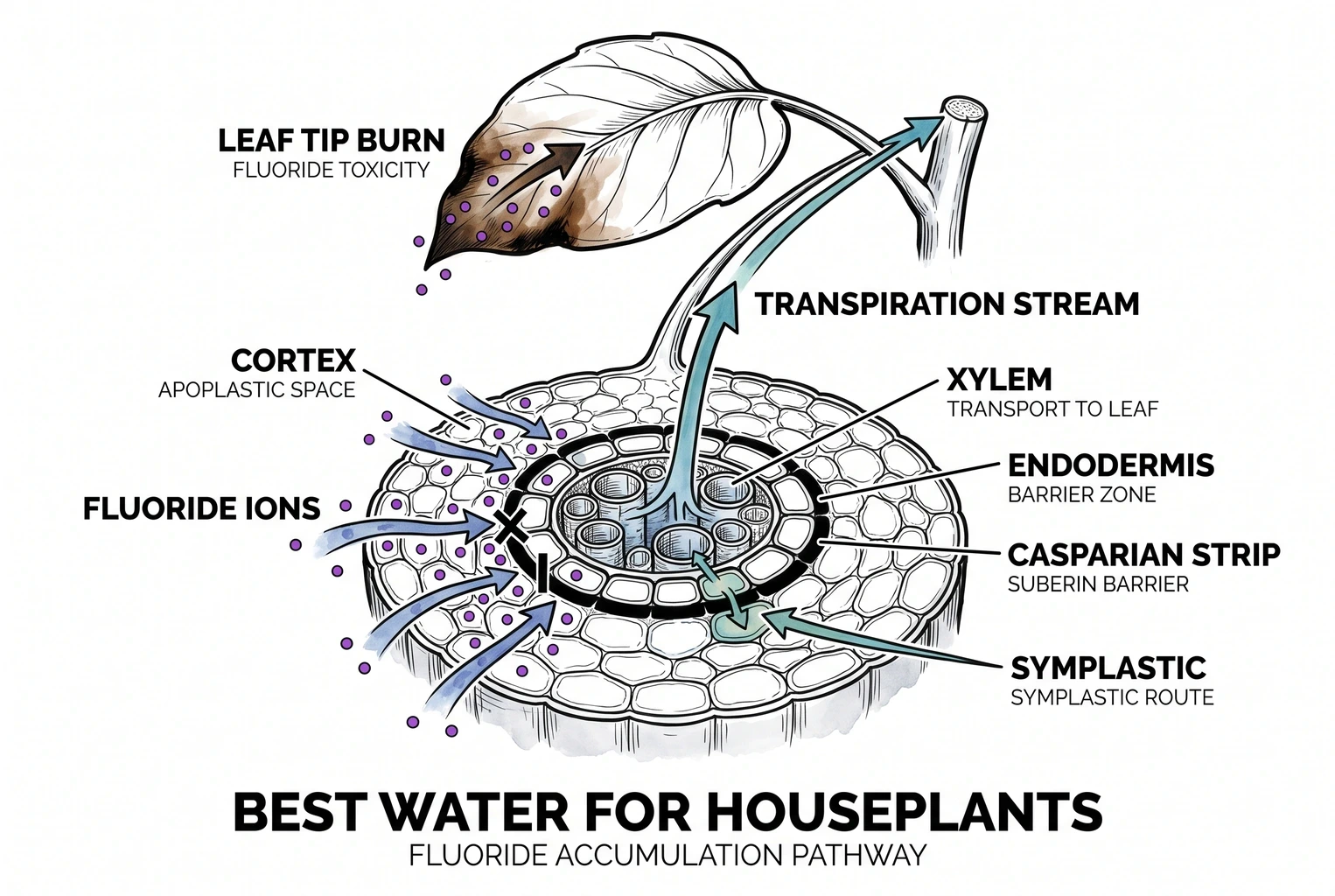
Fluoride is worth a closer look because its effects are gradual and easy to confuse with other problems.
Because it is not visible in the water, you can only know whether it is a factor by checking your utility report and, if needed, testing tissue or medium, not by assuming.
2.1 The More Sensitive Genera
| Sensitivity Level | Plant Genera | Symptoms of Toxicity |
|---|---|---|
| High Sensitivity | Dracaena (Corn Plant, Dragon Tree), Chlorophytum (Spider Plant), Spathiphyllum (Peace Lily), Calathea, Maranta, Stromanthe | Rapid necrosis of leaf tips. Distinct yellow band (chlorosis) separating dead and living tissue. Leaf elongation inhibition. |
| Moderate Sensitivity | Monstera, Philodendron, Epipremnum (Pothos), Yucca | Slower accumulation. Marginal browning usually only on older leaves. General lack of vigor. |
| Accumulators (Tolerant) | Camellia sinensis (Tea), Ficus elastica (Rubber Plant) | Can store high levels of F without visible symptoms initially, but eventually suffer photosynthetic decline. |
Plants differ in how they respond to fluoride. These groupings are a rough guide drawn from horticultural experience and extension guidance rather than a single quantified ranking, so treat the categories as approximate.
Documented fluoride sensitivity is strongest for some Dracaena, Chlorophytum, and Cordyline. The placement of other genera is less firmly established, and cultivar, medium pH, and fluoride concentration all shift the outcome.
If you own a plant in the more sensitive group, fluoridated tap water is worth managing, but managing is the right word, not avoiding at all costs. Extension guidance for sensitive Dracaena, for example, aims to keep fluoride low (around 1 ppm) and medium pH near 6.0–6.5, not to demand a literal zero.
Response varies with cultivar, medium pH, concentration, leaching, and environment.
2.2 How Fluoride Affects Cells (at High Exposure)
How Fluoride Crosses the Root
The Casparian strip is a band of suberin in the endodermis that blocks the apoplastic pathway (the route through cell walls), forcing water and ions to cross a cell membrane before they can reach the xylem.
It is a barrier, not a filter that fluoride simply slips past. Fluoride uptake and its selectivity depend on membrane transporters, channels, and the ion's chemistry, not on it being small enough to sneak around the strip.
Under high fluoride exposure, studies describe impairment of photosystem II, part of the photosynthetic machinery, which can contribute to chlorosis (though yellowing has many causes, including nutrient and root problems).
High exposure is also associated with increased reactive oxygen species (ROS) such as superoxide (O₂⁻) and hydrogen peroxide (H₂O₂), which can damage cell membranes through lipid peroxidation.
These are dose- and species-dependent effects reported in the laboratory.
Endpoint
Where injury occurs, the affected tissue turns brown, papery, and dead, and that necrotic tissue does not recover. Manage the cause and the new growth going forward.
2.3 The Tea Plant Proxy
Some of the research on plant fluoride comes from the tea industry, because tea plants (Camellia sinensis) are fluoride hyperaccumulators and fluoride in the leaf ends up in the cup.
That makes tea a well-studied case, but its specialized accumulation also makes it a limited proxy for ordinary houseplants.
Work on tea has explored reducing fluoride uptake, including reports that calcium and magnesium can alter cell-wall structure in ways that lower fluoride binding.
It is a reasonable hypothesis that nutrition can influence toxicity, but extending a tea-specific result to a general rule for foliage houseplants, or to a particular silicon product, would need studies in those species at relevant doses.
Treat it as a hypothesis, not a proven prescription.
Part 3. Keep Silicon Claims in Proportion
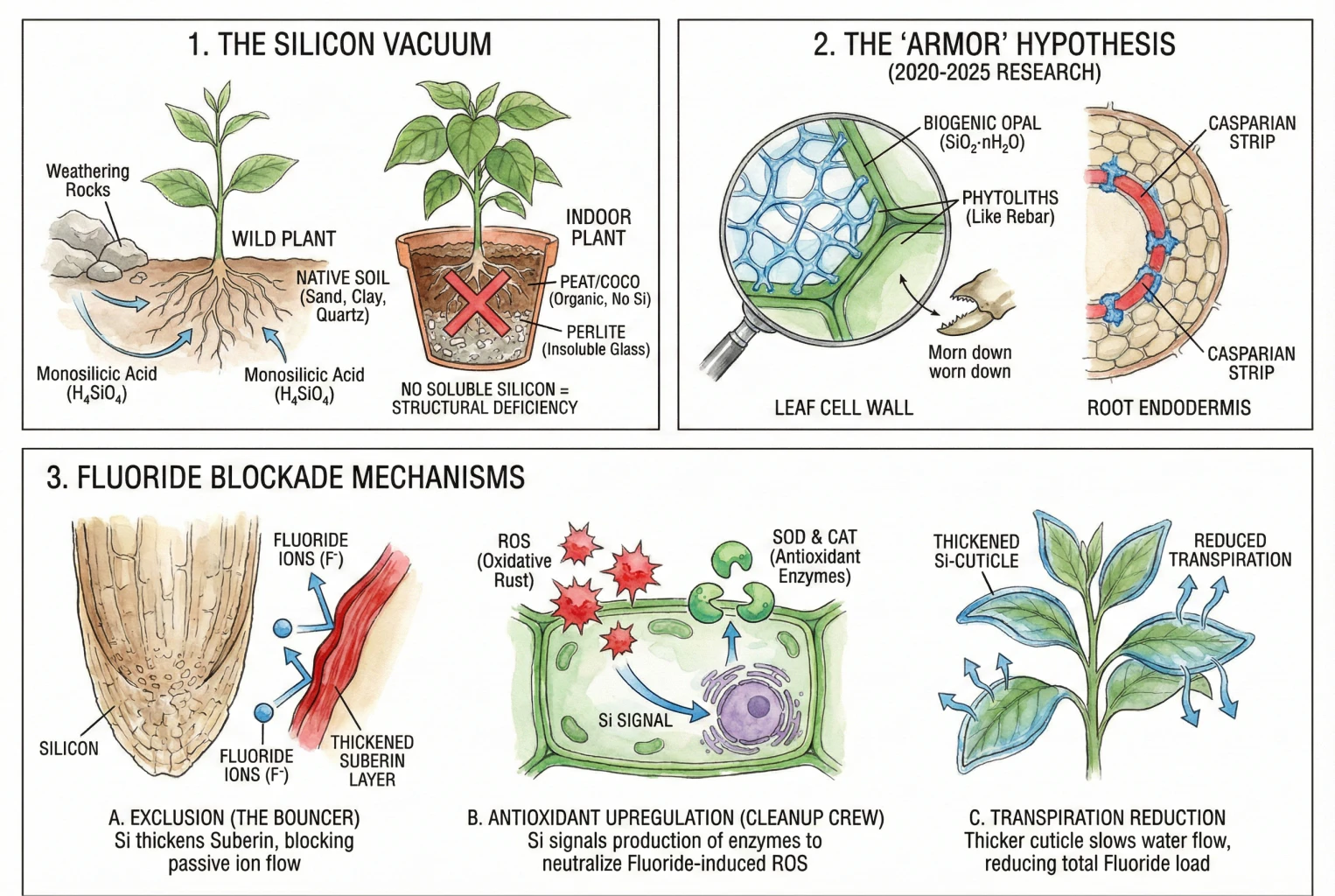
Silicon (Si) is a beneficial element for many plants but is not classified as essential for most, and how much a plant takes up and deposits varies widely by lineage.
Grasses and some other accumulators use a lot of it. Many broadleaf (dicot) houseplants accumulate far less.
So silicon is worth considering as a possible aid to stress tolerance, not as a nutrient every plant must have.
In nature, plants grow in mineral soil, and as silicate minerals weather they release small amounts of monosilicic (orthosilicic) acid (H₄SiO₄), the plant-available form.
Common soilless potting mixes, peat, coco coir, perlite, tend to be low in plant-available silicon.
Peat and Coco
These organic components are typically low in soluble silicon, though the exact amount depends on the material.
Perlite
Perlite is a silica (SiO₂) glass. It is not a meaningful immediate silicon source for plants, though that is different from saying it releases nothing over time.
The Takeaway
Peat-based mixes can be low in soluble silicon, so a silicon supplement may produce a response in some plants.
That is not the same as a universal deficiency. Whether your plants would benefit, and by how much, is not established for most houseplants, and optimum levels are undefined for many crops.
Silicon application improves tomato yield and nutritional quality
3.1 How Silicon Is Deposited
Silicon is sometimes called a quasi-essential element because of its role in stress resistance, though its benefits are species-dependent.
Where a plant takes up soluble silicon, it can deposit it in two places.
Cell Walls and Phytoliths
Silicon can polymerize in cell walls as hydrated silica, or biogenic opal. In silicon-accumulating species this stiffens tissue (a common analogy is rebar in concrete) but the degree of deposition varies widely, and many houseplants accumulate little.
Where deposition is substantial, reported effects include tougher leaves, more resistance to chewing pests, and reduced water loss.
These come mostly from crop and accumulator studies. The size of the effect in a given houseplant against a given pest is not something you can assume.
The Root Endodermis
Some research reports that silicon can be associated with reinforcement of the root barrier. How much this translates into protection against a specific tap-water constituent in a specific houseplant is the open question, addressed next.
3.2 What the Silicon-and-Fluoride Research Actually Shows
What the Wheat Study Actually Tested
A 2025 study on wheat reported that silicon supplementation reduced fluoride toxicity. It grew two wheat cultivars in soil spiked with very high sodium fluoride (400 and 500 mg/kg) and applied sodium silicate (200 and 300 mg/kg).
Those are extreme, controlled soil conditions, not municipal tap water, and not Calathea or Monstera. Within that experiment, three mechanisms were proposed.
- Reduced uptake. Silicon was associated with more suberin (a corky, waxy material) in the roots, correlating with lower fluoride uptake in the silicon-treated plants. This is a soil-treatment result, at those doses, in wheat.
- Antioxidant response. Silicon-treated plants showed increased antioxidant enzymes such as superoxide dismutase (SOD) and catalase (CAT), which counter ROS. Changes in these enzymes under stress are a common finding in silicon studies.
- Transpiration. In some species, added silica can reduce water loss through the leaf, because ion accumulation tracks water throughput, lower transpiration could lower the accumulated load. Whether this holds safely in houseplants is not established.
What the Evidence Supports
In a high-dose wheat experiment, silicon partly mitigated fluoride stress. That is a promising lead, not proof that a silicon product protects your Calathea from tap water. If you try it, treat it as an experiment with a specific product and watch the plant's response.
Part 4. The Forms of Silicon on the Market
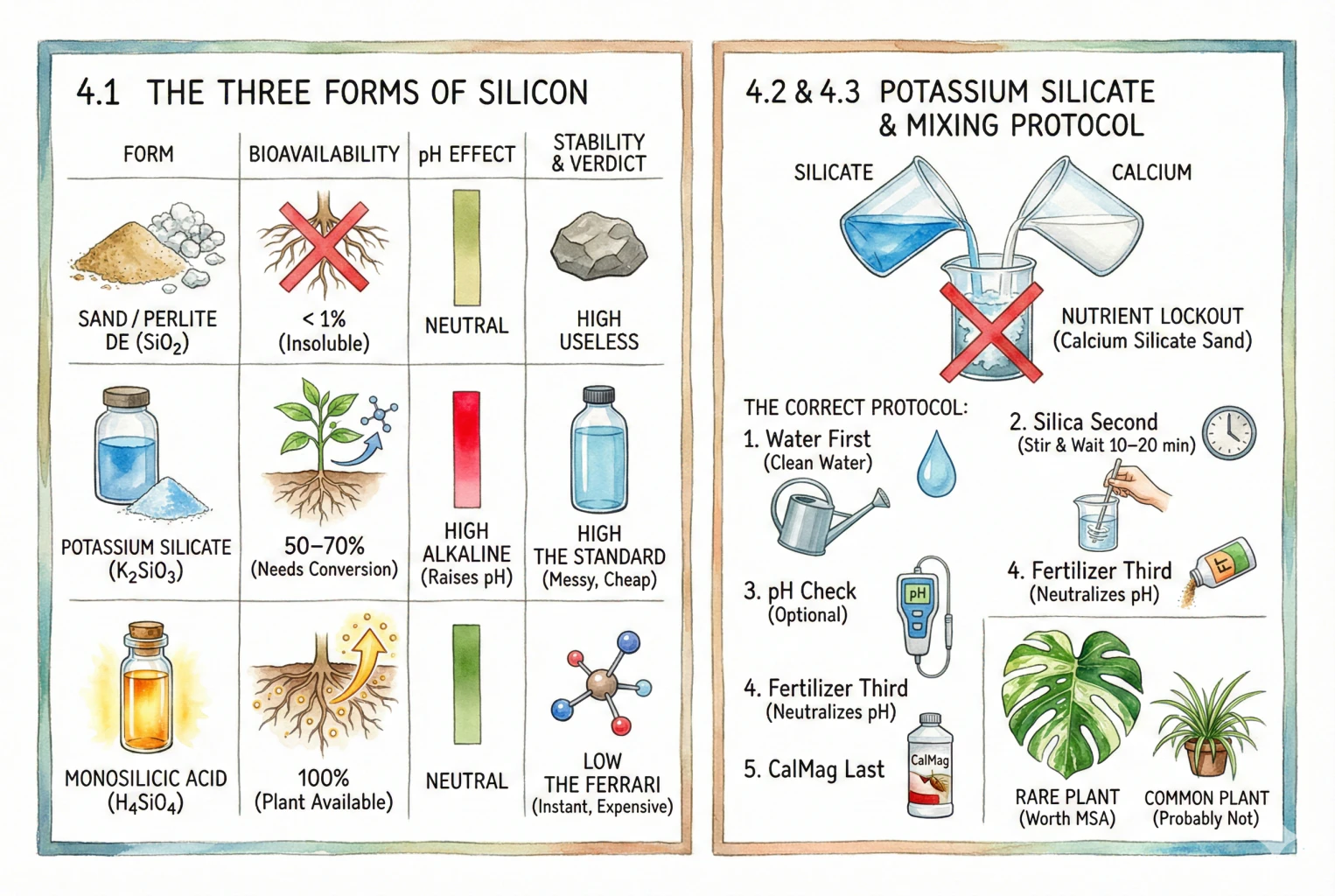
If you decide to try silicon, it helps to know the forms sold, because they behave differently.
The labels are confusing and not all silicon products are interchangeable.
4.1 The Three Forms of Silicon
| Form | Chemical name | Availability to plants | pH effect | In practice |
|---|---|---|---|---|
| Sand / perlite / DE | Silicon dioxide (SiO₂) | Negligible for immediate uptake | Neutral | Useful for soil structure, not as a silicon source you can rely on. |
| Potassium silicate | K₂SiO₃ (approx.) | Needs to hydrolyze in solution first | Alkaline (product-dependent) | Inexpensive. Add to water first, mix per the label, and check final pH. |
| Monosilicic acid | H₄SiO₄ (MSA) | Delivered as the plant-available form | Nearer neutral (product-dependent) | Convenient, low-dose, more expensive. Follow the specific product. |
The percentages you see for silicon bioavailability should be read loosely. Chemical identity, how the product dissolves and speciates in solution, its concentration, and how much a given plant actually takes up are separate things that cannot be collapsed into one number.
Even a product named for monosilicic acid does not guarantee that all the silicon you add is absorbed.
Use this comparison as a qualitative guide, not as a set of exact figures.
| Form | Speed | pH | Notes |
|---|---|---|---|
| Monosilicic acid (MSA) | Fast (plant-available form) | Near neutral (product-dependent) | Convenient but pricey. Follow the product's own dose |
| Potassium silicate | Needs to hydrolyze | Alkaline (varies by product) | Cheaper. Add to water first, check final pH per label |
| Wollastonite (calcium silicate) | Slow (weeks to months) | Liming (raises pH) | Soil amendment. A liming material, so test soil |
| Perlite / quartz | Negligible for immediate uptake | Not specified | Silica largely locked in glass |
4.2 Potassium Silicate (The Workhorse)
This is the chemistry behind products such as Pro-TeKt, Armor Si, or Silica Blast. Each has its own formulation and analysis, so check the specific label rather than assuming they are identical. These products are typically alkaline and inexpensive per dose.
In Solution
Potassium silicate needs to hydrolyze toward the plant-available monomer (H₄SiO₄). How it speciates depends on pH and concentration.
The Risk
Mixing it carelessly with other concentrated nutrients can cause precipitation and cloudiness (a sign of incompatibility). That does not mean every nutrient is lost, but it is a signal to check your order, pH, and water chemistry.
Why Mixing Order Matters
Do not combine concentrated potassium silicate directly with concentrated calcium (from CalMag) or magnesium. At high concentration and high pH they can react and precipitate.
Cloudy water is that warning sign.
General mixing order
- Water first. Start with clean water at the volume, quality, and temperature the label specifies.
- Silicate second. Add the potassium silicate and stir. Many products, including GT Silica, specify a rest period (GT Silica calls for about 15 minutes) before adding anything else. Follow the label's time.
- Fertilizer next. Add liquid fertilizer. Most fertilizers are acidic and will pull the pH down, but this is not guaranteed for every combination.
- CalMag last. Add any calcium/magnesium supplement last. GT Silica specifies a second rest after adding nutrients.
- Check the final solution. Measure the pH (and ideally EC) of the finished mix with a calibrated meter, and adjust toward the product's target (GT Silica's is roughly pH 5.5–6.5). Do not eyeball it, and do not adjust before everything is in.
Bottled potassium silicate is an inexpensive soluble-silicon source, provided you follow the specific product's mixing directions and verify the final pH.
It supplies silicon. It is not a proven fluoride antidote.
Growth Technology GT Silica
Growth Technology GT Silica is a soluble-silicon horticultural additive with about 0.58% potassium and 1.07% silica by volume.
The manufacturer's directions for potting mix are roughly 2–3 mL/L, added to plain water with a rest before and after nutrients, finishing near pH 5.5–6.5.
It is alkaline as supplied, so follow the label and handle it accordingly. If you try it, judge it by your plants' response rather than expecting it to detoxify your water.
4.3 Monosilicic Acid (MSA) (The Gold Standard)
Some products (such as Dune, Power Si, or Alchemist) are marketed as stabilized monosilicic acid.
Active ingredient, concentration, pH, and directions vary by product, so read each label rather than treating the category as one thing.
The Idea
The plant-available form is delivered directly, so doses are small and the pH swing is usually less than with raw potassium silicate. How neutral and how instant depends on the specific stabilizer and formulation.
The Catch
Monosilicic acid tends to polymerize back toward silica, so manufacturers add stabilizers to keep it in solution. These products are generally more expensive than potassium silicate.
Is It Worth It?
That is a value judgment, not an agronomic fact. A plant's price does not determine whether it needs silicon. If you want the convenience of a low-dose, near-neutral form, it is an option to try and evaluate on your own plants.
Part5 (Wollastonite, A Slow-Release Calcium-Silicate Amendment)
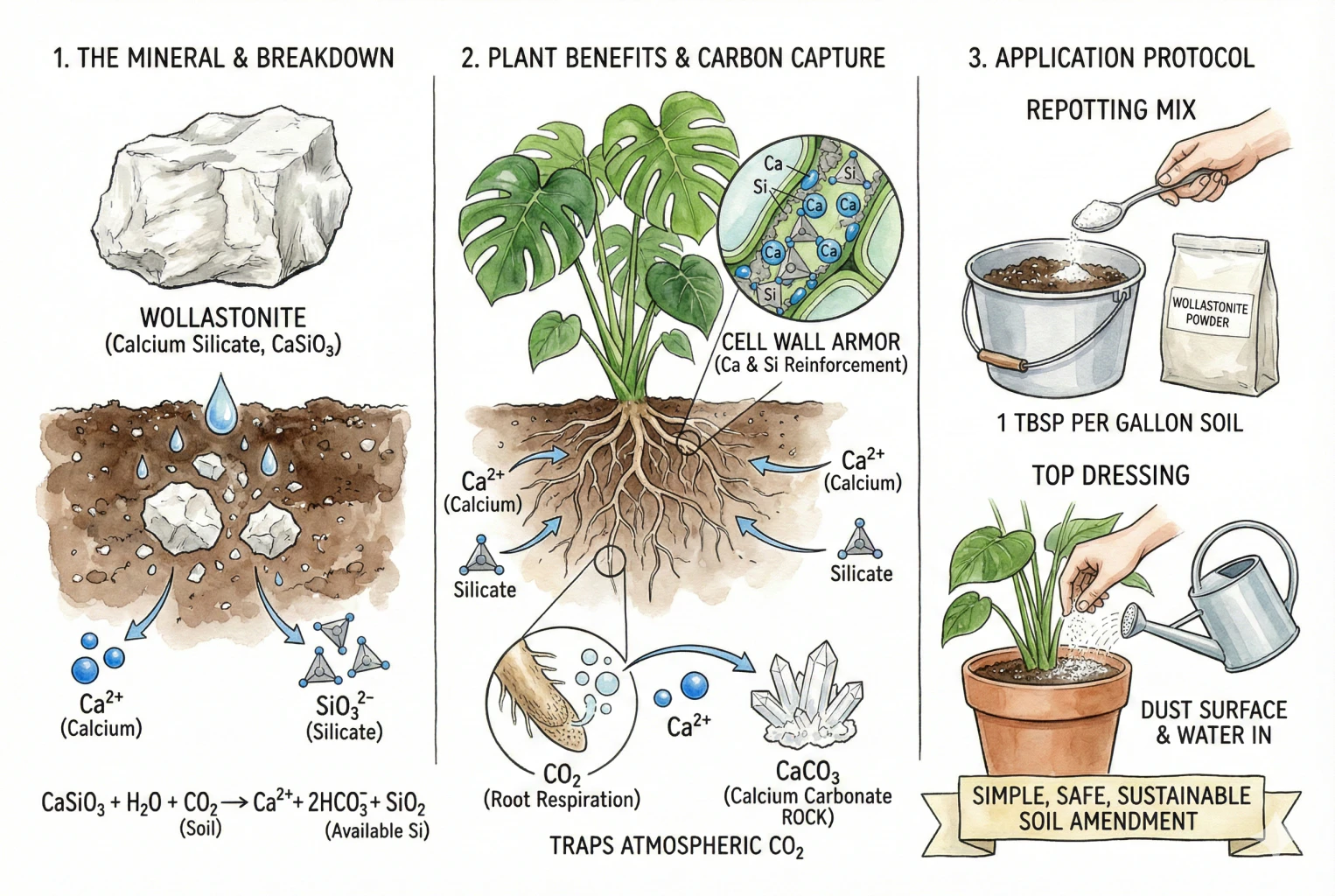
If you would rather supply calcium and silicon as a slow-release solid than mix liquids, wollastonite is worth knowing about, with the important caveat that it is a liming material and needs to be dosed accordingly.
Wollastonite is a naturally occurring mineral with the ideal formula calcium silicate (CaSiO₃).
A rock dust sold under that name is not necessarily pure. Without a guaranteed analysis you do not know its actual composition.
Earlier we saw that precipitating calcium silicate out of a liquid feed is a problem because it leaves solution.
As a solid soil amendment the context is different. The mineral weathers slowly in the medium and releases ions over time.
Solubility, surface area, pH, and soil biology all affect how fast. It does not remove fluoride or chloramine, and it does not turn tap water into something else. It changes the root-zone chemistry, gradually.
5.1 The Slow-Release Mechanism
Wollastonite weathers in the soil faster than quartz sand, on the order of weeks to months rather than geological time, though the rate depends heavily on particle size, pH, moisture, and the mineral's purity. The process releases calcium ions and plant-available silicon over time.
- Calcium ions (Ca²⁺)
- Silicon, which in normal soil solution ends up mainly as plant-available orthosilicic acid (H₄SiO₄), not as the SiO₃²⁻ ion the mineral formula might suggest.
So it can act as a slow supply of calcium and silicon. Whether that meaningfully reduces fluoride injury in a given houseplant depends on your water's fluoride level and the species. It is a plausible aid, not a demonstrated cure.
For a separate watering example, see the money tree (Pachira aquatica) care guide.
Wollastonite (calcium silicate) as a soil amendment. Weathering, silicon supply, and plant growth
5.2 The Carbon-Capture Angle (in Context)
Wollastonite is also studied for enhanced weathering. As it dissolves, calcium can combine with CO₂ to form carbonates, locking away some carbon.
This is real chemistry, but it is researched at the scale of agricultural fields and drainage systems, not a single pot.
A houseplant does not meaningfully fight climate change, and a full accounting would have to weigh carbonate formation against bicarbonate leaching, possible CO₂ re-release, and the emissions from mining and shipping the mineral.
Treat the carbon angle as an interesting property of the mineral, not a reason to add it to your pots.
5.3 How to Use It (and the Cautions)
- Dosage. Because wollastonite is a liming material, the right amount depends on your medium's starting pH and the product's lime equivalence, not a fixed spoon count. Test your soil pH first, follow the product's stated rate, and start low. The commonly repeated 1 tablespoon per gallon is not tied to any label and does not account for pot volume or particle density.
- Effect. It supplies calcium and silicon and, as a liming material, raises pH. That can help if your medium is too acidic, but it can also overshoot. A crop-soil study found that high rates pushed soil pH up and reduced yield, so it is not impossible to overdose.
- Dust safety. Mineral rock dust can contain crystalline silica. Inhaling fine dust is a respiratory hazard. Check the product's SDS, and wear a dust mask and eye protection when handling it. Wet the surface after applying rather than creating a cloud.
- Where to get it. It is sold as an agricultural soil amendment. Purity, particle size, and heavy-metal content vary, so prefer a product with a published analysis.
Used with a soil test and at a modest rate, wollastonite can be a convenient slow-release calcium and silicon source. Its liming effect is the thing to watch.
Wollastonite Rock Dust
Wollastonite rock dust is a generic calcium-silicate rock dust listing. It does not publish a manufacturer analysis, purity, particle size, heavy-metal data, or a houseplant application rate, so treat those as unknowns. Confirm the product's SDS and analysis before use, test your soil pH, dose conservatively as a liming material, and handle the dust with protection.
It works over weeks, so it is prevention rather than a rescue.
Part 6. Comparing Water Sources
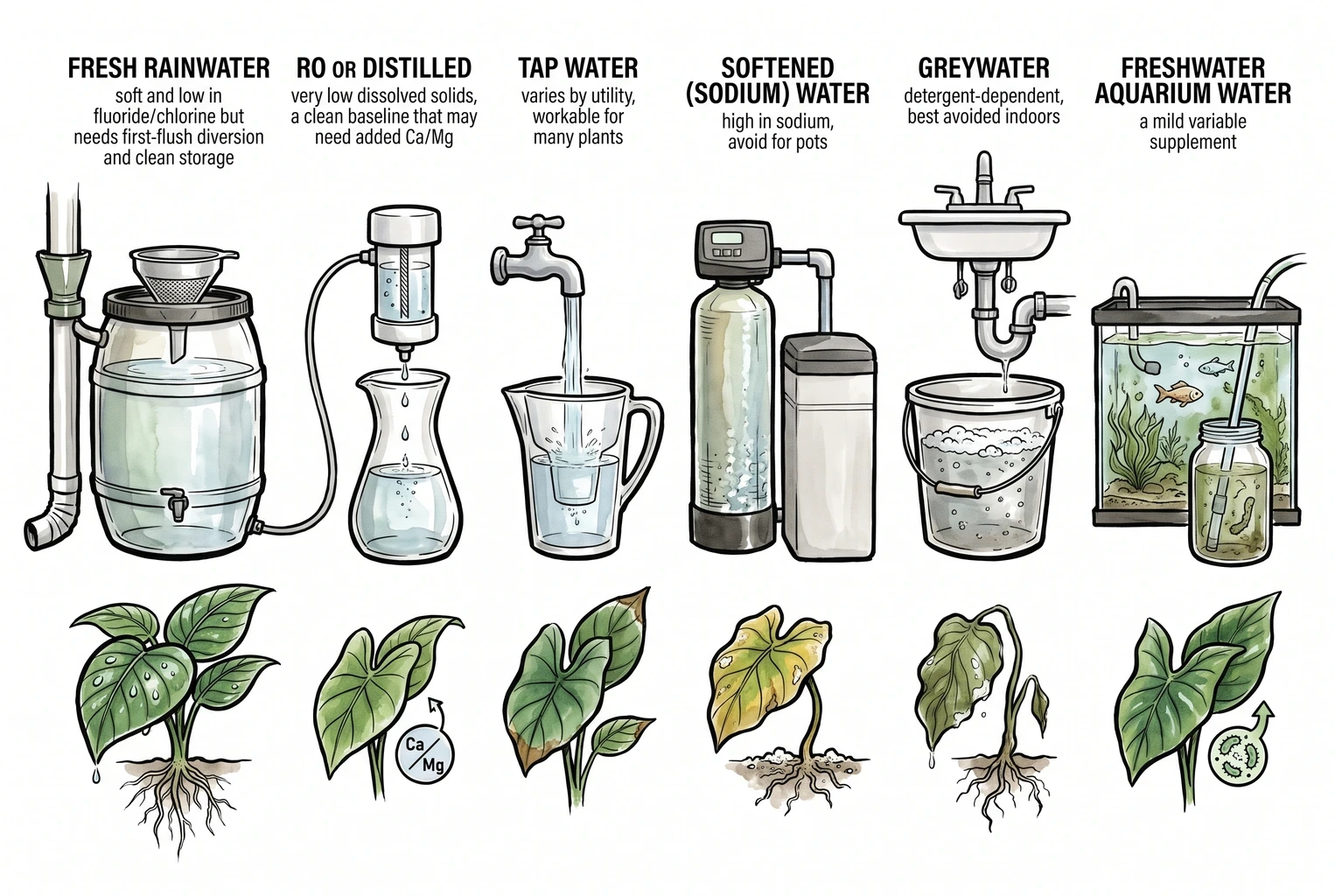
Compare Water by Its Actual Risks
Compare each available source by its contaminants, EC and alkalinity, collection and storage requirements, nutrient contribution, and fit for your species rather than using a fixed ranking.
6.1 Rainwater (Often Good, With Real Caveats)
Rainwater is naturally soft, tends to be slightly acidic, and carries some dissolved oxygen.
Its exact pH and nitrate content vary with location, the storm, and the collection surface, so it is not a fixed perfect water, and lightning-derived nitrate is small and variable.
- Pros
Soft, low in fluoride and chlorine, and free once you have a system. - Cons
Collection and storage take effort and cost. Roof runoff can pick up metals, microbes, bird droppings, and debris. The first flush is the dirtiest. Stagnant storage breeds mosquitoes and can go anaerobic. Local rules may restrict rainwater harvesting. - How to manage it. Divert the first flush, use an opaque, mosquito-screened container, keep it cool, use it reasonably fresh, and clean the system periodically. Treat stored rainwater as non-potable.
6.2 Reverse Osmosis (RO) and Distilled Water (The Blank Slate)
Reverse osmosis and distillation are different processes that both remove most dissolved solids (a well-maintained system gets close to 0 ppm, though the actual figure depends on the membrane, maintenance, storage, and meter).
- Pros
Very low in fluoride, sodium, and chlorine, which makes it a clean baseline for sensitive plants. Removal is high but not literally guaranteed if maintenance lapses or the water is re-contaminated after treatment. - A common misconception is that RO water is hungry water that pulls nutrients out of roots. That reverses the physics. Low-solute water outside the roots favors water moving into the plant. Repeated flushing with mineral-free water can instead leach salts out of the medium. That is a soil effect, not water being pulled back out of the roots.
- Remineralizing. If you water long-term with pure RO/distilled and use a fertilizer that is low in calcium and magnesium, a CalMag supplement can make sense. But a complete fertilizer may already supply Ca and Mg, so adding more can be unnecessary or push EC too high. Decide based on your fertilizer, medium, plant, and an EC reading, not a fixed ppm target.
Carnivorous bog plants are a stricter case than the typical houseplant. Water choice and medium choice have to work together. For a complete setup using low-mineral water with an unfertilized peat-and-perlite medium, follow the Venus flytrap soil and water guide.
6.3 Tap Water (The Manageable Risk)
This is what most people use, and for many houseplants it is fine.
- Pros
Convenient, and if it is hard it contributes some calcium and magnesium. - Cons
Depending on your utility, it may contain chlorine or chloramine, fluoride, and sodium, but not every tap has all three, and concentrations vary. This is where your CCR and an EC meter come in. Do not assume toxic without checking.
Start With the Water Report
Begin with the utility report, then treat the water only when the data and plant symptoms justify it.
Dechlorinate If Warranted
If your utility uses chloramine and you keep a sensitive plant, a chemical conditioner works faster than standing water.
Seachem Prime Water Conditioner
Seachem Prime Water Conditioner is an aquarium conditioner. Its label dose is about 5 mL per 50 US gallons (roughly 1 mL per 10 gallons, about 2 drops per gallon).
Generic sodium thiosulfate doses differ by concentration, so follow that product's directions.
How Aquarium Conditioners Work
With chloramine they remove the chlorine portion and bind the released ammonia. In an aquarium a biofilter then processes that ammonia. A pot is not an aquarium, so the manufacturer does not claim potting-soil or repeated-houseplant-watering benefits. Use it for what it is verified to do, preparing water, and do not treat it as a soil-microbiome protectant.
Keep the Off-Label Limits in View
This is a genuine freshwater and saltwater aquarium conditioner at the dose above. It is practical for treating chloraminated water, but its label scope is aquariums. Long-term houseplant watering and soil effects are not something the manufacturer certifies.
If you use it, you are applying an aquarium product off-label.
- If fluoride is a concern. Home filters do not remove it easily. Silicon or wollastonite may help some sensitive plants tolerate it, based on crop research, but silicon does not remove fluoride and is not a substitute for using lower-fluoride water where it matters. Whether you need any of this depends on your fluoride level (check the CCR) and your species. See our related piece on silicon in soil.
- Consider pH and alkalinity together. A source-water pH reading alone does not tell you how much your medium's pH will drift, because that is driven by alkalinity. If you decide to acidify irrigation water, do it deliberately. A commercial pH Down is a concentrated acid, so read the product label and its SDS, wear eye and skin protection, work in a ventilated area, add acid to water (never the reverse), use a calibrated meter, and confirm the final pH and EC. This is not a casual step, and many home growers never need it.
6.4 Greywater (Best Avoided for Pots)
People ask about reusing bathwater or dishwater (greywater). The conservative default for container houseplants is to avoid it, but the reasons depend on what is in it.
- Why caution. Some detergents contribute sodium or boron, some are strongly alkaline, and greywater can carry disinfectants, bleach, or pathogens. Not every surfactant is a sodium salt or pH 10, so judge by the specific detergent, the EC, and local rules rather than a blanket claim.
- Outdoors is not automatically safe. Garden soil can still accumulate sodium and boron over time, so use it outdoors is not a free pass, and many areas regulate greywater use.
6.5 Aquarium Water (A Useful By-Product)
If you keep a freshwater tank, the water from a water change can be a handy source for plants, but its quality varies by tank, so it is not a universal best water.
- Why it can help. It is usually dechlorinated and room temperature, and it carries some nitrate and phosphate from fish waste. The concentrations differ a lot by stocking and feeding, so count it as a mild supplement, not a complete fertilizer, and factor it into your feeding.
- Caveats
Avoid it if you have added salt, medicated the fish, or used copper-based or algae treatments. Also consider disease and whatever was in your source water to begin with.
Part 7. Notes by Plant Group
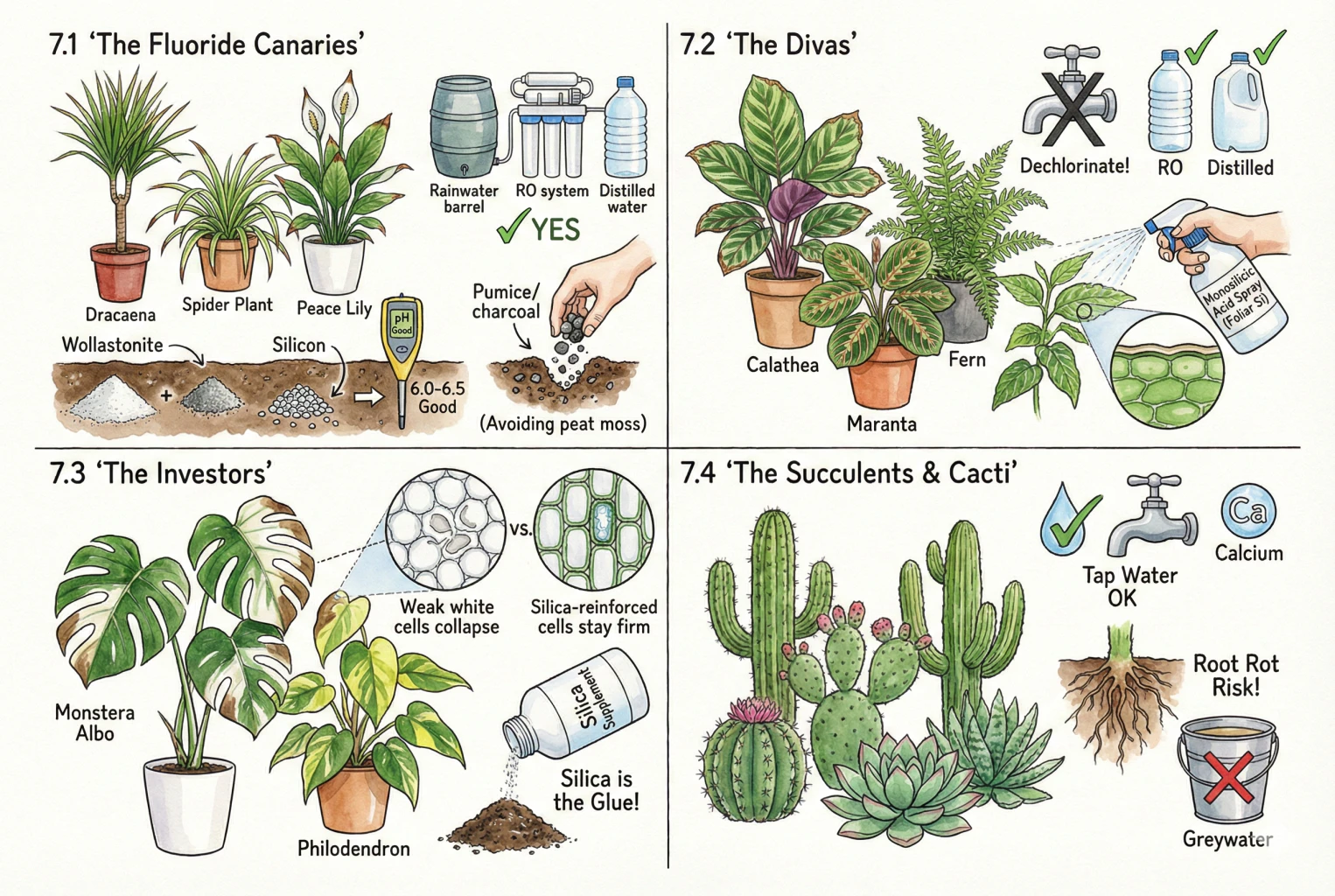
Apply the Water Analysis to Each Plant Group
These broad groupings show how the water analysis can apply by genus, but cultivar and growing conditions still matter.
7.1 The More Fluoride-Sensitive Group (Dracaena, spider plant)
Some of these get marginal browning readily. Documented fluoride sensitivity is strongest for Dracaena and Chlorophytum.
- Water. If your tap is fluoridated, lower-fluoride sources (rainwater, RO, or distilled) are a reasonable choice. This is about keeping fluoride low, not chasing a literal zero. With a suitable medium pH and modest tap fluoride, many are manageable on tap.
- Soil. Wollastonite or a silicon amendment is an option some growers try, not a requirement. There is no controlled evidence that these genera need silicon.
- pH. Extension guidance for sensitive Dracaena aims for a medium pH around 6.0–6.5, where fluoride is less available. Treat that as a target for these genera specifically. Amendments like pumice or charcoal change structure but do not by themselves fix pH.
7.2 The Crispy-Edge Group (Calathea, Maranta, ferns)
These often show browning edges, and the cause is worth diagnosing rather than assuming.
- The cause. It may be salts or chloramine affecting fine roots, but low humidity and inconsistent watering are also common culprits. There is no reliable prevalence data saying one dominates. Check watering consistency and the medium's EC before blaming water chemistry.
- Water. If you suspect water quality, RO or distilled is a clean test. On tap, dechlorinate chemically if your utility uses chloramine.
- Silicon note. Silicon is generally more effective applied to soil/roots than as a foliar spray, and foliar silicon is often not effective (per Rutgers guidance). If you try a foliar product, use one labeled for it, follow its concentration, and watch for leaf burn or residue. Do not spray a home-mixed solution blind.
7.3 Variegated Plants (Monstera Albo, variegated Philodendron)
A common question, illustrated by the community post below, is whether to apply silicon as a foliar spray or in the water.
The embedded discussion is a user question rather than settled evidence. Soil and root application is generally more reliable than foliar application, and the benefit for variegated tissue specifically remains unproven.
On highly variegated plants, the white sectors sometimes brown or melt.
- The biology. White sectors have little chlorophyll, so they produce little of their own energy and depend on sugars from the green tissue. That makes them more fragile, but they are still part of the plant, not parasite tissue. White-sector browning has several possible causes, light stress, watering, root damage, so identify which applies before reaching for an additive.
- On silicon. There is no controlled evidence that silicon prevents variegated white-sector browning or holds variegation together. It is not a fix to count on here. Sort out light, water, and root health first.
7.4 Succulents and Cacti
- Water. Many tolerate tap water well, though salinity, alkalinity, and the specific species still matter, so this is not a guarantee for every plant.
- Hardness. These plants need calcium, but that is a different question from tolerating high alkalinity or salt. Do not assume they prefer hard water across the board.
- Root rot. The main driver of root rot is persistently wet, oxygen-poor medium (interacting with watering, temperature, and pathogens), not a single waterborne pathogen. Water on a dry-down schedule and use a fast-draining mix. Avoid greywater.
Part 8. Conclusion
Water quality is a real variable, but it is one of several, and the honest picture is more conditional than a single recipe.
What to Carry Forward
Use the following points as a practical summary.
- Water is a chemical delivery system, so measure what is in yours (CCR, EC, and pH/alkalinity) before changing anything.
- Fluoride and chloramine can matter for some plants at some concentrations, but their effects depend on your location, dose, and species. They are not universal poisons.
- Silicon is a beneficial element that may help some plants tolerate stress. The evidence is largely from crops, not houseplants on tap water, so treat it as an option to test.
- Wollastonite is a slow-release calcium-silicate liming material. It can supply calcium and silicon and raise pH. Useful when a soil test calls for it, easy to overshoot when it does not.
A More Controlled Setup
A more controlled setup suits sensitive plants or problematic source water. Use a low-solids source such as RO or distilled, add calcium and magnesium only if your fertilizer does not already supply them, treat silicon as optional and label-bound, and set pH to your species' range with a calibrated meter.
The exact numbers depend on your plant, medium, and fertilizer. There is no single universal recipe.
A simpler setup
This works for many people. Tap water, dechlorinated if your utility uses chloramine, with amendments added only where a soil test or a diagnosed problem justifies them.
If tips brown, diagnose before dosing. Check humidity, watering consistency, salt buildup (EC), root health, and disease before assuming water chemistry or reaching for more silicon.
The goal is not a magic formula but a habit. Look at your actual water and your actual plant, change one thing at a time, and watch the response.
Appendix. Quick References (Use as Starting Points, Not Diagnoses)
Each symptom below has more than one possible cause. Treat these as leads to investigate (inspect the roots, check EC/pH and watering, and look at the pattern and spread of any lesions) not as one-step diagnoses.
| Symptom | Causes to consider | What to check / try |
|---|---|---|
| Browning at the tip with a yellow halo | Fluoride (in sensitive species). Also salts, low humidity, uneven watering | Check your CCR fluoride and the medium EC, if fluoride is high and the plant is sensitive, trial a lower-fluoride source and confirm medium pH. |
| Crispy edges around the whole leaf | Salt/EC buildup, inconsistent watering, low humidity | Measure medium EC. Leach with low-salt water if high. Stabilize watering. Avoid softened water. |
| Yellowing between veins (veins stay green) | pH-driven Fe/Mn lockout, or Mg deficiency, root damage, disease | Test medium pH and EC before feeding. Adjust deliberately rather than adding fertilizer blindly. |
| Yellowing of lower leaves | Normal aging, nitrogen deficiency, overwatering, root issues | Check roots and watering first. Feed only if a deficiency is likely. |
| Mushy brown spots | Root rot / infection from persistently wet, low-oxygen medium | Inspect roots, let the medium dry, improve drainage and airflow. Remove affected tissue. |
Comparing Water Sources on the Criteria That Matter
Not a fixed ranking (the right choice depends on your species, your source water, and how much effort you want).
| Source | Contaminant / salt profile | What to watch, and effort |
|---|---|---|
| Fresh rainwater | Soft, low fluoride/chlorine. Roof runoff can add metals, microbes, debris | Divert first flush, screen and cool storage, use fresh. Local rules may apply. Low cost, moderate effort. |
| Aquarium water (freshwater) | Usually dechlorinated. Variable, mild N/P from fish waste | Avoid if salted, medicated, or copper-treated. A supplement, not a complete feed. |
| RO / distilled | Very low dissolved solids. Low fluoride/sodium/chlorine | May need Ca/Mg only if your fertilizer lacks them. Check EC. Higher cost/effort. |
| Tap | Varies by utility. May include chlorine/chloramine, fluoride, sodium. Check the CCR | Dechlorinate if chloraminated. Workable for many plants. Lowest effort. |
| Softened (Na) water | High sodium, low Ca/Mg | Avoid for pots. Use the bypass tap. Salt accumulates over time. |
| Untreated greywater | Detergent-dependent. May carry sodium, boron, disinfectants, pathogens | Avoid indoors. Check local law. Not automatically safe outdoors. |
Affiliate Disclosure
This article contains Amazon affiliate links. As an Amazon Associate I earn from qualifying purchases. If you use these links, the site may earn a commission at no extra cost to you. Product availability, price, and specifications can change. Check the current listing before buying.