
Do Copper Pennies Cure Houseplant Fungus? The Truth
Do copper pennies cure houseplant fungus? No. A coin is not a standardized fungicide with a known dose, coverage, or tested effect, and modern pennies are 97.5% zinc. Here’s the science, the zinc-toxicity question, and how to diagnose gnats, rot, and leaf disease before you treat.
Jordan Cole · Published 2026-02-27 · 9 min read

Key Takeaways
- A copper penny is not a reliable treatment for houseplant disease. Copper is a real fungicide, but a solid coin has no known dose, coverage, or tested effect, and any release depends on the soil, moisture, and the coin’s condition.
- Modern pennies are mostly zinc. Post-1982 US pennies are 97.5% zinc. Excess zinc can cause toxicity symptoms under some conditions, but the hack does not measure how much zinc reaches the soil.
- People often misdiagnose the problem they are trying to solve. Fungus gnats, root rot, surface mold, and leaf disease need different responses, and a penny is not a registered control for any of them.
- Diagnose before you treat. Surface mold, fungus gnats, root rot, and foliar leaf disease are different problems with different fixes.
- For confirmed foliar disease, use a formulated product rather than a coin. A registered liquid copper fungicide can be a real option when the plant and disease appear on the product label.
A popular gardening tip claims that pushing a few copper pennies into the potting soil will revive a drooping, unhappy houseplant.
The idea is that the copper acts as a natural fungicide, killing off root rot and chasing away fungus gnats.
Does the Penny Plant Hack Actually Work?
No. A penny in the soil is not a standardized fungicide, and there is no tested evidence that it treats plant fungus, gnats, or rot.
The logic behind the hack seems sound at first glance. Copper is indeed a well-documented fungicide used in agriculture.
The problem is that a coin is nothing like a formulated copper product, and the soil environment matters too.
Modern US pennies minted after 1982 contain only about 2.5% copper. They are 97.5% zinc. (The composition changed during 1982 itself, so coins from that year exist in both the older copper and the newer zinc-core versions.)
More importantly, elemental copper (the metal form) does not dissolve readily into potting soil the way a formulated fungicide is designed to.
A solid coin has no known, standardized dose or coverage. Any copper it releases depends on moisture, oxygen, pH, and the coin’s surface condition, so there is no reliable way to know it reaches pathogens at a useful amount.
Why is Copper Used as a Fungicide?
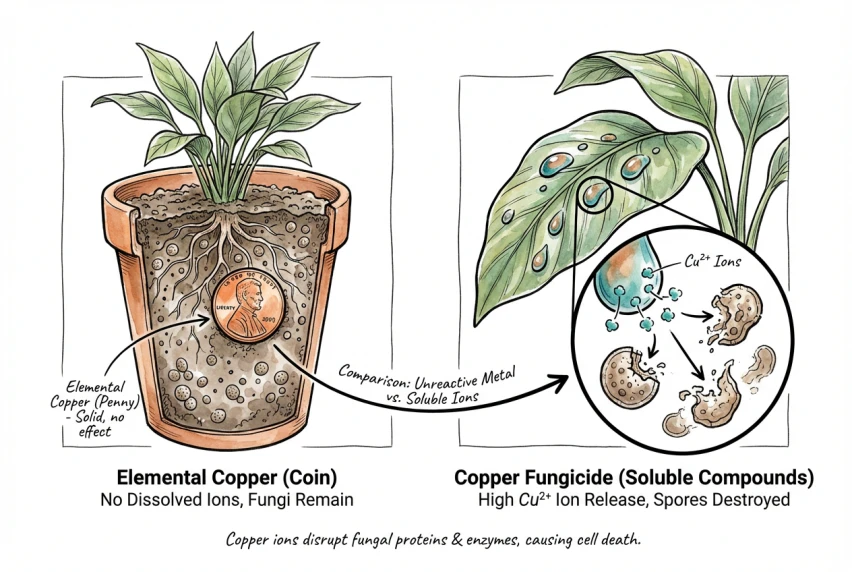
| Feature | Pennies (Coin) | Copper Fungicide |
|---|---|---|
| Copper Content | ~2.5% (Post-1982) | Varies (formulated active ingredient) |
| Copper Release | Slow, uncontrolled, depends on soil and corrosion | Formulated to release ions under label conditions |
| Fungal Effectiveness | No tested dose or effect | Registered for specific diseases at label rate |
Copper compounds can suppress some fungal diseases when their active ingredient reaches the plant surface at a labeled rate. Results still depend on the product, pathogen, and application timing.
Why Formulation Matters
Horticultural copper fungicides are formulated products with different release behavior. Some, such as copper sulfate, are more soluble. Fixed coppers like copper hydroxide or copper octanoate are relatively insoluble and release copper ions gradually under specific water and pH conditions. They are not interchangeable, and most act as protectants on plant surfaces rather than curatives inside the plant.
Will Old Pennies Work Better?
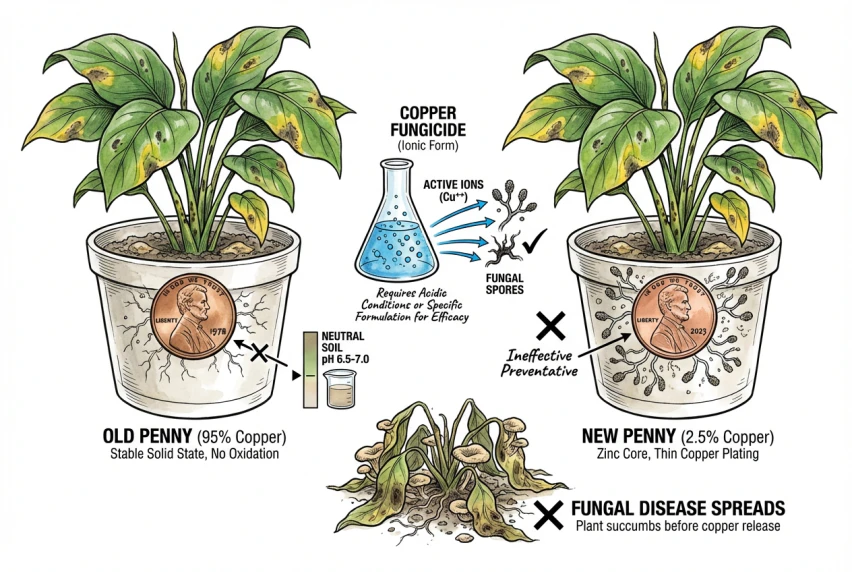
Even pre-1982 pennies, which are about 95% copper, are not a reliable cure for houseplant fungal problems.
An older penny does contain far more copper, but it is still solid metal, and solid copper is not the same as a standardized, tested dose in the soil.
Potting mixes vary in pH and in salt and organic content. Copper can corrode and release ions under the right conditions (strong acids are not strictly required) but a coin still gives you no way to control how much is released or when.
The real problem is that there is no verified dose, coverage, or efficacy for a coin, so it should not be used in place of an actual diagnosis and treatment for root rot or disease.
Copper Fungicides | Cornell Vegetables
Can Pennies Actually Harm My Plants?
The Zinc-Toxicity Question
How Zinc Could Cause Problems
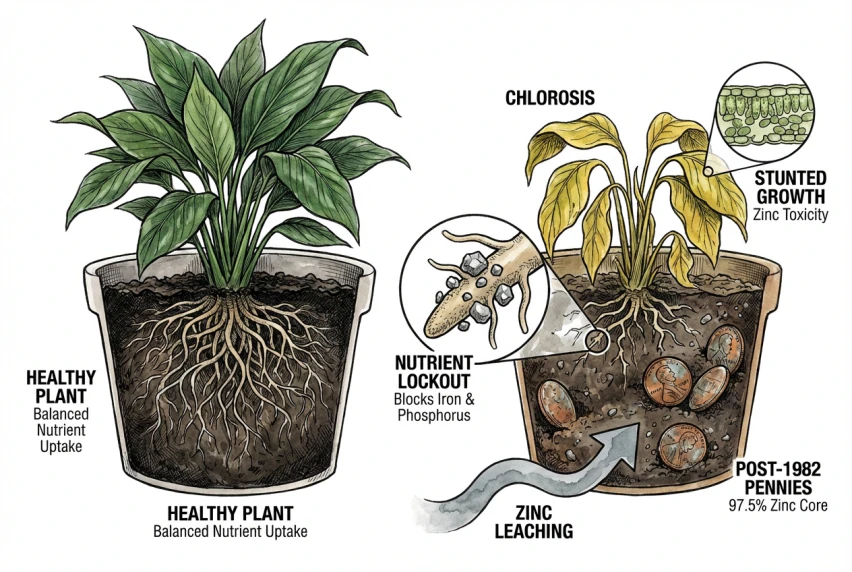
There is also a plausible downside. Post-1982 pennies are mostly zinc, and excess zinc can be harmful to plants under some conditions.
Zinc makes up the vast majority (97.5%) of a modern penny’s core.
Zinc is an essential micronutrient in small amounts, and intact copper plating limits how quickly the zinc core is exposed.
If the plating is damaged and the soil is acidic, more zinc can leach out over time, but how much actually reaches the soil depends on those conditions, not on the coin alone.
In excess, zinc can cause chlorosis (yellowing of new leaves) and stunted root growth, partly through its interactions with iron and phosphorus uptake.
These interactions run in both directions and vary by species, medium, and concentration, so yellowing leaves alone do not confirm zinc from a penny as the cause.
The broader point is a precautionary one. It is best not to add uncontrolled sources of metal to a confined pot.
The risk depends on dose, and without measuring actual leaching you cannot assume a single coin causes toxicity.
What Are People Actually Trying to Treat?
Misdiagnosing Fungus Gnats
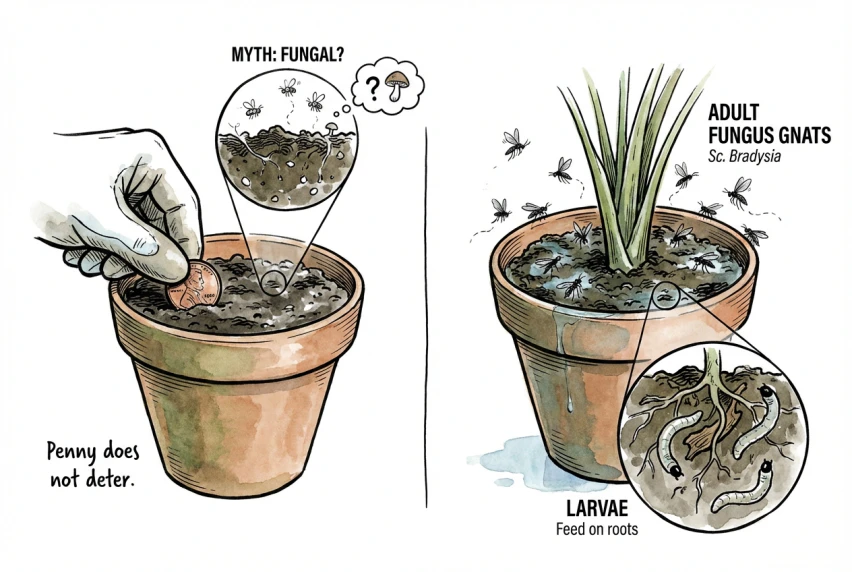
Often people reach for the penny hack because they see tiny dark flies around the soil and assume the plant has a fungal problem.
These are usually fungus gnats, though a photo, a sticky trap, or a look at the larvae helps, since similar tiny flies such as shore flies can be confused for them.
They are drawn to consistently moist soil where they lay their eggs, and their larvae feed mainly on fungi and decaying organic matter.
In heavy infestations, or with young or seedling plants, the larvae can also damage roots.
A penny on the soil surface is not a registered gnat control, and there is no evidence it deters egg-laying adults or kills the larvae below.
Before treating anything, I inspect the foliage, soil surface, and drainage holes as three separate zones. A fresh sticky card goes at soil level for flying insects, and I smell the drainage water. The root ball comes out only when the plant and pot allow it safely.
These observations keep a gnat problem, harmless surface growth, and declining roots from being collapsed into the same vague diagnosis of fungus.
I write down the visible sign before I choose a remedy. If I cannot name what the penny is supposed to fix, I do not add the penny or any other treatment to the pot.
Confusing Rot with Fungus
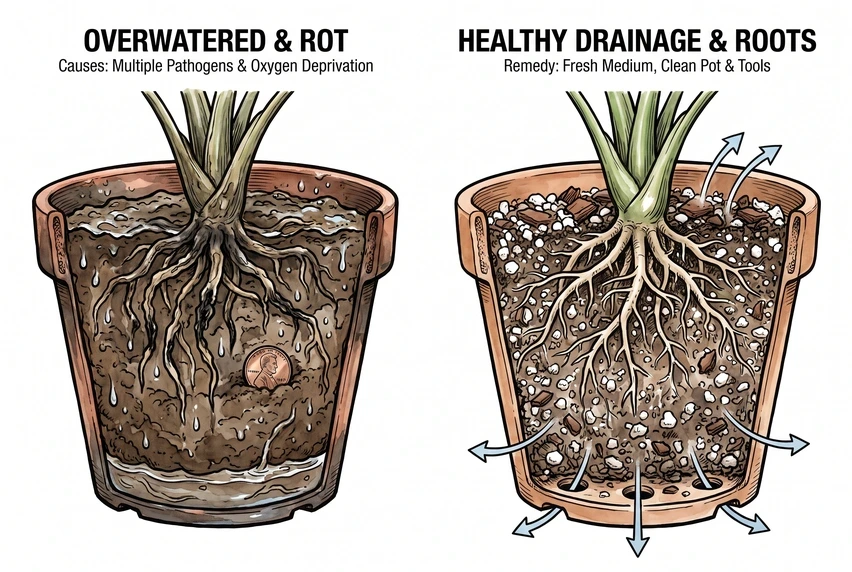
Root rot is another common reason people try this hack.
Drainage Comes Before Any Treatment
Root rot is often associated with water molds (oomycetes) such as Pythium and Phytophthora, which thrive in soggy, oxygen-deprived soil, though other pathogens like Rhizoctonia and non-infectious root damage are also possible.
Pushing a penny into waterlogged soil does not add oxygen or improve drainage.
Overwatering and poor drainage are common contributors, not a lack of copper, but managing rot also means diagnosing the cause, checking for infected or contaminated soil, removing badly affected tissue, and repotting into a clean pot with fresh, well-draining medium.
Isolating or discarding severely infected plants and sanitizing tools helps prevent it from spreading.
What to Do Instead of the Penny Hack
Cinnamon and Surface Mold
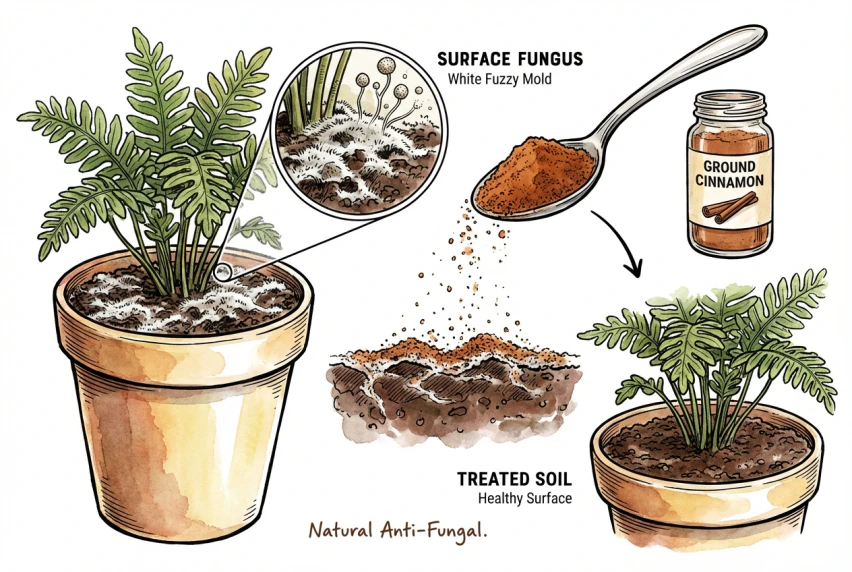
What Cinnamon Can and Cannot Do
Ground cinnamon is a popular home remedy for the harmless white mold that can appear on the surface of potting soil, though its real-world effect there is not well established.
Cinnamon essential oil, and its main compound cinnamaldehyde, have shown anti-fungal activity in laboratory tests.
That is not the same as kitchen-cabinet ground cinnamon sprinkled on a pot. The amount of active compound, how much is released, and its effect on soil pathogens under real conditions have not been well characterized.
If you see white fuzzy growth on the top of your potting soil, first check whether it is simply surface saprophytic mold, which is usually harmless.
Improving air circulation, letting the surface dry between waterings, and removing excess organic debris address the cause.
A light dusting of cinnamon is unlikely to hurt and may temporarily suppress visible growth, but treat it as a cosmetic step rather than a proven cure, and note it can cover mold visually without eliminating the conditions causing it.
For seedlings, damping-off is best prevented with clean containers and medium, good air movement, avoiding overwatering, and appropriate temperature and spacing.
Managing Fungus Gnats
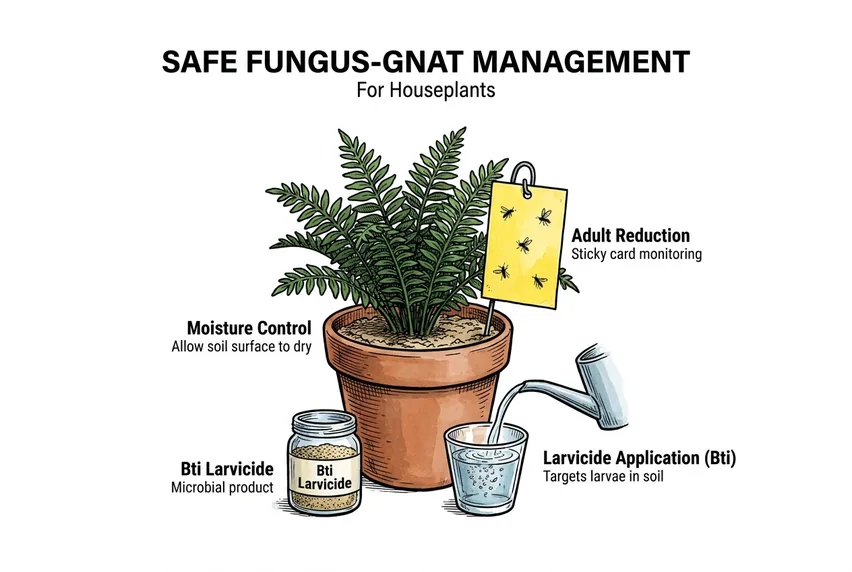
The most reliable approach to fungus gnats is to make the soil less hospitable and to target the larvae with a product registered for the job.
Because gnats need consistently moist soil, letting the top layer dry out between waterings and improving drainage reduces breeding.
Yellow sticky cards help you monitor the infestation and trap some adults, though they will not clear an established population on their own.
Use a Registered Larvicide
For the larvae, use a product based on Bacillus thuringiensis subsp. israelensis (Bti), a soil bacterium that targets fungus gnat larvae. Choose one whose current label lists fungus gnats and the intended indoor or container-plant site, then follow that label’s amount, method, and repeat interval. To match a control to the pest’s life stage, decide whether you are targeting adults, larvae, or both.
A note on hydrogen peroxide. Some gardeners drench soil with diluted 3% hydrogen peroxide, but there is no controlled evidence that it cures root rot, and a soil-wide drench is a non-selective oxidant that can also damage healthy roots and beneficial soil life.
If you use peroxide at all, treat it as unproven for this purpose rather than a first-line remedy, and prioritize diagnosis, moisture and drainage correction, and the sanitation steps above.
Commercial Copper Fungicides
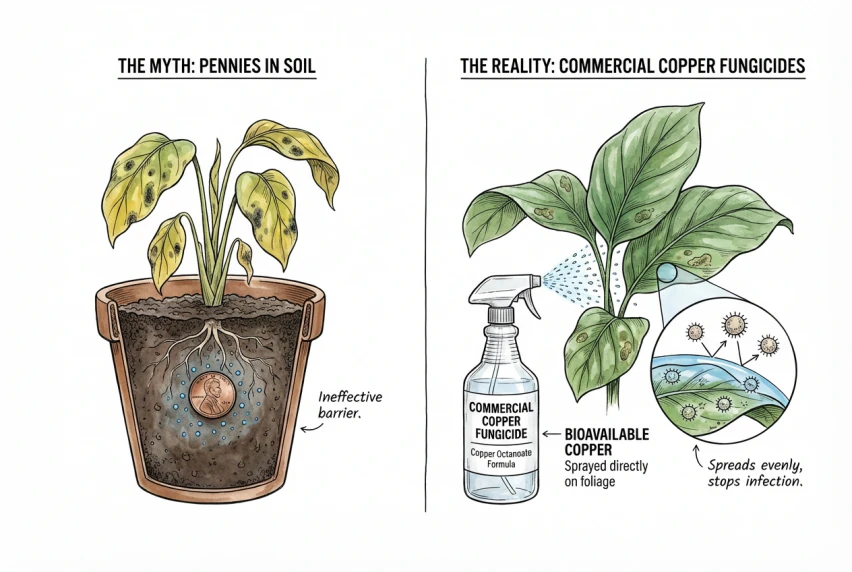
Use a Formulated Product on Leaves
If you have what looks like a fungal leaf spot or blight, a formulated liquid copper fungicide is one option. First try to identify the actual pathogen, since not all leaf spots are fungal and not every disease is on a given product’s label.
Unlike a penny, commercial copper soap (copper octanoate) is designed to be sprayed on and coat the leaf surface, acting mainly as a protectant that helps prevent new infections.
It is a barrier on the surface, not a cure that reverses an infection already established inside the plant.
A ready-to-use copper-soap fungicide is one possible option only when its current label covers the plant, disease, site, and application method. Apply it only where that label permits, and check the plant’s copper sensitivity before treating a larger area.
Copper can be phytotoxic if overapplied, especially in heat or on tender new growth. Apply only at the labeled rate, spray under the conditions the label permits, and use that product’s reapplication interval. Copper formulations and registered uses differ, so do not borrow a schedule from another product.
Wear the protective equipment required by the label, follow its environmental precautions, and keep copper away from ponds and aquariums because it is toxic to fish and invertebrates.