
Money Tree Care (Pachira): Water, Light, Soil & Root Rot
Care for a Money Tree (Pachira aquatica) with well-draining soil, bright indirect light and thorough watering. Diagnose braid constriction, pests and root rot.
Priya Patel · Published 2025-12-24 · 20 min read
Key Takeaways
- A Money Tree tolerates flooding in the wild, but a pot still needs oxygen at the roots. Stagnant, saturated soil is the indoor condition that most often invites root rot.
- Overwatering is primarily an oxygen problem. Use a well-draining mix with drainage holes and let the pot dry appropriately between waterings rather than keeping it soggy.
- Inspect the braid for a restrictive tie before disturbing the roots. If tape or a rubber band is cutting into a trunk, remove it carefully and avoid digging into shallow roots by default.
- Give the plant bright, indirect light. A very dark spot encourages stretching and lower-leaf drop, although watering, nutrition, and temperature can also affect legginess.
- Use room-temperature water and a balanced fertilizer at label rates. Skip ice cubes and high-phosphorus bloom products, and treat a roughly 3-1-2 label ratio as a practical foliage-plant starting point rather than a species requirement.
1.Care for the Plant It Actually Is
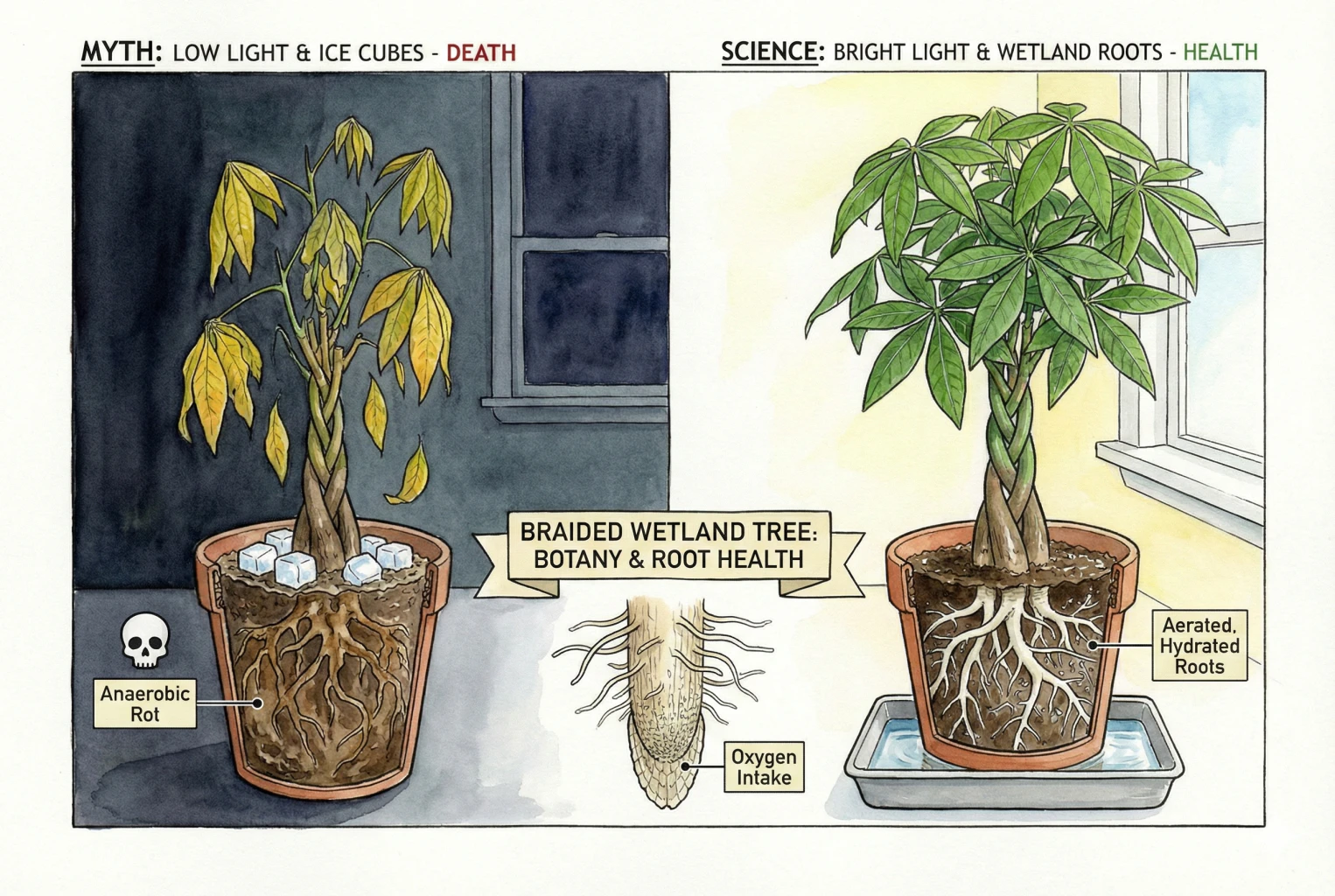
Money Trees often struggle when they’re treated like a generic desk plant, watered on a fixed schedule and parked in a dark corner. They are braided Pachira aquatica, a wetland tree with preferences that do not always match the low-light and ice-cube advice on a care tag.
Its botany and root-zone behavior explain why drainage, light, and watering need to be handled together.
I photograph every tie and contact point on a braided trunk and check whether stems are swelling around plastic, wire, or each other. A decorative braid can hide constriction long before the canopy reacts.
I loosen only an external tie that moves independently of the trunk and admits a 2 mm plastic plant label without pressure. If tissue covers it, the groove is soft or wet, or removal requires cutting toward the trunk, I stop and seek an experienced arborist or nursery professional. I photograph the same angle immediately and on days 3, 7, and 14, ending the check only when firm tissue shows no new indentation, darkening, cracking, or swelling on the final two dates. The 2 mm clearance protects the bark, while two unchanged checks keep one quiet day from looking like recovery.
If the canopy droops while the pot remains heavy, I inspect drainage and roots before watering again. Pachira often gets treated as thirsty when the lower root zone is still saturated.
2. The Science of Money Tree Houseplant Care (The ‘Why’)
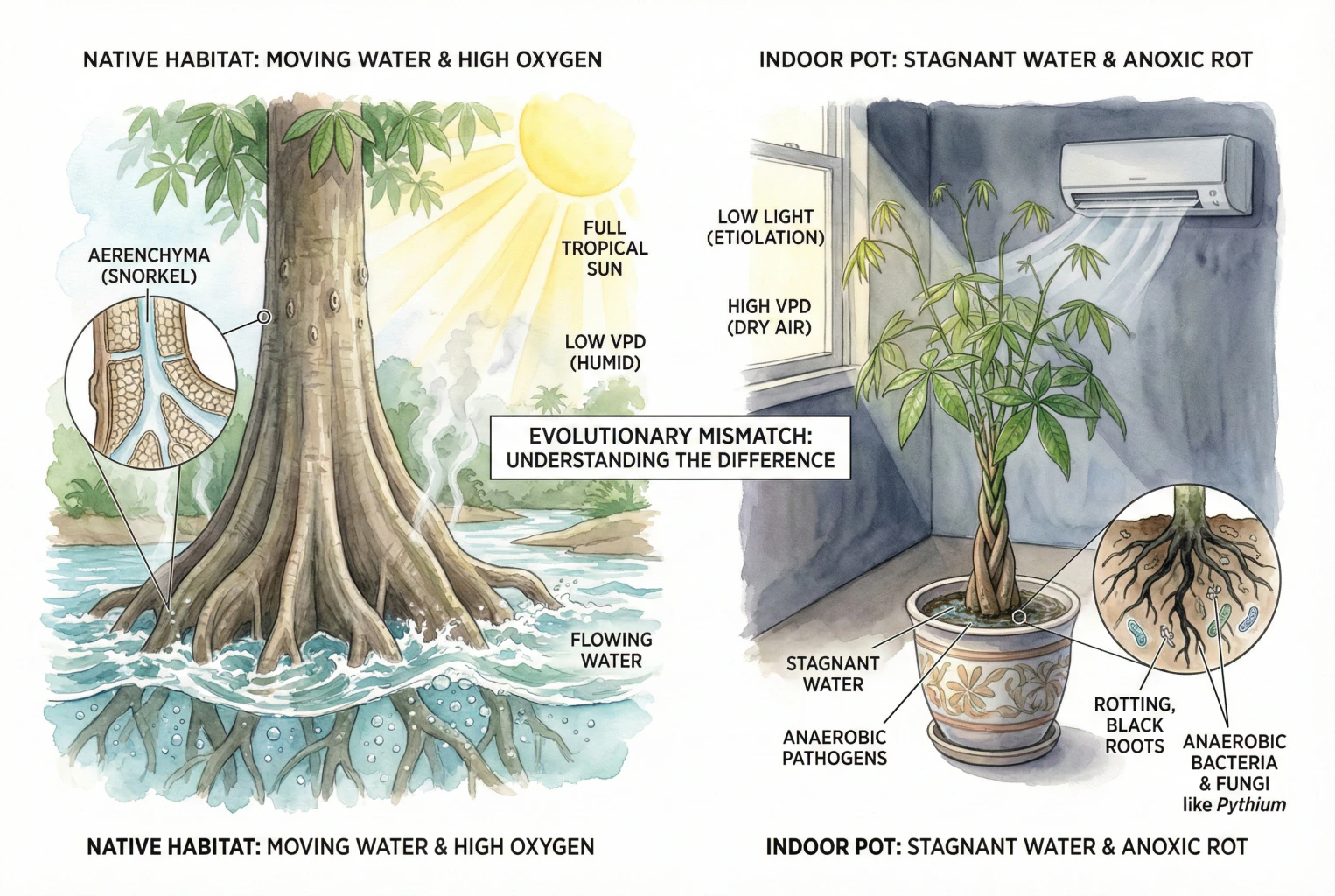
Good care starts with understanding where this plant comes from and what it’s adapted to.
Pachira has adapted over a long evolutionary history to particular conditions, and matching those conditions indoors is what keeps it healthy.
2.1 The Native Habitat (It’s All About the Estuary)
Pachira aquatica is native to Mexico through tropical Central and South America, where it grows in freshwater swamps, estuaries, riverbanks, and rainforests, according to Kew and NC State Extension.
The species name aquatica is Latin for aquatic, a fair hint about its watery habitat. Accounts of the genus name’s origin vary, so it is best not to over-read it.
In the wild these trees can grow large, with buttressed roots that help stabilize them in soft, wet ground.
They tolerate seasonal flooding, when a rising water table can keep the root zone saturated for extended periods.
The Adaptation Mechanism
So if it lives in a swamp, why does it struggle when overwatered in a pot? The key is not simply moving water versus still water, because many natural wetland soils are themselves low in oxygen.
The difference is that wetland plants have adaptations to cope with saturated, low-oxygen soil, and those adaptations only go so far in a dense, undrained container.
Flowing or well-mixed water can carry more dissolved oxygen (DO), but a healthy swamp is not always churning. Its saturated soils are often hypoxic.
How Aerenchyma Help
Many flood-tolerant plants develop aerenchyma, tissues with air-filled channels that help move oxygen internally from the shoot toward the roots. This kind of internal gas transport helps roots respire in waterlogged soil.
The specific bark-lenticel-to-root pathway sometimes described for Pachira is not established in the literature cited here, so treat it as a general mechanism rather than a species-specific fact.
The Pot Problem
Inside a pot with dense soil, poor drainage, and water that cannot escape, the root zone stays saturated, so drainage and watering habits matter here as much as the pot material.
Root and microbial respiration consume oxygen, and in saturated soil it isn’t replaced quickly, so the environment can become hypoxic (low oxygen).
How fast this happens depends on temperature, substrate, and microbial activity.
With less oxygen, roots rely more on inefficient anaerobic (fermentative) metabolism and produce less usable energy.
Prolonged low oxygen can damage root tissue and leave it more vulnerable to opportunistic pathogens, including water molds such as Pythium and Phytophthora (which are oomycetes, not true fungi).
This is the mechanism behind root rot. The most common way these plants are lost indoors.
Key Takeaway
Your Money Tree needs both water and oxygen at the roots. The practical goal indoors is soil that holds moisture but also drains and re-aerates, rather than staying constantly waterlogged.
Mechanisms of waterlogging tolerance in plants (open-access review)
2.2 The Physics of Light (Photons vs. Shadows)
Photosynthesis is more than a plant simply eating light. Leaves capture light energy to split water and fix carbon dioxide into sugars, and light intensity strongly affects growth form.
Pachira aquatica is fairly adaptable. In nature it can grow in bright tropical sun or in shadier understory positions.
Outdoor sun can be very bright (well over 1,000 µmol/m²/s), but that’s a natural extreme, not a requirement for a mature indoor plant.
Commercial growers often produce these plants under shade cloth. Published greenhouse work on Pachira, for example, used production light levels in the low-to-mid hundreds of µmol/m²/s combined with growth-regulator treatments (nursery conditions, not a survival threshold for your living room).
The Etiolation Trap
Move a greenhouse-grown Money Tree into a windowless hallway and the light may fall below the plant’s light compensation point, the level where photosynthesis just offsets respiration.
In very low light it tends to etiolate, which means the spaces between leaves lengthen as the plant stretches toward light.
Aim for Bright Indirect Light
The internodes, or spaces between leaves, get long and spindly as the plant reaches for light.
If you want to check rather than guess, use the PPFD and DLI guide to measure at leaf level instead of eyeballing the room. The practical target is bright, indirect light rather than a dim corner.
2.3 The Humidity Equation. Vapor Pressure Deficit (VPD)
Indoor air is often drier than these plants’ native range. Heated or air-conditioned homes can sit around 30-40% relative humidity (RH), depending on climate and season.
Parts of the humid tropics can run much higher (roughly 60-90% RH), though it varies by region and time of year. Humidity matters because of transpiration.
Plants lose water vapor through stomata (leaf pores). The driving force is the vapor pressure deficit (VPD) between leaf and air, influenced by humidity, air temperature, and leaf temperature, essentially how strongly the air pulls moisture from the leaf.
High VPD and Dry Air
The air pulls water from the leaves faster, and if it outpaces uptake the plant may partly close its stomata to conserve water. That reduces CO2 uptake and can slow photosynthesis. It is a matter of degree, not an on-or-off switch. Closing stomata does not drop CO2 to zero or immediately starve the plant.
Low VPD and Humid Air
Water loss is gentler and stomata can stay more open, which supports gas exchange. Very low VPD is not automatically better. It can slow transpiration-driven nutrient movement and favor condensation and fungal issues.
Your Money Tree Houseplant Care Protocol

The aim of a good setup is soil that holds some moisture but also drains freely and re-aerates between waterings (a balance of water retention and air, adjusted to your pot and environment).
Step 1. The Substrate
Straight garden soil often compacts and drains poorly in a container. A dense, fine potting mix can do the same.
The issue is structure, not price (some inexpensive mixes are fine, and some pricey ones are too fine) so judge the actual texture and drainage.
Overly dense mixes have high bulk density and low air-filled porosity, which leaves less room for oxygen at the roots.
A well-draining mix
Use this as a practical starting point and adjust it to your environment and watering habits.
Starting Mix Proportions
- ~40% quality potting soil (peat- or coco-coir-based). This holds moisture and nutrients (cation exchange capacity). Note that peat and coir behave a bit differently, so tweak the ratio to your watering habits.
- ~30% perlite or pumice. These add coarse pores for drainage and air. Perlite and pumice aren’t identical, and the right amount depends on your substrate grade, pot, and climate.
- ~20% orchid bark (pine bark fines). Adds structure and resists compaction.
- ~10% worm castings. A useful source of nutrients and microbial life. Products vary in salt content and maturity, so use in moderation rather than assuming there’s no burn risk.
A ready-made base option
FoxFarm Ocean Forest
FoxFarm Ocean Forest is a popular, nutrient-rich container mix and a reasonable base if you’d rather not blend from scratch.
Per FoxFarm, it contains aged forest products, sphagnum peat moss, earthworm castings, bat guano, and similar inputs, giving it a fairly loose texture and a starting nutrient charge.
That pre-charge is a plus for feeding, but it also means you should go easy on additional fertilizer at first.
FoxFarm lists its pH in a mildly acidic range (around 6.3-6.8), which suits most houseplants.
It saves you from mixing several ingredients, because it’s fairly rich and moisture-retentive, many growers add extra perlite for a chunkier, better-draining blend, though that’s optional and environment-dependent.
A large bag is more than one plant needs, so factor that in.
Step 2. The Vessel (Pot Science)
Terracotta Pots
Terracotta is helpful if you tend to overwater because porous clay lets moisture evaporate through the walls and dries faster. The trade-offs are more frequent watering and some mineral or salt buildup on the clay over time.
Plastic and Glazed Ceramic Pots
These materials hold moisture longer. You do not have to add perlite. You can water a bit less often, but a chunkier mix helps if you are prone to overwatering.
Drainage Holes
For a standard potted plant, drainage holes are strongly recommended. A drainless cachepot can work if you use a nursery pot inside it and empty excess water, but leaving a plant in a sealed, drainless pot invites rot.
Step 3. The Light Setup
Find your brightest window. ‘Indirect’ light is a vague term. Aim for bright, diffused light.
Window directions below assume the Northern Hemisphere, flip north and south if you’re in the Southern Hemisphere, and actual brightness also depends on latitude, season, glass, and outside obstructions.
A light meter beats the compass-direction rule of thumb.
North-Facing Window
Usually the dimmest in the Northern Hemisphere. It can still work in some rooms, but check the light rather than assuming.
South-Facing Window
Typically the brightest in the Northern Hemisphere. Set the plant back from the glass or use a sheer curtain if midday sun is intense.
East and West Windows
Both can work well. East tends to give gentler morning sun, while west gets stronger afternoon sun.
Step 4. Water Chemistry
Water quality is worth a look. Some houseplants can show leaf-tip damage from certain tap-water constituents, though how sensitive Pachira is specifically isn’t well documented, so don’t assume the worst without symptoms.
Before buying a filter, compare tap, filtered, rain, and reverse-osmosis options in the houseplant water guide.
Free Chlorine
Free chlorine can dissipate as water sits or is aerated. Letting water stand helps, but how much and how fast depend on the concentration, container, and aeration. Twenty-four hours is not a guaranteed number.
Chloramine
Many utilities use chloramine, which does not readily evaporate, so standing water will not remove it. Leaf-tip necrosis is more often linked to accumulated salts or fluoride than to chloramine itself.
Dissolved Salts and Fluoride
These do not leave by standing the water either. Only a filter such as reverse osmosis or distillation removes them.
Water-Treatment Options
A dechlorinator matched to your utility’s disinfectant, or RO or distilled water, can help. If you rely on RO or distilled water long-term, remember it has few minerals, so complete feeding and pH and EC awareness matter.
Expert Money Tree Houseplant Care Tips
With the basics covered, here are some tips to help a Money Tree grow well rather than just hang on.
4.1 The Braided Trunk (What to Watch For)
The braid isn’t a natural growth form. Several flexible young stems are woven together, a practice popularized in Taiwan. (Stories about a single inventor are folklore.)
Watch for Constriction
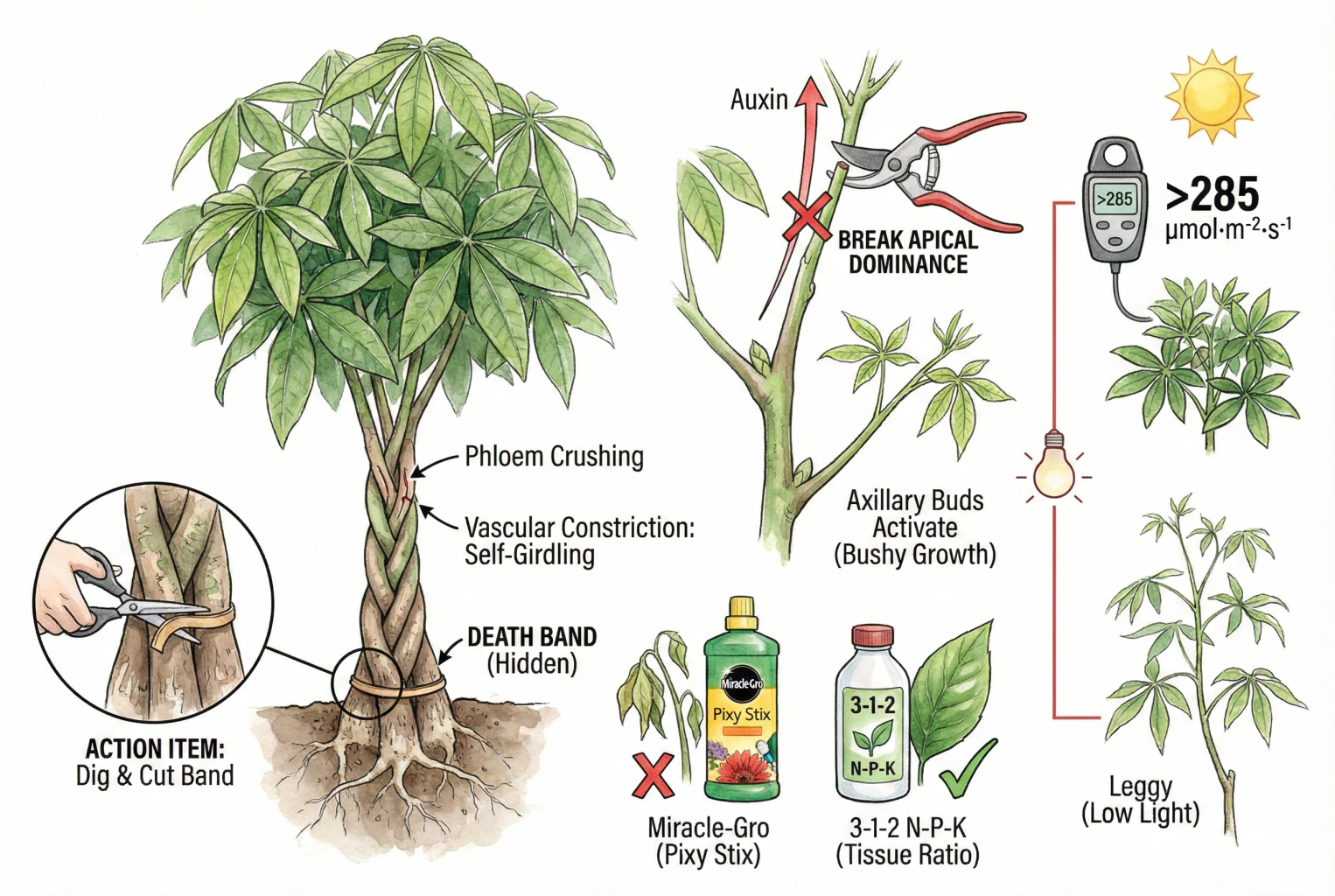
As the separate trunks thicken, they can press against each other or against anything binding them.
Sustained pressure can damage the phloem (the vascular tissue that moves sugars from leaves to roots).
But if one trunk turns mushy while the others are fine, don’t assume it was strangled. Rot, injury, or a watering problem are at least as likely, so inspect before concluding.
Check for a Restrictive Tie
Some nurseries secure the braid with tape or a rubber band, sometimes near the base, and it isn’t always removed before sale.
If such a tie stays on, it can dig into the trunk as the stems thicken.
What to Do
Look over the trunk base for any tape or band. If you can see one cutting in, remove it carefully.
You can also feel just below the surface, but avoid gouging into the shallow roots. Inspect gently rather than excavating by default.
4.2 Pruning (Controlling the Hormones)
Money Trees show apical dominance. The growing tip produces auxin that tends to suppress lower side shoots.
Other hormones such as cytokinins and strigolactones are part of the picture too, so this is a network rather than a single on-or-off signal. Pinching the tip can encourage a bushier canopy.
The Pinch
Snip the growing tip of a branch. This removes the main auxin source at that tip.
The Response
Lower axillary buds, which are dormant nodes down the stem, are more likely to activate.
The Result
New branching often follows, though how many shoots emerge varies with node health, light, and cultivar. It is not always exactly two.
A precise tool option
Fiskars Micro-Tip Pruning Snips
Fiskars Micro-Tip Pruning Snips suit a Money Tree’s younger green, soft stems, which do not require large loppers. Older growth becomes woodier.
Fine-tipped snips like these make it easier to reach into a dense canopy and cut cleanly a short distance above a node.
Leave a little clearance rather than cutting right at the node, and use a clean, sharp blade.
Whatever tool you use, wipe it with alcohol between plants and cuts to avoid spreading disease.
The spring action helps reduce hand fatigue during repeated cuts. This is a solid, precise pruner. The clean cut and sterilized tool matter more than the exact millimeter.
4.4 Feeding (The N-P-K Ratio)
Read N-P-K Labels Correctly
The N-P-K numbers on a label, such as 9-3-6, report percentages of nitrogen, available phosphate as P₂O₅, and potash as K₂O. They do not show the elemental N, P, and K a plant contains or takes up.
A 3-1-2 ratio therefore refers to label proportions, not a measured tissue analysis for Pachira.
A balanced fertilizer with a roughly 3-1-2 label ratio is a common, sensible choice for foliage plants.
There is no strong evidence Pachira consumes exactly that ratio, but it is a reasonable default.
A high-phosphorus bloom booster is not what a foliage plant needs. Common all-purpose products can already use a similar label ratio, so the issue is usually dose and formulation rather than brand.
A complete-fertilizer option
Dyna-Gro Foliage Pro 9-3-6
Dyna-Gro Foliage Pro 9-3-6 is a complete fertilizer with a three-to-one-to-two nitrogen, phosphorus, and potassium ratio. That makes it a convenient general feed, not proof that every Money Tree needs the same strength or schedule.
It includes calcium and magnesium plus a range of trace elements, providing a broad profile of the mineral nutrients plants need.
Calcium and magnesium are macronutrients, not micronutrients, so describing the product as supplying 16 essential micronutrients would be inaccurate. Think of it as covering the full set of essential mineral nutrients.
Adequate calcium supports normal new growth. It’s urea-free, which some growers prefer. Whatever you choose, follow the label rate and account for nutrients already in your mix (Ocean Forest, for instance, is pre-charged) so you don’t over-feed.
4.5 A Note on Light and Legginess
Light intensity strongly influences how a Pachira grows indoors. As light drops, internodes stretch and lower leaves may be shed, which is why commercial growers keep them bright (and sometimes use growth retardants) to hold a compact, full look.
Legginess usually points to insufficient light, though root stress, nutrition, and temperature can also play a role, so consider the whole picture.
Money Tree Troubleshooting Questions
The questions below address common advice that can fail when it ignores the plant’s actual conditions.
Can I water a Money Tree with ice cubes once a week?
The Verdict
Not a great idea, mainly because it tends to under-water.
The Reasoning
Pachira aquatica is a warmth-loving tropical plant (NC State lists a comfortable range of roughly 65-75°F indoors).
There isn’t Pachira-specific evidence that two ice cubes kill root hairs by cold shock. The more common problem is that a couple of cubes deliver too little, uneven water.
The Fix
Water thoroughly with room-temperature water until it drains from the bottom, then let the pot drain fully.
Does a Money Tree thrive in low light?
The Verdict
Misleading. It tolerates lower light, but it doesn’t thrive in it.
The Reasoning
Tolerating low light is not the same as doing well. In dim conditions a Pachira tends to stretch, hold less compact growth, and lose vigor over time.
The often-repeated claim that it cannot make enough ATP to fight pathogens is not well supported, so diagnose the visible growth and root conditions instead.
The Fix
Give it the brightest spot you have, easing it in to avoid scorching midday sun.
Does daily misting raise humidity for a Money Tree?
The Verdict
Not very effective for lasting humidity.
The Reasoning
Misting raises humidity right around the leaf only briefly as the droplets evaporate. The effect is short-lived and does not hold the room’s overall humidity, although it does momentarily change conditions at the leaf surface during evaporation.
The Fix
A humidifier is the most effective way to raise room humidity. A pebble tray adds only a little locally, so treat it as a minor help, not an equivalent solution.
Why is one Money Tree trunk soft or squishy?
Likely Cause
Soft tissue usually points to root or stem rot.
The Reality
A soft, squishy section usually indicates rot, but it doesn’t mean the whole trunk is beyond saving.
Check how far the soft tissue extends, whether it’s mushy or firm above the affected area, and how the roots look and smell.
What to Do
Unpot the plant to inspect the roots. Cut away only clearly dead, necrotic tissue, and don’t force apart trunks or roots that are naturally intertwined.
Sterilize your tools (and the pot, if reusing) with alcohol before and after. Repot the healthy parts in fresh, well-draining but not bone-dry mix, and let it recover in moist, not soggy, soil.
The Protocol
Keeping a Money Tree healthy comes down to matching its conditions, not luck.
Remember that you’ve taken a flood-tolerant wetland tree and put it in a container, where drainage and oxygen at the roots become the priorities.
Quick Care Checklist
- Soil. Well-draining and airy (e.g. A quality mix such as Ocean Forest, with extra perlite if it’s too moisture-retentive for your setup).
- Pots. Use drainage holes. Terracotta is forgiving for beginners. Plastic works too with adjusted watering.
- Light. Bright, indirect. Brighter is generally better within reason.
- Water. Water thoroughly, then let the top of the mix dry before watering again (moist but not soggy, and not bone-dry). Skip the ice cubes.
- Food. A balanced complete fertilizer (roughly 3/1/2 label ratio) at label rates during active growth. Ease off in low-light winter months.
- Inspection. Check for and remove any restrictive tie on the braid.
Treat it as a living system with a few clear needs, and it will grow into a full, attractive plant over time.
If you suspect trouble, checking the roots is a good next step.
8. Common Pests
Pests aren’t inevitable, but catching them early makes them much easier to manage. Identify what you’re dealing with before reaching for treatments.
8.1 Spider Mites (Tetranychidae)
These are a common Money Tree pest and are favored by warm, dry indoor air.
Spider Mite Signs
Tiny pale dots, called stippling, appear on leaves with fine webbing in leaf axils. Check leaf undersides, ideally with magnification, to confirm.
What Helps With Spider Mites
Warmth speeds up their reproduction. Rinsing the plant with a firm spray of water dislodges many of them, but it will not remove all, and raising humidity alone is not reliable control. Expect to repeat treatment and monitor.
8.2 Scale Insects (Coccoidea)
These often look like small brown bumps on stems and suck sap. Settled adults stay put, but the young crawler stage does move around.
What Helps With Scale
The waxy covering makes contact sprays less effective, so physically removing scales with a cotton swab dipped in rubbing alcohol works well for small infestations. It is not the only method. Spot-test alcohol for leaf sensitivity, ensure ventilation, and repeat as new crawlers appear.
8.3 Fungus Gnats (Sciaridae)
The adult gnats are mostly a nuisance, but in large numbers the larvae can damage roots, especially on seedlings and young plants.
What Causes Fungus Gnats
Consistently moist, organic soil favors breeding.
What Helps With Fungus Gnats
Let the soil surface dry between waterings. Mosquito Bits contain Bti (Bacillus thuringiensis subsp. israelensis). The larvae ingest its toxin. Follow the label rate and repeat as directed. For a life-stage plan, use the fungus gnat control chooser.
9. Advanced Hydrology (Water Quality Deep Dive)
Beyond chlorine, water hardness, dissolved solids, and pH also affect care. Total dissolved solids (TDS) are best measured with an inexpensive TDS/EC meter and read against your source water, but the specific target for Pachira isn’t well defined. The practical aim is to avoid a steady buildup of salts.
9.1 The pH Balance
A slightly acidic to near-neutral mix is generally fine. Sources such as NC State and the RHS list a fairly broad tolerance for Pachira aquatica rather than a narrow window, so don’t obsess over a precise number.
Alkalinity Versus Hardness
Water that is high in alkalinity, or acid-neutralizing capacity, can gradually raise your mix’s pH over time. Hardness, which is mostly calcium and magnesium, and alkalinity are different things, so hard water alone does not tell you the pH effect. Test if you are unsure.
Nutrient Availability and pH
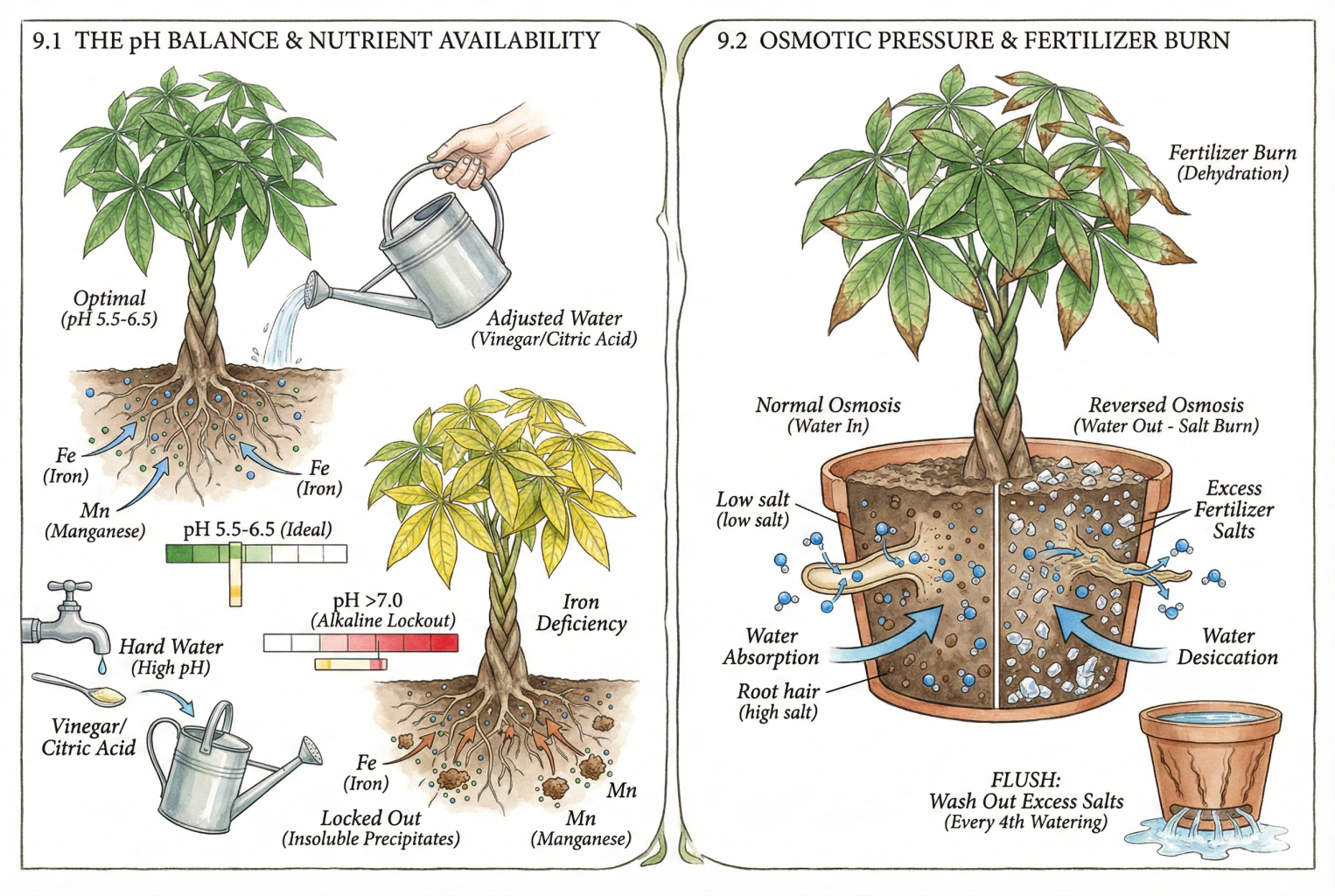
As pH rises, iron and manganese become less available. It is a gradual shift, not a hard cutoff at pH 7.0.
Correct pH by Measurement
Acidifying water can help if alkalinity is high, but do it by measurement, not by a fixed recipe. Adding acid needs your water’s alkalinity, volume, and a measured target pH. An unspecified vinegar dose is unpredictable and can overshoot, so test and adjust rather than dosing blindly.
9.2 Osmotic Pressure and Fertilizer Burn
Roots take up water largely by osmosis, which is driven by differences in water potential.
Normally the water potential in the soil solution is higher than inside the root, so water moves inward.
Over-Fertilizing
If the soil solution becomes too concentrated with salts from excess fertilizer, its water potential drops and can approach or fall below that of the root.
Water uptake is hindered, and in extreme cases water can move out of the root, which is the mechanism behind fertilizer burn. This is about water potential, not reverse osmosis, which is a pressure-driven filtration process used to treat water.
Prevention
Periodically flushing the pot with plain water helps wash out accumulated salts. How often and how much depend on your feed strength, source-water EC, and any symptoms. A rigid every-fourth-watering or double-the-pot-volume rule is not universal and can overwater or leach nutrients, so use it as a guideline and adjust.
Affiliate Disclosure
This article contains Amazon affiliate links. As an Amazon Associate I earn from qualifying purchases. If you use these links, the site may earn a commission at no extra cost to you. Product availability, price, and specifications can change. Check the current listing before buying.