
Bloom Booster Myth: What High-Phosphorus Feeds Actually Do
Do high-phosphorus bloom boosters help? A 2025 Arabidopsis study suggests phosphorus permits flowering rather than driving it, and heavy dosing can push zinc and iron out of solution. Correct a measured deficiency, feed a balanced ratio, and check light and temperature.
Marcus Hale · Published 2025-12-23 · 26 min read

Key Takeaways
- There is little evidence that high-phosphorus bloom boosters increase flowering. A 2025 study in Arabidopsis found that low phosphorus can delay flowering, but it did not test whether feeding above sufficiency boosts blooms.
- Heavy phosphorus dosing can create problems. High concentrations can push zinc and iron out of solution and suppress mycorrhizal fungi, so diagnose with a tissue, media, or water test rather than assuming.
- Much high-phosphorus advice traces to cold-soil crop starter fertilizer. Warm room temperature alone does not guarantee an indoor plant has enough phosphorus because low inputs, wrong pH, poor roots, or leaching can still cause deficiency.
- Several orchid trials found no increase in flower count from high-phosphorus feeds. Those treatments also changed nitrogen and potassium, while light and temperature remain common indoor limits.
- Correct a measured deficiency, feed a balanced ratio matched to the plant, and check light and temperature. Dilution and flushing depend on species and conditions, so measure rather than follow a fixed recipe.
Introduction
Bloom booster fertilizers (high-middle-number formulas sold to force flowering) are a familiar sight on garden-center shelves.
The common sales pitch is that loading a plant with phosphorus produces more blooms. That claim is worth examining rather than taking on faith.
Some of this thinking is carried over from field agriculture, where a phosphorus-rich starter can help crops in cold spring soil.
Applied uncritically to warm, container-grown tropical plants and bioactive setups, unnecessary high-phosphorus feeding can do more harm than good.
Recent research adds useful detail. A 2025 study (published in Developmental Cell, led by researchers including Michigan State University) identified a molecular pathway in Arabidopsis, involving the protein bGLU25, that links low phosphorus to delayed flowering.
That work helps explain how a plant senses phosphorus. It does not, by itself, test commercial bloom boosters, so treat it as one line of evidence among several rather than a final verdict.
Part 1. Why Extra Phosphorus Does Not Force Blooms
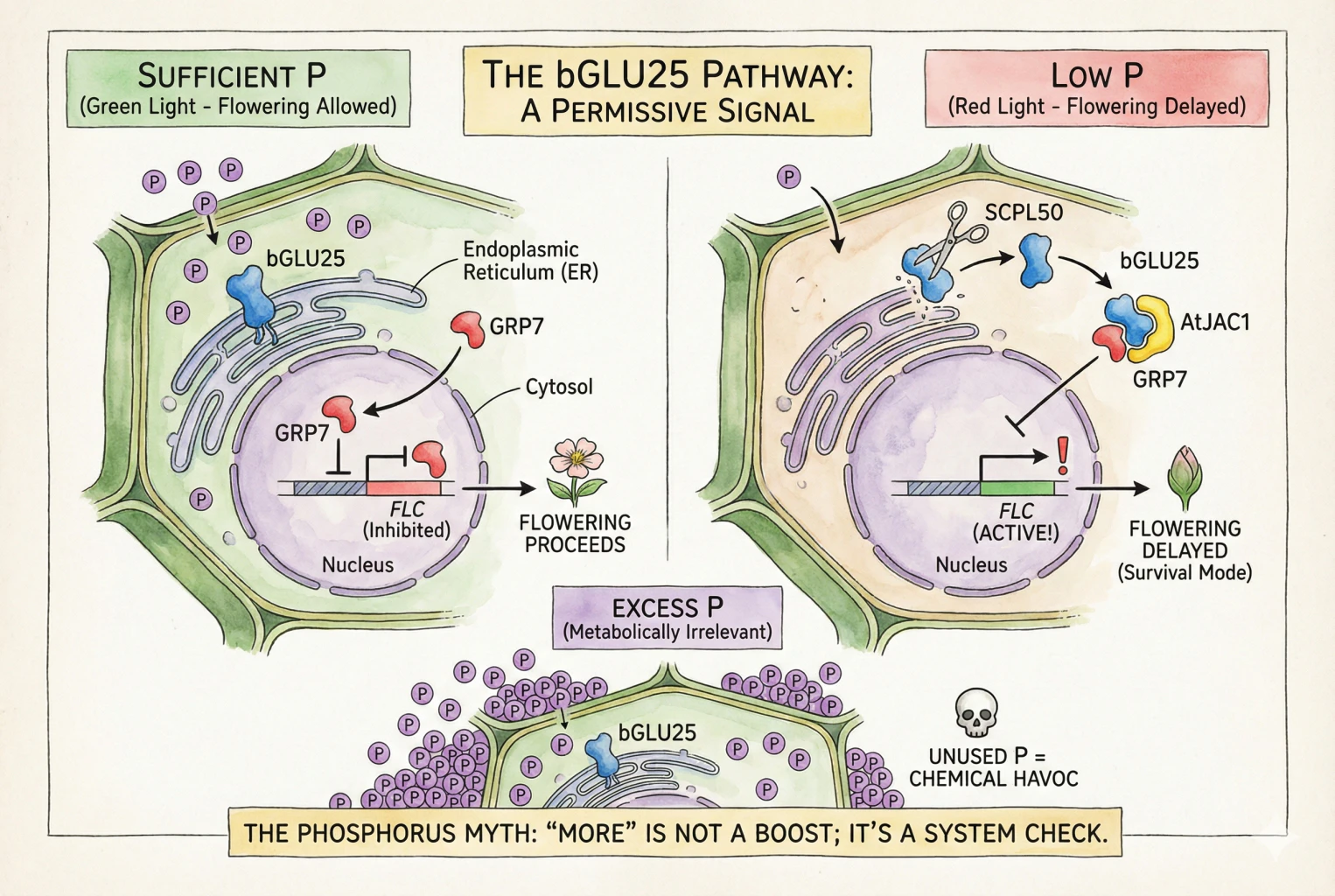
To weigh the case for and against high-phosphorus feeding, it helps to start with how a plant senses its own phosphorus status.
Plant nutrition has been studied experimentally for a long time. Uptake, deficiency symptoms, and dose responses are well documented.
What stayed unclear for many years was the precise molecular sensor.
Researchers have long observed that phosphorus-starved plants often delay flowering. That fits a general pattern. Reproduction is energy-expensive, so a plant short on resources may favor survival over setting seed.
The 2025 work described one such sensing mechanism in Arabidopsis through the bGLU25 pathway. It is best read as a phosphorus-timing signal rather than a stimulation dial.
1.1 The Mechanism of the Switch
The research, highlighted by the MSU Plant Resilience Institute, describes an intracellular signaling network in Arabidopsis that regulates flowering timing in response to phosphorus.
It is one input into flowering, alongside other pathways, not the sole gatekeeper for every plant.
This network relies on the movement of proteins between different compartments of the plant cell, specifically the Endoplasmic Reticulum (ER) and the Cytosol.
The key player is bGLU25 (Beta-Glucosidase 25). In the study's phosphorus-sufficient plants, bGLU25 largely stays put.
It resides within the Endoplasmic Reticulum, the cell's organelle responsible for protein folding and transport.
When phosphorus is sufficient, bGLU25 stays anchored in the ER, sequestered from the rest of the cell's machinery.
When the plant senses low phosphorus, it initiates a starvation response. In the study, this began once cellular phosphate dropped low enough to trigger the pathway.
1. Cleavage
A protease enzyme known as SCPL50 is activated. This enzyme acts like a pair of molecular scissors, cutting the bGLU25 protein loose from its anchor in the ER.
2. Migration
The liberated bGLU25 migrates out of the ER and enters the cytosol, the fluid matrix of the cell.
3. The Arrest
Once in the cytosol, bGLU25 binds to a scaffold protein called AtJAC1. Together they retain a third protein called GRP7, or Glycine-Rich Protein 7.
4. The Consequence
Under sufficient-phosphorus conditions, GRP7 travels to the cell nucleus, where it helps repress FLC, a gene that inhibits flowering. With FLC kept low, flowering can proceed subject to the plant's other cues.
5. The Blockade
When phosphorus is low, the bGLU25/AtJAC1 complex holds GRP7 in the cytosol, preventing it from entering the nucleus. FLC activity rises, and the plant delays flowering. This is a delay to conserve resources, not necessarily a complete halt.
1.2 Permissive vs. Stimulative Signals
This helps frame a common marketing claim. Bloom boosters are often sold as if phosphorus were a stimulative signal (the idea that adding more of it, like pressing a gas pedal, makes flowering faster and more intense).
The bGLU25 pathway instead behaves more like a permissive check for flowering timing. Think of a system-ready light on a dashboard.
Low Phosphorus
The check does not pass. The bGLU25 mechanism engages, GRP7 is held in the cytosol, FLC rises, and flowering is delayed.
Sufficient Phosphorus
The check passes. BGLU25 remains in the ER, GRP7 enters the nucleus, FLC is repressed, and flowering can proceed according to other cues such as light, temperature, and age.
Excess Phosphorus
Here the evidence runs out. The 2025 study compared low versus sufficient phosphorus. It did not test doses above sufficiency, so it cannot tell us whether extra phosphorus further tunes this pathway. There is simply no result to cite either way.
So the honest reading is narrower than more P can never help. For this timing pathway, once phosphorus is sufficient there is no measured evidence that more accelerates flowering, but that is not the same as proving extra phosphorus has no effect anywhere in the plant.
Phosphorus above a plant's needs is not a reliable way to force blooms, and heavy dosing carries its own risks in the substrate.
Phosphorus availability controls flowering time through subcellular reprogramming of bGLU25 and GRP7 in Arabidopsis
1.3 The Evolutionary Logic
Why might plants regulate flowering this way? In many soils phosphorus is a limiting nutrient. It binds to soil minerals (its availability depends on pH, mineralogy, organic matter, and microbes) and can become hard to take up.
Many plants are efficient at scavenging phosphorus and conservative in using it. A timing mechanism like bGLU25 fits that pattern, holding back flowering when phosphorus is too low to support setting seed.
The logical error in the bloom-booster pitch is running this backwards. If lack of P delays flowering, excess P does not necessarily create more flowers. Delaying flowering under scarcity does not imply that surplus phosphorus adds blooms.
Part 2. The Agricultural Hangover – Origins of the Myth
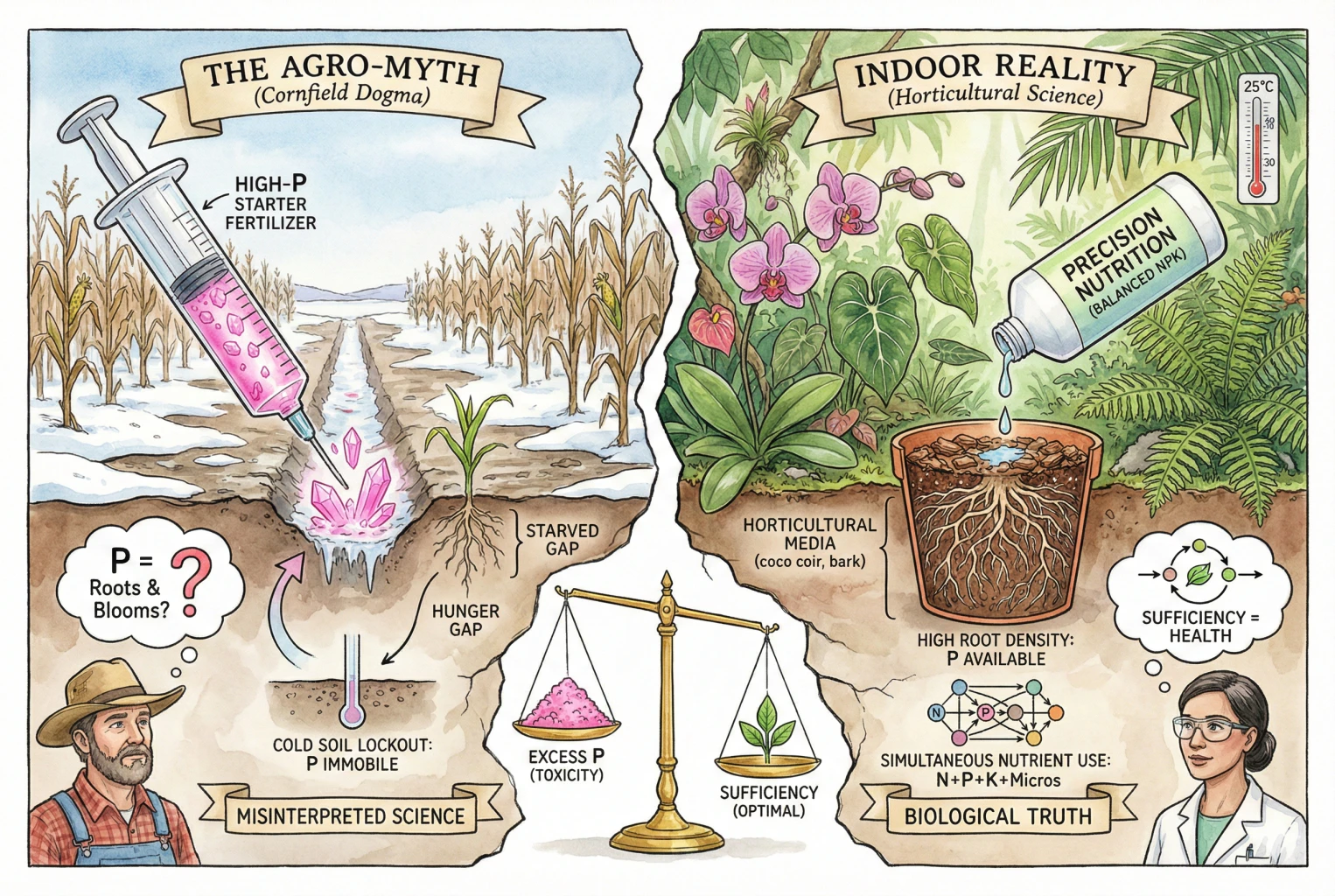
If high-P feeding rarely boosts flowering, why do garden centers still stock so many high-phosphorus products? Part of the answer is where the advice came from.
Much of the guidance aimed at indoor growers is borrowed from field agronomy and stripped of the conditions that made it useful, then applied to a very different environment.
2.1 The Starter Fertilizer Effect
A likely root of the high P for roots and blooms idea is crop starter fertilizer, used where seeds go into cold, wet spring soil.
The exact marketing history is not well documented, so treat the origin story as plausible rather than established.
Cold soil slows several things at once. Low temperatures reduce root growth and the microbial activity that mineralizes organic phosphorus into plant-available orthophosphate, and they slow how fast phosphate moves to the root.
Phosphorus is also relatively immobile in soil. Compared with nitrate, phosphate ions diffuse slowly, so a root largely has to grow into a phosphate ion to take it up.
Young seedlings have small root systems. In cold soil where phosphorus diffusion is slow, they can face a temporary shortfall (a hunger gap). A phosphorus-rich starter, placed near the developing roots, can help bridge it.
Placement matters and is not always in-furrow with the seed. Because high rates next to the seed risk salt or ammonia injury, growers often use a band offset from the seed (for example, a couple of inches to the side and below).
Whether a starter helps at all depends on soil test, rate, and placement.
2.2 The Context Mismatch
A field-crop, cold-soil result does not automatically transfer to a warm living room or vivarium.
Several conditions differ, but note that different is not the same as guaranteed sufficient.
Temperature
Indoor containers usually sit at room temperature (about 20–25 °C), so the cold-soil hunger gap is less likely. It is not ruled out, though. Low fertilizer input, high or low pH, poor root health, or leaching can still leave a warm plant short of phosphorus.
Substrate Chemistry
Horticultural media such as peat, coco coir, pine bark, and sphagnum differ chemically from mineral field soil, which can strongly fix phosphorus through iron, aluminum, and calcium minerals at certain pH values. Soilless media are not chemically identical to each other and do not guarantee phosphorus stays available. pH and fertilizer form still matter. Cation exchange capacity mainly describes how a medium holds cations and is not the direct measure of phosphate retention.
Root Density
Container root density can be high, which reduces the need for a concentrated fertilizer band. But whether nutrients are evenly available also depends on irrigation, drainage, and root health. Root-bound, waterlogged, or diseased roots do not explore the whole pot.
Confirm Phosphorus Need Before Feeding
Much of the time indoor plants are not phosphorus-limited, so a blanket high-P feed solves a problem many of them do not have.
Confirm the need with a symptom check and, ideally, a test rather than assuming.
2.3 The N-P-K Fallacy
The myth is further propagated by the simplified N-P-K narrative. N for leaves, P for flowers, K for roots. This is a gross oversimplification of plant physiology.
Plants require all nutrients simultaneously for all processes.
Nitrogen
Nitrogen drives vegetative biomass and is also a key building block of the proteins and amino acids needed to form a flower structure. Building a large orchid spike takes nitrogen.
Phosphorus
Phosphorus is essential for ATP, DNA and RNA, and phospholipids. Those functions support both leaf growth and flowering, not just flowers.
Potassium
Potassium regulates stomatal opening and enzyme activation, which support the photosynthesis that powers a bloom.
So remove nitrogen, load phosphorus to steer flowering oversimplifies. Reducing nitrogen can slow leaf production, but adding excess phosphorus does not fill that space with flowers.
Pushed too far, an unbalanced high-P feed can contribute to poor growth and salt buildup (how much depends on dose, drainage, and the medium).
Part 3. Too Much Phosphorus Can Cause Problems
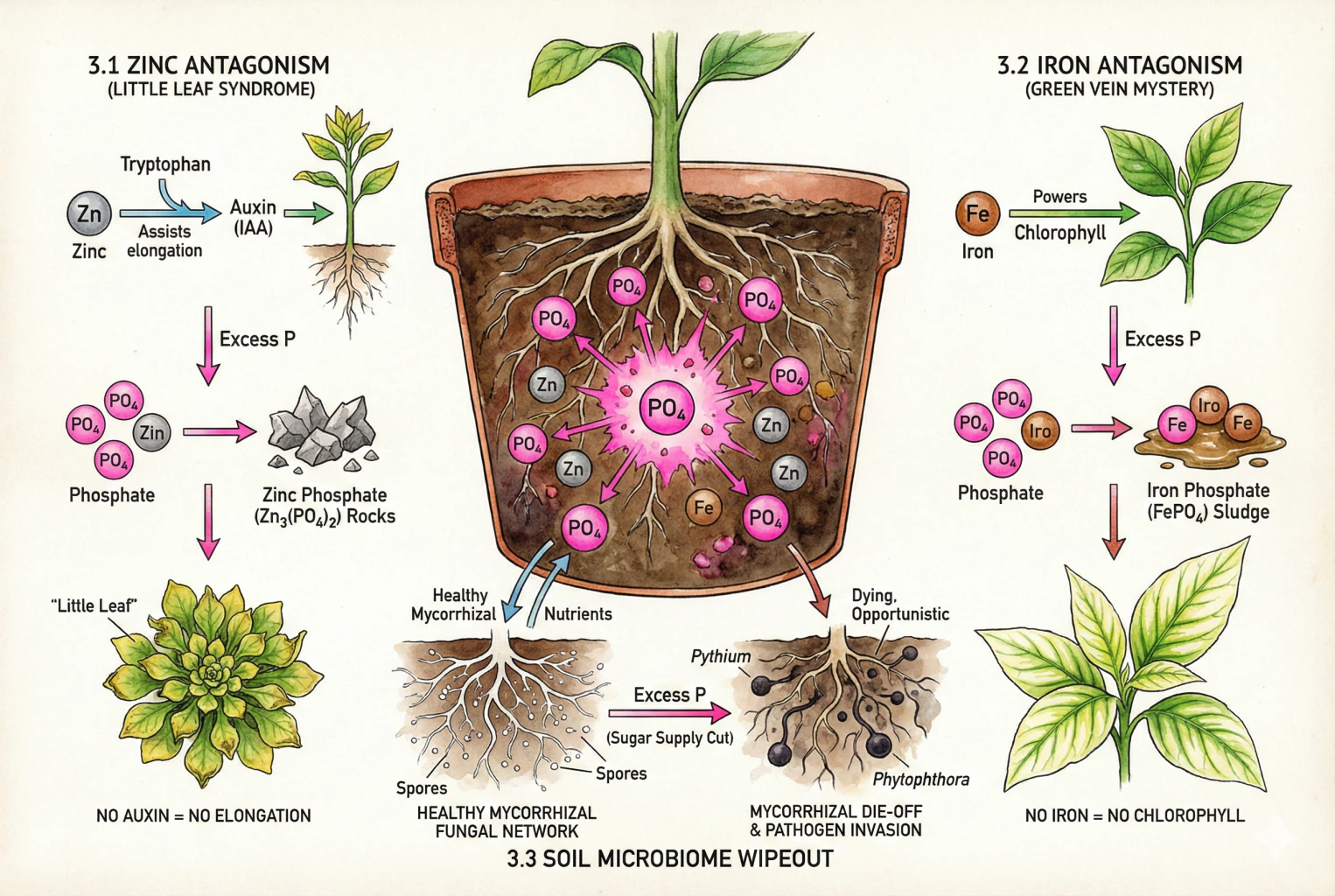
Even where a bloom booster does not help, heavy dosing is not automatically harmless. In the confined volume of a pot, and especially a vivarium, excess nutrients have fewer places to go.
Ions in solution interact. Adding a high concentration of phosphate anions (mainly H2PO4− and HPO42− at typical root-zone pH) can shift the chemistry around micronutrients such as zinc and iron.
Zinc and iron are the ones most often discussed here, though calcium, manganese, and copper, and the mycorrhizal symbiosis, can also be involved depending on conditions.
Recognize Nutrient Antagonism
Nutrient antagonism occurs when high levels of one nutrient reduce the availability or uptake of another. It is one reason a heavily fertilized plant can still show deficiency symptoms, though overwatering, root disease, and pH are other common causes to rule out first.
3.1 The Zinc Antagonism (Little Leaf Syndrome)
Zinc (Zn) is needed only in trace amounts, but it plays several roles. One of them is in the biosynthesis of the amino acid tryptophan, though zinc is not the single decisive cofactor and the link between zinc status and auxin metabolism is complex.
Tryptophan is a precursor for indole-3-acetic acid (IAA), the main auxin. Plants make IAA through several tryptophan-dependent routes and some tryptophan-independent ones, so this is not a single unbroken chain.
Auxin contributes to cell elongation, helping internodes stretch and leaf blades expand (its effect depends on concentration, tissue, and other hormones).
When a grower repeatedly over-applies a high-phosphorus fertilizer (for example a 10-52-10), a few processes can reduce zinc availability, though whether and how much they occur depends on pH, chelation, and the substrate.
Reduced Availability
Phosphate can react with free zinc to form poorly soluble zinc phosphate, and high phosphate can shift zinc into less available forms. Roots take up dissolved ions, so zinc tied up this way is harder to absorb. This is a possible pathway, not an inevitable reaction in every pot. The rhizosphere can also re-dissolve and chelate zinc.
Uptake and Transport Effects
High phosphorus is associated with reduced zinc uptake and root-to-shoot transport. The mechanisms involve availability and gene regulation. A simple physical blockage of the transporters is not well established.
Growth Dilution
If growth outpaces zinc supply, the existing zinc pool can be diluted across more tissue, lowering its concentration. Whether phosphorus itself drove that growth would need treatment-by-treatment data.
Possible Zinc-Deficiency Symptoms
Zinc deficiency can reduce auxin activity and elongation, though not to zero. Several biosynthetic and signaling routes remain.
Severe zinc deficiency is associated with little-leaf or rosette patterns.
- New leaves emerge smaller than earlier growth.
- Internodes stay short, so leaves bunch into a tight cluster (rosette).
- New growth may show interveinal chlorosis (yellowing) and distortion.
These signs are not specific to zinc or to high phosphorus. PH, root rot, salt injury, pests, light, and other nutrients can produce similar-looking symptoms, and cultivars vary.
In orchids, small stalled leaves are often caused by root loss, dehydration, or heat and light rather than a nutrient lock-out.
The failure mode to avoid is treating any small-leaf symptom as hunger and adding still more bloom booster without a diagnosis.
If a tissue, media, or water test points to a zinc or phosphorus issue, address that specifically instead of dosing blindly.
3.2 The Iron Antagonism (The Green Vein Mystery)
Iron (Fe) can be affected in a similar way. Iron is needed for chlorophyll synthesis and for electron transport. It is required for making chlorophyll rather than being an atom within the chlorophyll molecule itself.
Iron can react with phosphate to form iron phosphate (FePO4), but whether this happens depends on iron form, redox state, pH, chelation, and concentration. It is not an instant reaction in every pot.
Ferric phosphate is poorly soluble. It is used as the active ingredient in slug and snail baits, but as an ingested molluscicide that damages the pests' digestive tissue, where the label dose is what matters.
Low solubility is not the reason it works, and it is not a blanket pet-safe guarantee. Large amounts can still harm pets, so follow the product label.
Where iron does precipitate or shift to unavailable forms, less iron reaches the plant.
Possible Iron-Deficiency Symptoms
Iron is fairly immobile within the plant, so deficiency usually shows first on the newest growth (with species and severity exceptions).
- Interveinal chlorosis. The leaf blade turns pale yellow or white while the veins stay green.
- In severe cases, new leaves can emerge bleached and necrotic.
These signs also fit high pH, root dysfunction, salt burn, or sun injury, so confirm the cause before treating.
Iron chelates can be an effective fix where the real problem is availability or pH.
If the underlying issue really is excess phosphorus, adding more iron without correcting that may give limited benefit.
But not all chelated iron promptly turns into FePO4 (chelate stability, pH, and iron form all matter).
The right first step is to diagnose, then flush confirmed soluble-salt buildup and correct pH as needed.
3.3 The Soil Microbiome Wipeout
Bioactive vivariums lean on a soil food web that includes beneficial bacteria and, for many plants, mycorrhizal fungi.
These fungi form symbioses with plant roots, extending their reach into the substrate and trading scavenged phosphorus for plant carbon (sugars).
Exactly how much they extend absorptive reach varies by species and conditions, so avoid fixed multipliers.
Maintaining a fungal partner costs the plant carbon. Nutrient signaling reflects this trade-off. It is a physiological response, not a conscious calculation.
When soluble phosphorus is abundant, arbuscular-mycorrhizal signaling and colonization can decline, but this depends on the host, the fungus, nitrogen status, dose, and duration.
Reduced colonization is not the same as wiping the fungi out. It does not mean every colony dies or that the root zone becomes sterile. Non-mycorrhizal fungi and bacteria remain present.
- Loss of some benefits Established mycorrhizae can aid water uptake and stress tolerance, so reduced colonization may weaken those benefits. The size of the effect varies with the plant, fungus, and environment.
- Disease risk. Water molds such as Pythium and Phytophthora are driven mainly by inoculum, waterlogging, temperature, sanitation, and susceptible hosts. There is no good evidence that high phosphorus alone creates a sterile vacuum that these pathogens then invade, so do not treat that as a proven chain.
Use Restraint in Bioactive Systems
In a bioactive tank you generally want to avoid dumping in soluble fertilizer you do not need, because it can disturb the microbial balance.
That is a reason for restraint and testing, not evidence of a system-wide collapse.
Interactions Between Phosphorus, Zinc, and Iron Homeostasis in Nonmycorrhizal and Mycorrhizal Plants
Part 4. Case Studies – The Reality in the Pot
Chemistry alone is not proof, so it helps to look at trials on real plants. Orchid studies are useful here, with one important caveat. Several of them changed more than one nutrient at once, so they test whole fertilizer regimes rather than phosphorus in isolation.
4.1 The Phalaenopsis Trials
The moth orchid (Phalaenopsis) is a mainstay of the indoor-plant trade and a frequent target of bloom-booster marketing.
Work by Dr. Yin-Tung Wang and colleagues tested different fertilizer regimes on hybrid Phalaenopsis and measured date of spiking (stalk appears), date of anthesis (flower opens), flower count, and flower size.
Read the Treatments Before the Results
In Wang's 2000 study the control supplied roughly 100/44/83 mg L−1 of N/P/K, while the high-P treatment supplied about 30/398/506 mg L−1. That is, it also cut nitrogen sharply and raised potassium, not just phosphorus.
So any difference reflects the whole regime, not phosphorus alone.
The findings
- No earlier flowering. The high-P treatment did not make plants spike or open sooner than the control. Feeding more phosphorus did not speed things up in this trial.
- Fewer flowers on the high-P regime. Those plants averaged about 15–19 flowers versus about 24 in the control. Because nitrogen was much lower in that treatment, this cannot be pinned on phosphorus by itself.
- Nitrogen mattered. The authors concluded that maintaining adequate nitrogen was important for flowering performance. A low-N, high-P regime left the plant short of the nitrogen needed to build large inflorescences. (A label like 10-30-20 does not by itself tell you the applied nitrogen in ppm.)
Phosphorus still matters, but starving a plant of nitrogen to chase it is counterproductive.
Nitrogen builds flower structure, potassium supports the water pressure to open flowers, and phosphorus is needed in smaller but real amounts for energy and nucleic acids.
4.2 Dendrobium and the NPK Balance
A 2008 factorial study on a nobile-type Dendrobium hybrid tested phosphorus at 0, 25, 50, 100, and 200 mg L−1.
Zero phosphorus delayed flowering, but 25 mg L−1 and above all gave about the same flower count (around 29), so beyond a modest level, more phosphorus added no benefit.
The authors recommended roughly 100N/25P/100K mg L−1 for that hybrid.
That study did not report that high phosphorus caused trace-element problems, so no such claim should be drawn from it.
And because it used one hybrid, its exact ratio should not be generalized to every Dendrobium.
A recurring theme is that phosphorus is often not the limiting factor for indoor flowering.
Light (daily light integral) and the carbohydrate reserves it builds are common limits, but not the only ones.
Temperature matters too. Phalaenopsis flower initiation is strongly influenced by cooler day temperatures, and nobile Dendrobium needs a cool-temperature cue.
Photoperiod, maturity, genotype, and water status also play a part, so sufficient light alone does not guarantee blooming, and low light cannot be substituted for with phosphorus.
Part 5. The Vivarium Danger – Closed Loop Toxicity
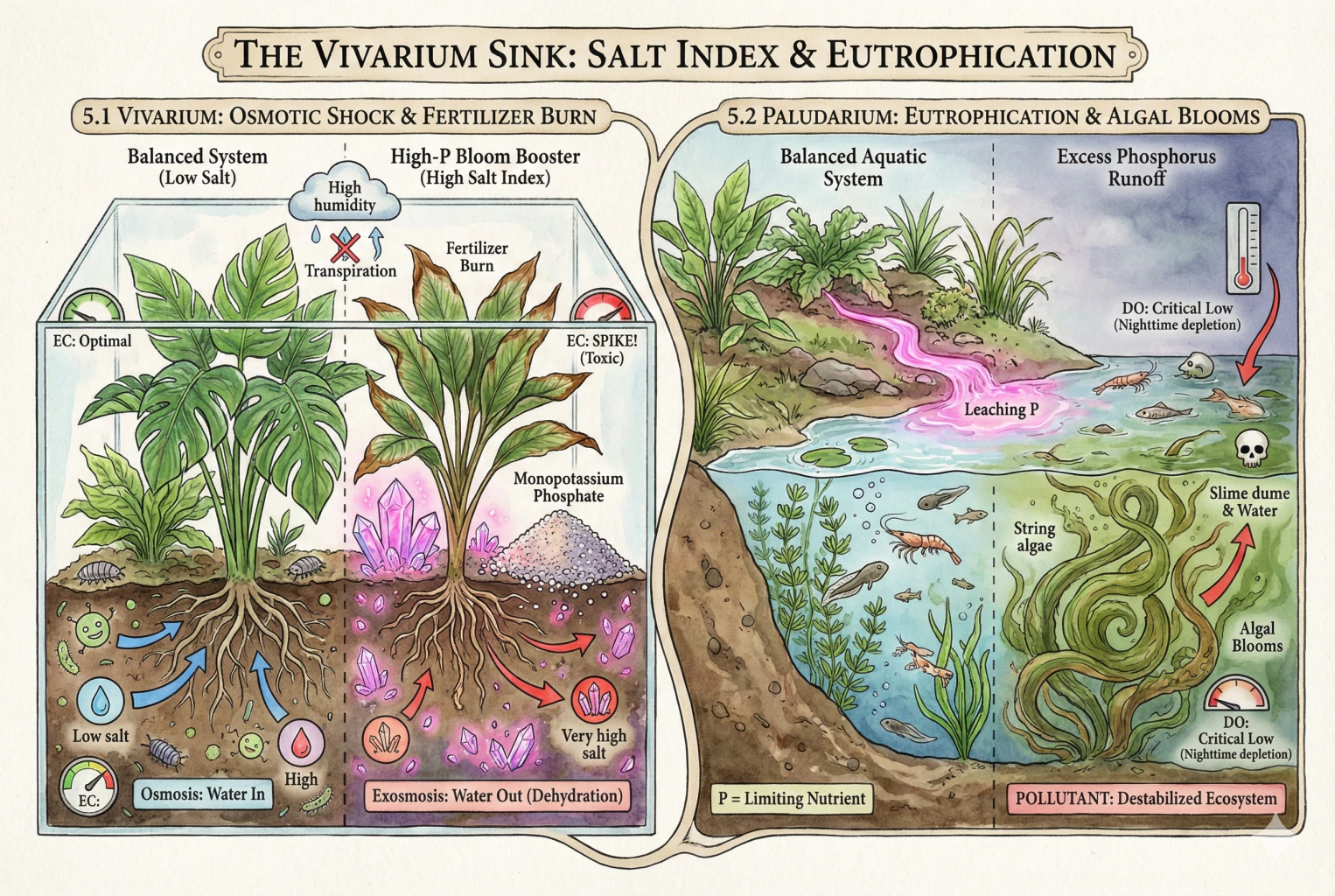
Enclosures deserve extra caution, especially where plants share the system with animals. In a potted plant on a saucer you can flush excess salts away. A closed vivarium has fewer outlets, so nutrients can accumulate.
That said, not every enclosure is truly closed. Sealed, drained, plumbed, filtered, or regularly water-changed systems behave differently, so what goes in stays in is an approximation for fully closed setups only.
5.1 Salt Buildup and Osmotic Stress
Fertilizers are salts. Dissolved in water they dissociate into ions (for example K+, NO3−, and phosphate as H2PO4−/HPO42− at typical pH), raising the electrical conductivity (EC) of the substrate water.
The risk here is the total dissolved-salt concentration, not the identity of any one source.
It is worth correcting a common myth. Monopotassium phosphate (MKP) actually has a low salt index per unit of nutrient (about 0.097 in the University of Minnesota table, far below potassium chloride at 1.936 or ammonium sulfate at 3.252).
Any concentrated soluble fertilizer applied heavily can push EC too high. That is a dose-and-concentration problem, not something specific to MKP.
- Water moves toward higher salt. If the substrate solution becomes saltier than the root cells, water tends to move out of the roots rather than in.
- Fertilizer burn. The plant can dehydrate even in wet substrate, with browning leaf tips. Severity depends on EC, the ions involved, species, and moisture. High humidity can lower transpiration, which may slow recovery in some cases, though this varies by plant.
5.2 Eutrophication in Paludariums
In a paludarium, if the land's drainage layer connects to the water feature, phosphorus leaching from the land can enter the water column.
Check whether your build actually has that connection before assuming.
Phosphorus is frequently a limiting nutrient in fresh water, so adding it can promote algae, but it is not the sole trigger.
Light, temperature, flow, mixing, nutrient ratios, and the species present all interact (per the EPA and USGS), so outcomes are not deterministic.
- Algae growth. Higher phosphate can encourage string algae, green water, or cyanobacteria (often called slime algae, though these are bacteria, not the same organisms as green string algae). How much depends on the system.
- Oxygen swings. Algae and plants respire at night, and decomposition of dying algae also consumes oxygen. In a small water feature this can lower dissolved oxygen enough to stress or kill shrimp, tadpoles, or fish (the risk rises with biomass, temperature, and poor aeration).
Aquatic-Safety Gate Before Fertilizing
Check whether the land drains into the water, use products labeled safe for aquatic life (or keep dosing isolated to the land and away from the water), test water phosphate, ammonia, and dissolved oxygen, and keep an emergency water change and aeration on hand.
Terrestrial cleanup crews (isopods, springtails) process leaf litter. They do not regulate dissolved phosphate, algae, or oxygen in the water column, so do not rely on them for aquatic balance.
Given these unknowns, no fertilizer is a blanket recommendation for tanks holding shrimp, tadpoles, or fish.
Part 6. DIY Amendments – Banana Peels and Eggshells
Wary of synthetic fertilizers, many hobbyists turn to DIY amendments such as banana peels and eggshells.
These are worth a closer look, since their composition is often unknown and results are hard to predict.
6.1 Banana Peel Tea
A common tip is to soak banana peels in water for a potassium-rich fertilizer.
- What's in it. Banana peels contain potassium (K) along with sugars and cellulose. The exact amounts extracted by a home soak are unknown.
- Why to be cautious. A soak of unknown concentration and microbial load is hard to recommend. Added sugars can feed microbes, which in some conditions could lower oxygen in the root zone or attract fungus gnats and fruit flies. These are plausible risks rather than guaranteed outcomes, since they depend on dose, fermentation, and the medium.
- Better use. Banana peels are well suited to a hot compost pile or a worm bin, where they break down and their nutrients become available in a more controlled way.
6.2 The Eggshell Reality Check
Eggshells are often suggested as a calcium source and pH buffer.
- The chemistry. Eggshell is mostly calcium carbonate (CaCO3), broadly like agricultural lime or chalk, though with an organic matrix and not identical in fineness or reactivity to ground lime.
- Solubility. Calcium carbonate dissolves slowly and needs acidity to break down, and how fast depends on particle size and pH. Note that many potting mixes based on peat or bark are acidic rather than neutral, so most mixes are pH 7 is not accurate. Finely ground shell can raise pH, which can harm acid-loving plants.
- Timeline. As a slow liming agent and calcium source, powdered shell takes months to become available. It will not quickly fix blossom-end rot, and that disorder is usually a calcium-transport (often water-related) problem rather than a soil-calcium shortage.
- Where it fits. Finely ground eggshell can be a reasonable long-term calcium source in some terrariums (isopods use it), provided it suits your plants' pH target and you watch dose and sanitation. It is not an immediate fertilizer.
Part 7. The Solution – The 3-1-2 Ratio and Sufficiency
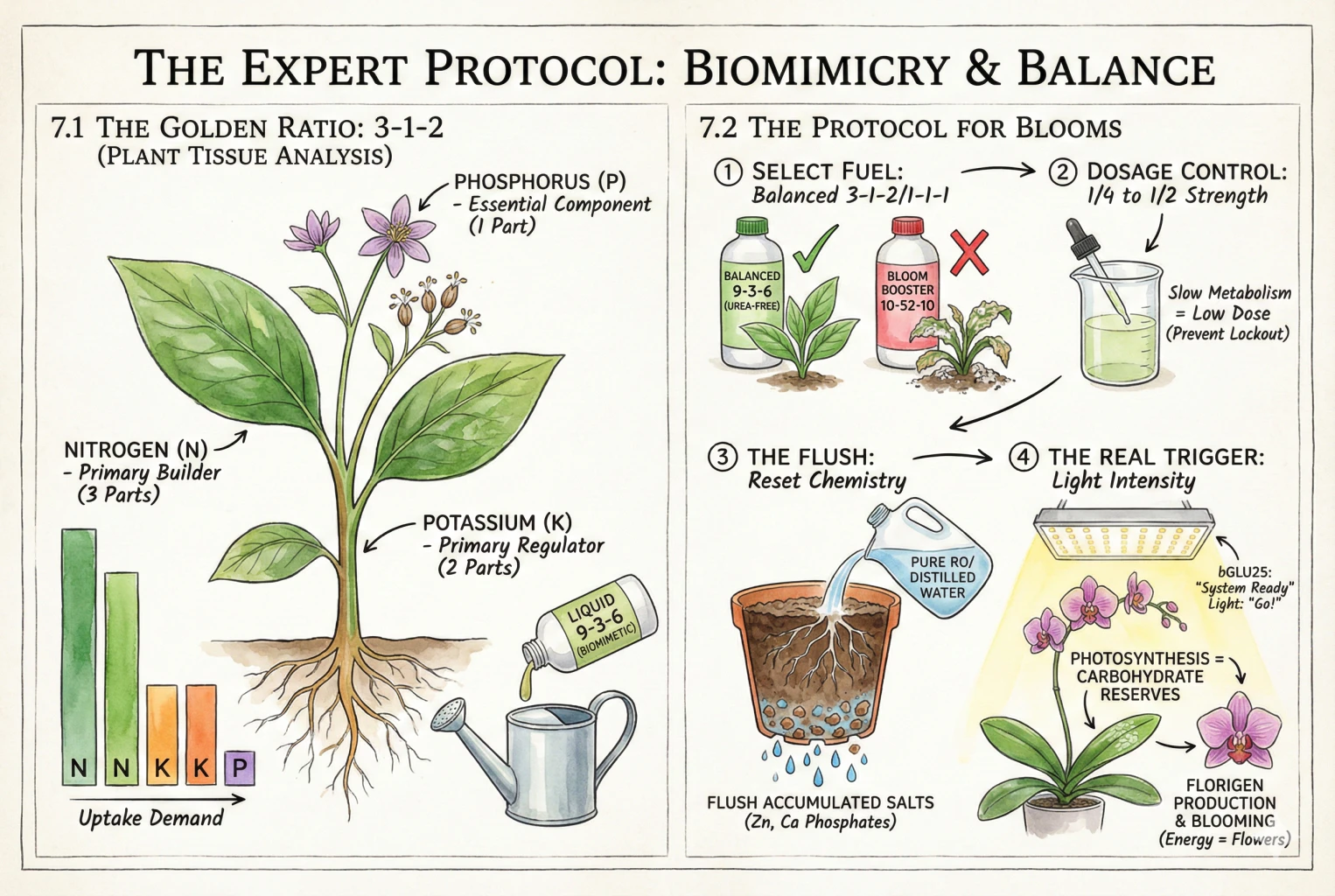
If bloom boosters usually don't help and DIY teas are unreliable, what is a sensible default?
A balanced feed matched to the plant, plus attention to light and temperature, with a test rather than a fixed recipe when things go wrong.
7.1 A Balanced Ratio (Roughly 3-1-2)
Analyses of plant tissue often show nitrogen, phosphorus, and potassium in a rough ballpark of 3 parts N, 1 part P, 2 parts K for many foliage plants.
This is a useful heuristic, not a universal law. Tissue ratios vary by species, plant part, growth stage, and environment.
A rough 3-1-2 (or 3-1-3) is a reasonable starting point for many general-purpose feeds, but it is a default to adjust, not a fixed prescription.
- Nitrogen. A major structural nutrient.
- Potassium. Important for osmoregulation and enzyme activation.
- Phosphorus. Essential, and typically needed in smaller amounts than N and K in many tissues.
One clarification about labels. The three numbers are percentages of N, P2O5, and K2O by weight, not elemental N–P–K. Converting to elements, a 9-3-6 works out to roughly 9–1.3–5, so it does not literally mirror an elemental 3/1/2 tissue ratio, but it does avoid the middle-number-heavy shape of a bloom booster, which is the practical point.
No fertilizer ratio, by itself, prevents salt buildup. Accumulation depends on total concentration, feeding frequency, uptake, water alkalinity and EC, and how well you leach and drain.
A balanced complete feed used at a sensible rate simply makes buildup less likely.
A balanced complete liquid feed
A complete liquid fertilizer labeled for the plant and growing method can provide nitrogen, phosphorus, potassium, calcium, magnesium, and micronutrients for maintenance.
No single N-P-K ratio guarantees blooms, and no complete feed is immune to salt buildup or micronutrient imbalance. Outcomes still depend on the applied nutrient amounts, water, substrate, and drainage.
Use the label rate for your application and compare applied nitrogen in ppm. A dilution copied from another concentrate may deliver a different dose.
In systems with animals or water features, check aquatic-life compatibility first.
7.2 The Protocol for Blooms
A practical way to think about blooms is to work through the plant's needs in order, rather than reaching first for a fertilizer.
- Start with the plant and its cues. Identify the species or hybrid and whether it is mature enough to flower, then check its flowering cues, for many orchids that means temperature and photoperiod, not just feeding.
- Check light. Measure or estimate light (PPFD/daily light integral) against what the plant needs. Adequate light and the carbohydrate reserves it builds are common limits on flowering.
- Check roots and water. Healthy roots and appropriate watering come before nutrient tweaks. Root loss and dehydration mimic hunger.
- Then look at nutrients. If symptoms or a tissue, media, or water test point to a deficiency, correct it. A balanced liquid feed with a ratio near 3-1-2 is a good default. Avoid formulas where the middle number is highest unless you have a specific reason. Urea-free fertilizer can suit some orchids, but it is not a strict requirement. Phalaenopsis can take up urea directly, so weigh the nitrogen source, nitrogen concentration, and your growing conditions rather than following a blanket label rule.
- Dose to your plant, not a blanket fraction. Label rates differ by product and use (maintenance, production, foliar, hydroponic). Match applied nitrogen in ppm and watch substrate EC instead of defaulting to a fixed quarter to half strength.
- Flush based on evidence, not the calendar. If leachate EC, a salt crust, or symptoms show buildup, leach with several pot volumes of clean water (or repot in severe cases). A small routine runoff will not remove poorly soluble precipitates, and confirmed salt injury needs a real remedial flush. If you use RO or distilled water, remember it has little calcium, magnesium, or alkalinity, so keep up a complete feed and pH management, and make sure runoff does not drain into an animal water feature.
Where low light is the real limit, a grow light will do more for flowering than any fertilizer.
Where the limit is temperature cue, maturity, or a genuine deficiency, a light alone will not fix it, so diagnose before you buy.
I inspect growing points with a loupe and photograph any swelling before changing fertilizer. A bud that was already initiated can open after a new product is applied, making the product look like the trigger even though the developmental decision came earlier.
The photo log also captures light duration, night temperature, plant maturity, and the last several feedings. When blooms appear, I can then check the whole induction window instead of crediting the most recent high-phosphorus bottle.
Full-spectrum LED grow bars
Full-spectrum LED strip lights can be a useful shelf light for flowering.
Be wary of a wattage-equivalent figure, which is a marketing number, not a plant-lighting spec. If a fixture does not give PPFD at a working distance or the resulting daily light integral, you cannot tell from it alone whether it will flower a given plant. Use the general grow-light guide to compare measured PPFD and DLI, then check coverage and mounting distance for your setup.
In a humid or planted enclosure, safety comes first. Check the fixture's wet-location rating, use a GFCI/RCD outlet, add a drip loop, protect against condensation, mount it securely, and account for heat and the animals' day/night cycle.
Why Balanced Feed Beats Bloom Boosters
What the Evidence Supports
There is little evidence that high-phosphorus bloom boosters increase flowering.
The 2025 bGLU25 work in Arabidopsis supports the idea that phosphorus permits flowering timing rather than driving it, and orchid trials show no benefit from high-P regimes. Those trials also varied nitrogen and potassium, so read them as evidence about whole feeds, not phosphorus in isolation.
Feeding phosphorus above a plant's needs is an unreliable way to force blooms, and at high doses it can create real problems by shifting zinc and iron toward less available forms, suppressing mycorrhizal colonization, and raising salt levels that stress roots.
How much of this happens depends on dose, pH, substrate, and the system, so diagnose rather than assume.
For most indoor and vivarium plants, a balanced complete feed at a sensible rate is a better default than a middle-number-heavy booster. Skip the more is better pitch.
Use a Balanced Blooming Strategy
Correct a measured deficiency, feed a balanced ratio matched to the plant, and check the cues that actually gate flowering (light, temperature, maturity, and root and water health).
If a plant won't bloom, work through those before reaching for a bottle. And in any enclosure that holds animals or water, put safety and testing ahead of adding fertilizer at all.