
Snake Plant Flower Sap: Why It Drips Sticky Nectar
If the sticky droplets are coming from a flower stalk, they’re most likely floral nectar rather than sap, but sticky film on leaves or the floor can also be pest honeydew. Here’s what the 2025 Dracaena trifasciata study actually found, and how to tell the two apart.
Jordan Cole · Published 2026-01-02 · 25 min read

Key Takeaways
- Check where the liquid comes from because droplets on a flower stalk are most likely floral nectar, while sticky film on leaves or the floor without a flower is more often pest honeydew.
- Nectar becomes thicker as water evaporates and the remaining sugars concentrate, so day-old or accumulated droplets are stickier than fresh secretion.
- A bloom mostly signals reproductive maturity rather than plant health because both healthy and stressed snake plants can flower.
- Indoor flowers usually do not set fruit because the flowers are self-compatible but cannot self-pollinate without a pollinator or hand-pollination.
- Cutting the stalk is optional cleanup that stops future drips from that stalk, but it does not remove the saponins in the leaves and rhizomes.
The Identity Crisis and the Weeping Plant
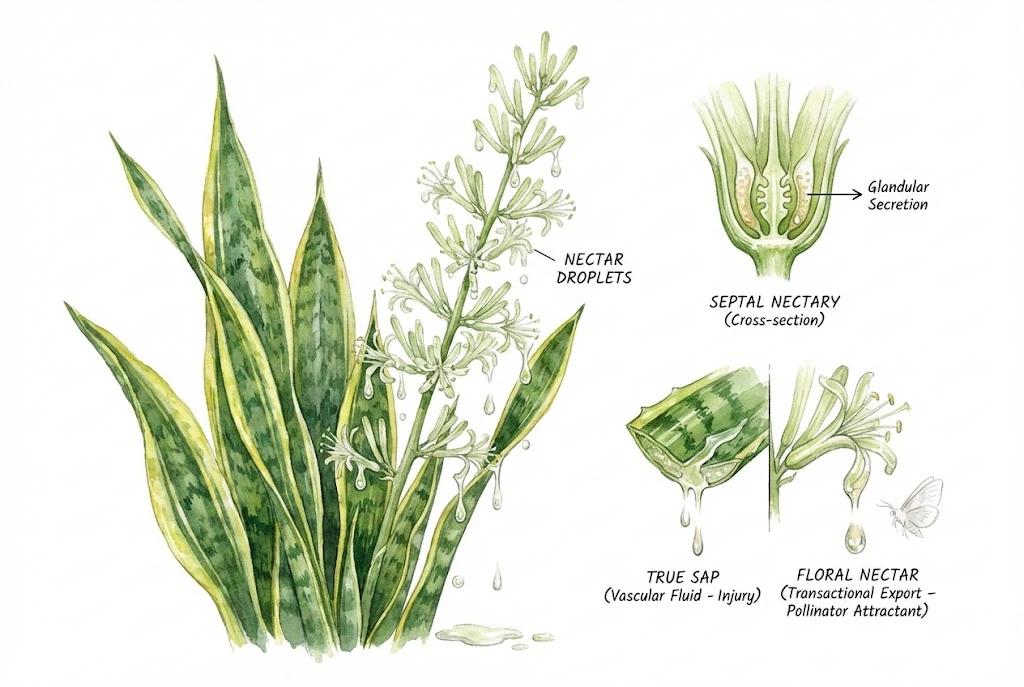
If your snake plant has sprouted a tall stalk and it is dripping sticky liquid, the first step is to find out where the liquid is actually coming from.
I place clean white cards beneath the inflorescence and beneath ordinary leaves overnight, keeping them away from pets. Flower nectar should map below flowers, while scattered droplets under foliage send me back to a pest inspection.
Before wiping anything, I photograph the source. Sticky residue alone cannot distinguish nectar, guttation, and honeydew once it has fallen onto a shelf.
The sequence records emergence, opening, scent period, droplets, and fading without a fertilizer change to chase the bloom. It becomes a reference if the same plant flowers again under different seasonal conditions.
Check the Source First
If the droplets are on and below an open flower stalk, they are most likely floral nectar, a normal secretion rather than a sign of illness.
But if there is no flower and you are finding a sticky film on the leaves, at the leaf axils, or on the floor under the foliage, that is more likely honeydew, the sugary waste excreted by sap-sucking pests such as scale, mealybugs, or aphids.
Turn a few leaves over and look for small brown bumps, cottony white masses, or clustered insects. If you find them, treat this as a pest problem by isolating the plant and using a species-appropriate control, not as a flowering event.
The flower-stalk diagnosis depends on what nectar is, why the plant makes it, and which claims are supported by the 2025 study of this species’ floral biology by Primo et al. Broader ecological explanations remain separate from what that study directly measured.
A Quick Note on Names
Dracaena trifasciata is the accepted botanical name. Many people still call it Sansevieria trifasciata, which current botanical databases such as Kew’s Plants of the World Online treat as a synonym. Both names refer to the same plant.
1.1 The Sap Misconception (Vascular Fluid vs. Glandular Secretion)
In botanical terms, sap refers to the fluid transported in the xylem (water and minerals from roots) or phloem (sugars and photosynthates from leaves). Sap circulates inside the plant. When you see sap outside the plant it can mean a wound or feeding damage, but plants also release fluids in normal ways (guttation droplets at leaf tips, exudate at a fresh cut, and glandular secretions like nectar). Fluid on the outside is not automatically a sign of injury.
What drips from the Dracaena flower is a different kind of fluid. Nectar is a glandular secretion produced by nectary tissue. In lilioid monocots like this one, the nectaries are typically septal nectaries, located in the partitions or septa of the ovary. Nectar is made to be given away to a visitor, so losing it is not a wound. It is the flower doing its job.
Sap stays inside
Sap is part of the plant’s internal transport system. If it is genuinely leaking from damaged tissue, that points to an injury or feeding damage that the plant has to seal.
Nectar is meant to leave
Nectar is the opposite. The plant produces it specifically to be taken by a pollinator. The plant spends energy making it, and that reward is thought to help attract the animals that move pollen between flowers.
This distinction matters for diagnosis. A sticky film spreading across leaves is usually not the leaf leaking sap. Sap-sucking insects feed inside the plant and excrete the excess sugar as honeydew, which then coats the leaf surface. Droplets pooling at an open flower, by contrast, are nectar.
Recognizing which one you have turns a puzzling mess into a straightforward question. Is there a flower, or a pest?
2. What Flowering Means
Much of what people said about this plant’s flowers used to be inferred from its appearance or from related species. It opens at night, it smells sweet, so moths were assumed to be involved.
Some earlier work does exist, for example, a 1986 survey of Sansevieria nectar sugars, but a detailed account of this species’ nectar dynamics and breeding system was not available until recently.
A 2025 study titled Floral biology, nectar dynamics and reproductive system of the phalaenophilous species Dracaena trifasciata (Asparagaceae) by Primo et al. in the Brazilian Journal of Botany provides that fuller account. It is the main source for the flower biology described below.
Measured results from the study are separated from broader ecological interpretations. The latter explain possible mechanisms but are not findings from this experiment.
Floral biology, nectar dynamics and reproductive system of the phalaenophilous species Dracaena trifasciata (Asparagaceae)
2.1 The Phalaenophily Syndrome
The researchers reported that D. trifasciata shows a suite of traits strongly compatible with phalaenophily, the pollination syndrome associated with small, settling moths, while also sharing some features with sphingophily (hawkmoth pollination).
A pollination syndrome is a match of floral traits to a likely pollinator group. It is a hypothesis about who visits, not a record of the insects actually seen at the flowers.
The idea behind a syndrome is that plants cannot move to find mates, so a set of floral signals and rewards tends to fit certain animals better than others.
The traits below are what the study describes. The pollinator each trait may fit is an inference, not a direct observation from this study.
Nocturnal Anthesis
The flowers open exclusively at night, matching the circadian rhythm of nocturnal Lepidoptera.
Visual Signal
The tepals are white to greenish-white. Pale, night-opening flowers are a common feature of moth-pollinated plants, and the usual interpretation is that a light color stands out better against dark foliage in low light than a saturated hue would.
The exact reflectance of this species’ flowers was not measured here.
Olfactory Signal
The flowers give off a noticeable scent at night. Night scent is another moth-pollination trait, and in many moth-pollinated plants the scent plume is thought to help insects locate flowers from a distance and fly upwind toward them.
How far this particular plant’s scent carries, and which insects respond, was not quantified in this study.
Flower Shape
The floral tube is short. Flower shape can influence which insects can reach the nectar.
In flowers with very deep tubes, only long-tongued visitors (such as some hawkmoths) can reach the reward at the bottom.
A short tube is easier to access, so it is generally compatible with a wider range of moths, including shorter-tongued settling moths that land on the flower to feed rather than hovering.
This is a reasonable inference from shape. It does not tell us which insects actually visit a given plant, which would require watching the flowers.
2.2 Nectar Dynamics (Continuous Reward)
One of the useful findings of the Primo et al. (2025) study is how the nectar is produced over time. Rather than appearing in a single burst, nectar accumulates and persists at the flower.
Continuous Secretion
The study describes continuous secretion. Nectar accumulates at the base of the floral tube and persists through the night, rather than being released as a single batch at dusk. Whether nectar is also reabsorbed and how much evaporates are separate processes that would need their own measurements, so they should not be read into this finding.
Why this might help
A plausible reading is that continuous secretion keeps the flower rewarding for a visitor arriving at any point during the night, rather than only just after dusk. Whether a moth comes early or late, there is nectar available.
Keeping a reward topped up all night is not free (it costs the plant energy) and the usual argument is that it improves the odds of pollination where visits are infrequent.
That is an ecological interpretation of the pattern, not something the study tested directly.
The Response to Removal
The study also repeatedly removed nectar to imitate a pollinator feeding, and measured how the plant responded.
Compared with flowers left alone, flowers that had nectar removed repeatedly produced slightly less nectar overall (a reduction of roughly 16%). It is a modest difference.
Interpretation
In some plants, taking nectar prompts the flower to refill and even over-produce. That did not happen here. Removal produced slightly less, not more.
A small reduction does not prove that each flower runs on a strict budget or that the plant detects pollination. Those are interpretations, not measurements.
This species does not appear to ramp up production after visits.
Practically, this is also why an unvisited flower can keep a standing pool of nectar. Left long enough, that pool can build up and drip, creating the weeping effect people notice. The study did not measure how much a houseplant drips onto a floor, so treat the amount as anecdotal.
2.3 Reproductive Systems and Compatibility
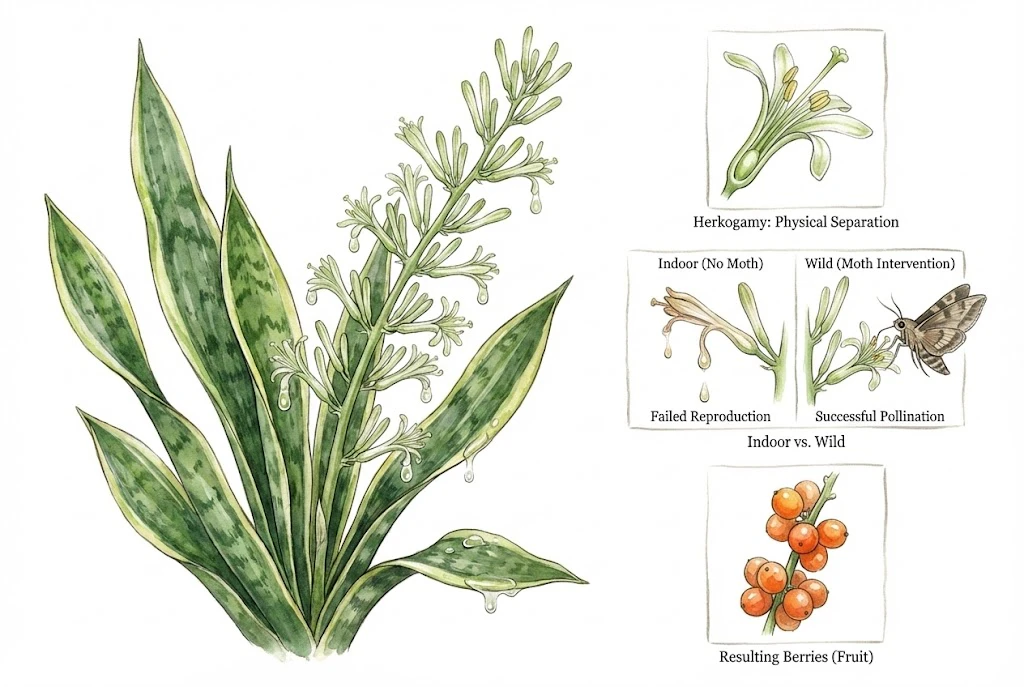
The study confirmed that D. trifasciata is self-compatible but lacks the ability for self-pollination (herkogamy).
Self-Compatible
The plant’s own pollen can fertilize its own ovules. It is not genetically barred from inbreeding.
No Self-Pollination on Its Own
The flower’s structure separates the anthers (pollen source) from the stigma (pollen receptor) in space. A condition called herkogamy. Because of that separation, the flower does not pollinate itself automatically. Something has to carry pollen to the stigma. That something is normally a pollinator, but it can also be a person hand-pollinating.
Implication for Home Growers
This is why an indoor snake plant often blooms without ever producing berries. If no pollinator visits and no one hand-pollinates, pollen usually doesn’t reach the stigma.
In the studied population, controlled pollinations suggested pollinators were in short supply, which is consistent with what many indoor growers see.
So most of the time the nectar drips, the flower fades, and no fruit sets. The orange berries sometimes seen on outdoor plants indicate that pollination did happen. The study points to moths as the likely pollinators, though it does not prove that berries can form no other way.
3. Why the Droplets Get Sticky
Why Nectar Gets Thicker
People describe the droplets as sticky, gooey, or syrup-like. The reason comes down to simple physics and chemistry, including what nectar is made of and what happens after it sits in room air.
3.1 Why It Thickens (Evaporation)
Freshly secreted nectar is usually fairly watery. The thick, sticky consistency people notice at home develops mostly after secretion, as the droplet loses water to the air.
Initial Secretion
Nectar leaves the nectary as a watery, sugary solution. Published sugar concentrations vary a lot between species, sampling times, and conditions, and exact figures for this species’ floral nectar have not been reported, so no specific starting percentage can be assigned.
The Evaporation Factor
Once nectar pools in the floral tube and starts to overflow, it is exposed to the room air. Water evaporates from the surface of the droplet while the sugars remain, and dry indoor air speeds this up.
Like Reducing a Sauce
It is a bit like reducing a sauce on the stove. As water leaves, whatever is dissolved becomes more concentrated. The nectar shrinks in volume and the sugar concentration rises, so an older or accumulated droplet is thicker than a fresh one.
The comparison is only rough, though. Nectar in a living flower can be topped up, partly reabsorbed, or fed on by visitors at the same time it is drying, so it is not a closed pan on a burner.
Because the exact sugar levels for this species have not been measured, the direction of change is clear but firm before-and-after percentages are not.
Consequence
A more concentrated sugar solution is thicker and stickier, which is why dried nectar clings to floors and furniture and can be a nuisance to clean.
The same thickening may matter to a feeding moth. Very viscous nectar can be harder to draw up through a narrow proboscis. That is a general point about sugar solutions and feeding, not something measured for this plant’s visitors.
3.2 Chemical Composition (The Sugars)
Nectar is not just sugar water in a single form. The mix of sugars varies between plants, and that mix can relate to which animals visit.
Sucrose-Dominant Nectar
Sucrose is a disaccharide (glucose plus fructose). A 1986 survey of Sansevieria nectars found the floral nectar was sucrose-dominant across the sampled taxa, so it is reasonable to expect this species’ floral nectar to be sucrose-rich as well. Exact ratios for D. trifasciata specifically were not part of that survey.
Many moths do tend to prefer sucrose-rich nectar, but preferences differ by moth group, by concentration, and by other factors, so this is a general tendency rather than a fixed rule.
A Note on Stability
It is sometimes said that sucrose-rich nectar is more stable than glucose-rich nectar. Be cautious with that. Sucrose can also be broken down and fermented by microbes, so it is not immune to spoiling.
How quickly any nectar ferments depends on the whole picture (total sugar concentration, pH, any antimicrobial compounds, and which microbes are present) not on the sugar type alone.
3.3 Saponins (What We Do and Don’t Know)
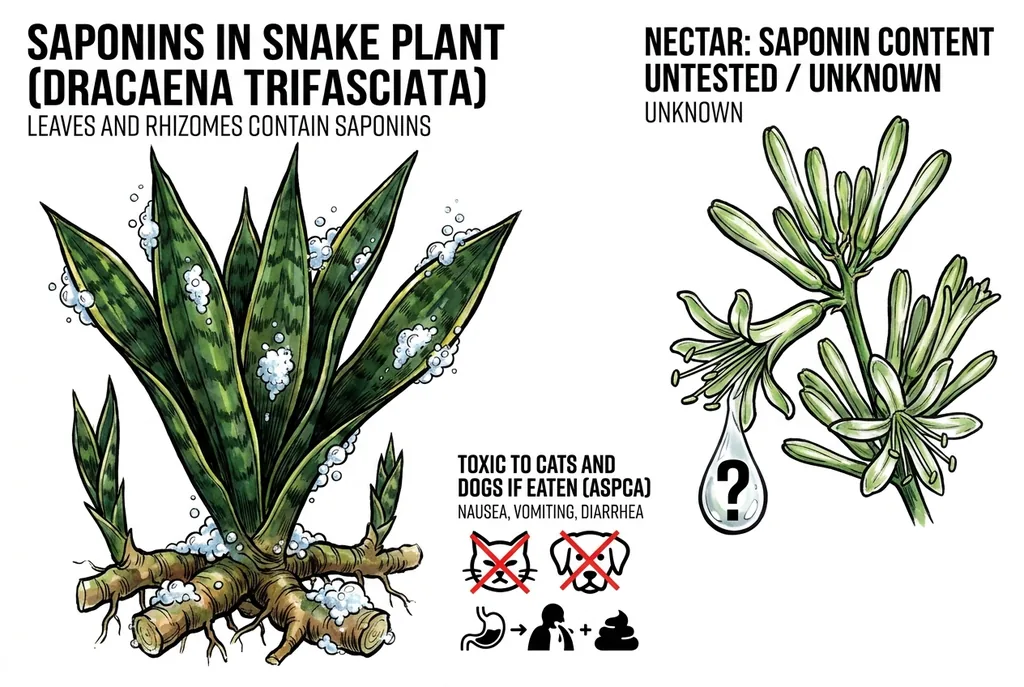
Snake plant tissues contain saponins. The ASPCA lists the snake plant as toxic to cats and dogs, with saponins as the toxic principle and vomiting, diarrhea, and nausea as the signs after a pet eats the plant.
That much is well established for the plant’s tissues.
What Are Saponins?
Saponins are glycosides with a steroid or triterpenoid backbone. They are named for the soapy foam they form when shaken in water.
Many plants use compounds like these as defenses, and some saponins can disrupt cell membranes in laboratory tests.
How toxic a given saponin is in practice depends on the specific compound, the dose, and how it is encountered. A lab hemolysis test is not the same as a pet swallowing a bite of leaf.
Are Saponins in the Nectar?
The 2025 study measured sugars and reproduction, not nectar toxins, and a chemical analysis has not established saponins in this species’ floral nectar.
Some plants have defensive compounds in their nectar, but that possibility is not evidence for D. trifasciata.
State of the Nectar Evidence
The leaves and rhizomes contain saponins, but whether the flower’s nectar does, and at what level, has not been tested.
Treat the nectar’s toxicity as unknown rather than assuming it matches the leaves.
3.4 The CAM Connection
Dracaena trifasciata uses Crassulacean Acid Metabolism (CAM) photosynthesis, which is part of what makes it drought-tolerant.
The Mechanism
In the simplest terms, many plants take up CO2 through open stomata during the day, which also loses water. CAM plants instead take in most of their CO2 at night, store it as malic acid, and use it during the day with stomata largely closed, which reduces daytime water loss.
Real CAM is more flexible than a strict day-closed/night-open switch, but that is the basic idea.
The Connection to Nectar
Nectar is water-based, so producing it does use some water. It is tempting to conclude that a dripping plant must therefore be well-hydrated, but that is not a reliable test.
A plant can secrete nectar using stored water and sugars laid down earlier, and the amount of nectar does not measure current soil moisture or root health.
It is fair to say a severely drought-stressed plant would generally have less to spend on watery secretions.
But the presence of nectar is weak evidence about hydration, and it says nothing about what triggered flowering in the first place.
Do not use the fact that it is dripping as a health check, and do not use it either to prove or disprove the stress idea because those are separate questions.
4. Chemical Ecology (The Scent of the Night)
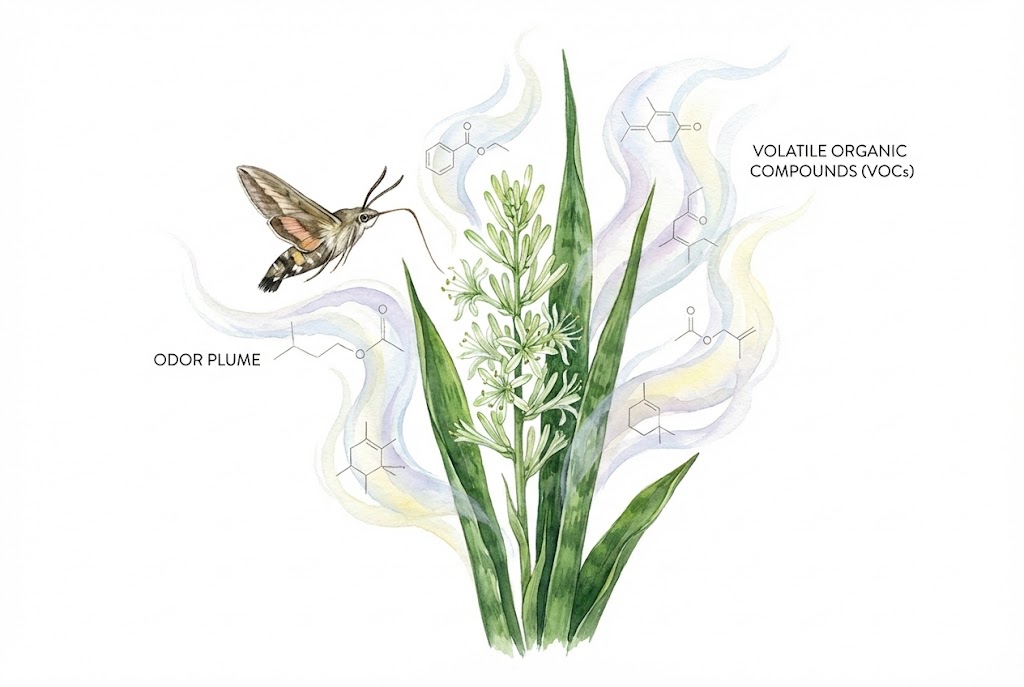
Alongside the nectar, the scent is the part of the flower most people actually notice, because the fragrance can be strong at night.
4.1 Volatile Organic Compounds (VOCs)
The sweet odor is a mixture of volatile organic compounds (VOCs). Small molecules that evaporate easily and travel through the air.
A Common Chemical Palette
Night-blooming, moth-associated flowers often share a broadly similar scent chemistry, frequently including esters (fruity/sweet notes) and terpenoids such as linalool or ocimene (floral/fresh notes).
Those are examples from moth-pollinated plants in general. The specific VOCs given off by D. trifasciata have not been analyzed, so treat these as illustrative rather than this plant’s confirmed profile.
How Scent Travels
Whether a molecule evaporates readily depends mainly on its vapor pressure at a given temperature, not simply on being light or heavy. Once in the air, scent molecules are carried and spread by air movement and turbulence, forming a plume that broadens downwind.
Moths can follow such plumes upwind to a scent source, sometimes over considerable distances. How far this particular plant’s scent reaches, and which insects respond to it, has not been measured.
Metabolic Cost
Producing scent compounds does cost the plant carbon and energy. Different VOCs are built through different biochemical pathways, so it is an oversimplification to say all of them are made by diverting fatty acids and amino acids specifically.
This cost is sometimes used to argue that only a well-resourced, mature plant can afford to flower and perfume all night. It is a reasonable intuition, but a running scent factory is not by itself proof that the plant is thriving.
4.2 A Nightly Rhythm
Many night-blooming flowers release scent on a daily rhythm rather than constantly, typically stronger at night when their likely pollinators are active.
This kind of timing is well documented in some moth-pollinated plants.
The Rhythm
Where it has been measured in other species, scent output often rises around dusk, stays higher through the night, and falls toward dawn. Roughly matching when moths are flying.
The exact emission curve for D. trifasciata has not been recorded, so the general pattern does not establish precise timings for this plant.
What Owners Notice
Consistent with this, many owners report that a blooming snake plant smells much stronger in the evening than in the afternoon.
That is an everyday observation rather than a measured curve, but it fits the general night-scent pattern.
5. The Reproductive Actors (Pollinators and Interlopers)
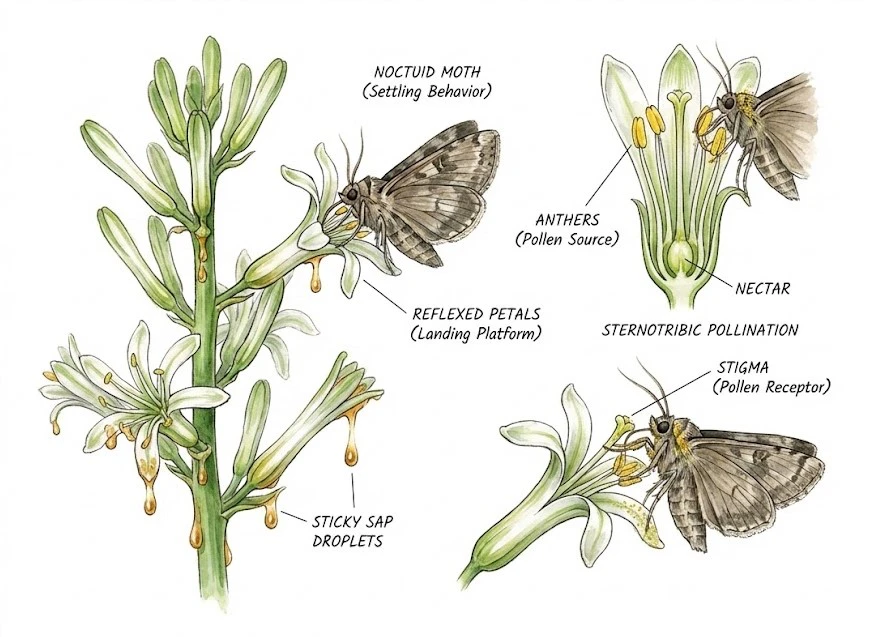
The nectar and scent set the scene. The insects are what the flower is built to interact with. Both in the wild and around the home, the cast can include more than moths.
5.1 The Likely Pollinators (Moths)
Based on the flower’s traits, the study points to moths as the likely pollinators (settling moths in particular, and possibly some short-tongued hawkmoths).
This is a conclusion from the syndrome (the flower’s features), not a list of insects recorded visiting.
Settling Behavior
Unlike hawkmoths that hover, settling moths land on the flower to feed. The reflexed (bent-back) tepals of this species would give such a moth a surface to land on, which is consistent with settling-moth visitation.
How Pollen Could Transfer
Given the flower’s layout, a plausible mechanism is this. As a moth pushes its head into the tube to reach the nectar, the anthers near the throat brush the underside of its head or thorax and deposit pollen there.
At the next flower, the protruding stigma could pick that pollen back up.
This is a reasonable inference from the flower’s structure, with contact on the underside of the insect. It describes how transfer could work, not a filmed observation of it happening in this species.
5.2 Ants at the Flower
Growers often notice ants on the flower stalks of snake plants. Ants are drawn to sugar, so a dripping, sugary nectar is a plausible attractant.
Nectar Thieves
Ants can act as nectar thieves. Small enough to reach the nectar without contacting the anthers or stigma, they take the reward without moving pollen. Whether ants meaningfully rob nectar from this species specifically has not been documented. This is a general possibility, not a measured effect here.
Do the Ants Protect the Plant?
Some plants recruit ants as defenders through nectar, and it can be tempting to assume the same is happening on a snake plant stalk.
But there is no evidence that snake plants use ants this way, so treat that as speculation rather than fact.
The often-cited example below (Tococa guianensis) is worth reading carefully, because it does not transfer cleanly to a snake plant.
Why the Tococa Example Doesn’t Apply Directly
Tococa guianensis is in a different plant family (Melastomataceae) and is an ant-plant with leaf pouches (domatia).
In that species, nectar is secreted on flower buds to attract ants that reduce bud damage. Once the flowers open, that bud nectar stops and the open flowers offer pollen to bees, not nectar.
So it is a different family, a different reward, and a different pollinator system. It is not a model for what a snake plant’s open, nectar-dripping flowers do, and there is no basis for a bodyguard explanation in Dracaena.
One practical note. If ants are swarming your plant, also check for sap-sucking pests. Ants are attracted to the honeydew produced by scale, mealybugs, and aphids, and they sometimes protect those pests. So ants can be a clue to a pest problem, not just to a flower.
Nectar secretion of floral buds of Tococa guianensis mediates ant interactions that reduce florivory
6. Physiological Triggers (Stress Claims vs. Photoperiod Evidence)
Why does the plant bloom? This is one of the more debated questions among growers, and honestly the trigger is not well pinned down for this species.
6.1 The Stress Idea
A common belief is that snake plants only bloom when stressed, especially when root-bound or neglected. The reasoning is that a plant sensing hard times reproduces before it might die.
The Grain of Truth
There is something to it. Some plants do flower in response to stress, and many blooming snake plants are indeed in tight pots.
The Catch
But correlation is not causation. Snake plants grow slowly, so by the time one is old enough to flower it has usually filled its pot with rhizomes anyway.
Being root-bound may therefore be a side effect of age rather than the trigger for flowering.
This is a reasonable alternative explanation, not a proven one. The actual trigger has not been isolated in controlled trials for this species.
6.2 Maturity and Light
An alternative explanation is that maturity matters most. A plant flowers once it is old and well-resourced enough to reproduce.
Day length or photoperiod is sometimes suggested as a contributing factor too. Both are plausible, but neither has been confirmed as the driver in D. trifasciata, so they remain competing, unconfirmed ideas rather than a settled consensus.
The Photoperiod Idea
Some tropical plants flower more readily under shorter days (longer nights), a short-day response. It is sometimes assumed snake plants work this way, which would fit anecdotes about indoor blooms in winter and spring.
But this species has not been tested for a short-day response, and the photoperiod study cited below examined six annual bedding plants (zinnia, sunflower, marigolds, cockscomb, cosmos), not snake plants, so it cannot classify a snake plant. Treat the seasonal-timing idea as an untested observation.
Energy Cost
Producing a flower stalk, many flowers, and sugary nectar is a real investment for the plant, but exact figures for stalk length or nectar mass are not established.
Reproduction draws on stored resources. Flowering does not prove the plant is thriving (both healthy and stressed plants can flower) so a bloom is not a substitute for checking the plant’s actual condition.
Real-Life Practice
If your plant flowers, that generally means it has reached reproductive age under conditions it has tolerated, not that you are harming it. Enjoying the bloom is fine.
Use Light for Growth, Not as a Flowering Switch
Snake plants tolerate low light but grow slowly in it. More usable light supports faster, sturdier growth, though light alone is not shown to force flowering in this species.
If a plant is genuinely light-starved and moving it to a brighter window is not an option, a supplemental grow light can help as growth support rather than as a flowering switch.
Supplemental grow light
A compatible screw-in LED grow bulb is a simple supplemental option for a single plant. Compare the exact bulb’s PPF and PPFD at distance, then measure at the leaves and adjust mounting height and photoperiod to the resulting DLI. Use a socket and fixture rated for the bulb’s electrical load, weight, and heat, and follow any restriction on enclosed fixtures.
A cheaper first step costs nothing. Assess your existing daylight and try a brighter spot before buying anything. If you do buy, use the general grow-light guide to compare measured PPFD and DLI rather than wattage alone.
Effects of photoperiod on flowering time of facultative short-day ornamentals
7. Practical Implications (Living with the Bloom)
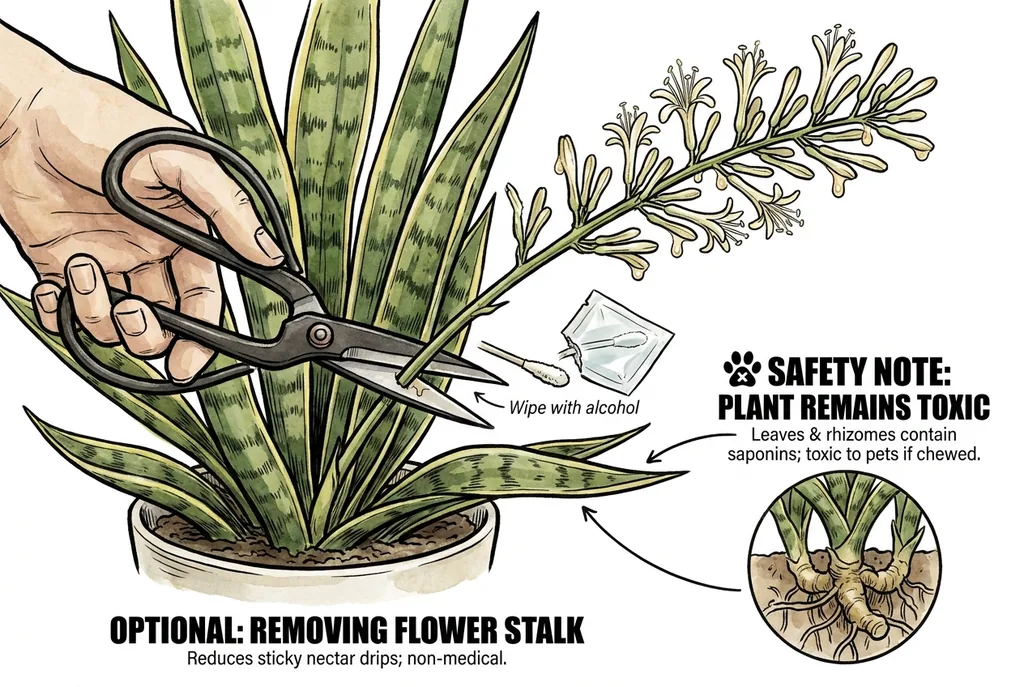
Whether you keep or remove the bloom is mostly a housekeeping decision. The options are straightforward.
7.1 To Cut or Not to Cut?
Nectar drips can be messy. The sugary residue can attract ants, and mold can grow on top of the sugar film. That surface fungus is usually sooty mold and does not mean the plant tissue is infected.
If you find a black sticky film without an obvious flower, check again for scale, mealybugs, or aphids because their honeydew looks similar.
Your Options
There is no biological requirement to cut the stalk. If the mess doesn’t bother you, you can leave it and enjoy the flowers, which is not harmful to the plant.
Cutting it is reasonable if you want to avoid the drips, smell, or cleanup. Because the flowers are self-compatible but do not self-pollinate on their own, deliberately setting seed indoors would mean hand-pollinating rather than relying on the plant to do it alone.
If You Do Cut
Removing the stalk stops that stalk from producing more nectar and dripping further. It is sometimes said this redirects energy into the leaves. That is plausible but has not been measured, so do not treat it as a growth benefit.
Use a clean, sharp blade and cut near the base. Clean, sharp household scissors can do this. Small pruning snips are also fine.
What matters most is that the tool is clean and sharp. Wipe it and disinfect it (for example with 70% isopropyl alcohol) before cutting, which is the usual advice for reducing the chance of introducing disease.
A clean, sharp cutting tool
A pair of small micro-tip pruning snips is one option if you don’t already own something suitable. It is not a required purchase, and clean sharp scissors you already have will work.
Either way, cutting the stalk removes the source of new drips on your floor.
7.2 Pets
The snake plant is listed by the ASPCA as toxic to cats and dogs, with saponins as the toxic principle. This applies to the plant’s tissues (leaves, rhizomes).
What’s Known and Not Known
According to the ASPCA, a pet that eats the plant may show nausea, vomiting, and diarrhea.
More severe effects like red-blood-cell damage are described for saponins in laboratory settings and high doses. That is not the same as the typical result of a pet nibbling a leaf, so do not treat it as the expected outcome.
Whether the nectar itself contains saponins, and if so, how much, has not been tested. The effects of licking the nectar are therefore unknown.
The sensible approach is to treat the whole plant as potentially irritating if eaten, rather than making specific claims about the droplets.
Recommendation
Cutting the flower stalk removes the messy nectar, but it does not make the plant pet-safe. The leaves and rhizomes still contain saponins.
If pets tend to chew plants, keep the whole plant out of reach and wipe up any nectar residue.
If you suspect your pet has eaten part of the plant or is showing symptoms, contact your veterinarian or an animal poison-control service.
7.3 A Note for Vivarium Keepers
If you keep this plant in a bioactive enclosure with animals, be cautious, because there is little species-specific data to rely on here.
Ants
Sugary nectar can attract ants into an enclosure. Even cleanup-crew invertebrates carry tradeoffs, including escape, biting or stinging, tending pest insects, and stressing resident animals, so do not assume ants at the flower are harmless. Evaluate them for your specific setup.
Reptiles and Amphibians
Reliable data on whether nectar-feeding reptiles such as crested geckos are harmed by this plant’s nectar are not available. The nectar’s chemistry itself is unstudied.
Because the plant’s tissues are known to contain saponins and the nectar is an unknown, the conservative choice is to remove the bloom or keep the plant out of reach in an enclosure with animals that might sample it, rather than to rely on it being safe.
8. Conclusion
When a snake plant blooms and drips, the useful first move is to confirm the source. Droplets on a flower stalk are most likely nectar, while a sticky film on leaves or the floor with no flower is more likely pest honeydew, so inspect for scale, mealybugs, and aphids before assuming.
For the flower case, the 2025 study supports a clear core. The flowers open at night, the nectar accumulates at the base of the floral tube and is secreted continuously through the night, repeated removal reduces total nectar by roughly 16% (it does not trigger a refill), and the flowers are self-compatible but do not self-pollinate on their own.
That last point is why indoor plants usually bloom without setting fruit.
Several popular explanations go beyond what has been measured for this species. Exact nectar sugar percentages, saponins in the nectar, specific pet toxicity from the nectar, its VOC profile, and a definite flowering trigger are all unconfirmed.
A bloom mostly tells you the plant is mature, not that it is thriving or well-hydrated. Check the plant’s actual condition separately.
Practically, cutting the stalk is an optional way to stop the mess, while keeping it and enjoying the flowers is also fine.
Keep the plant away from pets that chew because the leaves and rhizomes contain saponins, and contact a vet or animal poison control if you suspect ingestion.