
Silicon for Plants: The Overlooked Element in Soilless Mixes
Soilless mixes tend to be low in plant-available silicon. In many studied species silicon can stiffen tissue, reduce water loss, and slow some pests (the evidence, the caveats, and how to use the main sources safely).
Priya Patel · Published 2025-12-23 · 23 min read
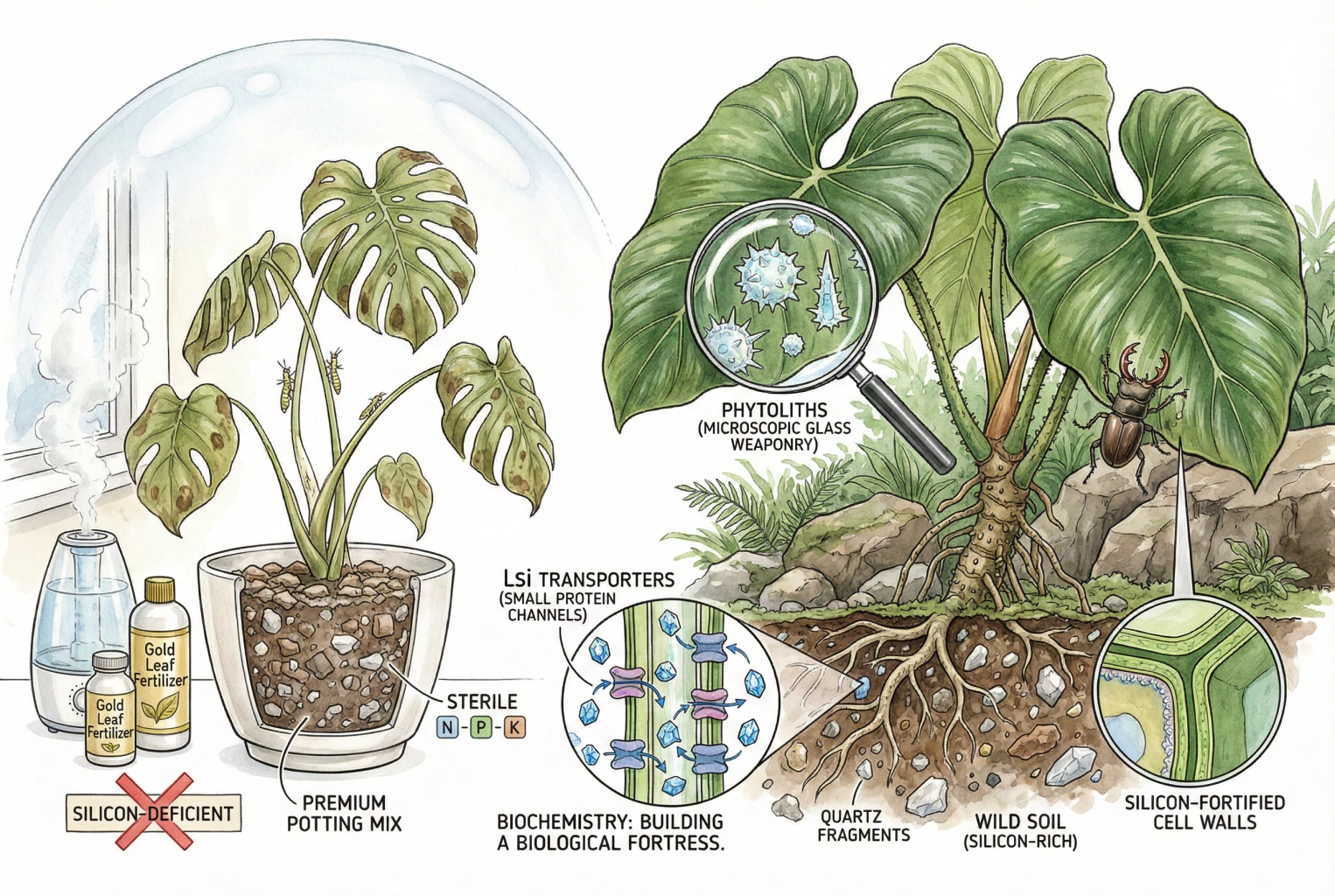
Key Takeaways
- Modern soilless mixes (peat, coir, perlite) tend to be low in plant-available silicon compared with mineral soil, even though they still contain some mineral content. How much a given plant misses depends on the species and the substrate.
- In many studied plants, absorbed silicon is deposited in cell walls and beneath the cuticle. In those species it can stiffen tissue, reduce water loss, and make leaves harder for some pests to chew or pierce (the size of the effect varies by species, dose, and conditions).
- The classic silicon accumulators studied in agriculture are grasses (rice, sugarcane, bamboo). Whether Monstera, Philodendron, or Alocasia accumulate silicon strongly has not, as far as I can find, been directly measured, so treat aroid claims here as plausible extrapolation, not established fact.
- Silicon may also prime the jasmonic-acid defense pathway in some species, and pests can adapt to any single defense over time. Silicon is not an evolution-proof shield.
- Mixing order matters. Potassium silicate is very alkaline, so follow the product label. For the two brands cited here, that means adding it to plain water, mixing, adding your nutrients, and adjusting pH last, not neutralizing the silicate before you feed. Dumping concentrates together can precipitate calcium and iron out of solution.
What Silicon Can and Cannot Do for Houseplants
Even carefully tended houseplants can be surprisingly fragile. You’ve followed the usual advice, chunky soil, good fertilizers, added humidity, yet they still wilt the moment you miss a watering or a pest arrives.
In the wild, the same species are tougher on average, though they too are damaged by drought, flooding, herbivores, and disease.
Part of the difference is the chemistry of the substrate. Most hobbyists feed a basic NPK fertilizer and rarely think about silicon, an element abundant in mineral soil but scarce in readily available form in many soilless mixes.
Older textbooks classify silicon as non-essential, and that is still the mainstream view. For most plants it is a beneficial element, helpful under certain stresses rather than strictly required.
Over the last several years, though, a growing body of research has documented real benefits in many species, which is why it is worth a closer look for indoor growers.
Use the guide to decide whether a cautious trial makes sense for your setup, then follow the chosen product label exactly. For background on glass vessels themselves, see this related piece on terrarium containers.
Why Soilless Mixes Supply Little Available Silicon
A Helpful Extra, Not a Missing Essential Nutrient
Most plants can complete their life cycle without supplemental silicon. It is best treated as a beneficial extra that may help under some stresses, not as a missing nutrient that every houseplant requires.
Mineral soil can supply dissolved silicon. Peat, coir, and perlite are useful potting ingredients but usually supply much less in a form roots can use.
Soilless culture changed the supply. Many indoor plants grow in peat moss (decayed sphagnum), coconut coir (husk fiber), and perlite (expanded volcanic glass).
These substrates are useful for air and water management. They are not empty, but their minerals are often less available than those in mineral soil.
Peat is mostly organic matter and low in mineral content, though not zero. Coir contains some inorganic ions (potassium, sodium, chloride, and others), which is one reason it often needs calcium buffering.
Perlite is largely silica (SiO2), but that silica is essentially insoluble on gardening timescales.
So the issue is availability, not total content. The silicon may be present but locked in forms the plant cannot readily take up. A bit like trying to get iron by licking a steel beam.
The practical point is that plants which, in the ground, could take up some silica from mineral soil often get very little of it in a soilless pot.
Whether that leaves a particular plant measurably weaker has not been tested for most houseplants.
And when you read the back of a fertilizer bottle, you usually see N-P-K, sometimes calcium or iron, but rarely silicon.
How Plants Use It
Roots take up soluble silicon with water. In species that accumulate it, some is deposited in leaves and cell walls, where it can contribute to firmer tissue and slightly lower water loss.
How much reaches a leaf, and whether that changes performance, varies greatly by species and growing conditions.
Silicon application improves tomato yield and nutritional quality
Different Plants Respond Differently
Plants vary widely in how much silicon reaches their leaves. Grasses are well-known high accumulators. Many broadleaf plants take up less, so an effect that is reliable in rice or sugarcane may be small or absent in a houseplant.
High Accumulators
These concentrate silicon in their tissues well above the level in the soil solution. The classic examples are grasses (rice, sugarcane, and bamboo (order Poales), plus some palms (order Arecales)). Arecales (palms) is a different group from Araceae (the aroids such as Monstera and Philodendron). Older summaries sometimes blur the two, but they are not the same.
Intermediate Accumulators
These take up silicon roughly in proportion to how much water they transpire. Many broadleaf dicots fall here. They can still benefit, but to a lesser and more variable degree.
Low Accumulators and Excluders
Many eudicots accumulate little silicon. A few actively limit uptake. This is common rather than exotic.
Direct measurements of tissue silicon, uptake kinetics, or Lsi transporters for Monstera, Philodendron, Alocasia, or Anthurium are not available.
How strongly these aroids accumulate silicon remains unknown. The suggestions that follow are reasonable experiments rather than established requirements.
Silicon and its interactions with essential and beneficial elements in plants
Silicon Is Not a Substitute for Basic Care
Drought, heat, fertilizer salts, and cold can all damage houseplants. Silicon may make some studied plants a little more resilient, but it cannot make up for repeated dry-downs, harsh sun, or an over-strong feed.
1. Drought (Possible Water-Loss Benefits)
Under-watering is a common way houseplants get stressed. You go on vacation, or you just get busy.
The substrate dries out and the roots lose good contact with water.
The turgor pressure (the internal water pressure that holds the plant up) drops and the plant wilts.
If it stays severely wilted too long, cells can be damaged past recovery, though whether wilting is reversible depends on the species and how long it lasts.
Silicon can help several crops cope with water deficit. In a controlled greenhouse experiment, silicon supplementation improved some drought responses in sorghum.
That is a grass grown in a specific pot-and-drought setup, so it is a useful proof of concept rather than a direct result for decorative plants. The mechanisms below are drawn from a mix of species and do not all point the same way.
Possible Water-Loss Benefit
In plants that deposit silicon near the leaf surface, it may modestly slow water loss. That has not been shown directly for common houseplants, so water thoroughly when the mix needs it rather than expecting a supplement to prevent wilting.
Salt Stress and Brown Leaf Tips
If you have grown a Dracaena, spider plant, prayer plant, or Calathea, you may know the crispy brown tip. Its causes are usually multiple, including low humidity, irregular watering, accumulated fertilizer salts, and chlorine or fluoride in the water.
Several of those species are genuinely fluoride-sensitive, so fluoride can be relevant without being the only explanation.
Where Salt Builds Up
Two sources of salt buildup are worth noting.
Tap Water
Water hardness is defined mainly by calcium and magnesium, not sodium. Hard water is not automatically high in sodium. Softened water can be higher in sodium, but that is a separate situation. Some tap water also contains chloride and fluoride.
Fertilizer Buildup
Feeding adds salts such as nitrates and phosphates. Without occasional flushing, these can accumulate in the pot over time.
Excess salt raises the osmotic pressure of the soil solution, which can make it harder for roots to take up water.
Sodium and chloride can also accumulate and injure leaf margins in some plants.
Silicon is not an antidote or a filter for salt, but in some species and conditions it has been reported to reduce salt-stress damage.
The effect is species- and cultivar-dependent, and reviews caution that some apparent benefits may partly reflect growth dilution rather than a confirmed membrane mechanism.
Some crop studies report less sodium damage after silicon treatment, but the response depends on the crop and conditions. It is not evidence that silicon will correct brown tips caused by a houseplant’s water or fertilizer program.
In practice
If you are stuck watering a fluoride-sensitive plant like a Calathea with hard or fluoridated tap water, the more reliable fixes are to test your water, reduce fertilizer salt buildup by flushing, and consider a lower-mineral water source.
Silicon might help at the margins, but it does not replace addressing the water itself, and there is no aroid or Calathea trial showing it reliably keeps edges green.
Metal Problems Need a Test, Not a Guess
Metal availability can shift with pH. If a mix becomes quite acidic, metals such as manganese (Mn) and aluminum (Al) can become more soluble.
How often this reaches toxic levels in an ordinary potting mix depends on the substrate and the actual concentrations, so it is worth confirming rather than assuming.
Toxicity can show up as leaf crinkling or necrotic spots, but those symptoms are non-specific and have many causes, so they do not by themselves point to a metal problem.
Silicon can alter how some plants handle metals, but it is not a general detoxifier. Check pH, water, fertilizer strength, and the affected tissue before adding another supplement.
A Supporting Layer in Pest Control
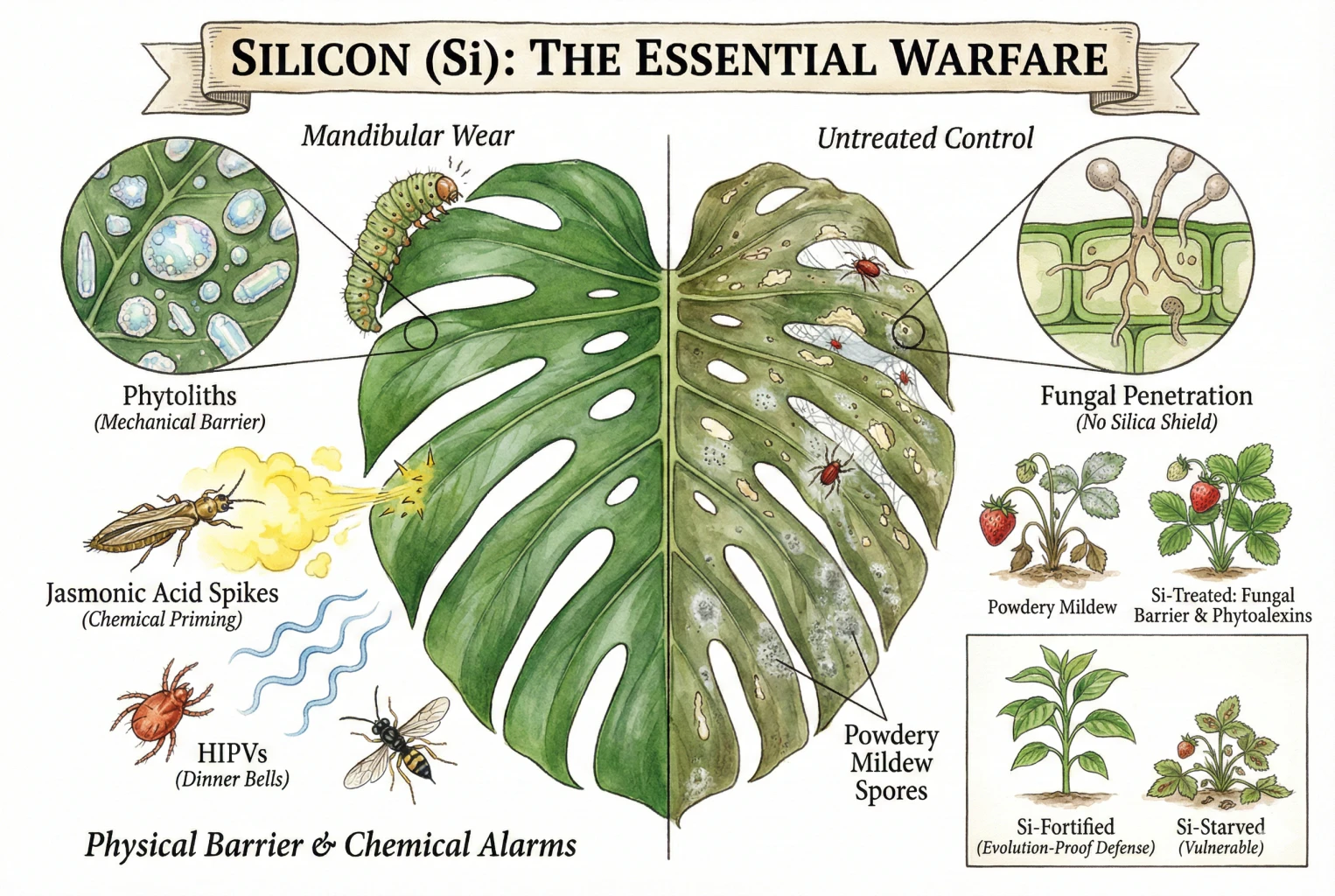
Silicon can also play a role against pests, though as a supporting factor rather than a cure.
Common indoor problems include thrips, spider mites, and mealybugs.
Standard controls include neem oil, spinosad, and systemic products. These can be effective, but some carry drawbacks such as odor or, at the wrong dose, leaf phytotoxicity, not all products share the same downsides, so follow each label.
Pests can adapt to control measures over time, and silicon-based defenses are not complete either. Treat silicon as one more layer, not an evolution-proof shield.
Tougher Tissue May Slow Some Pests
In some plants, silicon becomes part of tougher leaf tissue. This can make feeding less efficient for certain pests, but it does not make a leaf pest-proof.
Against chewing pests (caterpillars, beetles)
Studies in a few grass-and-caterpillar systems show slower feeding or growth. Do not transfer that result directly to a houseplant or rely on it in place of pest control.
Against sucking pests (thrips, mites, aphids)
Thrips, mites, and aphids feed differently. There is no direct evidence that silicon stops any of them on aroids, so inspect plants and use an appropriate labeled control when an infestation is active.
It May Support Existing Defenses
Some research suggests silicon can help a plant react to attack. The effect differs by plant and pest and has not been established for common aroids, so treat it as a possible bonus rather than a control method.
Silicon-mediated enhancement of plant defense against herbivores
It Does Not Replace Disease Control
High humidity in vivariums and terrariums favors fungal problems such as powdery mildew, as well as Botrytis and root rots. These are different diseases with different biology, not a single target for one shield.
Silicon has reduced disease severity in some crop studies, but that result does not prescribe a cure for a terrarium or houseplant. Improve airflow, avoid keeping foliage wet, remove badly affected tissue, and use a suitable diagnosis and control plan.
What This Means for Aroids
For the aroids and epiphytes many hobbyists grow, direct evidence is still limited. Monstera, Philodendron, Alocasia, and Anthurium have not been directly tested here for silicon accumulation or response, so the specific claims below are extrapolations.
Aroids can grow with or without supplemental silicon. Their silicon uptake and response have not been measured well enough to call it a requirement, so a cautious test on a few plants is more defensible than treating it as standard care.
Floppy Leaves
Growers often note that Philodendron leaves can be floppy or that leaves melt during shipping or heat.
These symptoms have several causes, including water status, root injury, transport stress, and heat. They are not a specific sign of weak cell walls.
There is no houseplant trial showing that silicon supplementation reliably produces thicker, more leathery leaves in a set time, or that it measurably stiffens Monstera petioles or reduces staking.
It is plausible for a strong accumulator, but for these aroids it remains untested. Treat any improvement you see as anecdotal.
Vivarium & Paludarium Notes
Vivariums involve a real trade-off with humidity. High humidity is good for many tropicals but reduces transpiration.
Because silicon uptake in many plants is linked to transpiration, low transpiration in a humid enclosure would tend to mean less silicon uptake, not more.
A root drench cannot force a plant to build silica-reinforced walls if it is barely transpiring and therefore barely taking silicon up.
Soft, water-logged growth and sudden melt in enclosures are driven mainly by temperature, airflow, wetness, and the species involved.
Silicon is not a proven insurance policy against terrarium melt. Manage ventilation and moisture first.
Choose a Source for Your Setup
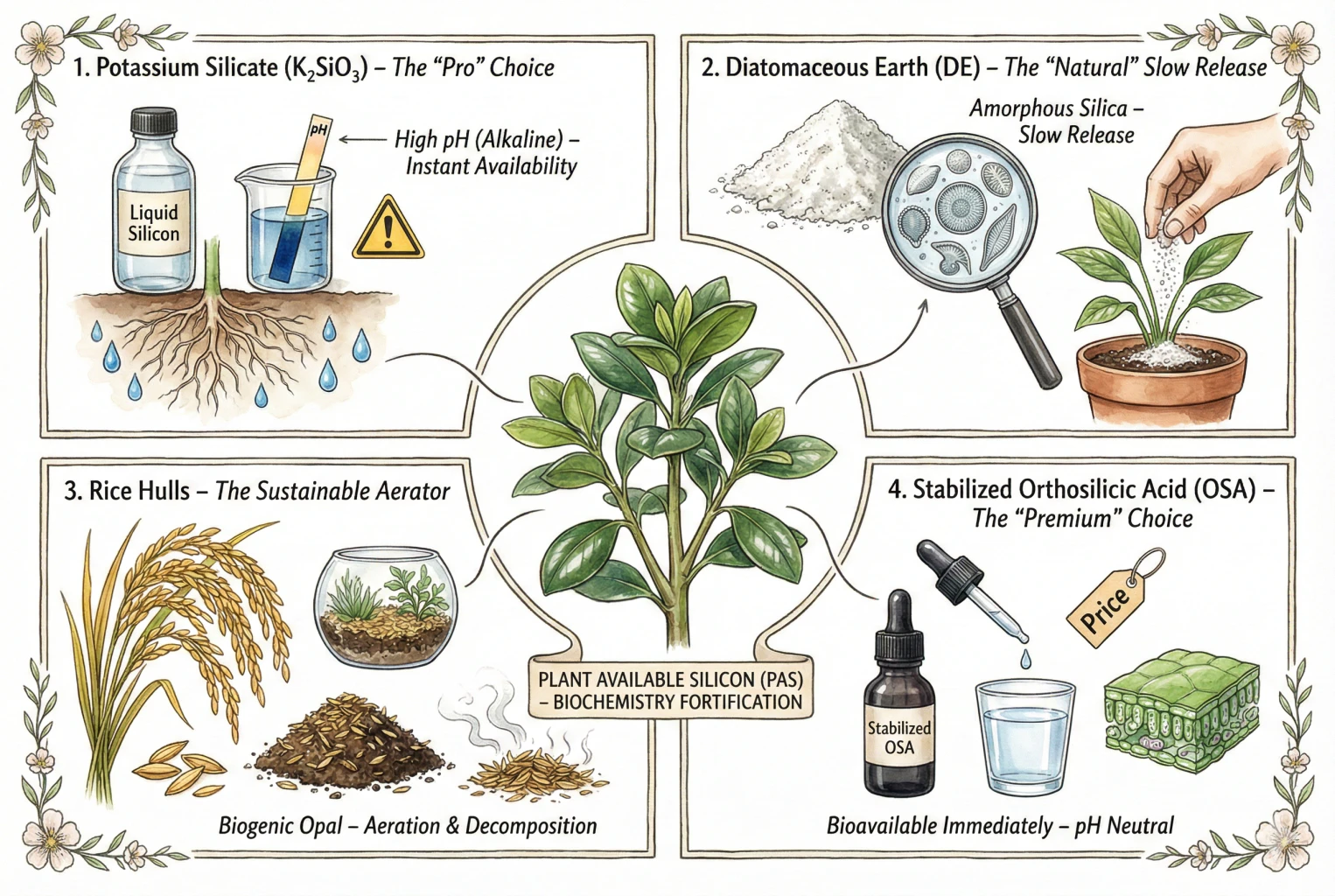
A bag of silica sand will not provide a useful short-term silicon supply because it dissolves extremely slowly. Choose the form for its availability, the substrate or water system, and the handling it requires.
The common sources below differ in availability, speed, and handling requirements.
1. Potassium Silicate for a Fast Liquid Option
Potassium silicate is a common liquid source for hydroponic and container growers.
- Pros
A soluble source that supplies silicon relatively quickly and also contributes potassium. The actual speed depends on pH and product. - Cons
It is alkaline. Concentrated potassium silicate is a strong-base solution. The exact pH varies by product, so check your label rather than assuming a fixed value.
Because the concentrate is alkaline, adding it carelessly can raise solution pH.
At high pH, some nutrients (calcium, iron, magnesium) can become less available or precipitate, especially if concentrates are combined directly, though not every element instantly drops out in every mix.
- Bottom line. Potassium silicate is a practical fast-acting source, but the right choice depends on your crop, system, target silicon level, and cost, and you must mix it in the order the product specifies (see Part 6).
Formulas differ in concentration and potassium content. Do not carry a dose from one bottle to another.
Use potassium silicate only when you can follow that product’s dilution and mixing order, then check the final pH.
2. Diatomaceous Earth for a Slow Substrate Amendment
DE is the fossilized remains of diatoms, microscopic algae with silica shells. It is mostly amorphous silica, which is a mineral rather than an organic material.
- Pros
Inexpensive and roughly neutral in pH. Dry DE can also act as a mechanical insecticide. - Cons
Low solubility, so it releases silicon slowly. How slowly depends on the product, particle size, and substrate, and slow release is not a fast fix for any presumed deficiency. - Safety. Even food-grade DE is a fine dust that can irritate the eyes, skin, and airways, and some products carry a crystalline-silica warning. Avoid inhaling it. Work in a ventilated area, wet it down when mixing, and wear a dust mask.
- Bottom line. Mixed into a potting mix, DE can provide a slow baseline supply of silicon. Whether it meaningfully re-mineralizes a given mix depends on the product and plant, so treat it as an option to try, not a guaranteed upgrade.
Watch for a form mismatch. A fine food-grade powder is common, but a coarse granular or aggregate form is better suited to mixing into substrate. Fine powder, calcined pool-grade DE, and oil-absorbent granules are not interchangeable, so pick the form that matches your intended use.
If you do use a fine powder, follow the dust warning above and wet it into the mix rather than dusting it on top. Dry DE can also harm a bioactive clean-up crew such as isopods or springtails.
Either way it releases silicon far more slowly than a liquid silicate.
3. Rice Hulls for Aeration With a Modest Silicon Contribution
Rice hulls improve aeration and can release some silicon as they break down. They are not a concentrated silicon fertilizer, so use them for substrate structure first.
- Pros
A more sustainable aeration amendment than perlite, and some silicon becomes available as they break down. - Cons
They decompose over time, so the mix loses volume. How fast depends on processing (raw, parboiled, etc.). Unsterilized hulls can carry weed seeds. - Bottom line. A reasonable choice for living-soil setups where slow decomposition is expected, with results depending on processing, particle size, and conditions.
4. Stabilized Orthosilicic Acid for Lower-pH Systems
Newer products (often pricey, sold in small bottles) are marketed as stabilized monosilicic acid.
- Pros
Marketed as readily bioavailable, and often formulated closer to neutral or acidic, so they disturb a nutrient mix’s pH less than potassium silicate. Actual composition varies by product, so read the label. - Cons
Price, which reflects the stabilization chemistry. Value depends on the concentration and dose per bottle. - Bottom line. These can work, but there is no head-to-head evidence that they are universally better or that potassium silicate performs equally well across all plants and applications. If you use potassium silicate, its main drawback is that you must manage pH.
Apply It Without Creating a New Problem
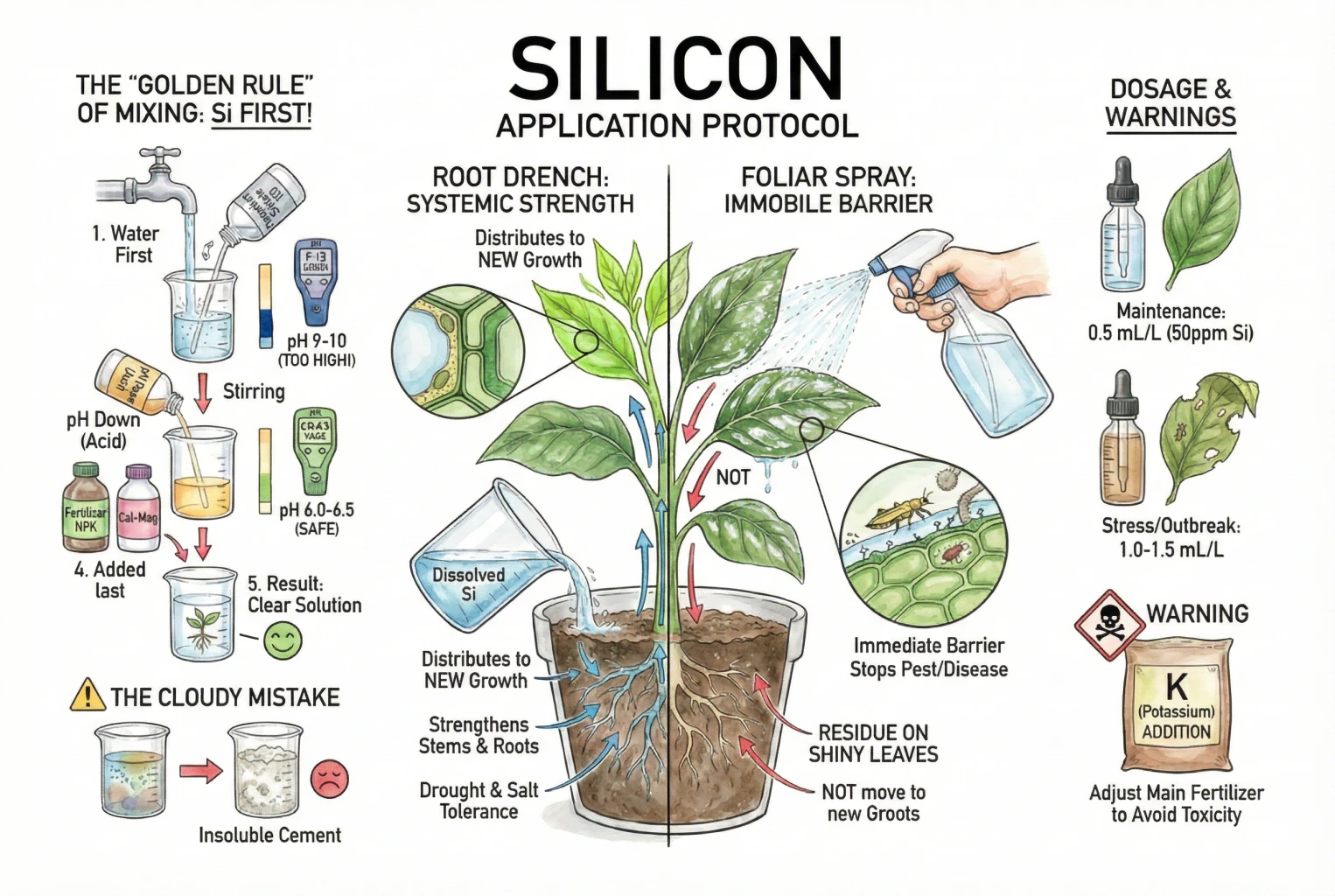
Used carelessly, a silicon supplement can cause problems. Follow your product’s own mixing instructions. The sequence below is a common pattern, not a substitute for that label.
Mixing Order (Silicate Into Water First)
Concentrated potassium silicate can react with calcium and magnesium (from a base fertilizer or Cal-Mag) if the concentrates are combined directly, which can precipitate compounds out of solution and turn the mix cloudy.
If the selected label uses this sequence, dilute the silicate in water before adding other concentrates, then check and adjust pH at the point the label specifies.
- Water first. Start with plain water in the watering can.
- Silicate next. Add the labeled amount and mix for the stated time before anything else goes in.
- Nutrients third. Add your fertilizer and any Cal-Mag, and mix again.
- pH after mixing. Check and adjust pH only when the silicate and base-nutrient labels direct.
If you use an acid to lower pH, add it slowly and follow the acid product’s own safety instructions (eye protection, ventilation).
Whether the result stays perfectly clear also depends on your water’s alkalinity and the specific products, so watch for cloudiness and re-check.
Root Drench vs. Foliar Spray
There is no single correct answer here. The choice depends on the goal, the species, and the product.
Root drench
- Pros
Getting silicon in through the roots is the main route for moving it into the xylem and out to new growth, which is where the structural and stress-tolerance benefits would come from. - Cons
Effects build gradually. - How often. Frequency should match your product’s label, your water quality, and your fertilizer program. Every or every-other watering is common in hydro guides but is not a safe universal rule, so start conservatively.
Foliar spray
- Pros
Can coat existing leaves directly. Some growers use it as a spot treatment, but it should not be relied on to stop an active powdery-mildew outbreak or thrips wave by itself. - Cons
Silicon has limited mobility once deposited, so a sprayed leaf mostly keeps what it gets and it does not move to new growth. Potassium silicate sprays can also leave a white, chalky residue on glossy leaves. - How to use it. If you spray, use your product’s stated foliar rate, test on a few leaves first for phytotoxicity, spray in low light to reduce leaf burn, and wear appropriate protection. This is an optional adjunct, not the primary method.
Dosage
- Follow the label, and know what the number means. Concentration may be reported as elemental silicon or as SiO2, which are not the same value. Calculate the delivered amount from the exact analysis and dose on your bottle.
- Don’t escalate blindly. Ramping up to 1–1.5 mL/L for stress is arbitrary without matching it to the product label, the species, and whether you are drenching or spraying.
- Potassium adds up. Potassium silicate also supplies potassium, so account for it against your base feed and monitor rather than assuming toxicity is too rare to matter.
Consider the Whole Enclosure
Protect Microbes and Clean-up Crews
Potting mixes and bioactive enclosures contain living organisms that respond differently to pH and dust. Keep the choice and dose conservative when they are part of the setup.
- pH. Potassium silicate is alkaline and can raise pH. Check and correct it only as the label directs.
- Microbial products. Do not assume a microbial inoculant will make DE release silicon faster.
- Biochar. It can affect water, nutrients, and microbes, but combining it with silicon does not create a proven special soil system.
Bioactive setups
In a vivarium with isopods and springtails, be cautious with dry diatomaceous earth.
DE works on arthropods mainly by absorbing the waxy lipids from their cuticle, causing desiccation, rather than simply shredding them. As a dry dust it can harm a clean-up crew.
Wetting DE into the substrate reduces its immediate dust action, but if it dries out again the effect can return, so wet does not automatically mean harmless.
Root-drenched potassium silicate is far less likely than surface DE dust to harm a clean-up crew because it is applied in solution rather than as a powder.
Even so, it is not guaranteed safe. Ecotoxicity depends on pH and dose.
Use a Simple Mix You Can Adjust
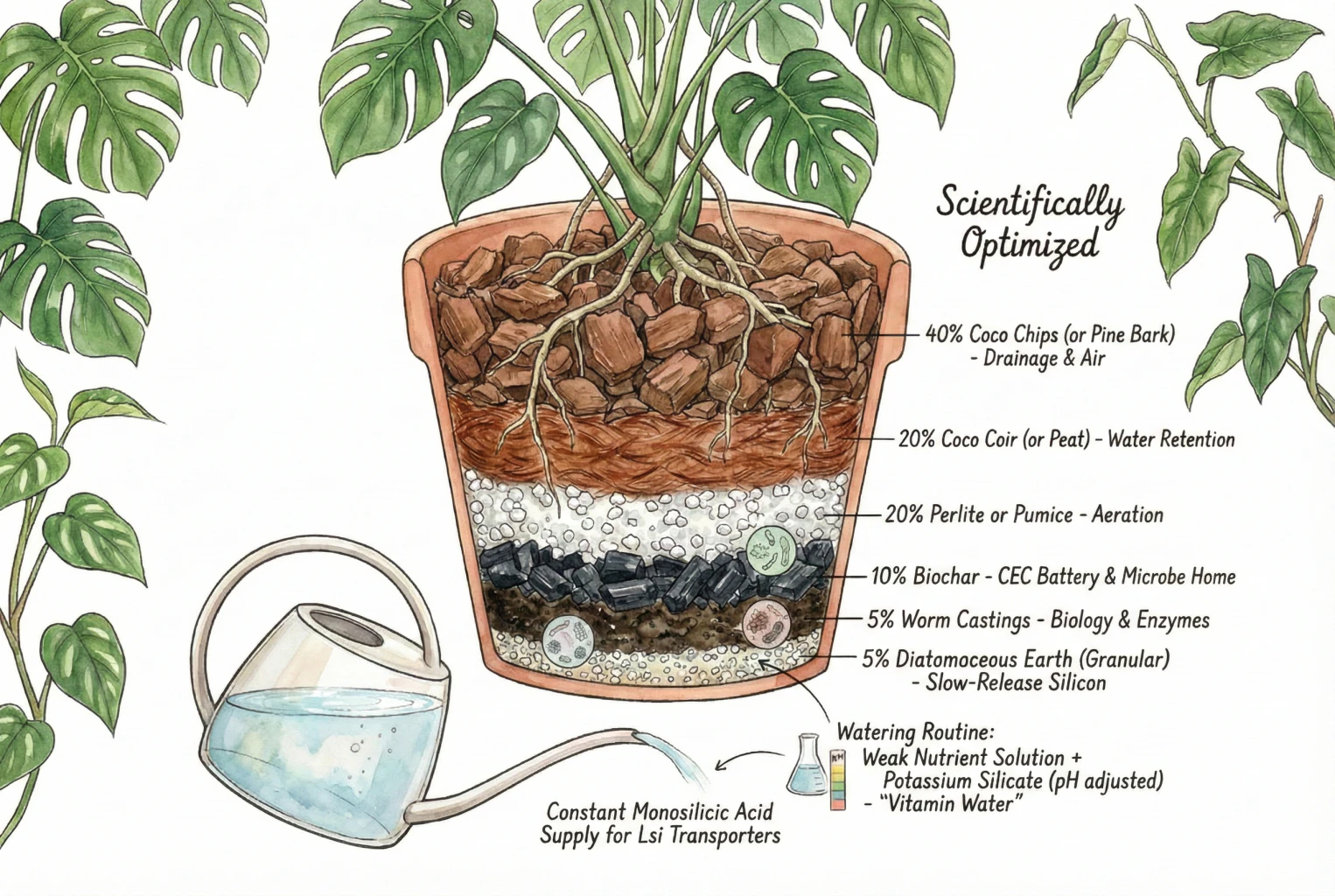
This aroid-and-tropical mix is a sensible starting point rather than a scientifically optimized recipe. The exact ratios have not been tested against your species, particle sizes, pot, and watering, so adjust based on how your plants respond.
Mix the components uniformly rather than building them into horizontal layers, which changes how water behaves in the pot.
The base (structure and air)
- ~40% coco chips or pine bark. Chunky drainage that suits many aroid roots. The ideal amount depends on particle size and how you water.
- ~20% coco coir or peat. Water retention. Coir is more sustainable but often needs calcium buffering.
- ~20% perlite or pumice. Inert aeration to reduce compaction.
The amendments
- ~10% biochar. Biochar can raise cation exchange capacity and hold nutrients, and can house microbes, but this varies with the feedstock, pyrolysis, and how it is charged, so treat it as helpful, not automatic.
- ~5% worm castings. Adds some biology and gentle organic nutrients.
- ~5% diatomaceous earth. A slow-release silicon source. Use a horticultural DE product suited to mixing into substrate, and be aware that oil-absorbent granules and calcined pool-grade DE are different products, not interchangeable with food-grade powder. Mind the dust-safety notes above.
Watering
- If you want to include potassium silicate, add it, with pH adjusted per the label, to a weak feed. How often depends on your water quality, EC, and plant response rather than a fixed every-watering rule.
- The aim is a modest, steady supply of silicic acid. How much a given aroid actually takes up is uncertain, since their uptake has not been measured.
Troubleshooting
Myth. Silica Makes Plants Brittle
In short
Not exactly. In species where it accumulates, silicon tends to stiffen tissue rather than make it snap easily, but effects vary with the tissue, dose, and species, so this is not a blanket rule.
Where it does stiffen growth, the trade-off is reduced flexibility. If you plan to train a climbing plant tightly around a trellis, very stiff stems can be harder to bend. Some growers ease off supplementation before a big bend, though there is no formal protocol showing exactly how long that takes.
Myth. Quartz Crystals Supply Plant Silicon
In short
This does nothing nutritionally.
Quartz dissolves so slowly that it will not supply meaningful silicon on any useful timescale, so a plant cannot rely on it. For a usable source you need a soluble silicate.
Problem. Cloudy Nutrient Solution
Cause and fix
The silicate concentrate was likely combined too directly with Cal-Mag or fertilizer concentrate, precipitating some nutrients. Discard the batch and start over.
Discard the batch and remake it in the exact order and dilution stated on the silicate and nutrient labels.
Problem. White Spots After Spraying
Cause
Residue. Potassium silicate can dry into a thin film on the leaf.
It usually looks like hard-water spotting. Whether it is entirely harmless depends on the product and concentration, so don’t assume it is protective.
Fix
It is mainly cosmetic. You can wipe it off with a damp cloth.
To reduce visible residue, use a lower foliar concentration within the product’s stated range, or simply stick to root drenching.
A Cautious Way to Experiment
Silicon is worth thinking about beyond the usual N-P-K, but it is not a miracle cure. For most plants it remains a beneficial rather than essential element, and the strongest evidence comes from crops and controlled experiments, not from direct trials on aroids and other popular houseplants.
Soilless mixes do tend to be lower in plant-available silicon than mineral soil, though they are not literally silica-free, and whether that leaves a given houseplant measurably weaker has not been established.
Used sensibly, a silicon source (a potassium-silicate drench or a diatomaceous-earth amendment) is a reasonable thing to try.
It may help some plants cope with drought, salt, or pests to some degree, with results that vary by species, dose, and conditions, and no guarantee of a structurally transformed, pest-proof plant.
When I test potassium silicate, I calculate the potassium it adds and reduce other potassium sources where the formulation allows. I mix a normal-care batch and a silicon batch from the same water, then record final pH and EC after every ingredient is added.
I compare new growth on matched plants and track pest damage, leaf firmness, and root condition separately. If the silicon mix also changed potassium, pH, or total salts, I do not describe the result as a clean silicon effect.
Key Takeaway for the Everyday Gardener
If you want to experiment, pick a silicon product and read its label carefully, since concentration and dosing differ by brand.
Add it at the label rate, mix it in the order the label specifies (silicate into water, then nutrients, then pH), and adjust pH as directed.
Then observe your own plants over a couple of months. Treat any improvement as an informal experiment, not proof. A single before/after photo with no untreated control cannot show cause and effect on its own.
Summary Data Tables
These summaries condense the article. Every entry is a general tendency reported in some studied plants, not a guaranteed result for a specific houseplant (see the caveats in each section above).
Table 1. Reported Effects of Silicon by Stress Type (species- and condition-dependent)
| Stress | How silicon helps |
|---|---|
| Drought | A silica layer near the cuticle may reduce water loss in some species. Effects on root water uptake are inconsistent |
| Salt | May reduce sodium’s apoplastic bypass in some cultivars, not a cure for crispy tips |
| Metal toxicity | Can bind manganese and aluminum in some conditions |
| Chewing pests | Phytoliths can wear insect mandibles in some plant–pest systems |
| Sucking pests | A tougher epidermis may resist stylets and rasping. Untested on aroids |
| Fungal disease | Partial physical barrier to hyphae, plus phytoalexin priming in some systems |
Table 2 (Comparison of Silicon Sources)
| Source | Availability | pH | Best use |
|---|---|---|---|
| Potassium silicate | Fast | Alkaline (varies by product) | Common supplement. Follow the exact label’s dilution and mixing order |
| Diatomaceous earth | Slow (months) | Neutral | Soil amendment for a baseline supply |
| Rice hulls | Slow | Neutral | Sustainable aeration in living soil |
| Stabilized orthosilicic acid | Fast (per marketing) | Neutral/acidic (varies) | Premium, pricey, optional |
| Quartz / silica sand | Effectively none on gardening timescales | Not specified | Not a practical feeding source |
Table 3. An Example Aroid Mix (a starting point, not a validated formula)
| Component | Share | Role |
|---|---|---|
| Coco chips or pine bark | ~40% | Chunky drainage |
| Coco coir or peat | ~20% | Water retention |
| Perlite or pumice | ~20% | Aeration |
| Biochar | ~10% | Can raise CEC and host microbes (varies by product) |
| Worm castings | ~5% | Biology and gentle nutrients |
| Diatomaceous earth (horticultural) | ~5% | Slow-release silicon. Mind dust safety |