
RO Water Remineralization Product Chooser
RO water remineralization product chooser for planted and shrimp tanks: pick the right RO unit, TDS meter, and GH/KH salt, then dose to a measured target.
Marcus Hale · Published 2026-07-29 · 30 min read
Key Takeaways
- Measure RO base water before dosing and judge the membrane by rejection against its own specification. Do not treat a single fixed ppm cutoff as proof of performance.
- Use species-appropriate hardness ranges as starting points rather than universal targets. A planted community may start around 4–8 dGH and 1–4 dKH, Caridina around 4–6 dGH, and Neocaridina around 6–8 dGH.
- Remineralize RO water used for water changes to a measured GH or KH target. Plain RO or DI water is normal for evaporation top-off because evaporation leaves minerals behind.
- A TDS or EC meter checks total dissolved ions and batch repeatability, but it does not measure GH or KH. Use a GH/KH test kit for those hardness values.
- Choose GH-only salt for planted tanks and Caridina, and GH/KH salt for Neocaridina or buffered setups. The correct chemistry depends on the livestock and substrate.
Hard or unstable tap water is one of several factors that can contribute to melting crypts or failed shrimp molts, alongside plant adaptation, nutrients, CO2, disease, and feeding.
Use RO to make a consistent base water, then rebuild only the GH and KH that your livestock and substrate require. Measure every batch rather than relying on a scoop or a TDS number alone.
What should I actually buy for a planted tank vs a shrimp tank?
Buy three core tools plus a vessel, and match the remineralizer to the livestock. For a planted tank, a common setup pairs a genuine thin-film-composite (TFC) RO unit with a GH-only salt like Seachem Equilibrium.
That sets calcium and magnesium while leaving carbonate hardness for you to control separately, which suits CO2-injected tanks. Size the unit to your actual weekly demand rather than a fixed GPD floor.
For Neocaridina (cherry) shrimp, a GH/KH salt adds buffer along with hardness, which helps hold pH in one product.
For Caridina (bee/crystal) shrimp over active soil, a GH-only shrimp salt is common, leaving the substrate to manage the low pH. Note that a soil's acid-buffering capacity is not permanent and depends on your source water and change schedule.
A handheld TDS/EC meter supports several of these steps. It confirms your RO output reads low, and it checks that a finished batch lands on the same total-ion figure each time you mix it.
It does not, on its own, tell you GH, KH, or which specific ions are present, so pair it with a GH/KH test kit rather than treating one number as full verification.
If your tap is already soft and stable, and tests clean for other concerns like nitrate, copper, chloramine, or softener sodium, you may be able to skip the RO unit and just buy the meter and a test kit.
Use the aquarium water test kit product chooser to measure water before deciding whether production equipment is necessary.
I dedicate one marked bucket to remineralization and record the exact finished water volume, salt mass, mixing time, temperature, GH, KH, and conductivity for every batch. The bucket is tested before it reaches the aquarium rather than correcting hardness around livestock.
Once a successful recipe is established, conductivity becomes a quick repeatability check but never a substitute for periodic GH and KH tests. A different salt blend can reach the same conductivity with a different mineral balance.
How does RO water work, and what hardness numbers am I aiming for?
Hardness is mostly dissolved calcium and magnesium, and a TFC membrane strips both toward very low levels so you can rebuild to a measured target.
The USGS reports hardness in mg/L as calcium carbonate and draws four bands. Soft is 0 to 60, moderately hard 61 to 120, hard 121 to 180, and very hard above 180 mg/L CaCO3.
These are a US classification of natural and household water, not an aquarium-suitability table, so treat them as background rather than target ranges.
In aquarium units, 1 degree of general hardness (1 dGH) is roughly 17.8 mg/L CaCO3. So the soft ceiling of 60 mg/L is about 3.4 dGH.
A TFC membrane lets water pass while holding back most dissolved ions. That is what makes it useful for lowering hardness before you rebuild the water to a known target.
Calcium and magnesium are usually reduced strongly, but actual rejection changes with the membrane, feed water, temperature, and pressure. Judge a unit by its own measured rejection against the manufacturer’s specification, not by a laboratory figure or a carbon filter’s claims.
What does percent rejection actually remove?
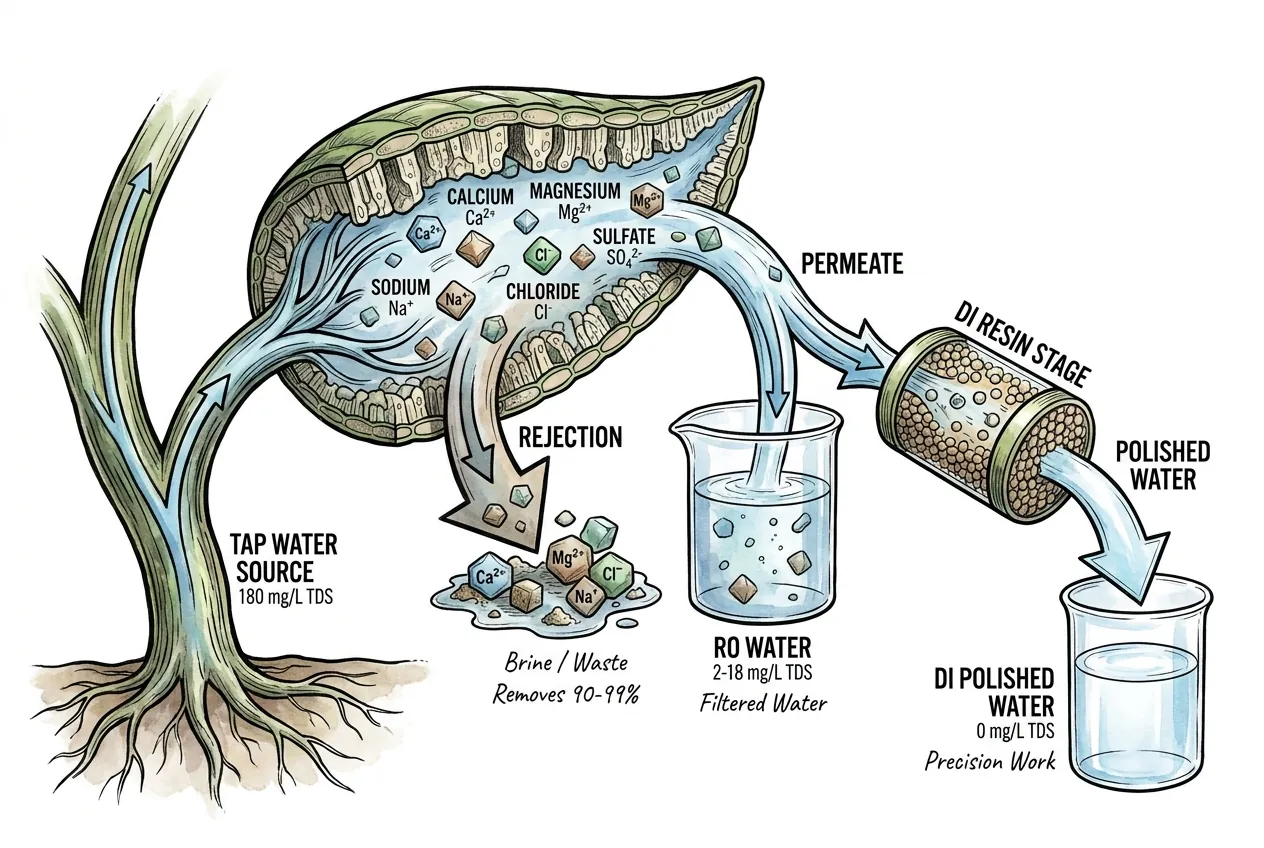
Rejection is the fraction of a given ion kept out of the permeate, calculated against the feed at the same moment.
As a worked example, a membrane rejecting 90 to 99% starting from 180 mg/L tap turns out roughly 2 to 18 mg/L permeate. Real readings shift with ion mix, temperature, pressure, and recovery.
Adding a deionization (DI) resin stage can polish the last few ppm down close to zero for precision work.
Why are GH and KH two different jobs?
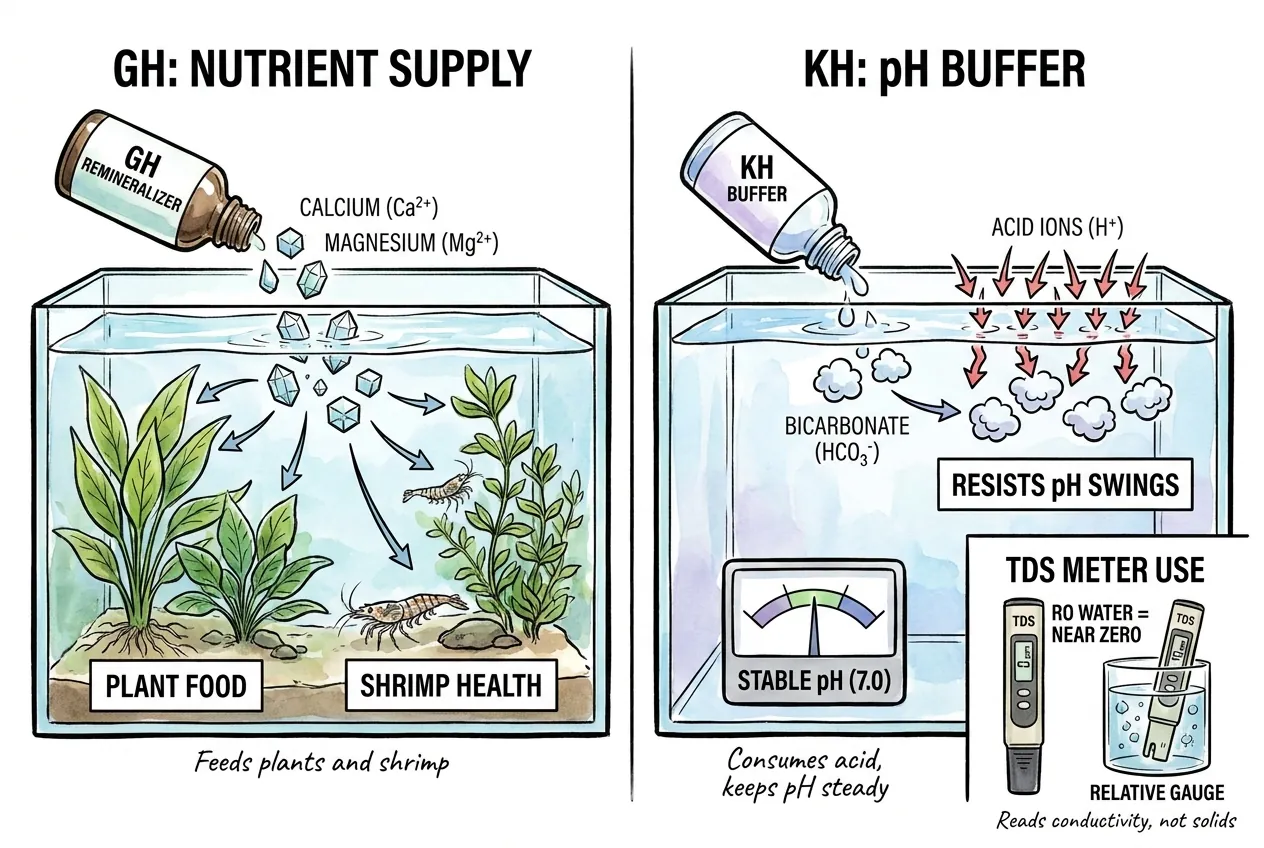
General hardness (GH) is the calcium and magnesium pool that plants and shrimp draw on. Carbonate hardness (KH) is the main measured buffer in most tanks, though alkalinity involves bicarbonate, carbonate, and other acid-neutralizing species, and substrate can buffer too.
When acid enters the water, bicarbonate consumes the hydrogen ions and pH holds relatively steady.
If KH is drawn down faster than it is replenished, pH becomes more likely to move. How fast depends on the acid load, CO2, gas exchange, substrate, and water-change routine.
A tank running near-zero KH can drift acidic over time rather than always crashing overnight.
You set GH and KH independently when you build water from RO. That is also why raising KH deliberately from stones is a separate technique, covered in raising KH with Iwagumi stones.
A TDS meter does not weigh solids. It reads electrical conductivity and multiplies by a conversion factor of roughly 0.5 to 0.82 that depends on the water's ionic composition and the scale the meter uses, reporting mg/L, which in dilute water is treated as equal to parts per million.
Use it as a relative gauge. Confirm that RO output stays low and that the same final ppm appears in each mixed batch.
Shrimp need stable mineral conditions through the molt cycle. That is why a repeatable GH target matters more than copying one TDS number.
USGS Water Science School. Hardness of Water
Advanced Fabrication and Characterization of Thin-Film Composite Polyamide RO Membranes
Nanofiltration Modeling. The Role of Dielectric Exclusion in Membrane Characterization
NDSU Extension. Using Electrical Conductivity and TDS Meters to Field Test Water
Alkalinity and Water (USGS Water Science School)
Effects of Dietary Calcium and Magnesium on Exoskeleton Development and Molting of Chinese Mitten Crab
Which measurable spec decides each product role?
Each role has a few key specs you can check against a datasheet or a meter, though real selection also depends on tank volume, weekly demand, feed water, and budget.
The table below is a starting rubric to apply before any brand name enters the decision. Judge an RO unit by its output under your own conditions, not the box number, because GPD is a rated figure taken under specific test conditions.
Manufacturer GPD is rated under stated test conditions (commonly a set feed concentration, pressure, and 25°C), but those conditions vary by datasheet, so check each product's own rating.
Colder, more viscous water lowers permeate flux, and low feed pressure lowers both output and rejection.
A unit on cold winter tap can deliver well below its label. One manufacturer worked example shows a 75 GPD unit falling to about 46 GPD (roughly 61%) at 13°C. Pressure matters too, but the relationship is not a simple linear fraction because it works against osmotic pressure and backpressure.
| Role | Spec that matters | Go / no-go threshold | Why the threshold exists |
|---|---|---|---|
| RO / RO-DI unit | Output under your conditions and % ion rejection on a genuine TFC membrane | Output sized to your weekly demand. Rejection meeting the product's own spec, judged as (feed − permeate) / feed against a paired feed reading | Cold and low-pressure feed derate output. A real membrane, not carbon, removes hardness |
| TDS/EC meter | Accuracy, temperature compensation, range, calibration | Roughly plus/minus 2% of reading, ATC or same-temperature sampling, range covering your target, and regular calibration | Conductivity rises with temperature, so uncompensated or unmatched readings drift. A meter checks totals, not GH |
| GH / GH-KH remineralizer | Published dGH-per-dose, chemistry, purity | Stated grams-per-volume, GH-only vs GH+KH, no nitrate/phosphate | You dose to a meter number. The wrong chemistry fights your pH plan |
| Storage / mixing vessel | Material, opacity, volume | Food-contact plastic, opaque, sized to at least one water-change volume with mixing headroom | Algae growth is light-driven, so opacity helps. Use a container intended for food/water contact |
Look for a meter rated around plus/minus 2% of reading, with automatic temperature compensation (ATC) or a habit of sampling at a consistent temperature, plus regular calibration.
Conductivity rises with temperature, so uncompensated or unmatched samples can disagree.
The remineralizer's key spec is a published grams-per-volume that raises a stated dGH, so you can start from a number rather than a scoop and confirm with a test kit.
The vessel should be an opaque, food-contact plastic container sized to at least one water-change volume with headroom to mix.
Factors That Affect Reverse Osmosis Production. Pure Water Products
COM-100 EC/TDS/Temp Combo Meter. HM Digital (manufacturer spec)
Seachem Equilibrium Dosing Instructions (manufacturer spec)
Which RO/RO-DI unit and TDS meter do I need?
This section pairs the water-producing hardware with the meter that helps you check it. If your tap is genuinely hard, you generally want both.
Which RO / RO-DI unit should I look for?
Look for a genuine TFC membrane whose rated rejection and output suit your tank. Check performance by measuring feed and permeate together and comparing the resulting rejection to the product's own spec, rather than relying on a single fixed ppm cutoff.
Carbon blocks and sediment cartridges alone remove chlorine and grit but leave calcium, magnesium, and carbonate in the water.
Only the RO membrane rejects those ions, by size exclusion plus charge repulsion across a dense polyamide film.
The DI (deionization) stage is a conditional add-on, not a default. Plain RO commonly rejects a high fraction of ions, so as an example 200 ppm tap at 95% rejection yields roughly 10 ppm.
DI is worth considering when RO alone leaves more residual than your target allows, when a water analysis shows something RO handles poorly, or when a setup genuinely needs the lowest achievable base TDS. Weigh it against the cost of resin and simpler alternatives.
DI resin is a consumable that exhausts. A color change in mixed-bed resin is a rough indicator, best confirmed with a post-DI TDS reading.
AquaticLife Twist-In, 75 GPD
This compact RO/DI unit suits one smaller tank or modest weekly water changes when you want DI-polished base water. Its stated output is a laboratory rating, so check your own feed pressure, temperature, and rejection rather than expecting the box number at home.
The DI polish then brings base water close to zero. It is a reasonable option for a nano or single planted tank on moderate tap, though whether it is the best value depends on replacement-cartridge cost, waste ratio, your feed water, and weekly volume.
The twist-in cartridges are proprietary and cost more per replacement than standard 10-inch filters.
And 75 GPD is slow for large or multi-tank changes on cold winter tap. Skip it if your tap is already soft, or if you want cheap generic replacement media.
LiquaGen RO/DI, 100 GPD
This LiquaGen RO/DI unit suits larger water demand or a precision shrimp setup where you want extra DI polishing and a way to monitor feed pressure. It is unnecessary if plain RO already meets the target for your livestock, and replacement resin is an ongoing cost.
That lets you confirm feed pressure against the GPD rating. The 100 GPD rating also gives headroom for cold-water output loss, which can be substantial on winter tap.
Six stages and two DI cartridges mean more consumables to replace. Compare the actual cost per gallon against the proprietary-cartridge units before assuming it is cheaper or dearer.
The dual DI mainly pays off if you truly need near-zero water, so it is less compelling if you only need soft, not zero, water for a planted tank.
Important Approaches to Enhance RO Thin Film Composite Membranes Performance (MDPI Membranes)
AquaticLife Twist-In 4-Stage RO/DI. First-party specification page
Which TDS/EC meter verifies RO output and the target?
Look for a meter at roughly plus/minus 2% of reading with a range that covers your target, since remineralization is hard to judge by eye. The meter does two jobs.
First, confirm RO output reads low. Second, confirm the finished batch lands on a repeatable number before it touches livestock.
ATC is helpful because conductivity rises with temperature. Without it, a cold RO sample and a warm mixing bucket can disagree, so either use ATC or sample both at the same temperature.
Regular calibration matters as much as the range.
The most important honest limit runs through this whole role. A TDS reading in ppm is not the same measurement as GH in dGH.
Conductivity responds to every ion (sodium, chloride, nitrate, calcium, magnesium, carbonate), so two waters can read an identical 150 ppm while having completely different GH.
The meter can never report a calcium-to-magnesium ratio. It verifies totals. Use a GH/KH titration kit when you need a specific hardness measurement.
HM Digital TDS-3 Meter
This budget meter suits checking that RO output remains low and that a mixed batch is repeatable. Rinse the probe, let the reading stabilize, and check calibration periodically. It does not measure GH, KH, or calcium-to-magnesium balance.
It reports TDS ppm only, so it gives no raw conductivity. Like every TDS meter, it can not report GH or the calcium-to-magnesium ratio.
Skip it if you want to read true micro-siemens rather than a pre-baked ppm.
HM Digital COM-100 Meter
This meter suits users who want to compare true conductivity or choose the conversion scale, rather than read one fixed ppm value. It costs more and has more settings to manage, while still not measuring GH or KH.
It holds plus/minus 2% accuracy, ATC using three temperature coefficients over 0-55°C, and IP-67 waterproofing.
Reading raw micro-siemens avoids being locked into one meter's TDS factor.
It costs more than the TDS-3, has more settings to get wrong, and still can not report GH. Skip it if a single-button ppm reading is all you want.
USGS. Chloride, Salinity, and Dissolved Solids
EPA. Indicators. Conductivity
Which remineralizer rebuilds the water (GH-only or GH/KH?)
Match the salt chemistry to the livestock. GH-only is common for planted tanks and Caridina, GH/KH for Neocaridina and buffered setups, though the right choice also depends on where a tank gets its alkalinity and on each species.
RO water is ionically near-empty, so the remineralizer largely decides what the water becomes.
Each option below publishes a dose-per-volume number. Use it as a starting point and confirm with a GH/KH kit, using EC/TDS to check batch consistency.
Calcium is a structural cross-linker in the plant cell wall and a cofactor in photosystem II. Magnesium is the central atom of chlorophyll. Reintroducing both restores what RO stripped.
For shrimp, adequate calcium and magnesium are what let the animal rebuild its exoskeleton at each molt.
Which GH-only salt suits planted tanks and Caridina?
Pick a GH-only salt when you want to control KH separately. It raises calcium and magnesium while adding little to no carbonate hardness, which suits CO2-injected aquascapes and many soft-water Caridina setups. PH still depends on CO2, substrate, and your source water rather than being fixed by the salt.
Seachem Equilibrium (GH-only, planted)
Seachem Equilibrium suits a planted tank when you want to raise GH while controlling KH separately. It is not a buffer and will not hold pH on its own, so it is a poor fit when you need GH and KH together in one product.
The potassium doubles as a plant macronutrient, which is why it is aimed at planted tanks.
Seachem's general plant guide is roughly 3 to 6 dH. Pick a target for your own plants and stock, dose proportionally, and verify with the meter and a GH kit.
It adds no carbonate, so it will not buffer pH. A pH-swing-prone tank or a Neocaridina keeper who wants buffering in one product should choose a GH/KH salt instead.
Seachem also advises against using Equilibrium to replace evaporated water, since minerals stay behind when water evaporates.
Bee Shrimp GH+ (Caridina)
This GH-only salt suits bee, crystal, and tiger shrimp over active soil, where you want hardness without adding carbonate buffer. It is not a pH guarantee, and it is a poor fit for a setup that needs KH to stabilize its water.
It is a poor match for Neocaridina, which usually want some KH, unless you add alkalinity separately.
It also will not, on its own, provide pH stability, since it adds no buffer.
Which GH/KH salt suits Neocaridina and buffered tanks?
Pick a GH/KH salt when you want buffered water in one scoop. It raises general and carbonate hardness together at a fixed ratio, so each degree of GH brings a set amount of KH. In the tank, that buffer is then drawn on by incoming acid and substrate over time.
Shrimp GH/KH+ (Neocaridina)
This salt suits Neocaridina or another buffered setup because it raises GH and KH together. It is not the right default for Caridina over active soil, where extra KH can work against the intended low-buffer chemistry.
That carbonate gives a cherry-shrimp tank some resistance to drifting acidic. For Neocaridina in the common 6 to 8 dGH range, dose toward the GH number and KH follows at the fixed ratio.
The fixed KH lift is a poor fit for Caridina over active soil, or for anyone wanting independent KH control.
Overdosing raises both GH and KH, so verify with a GH/KH kit, not the meter alone.
New-water chemistry also interacts with a freshly set-up substrate. Cycling a new aquasoil tank has its own timeline, covered in aquasoil ammonia leach and week-1 cycling.
Calcium. Nutrient and Messenger
The Power of Magnesium in Horticultural Crops
SaltyShrimp Shrimp Mineral GH/KH+ (manufacturer spec)
SaltyShrimp Bee Shrimp Mineral GH+ (manufacturer spec)
Calcium Balance in the Crustacea (exoskeleton calcification from water)
How do I store, mix, and pressurize the water?
Store remineralized water in an opaque, food-contact vessel sized to at least one water-change volume, and mix it until the reading is stable before you trust the meter.
Algae growth is light-driven, so an opaque container helps limit blooms in stored water, though it does not remove the need for clean containers and occasional maintenance.
Choose a container intended for food or water contact. Food-contact compliance is about intended-use conditions, not a guarantee of literally zero migration, so use a suitable container rather than an unknown one. RO water is a solvent, but real contamination depends on the specific plastic, contact time, and conditions.
Dry salt does not dissolve into homogeneous water instantly. Undissolved salt on the bottom or a stratified column means the meter sample may not represent the batch until the water is mixed.
Run an air stone or small powerhead, use water near your tank temperature, and re-verify TDS once the reading stabilizes.
Dissolution time varies by product (SaltyShrimp salts dissolve in seconds. Seachem haze clears in roughly 15 to 30 minutes), so let the reading settle before dosing more.
Which storage and pressure products do the job?
Legacy storage containers
These opaque, food-grade containers suit storing mixed water out of light. The linked set is several smaller containers rather than one large vessel, so choose it only if that volume and lifting weight fit your water-change routine.
The opaque, blue walls limit light for algae control, and the manufacturer describes the plastic as BPA-free and food-grade (the specific resin and any 21 CFR compliance are not confirmed from the current product page).
Store the mixed batch out of light and dispense through the spigot on the fitted container.
Each 5-gallon container is one small change and weighs roughly 40 lb when full, so match the number of containers you fill to your largest single water change.
Aquatec 8800 booster pump
Low feed pressure can occur with well water, an upstairs bathroom, or some apartments, and it lowers both output and rejection.
A booster lifts the supply toward a membrane's rated pressure, but stay within each membrane's maximum (the AquaticLife membrane above tops out at 80 psi), using a gauge and pressure control so you do not over-pressurize the system.
This 8800-series booster kit is sold rated for RO systems up to roughly 200 GPD. Buy it only if you have measured low feed pressure, and match the exact model, transformer, and fittings to your system.
It adds cost and noise and needs a transformer, and it is unnecessary if your feed is already adequate.
Because it runs a low-voltage electrical circuit near water, plug the transformer into a GFCI-protected outlet and keep all electrical connections dry and above the water line.
For unattended fills, a float valve alone is not enough. The float creates backpressure that must trigger a separate automatic shut-off valve (ASOV), typically with a check valve, to actually stop feed and reject water. Without those parts, waste water can keep flowing.
Source the float valve, ASOV, check valve, and fittings as separate plumbing components matched to your system diagram.
Adjusted Light and Dark Cycles Optimize Photosynthetic Efficiency in Algae (PLOS ONE)
Aquatec Pressure Booster Pumps (manufacturer)
What is the correct setup sequence and target hardness?
Follow a consistent order. Install and flush the unit, verify base water is low, remineralize to your target, mix until stable, then use the water for a change.
Each step supports the next, and skipping the measurement makes downstream dosing hard to repeat.
Measure the base water before you dose, because a failing membrane can let through more tap ions, which shifts what your dose actually produces.
The five-step remineralization workflow
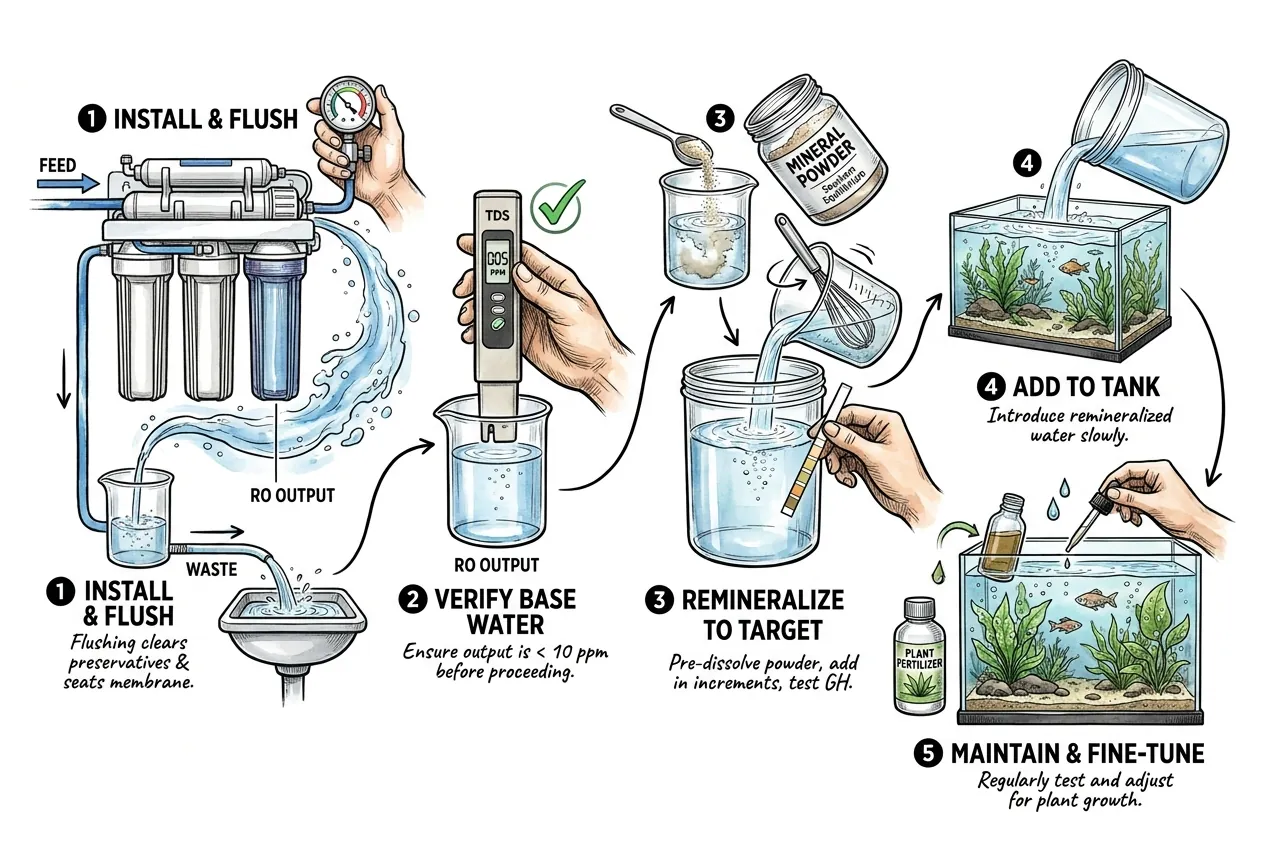
Step 1. Install and flush
Install the unit, confirm feed pressure is adequate, and flush the new membrane to waste before collecting product water.
Flushing clears manufacturing preservative and seats the membrane. Low feed pressure lowers both output rate and rejection, so verify pressure before blaming the membrane.
Step 2. Verify base water is low
Read the RO output on the meter, and ideally the feed at the same time so you can calculate rejection as (feed − permeate) / feed and compare it to your membrane's spec.
A high output on its own is not proof of failure if your feed is very high. Judge it by rejection, not a single ppm line.
If rejection has dropped below spec, or output is higher than your target after accounting for feed, check pre-filters and pressure, then the DI stage or membrane.
Step 3. Remineralize to a measured target
Convert your target dGH into grams using the published dose. Seachem Equilibrium raises GH by 3 dGH per 16 g in 80 L on RO water, so about 32 g per 80 L reaches roughly 6 dGH.
Do this for water-change water, not for evaporation top-off.
Pre-dissolve the powder in about 1 L first, add it to the batch, and adjust in small increments.
If you overshoot, you can dilute with more RO water rather than remove salt directly. Treat these bands as starting points, then confirm with your own GH/KH kit.
| Livestock | Target GH | Target KH | Salt type |
|---|---|---|---|
| Planted community | 4-8 dGH | 1-4 dKH | GH-only, add carbonate if needed |
| Neocaridina (cherry) | roughly 6-8 dGH | roughly 2-5 dKH | GH/KH |
| Caridina (bee/crystal) | roughly 4-6 dGH | 0-1 dKH | GH-only |
These are common hobby starting points, not fixed rules. The right numbers vary with species, strain, breeder water, substrate, temperature, and how the animals were acclimated.
Match new stock to where it was kept when you can, and adjust gradually.
Step 4. Mix and store out of light
Circulate with an air stone or powerhead until the reading stabilizes. Seachem haze clears in roughly 15 to 30 minutes.
Store the batch in the opaque food-contact vessel until the change. A stable meter reading confirms mixing, not chemical equilibrium or microbiological safety.
Step 5. Water change (and acclimate new arrivals)
For a routine water change, temperature-match the prepared water and add it gradually. You normally leave existing livestock in the tank rather than removing and re-acclimating them.
Match the replacement water's GH, KH, and temperature to the tank so the change is gentle, and be more careful the larger the change.
Drip acclimation is for a different situation. Introducing newly bought or transferred animals in a separate container, where their water may differ in parameters.
Rates and timing depend on the volume and on how far the two waters differ, so use the starting and target parameters as your guide rather than a single fixed drops-per-second figure.
(The shrimp gill-damage finding sometimes cited here comes from a study of Macrobrachium nipponense held at 0, 8, 14, and 22‰ salinity for six weeks, with severe gill damage at 22‰. That is a high-salinity marine-range stressor, not ordinary freshwater changes, so it does not set a drip rate.)
A key safety point for water changes. Match replacement water to the tank rather than adding un-remineralized, zero-GH RO water for a change, which stresses osmoregulation and molting.
Evaporation top-off is the exception, where plain RO/DI restores the water level because the dissolved minerals stayed behind.
Thin Film Composite Polyamide RO Membrane Technology
Salinity Stress, Histological Changes, and Metabolism in Freshwater Shrimp
Seachem Equilibrium Dosing Instructions (manufacturer spec)
Who should not buy an RO system?
If your tap is already soft and stable, or you keep hard-water livestock, RO may be unnecessary.
Base the decision on measurement. Pull your municipal water report, then confirm with a meter and a GH/KH kit.
A hardness number alone does not rule out other issues like nitrate, copper, sodium from a softener, chloramine, or silica, so consider what you actually need to remove.
If your tap sits in the soft band (0 to 60 mg/L CaCO3), holds steady week to week, and tests clean for your other concerns, RO may solve a problem you do not have.
A reasonable first purchase is then a TDS meter and a test kit.
RO is often the wrong tool for hard-water species. African rift-lake cichlids and common livebearers (guppies, mollies, platies) generally want the calcium, magnesium, and carbonate buffering that RO removes.
Stripping minerals with RO only to add them back can mean paying twice to undo your own tap.
For those keepers, adding a mineral or buffer product to tap water is often simpler, but measure existing GH, KH, and sodium first so you do not overdose.
Low-volume setups can lose on cost too. Owning a system means drain waste, pre-filter replacements, and a membrane every few years, plus resin and remineralizer.
For low weekly volumes, grocery-store RO or distilled water is sometimes cheaper per gallon, though the break-even depends on your local water and sewer rates, the store price, travel, and the unit's waste ratio.
Buying store water shifts where the water and concentrate are produced rather than eliminating them.
How bad is the RO wastewater tradeoff?
A typical point-of-use RO system sends 5 gallons or more to the drain for every gallon it produces, and inefficient units up to 10 gallons.
EPA WaterSense-labeled units cap that at 2.3 gallons to drain per gallon treated, saving on average more than 3,100 gallons per year (this is a residential point-of-use program. The aquarium units here are not confirmed to be WaterSense-certified, so check each product's own waste ratio).
The reject stream is concentrated in whatever your tap contained, so before reusing it for laundry or the garden, consider your source-water composition, plant salt sensitivity, detergent interactions, and local plumbing rules rather than assuming it is safe to reuse.
EPA WaterSense. Point-of-Use Reverse Osmosis Systems
Biomineralizations. Insights and Prospects from Crustaceans
How do I maintain the system and spot failures?
Follow your product's own maintenance schedule and track rejection over time rather than a single number.
As a rough guide, pre-filters are often changed every 6 to 12 months and membranes last a few years, but intervals vary by feed quality, usage, and manufacturer (AquaticLife, for example, suggests its membrane at 1 to 2 years and sediment/carbon at 6 months).
Sediment and carbon pre-filters protect the membrane from chlorine and grit, and neglecting them shortens membrane life.
A healthy TFC membrane rejects a high fraction of dissolved ions. A failing one tends to show as rising RO-output TDS even after fresh pre-filters, but confirm by calculating rejection against a paired feed reading, since feed changes, pressure, temperature, TDS creep after idle time, and probe calibration can all raise the number.
The TDS meter is a useful early-warning gauge here. If output creeps from, say, 4 ppm to 25 ppm under the same feed conditions over a year, confirm the pre-filters are fresh and pressure is adequate, re-check rejection, then replace the membrane if it is genuinely below spec.
Some systems (such as the GE guidance cited below) suggest replacing the membrane when TDS reduction drops below about 75%, but that threshold is specific to that system, not universal.
Color-changing DI resin gives a rough exhaustion cue. Many mixed-bed resins shift color (often toward amber) as they exhaust, via a bound indicator dye.
Not all resins change the same way, so confirm with a post-DI TDS reading rather than color alone. When the reading climbs off zero, the resin is spent.
On the remineralizer side, common problems are overdosing to too-high GH (osmotic and molt stress) and running near-zero KH where you actually wanted a buffer (pH more likely to drift).
Near-zero KH is deliberate in some active-soil Caridina setups, so this is context-dependent.
Guard against both by confirming GH and KH with a test kit, since the meter alone cannot tell them apart.
GE Appliances. RO System. When to Change the Membrane
Frizzlife. Reverse Osmosis Membrane Life Expectancy
Frequently asked questions
Is RO water safe for fish and shrimp without remineralizing?
Not for water used to make up the tank. Shrimp draw much of their shell calcium from the water, and near-empty RO water supplies little. With zero KH it also offers no buffer.
Remineralize to a target GH and KH before using RO water for a water change.
The exception is evaporation top-off. Since evaporation leaves minerals in the tank, plain RO/DI is the normal choice for restoring the water level, and re-mineralizing top-off would slowly build up GH and TDS.
Does a TDS meter tell me my GH?
No. A TDS/EC meter reads total dissolved ions as one lumped number and can not distinguish calcium and magnesium hardness (GH) from carbonate buffering (KH) or other salts.
Use the meter to verify RO output and total target, but use a GH/KH test kit to hit the specific hardness numbers.
Do I need the DI stage, or is plain RO enough?
For most planted tanks, plain RO with low output is enough. Consider adding a DI stage mainly in two cases.
First, when a setup genuinely needs the lowest achievable base TDS. Second, when your tap TDS is high enough that RO alone leaves more residual than your target allows.
DI resin is a consumable, so weigh it against the extra cost.
Can I use distilled or bottled water instead?
Distilled water is functionally like RO/DI base water, still near zero-mineral, so water-change water made from it needs the same remineralization (top-off is again the exception).
Bottled spring or drinking water has variable minerals that differ batch to batch, so test it before trusting it.
For a nano tank, store-bought RO can be cheaper than owning a system, depending on local prices.
How many GPD do I need?
Size to real output under your conditions, not the label, since cold water and low feed pressure both cut production, sometimes substantially.
Use the manufacturer's performance chart or a conservative measured output for your feed temperature and pressure, then pick a unit that meets your weekly demand in a reasonable collection time.
A higher GPD rating buys headroom on cold or low-pressure tap, but there is no universal minimum. Even a smaller unit can suit a small tank.
Why is my RO output TDS rising?
A degrading or fouling membrane is one cause, but not the only one. Rule out spent pre-filters, low pressure, temperature and feed changes, TDS creep after idle time, and probe calibration first, and calculate rejection against a paired feed reading.
Replace the membrane when its rejection is genuinely below its own spec.
Affiliate Disclosure
This article contains Amazon affiliate links. As an Amazon Associate I earn from qualifying purchases. If you use these links, the site may earn a commission at no extra cost to you. Product availability, price, and specifications can change. Check the current listing before buying.